2002 LAND ROVER DISCOVERY LOCK doors
[x] Cancel search: LOCK doorsPage 1530 of 1672

ALARM SYSTEM AND HORN
DESCRIPTION AND OPERATION 86-4-21
Emergency key access
If the handset fails to operate, the engine can be remobilised by using the key to enter a unique four digit Emergency
Key Access (EKA) code.
There are three configurations for emergency key access:
lEKA not active (no immobiliser fitted).
lEKA active.
lEKA with super locking on receiving good passive remobilisation exciter coil signal.
The code is recorded on the security information card and is entered as follows:
1Using the key, turn the driver's door lock to the UNLOCK position and hold in this position for at least 5 seconds.
An audible warning is then emitted to indicate that the body control unit is ready to accept the code. Return the
key to the centre position. It is now possible to use the key to enter the separate numerical values of the four
digits that make up the EKA code.
2Enter the first digit of the code. If the first digit is 4, turn the key to the UNLOCK position 4 times. Ensure the
key is fully returned to the centre position after each turn of the key.
3Enter the second digit of the code. If the second digit is 3, turn the key to the LOCK position 3 times. Ensure
the key is fully returned to the centre position after each turn of the key.
4Enter the third digit of the code. If the third digit is 2, turn the key to the UNLOCK position twice. Ensure the key
is fully returned to the centre position after each turn of the key.
5Enter the fourth digit of the code. If the fourth digit is 1, turn the key to the LOCK position once. Ensure the key
is fully returned to the centre position after each turn of the key.
6Finally, turn the key to the UNLOCK position and back to the centre position, a double bleep will indicate that
the code has been entered correctly. A single bleep indicates that the code has been entered incorrectly.
Then, before opening the door, wait 5 minutes for the alarm and immobiliser to be de-activated. During the 5
minute wait for the alarm and immobiliser to be de-activated, the alarm indicator LED in the instrument pack
continues to flash (one flash every 2 seconds). DO NOT OPEN THE DOOR OR ATTEMPT TO ENTER THE
CAR until the full delay period has elapsed.
When the 5 minute wait has elapsed, the alarm indicator LED stops flashing. Immediately open the door, insert
the key in the ignition switch and turn the switch to position II. If the ignition switch is not turned to position II
within 30 seconds of the end of the 5 minute wait, the engine is automatically immobilised again.
The EKA code will not be recognised if there is an interval of 10 seconds or more between key turns or if the key is
held turned for 5 seconds or more during the procedure.
In some system configurations a successful EKA code entry is indicated by the audible warning device pulsing twice
for a period of 50 ms on, 200 ms off. The theft deterrent LED is switched on for 1 second, all doors unlock, the alarm
disarms and the vehicle is remobilised allowing the engine to start.
If an incorrect code is entered, an audible warning is emitted and the procedure must be repeated. Up to a maximum
of 10 attempts to enter the code is possible. After 10 attempts, the BCU will not allow any further codes to be entered
for a period of 10 minutes.
Single point entry
Single point entry (SPE) allows the driver to unlock the driver's door while leaving all other doors locked.
There are two configurations for single point entry:
lSPE not active.
lSPE active.
To use SPE, press the unlock button on the handset once. Depressing the unlock button a second time in the space
of one minute unlocks the remaining doors. SPE is also possible by turning the key in the driver's door lock to the
unlock position once. Turning the key to the unlock position again within one minute unlocks the remaining doors.
In order for SPE to operate, the following conditions must be met:
lThe ignition is off.
lAll doors are locked.
Page 1531 of 1672

ALARM SYSTEM AND HORN
86-4-22 DESCRIPTION AND OPERATION
Speed related locking
For added protection the vehicle doors can automatically lock when the vehicle exceeds a specific road speed.
There are two configurations for speed related locking:
lSpeed related locking not active.
lSpeed related locking active.
Speed related locking causes the doors to automatically lock when the vehicle exceeds a speed of 4 mph (7 km/h).
When the ignition is switched off, the doors are automatically unlocked. Depressing the instrument panel mounted
central door unlocking switch disables the speed related locking for the duration of the journey.
Speed related locking only activates once per ignition cycle. If speed related locking activates and a door is then
unlocked, the door does not automatically re-lock.
In order for speed related locking to activate the following conditions must be met:
lAll doors unlocked.
lEngine running.
lVehicle speed greater than 4 mph (7 km/h).
Acclimatisation related locking
Acclimatisation related locking allows the engine to be started and then the vehicle locked with a spare key and left
unattended to allow the vehicle interior to reach the desired temperature.
There are two configurations for acclimatisation related locking:
lAcclimatisation related locking not active.
lAcclimatisation related locking active.
Once the engine is started, the vehicle is locked with a spare key at the driver's door while the engine is running.
During these conditions the alarm is not armed.
In order to activate acclimatisation related locking the following conditions must be met:
lEngine running.
lAll doors closed.
Visual warnings
The direction indicators serve as a visual indication when the alarm is triggered. The direction indicators are also used
as a visual indication during lock/unlock procedures.
There are three configurations of alarm armed/disarmed indication:
lNo direction indicators on, alarm armed/disarmed/trigger.
lDirection indicators on, alarm trigger only.
lDirection indicators on, alarm armed/disarmed/trigger.
Dependent on system configuration the direction indicators flash one short pulse to confirm that the alarm is armed
and flash two short pulses to confirm that the vehicle is super locked. If the alarm is triggered the direction indicators
operate in phase with the audible warning. When the alarm is disarmed, the direction indicators flash one long pulse.
Audible warning
An audible warning device is used to indicate that the alarm has been triggered, or a mislock has occurred, or an EKA
request has occurred, or the EKA code has been entered.
There are six audible warning configurations:
lNo sound (audible warnings disabled).
lAlarm sounder only.
lVehicle horn only.
lAlarm sounder and vehicle horn.
lBBUS only.
lAlarm sounder, vehicle horn and BBUS.
Page 1569 of 1672
IN CAR ENTERTAINMENT
86-6-16 REPAIRS
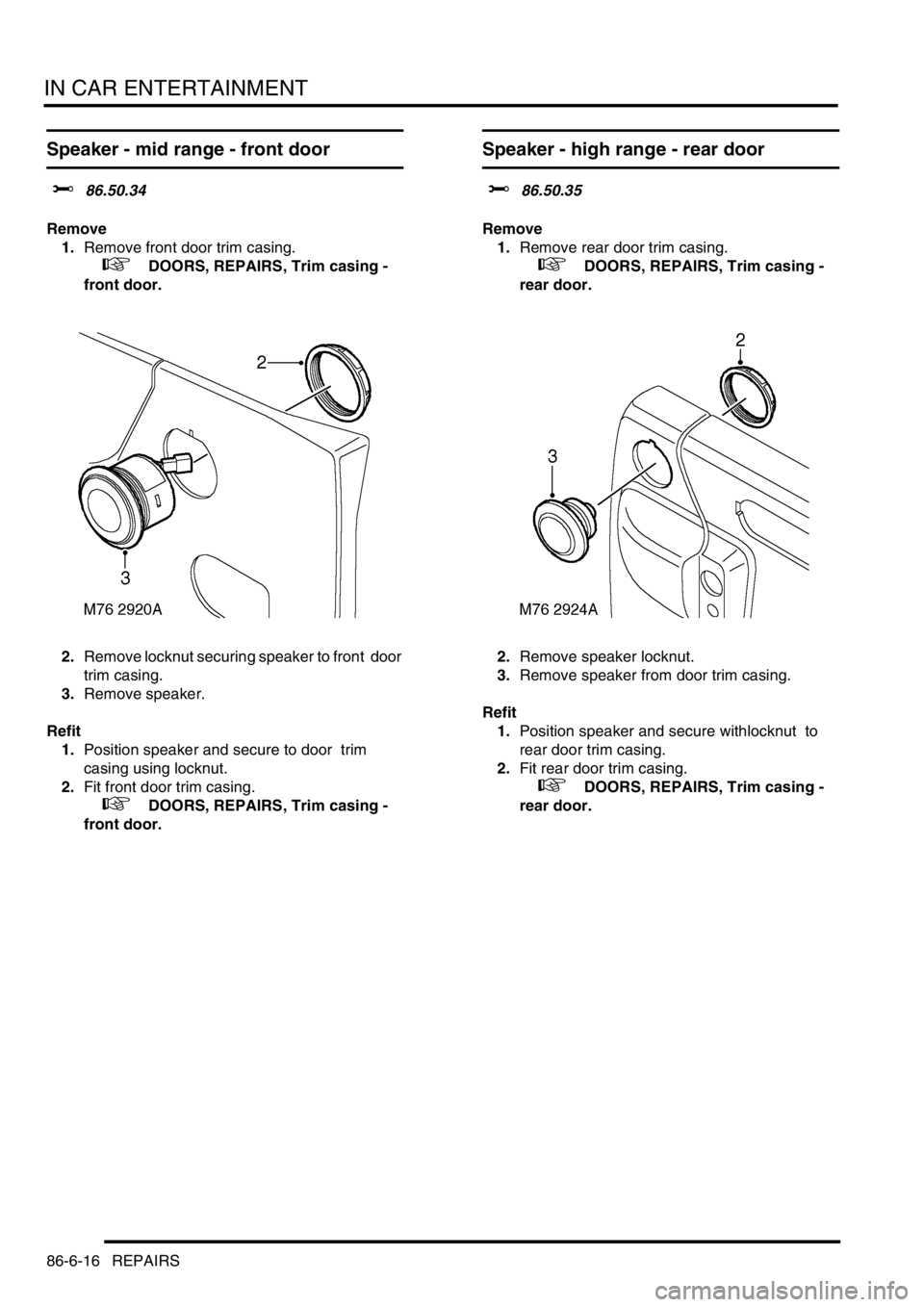
Speaker - mid range - front door
$% 86.50.34
Remove
1.Remove front door trim casing.
+ DOORS, REPAIRS, Trim casing -
front door.
2.Remove locknut securing speaker to front door
trim casing.
3.Remove speaker.
Refit
1.Position speaker and secure to door trim
casing using locknut.
2.Fit front door trim casing.
+ DOORS, REPAIRS, Trim casing -
front door.
Speaker - high range - rear door
$% 86.50.35
Remove
1.Remove rear door trim casing.
+ DOORS, REPAIRS, Trim casing -
rear door.
2.Remove speaker locknut.
3.Remove speaker from door trim casing.
Refit
1.Position speaker and secure withlocknut to
rear door trim casing.
2.Fit rear door trim casing.
+ DOORS, REPAIRS, Trim casing -
rear door.
Page 1578 of 1672
HARNESSES
REPAIRS 86-7-7
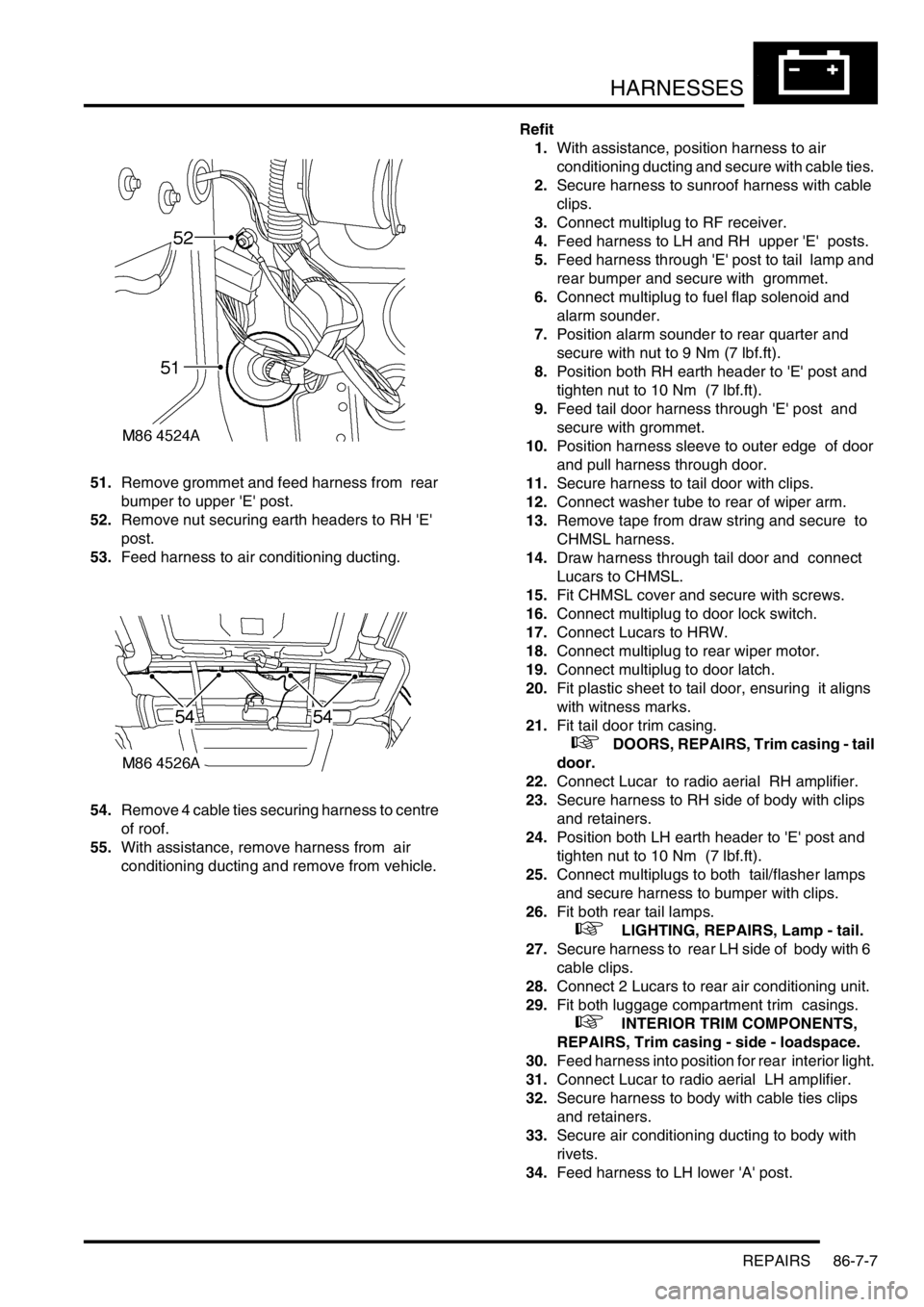
51.Remove grommet and feed harness from rear
bumper to upper 'E' post.
52.Remove nut securing earth headers to RH 'E'
post.
53.Feed harness to air conditioning ducting.
54.Remove 4 cable ties securing harness to centre
of roof.
55.With assistance, remove harness from air
conditioning ducting and remove from vehicle. Refit
1.With assistance, position harness to air
conditioning ducting and secure with cable ties.
2.Secure harness to sunroof harness with cable
clips.
3.Connect multiplug to RF receiver.
4.Feed harness to LH and RH upper 'E' posts.
5.Feed harness through 'E' post to tail lamp and
rear bumper and secure with grommet.
6.Connect multiplug to fuel flap solenoid and
alarm sounder.
7.Position alarm sounder to rear quarter and
secure with nut to 9 Nm (7 lbf.ft).
8.Position both RH earth header to 'E' post and
tighten nut to 10 Nm (7 lbf.ft).
9.Feed tail door harness through 'E' post and
secure with grommet.
10.Position harness sleeve to outer edge of door
and pull harness through door.
11.Secure harness to tail door with clips.
12.Connect washer tube to rear of wiper arm.
13.Remove tape from draw string and secure to
CHMSL harness.
14.Draw harness through tail door and connect
Lucars to CHMSL.
15.Fit CHMSL cover and secure with screws.
16.Connect multiplug to door lock switch.
17.Connect Lucars to HRW.
18.Connect multiplug to rear wiper motor.
19.Connect multiplug to door latch.
20.Fit plastic sheet to tail door, ensuring it aligns
with witness marks.
21.Fit tail door trim casing.
+ DOORS, REPAIRS, Trim casing - tail
door.
22.Connect Lucar to radio aerial RH amplifier.
23.Secure harness to RH side of body with clips
and retainers.
24.Position both LH earth header to 'E' post and
tighten nut to 10 Nm (7 lbf.ft).
25.Connect multiplugs to both tail/flasher lamps
and secure harness to bumper with clips.
26.Fit both rear tail lamps.
+ LIGHTING, REPAIRS, Lamp - tail.
27.Secure harness to rear LH side of body with 6
cable clips.
28.Connect 2 Lucars to rear air conditioning unit.
29.Fit both luggage compartment trim casings.
+ INTERIOR TRIM COMPONENTS,
REPAIRS, Trim casing - side - loadspace.
30.Feed harness into position for rear interior light.
31.Connect Lucar to radio aerial LH amplifier.
32.Secure harness to body with cable ties clips
and retainers.
33.Secure air conditioning ducting to body with
rivets.
34.Feed harness to LH lower 'A' post.