2002 LAND ROVER DISCOVERY earth
[x] Cancel search: earthPage 530 of 1672

ENGINE MANAGEMENT SYSTEM - V8
REPAIRS 18-2-73
5.Remove 2 nuts and release ECM from studs
and location on 'A' post lower panel.
6.Lower ECM into footwell and disconnect 5
multiplugs.
7.Remove ECM.
Refit
1.Position new ECM and connect multiplugs.
2.Fit ECM and secure with nuts.
3.Fit lower trim panel to 'A' post and secure with
fixings.
4.Fit diagnostic socket to closing panel, fit closing
panel and secure with fixings.
5.Connect battery earth lead.
6.Fit battery cover and secure with fixings.
7.Programme ECM and reset adaptions using
TestBook.
Sensor - engine coolant temperature
(ECT)
$% 18.30.10
Remove
1.Release turnbuckles and remove battery cover.
2.Disconnect battery earth lead.
3.Remove auxiliary drive belt.
+ CHARGING AND STARTING,
REPAIRS, Belt - auxiliary drive.
4.Remove 2 bolts securing alternator, release
alternator from support bracket and position
aside.
Page 531 of 1672

ENGINE MANAGEMENT SYSTEM - V8
18-2-74 REPAIRS
5.Disconnect multiplug from ECT sensor.
6.Remove sensor from inlet manifold and discard
sealing washer.
Refit
1.Clean sealant from threads in manifold.
2.Apply Loctite 577 to sensor threads.
3.Fit new sealing washer to ECT sensor and
tighten sensor to 10 Nm (7 lbf.ft).
4.Connect multiplug to ECT sensor.
5.Position alternator, fit bolts and tighten to 45
Nm (33 lbf.ft).
6.Fit auxiliary drive belt.
+ CHARGING AND STARTING,
REPAIRS, Belt - auxiliary drive.
7.Top up cooling system.
8.Connect battery earth lead.
9.Fit battery cover and secure with fixings.
Sensor - crankshaft position (CKP)
$% 18.30.12
Remove
1.Release fixings and remove battery cover.
2.Disconnect battery earth lead.
3.Raise front of vehicle.
WARNING: Do not work on or under a
vehicle supported only by a jack. Always
support the vehicle on safety stands.
4.Release fixings and remove underbelly panel.
5.Release CKP sensor multiplug from bracket.
6.Remove 2 bolts securing CKP sensor heat
shield and position aside.
7.Remove 2 nuts securing CKP sensor, remove
2 spacers, CKP sensor and sensor mounting.
8.Disconnect CKP sensor multiplug from engine
harness.
Refit
1.Ensure all components are clean.
2.Connect CKP sensor multiplug to engine
harness.
3.Fit sensor mounting, CKP sensor, 2 spacers
and tighten CKP sensor retaining nuts to 6 Nm
(5 lbf.ft).
Page 532 of 1672

ENGINE MANAGEMENT SYSTEM - V8
REPAIRS 18-2-75
4.Fit CKP sensor heat shield and secure with
bolts.
5.Fit underbelly panel and secure with fixings.
6.Remove stand(s) and lower vehicle.
7.Connect battery earth lead.
8.Fit battery cover and secure the fixings.
9.Reset adaptions using TestBook.
Sensor - radiator temperature
$% 18.30.20
Remove
1.Disconnect battery earth lead.
2.Position container to collect coolant spillage.
3.Disconnect multiplug from sensor.
4.Remove sensor and discard sealing washer.
Refit
1.Fit new sealing washer to sensor.
2.Fit and tighten sensor.
3.Connect multiplug to sensor.
4.Refill cooling system.
5.Connect battery earth lead.
Page 533 of 1672
ENGINE MANAGEMENT SYSTEM - V8
18-2-76 REPAIRS
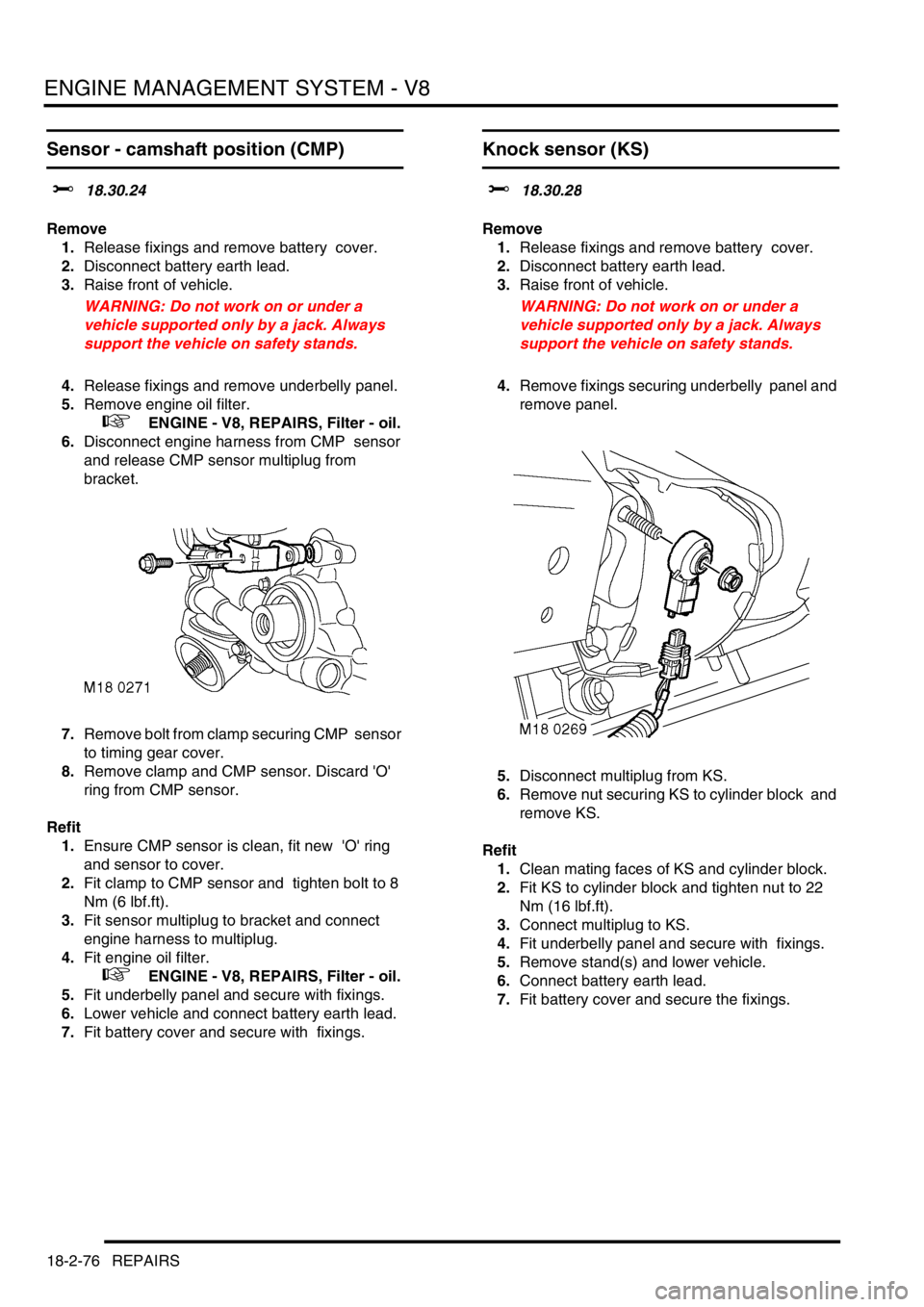
Sensor - camshaft position (CMP)
$% 18.30.24
Remove
1.Release fixings and remove battery cover.
2.Disconnect battery earth lead.
3.Raise front of vehicle.
WARNING: Do not work on or under a
vehicle supported only by a jack. Always
support the vehicle on safety stands.
4.Release fixings and remove underbelly panel.
5.Remove engine oil filter.
+ ENGINE - V8, REPAIRS, Filter - oil.
6.Disconnect engine harness from CMP sensor
and release CMP sensor multiplug from
bracket.
7.Remove bolt from clamp securing CMP sensor
to timing gear cover.
8.Remove clamp and CMP sensor. Discard 'O'
ring from CMP sensor.
Refit
1.Ensure CMP sensor is clean, fit new 'O' ring
and sensor to cover.
2.Fit clamp to CMP sensor and tighten bolt to 8
Nm (6 lbf.ft).
3.Fit sensor multiplug to bracket and connect
engine harness to multiplug.
4.Fit engine oil filter.
+ ENGINE - V8, REPAIRS, Filter - oil.
5.Fit underbelly panel and secure with fixings.
6.Lower vehicle and connect battery earth lead.
7.Fit battery cover and secure with fixings.
Knock sensor (KS)
$% 18.30.28
Remove
1.Release fixings and remove battery cover.
2.Disconnect battery earth lead.
3.Raise front of vehicle.
WARNING: Do not work on or under a
vehicle supported only by a jack. Always
support the vehicle on safety stands.
4.Remove fixings securing underbelly panel and
remove panel.
5.Disconnect multiplug from KS.
6.Remove nut securing KS to cylinder block and
remove KS.
Refit
1.Clean mating faces of KS and cylinder block.
2.Fit KS to cylinder block and tighten nut to 22
Nm (16 lbf.ft).
3.Connect multiplug to KS.
4.Fit underbelly panel and secure with fixings.
5.Remove stand(s) and lower vehicle.
6.Connect battery earth lead.
7.Fit battery cover and secure the fixings.
Page 550 of 1672

FUEL DELIVERY SYSTEM - TD5
DESCRIPTION AND OPERATION 19-1-5
The fuel pump is a 'self priming', wet type, two stage pump which is immersed in fuel in the tank and operates at all
times when the ignition switch is in position II. If the engine is not started, the ECU will 'time-out' after three minutes
and de-energise the fuel pump relay. The pump receives a feed from the battery via fuse 10 in the engine
compartment fusebox and the fuel pump relay. The relay is energised by the ECM when the ignition switch is moved
to position II.
The fuel pump assembly is retained with a locking ring and sealed with a rubber seal. The locking ring requires a
special tool for removal and refitment. An access panel for the fuel pump is located in the loadspace floor below the
carpet. The access panel is sealed to the floor with a rubber seal and retained by six self-tapping screws. A four pin
electrical connector is located on the top cover and provides power feed and earth for the fuel pump and also inputs
and outputs for the fuel gauge sender operation.
The fuel gauge sender is integral with the fuel pump. The sender is submerged in the fuel and is operated by a float
which moves with the fuel level in the tank.
Fuel pump
The fuel pump assembly comprises a top cover which locates the electrical connector, fuel burning heater connection
and four fuel pipe couplings. The top cover is attached to a plastic cup shaped housing and retained on three sliding
clips. Two coil springs are located between the cover and the housing and ensure that the fuel pump remains seated
positively at the bottom of the tank when installed.
The housing locates the two stage fuel pump and also the fuel gauge sender unit. The lower part of the housing is the
swirl pot which maintains a constant level of fuel at the fuel pick-up. A coarse filter is located in the base of the housing
and prevents the ingress of contaminants into the pump and the fuel system from the fuel being drawn into the pump.
A fine filter is located in the intake to the low pressure stage to protect the pump from contaminants. Flexible pipes
connect the couplings on the top cover to the pump.
A non-return valve is located in the base of the housing. When the fuel tank is full, fuel pressure keeps the valve lifted
from its seat allowing fuel to flow into the swirl pot. As the tank level reduces, the fuel pressure in the tank reduces
causing the valve to close. When the valve is closed fuel is retained in the swirl pot, ensuring that the swirl pot remains
full and maintains a constant supply to the fuel pump.
The two stage pump comprises a high and a low pressure stage. The low pressure stage draws fuel from the swirl
pot through the filter. The low pressure stage pumps fluid at a pressure of 0.75 bar (10.9 lbf.in
2) and a flow of 30 litres/
hour (8 US Gallons/hour) to the fuel filter. A proportion of the fuel from the low pressure stage also passes, via a
restrictor, through a jet pump which keeps fuel circulating in the swirl pot. The high pressure stage draws the low
pressure fuel from the fuel filter and pressurises it to a pressure of 4.0 bar (58 lbf.in
2). The pressurised fuel is then
passed from the pump to the injectors at a flow of 180 litres/hour (47.6 US Gallons/hour). A fuel pressure regulator is
located at the rear of the engine and ensures that the delivery pressure remains at 4.0 bar (58 lbf.in
2) by controlling
the amount of fuel returning to the fuel tank.
The fuel pump has a maximum current draw of 15 Amps at 12.5 V and is protected by a 20 Amp fuse in the engine
compartment fusebox.
Page 555 of 1672

FUEL DELIVERY SYSTEM - TD5
19-1-10 DESCRIPTION AND OPERATION
Water sensor
The water sensor has a three pin electrical connector. When the sensor detects water in the filter it illuminates a
warning lamp in the instrument pack .
+ INSTRUMENTS, DESCRIPTION AND OPERATION, Description.
The water sensor attachment thread has a slot machined down one side. The filter can be purged of water by partially
unscrewing the sensor which aligns the slot in the threads with a corresponding hole in the sensor. When aligned,
water and fuel can flow down the slot and flows from a small cast tube on the side of the sensor. Re-tightening the
sensor misaligns the slot and stops the flow of fuel.
The water sensor receives a battery supply from the fuel pump relay in the engine compartment fusebox on one of
the electrical connector pins. The two remaining pins are connected to the instrument pack and an earth header joint.
The sensor operation uses the measurement of resistance between two electrodes submerged in the fuel and
activated by the presence of water.
When the ignition is moved to position II the warning lamp will illuminate for approximately two seconds to check
warning lamp functionality. TestBook can also illuminate the warning lamp to check its functionality.
When the filter is full with fuel and no water is present the resistance of the Diesel fuel will show a reading of 15 mA
maximum on the feed wire to the instrument pack. This current will not illuminate the water sensor warning lamp in
the instrument pack. When sufficient water surrounds both electrodes the resistance of the water will show a reading
of 130 mA maximum. This will supply sufficient voltage to the instrument pack to illuminate the warning lamp to alert
the driver to the presence of water in the fuel system.
Page 560 of 1672

FUEL DELIVERY SYSTEM - TD5
REPAIRS 19-1-15
REPAIRS
Switch - inertia - fuel cut-off
$% 19.22.09
Remove
1.Disconnect multiplug from fuel cut-off switch.
2.Remove 2 screws securing fuel cut-off switch to
bulkhead.
3.Remove fuel cut-off switch from bulkhead.
Refit
1.Position fuel cut-off switch to bulkhead and
secure with screws.
2.Connect multiplug to fuel cut-off switch.
3.To set the fuel cut-off switch, depress the top of
the fuel cut-off switch.
Pump - fuel
$% 19.45.08
NOTE: The fuel pump and fuel gauge tank unit are
integral parts of the fuel pump housing and cannot be
renewed separately
Remove
1.Release fixings and remove battery cover.
2.Disconnect battery earth lead.
3. Models with third row seats: Remove RH
third row seat.
+ SEATS, REPAIRS, Seat - third row.
4.Remove 5 trim clips securing lower edge of RH
'D' post trim casing.
5. Models with rear ICE controls: Remove
screw securing remote ICE controls to RH side
trim casing.
6. Models with rear ICE controls: Release ICE
controls from RH side trim casing. Disconnect
multiplug and remove ICE controls.
7.Partially remove tail door aperture seal in the
area of the RH side trim casing.
Page 561 of 1672

FUEL DELIVERY SYSTEM - TD5
19-1-16 REPAIRS
8.Remove 2 trim clips securing RH side trim
casing to body.
9.Remove rear lamp access panel from RH side
trim casing.
10.Remove trim clip securing RH side trim casing
to lower 'E' post.
11. Models with third row seats:Remove bolt
securing lower mounting of RH third row seat
belt to body.
12.Remove RH side trim casing.
13.Pull back loadspace carpet from fuel pump
access panel.
14.Remove 6 screws securing access panel.
15.Remove access panel.
16.Disconnect multiplug and 4 fuel hoses from fuel
pump housing.
CAUTION: Always fit plugs to open
connections to prevent contamination.17.Use LRT-19-009 to remove locking ring from
fuel pump housing.
18.Remove fuel pump housing.
19.Remove and discard sealing ring from fuel
pump housing.
Refit
1.Clean fuel pump housing and mating face on
fuel tank.
2.Fit new seal to mating face on fuel tank.
3.Fit fuel pump housing to fuel tank and use LRT-
19-009 to fit locking ring.
4.Connect multiplug and fuel hoses to fuel pump
housing. Ensure each hose is installed in the
connector with the corresponding colour
code.
5.Fit access panel and secure with screws.
6.Reposition loadspace carpet.
7.Fit RH side trim casing.
8. Models with third row seats:Fit bolt securing
lower mounting of RH third row seat belt to
body and tighten to 50 Nm (37 lbf.ft).
9.Fit trim clip securing RH side trim casing to
lower 'E' post.
10.Fit rear lamp access panel to RH side trim
casing.
11.Fit trim clips securing RH side trim casing to
body.
12.Fit tail door aperture seal.
13. Models with rear ICE controls: Connect
multiplug to remote ICE controls.
14. Models with rear ICE controls: Fit ICE
controls to trim casing and secure with screw.
15.Fit trim clips securing lower edge of 'D' post
trim casing to body.
16. Models with third row seats: Fit RH third row
seat.
+ SEATS, REPAIRS, Seat - third row.
17.Connect battery earth lead.