2002 Hyundai Atos fuel pump
[x] Cancel search: fuel pumpPage 10 of 249
FEATURES OF YOUR HYUNDAI
FEATURES OF YOUR HYUNDAI FEATURES OF YOUR HYUNDAI
FEATURES OF YOUR HYUNDAI
FEATURES OF YOUR HYUNDAI
1- 1
1. FEATURES OF
YOUR HYUNDAI
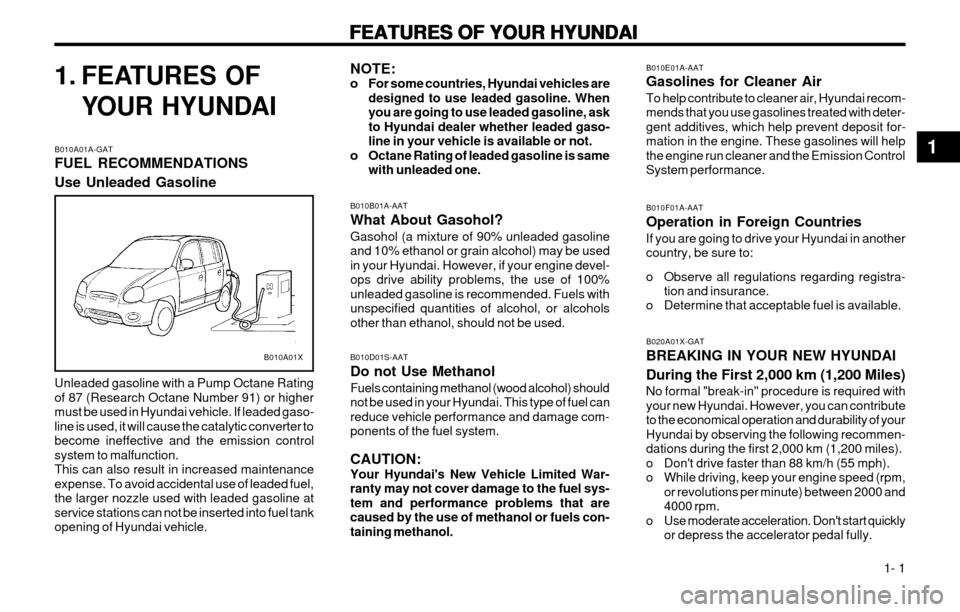
B010A01A-GAT FUEL RECOMMENDATIONS Use Unleaded Gasoline Unleaded gasoline with a Pump Octane Rating of 87 (Research Octane Number 91) or highermust be used in Hyundai vehicle. If leaded gaso-line is used, it will cause the catalytic converter tobecome ineffective and the emission controlsystem to malfunction.This can also result in increased maintenanceexpense. To avoid accidental use of leaded fuel,the larger nozzle used with leaded gasoline atservice stations can not be inserted into fuel tankopening of Hyundai vehicle. NOTE:
o For some countries, Hyundai vehicles are
designed to use leaded gasoline. Whenyou are going to use leaded gasoline, askto Hyundai dealer whether leaded gaso-line in your vehicle is available or not.
o Octane Rating of leaded gasoline is same with unleaded one.
B010B01A-AAT What About Gasohol? Gasohol (a mixture of 90% unleaded gasoline and 10% ethanol or grain alcohol) may be usedin your Hyundai. However, if your engine devel-ops drive ability problems, the use of 100%unleaded gasoline is recommended. Fuels withunspecified quantities of alcohol, or alcoholsother than ethanol, should not be used. B010D01S-AAT Do not Use Methanol Fuels containing methanol (wood alcohol) should not be used in your Hyundai. This type of fuel canreduce vehicle performance and damage com-ponents of the fuel system. CAUTION: Your Hyundai's New Vehicle Limited War-ranty may not cover damage to the fuel sys-tem and performance problems that arecaused by the use of methanol or fuels con-taining methanol. B010E01A-AAT Gasolines for Cleaner AirTo help contribute to cleaner air, Hyundai recom- mends that you use gasolines treated with deter-gent additives, which help prevent deposit for-mation in the engine. These gasolines will helpthe engine run cleaner and the Emission ControlSystem performance. B010F01A-AAT Operation in Foreign Countries If you are going to drive your Hyundai in another country, be sure to:
o Observe all regulations regarding registra-
tion and insurance.
o Determine that acceptable fuel is available. B020A01X-GAT BREAKING IN YOUR NEW HYUNDAI During the First 2,000 km (1,200 Miles) No formal "break-in" procedure is required with your new Hyundai. However, you can contributeto the economical operation and durability of yourHyundai by observing the following recommen-
dations during the first 2,000 km (1,200 miles).
o Don't drive faster than 88 km/h (55 mph).
o While driving, keep your engine speed (rpm,
or revolutions per minute) between 2000 and4000 rpm.
o Use moderate acceleration. Don't start quickly or depress the accelerator pedal fully.
B010A01X
1
Page 30 of 249

FEATURES OF YOUR HYUNDAI
FEATURES OF YOUR HYUNDAI FEATURES OF YOUR HYUNDAI
FEATURES OF YOUR HYUNDAI
FEATURES OF YOUR HYUNDAI
1- 21
B270A01A-AAT BRAKE PAD WEAR WARNING SOUND The front disc brake pads have wear indicators that should make a high-pitched squealing orscraping noise when new pads are needed. Thesound may come and go or be heard all the timewhen the vehicle is moving. It may also be heard
B260M01A-AAT
Low Fuel Level Warning Light
The low fuel level warning light comes on when thefuel tank is approaching empty. When it comes on,you should add fuel as soon as possible. Drivingwith the fuel level warning light on or with the fuellevel below "E" can cause the engine to misfireand damage the catalytic converter.
hydraulic system is dangerous, and could result in serious injury or death. Warning Light Operation The parking brake/brake fluid level warning light should come on when the parking brake is ap-plied and the ignition switch is turned to "ON" or"START". After the engine is started, the lightshould go out when the parking brake is re-leased.If the parking brake is not applied, the warninglight should come on when the ignition switch isturned to "ON" or "START", then go out when theengine starts. If the light comes on at any othertime, you should slow the vehicle and bring it toa complete stop in a safe location off the road-way.The brake warning light indicates that the brakefluid level in the brake master cylinder is low andhydraulic brake fluid conforming to DOT 3 orDOT 4 specifications should be added. Afteradding fluid, if no other trouble is found, the carshould be immediately and carefully drivento a Hyundai dealer for inspection. If furthertrouble is experienced, the vehicle should not bedriven at all but taken to a dealer by a profes-sional towing service or some other safe method.Your Hyundai is equipped with dual-diagonalbraking systems. This means you still have brak-ing on two wheels even if one of the dual systemsshould fail. With only one of the dual systemsworking, more than normal pedal travel andgreater pedal pressure are required to stop thecar. Also, the car will not stop in as short a B260J01S-GAT
Charging System Warning Light
The charging system warning light should comeon when the ignition is turned on, then go outwhen the engine is running. If the light stays onwhile the engine is running, there is a malfunctionin the electrical charging system. If the lightcomes on while you are driving, stop, turn off theengine and check under the hood. First, makecertain the generator drive belt is in place. If it is,check the tension of the belt.And then, have the system checked by yourHyundai dealer. CAUTION: If the drive belt (generator belt) is loosen,broken, or mission while the vehicle is driv-ing, there may be a serious malfunction, en-gine could overheat because this belt alsodrives the water pump.
B260L01A-GAT Door Ajar Warning Light
The door ajar warning light warns you that a door is not completely closed.
B260B01S-GAT SRS (Airbag) Service Reminder Indicator (SRI) (If installed)
The SRS service reminder indicator (SRI) comes on and flashes for about 6 seconds after theignition key is turned to the "ON" position or afterthe engine is started, after which it will go out.This light also comes on when the SRS is notworking properly. If the SRI does not come on, orcontinuously remains on after flashing for about6 seconds when you turned the ignition key to the"ON" position or started the engine, or if it comeson while driving, have the SRS inspected by anauthorized Hyundai Dealer.
distance with only half of the brake system work- ing. If the brakes fail while you are driving, shift toa lower gear for additional engine braking andstop the car as soon as it is safe to do so.
Page 31 of 249

FEATURES OF YOUR HYUNDAI
FEATURES OF YOUR HYUNDAI FEATURES OF YOUR HYUNDAI
FEATURES OF YOUR HYUNDAI
FEATURES OF YOUR HYUNDAI
1- 22 B300A01A-GAT SPEEDOMETER Your Hyundai's speedometer is calibrated in kilometers per hour or miles per hour.
B280A01A-AAT FUEL GAUGE The needle on the gauge indicates the approxi- mate fuel level in the fuel tank. The fuel capacityis given in Section 9.
B900A01A-GAT ACOUSTIC WARNING SOUND (If installed) The acoustic warning chime sounds when the tail lights are on and the door in driver side isopen. This prevents the battery from dischargingwhen the car is left with the tail lights on. Thechime sounds until the tail lights are turned off.
B260N02A-AAT
Malfunction Indicator Light (If installed)
This light illuminates when there is a malfunction of an exhaust gas related component, and thesystem is not functioning properly so that theexhaust gas regulation values are not satisfied.This light will also illuminate when the ignition keyis turned to the "ON" position, and will go out in afew seconds. If it illuminates while driving, ordoes not illuminate when the ignition key isturned to the "ON" position, take your car to yournearest authorized Hyundai dealer and have thesystem checked.
when the brake pedal is pushed down firmly. Excessive rotor damage will result if the wornpads are not replaced. See your Hyundai dealerimmediately.
B280A01X
B290A02A-AAT ENGINE COOLANT TEMPERATURE GAUGE WARNING: Never remove the radiator cap when the en-gine is hot. The engine coolant is under pres-sure and could erupt and cause severe burns.Wait until the engine is cool before removingthe radiator cap. The needle on the engine coolant temperature gauge should stay in the normal range. If itmoves across the dial to "H" (Hot), pull over andstop as soon as possible and turn off the engine.Then open the hood and check the coolant leveland the water pump drive belt. If you suspectcooling system trouble, have your cooling sys-tem checked by Hyundai dealer as soon aspossible.
B290A01X
B300A01X
Page 91 of 249

VEHICLE MAINTENANCE REQUIREMENTS
VEHICLE MAINTENANCE REQUIREMENTS VEHICLE MAINTENANCE REQUIREMENTS
VEHICLE MAINTENANCE REQUIREMENTS
VEHICLE MAINTENANCE REQUIREMENTS
5- 2 ENGINE CONTROL SYSTEM MAINTENANCE
1 ENGINE OIL & FILTER (SG OR ABOVE) See Note (1)
2 DRIVE BELT (WATER PUMP & GENERATOR)
3 FUEL FILTER (MFI)
4 FUEL LINES, FUEL HOSES & CONNECTIONS
5 TIMING BELT
6 VAPOR HOSE & FUEL FILLER CAP
7 VACUUM CRANKCASE VENTILATION HOSES
8 AIR CLEANER FILTER
9 SPARK PLUGS
10 VALVE CLEARANCE
F030A01A-GAT
SCHEDULED MAINTENANCE
SCHEDULED MAINTENANCE SCHEDULED MAINTENANCE
SCHEDULED MAINTENANCE
SCHEDULED MAINTENANCE
The following maintenance services must be performed to assure good
vehicle control and performance. Keep receipts for all vehicle services to protect your warranty. Where both mileage and time are shown, the frequency of service is
determined by whichever occurs first.
No. DESCRIPTION105
84
R
I I 120
96
R R R I I I
R
I I
90 72
R I I
R I I
RR I
7560
R
I I I
6048
R R R II I I
R
I
4536
R
I I
R
30 24
R I II I
R
I I
1512
R
I I
KILOMETERS X 1000 MONTHS
F030B01X-GAT R : Replace I : Inspect and, after inspection, clean, adjust, repair or replace if necessary
Note : (1) SF OR LOWER : EVERY 10,000 KM OR 6 MONTHS : "R"
Page 122 of 249
VEHICLE SPECIFICATIONS
VEHICLE SPECIFICATIONS VEHICLE SPECIFICATIONS
VEHICLE SPECIFICATIONS
VEHICLE SPECIFICATIONS
9-1
9.9.
9.9.
9.
VEHICLE SPECIFICA
VEHICLE SPECIFICA VEHICLE SPECIFICA
VEHICLE SPECIFICA
VEHICLE SPECIFICA
TIONS
TIONS TIONS
TIONS
TIONS
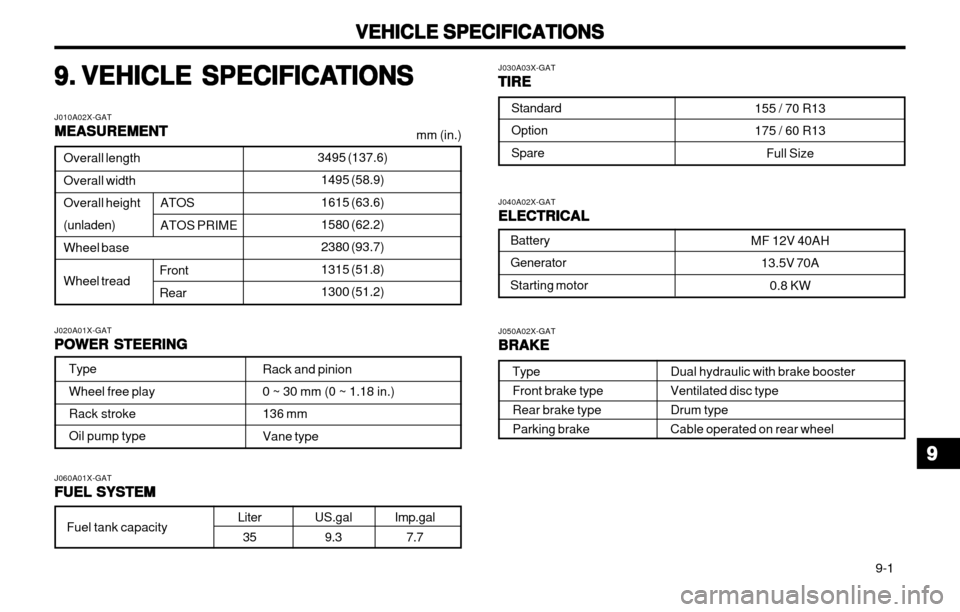
J010A02X-GAT MEASUREMENT
MEASUREMENT MEASUREMENT
MEASUREMENT
MEASUREMENT
mm (in.)
J020A01X-GAT POWER STEERING
POWER STEERING POWER STEERING
POWER STEERING
POWER STEERING
Imp.gal
7.7Liter35 US.gal
9.3
J060A01X-GAT
FUEL SYSTEM
FUEL SYSTEM FUEL SYSTEM
FUEL SYSTEM
FUEL SYSTEM J040A02X-GAT
ELECTRICAL
ELECTRICAL ELECTRICAL
ELECTRICAL
ELECTRICAL J050A02X-GAT
BRAKE
BRAKE BRAKE
BRAKE
BRAKE
Dual hydraulic with brake booster Ventilated disc typeDrum typeCable operated on rear wheel
J030A03X-GAT
TIRE
TIRE TIRE
TIRE
TIRE
3495 (137.6)
1495 (58.9) 1615 (63.6) 1580 (62.2) 2380 (93.7)1315 (51.8) 1300 (51.2)Overall length Overall widthOverall height (unladen) Wheel base Wheel tread
Front Rear
ATOS ATOS PRIME
Type Wheel free play Rack stroke Oil pump type Rack and pinion 0 ~ 30 mm (0 ~ 1.18 in.) 136 mmVane type
Standard Option Spare
155 / 70 R13175 / 60 R13
Full Size
Battery Generator Starting motor MF 12V 40AH
13.5V 70A
0.8 KW
Fuel tank capacity Type Front brake typeRear brake typeParking brake
99
99
9
Page 138 of 249
FEATURES OF YOUR HYUNDAI 1-1
ZB000A1-A
1. FEATURES OF
YOUR HYUNDAI cised when charging the vehicle tank from jerry cans or by means of a funnel that the fuel beingused is unleaded.
The use of leaded fuel in this vehicle will result
in irreversible pollution of the catalyst element.Such pollution will prevent correct operation ofthe catalyst and give rise to increased operat-ing temperatures leading to the catalyst ele-ment melting and restricting the exhaust flowalong with an increase in exhaust emissionlevels.
CAUTION: The vehicle warranty will not extend to dam-
age arising from the use of incorrect fuels.
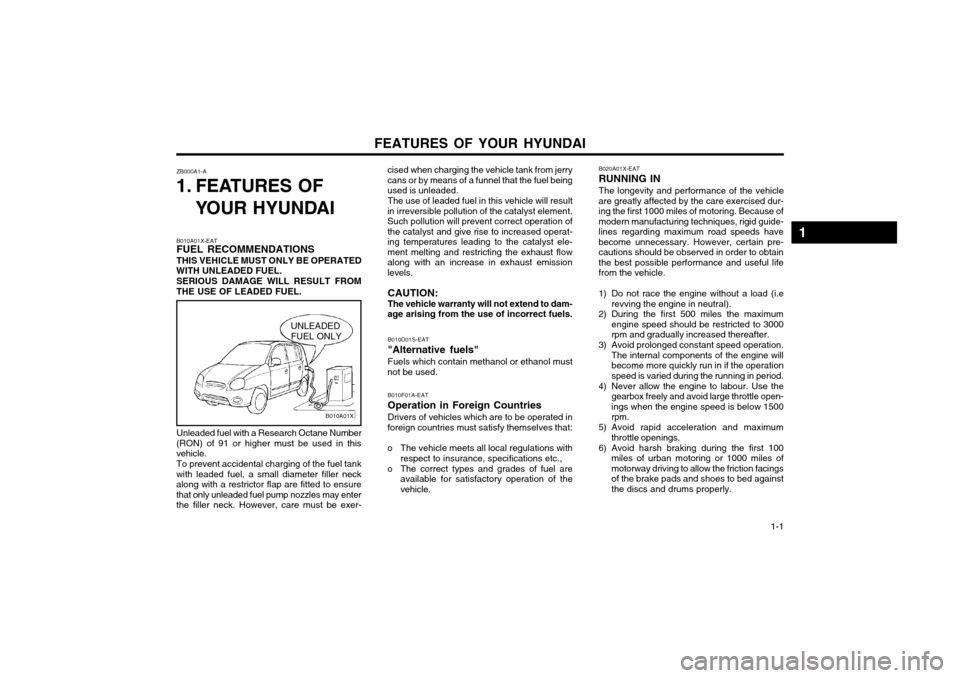
Unleaded fuel with a Research Octane Number
(RON) of 91 or higher must be used in this vehicle.
To prevent accidental charging of the fuel tank
with leaded fuel, a small diameter filler neckalong with a restrictor flap are fitted to ensurethat only unleaded fuel pump nozzles may enterthe filler neck. However, care must be exer-
B010A01X
UNLEADED FUEL ONLY
B010A01X-EAT FUEL RECOMMENDATIONS THIS VEHICLE MUST ONLY BE OPERATED
WITH UNLEADED FUEL.
SERIOUS DAMAGE WILL RESULT FROM
THE USE OF LEADED FUEL. B020A01X-EAT RUNNING INThe longevity and performance of the vehicle
are greatly affected by the care exercised dur- ing the first 1000 miles of motoring. Because ofmodern manufacturing techniques, rigid guide-lines regarding maximum road speeds havebecome unnecessary. However, certain pre-cautions should be observed in order to obtainthe best possible performance and useful lifefrom the vehicle.
1) Do not race the engine without a load (i.e revving the engine in neutral).
2) During the first 500 miles the maximum engine speed should be restricted to 3000 rpm and gradually increased thereafter.
3) Avoid prolonged constant speed operation. The internal components of the engine willbecome more quickly run in if the operationspeed is varied during the running in period.
4) Never allow the engine to labour. Use the gearbox freely and avoid large throttle open-ings when the engine speed is below 1500rpm.
5) Avoid rapid acceleration and maximum throttle openings.
6) Avoid harsh braking during the first 100 miles of urban motoring or 1000 miles ofmotorway driving to allow the friction facingsof the brake pads and shoes to bed againstthe discs and drums properly.
B010D01S-EAT "Alternative fuels"Fuels which contain methanol or ethanol must
not be used.
B010F01A-EATOperation in Foreign CountriesDrivers of vehicles which are to be operated in
foreign countries must satisfy themselves that:
o The vehicle meets all local regulations with respect to insurance, specifications etc.,
o The correct types and grades of fuel are available for satisfactory operation of the vehicle.
1
Page 157 of 249
FEATURES OF YOUR HYUNDAI
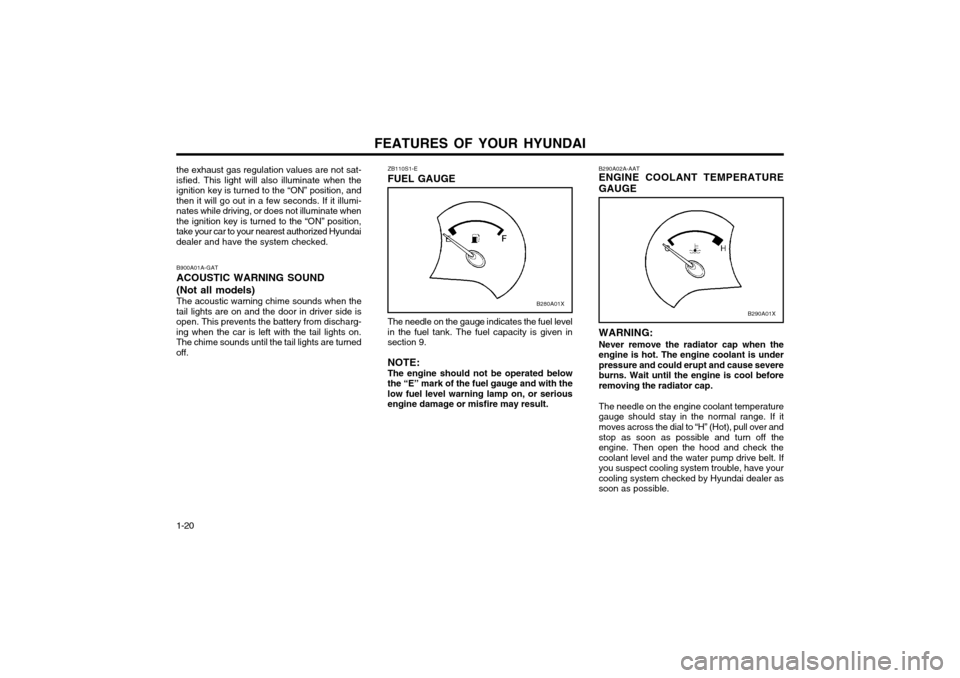
1-20 WARNING: Never remove the radiator cap when the engine is hot. The engine coolant is underpressure and could erupt and cause severeburns. Wait until the engine is cool beforeremoving the radiator cap. The needle on the engine coolant temperature
gauge should stay in the normal range. If itmoves across the dial to “H” (Hot), pull over and stop as soon as possible and turn off the engine. Then open the hood and check thecoolant level and the water pump drive belt. If
you suspect cooling system trouble, have yourcooling system checked by Hyundai dealer assoon as possible.
The needle on the gauge indicates the fuel levelin the fuel tank. The fuel capacity is given insection 9. NOTE: The engine should not be operated below the “E” mark of the fuel gauge and with thelow fuel level warning lamp on, or seriousengine damage or misfire may result. B290A02A-AAT ENGINE COOLANT TEMPERATURE GAUGE
ZB110S1-E FUEL GAUGE
B900A01A-GATACOUSTIC WARNING SOUND (Not all models) The acoustic warning chime sounds when the
tail lights are on and the door in driver side is open. This prevents the battery from discharg-ing when the car is left with the tail lights on.The chime sounds until the tail lights are turnedoff.
the exhaust gas regulation values are not sat-isfied. This light will also illuminate when theignition key is turned to the “ON” position, andthen it will go out in a few seconds. If it illumi-nates while driving, or does not illuminate whenthe ignition key is turned to the “ON” position,take your car to your nearest authorized Hyundaidealer and have the system checked.
B280A01XB290A01X
Page 192 of 249
DRIVING YOUR HYUNDAI 2- 3
C050A01A-AAT
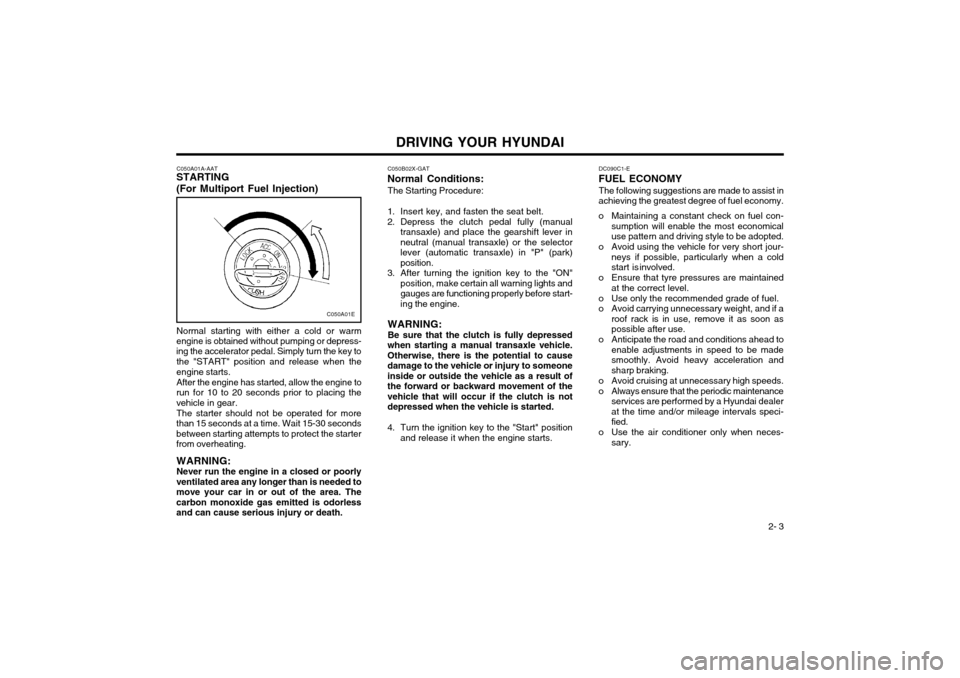
STARTING (For Multiport Fuel Injection)
Normal starting with either a cold or warm
engine is obtained without pumping or depress- ing the accelerator pedal. Simply turn the key to
the "START" position and release when the
engine starts.
After the engine has started, allow the engine to
run for 10 to 20 seconds prior to placing thevehicle in gear.
The starter should not be operated for more
than 15 seconds at a time. Wait 15-30 secondsbetween starting attempts to protect the starterfrom overheating.
WARNING:Never run the engine in a closed or poorly
ventilated area any longer than is needed tomove your car in or out of the area. Thecarbon monoxide gas emitted is odorlessand can cause serious injury or death. C050B02X-GAT
Normal Conditions:
The Starting Procedure:
1. Insert key, and fasten the seat belt.
2. Depress the clutch pedal fully (manual transaxle) and place the gearshift lever in neutral (manual transaxle) or the selectorlever (automatic transaxle) in "P" (park)position.
3. After turning the ignition key to the "ON" position, make certain all warning lights andgauges are functioning properly before start-
ing the engine.
WARNING: Be sure that the clutch is fully depressed
when starting a manual transaxle vehicle. Otherwise, there is the potential to cause
damage to the vehicle or injury to someoneinside or outside the vehicle as a result ofthe forward or backward movement of the
vehicle that will occur if the clutch is notdepressed when the vehicle is started.
4. Turn the ignition key to the "Start" position and release it when the engine starts. DC090C1-E
FUEL ECONOMY
The following suggestions are made to assist in
achieving the greatest degree of fuel economy.
o Maintaining a constant check on fuel con- sumption will enable the most economical use pattern and driving style to be adopted.
o Avoid using the vehicle for very short jour- neys if possible, particularly when a coldstart is involved.
o Ensure that tyre pressures are maintained at the correct level.
o Use only the recommended grade of fuel.
o Avoid carrying unnecessary weight, and if a roof rack is in use, remove it as soon aspossible after use.
o Anticipate the road and conditions ahead to enable adjustments in speed to be madesmoothly. Avoid heavy acceleration andsharp braking.
o Avoid cruising at unnecessary high speeds.
o Always ensure that the periodic maintenance services are performed by a Hyundai dealer at the time and/or mileage intervals speci-fied.
o Use the air conditioner only when neces- sary.
C050A01E