2002 Hyundai Atos ESP
[x] Cancel search: ESPPage 2 of 249
RESPONSIBILITY FOR MAINTENANCE
RESPONSIBILITY FOR MAINTENANCE RESPONSIBILITY FOR MAINTENANCE
RESPONSIBILITY FOR MAINTENANCE
RESPONSIBILITY FOR MAINTENANCE
The maintenance requirements for your new Hyundai are found in Section 5. As the owner,
it is your responsibility to see that all maintenance operations specified by the manufacturer are carried out at the appropriate intervals. When the vehicle is used in severe drivingconditions, more frequent maintenance is required for some operations. Maintenancerequirements for severe operating conditions are also included in Section 5.
A020A01A-AAT
Page 13 of 249
FEATURES OF YOUR HYUNDAI
FEATURES OF YOUR HYUNDAI FEATURES OF YOUR HYUNDAI
FEATURES OF YOUR HYUNDAI
FEATURES OF YOUR HYUNDAI
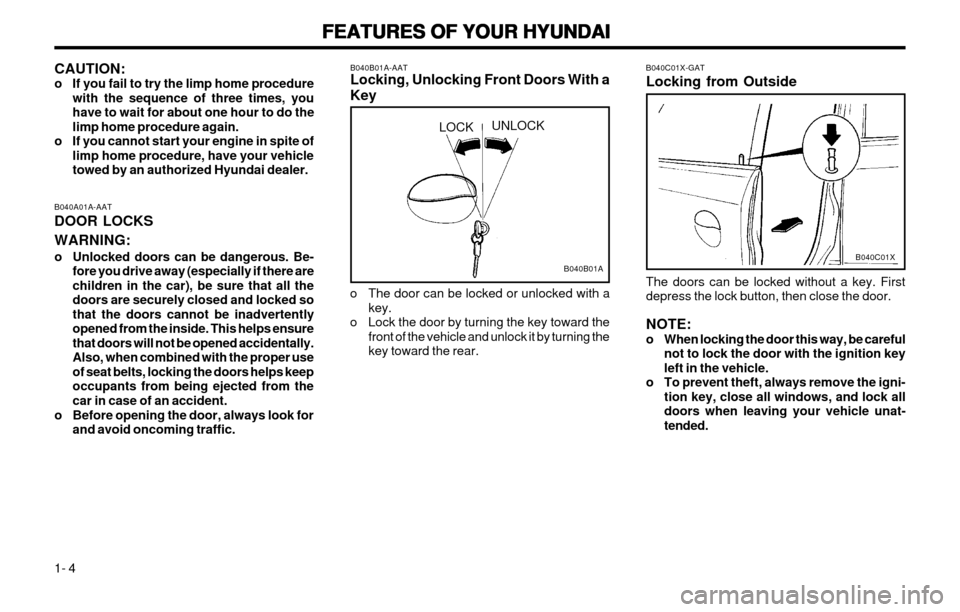
1- 4 B040B01A-AAT Locking, Unlocking Front Doors With a Key
LOCKUNLOCK
o The door can be locked or unlocked with a key.
o Lock the door by turning the key toward the front of the vehicle and unlock it by turning the key toward the rear.
B040B01A
CAUTION:
o If you fail to try the limp home procedurewith the sequence of three times, youhave to wait for about one hour to do thelimp home procedure again.
o If you cannot start your engine in spite of limp home procedure, have your vehicletowed by an authorized Hyundai dealer.
B040A01A-AAT DOOR LOCKS WARNING:
o Unlocked doors can be dangerous. Be- fore you drive away (especially if there are children in the car), be sure that all thedoors are securely closed and locked sothat the doors cannot be inadvertentlyopened from the inside. This helps ensurethat doors will not be opened accidentally.Also, when combined with the proper useof seat belts, locking the doors helps keepoccupants from being ejected from thecar in case of an accident.
o Before opening the door, always look for and avoid oncoming traffic. The doors can be locked without a key. Firstdepress the lock button, then close the door. NOTE:
o When locking the door this way, be careful
not to lock the door with the ignition keyleft in the vehicle.
o To prevent theft, always remove the igni- tion key, close all windows, and lock alldoors when leaving your vehicle unat-tended.
B040C01X-GAT Locking from Outside
B040C01X
Page 16 of 249
FEATURES OF YOUR HYUNDAI
FEATURES OF YOUR HYUNDAI FEATURES OF YOUR HYUNDAI
FEATURES OF YOUR HYUNDAI
FEATURES OF YOUR HYUNDAI
1- 7
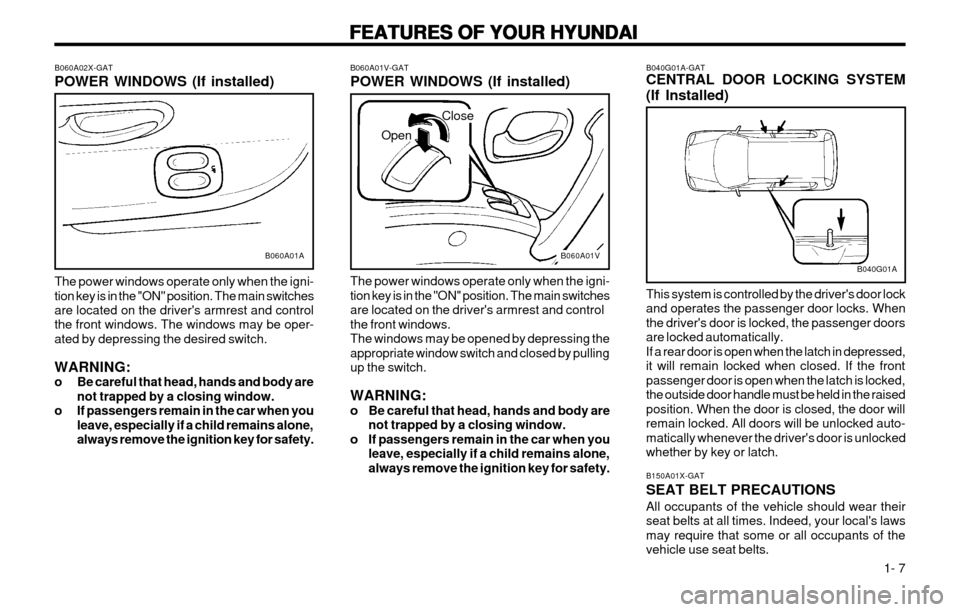
B060A01V-GAT POWER WINDOWS (If installed)
B060A01V
Open
Close
The power windows operate only when the igni- tion key is in the "ON" position. The main switchesare located on the driver's armrest and controlthe front windows.The windows may be opened by depressing theappropriate window switch and closed by pullingup the switch. WARNING:
o Be careful that head, hands and body are not trapped by a closing window.
o If passengers remain in the car when you leave, especially if a child remains alone,always remove the ignition key for safety.
B060A02X-GAT POWER WINDOWS (If installed) The power windows operate only when the igni- tion key is in the "ON" position. The main switches are located on the driver's armrest and control the front windows. The windows may be oper-ated by depressing the desired switch. WARNING:
o Be careful that head, hands and body are
not trapped by a closing window.
o If passengers remain in the car when you leave, especially if a child remains alone,always remove the ignition key for safety.
B060A01A
B040G01A-GAT CENTRAL DOOR LOCKING SYSTEM (If Installed)
B040G01A
This system is controlled by the driver's door lock
and operates the passenger door locks. Whenthe driver's door is locked, the passenger doorsare locked automatically.If a rear door is open when the latch in depressed,it will remain locked when closed. If the frontpassenger door is open when the latch is locked,the outside door handle must be held in the raisedposition. When the door is closed, the door willremain locked. All doors will be unlocked auto-matically whenever the driver's door is unlockedwhether by key or latch. B150A01X-GAT SEAT BELT PRECAUTIONS All occupants of the vehicle should wear their seat belts at all times. Indeed, your local's lawsmay require that some or all occupants of thevehicle use seat belts.
Page 52 of 249
FEATURES OF YOUR HYUNDAI
FEATURES OF YOUR HYUNDAI FEATURES OF YOUR HYUNDAI
FEATURES OF YOUR HYUNDAI
FEATURES OF YOUR HYUNDAI
1- 43
B901B02X-GAT
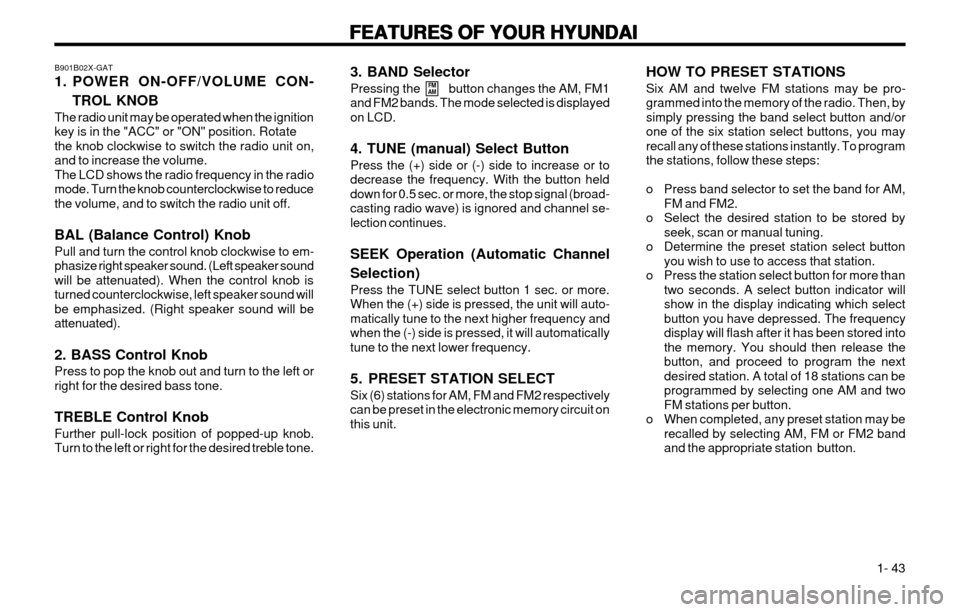
1. POWER ON-OFF/VOLUME CON-
TROL KNOB
The radio unit may be operated when the ignition key is in the "ACC" or "ON" position. Rotatethe knob clockwise to switch the radio unit on,and to increase the volume.The LCD shows the radio frequency in the radiomode. Turn the knob counterclockwise to reducethe volume, and to switch the radio unit off. BAL (Balance Control) Knob Pull and turn the control knob clockwise to em- phasize right speaker sound. (Left speaker soundwill be attenuated). When the control knob isturned counterclockwise, left speaker sound willbe emphasized. (Right speaker sound will beattenuated). 2. BASS Control Knob Press to pop the knob out and turn to the left or right for the desired bass tone. TREBLE Control Knob Further pull-lock position of popped-up knob. Turn to the left or right for the desired treble tone. 3. BAND Selector Pressing the button changes the AM, FM1 and FM2 bands. The mode selected is displayedon LCD. 4. TUNE (manual) Select Button Press the (+) side or (-) side to increase or to decrease the frequency. With the button helddown for 0.5 sec. or more, the stop signal (broad-casting radio wave) is ignored and channel se-lection continues. SEEK Operation (Automatic Channel Selection) Press the TUNE select button 1 sec. or more. When the (+) side is pressed, the unit will auto-matically tune to the next higher frequency andwhen the (-) side is pressed, it will automaticallytune to the next lower frequency.
5. PRESET STATION SELECT Six (6) stations for AM, FM and FM2 respectively can be preset in the electronic memory circuit onthis unit.
FM
AMHOW TO PRESET STATIONS Six AM and twelve FM stations may be pro- grammed into the memory of the radio. Then, bysimply pressing the band select button and/orone of the six station select buttons, you mayrecall any of these stations instantly. To programthe stations, follow these steps:
o Press band selector to set the band for AM,
FM and FM2.
o Select the desired station to be stored by seek, scan or manual tuning.
o Determine the preset station select button you wish to use to access that station.
o Press the station select button for more than two seconds. A select button indicator will show in the display indicating which selectbutton you have depressed. The frequencydisplay will flash after it has been stored intothe memory. You should then release thebutton, and proceed to program the nextdesired station. A total of 18 stations can beprogrammed by selecting one AM and twoFM stations per button.
o When completed, any preset station may be recalled by selecting AM, FM or FM2 bandand the appropriate station button.
Page 54 of 249
FEATURES OF YOUR HYUNDAI
FEATURES OF YOUR HYUNDAI FEATURES OF YOUR HYUNDAI
FEATURES OF YOUR HYUNDAI
FEATURES OF YOUR HYUNDAI
1- 45
B900B02X-GAT
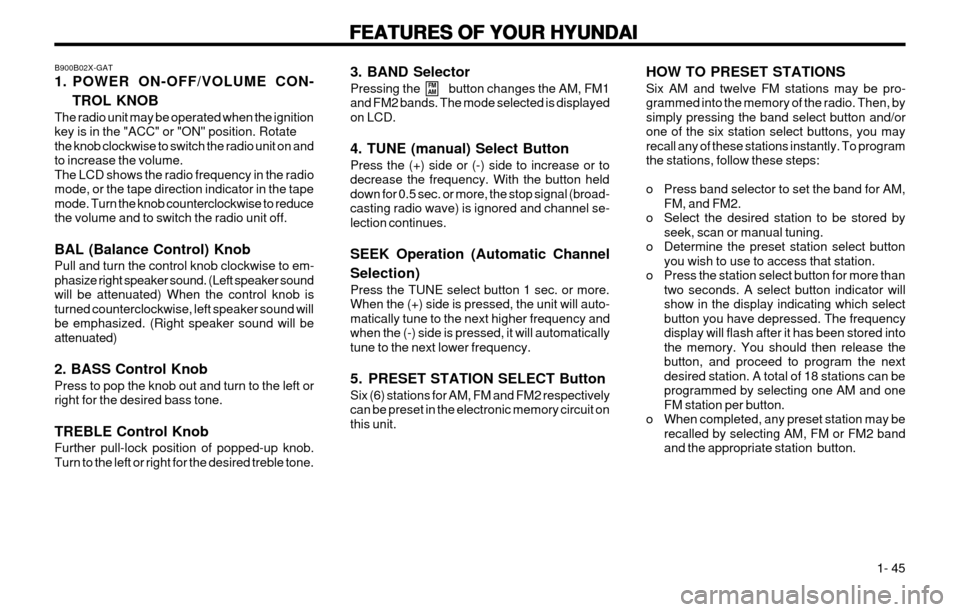
1. POWER ON-OFF/VOLUME CON-
TROL KNOB
The radio unit may be operated when the ignition key is in the "ACC" or "ON" position. Rotatethe knob clockwise to switch the radio unit on andto increase the volume.The LCD shows the radio frequency in the radiomode, or the tape direction indicator in the tapemode. Turn the knob counterclockwise to reducethe volume and to switch the radio unit off. BAL (Balance Control) Knob Pull and turn the control knob clockwise to em- phasize right speaker sound. (Left speaker soundwill be attenuated) When the control knob isturned counterclockwise, left speaker sound willbe emphasized. (Right speaker sound will beattenuated) 2. BASS Control Knob Press to pop the knob out and turn to the left or right for the desired bass tone. TREBLE Control Knob Further pull-lock position of popped-up knob. Turn to the left or right for the desired treble tone. 3. BAND Selector Pressing the button changes the AM, FM1 and FM2 bands. The mode selected is displayedon LCD. 4. TUNE (manual) Select Button Press the (+) side or (-) side to increase or to decrease the frequency. With the button helddown for 0.5 sec. or more, the stop signal (broad-casting radio wave) is ignored and channel se-lection continues. SEEK Operation (Automatic Channel Selection) Press the TUNE select button 1 sec. or more. When the (+) side is pressed, the unit will auto-matically tune to the next higher frequency andwhen the (-) side is pressed, it will automaticallytune to the next lower frequency.
5. PRESET STATION SELECT Button Six (6) stations for AM, FM and FM2 respectively can be preset in the electronic memory circuit onthis unit.
FM
AMHOW TO PRESET STATIONS Six AM and twelve FM stations may be pro- grammed into the memory of the radio. Then, bysimply pressing the band select button and/orone of the six station select buttons, you mayrecall any of these stations instantly. To programthe stations, follow these steps:
o Press band selector to set the band for AM,
FM, and FM2.
o Select the desired station to be stored by seek, scan or manual tuning.
o Determine the preset station select button you wish to use to access that station.
o Press the station select button for more than two seconds. A select button indicator will show in the display indicating which selectbutton you have depressed. The frequencydisplay will flash after it has been stored intothe memory. You should then release thebutton, and proceed to program the nextdesired station. A total of 18 stations can beprogrammed by selecting one AM and oneFM station per button.
o When completed, any preset station may be recalled by selecting AM, FM or FM2 bandand the appropriate station button.
Page 57 of 249
FEATURES OF YOUR HYUNDAI
FEATURES OF YOUR HYUNDAI FEATURES OF YOUR HYUNDAI
FEATURES OF YOUR HYUNDAI
FEATURES OF YOUR HYUNDAI
1- 48
B922B03X-GAT
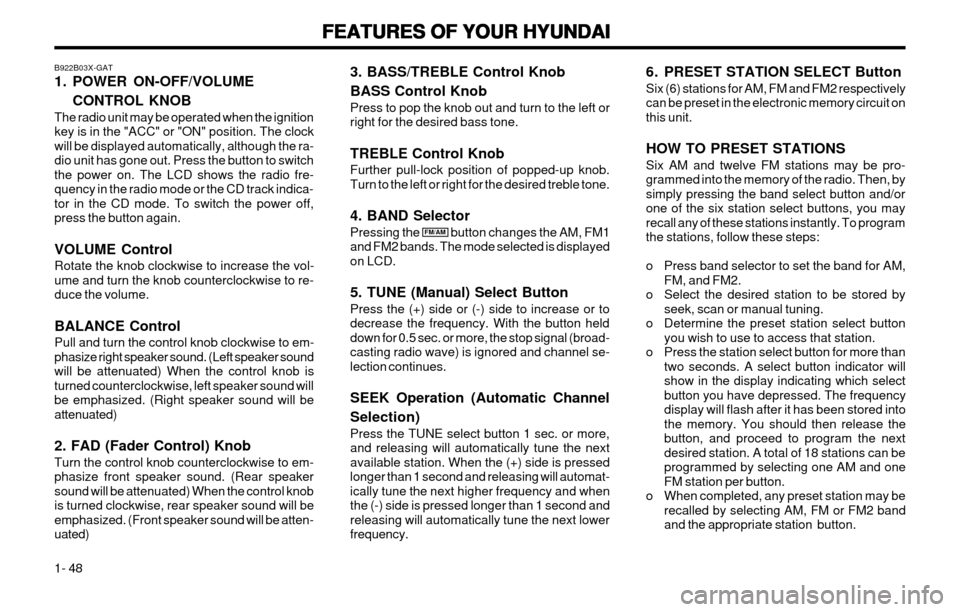
1. POWER ON-OFF/VOLUME
CONTROL KNOB
The radio unit may be operated when the ignition key is in the "ACC" or "ON" position. The clockwill be displayed automatically, although the ra-dio unit has gone out. Press the button to switchthe power on. The LCD shows the radio fre-quency in the radio mode or the CD track indica-tor in the CD mode. To switch the power off,press the button again. VOLUME Control Rotate the knob clockwise to increase the vol- ume and turn the knob counterclockwise to re-duce the volume. BALANCE Control Pull and turn the control knob clockwise to em- phasize right speaker sound. (Left speaker soundwill be attenuated) When the control knob isturned counterclockwise, left speaker sound willbe emphasized. (Right speaker sound will beattenuated) 2. FAD (Fader Control) Knob Turn the control knob counterclockwise to em- phasize front speaker sound. (Rear speakersound will be attenuated) When the control knobis turned clockwise, rear speaker sound will beemphasized. (Front speaker sound will be atten-uated)
FM/AM 6. PRESET STATION SELECT Button Six (6) stations for AM, FM and FM2 respectively can be preset in the electronic memory circuit onthis unit. HOW TO PRESET STATIONS Six AM and twelve FM stations may be pro- grammed into the memory of the radio. Then, bysimply pressing the band select button and/orone of the six station select buttons, you mayrecall any of these stations instantly. To programthe stations, follow these steps:
o Press band selector to set the band for AM,
FM, and FM2.
o Select the desired station to be stored by seek, scan or manual tuning.
o Determine the preset station select button you wish to use to access that station.
o Press the station select button for more than two seconds. A select button indicator will show in the display indicating which selectbutton you have depressed. The frequencydisplay will flash after it has been stored intothe memory. You should then release thebutton, and proceed to program the nextdesired station. A total of 18 stations can beprogrammed by selecting one AM and oneFM station per button.
o When completed, any preset station may be recalled by selecting AM, FM or FM2 bandand the appropriate station button.
3. BASS/TREBLE Control Knob BASS Control Knob Press to pop the knob out and turn to the left or right for the desired bass tone. TREBLE Control Knob Further pull-lock position of popped-up knob. Turn to the left or right for the desired treble tone. 4. BAND Selector Pressing the button changes the AM, FM1 and FM2 bands. The mode selected is displayedon LCD. 5. TUNE (Manual) Select Button Press the (+) side or (-) side to increase or to decrease the frequency. With the button helddown for 0.5 sec. or more, the stop signal (broad-casting radio wave) is ignored and channel se-lection continues. SEEK Operation (Automatic Channel Selection) Press the TUNE select button 1 sec. or more, and releasing will automatically tune the nextavailable station. When the (+) side is pressedlonger than 1 second and releasing will automat-ically tune the next higher frequency and whenthe (-) side is pressed longer than 1 second andreleasing will automatically tune the next lowerfrequency.
Page 67 of 249

DRIVING YOUR HYUNDAI
DRIVING YOUR HYUNDAI DRIVING YOUR HYUNDAI
DRIVING YOUR HYUNDAI
DRIVING YOUR HYUNDAI
2- 4 C070B01X-GAT
Using the Clutch of Manual transaxle
Using the Clutch of Manual transaxle Using the Clutch of Manual transaxle
Using the Clutch of Manual transaxle
Using the Clutch of Manual transaxle
The clutch should be pressed all the way to the floor before shifting, then released slowly. Theclutch pedal should be always used after fullyreturning to the original position. Do not restyour foot on the clutch pedal while driving. Thiscan cause unnecessary wear. Do not partiallyengage the clutch to hold the car on an incline.This causes unnecessary wear. Use the park-ing brake to hold the car on an incline. Do notoperate the clutch pedal rapidly and repeatedly. o Slow down when you encounter cross winds.
This gives you much better control of yourcar.
o Be sure the car is completely stopped be- fore you attempt to shift into reverse. Thetransaxle can be damaged if you do not. To
shift into reverse, depress the clutch (manualtransaxle), move the shift lever to neutral,
wait three seconds, then shift to the reverseposition.
o Exercise extreme caution when driving on a slippery surface. Be especially careful whenbraking, accelerating or shifting gears. On aslippery surface, an abrupt change in ve-hicle speed can cause the drive wheels tolose traction and the vehicle to go out ofcontrol.
CAUTION:
CAUTION: CAUTION:
CAUTION:
CAUTION:
oo
oo
o The risk of rollover is greatly increased if
The risk of rollover is greatly increased if The risk of rollover is greatly increased if
The risk of rollover is greatly increased if
The risk of rollover is greatly increased if
you you
you you
you lose control of your vehicle at high-
lose control of your vehicle at high- lose control of your vehicle at high-
lose control of your vehicle at high-
lose control of your vehicle at high-
way speeds.
way speeds. way speeds.
way speeds.
way speeds.
oo
oo
o Loss of control often occurs if two or
Loss of control often occurs if two or Loss of control often occurs if two or
Loss of control often occurs if two or
Loss of control often occurs if two or
more wheels drop off the
more wheels drop off the more wheels drop off the
more wheels drop off the
more wheels drop off the roadway and
roadway and roadway and
roadway and
roadway and
the driver oversteers to reenter the road-
the driver oversteers to reenter the road- the driver oversteers to reenter the road-
the driver oversteers to reenter the road-
the driver oversteers to reenter the road-
way.
way. way.
way.
way.
oo
oo
o In the event your vehicle leaves the road-
In the event your vehicle leaves the road- In the event your vehicle leaves the road-
In the event your vehicle leaves the road-
In the event your vehicle leaves the road-
way, do not steer sharply.
way, do not steer sharply. way, do not steer sharply.
way, do not steer sharply.
way, do not steer sharply. Instead, slow
Instead, slow Instead, slow
Instead, slow
Instead, slow
down before pulling back into the travel
down before pulling back into the travel down before pulling back into the travel
down before pulling back into the travel
down before pulling back into the travel
lanes.
lanes. lanes.
lanes.
lanes.
oo
oo
o
In a collision crash, on unbelted person
In a collision crash, on unbelted person In a collision crash, on unbelted person
In a collision crash, on unbelted person
In a collision crash, on unbelted person
is significantly more likely to die than a
is significantly more likely to die than a is significantly more likely to die than a
is significantly more likely to die than a
is significantly more likely to die than a
person wearing a seatbelt.
person wearing a seatbelt. person wearing a seatbelt.
person wearing a seatbelt.
person wearing a seatbelt.
oo
oo
o Ensure that the engine is not over-revved
Ensure that the engine is not over-revved Ensure that the engine is not over-revved
Ensure that the engine is not over-revved
Ensure that the engine is not over-revved
by upshifting.
by upshifting. by upshifting.
by upshifting.
by upshifting.
oo
oo
o Do not coast with the shift lever at the
Do not coast with the shift lever at the Do not coast with the shift lever at the
Do not coast with the shift lever at the
Do not coast with the shift lever at the
neutral position.
neutral position. neutral position.
neutral position.
neutral position.
oo
oo
o
When descending long gradients, make
When descending long gradients, make When descending long gradients, make
When descending long gradients, make
When descending long gradients, make
use of the engine braking
use of the engine braking use of the engine braking
use of the engine braking
use of the engine braking
to assist the
to assist the to assist the
to assist the
to assist the
footbrake to avoid brake fade or over-
footbrake to avoid brake fade or over- footbrake to avoid brake fade or over-
footbrake to avoid brake fade or over-
footbrake to avoid brake fade or over-
heating.
heating. heating.
heating.
heating.
oo
oo
o When slippery conditions are encoun-
When slippery conditions are encoun- When slippery conditions are encoun-
When slippery conditions are encoun-
When slippery conditions are encoun-
tered, increased caution should
tered, increased caution should tered, increased caution should
tered, increased caution should
tered, increased caution should be ex-
be ex- be ex-
be ex-
be ex-
ecuted when gear changing, braking or
ecuted when gear changing, braking or ecuted when gear changing, braking or
ecuted when gear changing, braking or
ecuted when gear changing, braking or
accelerating. Abrupt changes in
accelerating. Abrupt changes in accelerating. Abrupt changes in
accelerating. Abrupt changes in
accelerating. Abrupt changes in
speed
speed speed
speed
speed
may cause a loss of traction.
may cause a loss of traction. may cause a loss of traction.
may cause a loss of traction.
may cause a loss of traction.
oo
oo
o To shift into reverse, rest the lever in
To shift into reverse, rest the lever in To shift into reverse, rest the lever in
To shift into reverse, rest the lever in
To shift into reverse, rest the lever in
neutral for at least
neutral for at least neutral for at least
neutral for at least
neutral for at least
3 seconds after your
3 seconds after your 3 seconds after your
3 seconds after your
3 seconds after your
car is completely stopped. Then move
car is completely stopped. Then move car is completely stopped. Then move
car is completely stopped. Then move
car is completely stopped. Then move
the lever into the reverse position.
the lever into the reverse position. the lever into the reverse position.
the lever into the reverse position.
the lever into the reverse position.
oo
oo
o During cold weather, shifting may be dif-
During cold weather, shifting may be dif- During cold weather, shifting may be dif-
During cold weather, shifting may be dif-
During cold weather, shifting may be dif-
ficult until the transaxle lubricant has
ficult until the transaxle lubricant has ficult until the transaxle lubricant has
ficult until the transaxle lubricant has
ficult until the transaxle lubricant has
warmed up. This is normal and not harm-
warmed up. This is normal and not harm- warmed up. This is normal and not harm-
warmed up. This is normal and not harm-
warmed up. This is normal and not harm-
ful to the transaxle.
ful to the transaxle. ful to the transaxle.
ful to the transaxle.
ful to the transaxle.
oo
oo
o
If you 've come to a complete stop and
If you 've come to a complete stop and If you 've come to a complete stop and
If you 've come to a complete stop and
If you 've come to a complete stop and
it's hard to shift into 1
it's hard to shift into 1 it's hard to shift into 1
it's hard to shift into 1
it's hard to shift into 1 stst
stst
st
or R(Reverse),
or R(Reverse), or R(Reverse),
or R(Reverse),
or R(Reverse),
put the shift lever in N(Neutral) position
put the shift lever in N(Neutral) position put the shift lever in N(Neutral) position
put the shift lever in N(Neutral) position
put the shift lever in N(Neutral) position
and let up on the clutch. Press the clutch
and let up on the clutch. Press the clutch and let up on the clutch. Press the clutch
and let up on the clutch. Press the clutch
and let up on the clutch. Press the clutch
pedal back down, and then shift into 1
pedal back down, and then shift into 1 pedal back down, and then shift into 1
pedal back down, and then shift into 1
pedal back down, and then shift into 1 stst
stst
st
or R(Reverse) gear position.
or R(Reverse) gear position. or R(Reverse) gear position.
or R(Reverse) gear position.
or R(Reverse) gear position.
oo
oo
o
Do not use the shift lever as a handrest
Do not use the shift lever as a handrest Do not use the shift lever as a handrest
Do not use the shift lever as a handrest
Do not use the shift lever as a handrest
during driving, as this can result in pre-
during driving, as this can result in pre- during driving, as this can result in pre-
during driving, as this can result in pre-
during driving, as this can result in pre-
mature wear of the transaxle shift forks.
mature wear of the transaxle shift forks. mature wear of the transaxle shift forks.
mature wear of the transaxle shift forks.
mature wear of the transaxle shift forks. C070D01X-GAT
Good Driving Practices
Good Driving Practices Good Driving Practices
Good Driving Practices
Good Driving Practices
o Never take the car out of gear and coast
down a hill. This is extremely hazardous. Always leave the car in gear.
o Don't "ride" the brakes. This can cause them to overheat and malfunction. Instead,when you are driving down a long hill, slowdown and shift to a lower gear. When you dothis, engine braking will help slow the car.
o Slow down before shifting to a lower gear. This will help avoid over-revving the engine,which can cause damage.
WARNING:
WARNING: WARNING:
WARNING:
WARNING:
When downshifting from fifth gear to fourth
When downshifting from fifth gear to fourth When downshifting from fifth gear to fourth
When downshifting from fifth gear to fourth
When downshifting from fifth gear to fourth
gear, caution should
gear, caution should gear, caution should
gear, caution should
gear, caution should
be taken not to inad-
be taken not to inad- be taken not to inad-
be taken not to inad-
be taken not to inad-
vertently press the gear shift lever sideways
vertently press the gear shift lever sideways vertently press the gear shift lever sideways
vertently press the gear shift lever sideways
vertently press the gear shift lever sideways
in such
in such in such
in such
in such
a manner that second gear is en-
a manner that second gear is en- a manner that second gear is en-
a manner that second gear is en-
a manner that second gear is en-
gaged. Such over revving of the engine may
gaged. Such over revving of the engine may gaged. Such over revving of the engine may
gaged. Such over revving of the engine may
gaged. Such over revving of the engine may
possibly cause engine damage.
possibly cause engine damage. possibly cause engine damage.
possibly cause engine damage.
possibly cause engine damage.
Page 70 of 249

DRIVING YOUR HYUNDAI
DRIVING YOUR HYUNDAI DRIVING YOUR HYUNDAI
DRIVING YOUR HYUNDAI
DRIVING YOUR HYUNDAI
2- 7
C130A01A-AAT
GOOD BRAKING PRACTICES
GOOD BRAKING PRACTICES GOOD BRAKING PRACTICES
GOOD BRAKING PRACTICES
GOOD BRAKING PRACTICES
WARNING:
WARNING: WARNING:
WARNING:
WARNING:
Do not allow passengers to sit on the cargo
Do not allow passengers to sit on the cargo Do not allow passengers to sit on the cargo
Do not allow passengers to sit on the cargo
Do not allow passengers to sit on the cargo
area while the
area while the area while the
area while the
area while the car is moving as this is not a
car is moving as this is not a car is moving as this is not a
car is moving as this is not a
car is moving as this is not a
proper seating position and no seat belts
proper seating position and no seat belts proper seating position and no seat belts
proper seating position and no seat belts
proper seating position and no seat belts
are are
are are
are available for use when the seat back is
available for use when the seat back is available for use when the seat back is
available for use when the seat back is
available for use when the seat back is
folded down. This could result in
folded down. This could result in folded down. This could result in
folded down. This could result in
folded down. This could result in serious
serious serious
serious
serious
injury or death in case of an accident or a
injury or death in case of an accident or a injury or death in case of an accident or a
injury or death in case of an accident or a
injury or death in case of an accident or a
sudden stop. Objects should
sudden stop. Objects should sudden stop. Objects should
sudden stop. Objects should
sudden stop. Objects should not extend
not extend not extend
not extend
not extend
higher than the top of the front seats. This
higher than the top of the front seats. This higher than the top of the front seats. This
higher than the top of the front seats. This
higher than the top of the front seats. This
could allow cargo
could allow cargo could allow cargo
could allow cargo
could allow cargo
to slide forward and cause
to slide forward and cause to slide forward and cause
to slide forward and cause
to slide forward and cause
injury or damage during sudden stops.
injury or damage during sudden stops. injury or damage during sudden stops.
injury or damage during sudden stops.
injury or damage during sudden stops.
o After being parked, check to be sure the parking brake is not engaged and that the parking brake indicator light is out beforedriving away.
o Driving through water may get the brakes wet. They can also get wet when the car iswashed. Wet brakes can be dangerous!
Your car will not stop as quickly if the brakesare wet and it may also pull to one side. Todry the brakes, apply the brakes lightly untilthe braking action returns to normal, takingcare to keep the car under control at alltimes. If the braking action does not return tonormal, stop as soon as it is safe to do soand call your Hyundai dealer for assistance.
o Don't coast down hills with the car out of gear. This is extremely hazardous. Keep thecar in gear at all times, use the brakes toslow down, then shift to a lower gear so thatengine braking will help you maintain a safespeed.
o Exercise extreme caution when driving on a
slippery surface. Be especially careful whenbraking, accelerating or shifting gears. On aslippery surface, an abrupt change in ve-hicle speed can cause the drive wheels tolose traction and the vehicle to go out ofcontrol.
o Turn the overdrive switch on for good fuel economy and smooth driving. If engine brak-ing is needed in the "D" range or if repeatedupshifting and downshifting between 3rd and4th gear is needed when climbing a gentleslope, it is recommended that the overdriveswitch be turned off. Turn the overdriveswitch back on immediately afterward.
CAUTION:
CAUTION: CAUTION:
CAUTION:
CAUTION:
oo
oo
o The risk of rollover is greatly increased if
The risk of rollover is greatly increased if The risk of rollover is greatly increased if
The risk of rollover is greatly increased if
The risk of rollover is greatly increased if
you lose control of your vehicle at high-
you lose control of your vehicle at high- you lose control of your vehicle at high-
you lose control of your vehicle at high-
you lose control of your vehicle at high-
way speeds.
way speeds. way speeds.
way speeds.
way speeds.
oo
oo
o Loss of control often occurs if two or
Loss of control often occurs if two or Loss of control often occurs if two or
Loss of control often occurs if two or
Loss of control often occurs if two or
more wheels drop off the roadway and
more wheels drop off the roadway and more wheels drop off the roadway and
more wheels drop off the roadway and
more wheels drop off the roadway and
the driver oversteers to reenter the road-
the driver oversteers to reenter the road- the driver oversteers to reenter the road-
the driver oversteers to reenter the road-
the driver oversteers to reenter the road-
way.
way. way.
way.
way.
oo
oo
o In the event your vehicle leaves the road-
In the event your vehicle leaves the road- In the event your vehicle leaves the road-
In the event your vehicle leaves the road-
In the event your vehicle leaves the road-
way, do not steer sharply. Instead, slow
way, do not steer sharply. Instead, slow way, do not steer sharply. Instead, slow
way, do not steer sharply. Instead, slow
way, do not steer sharply. Instead, slow
down before pulling back into the travel
down before pulling back into the travel down before pulling back into the travel
down before pulling back into the travel
down before pulling back into the travel
lanes.
lanes. lanes.
lanes.
lanes.
oo
oo
o In a collision crash, on unbelted person
In a collision crash, on unbelted person In a collision crash, on unbelted person
In a collision crash, on unbelted person
In a collision crash, on unbelted person
is significantly more likely to die than a
is significantly more likely to die than a is significantly more likely to die than a
is significantly more likely to die than a
is significantly more likely to die than a
person wearing a seatbelt.
person wearing a seatbelt. person wearing a seatbelt.
person wearing a seatbelt.
person wearing a seatbelt.
C090N02A-AAT
Good Driving Practices
Good Driving Practices Good Driving Practices
Good Driving Practices
Good Driving Practices
o Never move the gear selector lever from "P"
or "N" to any other position with the acceler- ator pedal depressed.
o Never move the gear selector lever into "P" when the vehicle is in motion.
o Be sure the car is completely stopped be- fore you attempt to shift into "R".
o Never take the car out of gear and coast down a hill. This may be extremely hazard-ous. Always leave the car in gear whenmoving.
o Do not "ride" the brakes. This can cause them to overheat and malfunction. Instead,when you are driving down a long hill, slowdown and shift to a lower gear. When you dothis, engine braking will help slow the car.
o Slow down before shifting to a lower gear. Otherwise, the lower gear may not be en-gaged.
o Always use the parking brake. Do not de- pend on placing the transaxle in "P" to keepthe car from moving.
drive switch is turned off, the transaxle will notupshift to the overdrive gear. For normal driv-ing, the selector lever should be left in the "D"position and the overdrive switch turned on.
If you need to accelerate rapidly, press the
accelerator pedal all the way to the floor. Thetransaxle will automatically shift to a lower gear,depending on the vehicle speed and load.