2002 Hyundai Atos ESP
[x] Cancel search: ESPPage 198 of 249
DRIVING YOUR HYUNDAI 2- 9
ZC170C1-E
Anti-freeze/Corrosion inhibitor The cooling system must always contain an
Ethylene-Glycol based anti-freeze solution. The system is filled during manufacture with solu-tion of the correct strength which should bechecked before the onset of winter and adjust-ed or changed as required.
NOTE: The anti-freeze solution contains a corro-
sion inhibitor to prevent degradation of the aluminum castings contained within theengine. Therefore, never, drain the systemand refill with water only.
In addition, anti-freeze solution must ALWAYS
be used in vehicles fitted with air conditioning,to prevent the heater matrix from freezing andsubsequently bursting with the refrigeration sys-tem in use. ZC170B1-E
Electrical System
Winter conditions impose severe demands upon
vehicle electrical systems, particularly the charg-ing circuit. The battery condition and perfor-mance along with the alternator performanceand drive belt condition should be checked priorto the onset of winter.
o Don’t "lug" or "over-rev" the engine. Lugging
is driving too slowly in too high a gearresulting in the engine bucking. If this hap-pens to you, shift to a lower gear. Over-revving is racing the engine beyond its safe limit. This can be avoided by shifting atthe recommended speeds.
o Use your air conditioning sparingly. The air conditioning system is operated by the en-gine power so your fuel economy is reducedwhen you use it.
SC160A1-F
SMOOTH CORNERING Avoid braking or gear changing in corners,
especially when roads are wet. Ideally, cornersshould always be taken under gentle accelera-tion. If you follow these suggestions, tire wearwill be held to a minimum.
SC170A1-E
WINTER MOTORING The onset of winter conditions subject motor
vehicles to greater operating demands. There-fore, the following suggestions will assist inmaintaining peak performance and reliabilityduring these periods: ZC170D1-E
Door Locks
Should the door lock mechanism become fro-
zen, a proprietary lock de-icer should be used.Alternatively, warming the door key may thawthe door lock. However, the key should behandled carefully to avoid burning the fingers.
Never attempt to thaw a frozen door lock using
hot water, since the water will eventually freezeand compound the problem.
NOTE:The proper temperature for using the immo-
bilizer key is from -40°F to 176°F(from -40°Cto 80°C). If you heat the immobilizer keyover 176°F(80°C) to open the frozen lock, itmay cause damage to the transponder in itshead.
ZC170E1-E
Windscreen Washers & Wipers The windscreen washer bottle should be filled
with a solution of water and a proprietary winterscreen wash additive. The windscreen wipersshould not be used it the blades are frozen tothe windscreen or if they are covered withsnow, before this is removed.
NOTE: Never allow undiluted screen washer fluid
additive to spill upon the paintwork or use engine coolant anti-freeze since damage tothe paintwork may result.
Page 201 of 249
DRIVING YOUR HYUNDAI
2- 12 15. If you have to stop while going uphill, do not
hold the vehicle in place by pressing on the accelerator. This can cause the automatictransaxle to overheat. Use the parking brakeor footbrake.
NOTE: When towing, check transaxle fluid more frequently. CAUTION: If overheating should occur when towing,
(temperature gauge reads near red zone),taking the following action may reduce oreliminate the problem.
1. Turn off the air conditioner.
2. Reduce highway speed.
3. Select a lower gear when going uphill.
4. While in stop and go traffic, place the gear selection in park or neutral and idle theengine at a higher speed.
being passed by a large vehicle, keep aconstant speed and steer straight ahead. If there is too much wind buffeting, slow
down to get out of the other vehicle's airturbulence.
8. When parking your car and trailer, especial- ly on a hill, be sure to follow all the normalprecautions. Turn your front wheel into thecurb, set the parking brake firmly, and putthe transaxle in 1st or Reverse (manual) orPark (automatic). In addition, place wheelchocks at each of the trailer's tyres.
9. If the trailer has electric brakes, start your vehicle and trailer moving, and then applythe trailer brake controller by hand to be
sure the brakes are working. This lets you
check your electrical connection at the sametime.
10. During your trip, check occasionally to be sure that the load is secure, and that thelights and any trailer brakes are still working.
11. Avoid jerky starts, sudden acceleration or sudden stops.
12. Avoid sharp turns and rapid lane changes.
13. Avoid holding the brake pedal down too long or too frequently. This could cause the brakes to overheat, resulting in reduced brakingefficiency.
14. When going down a hill, shift into a lower gear and use the engine braking effect.When ascending a long grade, downshift thetransaxle to a lower gear and reduce speedto reduce chances of engine overloading
and or overheating.
WARNING:
o The tongue load should never exceed;
Auto Transaxle : 55.1 lb Manual Transaxle 9: 61.7 lb
o Maximun permissible mass of the cou- pling device (ATOS VAN only) : 44 lb
o Improperly loading your car and trailer can serious affect its steering and brak- ing performance causing a crash in which
you may be seriously injured or killed.
YC200E1-A
Trailer or Vehicle Towing Tips
1. Before towing, check hitch and safety chain connections as well as proper operation of the trailer running lights, brake lights, andturn signals.
2. Always drive your vehicle at a moderate speed (Less than 62 MPH).
3. Trailer towing requires more fuel than nor- mal conditions.
4. To maintain engine braking efficiency and electrical charging performance, do not usefifth gear (manual transaxle) or overdrive(automatic transaxle).
5. Always secure items in the trailer to prevent load shift while driving.
6. Check the condition and air pressure of all tires on the trailer and your car. Low tyrepressure can seriously affect the handling.Also check the spare tyre.
7. The vehicle/trailer combination is more af- fected by crosswind and buffeting. When
Page 212 of 249
VEHICLE MAINTENANCE REQUIREMENTS 5-1
NOTE: The inspection and testing of certain elec-
tronic fuel injection/engine management and automatic transmission control systems re-quire specialised electronic equipment spe-cifically designed for Hyundai vehicles. Theuse of general purpose electrical test equip-ment may result in damage to the controlunit microprocessors. be sure these are equivalent to the quality ofthe original Hyundai parts. Your Service Pass-port provides further information about yourwarranty coverage.
DF020F1-E SERVICE HISTORYIt is important that all scheduled maintenance
services are recorded in the warranty and ser- vice passport to ensure that proof of mainte-nance is available when warranty service isrequired.
DF020A1-E MAINTENANCE AND SERVICING REQUIREMENTS To ensure the continued reliability and safety of
the vehicle, certain routine maintenance opera-tions are required at specific mileage or timeintervals.
It is the responsibility of the vehicle owner to
ensure that the maintenance schedules shownin both this Owners Manual and the Warrantyand Service Passport are adhered to.
The new vehicle warranty may be invalidated if
the routine maintenance operations are notperformed in line with the recommendationsoutlined and the safety and durability of thevehicle adversely affected.
It is recommended that all maintenance opera-
tions with the exception of the daily operatingchecks are entrusted to a Hyundai dealer toensure that the latest repair and maintenanceprocedures and specialized servicing tools areemployed. In addition, the use of genuineHyundai replacement parts will ensure that thevehicle safety and performance will not becompromised. ZF010A1-A
5. VEHICLE MAINTE-
NANCE REQUIRE- MENTS
SF020C1-B Specified Scheduled ProceduresThese are the procedures such as inspections,
adjustments and replacements that are listed in the maintenance charts starting on page 5-2.These procedures must be performed at theintervals shown in the maintenance scheduleto assure that your warranty remains in effect.Although it is strongly recommended that theybe performed by the factory-trained or distribu-tor-trained technicians at your Hyundai dealer,these procedures may be performed at anyqualified service facility.
It is suggested that genuine Hyundai service
parts be used for any required repairs or re-placements. Other parts of equivalent qualitysuch as engine oil, engine coolant, manual orauto transaxle oil, brake fluid and so on whichare not supplied by Hyundai Motor Company orits distributor may be used without affectingyour warranty coverage but you should always
5
Page 227 of 249
DO-IT-YOURSELF MAINTENANCE 6-9
AS60160A
ZG080A1-A
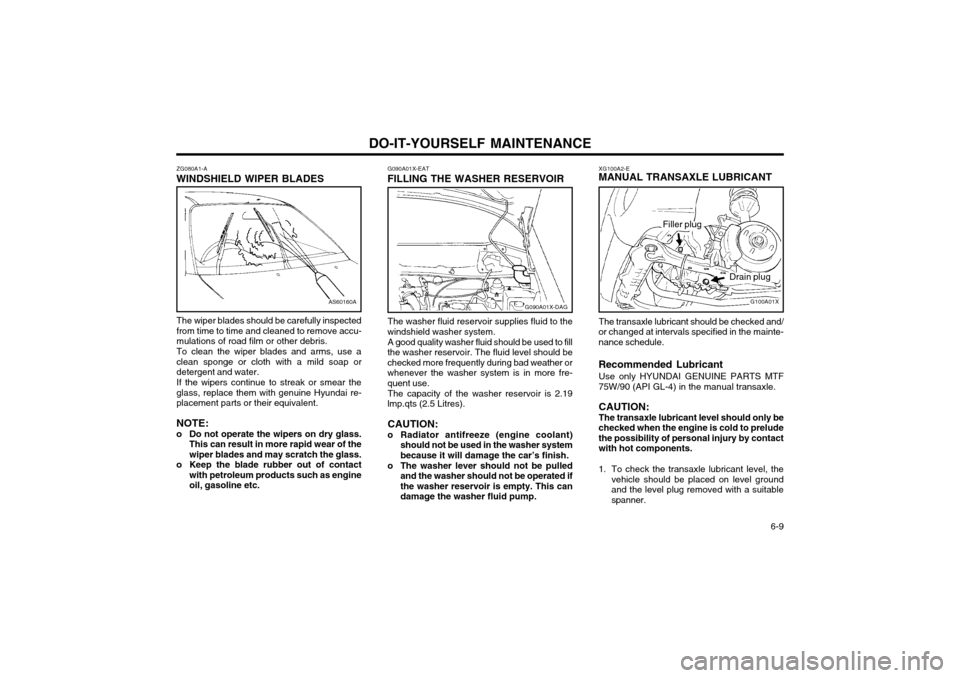
WINDSHIELD WIPER BLADES
The wiper blades should be carefully inspected from time to time and cleaned to remove accu-mulations of road film or other debris. To clean the wiper blades and arms, use a clean sponge or cloth with a mild soap ordetergent and water. If the wipers continue to streak or smear the glass, replace them with genuine Hyundai re-placement parts or their equivalent. NOTE:
o Do not operate the wipers on dry glass. This can result in more rapid wear of the wiper blades and may scratch the glass.
o Keep the blade rubber out of contact with petroleum products such as engineoil, gasoline etc.G090A01X-EAT
FILLING THE WASHER RESERVOIR
The washer fluid reservoir supplies fluid to the
windshield washer system.
A good quality washer fluid should be used to fill
the washer reservoir. The fluid level should be checked more frequently during bad weather orwhenever the washer system is in more fre-quent use.
The capacity of the washer reservoir is 2.19
lmp.qts (2.5 Litres).
CAUTION:
o Radiator antifreeze (engine coolant) should not be used in the washer systembecause it will damage the car’s finish.
o The washer lever should not be pulled and the washer should not be operated ifthe washer reservoir is empty. This can
damage the washer fluid pump. XG100A2-E
MANUAL TRANSAXLE LUBRICANT
G100A01X
Filler plug
Drain plug
The transaxle lubricant should be checked and/
or changed at intervals specified in the mainte- nance schedule. Recommended Lubricant
Use only HYUNDAI GENUINE PARTS MTF
75W/90 (API GL-4) in the manual transaxle.
CAUTION: The transaxle lubricant level should only be
checked when the engine is cold to preludethe possibility of personal injury by contactwith hot components.
1. To check the transaxle lubricant level, the vehicle should be placed on level ground and the level plug removed with a suitablespanner.
G090A01X-DAG