2002 Hyundai Atos ESP
[x] Cancel search: ESPPage 72 of 249

DRIVING YOUR HYUNDAI
DRIVING YOUR HYUNDAI DRIVING YOUR HYUNDAI
DRIVING YOUR HYUNDAI
DRIVING YOUR HYUNDAI
2- 9
resulting in the engine bucking. If this hap- pens, shift to a lower gear. Over-revving isracing the engine beyond its safe limit. Thiscan be avoided by shifting at the recom-mended speeds.
o Use your air conditioning sparingly. The air conditioning system is operated by enginepower so your fuel economy is reducedwhen you use it.
C150A01A-AAT SMOOTH CORNERING
SMOOTH CORNERING SMOOTH CORNERING
SMOOTH CORNERING
SMOOTH CORNERING
Avoid braking or gear changing in corners,
especially when roads are wet. Ideally, cornersshould always be taken under gentle accelera-tion. If you follow these suggestions, tire wearwill be held to a minimum.
C160A01A-AATWINTER DRIVING
WINTER DRIVING WINTER DRIVING
WINTER DRIVING
WINTER DRIVING
The more severe weather conditions of winter
result in greater wear and other problems. Tominimize the problems of winter driving, youshould follow these suggestions:
C160B01A-GATSnowy or Icy Conditions
Snowy or Icy Conditions Snowy or Icy Conditions
Snowy or Icy Conditions
Snowy or Icy Conditions
To drive your vehicle in deep snow, it may be
necessary to use snow tires or to install tirechains on your tires. If snow tires are needed,
it is necessary to select tires equivalent in size
and type to the original equipment tires.
o Be sure that the wheels are aligned correct-
ly. Improper alignment can result from hittingcurbs or driving too fast over irregular sur-faces. Poor alignment causes faster tirewear and may also result in other problemsas well as greater fuel consumption.
o Keep your car in good condition. For better fuel economy and reduced maintenancecosts, maintain your car in accordance withthe maintenance schedule in Section 5. Ifyou drive your car in severe conditions,more frequent maintenance is required (seeSection 5 for details).
o Keep your car clean. For maximum service, your Hyundai should be kept clean and freeof corrosive materials. It is especially impor-tant that mud, dirt, ice, etc. not be allowed toaccumulate on the underside of the car. Thisextra weight can result in increased fuelconsumption and also contribute to corro-sion.
o Travel lightly. Don't carry unnecessary weight in your car. Weight reduces fuel economy.
o Don't let the engine idle longer than neces- sary. If you are waiting (and not in traffic),turn off your engine and restart only whenyou're ready to go.
o Remember, your Hyundai does not require extended warm-up. As soon as the engine isrunning smoothly, you can drive away. Invery cold weather, however, give your en-gine a slightly longer warm-up period.
o Don't "lug" or "over-rev" the engine. Lugging is driving too slowly in too high a gear
C140A01A-AAT
DRIVING FOR ECONOMY
DRIVING FOR ECONOMY DRIVING FOR ECONOMY
DRIVING FOR ECONOMY
DRIVING FOR ECONOMY
You can save fuel and get more kilometers from
your car if you follow these suggestions:
o Drive smoothly. Accelerate at a moderate rate. Don't make "jack-rabbit" starts or full- throttle shifts and maintain a steady cruisingspeed. Don't race between stoplights. Try toadjust your speed to that of the other trafficso you don't have to change speeds unnec-essarily. Avoid heavy traffic whenever pos-sible. Always maintain a safe distance fromother vehicles so you can avoid unneces-sary braking. This also reduces brake wear.
o Drive at a moderate speed. The faster you drive, the more fuel your car uses. Driving ata moderate speed, especially on the high-way, is one of the most effective ways toreduce fuel consumption.
o Don't "ride" the brake or clutch pedal. This can increase fuel consumption and alsoincrease wear on these components. In ad-dition, driving with your foot resting on thebrake pedal may cause the brakes to over-heat, which reduces their effectiveness andmay lead to more serious consequences.
o Take care of your tires. Keep them inflated to the recommended pressure. Incorrect in-flation, either too much or too little, results inunnecessary tire wear. Check the tire pres-sures at least once a month.
Page 76 of 249
DRIVING YOUR HYUNDAI
DRIVING YOUR HYUNDAI DRIVING YOUR HYUNDAI
DRIVING YOUR HYUNDAI
DRIVING YOUR HYUNDAI
2- 13
4. To maintain engine braking efficiency andelectrical charging performance, do not use fifth gear (manual transaxle) or overdrive(automatic transaxle).
5. Always secure items in the trailer to prevent load shift while driving.
6. Check the condition and air pressure of all tires on the trailer and your car. Low tirepressure can seriously affect the handling.Also check the spare tire.
7. The vehicle/trailer combination is more af- fected by crosswind and buffeting. When being passed by a large vehicle, keep a constant speed and steer straight ahead.If there is too much wind buffeting slowdown to get out of the other vehicle's airturbulence.
8. When parking your car and trailer, especial- ly on a hill, be sure to follow all the normalprecautions. Turn your front wheel into thecurb, set the parking brake firmly, and putthe transaxle in 1st or Reverse (manual) orPark (automatic). In addition, place wheelchocks at each of the trailer's tires.
9. If the trailer has electric brakes, start your vehicle and trailer moving, and then applythe trailer brake controller by hand to besure the brakes are working. This lets youcheck your electrical connection at the sametime.
10. During your trip, check occasionally to be sure that the load is secure, and that thelights and any trailer brakes are still working.
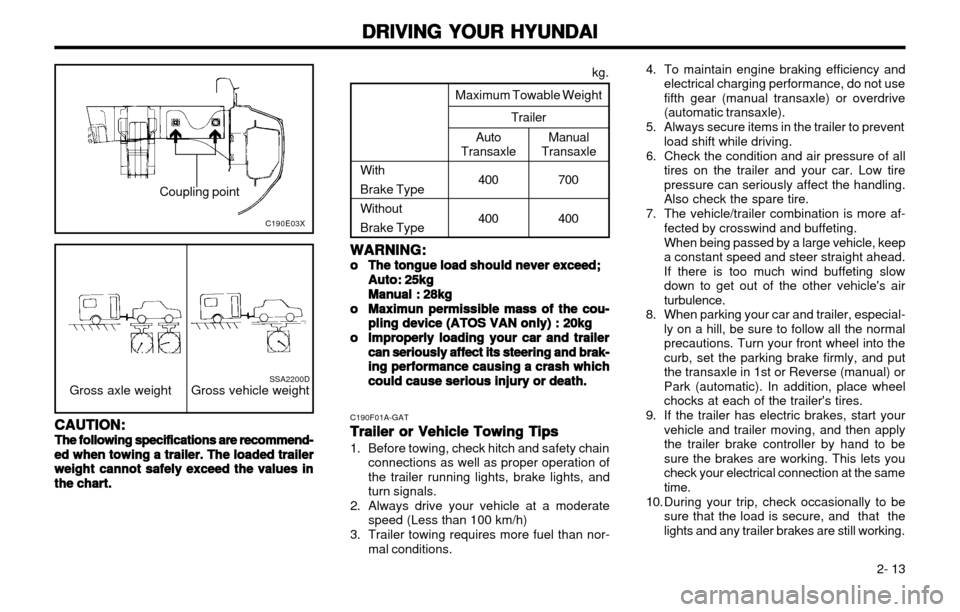
WARNING:
WARNING: WARNING:
WARNING:
WARNING:
oo
oo
o The tongue load should never exceed;
The tongue load should never exceed; The tongue load should never exceed;
The tongue load should never exceed;
The tongue load should never exceed;
Auto: 25kg
Auto: 25kg Auto: 25kg
Auto: 25kg
Auto: 25kg
Manual : 28kg
Manual : 28kg Manual : 28kg
Manual : 28kg
Manual : 28kg
oo
oo
o Maximun permissible mass of the cou-
Maximun permissible mass of the cou- Maximun permissible mass of the cou-
Maximun permissible mass of the cou-
Maximun permissible mass of the cou-
pling device (ATOS VAN only) : 20kg
pling device (ATOS VAN only) : 20kg pling device (ATOS VAN only) : 20kg
pling device (ATOS VAN only) : 20kg
pling device (ATOS VAN only) : 20kg
oo
oo
o Improperly loading your car and trailer
Improperly loading your car and trailer Improperly loading your car and trailer
Improperly loading your car and trailer
Improperly loading your car and trailer
can seriously affect its steering and brak-
can seriously affect its steering and brak- can seriously affect its steering and brak-
can seriously affect its steering and brak-
can seriously affect its steering and brak-
ing performance causing a crash which
ing performance causing a crash which ing performance causing a crash which
ing performance causing a crash which
ing performance causing a crash which
could cause serious injury or death.
could cause serious injury or death. could cause serious injury or death.
could cause serious injury or death.
could cause serious injury or death. kg.
Maximum Towable Weight Trailer
Manual
TransaxleAuto
Transaxle
With Brake TypeWithoutBrake Type 400 400
C190F01A-GAT
Trailer or Vehicle Towing Tips
Trailer or Vehicle Towing Tips Trailer or Vehicle Towing Tips
Trailer or Vehicle Towing Tips
Trailer or Vehicle Towing Tips
1. Before towing, check hitch and safety chain
connections as well as proper operation of the trailer running lights, brake lights, andturn signals.
2. Always drive your vehicle at a moderate speed (Less than 100 km/h)
3. Trailer towing requires more fuel than nor- mal conditions.
Gross axle weight Gross vehicle weightSSA2200D
CAUTION:
CAUTION: CAUTION:
CAUTION:
CAUTION:
The following specifications are recommend-
The following specifications are recommend- The following specifications are recommend-
The following specifications are recommend-
The following specifications are recommend- ed when towing a
ed when towing a ed when towing a
ed when towing a
ed when towing a trailer. The loaded trailer
trailer. The loaded trailer trailer. The loaded trailer
trailer. The loaded trailer
trailer. The loaded trailer
weight cannot safely exceed the values in
weight cannot safely exceed the values in weight cannot safely exceed the values in
weight cannot safely exceed the values in
weight cannot safely exceed the values in
the the
the the
the chart.
chart. chart.
chart.
chart. Coupling point
C190E03X
700 400
Page 80 of 249
WHAT TO DO IN AN EMERGENCY
WHAT TO DO IN AN EMERGENCY WHAT TO DO IN AN EMERGENCY
WHAT TO DO IN AN EMERGENCY
WHAT TO DO IN AN EMERGENCY
3-3
WARNING:
WARNING: WARNING:
WARNING:
WARNING:
While the engine is running, keep hands,
While the engine is running, keep hands, While the engine is running, keep hands,
While the engine is running, keep hands,
While the engine is running, keep hands, long hair
long hair long hair
long hair
long hair
and clothing away from moving
and clothing away from moving and clothing away from moving
and clothing away from moving
and clothing away from moving
parts such as the fan and drive belts to
parts such as the fan and drive belts to parts such as the fan and drive belts to
parts such as the fan and drive belts to
parts such as the fan and drive belts to
prevent
prevent prevent
prevent
prevent
injury.
injury. injury.
injury.
injury.
5. If the water pump drive belt is broken or engine coolant is leaking out, stop the en- gine immediately and call the nearestHyundai dealer for assistance.
WARNING:
WARNING: WARNING:
WARNING:
WARNING:
Do not remove the radiator cap when the
Do not remove the radiator cap when the Do not remove the radiator cap when the
Do not remove the radiator cap when the
Do not remove the radiator cap when the engine is hot. This may allow
engine is hot. This may allow engine is hot. This may allow
engine is hot. This may allow
engine is hot. This may allow coolant to be
coolant to be coolant to be
coolant to be
coolant to be
blown out of the opening and cause serious
blown out of the opening and cause serious blown out of the opening and cause serious
blown out of the opening and cause serious
blown out of the opening and cause serious
burns.
burns. burns.
burns.
burns.
6. If you cannot find the cause of the overheat-
ing, wait until the engine temperature has returned to normal. Then, if engine coolanthas been lost, carefully remove the radiator
cap and add engine coolant to bring the fluidlevel in the reservoir up to the halfway mark.
7. Proceed with caution, keeping alert for fur- ther signs of overheating. If overheating hap-pens again, call a Hyundai dealer for assis-tance.
CAUTION:
CAUTION: CAUTION:
CAUTION:
CAUTION:
Serious loss of engine coolant indicates
Serious loss of engine coolant indicates Serious loss of engine coolant indicates
Serious loss of engine coolant indicates
Serious loss of engine coolant indicates there is a leak in
there is a leak in there is a leak in
there is a leak in
there is a leak in the cooling system and this
the cooling system and this the cooling system and this
the cooling system and this
the cooling system and this
should be checked as soon as possible by a
should be checked as soon as possible by a should be checked as soon as possible by a
should be checked as soon as possible by a
should be checked as soon as possible by a
Hyundai
Hyundai Hyundai
Hyundai
Hyundai dealer.
dealer. dealer.
dealer.
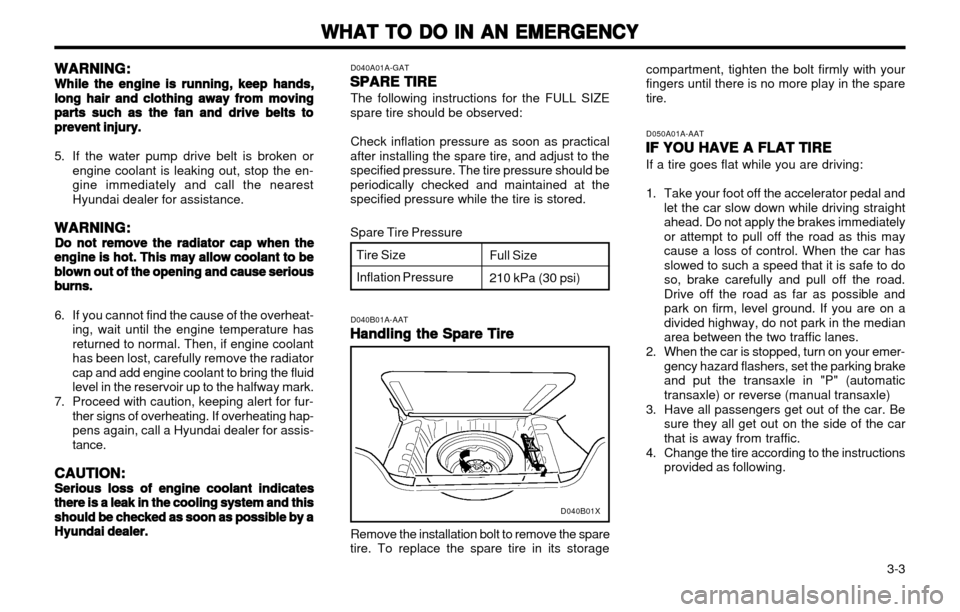
dealer. D040A01A-GAT
SPARE TIRE
SPARE TIRE SPARE TIRE
SPARE TIRE
SPARE TIRE
The following instructions for the FULL SIZE
spare tire should be observed:
Check inflation pressure as soon as practical
after installing the spare tire, and adjust to the specified pressure. The tire pressure should beperiodically checked and maintained at thespecified pressure while the tire is stored.
Tire Size Inflation Pressure Full Size 210 kPa (30 psi)
Spare Tire Pressure
D040B01A-AAT
Handling the Spare Tire
Handling the Spare Tire Handling the Spare Tire
Handling the Spare Tire
Handling the Spare Tire
Remove the installation bolt to remove the spare
tire. To replace the spare tire in its storage D050A01A-AAT
IF YOU HAVE A FLAT TIRE
IF YOU HAVE A FLAT TIRE IF YOU HAVE A FLAT TIRE
IF YOU HAVE A FLAT TIRE
IF YOU HAVE A FLAT TIRE If a tire goes flat while you are driving:
1. Take your foot off the accelerator pedal and
let the car slow down while driving straight ahead. Do not apply the brakes immediatelyor attempt to pull off the road as this may
cause a loss of control. When the car hasslowed to such a speed that it is safe to doso, brake carefully and pull off the road.Drive off the road as far as possible and
park on firm, level ground. If you are on adivided highway, do not park in the medianarea between the two traffic lanes.
2. When the car is stopped, turn on your emer- gency hazard flashers, set the parking brakeand put the transaxle in "P" (automatic
transaxle) or reverse (manual transaxle)
3. Have all passengers get out of the car. Be sure they all get out on the side of the carthat is away from traffic.
4. Change the tire according to the instructions provided as following.
compartment, tighten the bolt firmly with yourfingers until there is no more play in the sparetire.
D040B01X
Page 90 of 249
VEHICLE MAINTENANCE REQUIREMENTS
VEHICLE MAINTENANCE REQUIREMENTS VEHICLE MAINTENANCE REQUIREMENTS
VEHICLE MAINTENANCE REQUIREMENTS
VEHICLE MAINTENANCE REQUIREMENTS
5-1
5.5.
5.5.
5.
VEHICLE MAINTE-
VEHICLE MAINTE- VEHICLE MAINTE-
VEHICLE MAINTE-
VEHICLE MAINTE-
NANCE REQ
NANCE REQ NANCE REQ
NANCE REQ
NANCE REQ
UIRE-
UIRE- UIRE-
UIRE-
UIRE-
MENTS
MENTS MENTS
MENTS
MENTS
F010A01A-GAT MAINTENANCE INTERVALS
MAINTENANCE INTERVALS MAINTENANCE INTERVALS
MAINTENANCE INTERVALS
MAINTENANCE INTERVALS
Service requirements
Service requirements Service requirements
Service requirements
Service requirements
To assure that you receive the greatest number
of kilometers of satisfying operation from your Hyundai, certain maintenance procedures must
be performed. Although careful design and en-
gineering have reduced these to a minimum,those that are required are of the utmost impor-tance. It is your responsibility to have these mainte-
nance procedures performed to comply with theterms of the warranties covering your newHyundai. The Service Passport supplied withyour new vehicle provides further information
about these warranties. F010B01A-AAT
Maintenance Requirements
Maintenance Requirements Maintenance Requirements
Maintenance Requirements
Maintenance Requirements
The maintenance required for your Hyundai
can be divided into three main areas:
o Specified scheduled procedures
o General everyday checks
o Do-it-yourself maintenance F010C01A-GAT
Specified Scheduled Procedures
Specified Scheduled Procedures Specified Scheduled Procedures
Specified Scheduled Procedures
Specified Scheduled Procedures
These are the procedures such as inspections,
adjustments and replacements that are listed in the maintenance charts starting on page 5-2.These procedures must be performed at theintervals shown in the maintenance schedule to
assure that your warranty remains in effect.Although it is strongly recommended that they
be performed by the factory-trained or distribu-tor-trained technicians at your Hyundai dealer,
these procedures may be performed at any
qualified service facility.
It is suggested that genuine Hyundai service
parts be used for any required repairs or re-placements. Other parts of equivalent quality
such as engine oil, engine coolant, manual orauto transaxle oil, brake fluid and so on which
are not supplied by Hyundai Motor Company or
its distributor may be used without affectingyour warranty coverage but you should always
be sure these are equivalent to the quality of theoriginal Hyundai parts. Your Service Passport
provides further information about your warran-ty coverage. F010E01A-AAT
Do-It-Yourself Maintenance
Do-It-Yourself Maintenance Do-It-Yourself Maintenance
Do-It-Yourself Maintenance
Do-It-Yourself Maintenance
If you are mechanically inclined, own a few
tools that are required and want to take the timeto do so, you can inspect and service a number
of items. For more information about doing ityourself, see Section 6.
F010F01A-AATA Few Tips
A Few Tips A Few Tips
A Few Tips
A Few Tips
o Whenever you have your Hyundai serviced,
keep copies of the service records in your
glovebox. This will help ensure that you candocument that the required procedures have
been performed to keep your warranties ineffect. This is especially important when
service is not performed by an authorizedHyundai dealer.
o If you choose to do your own maintenance and repairs, you may find it helpful to havean official Hyundai Shop Manual. A copy of
this publication may be purchased at yourHyundai dealer's parts department.
F020A02X-GAT SCHEDULED MAINTENANCE RE-
SCHEDULED MAINTENANCE RE- SCHEDULED MAINTENANCE RE-
SCHEDULED MAINTENANCE RE-
SCHEDULED MAINTENANCE RE-
QUIREMENTS
QUIREMENTS QUIREMENTS
QUIREMENTS
QUIREMENTS
Inspection should be performed any time a
malfunction is experienced or suspected. Re-ceipts for all emission control system services
should be retained to demonstrate compliancewith conditions of the emissions system war-ranty. For severe usage maintenance require-ments, see page 5-4 of this section.
F010D01A-AAT
General Checks
General Checks General Checks
General Checks
General Checks
These are the regular checks you should per-
form when you drive your Hyundai or you fill thefuel tank. A list of these items will be found onpage 6-2.
55
55
5
Page 120 of 249
CONSUMER INFORMATION
CONSUMER INFORMATION CONSUMER INFORMATION
CONSUMER INFORMATION
CONSUMER INFORMATION
8-2
o Lower-than-recommended tire pressures
cause uneven tread wear and poor han- dling.
o Higher-than-recommended tire pressures increase the chance of damage from im-pacts and cause uneven tread wear.
CAUTION:
CAUTION: CAUTION:
CAUTION:
CAUTION:
Always observe the following:
Always observe the following: Always observe the following:
Always observe the following:
Always observe the following:
oo
oo
o Check pressures when the tires are cold.
Check pressures when the tires are cold. Check pressures when the tires are cold.
Check pressures when the tires are cold.
Check pressures when the tires are cold.
That is, after the car has been parked for
That is, after the car has been parked for That is, after the car has been parked for
That is, after the car has been parked for
That is, after the car has been parked for
at least three hours and hasn't been driv-
at least three hours and hasn't been driv- at least three hours and hasn't been driv-
at least three hours and hasn't been driv-
at least three hours and hasn't been driv-
en more than 1.6 km or one mile since
en more than 1.6 km or one mile since en more than 1.6 km or one mile since
en more than 1.6 km or one mile since
en more than 1.6 km or one mile since
starting up.
starting up. starting up.
starting up.
starting up.
oo
oo
o Check the pressure of your spare tire
Check the pressure of your spare tire Check the pressure of your spare tire
Check the pressure of your spare tire
Check the pressure of your spare tire
each time you check the pressure of
each time you check the pressure of each time you check the pressure of
each time you check the pressure of
each time you check the pressure of
other tires.
other tires. other tires.
other tires.
other tires.
oo
oo
o Never overload your car. Be especially
Never overload your car. Be especially Never overload your car. Be especially
Never overload your car. Be especially
Never overload your car. Be especially
careful about overloading if you equip
careful about overloading if you equip careful about overloading if you equip
careful about overloading if you equip
careful about overloading if you equip
your car with a luggage rack or car top
your car with a luggage rack or car top your car with a luggage rack or car top
your car with a luggage rack or car top
your car with a luggage rack or car top
carrier.
carrier. carrier.
carrier.
carrier. I040A01A-GAT
SNOW TIRES
SNOW TIRES SNOW TIRES
SNOW TIRES
SNOW TIRES
If you equip your car with snow tires, they
should be the same size and have the sameload capacity as the original tires. Snow tiresshould be installed on all four wheels; other-wise, poor handling may result.
Snow tires should carry 28 kPa (4 psi) more air
pressure than the pressure recommended forthe standard tires on the tire label on the driverside center pillar outer panel, or up to themaximum pressure shown on the tire sidewallwhichever is less.
Do not drive faster than the speed limit when
your car is equipped with snow tires. I050A01X-GAT
TIRE CHAINS
TIRE CHAINS TIRE CHAINS
TIRE CHAINS
TIRE CHAINS Tire chains, if necessary, should be installed on the front wheels. Be sure that the chains are theproper size and that they are installed in accor-dance with the manufacturer's instructions. To minimize tire and chain wear, do not con- tinue to use tire chains when they are no longerneeded.
WARNING:
WARNING: WARNING:
WARNING:
WARNING:
When driving on roads covered with snow
When driving on roads covered with snow When driving on roads covered with snow
When driving on roads covered with snow
When driving on roads covered with snow
or ice, drive at less
or ice, drive at less or ice, drive at less
or ice, drive at less
or ice, drive at less than 30 km/h (20 mph).
than 30 km/h (20 mph). than 30 km/h (20 mph).
than 30 km/h (20 mph).
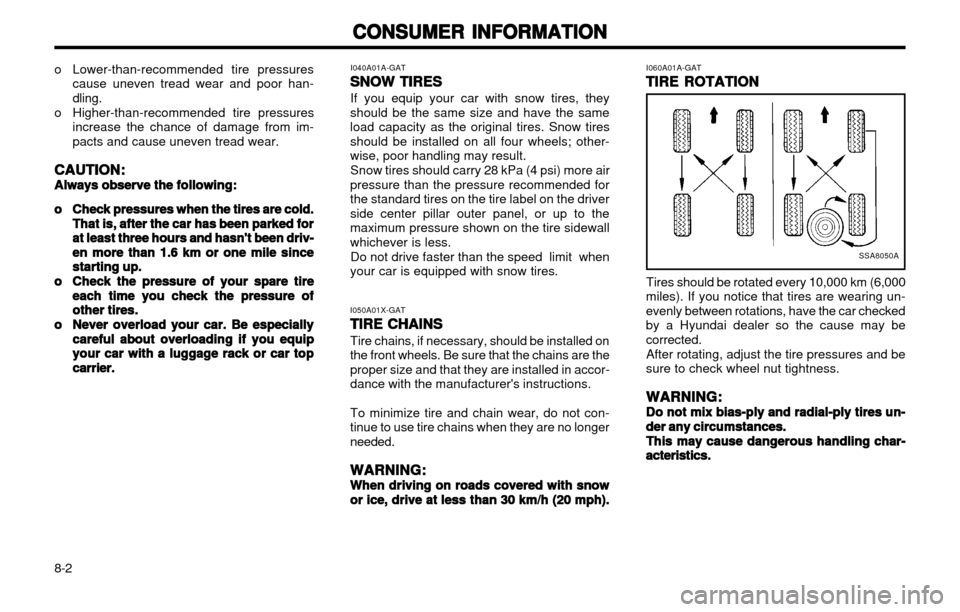
than 30 km/h (20 mph). I060A01A-GAT
TIRE ROTATION
TIRE ROTATION TIRE ROTATION
TIRE ROTATION
TIRE ROTATION
SSA8050A
Tires should be rotated every 10,000 km (6,000
miles). If you notice that tires are wearing un- evenly between rotations, have the car checkedby a Hyundai dealer so the cause may becorrected.
After rotating, adjust the tire pressures and be
sure to check wheel nut tightness.
WARNING:
WARNING: WARNING:
WARNING:
WARNING:
Do not mix bias-ply and radial-ply tires un-
Do not mix bias-ply and radial-ply tires un- Do not mix bias-ply and radial-ply tires un-
Do not mix bias-ply and radial-ply tires un-
Do not mix bias-ply and radial-ply tires un- der any circumstances.
der any circumstances. der any circumstances.
der any circumstances.
der any circumstances.
This may cause dangerous handling char-
This may cause dangerous handling char- This may cause dangerous handling char-
This may cause dangerous handling char-
This may cause dangerous handling char-acteristics.
acteristics. acteristics.
acteristics.
acteristics.
Page 131 of 249
XV020A1-E
OWNER’S MANUAL OperationMaintenanceSpecifications
The information in this Owner’s Manual is current at the time of publication. However, the right to amend specifications without notice or obligation to incorporate such amendments into vehicles already produced is reserved. This manual applies to all markets and includes descriptions and explanations of optional as well as standard equipment. As a result,
some of the equipment operating descriptions referred to may not apply to the particular vehicle with which this manual is supp lied.
Please refer to the nearest franchised Hyundai dealer for information regarding current standard and optional equipment levels. A030A02X
Page 132 of 249
A020A01A-EATResponsibilty For Maintenance
It is the responsibility of the vehicle owner/driver to ensure that all routine maintenance services are undertaken in line with the recommendations specifiedin Section 5 of this manual. In addition, in order to ensure continued validity ofthe new vehicle warranty and safe operation of the vehicle, non scheduledmaintenance/running repairs should be undertaken at the earliest availableopportunity. Under severe operating conditions, more frequent maintenance isrequired. Details of the maintenance schedule for such conditions are also givenin section 5.It is recommended that all maintenance operations and repairs are entrusted toa franchised Hyundai dealer to ensure that the latest repair methods, specializedtooling and genuine Hyundai parts are used to ensure the continued reliabilityand safety of the vehicle.
Page 138 of 249
FEATURES OF YOUR HYUNDAI 1-1
ZB000A1-A
1. FEATURES OF
YOUR HYUNDAI cised when charging the vehicle tank from jerry cans or by means of a funnel that the fuel beingused is unleaded.
The use of leaded fuel in this vehicle will result
in irreversible pollution of the catalyst element.Such pollution will prevent correct operation ofthe catalyst and give rise to increased operat-ing temperatures leading to the catalyst ele-ment melting and restricting the exhaust flowalong with an increase in exhaust emissionlevels.
CAUTION: The vehicle warranty will not extend to dam-
age arising from the use of incorrect fuels.
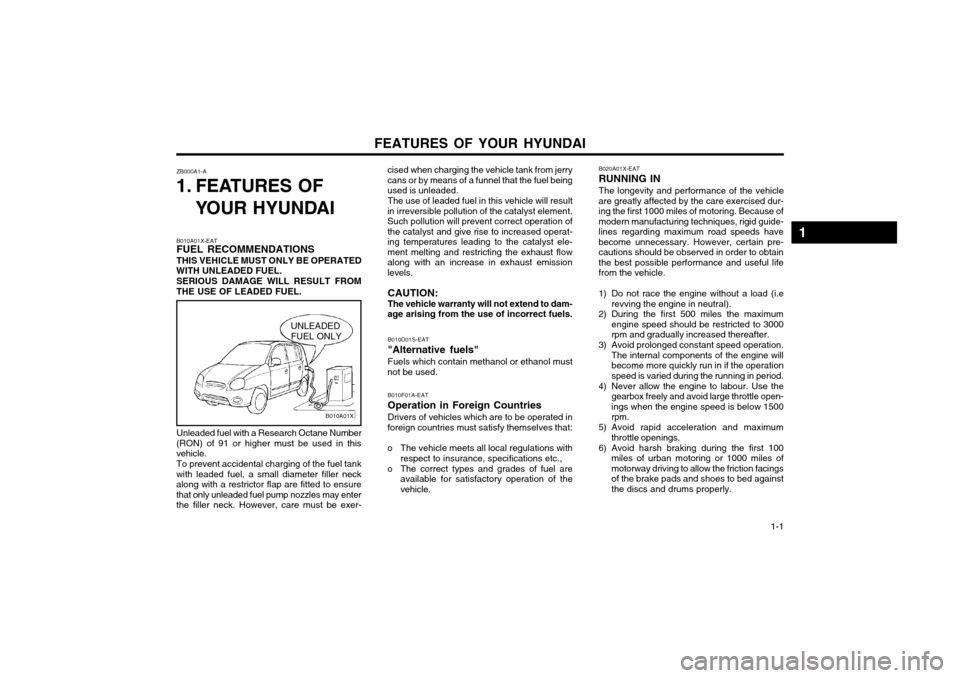
Unleaded fuel with a Research Octane Number
(RON) of 91 or higher must be used in this vehicle.
To prevent accidental charging of the fuel tank
with leaded fuel, a small diameter filler neckalong with a restrictor flap are fitted to ensurethat only unleaded fuel pump nozzles may enterthe filler neck. However, care must be exer-
B010A01X
UNLEADED FUEL ONLY
B010A01X-EAT FUEL RECOMMENDATIONS THIS VEHICLE MUST ONLY BE OPERATED
WITH UNLEADED FUEL.
SERIOUS DAMAGE WILL RESULT FROM
THE USE OF LEADED FUEL. B020A01X-EAT RUNNING INThe longevity and performance of the vehicle
are greatly affected by the care exercised dur- ing the first 1000 miles of motoring. Because ofmodern manufacturing techniques, rigid guide-lines regarding maximum road speeds havebecome unnecessary. However, certain pre-cautions should be observed in order to obtainthe best possible performance and useful lifefrom the vehicle.
1) Do not race the engine without a load (i.e revving the engine in neutral).
2) During the first 500 miles the maximum engine speed should be restricted to 3000 rpm and gradually increased thereafter.
3) Avoid prolonged constant speed operation. The internal components of the engine willbecome more quickly run in if the operationspeed is varied during the running in period.
4) Never allow the engine to labour. Use the gearbox freely and avoid large throttle open-ings when the engine speed is below 1500rpm.
5) Avoid rapid acceleration and maximum throttle openings.
6) Avoid harsh braking during the first 100 miles of urban motoring or 1000 miles ofmotorway driving to allow the friction facingsof the brake pads and shoes to bed againstthe discs and drums properly.
B010D01S-EAT "Alternative fuels"Fuels which contain methanol or ethanol must
not be used.
B010F01A-EATOperation in Foreign CountriesDrivers of vehicles which are to be operated in
foreign countries must satisfy themselves that:
o The vehicle meets all local regulations with respect to insurance, specifications etc.,
o The correct types and grades of fuel are available for satisfactory operation of the vehicle.
1