Page 193 of 264

A typical paint sealant lasts approximately six
months to a year, depending on local weather
conditions and the cleaning soap that is used in
washing the vehicle.
Do not use a wax that beads excessively.
Do not allow paint sealant to come in contact
with any non-body (low-gloss black) colored
trim, such as grained door handles, roof racks,
bumpers, side moldings, mirror housings or the
windshield cowl area. The paint sealant will
ªgrayº or stain the parts over time.
REPAIRING PAINT CHIPS
Remove particles such as bird droppings, tree sap,
insect deposits, tar spots, road salt and industrial
fallout before repairing paint chips.
Minor scratches or paint damage from road debris
may be repaired using the Ultra Touch Prep and
Finishing Kit (F7AZ-19K507±BA), which is available
at your authorized Ford, Lincoln or Mercury dealer.
This kit contains:
²Lacquer Touch-Up Paint (ALBZ-19500±XXXXA)
²Exterior Acrylic Spray Lacquer
(ALAZ-19500±XXXXA)
Please note that the part numbers (shown as XXXX
above) will vary with your vehicle's specific coloring.
Carefully observe the application instructions
on the products.
CLEANING THE WHEEL RIMS AND COVERS
Aluminum wheel rims or covers are coated with
a clearcoat paint finish.
Some automatic car washes may cause damage to
the finish on your wheel rims or covers.
Chemical-strength cleaners, or cleaning chemicals, in
combination with brush agitation to remove brake
dust and dirt, could wear away the clearcoat finish
over time.
Cleaning
193
Page 201 of 264

SERVICE RECOMMENDATIONS
To help you service your vehicle:
²We highlight do-it-yourself items in the engine
compartment for easy location.
²We provide a scheduled maintenance guide which
makes tracking routine service easy.
If your vehicle requires professional service, your
dealership can provide the necessary parts and
service. Check yourWarranty Guideto find out
which parts and services are covered.
Use only recommended fuels, lubricants, fluids and
service parts conforming to specifications. Motorcraft
parts are designed and built to provide the best
performance in your vehicle.
PRECAUTIONS WHEN SERVICING YOUR
VEHICLE
Be especially careful when inspecting or servicing
your vehicle.
²Do not work on a hot engine.
²When the engine is running, keep loose clothing,
jewelry or long hair away from moving parts.
²Do not work on a vehicle with the engine running
in an enclosed space, unless you are sure you
have enough ventilation.
²Keep all lit cigarettes, open flames and other lit
material away from the battery and all fuel related
parts.
If you disconnect the battery, the engine must
ªrelearnº its idle conditions before your vehicle will
drive properly, as explained in theBatterysection in
this chapter.
Working with the engine off
²Automatic transmission:
1. Set the parking brake and ensure the gearshift is
securely latched in P (Park).
Maintenance and Specifications
201
Page 202 of 264
2. Turn off the engine and remove the key.
3. Block the wheels to prevent the vehicle from
moving unexpectedly.
²Manual transmission:
1. Set the parking brake.
2. Depress the clutch and place the gearshift in 1
(First).
3. Turn off the engine and remove the key.
4. Block the wheels to prevent the vehicle from
moving unexpectedly.
Working with the engine on
²Automatic transmission:
1. Set the parking brake and ensure the gearshift is
securely latched in P (Park).
2. Block the wheels to prevent the vehicle from
moving unexpectedly.
Note:Do not start your engine with the air cleaner
removed and do not remove it while the engine is
running.
²Manual transmission:
1. Set the parking brake, depress the clutch and
place the gearshift in neutral.
2. Block the wheels to prevent the vehicle from
moving unexpectedly.
Note:Do not start your engine with the air cleaner
removed and do not remove it while the engine is
running.
The cooling fan is automatic and may come
on at any time. Always disconnect the
negative terminal of the battery before working
near the fan.
Maintenance and Specifications
202
Page 204 of 264
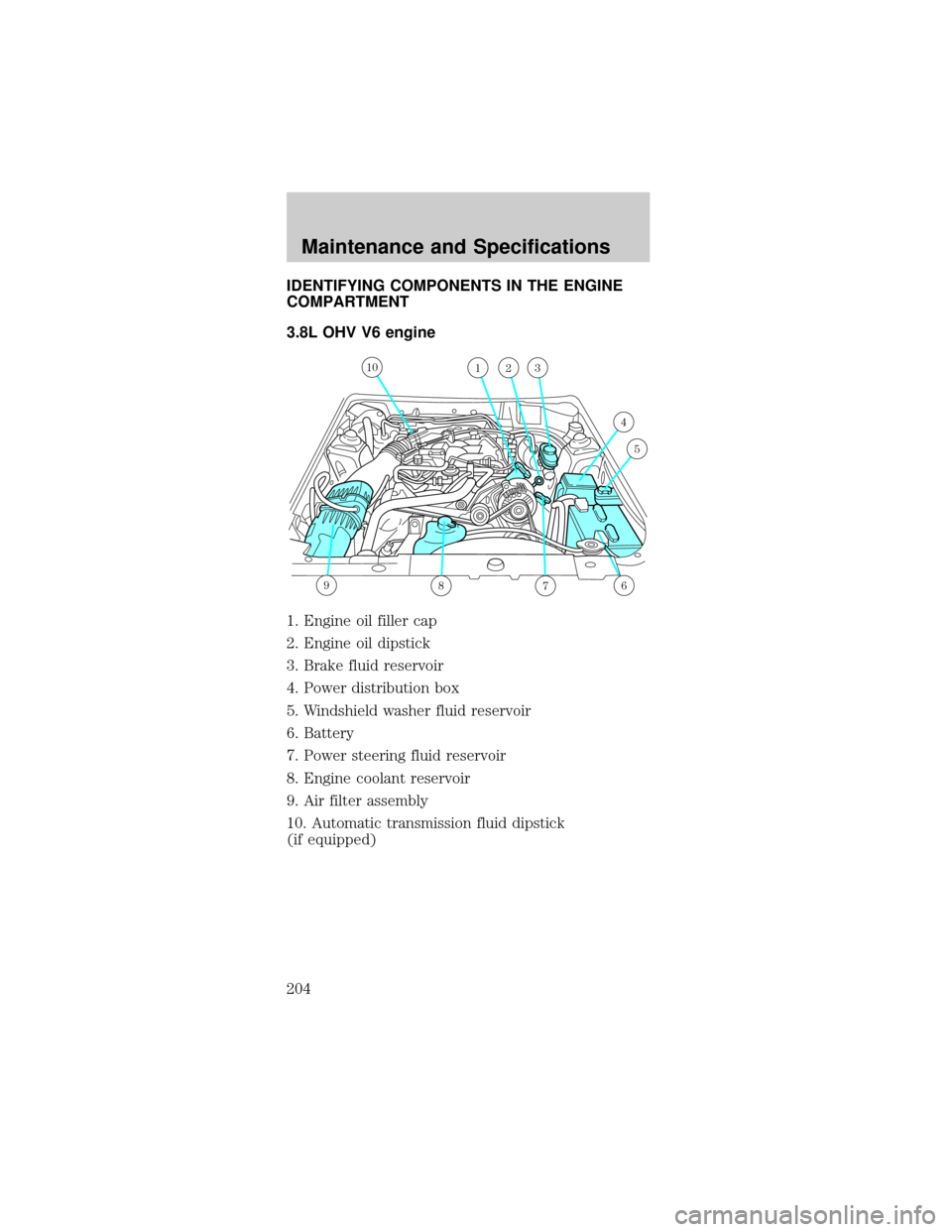
IDENTIFYING COMPONENTS IN THE ENGINE
COMPARTMENT
3.8L OHV V6 engine
1. Engine oil filler cap
2. Engine oil dipstick
3. Brake fluid reservoir
4. Power distribution box
5. Windshield washer fluid reservoir
6. Battery
7. Power steering fluid reservoir
8. Engine coolant reservoir
9. Air filter assembly
10. Automatic transmission fluid dipstick
(if equipped)
6
1023
4
5
789
1
Maintenance and Specifications
204
Page 205 of 264
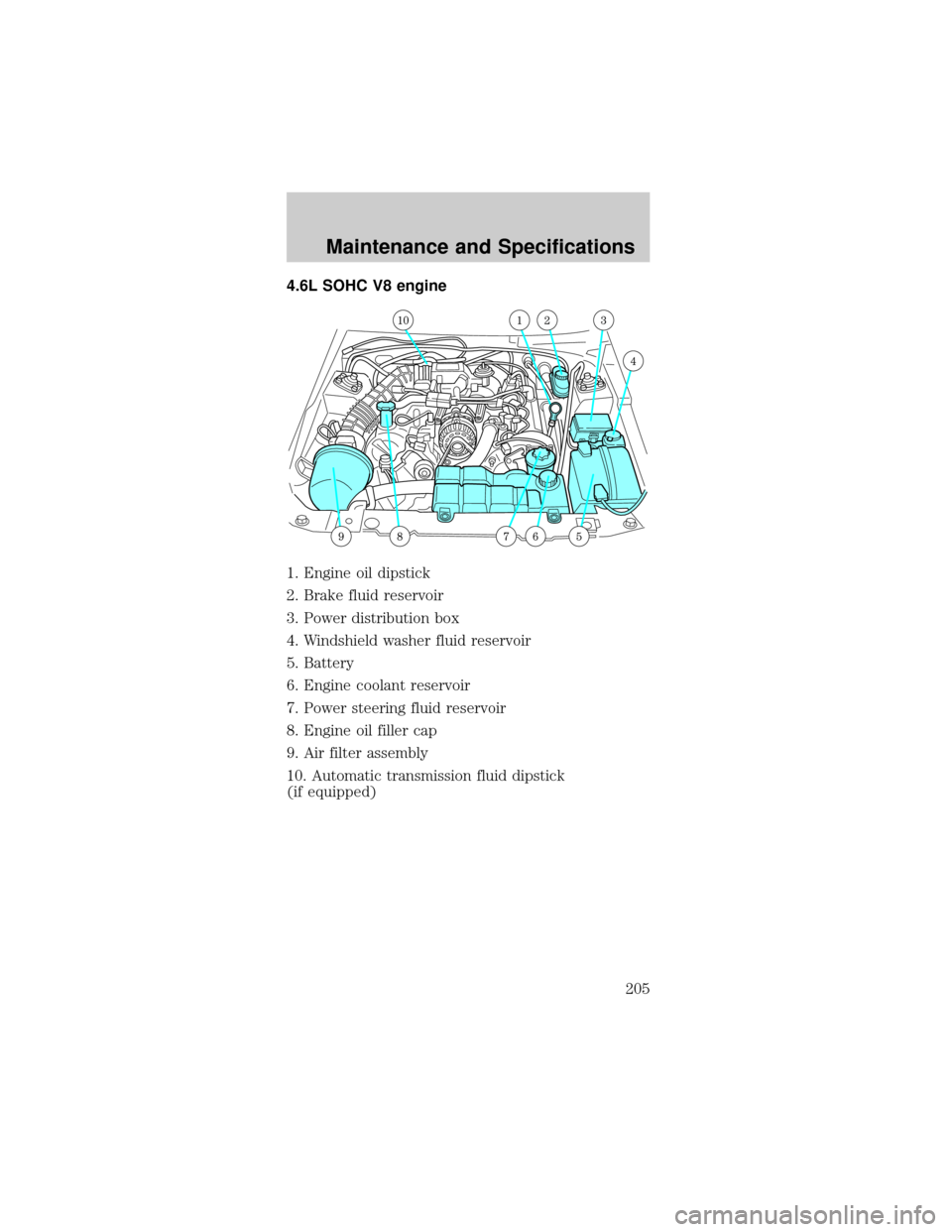
4.6L SOHC V8 engine
1. Engine oil dipstick
2. Brake fluid reservoir
3. Power distribution box
4. Windshield washer fluid reservoir
5. Battery
6. Engine coolant reservoir
7. Power steering fluid reservoir
8. Engine oil filler cap
9. Air filter assembly
10. Automatic transmission fluid dipstick
(if equipped)
Maintenance and Specifications
205
Page 206 of 264

WINDSHIELD WASHER FLUID
Washer fluid
Check the washer fluid
whenever you stop for
fuel. The reservoir is
highlighted with a
symbol.
If the level is low, add
enough fluid to fill the
reservoir. In very cold
weather, do not fill the
reservoir all the way.
Only use a washer fluid that meets Ford
specification ESR-M17P5±A. Refer toLubricant
specificationsin this chapter.
State or local regulations on volatile organic
compounds may restrict the use of methanol, a
common windshield washer antifreeze additive.
Washer fluids containing non-methanol antifreeze
agents should be used only if they provide cold
weather protection without damaging the vehicle's
paint finish, wiper blades or washer system.
Note:Do not put washer fluid in the engine coolant
reservoir. Washer fluid placed in the cooling system
may harm engine and cooling system components.
ENGINE OIL
Checking the engine oil
Refer to the scheduled maintenance guide for the
appropriate intervals for checking the engine oil.
1. Make sure the vehicle is on level ground.
2. Turn the engine off and wait 5 to 10 minutes for
the oil to drain into the oil pan.
3. Set the parking brake and ensure the gearshift is
securely latched in P (Park) (automatic
transmissions) or 1 (First) (manual transmissions).
Maintenance and Specifications
206
Page 212 of 264

To begin this process:
1. With the vehicle at a complete stop, set the
parking brake.
2. Put the gearshift in P (Park) (automatic
transmission) or the neutral position (manual
transmission), turn off all accessories and start the
engine.
3. Run the engine until it reaches normal operating
temperature.
4. Allow the engine to idle for at least one minute.
5. Turn the A/C on and allow the engine to idle for
at least one minute.
6. Drive the vehicle to complete the relearning
process.
²The vehicle may need to be driven 16 km
(10 miles) or more to relearn the idle and fuel
trim strategy.
²If you do not allow the engine to relearn its
idle trim, the idle quality of your vehicle may
be adversely affected until the idle trim is
eventually relearned.
When the battery is disconnected or a new battery
installed, the transmission must relearn its adaptive
strategy. As a result of this, the transmission may
shift firmly. This operation is considered normal and
will not affect function or durability of the
transmission. Over time the adaptive learning
process will fully update transmission operation to
its optimum shift feel.
If the battery has been disconnected or a new
battery has been installed, the clock and the preset
radio stations must be reset once the battery is
reconnected.
Maintenance and Specifications
212
Page 230 of 264

²Anticipate stopping; slowing down may eliminate
the need to stop.
²Sudden or hard accelerations may reduce fuel
economy.
²Slow down gradually.
²Driving at reasonable speeds (traveling at 88 km/h
[55 mph] uses 15% less fuel than traveling at
105 km/h [65 mph]).
²Revving the engine before turning it off may
reduce fuel economy.
²Using the air conditioner or defroster may reduce
fuel economy.
²You may want to turn off the speed control in
hilly terrain if unnecessary shifting between third
and fourth gear occurs. Unnecessary shifting of
this type could result in reduced fuel economy.
²Warming up a vehicle on cold mornings is not
required and may reduce fuel economy.
²Resting your foot on the brake pedal while driving
may reduce fuel economy.
²Combine errands and minimize stop-and-go
driving.
Maintenance
²Keep tires properly inflated and use only
recommended size.
²Operating a vehicle with the wheels out of
alignment will reduce fuel economy.
²Use recommended engine oil. Refer toLubricant
specificationsin this chapter.
²Perform all regularly scheduled maintenance
items. Follow the recommended maintenance
schedule and owner maintenance checks found in
your vehicle scheduled maintenance guide.
Maintenance and Specifications
230