Page 145 of 264

stopping distance. Always leave enough room
between your vehicle and the vehicle in front of
you to stop.
²We recommend that you familiarize yourself with
this braking technique. However, avoid taking any
unnecessary risks.
Hydraulic brake booster system (Hydroboost)
The Hydroboost system receives fluid pressure from
the power steering pump to provide power assist
during braking.
The sound of the pump operating may be heard by
the driver, but this is a normal characteristic of the
system.
For Hydroboost-equipped vehicles operating under
normal conditions, the noise of the fluid flowing
through the booster may be heard whenever the
brake is applied. This condition is normal. Vehicle
service is not required.
If braking performance or pedal response becomes
very poor, even when the pedal is strongly
depressed, it may indicate the presence of air in the
hydraulic system or leakage of fluid. Stop the vehicle
safely as soon as possible and seek service
immediately.
TRACTION CONTROLY
Your vehicle may be equipped with the optional
Traction Controlysystem. This system helps you
maintain the stability and steerability of your
vehicle. It is especially useful on slippery road
surfaces. The system operates by detecting and
controlling wheel spin. The system borrows many of
the electronic and mechanical elements already
present in the anti-lock braking system (ABS).
Wheel-speed sensors allow excess rear wheel spin to
be detected by the Traction Controlyportion of the
ABS computer. Any excessive wheel spin is
controlled by automatically applying and releasing
the rear brakes in conjunction with engine torque
Driving
145
Page 148 of 264

To reduce the risk of injury, never run the
engine with one wheel off the ground, such
as when changing a tire.
AUTOMATIC TRANSMISSION OPERATION
(IF EQUIPPED)
Brake-shift interlock
This vehicle is equipped with a brake-shift interlock
feature that prevents the gearshift lever from being
moved from P (Park) when the ignition is in the ON
position unless brake pedal is depressed.
If you cannot move the gearshift lever out of P
(Park) with ignition in the ON position and the
brake pedal depressed:
1. Apply the parking brake, turn ignition key to
LOCK, then remove the key.
2. Insert the key and turn it to OFF.Apply the
brake pedal and shift to N (Neutral).
In the ignition OFF position, the automatic
transmission shift lever can be moved from
the P (Park) position without the brake pedal
depressed. To avoid unwanted vehicle movement,
always set the parking brake.
3. Start the vehicle.
If it is necessary to use the above procedure to
move the gearshift lever, it is possible that a fuse
has blown or the vehicle's brakelamps are not
operating properly. Refer toFuses and relaysin the
Roadside emergencieschapter.
Do not drive your vehicle until you verify
that the brakelamps are working.
Driving
148
Page 149 of 264

If your vehicle gets stuck in mud or snow it may be
rocked out by shifting from forward and reverse
gears, stopping between shifts, in a steady pattern.
Press lightly on the accelerator in each gear.
Do not rock the vehicle if the engine is not at
normal operating temperature or damage to
the transmission may occur.
Do not rock the vehicle for more than a few
minutes or damage to the transmission and
tires may occur or the engine may overheat.
Always set the parking brake fully and make
sure the gearshift is latched in P (Park).
Turn the ignition to the LOCK position and remove
the key whenever you leave your vehicle.
If the parking brake is fully released, but the
brake warning lamp remains illuminated, the
brakes may not be working properly. See your
dealer or a qualified service technician.
Driving with an automatic overdrive
transmission with console gearshift and O/D off
switch
Your automatic
overdrive transmission
provides fully
automatic operation in
either D (Overdrive) or
with the O/D OFF
switch depressed.
Driving with the
gearshift lever in D
(Overdrive) gives the
best fuel economy for
normal driving
conditions. For manual control, start in 1 (First) and
then shift manually.
Driving
149
Page 150 of 264
Driving with a 4±speed automatic transmission
(if equipped)
Use the following
procedure to put your
vehicle in gear.
1. Start the engine.
2. Depress and hold
the brake pedal.
3. Push and hold the
thumb button.
4. Move gearshift lever
out of P (Park).
Hold the brake pedal down while you move
the gearshift lever from P (Park) to another
position. If you do not hold the brake pedal down,
your vehicle may move unexpectedly and injure
someone.
Understanding gearshift positions
P (Park)
Always come to a
complete stop before
shifting into P (Park).
Make sure the gearshift
lever is securely
latched in P (Park).
This position locks the
transmission and
prevents the rear
wheels from turning.
Always set the parking brake fully and make
sure the gearshift lever is latched in P
(Park). Turn off the ignition whenever you leave
your vehicle.
Driving
150
Page 151 of 264
R (Reverse)
With the gearshift lever
in R (Reverse), the
vehicle will move
backward. Always come
to a complete stop
before shifting into and
out of R (Reverse).
N (Neutral)
With the gearshift lever
in N (Neutral), the
vehicle can be started
and is free to roll. Hold
the brake pedal down
while in this gear.
(Overdrive)
The normal driving
position for the best
fuel economy.
Transmission operates
in gears one through
four.
Driving
151
Page 154 of 264
MANUAL TRANSMISSION OPERATION
(IF EQUIPPED)
Using the clutch
Vehicles equipped with a manual transmission have a
starter interlock that prevents cranking the engine
unless the clutch pedal is fully depressed.
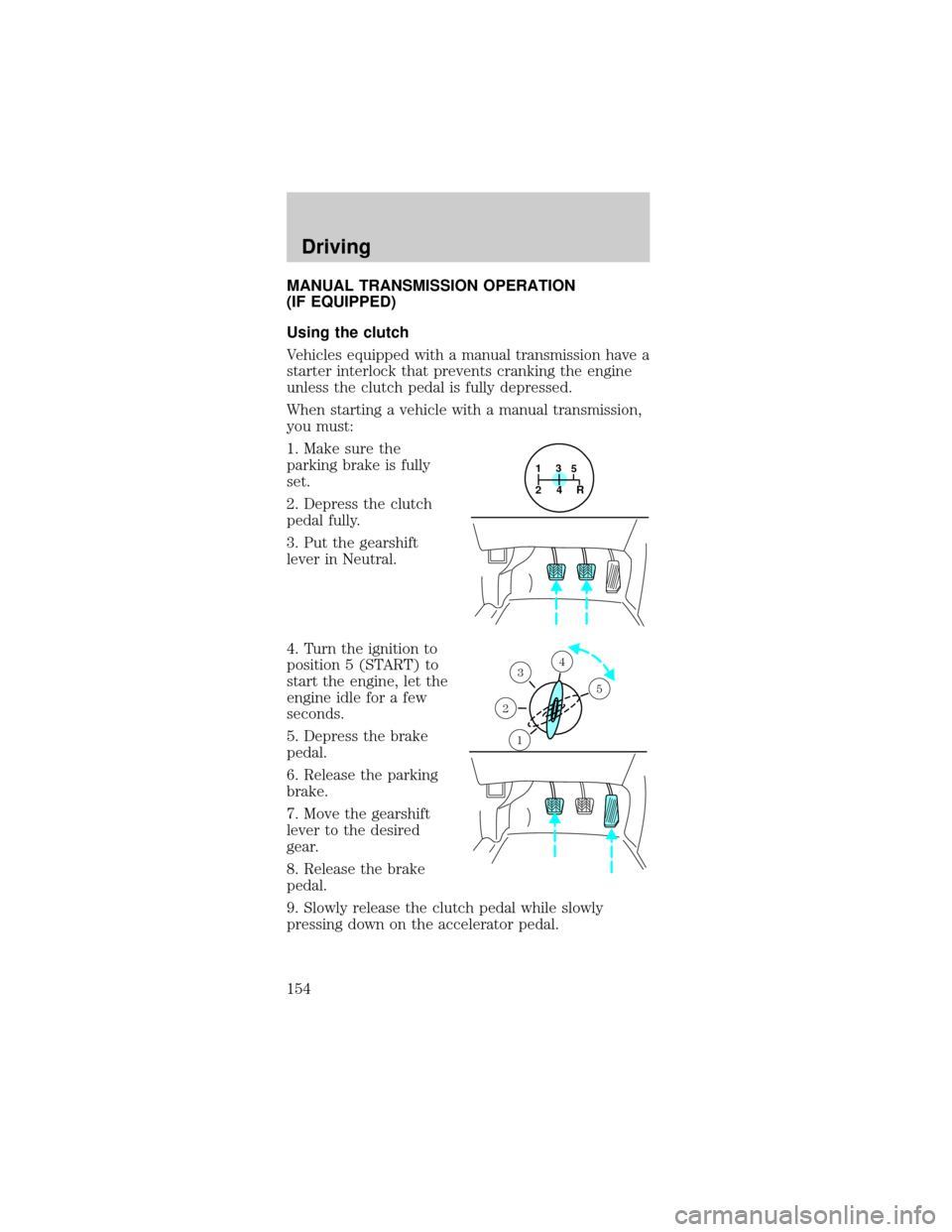
When starting a vehicle with a manual transmission,
you must:
1. Make sure the
parking brake is fully
set.
2. Depress the clutch
pedal fully.
3. Put the gearshift
lever in Neutral.
4. Turn the ignition to
position 5 (START) to
start the engine, let the
engine idle for a few
seconds.
5. Depress the brake
pedal.
6. Release the parking
brake.
7. Move the gearshift
lever to the desired
gear.
8. Release the brake
pedal.
9. Slowly release the clutch pedal while slowly
pressing down on the accelerator pedal.
1
24R3
5
1
2
34
5
Driving
154
Page 155 of 264
²Do not drive with your foot resting on the clutch
pedal and do not use the clutch to hold your
vehicle at a standstill while waiting on a hill.
These actions will greatly reduce clutch life.
Recommended shift speeds
Do not downshift into 1 (first) when your
vehicle is moving faster then 24 km/h (15 mph).
This will damage the clutch.
Upshift according to the following chart:
Upshifts when accelerating (recommended for best
fuel economy)
Shift from:
1 - 2 18 km/h (11 mph)
2 - 3 31 km/h (19 mph)
3 - 4 48 km/h (30 mph)
4 - 5 64 km/h (40 mph)
Parking your vehicle
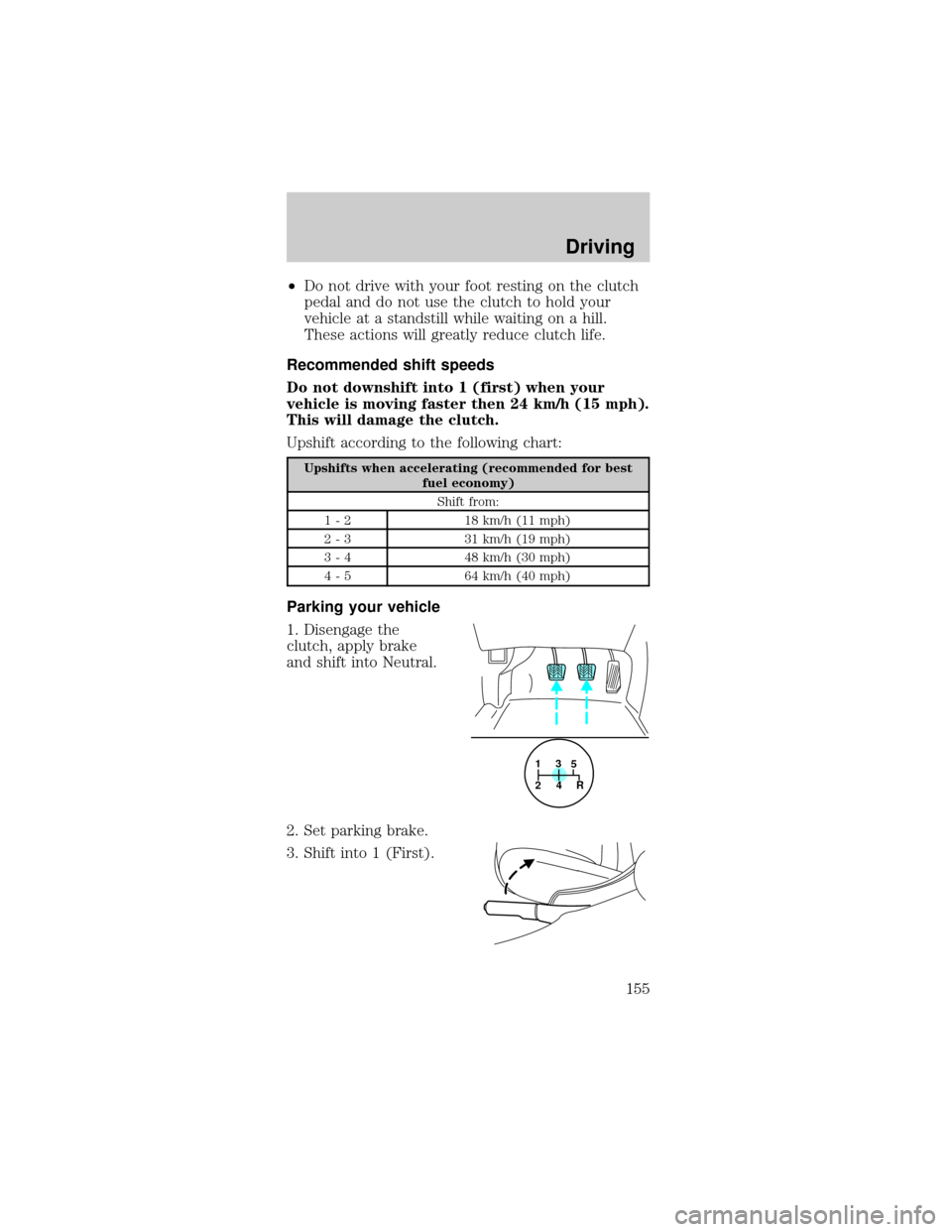
1. Disengage the
clutch, apply brake
and shift into Neutral.
2. Set parking brake.
3. Shift into 1 (First).
1
24R3
5
Driving
155
Page 156 of 264
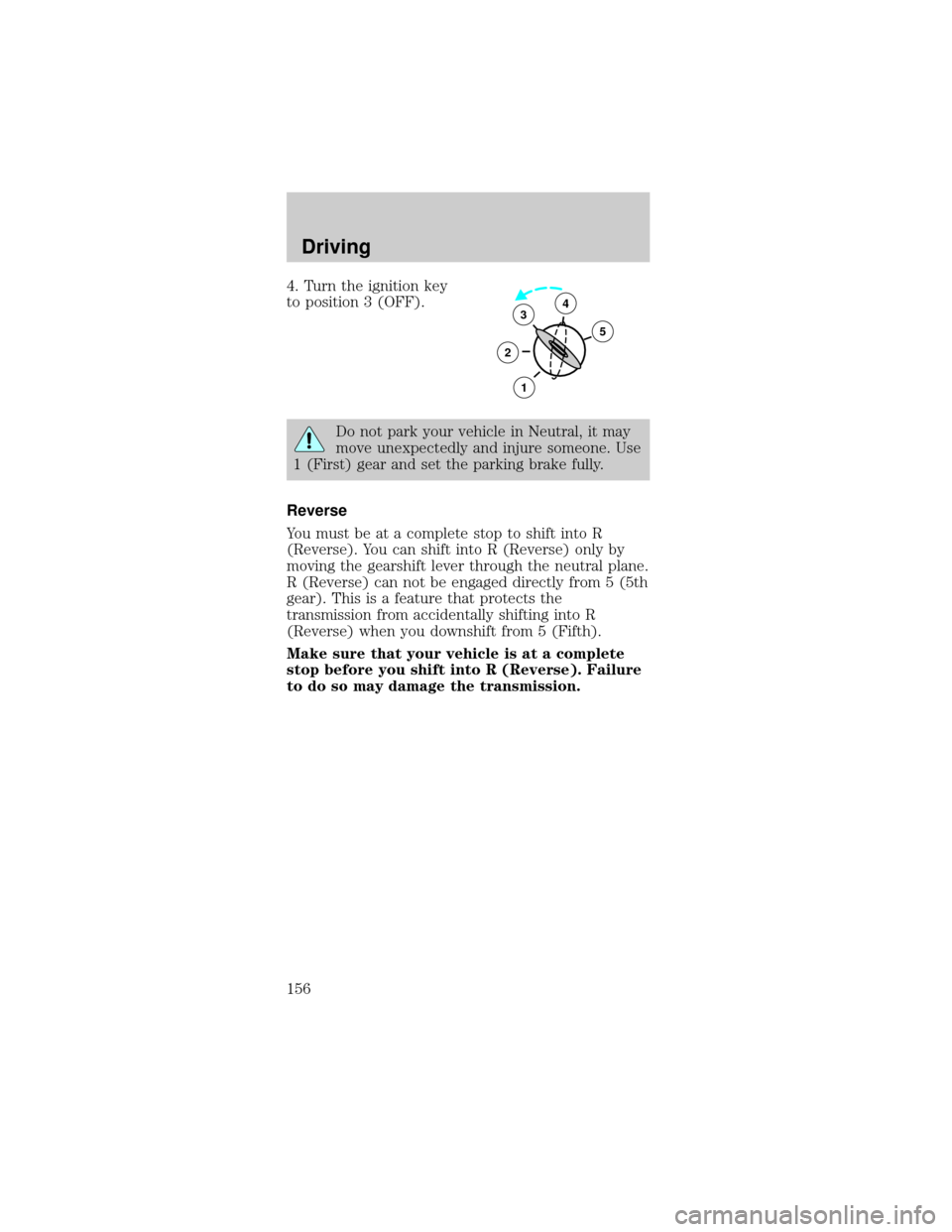
4. Turn the ignition key
to position 3 (OFF).
Do not park your vehicle in Neutral, it may
move unexpectedly and injure someone. Use
1 (First) gear and set the parking brake fully.
Reverse
You must be at a complete stop to shift into R
(Reverse). You can shift into R (Reverse) only by
moving the gearshift lever through the neutral plane.
R (Reverse) can not be engaged directly from 5 (5th
gear). This is a feature that protects the
transmission from accidentally shifting into R
(Reverse) when you downshift from 5 (Fifth).
Make sure that your vehicle is at a complete
stop before you shift into R (Reverse). Failure
to do so may damage the transmission.
3
2
1
5
4
Driving
156