2002 FORD EXPLORER SPORT manual transmission
[x] Cancel search: manual transmissionPage 68 of 184
Do not sit on top of a buckled safety belt to avoid the Belt
Minder chime. Sitting on the safety belt will increase the risk of
injury in an accident. To disable (one-time) or deactivate the Belt
Minder feature please follow the directions stated below.
One time disable
Any time the safety belt is buckled and then unbuckled during an
ignition ON cycle, BeltMinder will be disabled for that ignition cycle only.
Deactivating/activating the BeltMinder feature
Before following the procedure, make sure that:
•The ignition switch and headlamp control are in the OFF position and
all the doors are closed.
•The parking brake is set and the gearshift is in P (Park) (automatic
transmission) or neutral (manual transmission).
•The driver’s safety belt is unbuckled.
Read steps1-9before proceeding with the deactivation/activation
procedure.
BeltMinder deactivation/activation procedure:
To reduce the risk of injury, do not deactivate/activate the Belt
Minder feature while driving the vehicle.
1. Turn the ignition switch to the RUN (or ON) position without starting
the engine.
2. Wait for the safety belt warning light to turn off. (Approximately 1–2
minutes.)
•Steps 3–5 must be completed within 60 seconds or the procedure will
have to be repeated.
3. Buckle, then unbuckle, the safety belt three times, ending with the
safety belt unbuckled. This can be done before or during BeltMinder
warning activation.
4. Turn on the headlamp control, then turn it off.
5. Buckle then unbuckle the safety belt three times, ending with the
safety belt unbuckled.
•After step 5, the safety belt warning light will be turned on for three
seconds.
Seating and Safety Restraints
68
Page 88 of 184
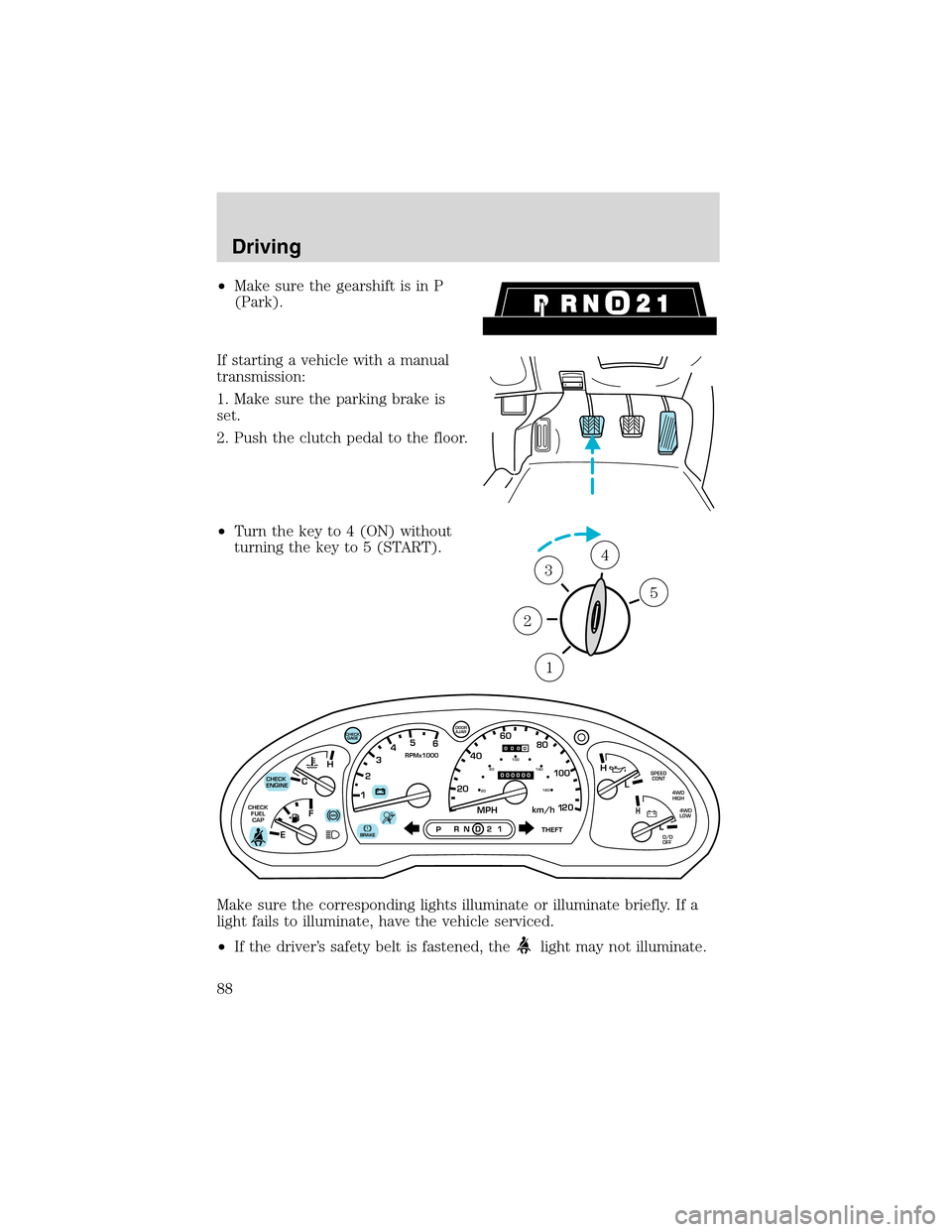
•Make sure the gearshift is in P
(Park).
If starting a vehicle with a manual
transmission:
1. Make sure the parking brake is
set.
2. Push the clutch pedal to the floor.
•Turn the key to 4 (ON) without
turning the key to 5 (START).
Make sure the corresponding lights illuminate or illuminate briefly. If a
light fails to illuminate, have the vehicle serviced.
•If the driver’s safety belt is fastened, the
light may not illuminate.
1
2
34
5
C12345
6
RPMx1000
ABS
CHECK
ENGINE
EFH
H
H
PRN D 2 1THEFT
SPEED
CONT
4WD
HIGH
4WD
LOW
O/D
OFFL
L
MPH 2060
4080
km/h
00
1
20
160100
140
180
20
DOOR
AJAR
CHECK
GAGE
!
BRAKE
CHECK
FUEL
CAP
Driving
88
Page 91 of 184
Even when the ABS is disabled,
normal braking is still effective. (If
your BRAKE warning lamp
illuminates with the parking brake
released, have your brake system
serviced immediately.)
Using ABS
When hard braking is required, apply continuous force on the brake
pedal; do not pump the brake pedal since this will reduce the
effectiveness of the ABS and will increase your vehicle’s stopping
distance. The ABS will be activated immediately, allowing you to retain
full steering control during hard braking and on slippery surfaces.
However, the ABS does not decrease stopping distance.
Parking brake
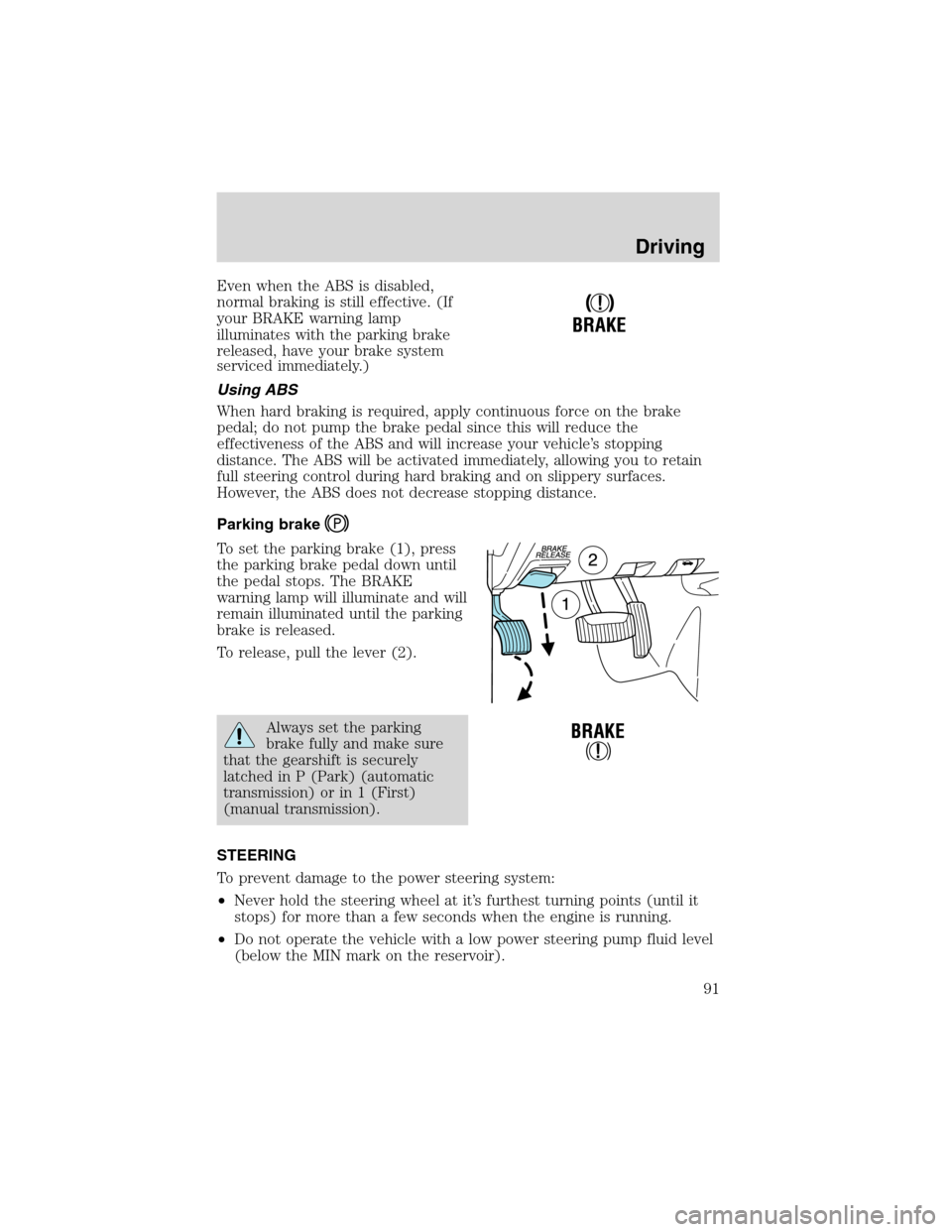
To set the parking brake (1), press
the parking brake pedal down until
the pedal stops. The BRAKE
warning lamp will illuminate and will
remain illuminated until the parking
brake is released.
To release, pull the lever (2).
Always set the parking
brake fully and make sure
that the gearshift is securely
latched in P (Park) (automatic
transmission) or in 1 (First)
(manual transmission).
STEERING
To prevent damage to the power steering system:
•Never hold the steering wheel at it’s furthest turning points (until it
stops) for more than a few seconds when the engine is running.
•Do not operate the vehicle with a low power steering pump fluid level
(below the MIN mark on the reservoir).
!
BRAKE
Driving
91
Page 96 of 184
MANUAL TRANSMISSION OPERATION (IF EQUIPPED)
Using the clutch
A starter interlock prevents cranking the engine unless the clutch pedal
is fully depressed.
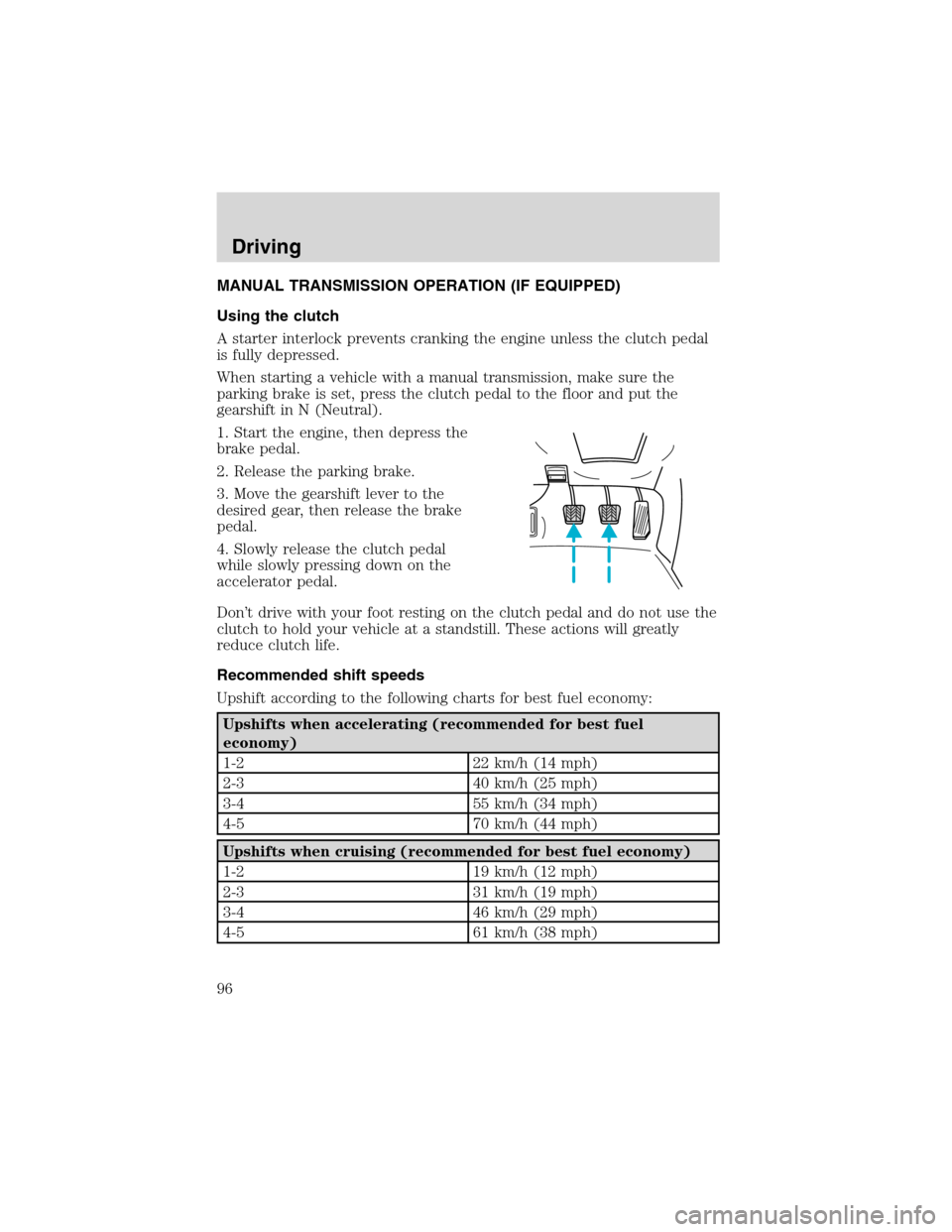
When starting a vehicle with a manual transmission, make sure the
parking brake is set, press the clutch pedal to the floor and put the
gearshift in N (Neutral).
1. Start the engine, then depress the
brake pedal.
2. Release the parking brake.
3. Move the gearshift lever to the
desired gear, then release the brake
pedal.
4. Slowly release the clutch pedal
while slowly pressing down on the
accelerator pedal.
Don’t drive with your foot resting on the clutch pedal and do not use the
clutch to hold your vehicle at a standstill. These actions will greatly
reduce clutch life.
Recommended shift speeds
Upshift according to the following charts for best fuel economy:
Upshifts when accelerating (recommended for best fuel
economy)
1-2 22 km/h (14 mph)
2-3 40 km/h (25 mph)
3-4 55 km/h (34 mph)
4-5 70 km/h (44 mph)
Upshifts when cruising (recommended for best fuel economy)
1-2 19 km/h (12 mph)
2-3 31 km/h (19 mph)
3-4 46 km/h (29 mph)
4-5 61 km/h (38 mph)
Driving
96
Page 99 of 184
vehicle is moving; this is normal and should be no reason for concern.
Refer toShifting to/from 4X4 LOWfor proper operation.
Shifting between 2WD and 4X4 HIGH
•Move the 4WD control between 2WD and 4X4 HIGH at any forward
speed.
Note:Do not perform this operation if the rear wheels are slipping.
Shifting to/from 4X4 LOW
1. Bring the vehicle to a complete stop
2. Depress the brake
3. On vehicles equipped with an automatic transmission, place the
transmission in N (Neutral); on vehicles equipped with a manual
transmission, depress the clutch.
4. Move the 4WD control to the desired position.
•If shifting into 4WD LOW, wait for the 4X4 LOW light in the
instrument cluster to turnonindicating the shift is complete.
•If shifting out of 4WD LOW, wait for the 4X4 LOW light in the
instrument cluster turn turnoffindicating the shift is complete.
Driving off-road with truck and utility vehicles
Basic operating principles
Maintain steering wheel control at all times, especially in rough terrain;
sudden changes in terrain can result in abrupt steering wheel motion. Do
not use 4WD on dry, hard surfaced roads (except models equipped with
Auto 4WD).
If your vehicle goes off the edge of the pavement
Slow down and don’t slam on the brakes. Ease the vehicle back onto the
pavement only after reducing your speed.
Do not turn the steering wheel sharply while returning to the
road as this may cause you to lose control of the vehicle.
It may be safer to stay on the shoulder of the road and slow down before
returning to the pavement.
If your vehicle gets stuck
The vehicle may be rocked out by shifting from forward and reverse
gears, stopping between shifts, in a steady pattern. Press lightly on the
Driving
99
Page 100 of 184
accelerator in each gear.Do not rock the vehicle for more than a
few minutes or damage to the transmission and tires may occur
or the engine may overheat.
Do not spin the wheels at over 56 km/h (35 mph). The tires may
fail and injure a passenger or bystander.
Emergency maneuvers
In an emergency situation where a sudden sharp turn must be made,
turn the steering wheel only as rapidly and as far as required to avoid
the emergency. Excessive steering will result in less vehicle control. Also
avoid abrupt braking. In the event of an emergency stop, do not attempt
any sharp steering wheel movements. If the vehicle goes from one type
of surface to another (i.e., from concrete to gravel) there will be a
change in the way the vehicle responds to a maneuver (steering,
acceleration or braking).
Parking
On some 4WD vehicles, when the transfer case is in the N (Neutral)
position, the engine and transmission are disconnected from the rest of
the driveline. Therefore, the vehicle is free to roll even if the automatic
transmission is in P (Park) or the manual transmission is in gear. Do not
leave the vehicle unattended with the transfer case in N (Neutral)
position. Always set the parking brake fully and turn off the ignition
when leaving the vehicle.
Normal characteristics
On some 4WD vehicles, the initial shift from two-wheel drive to
four–wheel drive while the vehicle is moving can cause some momentary
clunk and ratcheting sounds. This is normal and should be no cause for
concern.
Driving on sand, mud and water
When driving over sand, avoid reducing the tire pressures; instead, shift
to a lower gear. Apply the accelerator slowly and avoid spinning the
wheels. If you must reduce the tire pressure, make sure you re-inflate
the tires as soon as possible. Avoid excessive speed because vehicle
momentum can work against your vehicle and cause it to become stuck.
Driving
100
Page 102 of 184
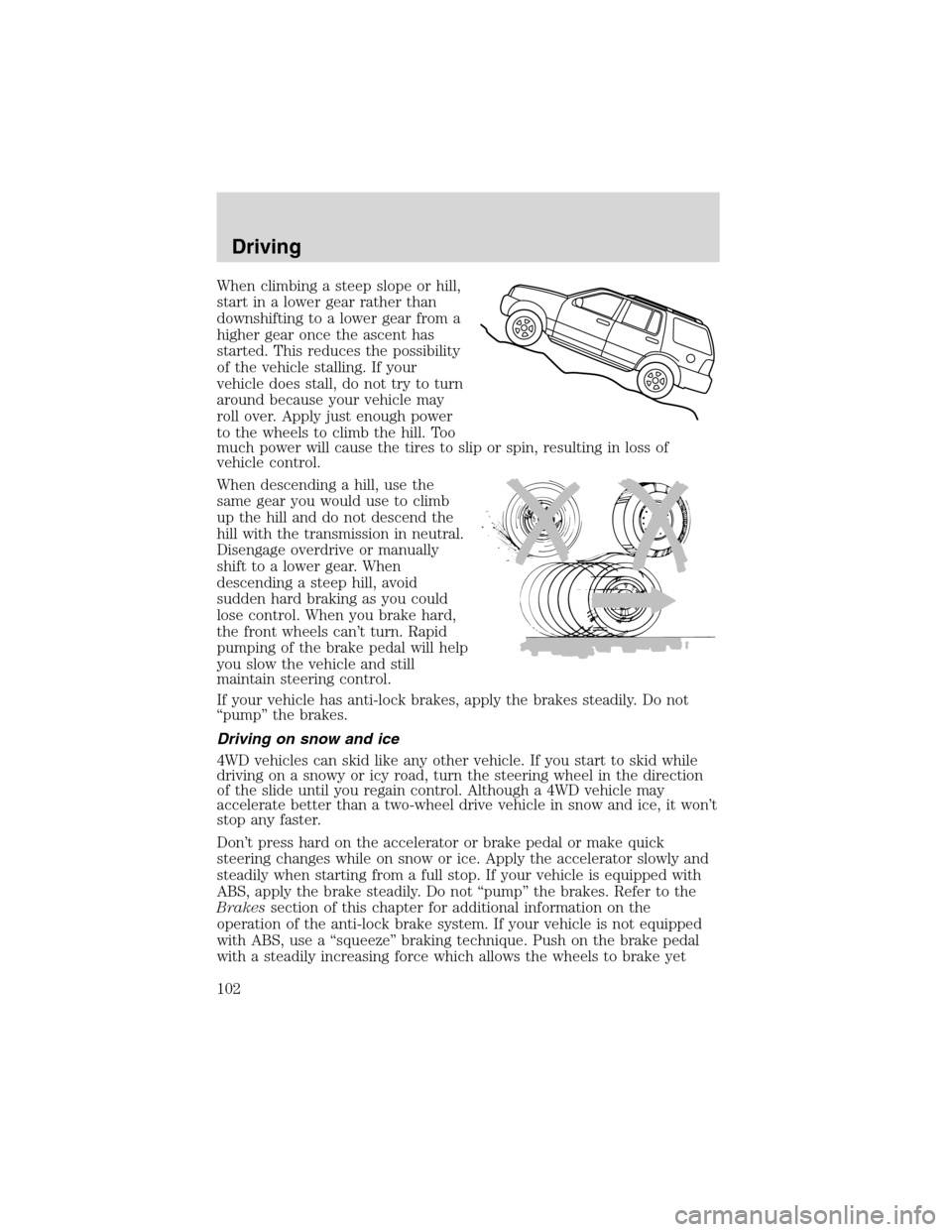
When climbing a steep slope or hill,
start in a lower gear rather than
downshifting to a lower gear from a
higher gear once the ascent has
started. This reduces the possibility
of the vehicle stalling. If your
vehicle does stall, do not try to turn
around because your vehicle may
roll over. Apply just enough power
to the wheels to climb the hill. Too
much power will cause the tires to slip or spin, resulting in loss of
vehicle control.
When descending a hill, use the
same gear you would use to climb
up the hill and do not descend the
hill with the transmission in neutral.
Disengage overdrive or manually
shift to a lower gear. When
descending a steep hill, avoid
sudden hard braking as you could
lose control. When you brake hard,
the front wheels can’t turn. Rapid
pumping of the brake pedal will help
you slow the vehicle and still
maintain steering control.
If your vehicle has anti-lock brakes, apply the brakes steadily. Do not
“pump”the brakes.
Driving on snow and ice
4WD vehicles can skid like any other vehicle. If you start to skid while
driving on a snowy or icy road, turn the steering wheel in the direction
of the slide until you regain control. Although a 4WD vehicle may
accelerate better than a two-wheel drive vehicle in snow and ice, it won’t
stop any faster.
Don’t press hard on the accelerator or brake pedal or make quick
steering changes while on snow or ice. Apply the accelerator slowly and
steadily when starting from a full stop. If your vehicle is equipped with
ABS, apply the brake steadily. Do not“pump”the brakes. Refer to the
Brakessection of this chapter for additional information on the
operation of the anti-lock brake system. If your vehicle is not equipped
with ABS, use a“squeeze”braking technique. Push on the brake pedal
with a steadily increasing force which allows the wheels to brake yet
Driving
102
Page 106 of 184
•Service your vehicle more frequently if you tow a trailer. Refer to the
severe duty schedule in the scheduled maintenance guide.
•Do not tow a trailer until your vehicle has been driven at least 800 km
(500 miles).
•Refer to the instructions included with towing accessories for the
proper installation and adjustment specifications.
Do not exceed the maximum loads listed on the Safety Compliance
Certification label. For load specification terms found on the label, refer
toVehicle loadingin this chapter. Remember to figure in the tongue
load of your loaded vehicle when figuring the total weight. Tongue load
should not exceed 10% of the loaded trailer.
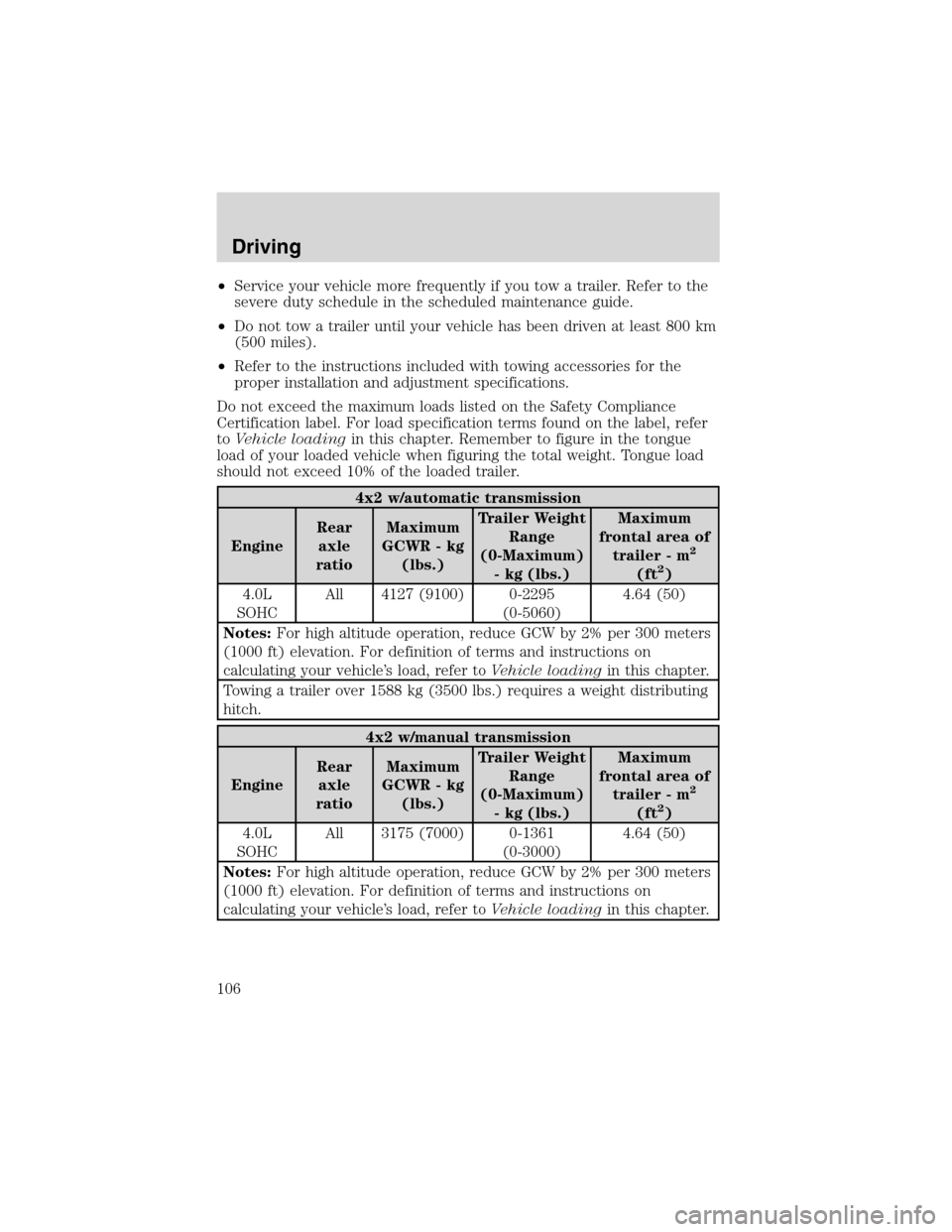
4x2 w/automatic transmission
EngineRear
axle
ratioMaximum
GCWR - kg
(lbs.)Trailer Weight
Range
(0-Maximum)
- kg (lbs.)Maximum
frontal area of
trailer - m
2
(ft2)
4.0L
SOHCAll 4127 (9100) 0-2295
(0-5060)4.64 (50)
Notes:For high altitude operation, reduce GCW by 2% per 300 meters
(1000 ft) elevation. For definition of terms and instructions on
calculating your vehicle’s load, refer toVehicle loadingin this chapter.
Towing a trailer over 1588 kg (3500 lbs.) requires a weight distributing
hitch.
4x2 w/manual transmission
EngineRear
axle
ratioMaximum
GCWR - kg
(lbs.)Trailer Weight
Range
(0-Maximum)
- kg (lbs.)Maximum
frontal area of
trailer - m
2
(ft2)
4.0L
SOHCAll 3175 (7000) 0-1361
(0-3000)4.64 (50)
Notes:For high altitude operation, reduce GCW by 2% per 300 meters
(1000 ft) elevation. For definition of terms and instructions on
calculating your vehicle’s load, refer toVehicle loadingin this chapter.
Driving
106