Page 2 of 184
Seating and Safety Restraints 55
Seating 55
Safety restraints 60
Air bags 70
Child restraints 77
Driving 86
Starting 86
Brakes 90
Transmission operation 93
Roadside Emergencies 111
Getting roadside assistance 111
Fuses and relays 113
Changing tires 120
Jump starting 125
Wrecker towing 127
Customer Assistance 128
The dispute settlement board 131
Utilizing the mediation/arbitration 134
Getting assistance outside the U.S. and Canada 134
Ordering additional owner’s literature 135
Reporting safety defects (U.S. only) 136
Cleaning 137
Table of Contents
2
Page 111 of 184
GETTING ROADSIDE ASSISTANCE
To fully assist you should you have a vehicle concern, Ford Motor
Company offers a complimentary roadside assistance program. This
program is separate from the New Vehicle Limited Warranty. The service
is available:
•24–hours, seven days a week
•for the New Vehicle Limited Warranty period of three years or 60 000
km (36 000 miles), whichever occurs first on Ford and Mercury
vehicles, and four years or 80 000 km (50 000 miles) on Lincoln
vehicles*.
Roadside assistance will cover:
•changing a flat tire
•jump-starts
•lock-out assistance
•limited fuel delivery*
•towing of your disabled vehicle to the nearest Ford Motor Company
dealership, or your selling dealer if within 25 kms (15.5 miles) of the
nearest Ford Motor Company dealership (one tow per disablement).
Even non-warranty related tows, like accidents or getting stuck in the
mud or snow, are covered (some exclusions apply, such as impound
towing or repossession).
* Canadian customers refer to your Owner Information Guide for exact
fuel amounts.
Using roadside assistance
Complete the roadside assistance identification card and place it in your
wallet for quick reference. In the United States, this card is found in the
Owner Guide portfolio in the glove compartment in Ford vehicles and is
mailed to you if you own a Mercury or Lincoln. In Canada, the card is
found in the Roadside Assistance book in the glove compartment.
U.S. Ford or Mercury vehicle customers who require roadside assistance,
call 1–800–241–3673; Lincoln vehicle customers call 1–800–521–4140.
Canadian customers who require roadside assistance, call
1–800–665–2006.
Roadside Emergencies
111
Page 125 of 184
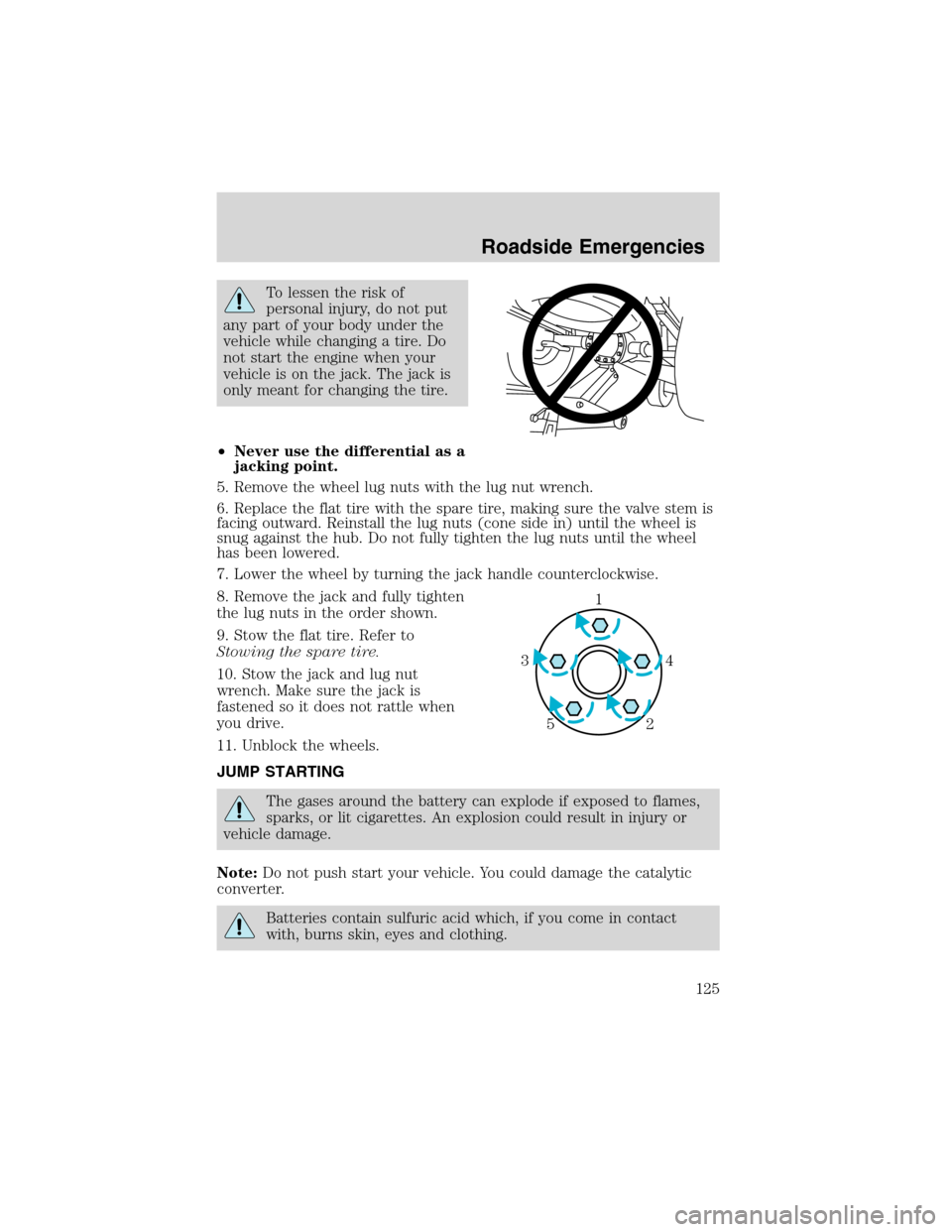
To lessen the risk of
personal injury, do not put
any part of your body under the
vehicle while changing a tire. Do
not start the engine when your
vehicle is on the jack. The jack is
only meant for changing the tire.
•Never use the differential as a
jacking point.
5. Remove the wheel lug nuts with the lug nut wrench.
6. Replace the flat tire with the spare tire, making sure the valve stem is
facing outward. Reinstall the lug nuts (cone side in) until the wheel is
snug against the hub. Do not fully tighten the lug nuts until the wheel
has been lowered.
7. Lower the wheel by turning the jack handle counterclockwise.
8. Remove the jack and fully tighten
the lug nuts in the order shown.
9. Stow the flat tire. Refer to
Stowing the spare tire.
10. Stow the jack and lug nut
wrench. Make sure the jack is
fastened so it does not rattle when
you drive.
11. Unblock the wheels.
JUMP STARTING
The gases around the battery can explode if exposed to flames,
sparks, or lit cigarettes. An explosion could result in injury or
vehicle damage.
Note:Do not push start your vehicle. You could damage the catalytic
converter.
Batteries contain sulfuric acid which, if you come in contact
with, burns skin, eyes and clothing.
1
4 3
2 5
Roadside Emergencies
125
Page 126 of 184
Only connect batteries with the
same nominal voltage (12 volts).
Use jump leads with insulated
clamps and sufficient cross section.
Do not disconnect the battery from
the vehicle’s electrical system.
Suitable jump leads for this purpose
can be obtained from your dealer.
Note:(+) terminal is larger than
the (-) terminal.
Preparing to jump start your vehicle:
•Position the vehicles so they do not touch.
•Turn off all electrical equipment.
•Keep jumper cables away from moving parts (fan blades and belts).
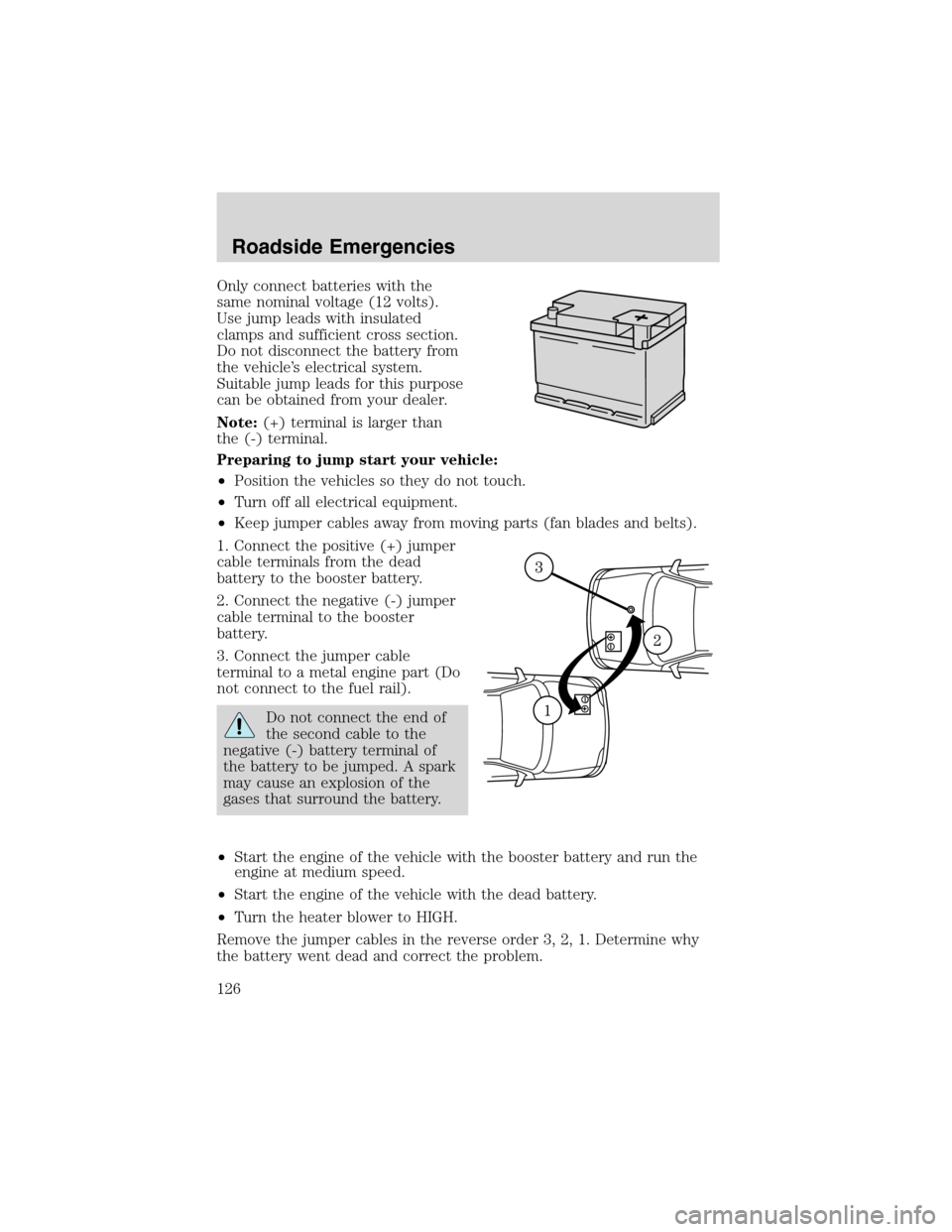
1. Connect the positive (+) jumper
cable terminals from the dead
battery to the booster battery.
2. Connect the negative (-) jumper
cable terminal to the booster
battery.
3. Connect the jumper cable
terminal to a metal engine part (Do
not connect to the fuel rail).
Do not connect the end of
the second cable to the
negative (-) battery terminal of
the battery to be jumped. A spark
may cause an explosion of the
gases that surround the battery.
•Start the engine of the vehicle with the booster battery and run the
engine at medium speed.
•Start the engine of the vehicle with the dead battery.
•Turn the heater blower to HIGH.
Remove the jumper cables in the reverse order 3, 2, 1. Determine why
the battery went dead and correct the problem.
Roadside Emergencies
126