2002 FORD EXPLORER SPORT brakes
[x] Cancel search: brakesPage 103 of 184
continue to roll so that you may steer in the direction you want to travel.
If you lock the wheels, release the brake pedal and repeat the squeeze
technique.
Never drive with chains on the front tires of 4WD vehicles without also
putting them on the rear tires. This could cause the rear to slide and
swing around during braking.
Maintenance and Modifications
Ford strongly recommends that you do not add or removing steering or
suspension parts (such as lift kits or stabilizer bars) or by using
replacement parts not equivalent to the original factory equipment. Do
not use aftermarket“lift kits”or other suspension modifications. These
could adversely affect the vehicle’s handling characteristics, which could
lead to loss of vehicle control or roll over and serious injury. Frequent
inspection of vehicle chassis components is recommended if the vehicle
is subjected to heavy off-road usage.
DRIVING THROUGH WATER
If driving through deep or standing water is unavoidable, proceed very
slowly especially if the depth is not known. Never drive through water
that is higher than the bottom of the hubs (for trucks) or the bottom of
the wheel rims (for cars). Traction or brake capability may be limited
and your vehicle may stall. Water may also enter your engine’s air intake
and severely damage your engine.
Once through the water, always dry the brakes by moving your vehicle
slowly while applying light pressure on the brake pedal. Wet brakes do
not stop the vehicle as quickly as dry brakes.Driving through deep
water where the transmission vent tube is submerged may allow
water into the transmission and cause internal transmission
damage.
VEHICLE LOADING
Before loading a vehicle, familiarize yourself with the following terms:
•Base Curb Weight:Weight of the vehicle including any standard
equipment, fluids, lubricants, etc. It does not include occupants or
aftermarket equipment.
•Payload:Combined maximum allowable weight of cargo, occupants
and optional equipment. The payload equals the gross vehicle weight
rating minus base curb weight.
•GVW (Gross Vehicle Weight):Base curb weight plus payload
weight.
Driving
103
Page 105 of 184
Do not use replacement tires with lower load carrying capacities than the
originals because they may lower the vehicle’s GVWR and GAWR
limitations. Replacement tires with a higher limit than the originals do
not increase the GVWR and GAWR limitations.
Special loading instructions for owners of pickup trucks and
utility-type vehicles
For important information regarding safe operation of this type
of vehicle, see thePreparing to drive your vehiclesection in
this chapter.
Loaded vehicles may handle differently than unloaded vehicles.
Extra precautions, such as slower speeds and increased stopping
distance, should be taken when driving a heavily loaded vehicle.
Your vehicle can haul more cargo and people than most passenger cars.
Depending upon the type and placement of the load, hauling cargo and
people may raise the center of gravity of the vehicle.
Calculating the load your vehicle can carry/tow
1. Use the appropriate maximum GCWR chart (in theTrailer Towing
section in this chapter) for your type of engine and rear axle ratio.
2. Weigh your vehicle without cargo. To obtain correct weights, take your
vehicle to a shipping company or an inspection station for trucks.
3. Subtract your loaded weight from the maximum GCWR in the chart.
This is the maximum trailer weight your vehicle can tow. It must be
below the maximum trailer weight shown in the chart.
TRAILER TOWING
Trailer towing puts additional loads on your vehicle’s engine,
transmission, axle, brakes, tires, and suspension. For your safety, and to
maximize vehicle performance, be sure to use the proper equipment
while towing.
Follow these guidelines to ensure safe towing:
•Stay within your vehicle’s load limits.
•Thoroughly prepare your vehicle for towing. Refer toPreparing to
towin this chapter.
•Use extra caution when driving witha trailer. Refer toDriving while
you towin this chapter.
Driving
105
Page 108 of 184
Hitches
Do not use hitches that clamp onto the vehicle bumper. Use a load
carrying hitch. You must distribute the load in your trailer so that 10% of
the total weight of the trailer is on the tongue.
Use a frame-mounted weight distributing hitch for trailers over
1588 kg (3500 lb).
Safety chains
Always connect the trailer’s safety chains to the frame or hook retainers
of the vehicle hitch. To connect the trailer’s safety chains, cross the
chains under the trailer tongue and allow slack for turning corners.Do
not attach safety chains to the bumper.
Trailer brakes
Electric brakes and manual, automatic or surge-type trailer brakes are
safe if installed properly and adjusted to the manufacturer’s
specifications.
Do not connect a trailer’s hydraulic brake system directly to your
vehicle’s brake system. Your vehicle may not have enough
braking power and your chances of having a collision greatly increase.
The braking system of the towing vehicle is rated for operation at the
GVWR not GCWR.
Trailer lamps
Make sure your trailer lamps conform to local and Federal regulations.
See your dealer or trailer rental agency for proper instructions and
equipment for hooking up trailer lamps.
Never connect any trailer lighting to the vehicle’s taillamp
circuits, because it may damage the electrical system resulting in
fire. Contact your local Ford dealership for assistance in proper trailer
tow wiring installation. Additional electrical equipment may be
required.
Using a step bumper
The rear bumper is equipped with an integral hitch and requires only a
ball with a 19 mm (3/4 inch) shank diameter. The bumper has a 1,590 kg
(3,500 lb.) trailer weight and 159 kg (350 lb.) tongue weight capability.
Use a frame-mounted weight distributing hitch for trailers over 1,590 kg
(3,500 lb).
Driving
108
Page 159 of 184
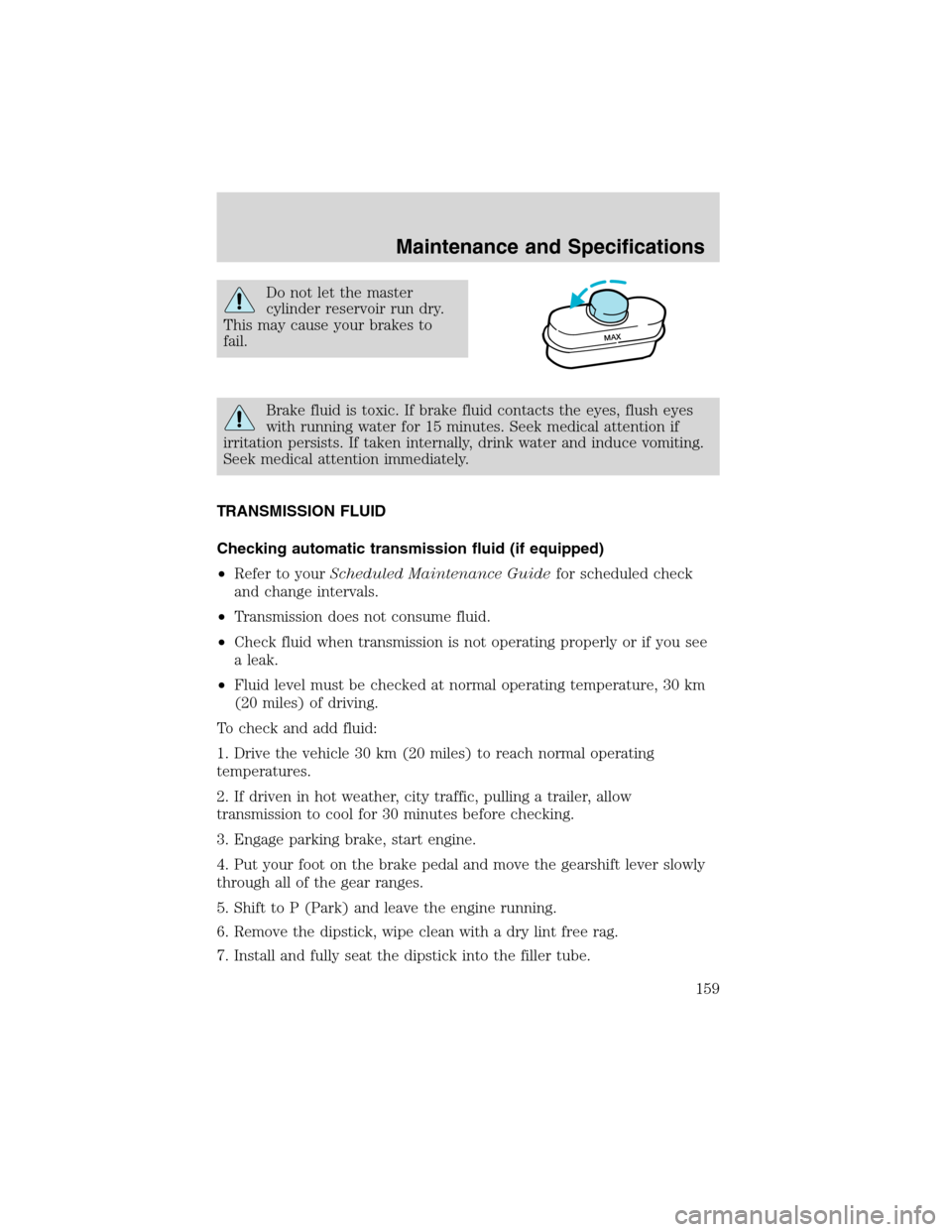
Do not let the master
cylinder reservoir run dry.
This may cause your brakes to
fail.
Brake fluid is toxic. If brake fluid contacts the eyes, flush eyes
with running water for 15 minutes. Seek medical attention if
irritation persists. If taken internally, drink water and induce vomiting.
Seek medical attention immediately.
TRANSMISSION FLUID
Checking automatic transmission fluid (if equipped)
•Refer to yourScheduled Maintenance Guidefor scheduled check
and change intervals.
•Transmission does not consume fluid.
•Check fluid when transmission is not operating properly or if you see
a leak.
•Fluid level must be checked at normal operating temperature, 30 km
(20 miles) of driving.
To check and add fluid:
1. Drive the vehicle 30 km (20 miles) to reach normal operating
temperatures.
2. If driven in hot weather, city traffic, pulling a trailer, allow
transmission to cool for 30 minutes before checking.
3. Engage parking brake, start engine.
4. Put your foot on the brake pedal and move the gearshift lever slowly
through all of the gear ranges.
5. Shift to P (Park) and leave the engine running.
6. Remove the dipstick, wipe clean with a dry lint free rag.
7. Install and fully seat the dipstick into the filler tube.
MAX
Maintenance and Specifications
159
Page 178 of 184
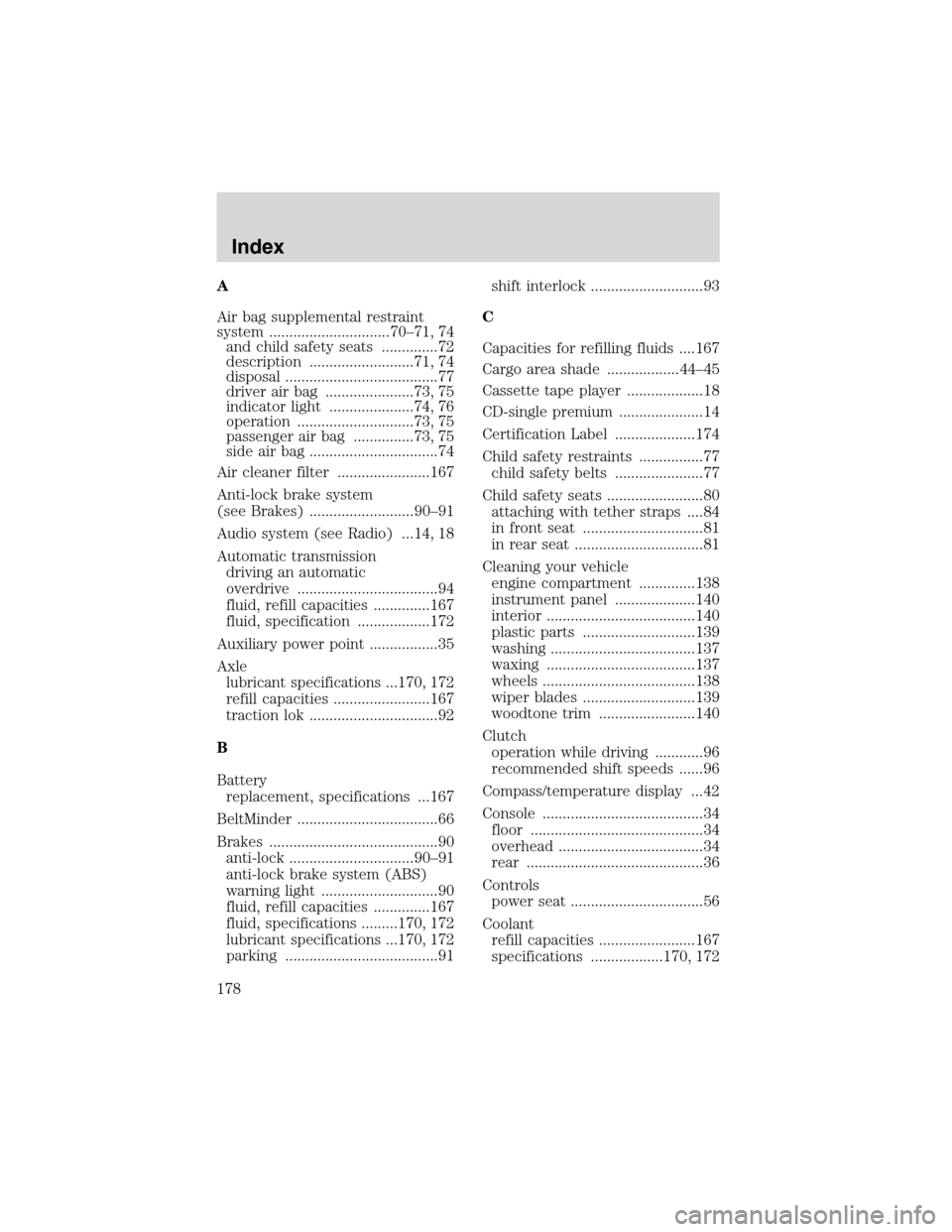
A
Air bag supplemental restraint
system ..............................70–71, 74
and child safety seats ..............72
description ..........................71, 74
disposal ......................................77
driver air bag ......................73, 75
indicator light .....................74, 76
operation .............................73, 75
passenger air bag ...............73, 75
side air bag ................................74
Air cleaner filter .......................167
Anti-lock brake system
(see Brakes) ..........................90–91
Audio system (see Radio) ...14, 18
Automatic transmission
driving an automatic
overdrive ...................................94
fluid, refill capacities ..............167
fluid, specification ..................172
Auxiliary power point .................35
Axle
lubricant specifications...170, 172
refill capacities ........................167
traction lok ................................92
B
Battery
replacement, specifications ...167
BeltMinder ...................................66
Brakes ..........................................90
anti-lock ...............................90–91
anti-lock brake system (ABS)
warning light .............................90
fluid, refill capacities ..............167
fluid, specifications .........170, 172
lubricant specifications...170, 172
parking ......................................91shift interlock ............................93
C
Capacities for refilling fluids ....167
Cargo area shade ..................44–45
Cassette tape player ...................18
CD-single premium .....................14
Certification Label ....................174
Child safety restraints ................77
child safety belts ......................77
Child safety seats ........................80
attaching with tether straps ....84
in front seat ..............................81
in rear seat ................................81
Cleaning your vehicle
engine compartment ..............138
instrument panel ....................140
interior .....................................140
plastic parts ............................139
washing ....................................137
waxing .....................................137
wheels ......................................138
wiper blades ............................139
woodtone trim ........................140
Clutch
operation while driving ............96
recommended shift speeds ......96
Compass/temperature display ...42
Console ........................................34
floor ...........................................34
overhead ....................................34
rear ............................................36
Controls
power seat .................................56
Coolant
refill capacities ........................167
specifications ..................170, 172
Index
178
Page 180 of 184
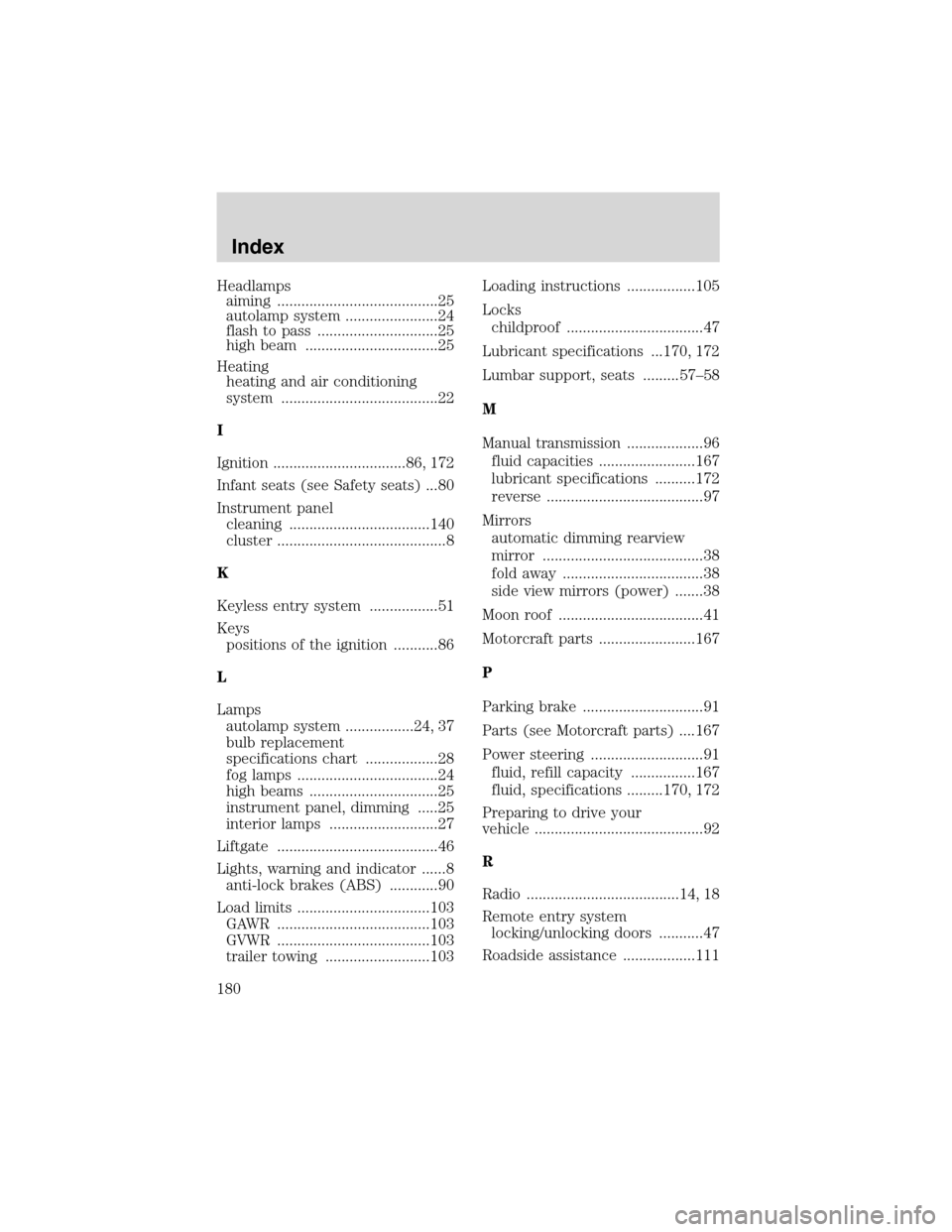
Headlamps
aiming ........................................25
autolamp system .......................24
flash to pass ..............................25
high beam .................................25
Heating
heating and air conditioning
system .......................................22
I
Ignition .................................86, 172
Infant seats (see Safety seats)...80
Instrument panel
cleaning ...................................140
cluster ..........................................8
K
Keyless entry system .................51
Keys
positions of the ignition ...........86
L
Lamps
autolamp system .................24, 37
bulb replacement
specifications chart ..................28
fog lamps ...................................24
high beams ................................25
instrument panel, dimming .....25
interior lamps ...........................27
Liftgate ........................................46
Lights, warning and indicator ......8
anti-lock brakes (ABS) ............90
Load limits .................................103
GAWR ......................................103
GVWR ......................................103
trailer towing ..........................103Loading instructions .................105
Locks
childproof ..................................47
Lubricant specifications ...170, 172
Lumbar support, seats .........57–58
M
Manual transmission ...................96
fluid capacities ........................167
lubricant specifications ..........172
reverse .......................................97
Mirrors
automatic dimming rearview
mirror ........................................38
fold away ...................................38
side view mirrors (power) .......38
Moon roof ....................................41
Motorcraft parts ........................167
P
Parking brake ..............................91
Parts (see Motorcraft parts) ....167
Power steering ............................91
fluid, refill capacity ................167
fluid, specifications .........170, 172
Preparing to drive your
vehicle ..........................................92
R
Radio ......................................14, 18
Remote entry system
locking/unlocking doors ...........47
Roadside assistance ..................111
Index
180