2002 DODGE RAM service
[x] Cancel search: servicePage 1456 of 2255
GEAR RATIOS
GEAR RATIO
FIRST 5.61:1
SECOND 3.04:1
THIRD 1.67:1
FOURTH 1.00:1
FIFTH 0.75:1
REVERSE 5.04:1
IDENTIFICATION
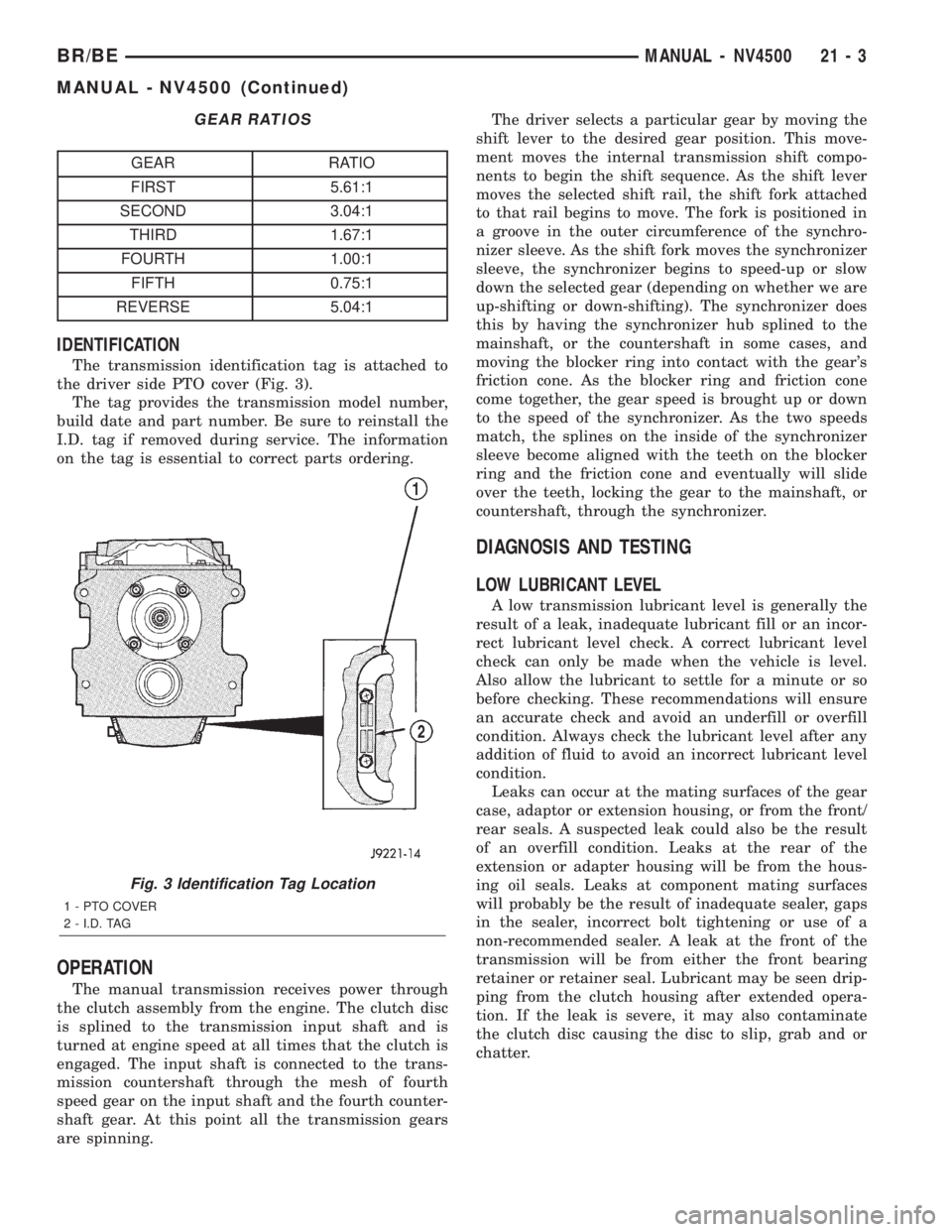
The transmission identification tag is attached to
the driver side PTO cover (Fig. 3).
The tag provides the transmission model number,
build date and part number. Be sure to reinstall the
I.D. tag if removed during service. The information
on the tag is essential to correct parts ordering.
OPERATION
The manual transmission receives power through
the clutch assembly from the engine. The clutch disc
is splined to the transmission input shaft and is
turned at engine speed at all times that the clutch is
engaged. The input shaft is connected to the trans-
mission countershaft through the mesh of fourth
speed gear on the input shaft and the fourth counter-
shaft gear. At this point all the transmission gears
are spinning.The driver selects a particular gear by moving the
shift lever to the desired gear position. This move-
ment moves the internal transmission shift compo-
nents to begin the shift sequence. As the shift lever
moves the selected shift rail, the shift fork attached
to that rail begins to move. The fork is positioned in
a groove in the outer circumference of the synchro-
nizer sleeve. As the shift fork moves the synchronizer
sleeve, the synchronizer begins to speed-up or slow
down the selected gear (depending on whether we are
up-shifting or down-shifting). The synchronizer does
this by having the synchronizer hub splined to the
mainshaft, or the countershaft in some cases, and
moving the blocker ring into contact with the gear's
friction cone. As the blocker ring and friction cone
come together, the gear speed is brought up or down
to the speed of the synchronizer. As the two speeds
match, the splines on the inside of the synchronizer
sleeve become aligned with the teeth on the blocker
ring and the friction cone and eventually will slide
over the teeth, locking the gear to the mainshaft, or
countershaft, through the synchronizer.
DIAGNOSIS AND TESTING
LOW LUBRICANT LEVEL
A low transmission lubricant level is generally the
result of a leak, inadequate lubricant fill or an incor-
rect lubricant level check. A correct lubricant level
check can only be made when the vehicle is level.
Also allow the lubricant to settle for a minute or so
before checking. These recommendations will ensure
an accurate check and avoid an underfill or overfill
condition. Always check the lubricant level after any
addition of fluid to avoid an incorrect lubricant level
condition.
Leaks can occur at the mating surfaces of the gear
case, adaptor or extension housing, or from the front/
rear seals. A suspected leak could also be the result
of an overfill condition. Leaks at the rear of the
extension or adapter housing will be from the hous-
ing oil seals. Leaks at component mating surfaces
will probably be the result of inadequate sealer, gaps
in the sealer, incorrect bolt tightening or use of a
non-recommended sealer. A leak at the front of the
transmission will be from either the front bearing
retainer or retainer seal. Lubricant may be seen drip-
ping from the clutch housing after extended opera-
tion. If the leak is severe, it may also contaminate
the clutch disc causing the disc to slip, grab and or
chatter.
Fig. 3 Identification Tag Location
1 - PTO COVER
2 - I.D. TAG
BR/BEMANUAL - NV4500 21 - 3
MANUAL - NV4500 (Continued)
Page 1471 of 2255
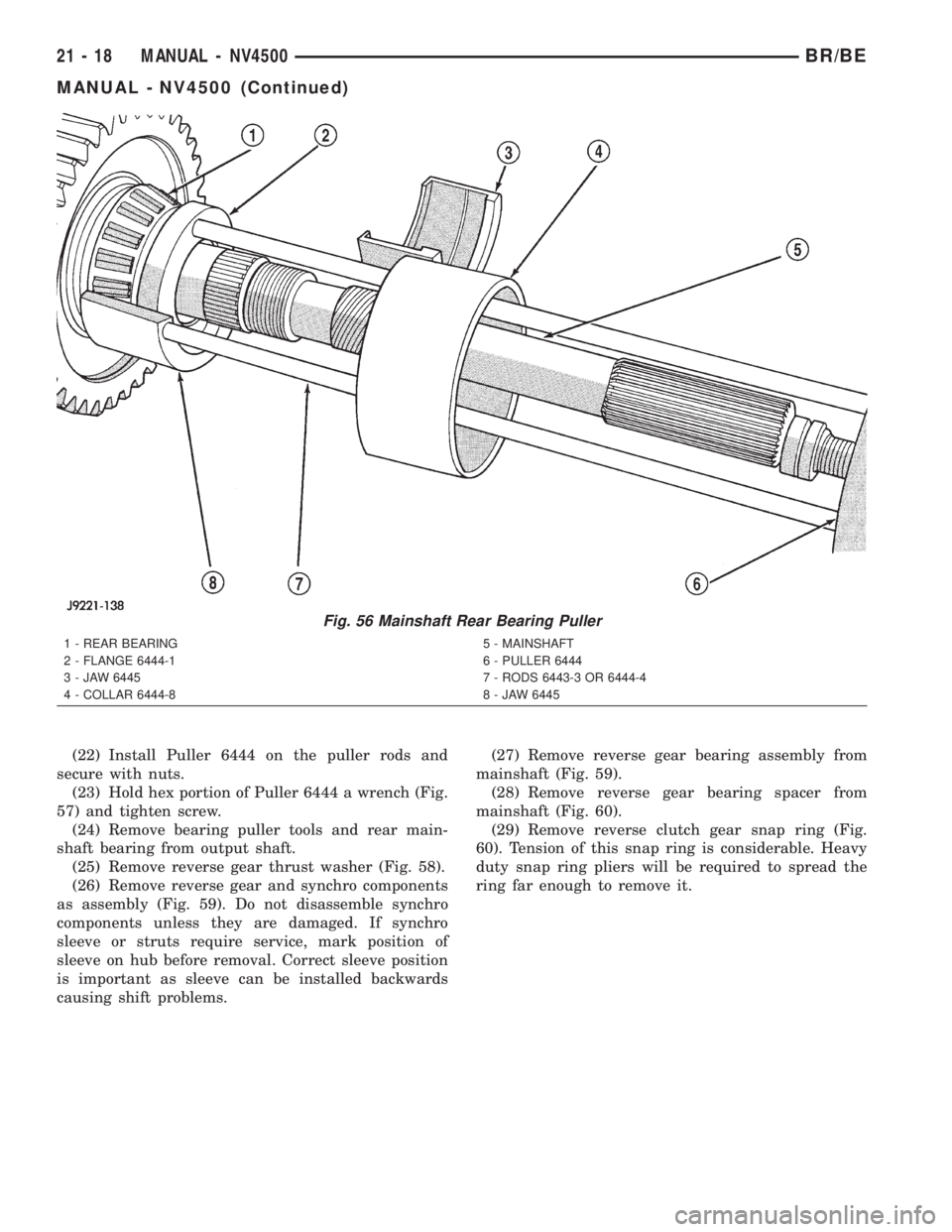
(22) Install Puller 6444 on the puller rods and
secure with nuts.
(23) Hold hex portion of Puller 6444 a wrench (Fig.
57) and tighten screw.
(24) Remove bearing puller tools and rear main-
shaft bearing from output shaft.
(25) Remove reverse gear thrust washer (Fig. 58).
(26) Remove reverse gear and synchro components
as assembly (Fig. 59). Do not disassemble synchro
components unless they are damaged. If synchro
sleeve or struts require service, mark position of
sleeve on hub before removal. Correct sleeve position
is important as sleeve can be installed backwards
causing shift problems.(27) Remove reverse gear bearing assembly from
mainshaft (Fig. 59).
(28) Remove reverse gear bearing spacer from
mainshaft (Fig. 60).
(29) Remove reverse clutch gear snap ring (Fig.
60). Tension of this snap ring is considerable. Heavy
duty snap ring pliers will be required to spread the
ring far enough to remove it.
Fig. 56 Mainshaft Rear Bearing Puller
1 - REAR BEARING
2 - FLANGE 6444-1
3 - JAW 6445
4 - COLLAR 6444-85 - MAINSHAFT
6 - PULLER 6444
7 - RODS 6443-3 OR 6444-4
8 - JAW 6445
21 - 18 MANUAL - NV4500BR/BE
MANUAL - NV4500 (Continued)
Page 1478 of 2255
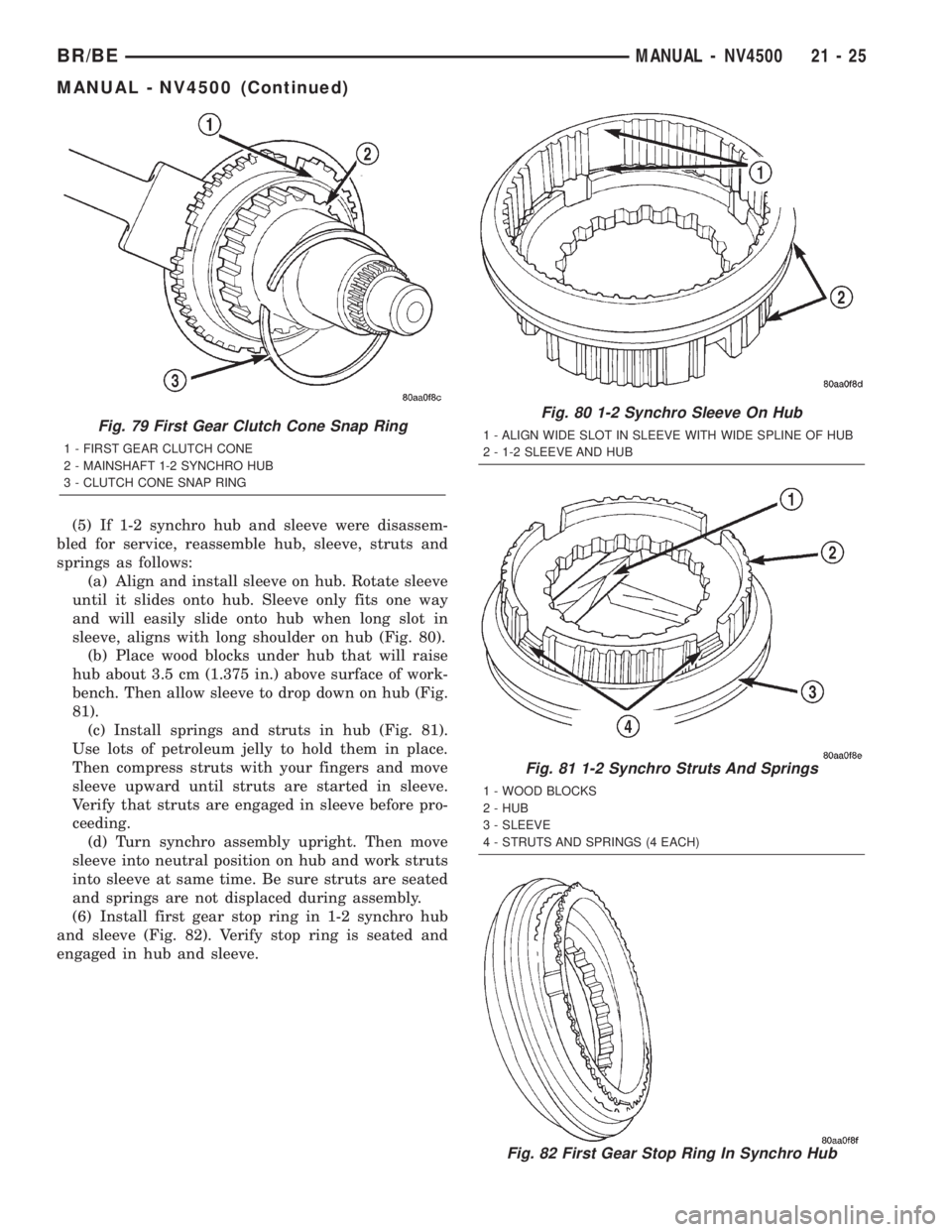
(5) If 1-2 synchro hub and sleeve were disassem-
bled for service, reassemble hub, sleeve, struts and
springs as follows:
(a) Align and install sleeve on hub. Rotate sleeve
until it slides onto hub. Sleeve only fits one way
and will easily slide onto hub when long slot in
sleeve, aligns with long shoulder on hub (Fig. 80).
(b) Place wood blocks under hub that will raise
hub about 3.5 cm (1.375 in.) above surface of work-
bench. Then allow sleeve to drop down on hub (Fig.
81).
(c) Install springs and struts in hub (Fig. 81).
Use lots of petroleum jelly to hold them in place.
Then compress struts with your fingers and move
sleeve upward until struts are started in sleeve.
Verify that struts are engaged in sleeve before pro-
ceeding.
(d) Turn synchro assembly upright. Then move
sleeve into neutral position on hub and work struts
into sleeve at same time. Be sure struts are seated
and springs are not displaced during assembly.
(6) Install first gear stop ring in 1-2 synchro hub
and sleeve (Fig. 82). Verify stop ring is seated and
engaged in hub and sleeve.
Fig. 79 First Gear Clutch Cone Snap Ring
1 - FIRST GEAR CLUTCH CONE
2 - MAINSHAFT 1-2 SYNCHRO HUB
3 - CLUTCH CONE SNAP RING
Fig. 80 1-2 Synchro Sleeve On Hub
1 - ALIGN WIDE SLOT IN SLEEVE WITH WIDE SPLINE OF HUB
2 - 1-2 SLEEVE AND HUB
Fig. 81 1-2 Synchro Struts And Springs
1 - WOOD BLOCKS
2 - HUB
3 - SLEEVE
4 - STRUTS AND SPRINGS (4 EACH)
Fig. 82 First Gear Stop Ring In Synchro Hub
BR/BEMANUAL - NV4500 21 - 25
MANUAL - NV4500 (Continued)
Page 1481 of 2255
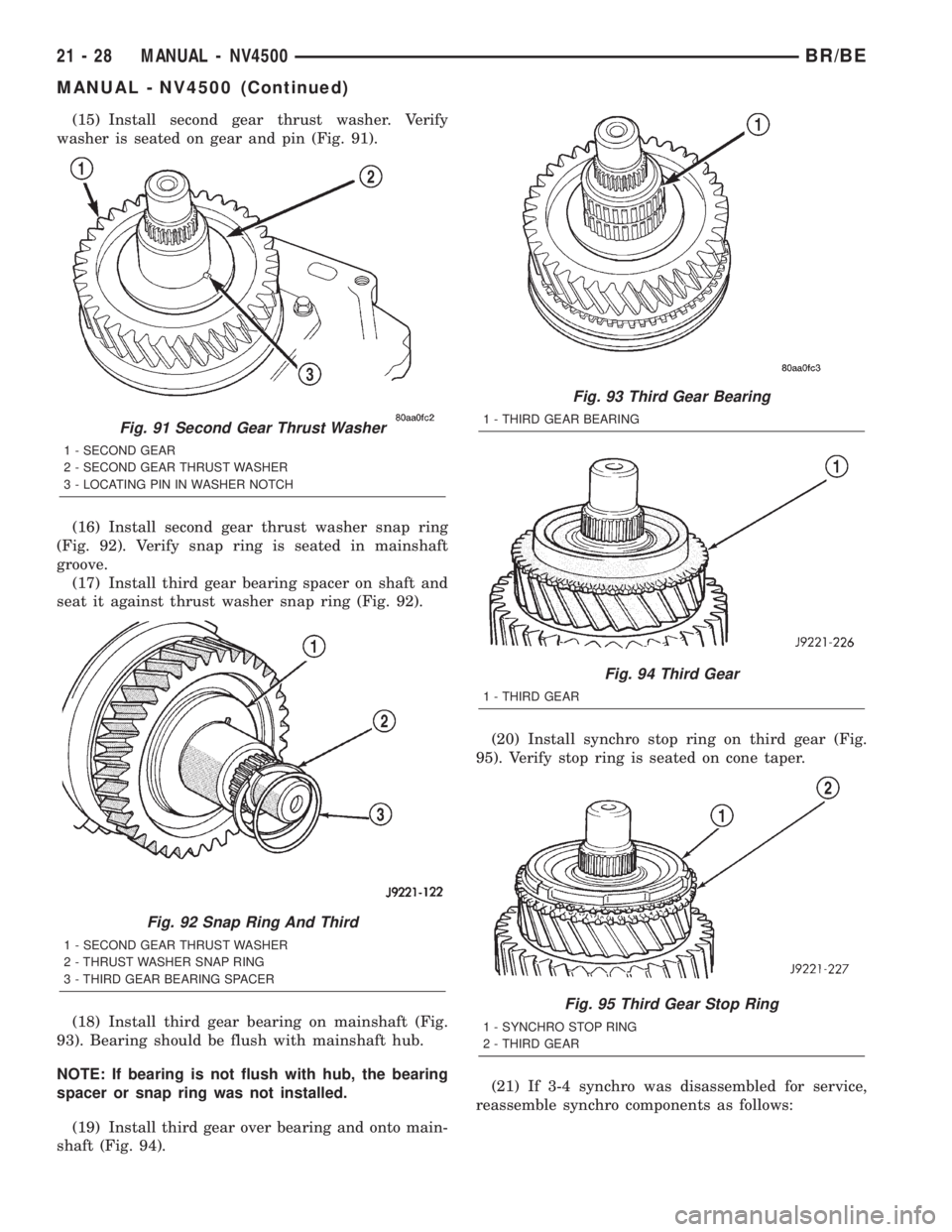
(15) Install second gear thrust washer. Verify
washer is seated on gear and pin (Fig. 91).
(16) Install second gear thrust washer snap ring
(Fig. 92). Verify snap ring is seated in mainshaft
groove.
(17) Install third gear bearing spacer on shaft and
seat it against thrust washer snap ring (Fig. 92).
(18) Install third gear bearing on mainshaft (Fig.
93). Bearing should be flush with mainshaft hub.
NOTE: If bearing is not flush with hub, the bearing
spacer or snap ring was not installed.
(19) Install third gear over bearing and onto main-
shaft (Fig. 94).(20) Install synchro stop ring on third gear (Fig.
95). Verify stop ring is seated on cone taper.
(21) If 3-4 synchro was disassembled for service,
reassemble synchro components as follows:
Fig. 91 Second Gear Thrust Washer
1 - SECOND GEAR
2 - SECOND GEAR THRUST WASHER
3 - LOCATING PIN IN WASHER NOTCH
Fig. 92 Snap Ring And Third
1 - SECOND GEAR THRUST WASHER
2 - THRUST WASHER SNAP RING
3 - THIRD GEAR BEARING SPACER
Fig. 93 Third Gear Bearing
1 - THIRD GEAR BEARING
Fig. 94 Third Gear
1 - THIRD GEAR
Fig. 95 Third Gear Stop Ring
1 - SYNCHRO STOP RING
2 - THIRD GEAR
21 - 28 MANUAL - NV4500BR/BE
MANUAL - NV4500 (Continued)
Page 1483 of 2255
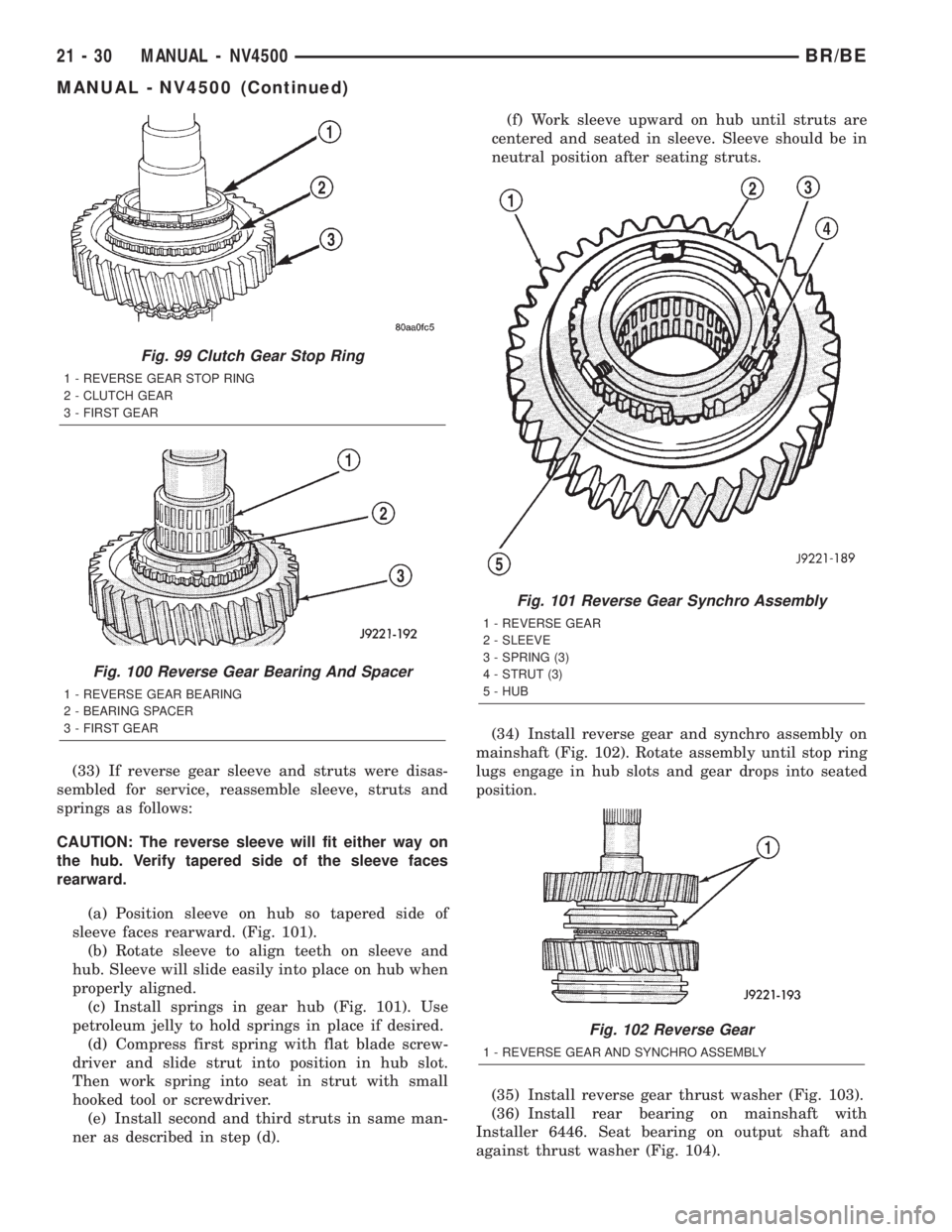
(33) If reverse gear sleeve and struts were disas-
sembled for service, reassemble sleeve, struts and
springs as follows:
CAUTION: The reverse sleeve will fit either way on
the hub. Verify tapered side of the sleeve faces
rearward.
(a) Position sleeve on hub so tapered side of
sleeve faces rearward. (Fig. 101).
(b) Rotate sleeve to align teeth on sleeve and
hub. Sleeve will slide easily into place on hub when
properly aligned.
(c) Install springs in gear hub (Fig. 101). Use
petroleum jelly to hold springs in place if desired.
(d) Compress first spring with flat blade screw-
driver and slide strut into position in hub slot.
Then work spring into seat in strut with small
hooked tool or screwdriver.
(e) Install second and third struts in same man-
ner as described in step (d).(f) Work sleeve upward on hub until struts are
centered and seated in sleeve. Sleeve should be in
neutral position after seating struts.
(34) Install reverse gear and synchro assembly on
mainshaft (Fig. 102). Rotate assembly until stop ring
lugs engage in hub slots and gear drops into seated
position.
(35) Install reverse gear thrust washer (Fig. 103).
(36) Install rear bearing on mainshaft with
Installer 6446. Seat bearing on output shaft and
against thrust washer (Fig. 104).
Fig. 99 Clutch Gear Stop Ring
1 - REVERSE GEAR STOP RING
2 - CLUTCH GEAR
3 - FIRST GEAR
Fig. 100 Reverse Gear Bearing And Spacer
1 - REVERSE GEAR BEARING
2 - BEARING SPACER
3 - FIRST GEAR
Fig. 101 Reverse Gear Synchro Assembly
1 - REVERSE GEAR
2 - SLEEVE
3 - SPRING (3)
4 - STRUT (3)
5 - HUB
Fig. 102 Reverse Gear
1 - REVERSE GEAR AND SYNCHRO ASSEMBLY
21 - 30 MANUAL - NV4500BR/BE
MANUAL - NV4500 (Continued)
Page 1552 of 2255
(2) Connect 100 psi Gauge C-3292 to accumulator
port. Then connect 300 psi Gauge C-3293-SP to rear
servo port.
(3) Disconnect throttle and gearshift cables from
levers on transmission valve body manual shaft.
(4) Have helper start and run engine at 1000 rpm.
(5) Move transmission shift lever fully forward
into 1 range.
(6) Gradually move transmission throttle lever
from full forward to full rearward position and note
pressures on both gauges:
²Line pressure at accumulator port should be
54-60 psi (372-414 kPa) with throttle lever forward
and gradually increase to 90-96 psi (621-662 kPa) as
throttle lever is moved rearward.
²Rear servo pressure should be same as line pres-
sure within 3 psi (20.68 kPa).
Test Two - Transmission In 2 Range
This test checks pump output, line pressure and
pressure regulation. Use 100 psi Test Gauge C-3292
for this test.
(1) Leave vehicle in place on hoist and leave Test
Gauge C-3292 connected to accumulator port.
(2) Have helper start and run engine at 1000 rpm.
(3) Move transmission shift lever one detent rear-
ward from full forward position. This is 2 range.
(4) Move transmission throttle lever from full for-
ward to full rearward position and read pressure on
gauge.
(5) Line pressure should be 54-60 psi (372-414
kPa) with throttle lever forward and gradually
increase to 90-96 psi (621-662 kPa) as lever is moved
rearward.
Test Three - Transmission In D Range Third Gear
This test checks pressure regulation and condition
of the clutch circuits. Both test gauges are required
for this test.
(1) Turn OD switch off.
(2) Leave vehicle on hoist and leave Gauge C-3292
in place at accumulator port.
(3) Move Gauge C-3293-SP over to front servo port
for this test.
(4) Have helper start and run engine at 1600 rpm
for this test.
(5) Move transmission shift lever two detents rear-
ward from full forward position. This is D range.
(6) Read pressures on both gauges as transmission
throttle lever is gradually moved from full forward to
full rearward position:
²Line pressure at accumulator in D range third
gear, should be 54-60 psi (372-414 kPa) with throttle
lever forward and increase as lever is moved rear-
ward.²Front servo pressure in D range third gear,
should be within 3 psi (21 kPa) of line pressure up to
kickdown point.
Test Four - Transmission In Reverse
This test checks pump output, pressure regulation
and the front clutch and rear servo circuits. Use 300
psi Test Gauge C-3293-SP for this test.
(1) Leave vehicle on hoist and leave gauge C-3292
in place at accumulator port.
(2) Move 300 psi Gauge C-3293-SP back to rear
servo port.
(3) Have helper start and run engine at 1600 rpm
for test.
(4) Move transmission shift lever four detents
rearward from full forward position. This is Reverse
range.
(5) Move transmission throttle lever fully forward
then fully rearward and note reading at Gauge
C-3293-SP.
(6) Pressure should be 145 - 175 psi (1000-1207
kPa) with throttle lever forward and increase to 230 -
280 psi (1586-1931 kPa) as lever is gradually moved
rearward.
Test Five - Governor Pressure
This test checks governor operation by measuring
governor pressure response to changes in vehicle
speed. It is usually not necessary to check governor
operation unless shift speeds are incorrect or if the
transmission will not downshift. The test should be
performed on the road or on a hoist that will allow
the rear wheels to rotate freely.
(1) Move 100 psi Test Gauge C-3292 to governor
pressure port.
(2) Move transmission shift lever two detents rear-
ward from full forward position. This is D range.
(3) Have helper start and run engine at curb idle
speed. Then firmly apply service brakes so wheels
will not rotate.
(4) Note governor pressure:
²
Governor pressure should be no more than 20.6
kPa (3 psi) at curb idle speed and wheels not rotating.
²If pressure exceeds 20.6 kPa (3 psi), a fault
exists in governor pressure control system.
(5) Release brakes, slowly increase engine speed,
and observe speedometer and pressure test gauge (do
not exceed 30 mph on speedometer). Governor pres-
sure should increase in proportion to vehicle speed.
Or approximately 6.89 kPa (1 psi) for every 1 mph.
(6) Governor pressure rise should be smooth and
drop back to no more than 20.6 kPa (3 psi), after
engine returns to curb idle and brakes are applied to
prevent wheels from rotating.
(7) Compare results of pressure test with analysis
chart.
BR/BEAUTOMATIC TRANSMISSION - 46RE 21 - 99
AUTOMATIC TRANSMISSION - 46RE (Continued)
Page 1555 of 2255
scored, either polish it with crocus cloth or replace
converter.
(5) Install new pump seal, O-ring, and gasket.
Replace oil pump if cracked, porous or damaged in
any way. Be sure to loosen the front band before
installing the oil pump, damage to the oil pump seal
may occur if the band is still tightened to the front
clutch retainer.
(6) Loosen kickdown lever pin access plug three
turns. Apply LoctiteŸ 592, or PermatextNo.2to
plug threads and tighten plug to 17 N´m (150 in. lbs.)
torque.
(7) Adjust front band.
(8) Lubricate pump seal and converter hub with
transmission fluid or petroleum jelly and install con-
verter.
(9) Install transmission and converter housing
dust shield.(10) Lower vehicle.
DIAGNOSIS AND TESTING - DIAGNOSIS
CHARTS
The diagnosis charts provide additional reference
when diagnosing a transmission fault. The charts
provide general information on a variety of transmis-
sion, overdrive unit and converter clutch fault condi-
tions.
The hydraulic flow charts in the Schematics and
Diagrams section of this group, outline fluid flow and
hydraulic circuitry. Circuit operation is provided for
PARK, NEUTRAL, FIRST, SECOND, THIRD,
FOURTH, MANUAL FIRST, MANUAL SECOND,
and REVERSE gear ranges. Normal working pres-
sures are also supplied for each of the gear ranges.
DIAGNOSIS CHARTS
CONDITION POSSIBLE CAUSES CORRECTION
HARSH ENGAGEMENT
(FROM NEUTRAL TO
DRIVE OR REVERSE)1. Fluid Level Low. 1. Add Fluid
2. Throttle Linkage Mis-adjusted. 2. Adjust linkage - setting may be too long.
3. Mount and Driveline Bolts Loose. 3. Check engine mount, transmission
mount, propeller shaft, rear spring to body
bolts, rear control arms, crossmember and
axle bolt torque. Tighten loose bolts and
replace missing bolts.
4. U-Joint Worn/Broken. 4. Remove propeller shaft and replace
U-Joint.
5. Axle Backlash Incorrect. 5. Check per Service Manual. Correct as
needed.
6. Hydraulic Pressure Incorrect. 6. Check pressure. Remove, overhaul or
adjust valve body as needed.
7. Band Mis-adjusted. 7. Adjust rear band.
8. Valve Body Check Balls Missing. 8. Inspect valve body for proper check ball
installation.
9. Axle Pinion Flange Loose. 9. Replace nut and check pinion threads
before installing new nut. Replace pinion
gear if threads are damaged.
10. Clutch, band or planetary
component damaged.10. Remove, disassemble and repair
transmission as necessary.
11. Converter Clutch Faulty. 11. Replace converter and flush cooler and
line before installing new converter.
21 - 102 AUTOMATIC TRANSMISSION - 46REBR/BE
AUTOMATIC TRANSMISSION - 46RE (Continued)
Page 1557 of 2255
CONDITION POSSIBLE CAUSES CORRECTION
NO DRIVE OR REVERSE
(VEHICLE WILL NOT
MOVE)1. Fluid Level Low. 1. Add fluid and check for leaks if drive is
restored.
2. Gearshift Linkage/Cable
Loose/Misadjusted.2. Inspect, adjust and reassemble linkage
as needed. Replace worn/damaged parts.
3. U-Joint/Axle/Transfer Case
Broken.3. Perform preliminary inspection procedure
for vehicle that will not move. Refer to
procedure in diagnosis section.
4. Filter Plugged. 4. Remove and disassemble transmission.
Repair or replace failed components as
needed. Replace filter. If filter and fluid
contained clutch material or metal particles,
an overhaul may be necessary. Perform
lube flow test. Flush oil. Replace cooler as
necessary.
5. Oil Pump Damaged. 5. Perform pressure test to confirm low
pressure. Replace pump body assembly if
necessary.
6. Valve Body Malfunctioned. 6. Check and inspect valve body. Replace
valve body (as assembly) if any valve or
bore is damaged. Clean and reassemble
correctly if all parts are in good condition.
7. Transmission Internal Component
Damaged.7. Remove and disassemble transmission.
Repair or replace failed components as
needed.
8. Park Sprag not Releasing - Check
Stall Speed, Worn/Damaged/Stuck.8. Remove, disassemble, repair.
9. Torque Converter Damage. 9. Inspect and replace as required.
SHIFTS DELAYED OR
ERRATIC (SHIFTS ALSO
HARSH AT TIMES)1. Fluid Level Low/High. 1. Correct fluid level and check for leaks if
low.
2. Fluid Filter Clogged. 2. Replace filter. If filter and fluid contained
clutch material or metal particles, an
overhaul may be necessary. Perform lube
flow test.
3. Throttle Linkage Mis-adjusted. 3. Adjust linkage as described in service
section.
4. Throttle Linkage Binding. 4. Check cable for binding. Check for return
to closed throttle at transmission.
5. Gearshift Linkage/Cable
Mis-adjusted.5. Adjust linkage/cable as described in
service section.
6. Clutch or Servo Failure. 6. Remove valve body and air test clutch,
and band servo operation. Disassemble
and repair transmission as needed.
7. Governor Circuit Electrical Fault. 7. Test using DRBTscan tool and repair as
required.
8. Front Band Mis-adjusted. 8. Adjust band.
9. Pump Suction Passage Leak. 9. Check for excessive foam on dipstick
after normal driving. Check for loose pump
bolts, defective gasket. Replace pump
assembly if needed.
21 - 104 AUTOMATIC TRANSMISSION - 46REBR/BE
AUTOMATIC TRANSMISSION - 46RE (Continued)