Page 314 of 486

4-23
The exit speed is usually posted.
Reduce your speed according to your speedometer, not
to your sense of motion. After driving for any distance
at higher speeds, you may tend to think you are going
slower than you actually are.
Before Leaving on a Long Trip
Make sure you're ready. Try to be well rested. If you
must start when you're not fresh
-- such as after a day's
work
-- don't plan to make too many miles that first part
of the journey. Wear comfortable clothing and shoes you
can easily drive in.
Is your vehicle ready for a long trip? If you keep it
serviced and maintained, it's ready to go. If it needs
service, have it done before starting out. Of course,
you'll find experienced and able service experts in
Chevrolet dealerships all across North America.
They'll be ready and willing to help if you need it.Here are some things you can check before a trip:
�Windshield Washer Fluid: Is the reservoir full?
Are all windows clean inside and outside?
�Wiper Blades: Are they in good shape?
�Fuel, Engine Oil, Other Fluids: Have you checked
all levels?
�Lamps: Are they all working? Are the lenses clean?
�Tires: They are vitally important to a safe,
trouble-free trip. Is the tread good enough for
long
-distance driving? Are the tires all inflated to the
recommended pressure?
�Weather Forecasts: What's the weather outlook
along your route? Should you delay your trip a short
time to avoid a major storm system?
�Maps: Do you have up
-to-date maps?
Page 377 of 486
6-5
To provide cleaner air, all gasolines in the United States
are now required to contain additives that will help
prevent engine and fuel system deposits from forming,
allowing your emission control system to work properly.
You should not have to add anything to your fuel.
Gasolines containing oxygenates, such as ethers and
ethanol, and reformulated gasolines may be available in
your area to contribute to clean air. General Motors
recommends that you use these gasolines, particularly if
they comply with the specifications described earlier.
NOTICE:
Your vehicle was not designed for fuel that
contains methanol. Don't use fuel containing
methanol. It can corrode metal parts in your
fuel system and also damage plastic and rubber
parts. That damage wouldn't be covered under
your warranty.
Fuels in Foreign Countries
If you plan on driving in another country outside the
United States or Canada, the proper fuel may be hard to
find. Never use leaded gasoline or any other fuel not
recommended in the previous text on fuel. Costly repairs
caused by use of improper fuel wouldn't be covered by
your warranty.
To check on fuel availability, ask an auto club, or
contact a major oil company that does business in the
country where you'll be driving.
Filling Your Tank
CAUTION:
Gasoline vapor is highly flammable. It burns
violently, and that can cause very bad injuries.
Don't smoke if you're near gasoline or refueling
your vehicle. Keep sparks, flames and smoking
materials away from gasoline.
Page 386 of 486
6-14 What Kind of Engine Oil to Use
Oils recommended for your vehicle can be identified by
looking for the starburst symbol.
This symbol indicates that the oil has been certified by
the American Petroleum Institute (API). Do not use any
oil which does not carry this starburst symbol.
If you change your own oil,
be sure you use oil that has
the starburst symbol on the
front of the oil container. If
you have your oil changed
for you, be sure the oil put
into your engine is
American Petroleum
Institute certified for
gasoline engines.
You should also use the proper viscosity oil for your
vehicle, as shown in the following chart:
Page 387 of 486
6-15
As in the chart shown previously, SAE 5W-30 is best for
your vehicle. However, you can use SAE 10W
-30 if it's
going to be 0�F (
-18�C) or above. These numbers on an
oil container show its viscosity, or thickness. Do not use
other viscosity oils, such as SAE 20W
-50.
NOTICE:
Use only engine oil with the American Petroleum
Institute Certified For Gasoline Engines
starburst symbol. Failure to use the
recommended oil can result in engine damage not
covered by your warranty.
GM Goodwrench� oil meets all the requirements for
your vehicle.
If you are in an area where the temperature falls
below
-20�F (-29�C), consider using either an
SAE 5W
-30 synthetic oil or an SAE 0W-30 oil.
Both will provide easier cold starting and better
protection for your engine at extremely
low temperatures.
Engine Oil Additives
Don't add anything to your oil. The recommended oils
with the starburst symbol are all you will need for good
performance and engine protection.
Page 398 of 486
6-26
What to Use
Refer to the Maintenance Schedule to determine what
kind of lubricant to use. See ªRecommended Fluids and
Lubricantsº in the Index.
Engine Coolant
The cooling system in your vehicle is filled with
DEX
-COOL� engine coolant. This coolant is designed
to remain in your vehicle for 5 years or 150,000 miles
(240 000 km), whichever occurs first, if you add only
DEX
-COOL� extended life coolant.
The following explains your cooling system and how
to add coolant when it is low. If you have a problem
with engine overheating, see ªEngine Overheatingº in
the Index.
A 50/50 mixture of clean, drinkable water and
DEX
-COOL� coolant will:
�Give freezing protection down to
-34�F (-37�C).
�Give boiling protection up to 265�F (129�C).�Protect against rust and corrosion.
�Help keep the proper engine temperature.
�Let the warning messages and gages work as
they should.
NOTICE:
When adding coolant, it is important that you use
only DEX
-COOL� (silicate-free) coolant.
If coolant other than DEX-COOL is added to the
system, premature engine, heater core or
radiator corrosion may result. In addition, the
engine coolant will require change sooner
-- at
30,000 miles (50 000 km) or 24 months,
whichever occurs first. Damage caused by the
use of coolant other than DEX
-COOL� is not
covered by your new vehicle warranty.
Page 405 of 486
6-33
United States Canada
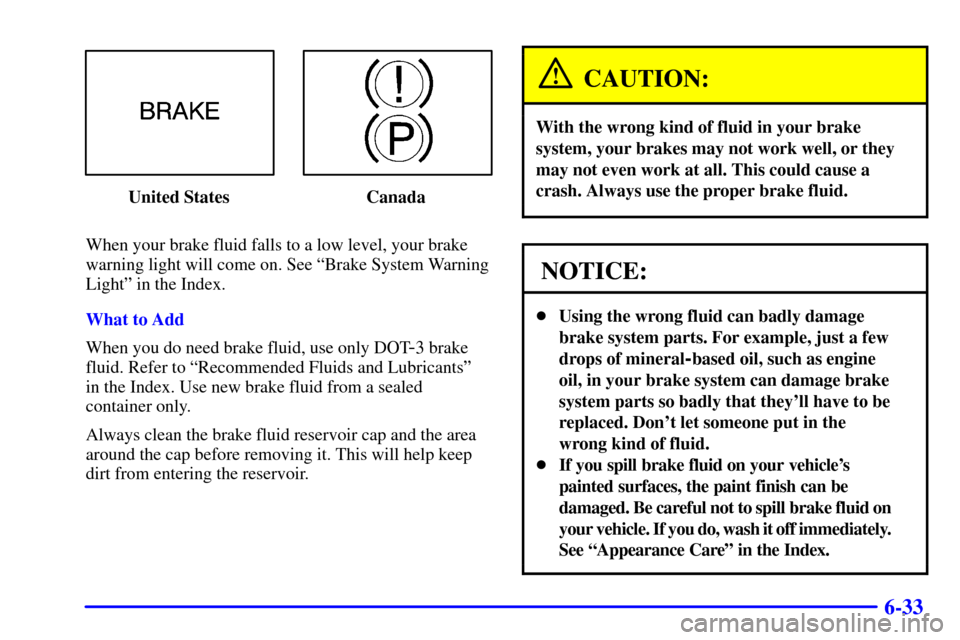
When your brake fluid falls to a low level, your brake
warning light will come on. See ªBrake System Warning
Lightº in the Index.
What to Add
When you do need brake fluid, use only DOT
-3 brake
fluid. Refer to ªRecommended Fluids and Lubricantsº
in the Index. Use new brake fluid from a sealed
container only.
Always clean the brake fluid reservoir cap and the area
around the cap before removing it. This will help keep
dirt from entering the reservoir.
CAUTION:
With the wrong kind of fluid in your brake
system, your brakes may not work well, or they
may not even work at all. This could cause a
crash. Always use the proper brake fluid.
NOTICE:
�Using the wrong fluid can badly damage
brake system parts. For example, just a few
drops of mineral
-based oil, such as engine
oil, in your brake system can damage brake
system parts so badly that they'll have to be
replaced. Don't let someone put in the
wrong kind of fluid.
�If you spill brake fluid on your vehicle's
painted surfaces, the paint finish can be
damaged. Be careful not to spill brake fluid on
your vehicle. If you do, wash it off immediately.
See ªAppearance Careº in the Index.
Page 445 of 486

6-73
Capacities and Specifications
The following approximate capacities are given in
English and metric measurements.
Please refer to ªRecommended Fluids and Lubricantsº
in the Index for more information.
Automatic Transaxle
Pan Removal
and Replacement 7.4 quarts (7.0 L). . . . . . . . . . . . .
Complete Overhaul 10.0 quarts (9.5 L). . . . . . . . . . .
AWD Automatic Transaxle
Pan Removal
and Replacement 8.7 quarts (8.3 L). . . . . . . . . . . . .
Complete Overhaul 10.8 quarts (10.3 L). . . . . . . . . .
Cooling System
With A/C 9.6 quarts (9.1 L). . . . . . . . . . . . . . . . . . . .
With Rear Climate Control 11.9 quarts (11.3 L). . . . . Engine Oil with Filter4.5 quarts (4.25 L) . . . . . . . .
Fuel Capacity
Standard/Regular 20.0 U.S. gallons (75.0 L). . . . . . .
Optional/Extended 25.1 U.S. gallons (95.0 L). . . . . .
Wheel Nut Torque100 lb
-ft (140 N´m) . . . . . . . . . .
All capacities are approximate. When adding, be
sure to fill to the appropriate level, as recommended
in this manual.
Engine Specifications
Engine VIN Code E. . . . . . . . . . . . . . . . . . . . . . . . . . .
Engine Type V6. . . . . . . . . . . . . . . . . . . . . . . . . . . . . .
Firing Order 1
-2-3-4-5-6 . . . . . . . . . . . . . . . . . . . . . .
Page 446 of 486

6-74
Air Conditioning
Refrigerant Capacity
If you do your own service work, you'll need the proper
service manual. See ªDoing Your Own Service Workº in
the Index for additional information. It is recommended
that service work on your air conditioning system be
performed by a qualified technician.
Air Conditioning Refrigerant Systems
Front A/C 1.7 lbs. (0.8 kg). . . . . . . . . . . . . . . . . . . .
Front and Rear A/C 2.2 lbs. (1.0 kg). . . . . . . . . . . . .
Use Refrigerant Oil, R134a Systems
Normal Maintenance
Replacement Parts
Engine Air Cleaner/Filter A-1208C* . . . . . . . . . . . . . .
Engine Oil Filter PF47. . . . . . . . . . . . . . . . . . . . . . . .
Passenger Compartment
Air Filter (2) GM Part No. 52482929. . . . . . . . . . . .
Spark Plugs 41
-940* . . . . . . . . . . . . . . . . . . . . . . . . . .
Gap: 0.060 inches (1.5 mm)
Windshield Wiper Blades
Length 24.0 inches (60.0 cm). . . . . . . . . . . . . . . . . .
Type Shepherd's Hook. . . . . . . . . . . . . . . . . . . . . . . .
Wiper Blade (Backglass)
Length 16.0 inches (40.6 cm). . . . . . . . . . . . . . . . . .
Type Shepherd's Hook. . . . . . . . . . . . . . . . . . . . . . . .
* ACDelco
� part number.