Page 7 of 486
1-
1-1
Section 1 Seats and Restraint Systems
Here you'll find information about the seats in your vehicle and how to use your safety belts properly. You can also
learn about some things you should not do with air bags and safety belts.
1
-2 Seats and Seat Controls
1
-6 Rear Seats
1
-30 Safety Belts: They're for Everyone
1
-34 Here Are Questions Many People Ask
About Safety Belts
-- and the Answers
1
-35 How to Wear Safety Belts Properly
1
-36 Driver Position
1
-44 Safety Belt Use During Pregnancy
1
-45 Right Front Passenger Position
1
-45 Air Bag Systems
1
-54 Safety Belt Pretensioners1
-54 Rear Seat Passengers
1
-58 Rear Safety Belt Comfort Guides for
Children and Small Adults
1
-60 Center Passenger Position (Bench Seat)
1
-62 Center Passenger Position (Bucket Seat)
1
-63 Children
1
-67 Built-in Child Restraint (Option)
1
-79 Restraint Systems for Children
1
-98 Older Children
1
-101 Safety Belt Extender
1
-101 Checking Your Restraint Systems
1
-102 Replacing Restraint System Parts
After a Crash
Page 13 of 486
1-7
Flip and Fold Feature
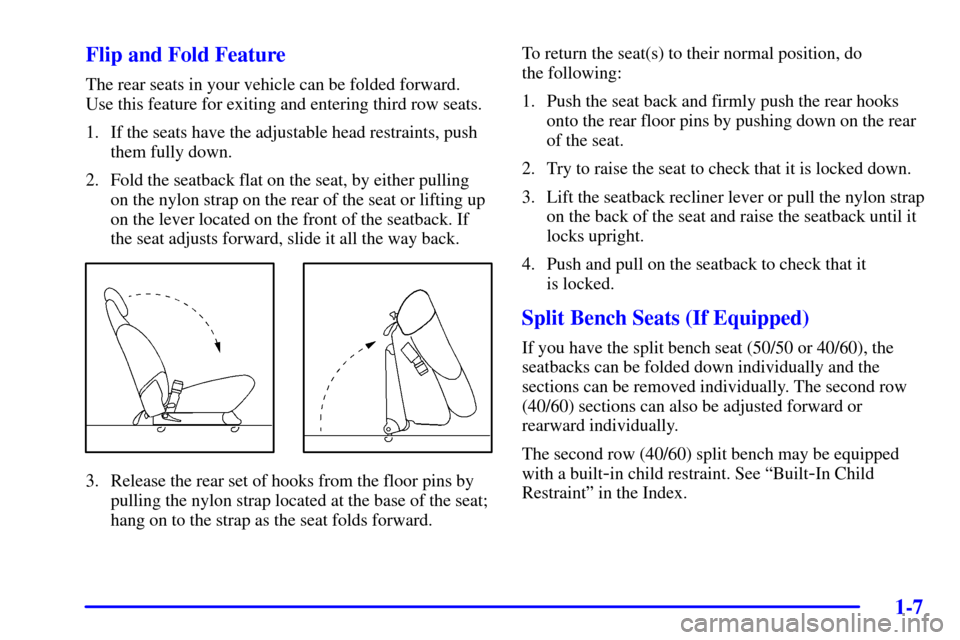
The rear seats in your vehicle can be folded forward.
Use this feature for exiting and entering third row seats.
1. If the seats have the adjustable head restraints, push
them fully down.
2. Fold the seatback flat on the seat, by either pulling
on the nylon strap on the rear of the seat or lifting up
on the lever located on the front of the seatback. If
the seat adjusts forward, slide it all the way back.
3. Release the rear set of hooks from the floor pins by
pulling the nylon strap located at the base of the seat;
hang on to the strap as the seat folds forward.To return the seat(s) to their normal position, do
the following:
1. Push the seat back and firmly push the rear hooks
onto the rear floor pins by pushing down on the rear
of the seat.
2. Try to raise the seat to check that it is locked down.
3. Lift the seatback recliner lever or pull the nylon strap
on the back of the seat and raise the seatback until it
locks upright.
4. Push and pull on the seatback to check that it
is locked.
Split Bench Seats (If Equipped)
If you have the split bench seat (50/50 or 40/60), the
seatbacks can be folded down individually and the
sections can be removed individually. The second row
(40/60) sections can also be adjusted forward or
rearward individually.
The second row (40/60) split bench may be equipped
with a built
-in child restraint. See ªBuilt-In Child
Restraintº in the Index.
Page 64 of 486
1-58
Rear Safety Belt Comfort Guides for
Children and Small Adults
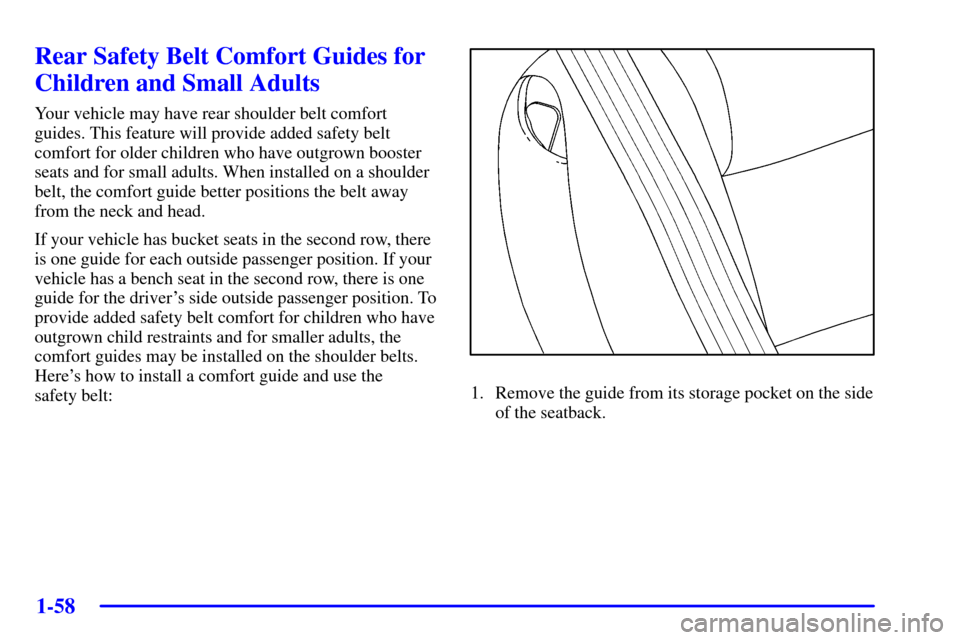
Your vehicle may have rear shoulder belt comfort
guides. This feature will provide added safety belt
comfort for older children who have outgrown booster
seats and for small adults. When installed on a shoulder
belt, the comfort guide better positions the belt away
from the neck and head.
If your vehicle has bucket seats in the second row, there
is one guide for each outside passenger position. If your
vehicle has a bench seat in the second row, there is one
guide for the driver's side outside passenger position. To
provide added safety belt comfort for children who have
outgrown child restraints and for smaller adults, the
comfort guides may be installed on the shoulder belts.
Here's how to install a comfort guide and use the
safety belt:
1. Remove the guide from its storage pocket on the side
of the seatback.
Page 72 of 486
1-66
Q:What are the different types of add-on
child restraints?
A:Add-on child restraints, which are purchased by the
vehicle's owner, are available in four basic types.
Selection of a particular restraint should take into
consideration not only the child's weight, height
and age but also whether or not the restraint will be
compatible with the motor vehicle in which it will
be used.
For most basic types of child restraints, there are
many different models available. When purchasing
a child restraint, be sure it is designed to be used in
a motor vehicle. If it is, the restraint will have a
label saying that it meets federal motor vehicle
safety standards.
The restraint manufacturer's instructions that come
with the restraint state the weight and height
limitations for a particular child restraint. In
addition, there are many kinds of restraints
available for children with special needs.
CAUTION:
Newborn infants need complete support,
including support for the head and neck. This is
necessary because a newborn infant's neck is
weak and its head weighs so much compared with
the rest of its body. In a crash, an infant in a
rear
-facing seat settles into the restraint, so the
crash forces can be distributed across the
strongest part of an infant's body, the back and
shoulders. Infants always should be secured in
appropriate infant restraints.
Page 73 of 486
1-67
CAUTION:
The body structure of a young child is quite
unlike that of an adult or older child, for whom
the safety belts are designed. A young child's hip
bones are still so small that the vehicle's regular
safety belt may not remain low on the hip bones,
as it should. Instead, it may settle up around the
child's abdomen. In a crash, the belt would apply
force on a body area that's unprotected by any
bony structure. This alone could cause serious or
fatal injuries. Young children always should be
secured in appropriate child restraints.
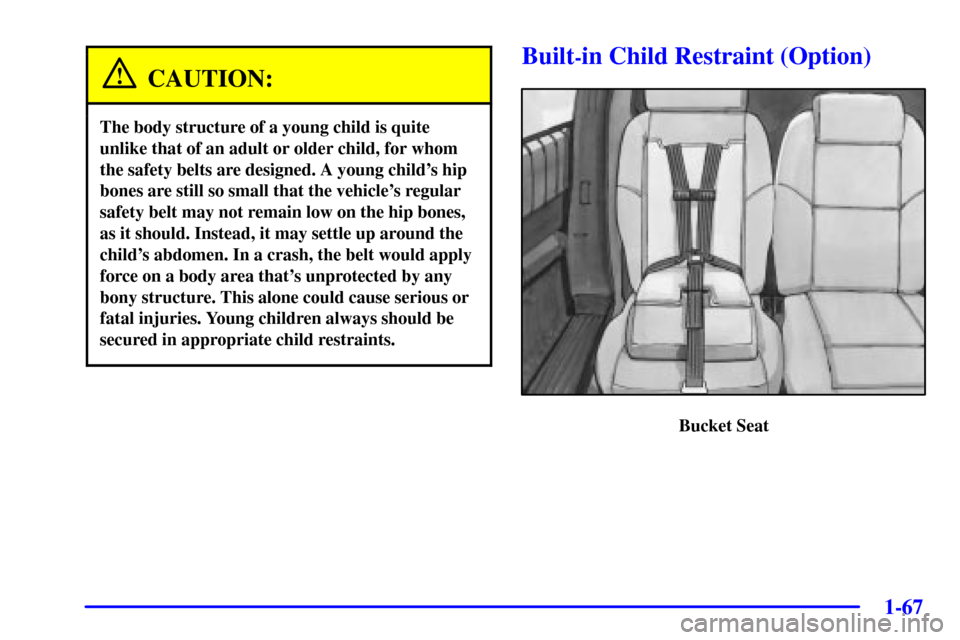
Built-in Child Restraint (Option)
Bucket Seat
Page 74 of 486
1-68
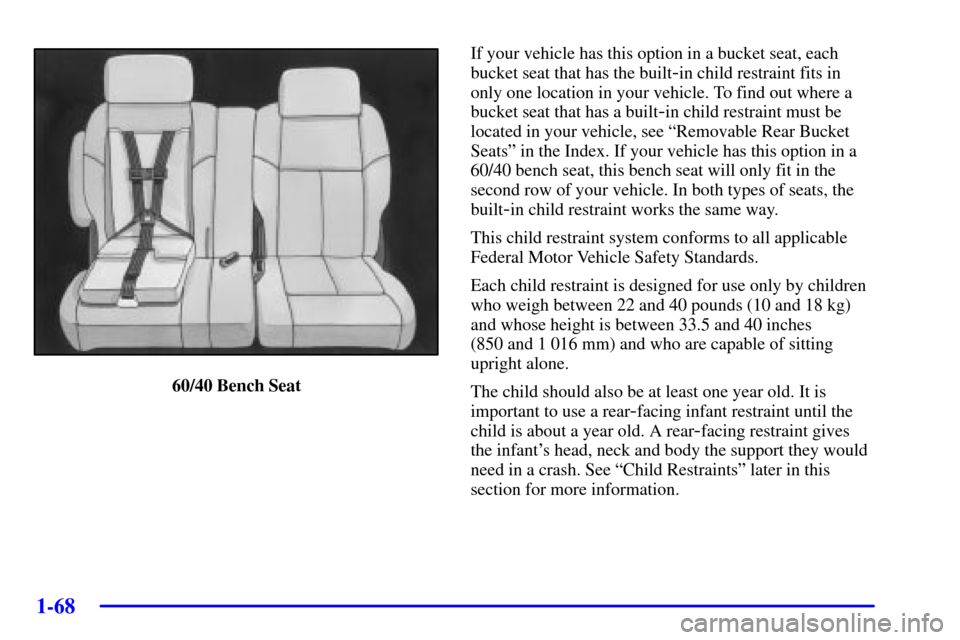
60/40 Bench SeatIf your vehicle has this option in a bucket seat, each
bucket seat that has the built
-in child restraint fits in
only one location in your vehicle. To find out where a
bucket seat that has a built
-in child restraint must be
located in your vehicle, see ªRemovable Rear Bucket
Seatsº in the Index. If your vehicle has this option in a
60/40 bench seat, this bench seat will only fit in the
second row of your vehicle. In both types of seats, the
built
-in child restraint works the same way.
This child restraint system conforms to all applicable
Federal Motor Vehicle Safety Standards.
Each child restraint is designed for use only by children
who weigh between 22 and 40 pounds (10 and 18 kg)
and whose height is between 33.5 and 40 inches
(850 and 1 016 mm) and who are capable of sitting
upright alone.
The child should also be at least one year old. It is
important to use a rear
-facing infant restraint until the
child is about a year old. A rear
-facing restraint gives
the infant's head, neck and body the support they would
need in a crash. See ªChild Restraintsº later in this
section for more information.
Page 75 of 486
1-69
Q:What if the top of my child's shoulders is above
the shoulder belt slots for the five
-point child
restraint harness system?
A:A child whose shoulders are above the shoulder
belt slots for the five
-point child restraint harness
system shouldn't use this child restraint. Instead,
the child should sit on the vehicle's regular seat
cushion and use the vehicle's adult safety belts.
CAUTION:
BEFORE YOU USE THIS CHILD RESTRAINT,
BE SURE THE TOP OF THE CHILD'S
SHOULDERS IS BELOW THE SLOTS THAT
THE HARNESS GOES THROUGH. A CHILD
WHOSE SHOULDERS ARE ABOVE THOSE
SLOTS COULD BE INJURED DURING A
SUDDEN STOP OR CRASH. IF THE TOP OF
THE CHILD'S SHOULDERS IS ABOVE THE
SLOTS, DON'T USE THIS CHILD RESTRAINT
WHILE THE VEHICLE IS IN MOTION.
Page 76 of 486
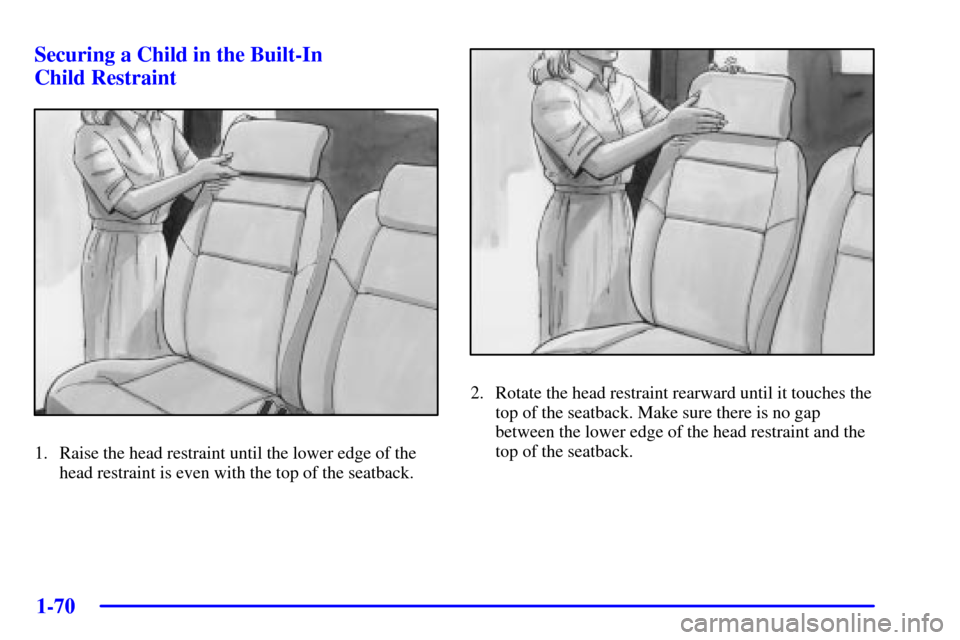
1-70 Securing a Child in the Built-In
Child Restraint
1. Raise the head restraint until the lower edge of the
head restraint is even with the top of the seatback.
2. Rotate the head restraint rearward until it touches the
top of the seatback. Make sure there is no gap
between the lower edge of the head restraint and the
top of the seatback.