Page 7 of 486
1-
1-1
Section 1 Seats and Restraint Systems
Here you'll find information about the seats in your vehicle and how to use your safety belts properly. You can also
learn about some things you should not do with air bags and safety belts.
1
-2 Seats and Seat Controls
1
-6 Rear Seats
1
-30 Safety Belts: They're for Everyone
1
-34 Here Are Questions Many People Ask
About Safety Belts
-- and the Answers
1
-35 How to Wear Safety Belts Properly
1
-36 Driver Position
1
-44 Safety Belt Use During Pregnancy
1
-45 Right Front Passenger Position
1
-45 Air Bag Systems
1
-54 Safety Belt Pretensioners1
-54 Rear Seat Passengers
1
-58 Rear Safety Belt Comfort Guides for
Children and Small Adults
1
-60 Center Passenger Position (Bench Seat)
1
-62 Center Passenger Position (Bucket Seat)
1
-63 Children
1
-67 Built-in Child Restraint (Option)
1
-79 Restraint Systems for Children
1
-98 Older Children
1
-101 Safety Belt Extender
1
-101 Checking Your Restraint Systems
1
-102 Replacing Restraint System Parts
After a Crash
Page 11 of 486
1-5
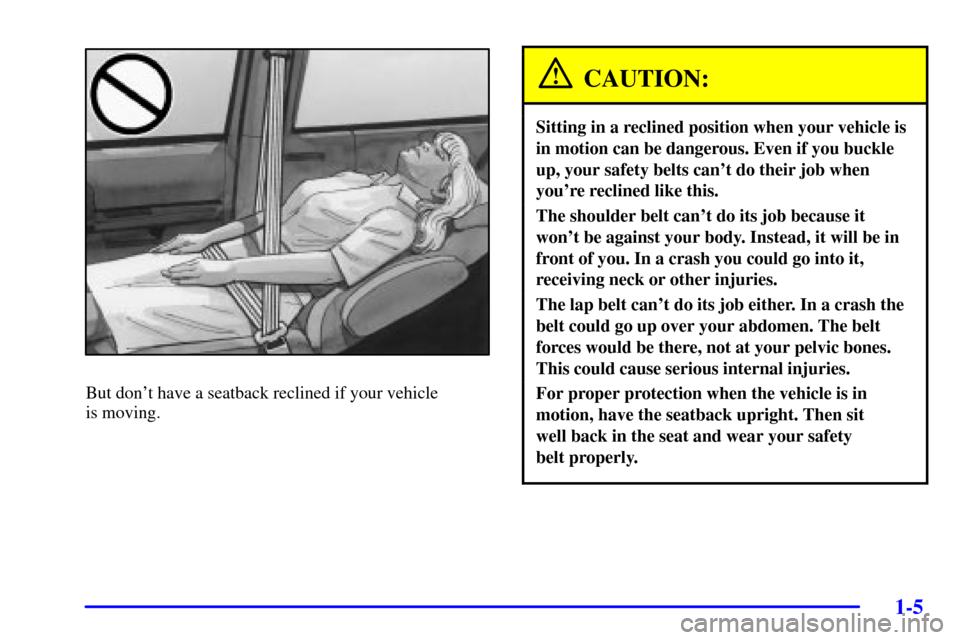
But don't have a seatback reclined if your vehicle
is moving.
CAUTION:
Sitting in a reclined position when your vehicle is
in motion can be dangerous. Even if you buckle
up, your safety belts can't do their job when
you're reclined like this.
The shoulder belt can't do its job because it
won't be against your body. Instead, it will be in
front of you. In a crash you could go into it,
receiving neck or other injuries.
The lap belt can't do its job either. In a crash the
belt could go up over your abdomen. The belt
forces would be there, not at your pelvic bones.
This could cause serious internal injuries.
For proper protection when the vehicle is in
motion, have the seatback upright. Then sit
well back in the seat and wear your safety
belt properly.
Page 12 of 486
1-6 Head Restraints
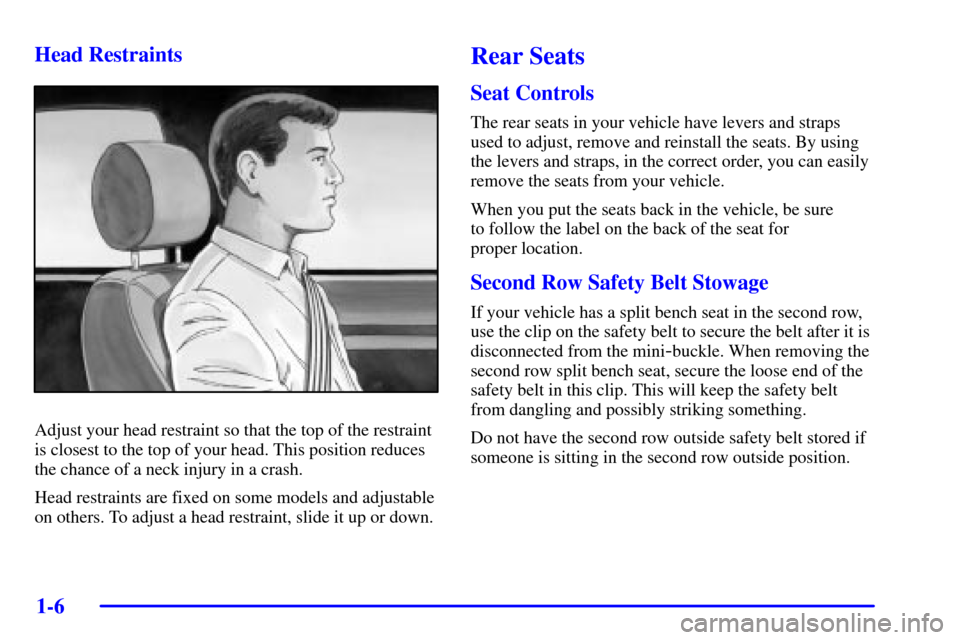
Adjust your head restraint so that the top of the restraint
is closest to the top of your head. This position reduces
the chance of a neck injury in a crash.
Head restraints are fixed on some models and adjustable
on others. To adjust a head restraint, slide it up or down.
Rear Seats
Seat Controls
The rear seats in your vehicle have levers and straps
used to adjust, remove and reinstall the seats. By using
the levers and straps, in the correct order, you can easily
remove the seats from your vehicle.
When you put the seats back in the vehicle, be sure
to follow the label on the back of the seat for
proper location.
Second Row Safety Belt Stowage
If your vehicle has a split bench seat in the second row,
use the clip on the safety belt to secure the belt after it is
disconnected from the mini
-buckle. When removing the
second row split bench seat, secure the loose end of the
safety belt in this clip. This will keep the safety belt
from dangling and possibly striking something.
Do not have the second row outside safety belt stored if
someone is sitting in the second row outside position.
Page 16 of 486
1-10
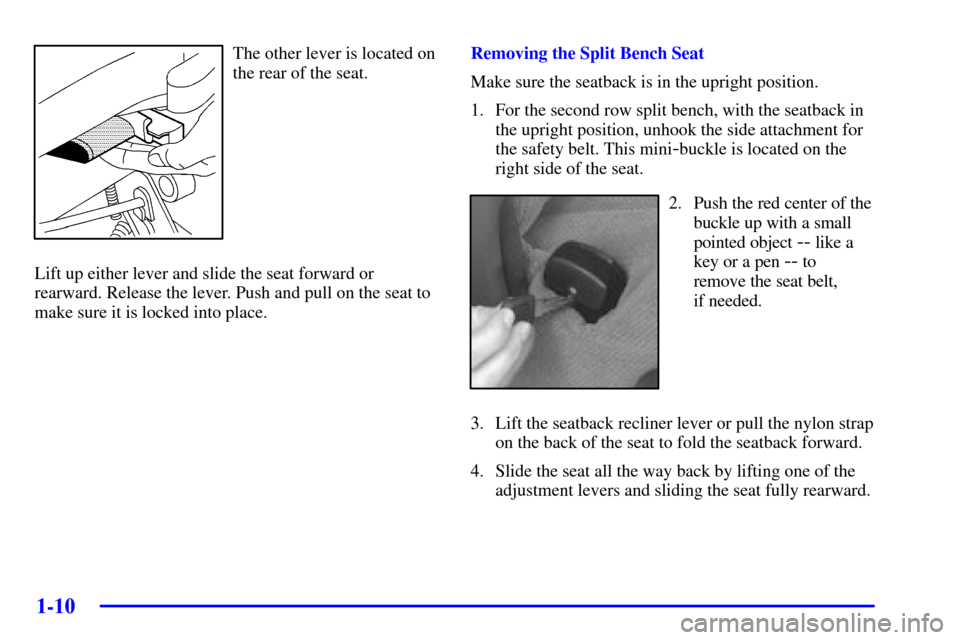
The other lever is located on
the rear of the seat.
Lift up either lever and slide the seat forward or
rearward. Release the lever. Push and pull on the seat to
make sure it is locked into place.Removing the Split Bench Seat
Make sure the seatback is in the upright position.
1. For the second row split bench, with the seatback in
the upright position, unhook the side attachment for
the safety belt. This mini
-buckle is located on the
right side of the seat.
2. Push the red center of the
buckle up with a small
pointed object
-- like a
key or a pen
-- to
remove the seat belt,
if needed.
3. Lift the seatback recliner lever or pull the nylon strap
on the back of the seat to fold the seatback forward.
4. Slide the seat all the way back by lifting one of the
adjustment levers and sliding the seat fully rearward.
Page 18 of 486
1-12
Replacing the Split Bench Sections
CAUTION:
If the seatback isn't locked, it could move
forward in a sudden stop or crash. That could
cause injury to the person sitting there. Always
press rearward on the seatback to be sure it
is locked.
CAUTION:
A seat that isn't locked into place properly can
move around in a collision or sudden stop. People
in the vehicle could be injured. Be sure to lock
the seat into place properly when installing it.
CAUTION:
A safety belt that is improperly routed, not
properly attached, or twisted won't provide the
protection needed in a crash. The person wearing
the belt could be seriously injured. After
installing the seat, always check to be sure that
the safety belts are properly routed and attached,
and are not twisted.
Make sure the seatback is in the upright position and the
safety belts are on the correct section of the seat.
Don't put the sections of the bench seat in so they face
rearward because they won't latch that way. If you want
more storage room behind the second row seat, adjust
each section by sliding it forward.
The split bench seats have seat position labels, located
on the back of each seat, showing where the seat must
go. Follow that diagram.
The seat must be placed in the proper location for the
legs to attach correctly.
Page 20 of 486
1-14
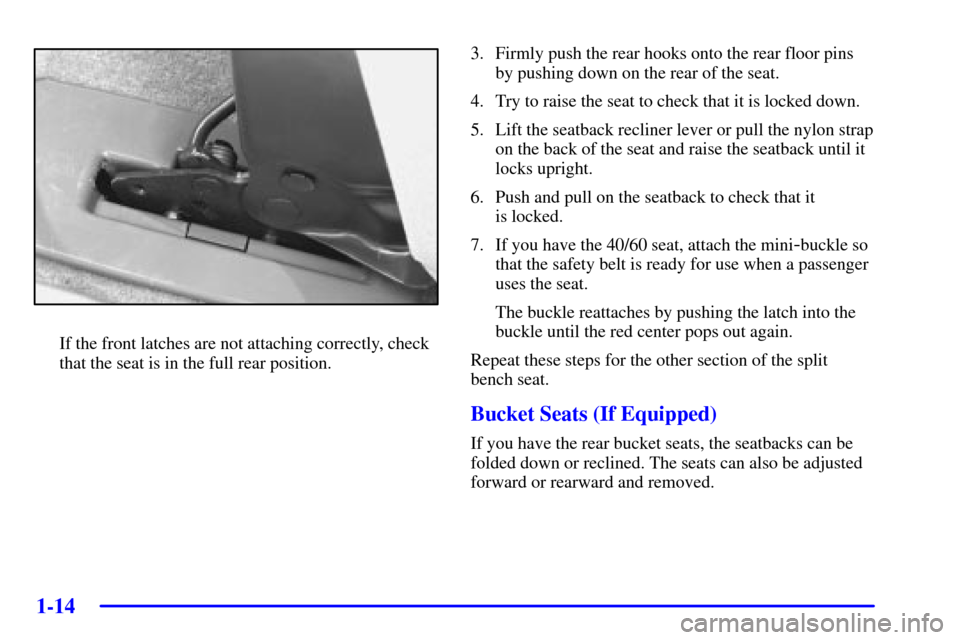
If the front latches are not attaching correctly, check
that the seat is in the full rear position.3. Firmly push the rear hooks onto the rear floor pins
by pushing down on the rear of the seat.
4. Try to raise the seat to check that it is locked down.
5. Lift the seatback recliner lever or pull the nylon strap
on the back of the seat and raise the seatback until it
locks upright.
6. Push and pull on the seatback to check that it
is locked.
7. If you have the 40/60 seat, attach the mini
-buckle so
that the safety belt is ready for use when a passenger
uses the seat.
The buckle reattaches by pushing the latch into the
buckle until the red center pops out again.
Repeat these steps for the other section of the split
bench seat.
Bucket Seats (If Equipped)
If you have the rear bucket seats, the seatbacks can be
folded down or reclined. The seats can also be adjusted
forward or rearward and removed.
Page 25 of 486
1-19
CAUTION:
A safety belt that is improperly routed, not
properly attached, or twisted won't provide the
protection needed in a crash. The person wearing
the belt could be seriously injured. After
installing the seat, always check to be sure that
the safety belts are properly routed and attached,
and are not twisted.
Don't put the seats in so they face rearward because they
won't latch that way. If you want more storage room
behind the seat, adjust the seat by sliding it forward.
The bucket seats have seat position labels, located on the
back of the seat, showing where the seat must go.
Follow that diagram. The seat must be placed in the
proper location for the legs to attach correctly.Make sure the seat is in the full rear position before
beginning this procedure.
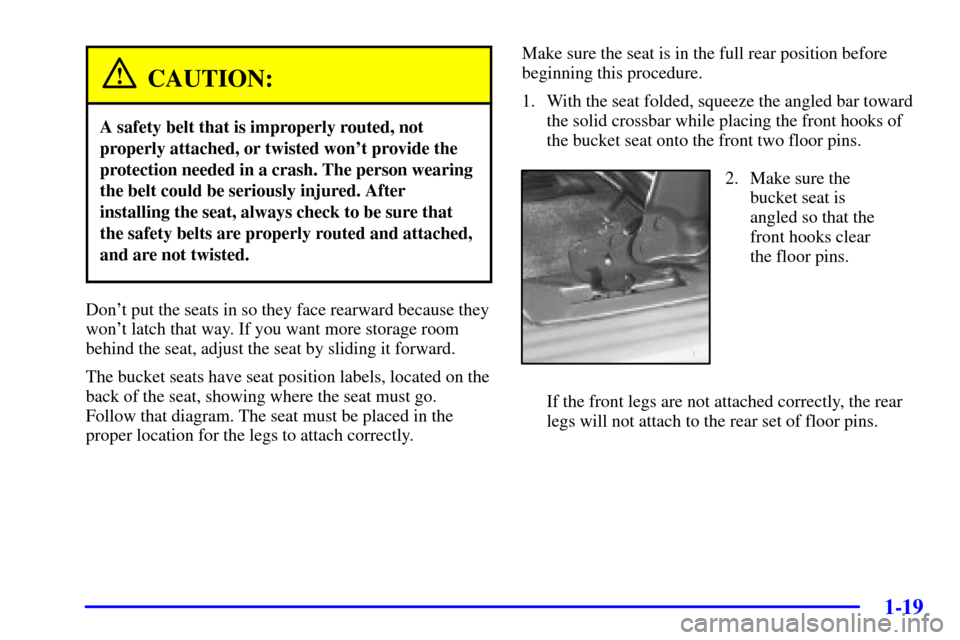
1. With the seat folded, squeeze the angled bar toward
the solid crossbar while placing the front hooks of
the bucket seat onto the front two floor pins.
2. Make sure the
bucket seat is
angled so that the
front hooks clear
the floor pins.
If the front legs are not attached correctly, the rear
legs will not attach to the rear set of floor pins.
Page 30 of 486
1-24
Replacing the Captain's Chairs
CAUTION:
If the seatback isn't locked, it could move
forward in a sudden stop or crash. That could
cause injury to the person sitting there. Always
press rearward on the seatback to be sure it
is locked.
CAUTION:
A seat that isn't locked into place properly can
move around in a collision or sudden stop. People
in the vehicle could be injured. Be sure to lock
the seat into place properly when installing it.
CAUTION:
A safety belt that is improperly routed, not
properly attached, or twisted won't provide the
protection needed in a crash. The person wearing
the belt could be seriously injured. After
installing the seat, always check to be sure that
the safety belts are properly routed and attached,
and are not twisted.
Don't put the seats in so they face rearward because they
won't latch that way. For the second row, if you want
more storage room behind the seat, adjust the seat by
sliding it forward.
The captain's chairs have seat position labels, located on
the back of the seat, showing where the seat must go.
Follow that diagram. The seat must be placed in the
proper location for the legs to attach correctly.
Make sure the seatbacks are in the upright position, the
seat belts are on the correct side of the chairs and the
second row captain's chairs are in the full rear position
before beginning this procedure.