Page 35 of 486
1-29
CAUTION:
A safety belt that is improperly routed, not
properly attached, or twisted won't provide the
protection needed in a crash. The person wearing
the belt could be seriously injured. After
installing the seat, always check to be sure that
the safety belts are properly routed and attached,
and are not twisted.
Do not put the stowable seat in so it faces rearward
because it will not latch that way. The stowable seat has
to go in before the convenience center. See ªConvenience
Centerº in the Index for more information.
The stowable seat has seat position labels, located on the
back of the seat, showing where the seat must go.
Follow the floor pin diagram. Use the front floor pins of
the floor cups and the rear floor cups in the third row.The seat must be placed in the proper location for the
legs to attach correctly.
Make sure the seat is in its upright position before
beginning this procedure.
1. Place the front hooks of the seat onto the front floor
pins in the third row. To do this, the seat will need to
be angled so the front hooks clear the floor pins.
If the front legs are not attached correctly, the rear
legs will not attach to the rear set of floor pins.
2. Firmly push the rear hooks into the rear floor pins by
pushing down on the rear of the seat.
3. Try to raise the seat to make sure that it is
locked down.
4. Push and pull on the seatback to make sure that it is
locked into place.
Page 36 of 486
1-30
Safety Belts: They're for Everyone
This part of the manual tells you how to use safety belts
properly. It also tells you some things you should not do
with safety belts.
And it explains the air bag system.
CAUTION:
Don't let anyone ride where he or she can't wear
a safety belt properly. If you are in a crash and
you're not wearing a safety belt, your injuries
can be much worse. You can hit things inside the
vehicle or be ejected from it. You can be seriously
injured or killed. In the same crash, you might
not be if you are buckled up. Always fasten your
safety belt, and check that your passengers' belts
are fastened properly too.
CAUTION:
It is extremely dangerous to ride in a cargo area,
inside or outside of a vehicle. In a collision,
people riding in these areas are more likely to be
seriously injured or killed. Do not allow people to
ride in any area of your vehicle that is not
equipped with seats and safety belts. Be sure
everyone in your vehicle is in a seat and using a
safety belt properly.
Page 37 of 486
1-31
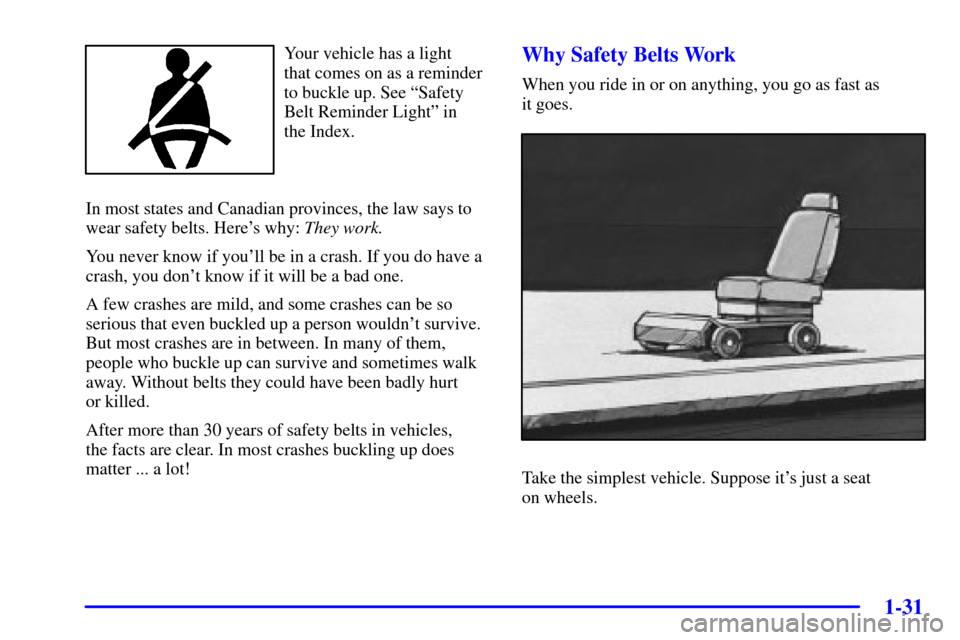
Your vehicle has a light
that comes on as a reminder
to buckle up. See ªSafety
Belt Reminder Lightº in
the Index.
In most states and Canadian provinces, the law says to
wear safety belts. Here's why: They work.
You never know if you'll be in a crash. If you do have a
crash, you don't know if it will be a bad one.
A few crashes are mild, and some crashes can be so
serious that even buckled up a person wouldn't survive.
But most crashes are in between. In many of them,
people who buckle up can survive and sometimes walk
away. Without belts they could have been badly hurt
or killed.
After more than 30 years of safety belts in vehicles,
the facts are clear. In most crashes buckling up does
matter ... a lot!Why Safety Belts Work
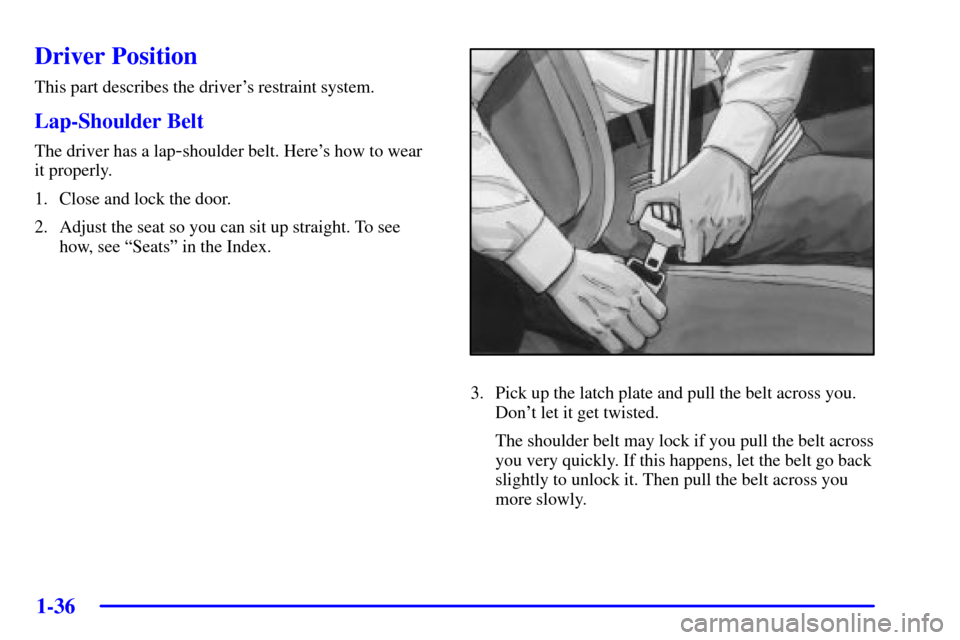
When you ride in or on anything, you go as fast as
it goes.
Take the simplest vehicle. Suppose it's just a seat
on wheels.
Page 40 of 486
1-34
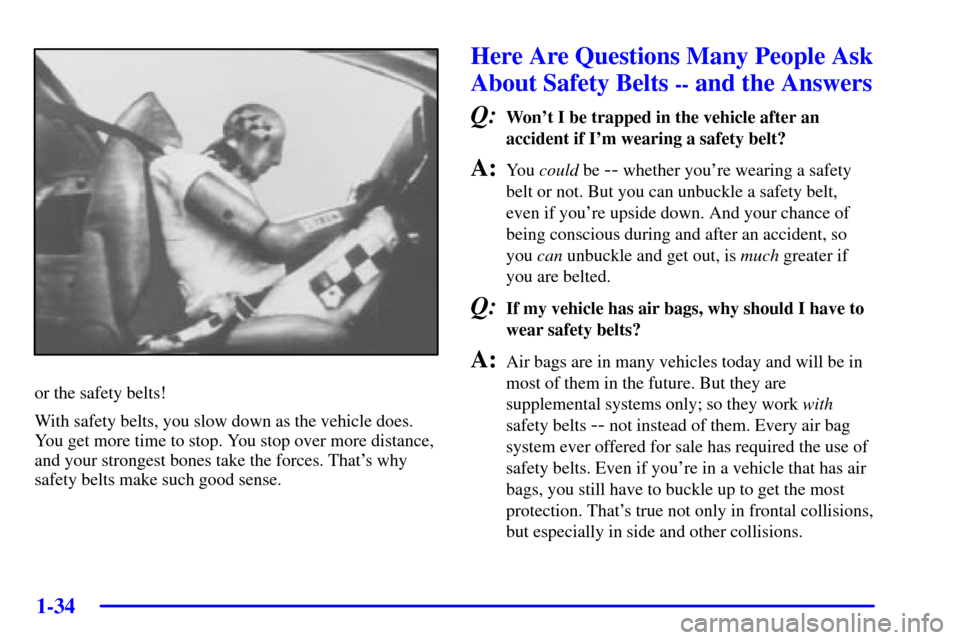
or the safety belts!
With safety belts, you slow down as the vehicle does.
You get more time to stop. You stop over more distance,
and your strongest bones take the forces. That's why
safety belts make such good sense.
Here Are Questions Many People Ask
About Safety Belts
-- and the Answers
Q:
Won't I be trapped in the vehicle after an
accident if I'm wearing a safety belt?
A:You could be -- whether you're wearing a safety
belt or not. But you can unbuckle a safety belt,
even if you're upside down. And your chance of
being conscious during and after an accident, so
you can unbuckle and get out, is much greater if
you are belted.
Q:If my vehicle has air bags, why should I have to
wear safety belts?
A:Air bags are in many vehicles today and will be in
most of them in the future. But they are
supplemental systems only; so they work with
safety belts
-- not instead of them. Every air bag
system ever offered for sale has required the use of
safety belts. Even if you're in a vehicle that has air
bags, you still have to buckle up to get the most
protection. That's true not only in frontal collisions,
but especially in side and other collisions.
Page 41 of 486
1-35
Q:If I'm a good driver, and I never drive far from
home, why should I wear safety belts?
A:You may be an excellent driver, but if you're in an
accident
-- even one that isn't your fault -- you and
your passengers can be hurt. Being a good driver
doesn't protect you from things beyond your
control, such as bad drivers.
Most accidents occur within 25 miles (40 km)
of home. And the greatest number of serious
injuries and deaths occur at speeds of less
than 40 mph (65 km/h).
Safety belts are for everyone.
How to Wear Safety Belts Properly
Adults
This part is only for people of adult size.
Be aware that there are special things to know
about safety belts and children. And there are different
rules for smaller children and babies. If a child will
be riding in your vehicle, see the part of this manual
called ªChildren.º Follow those rules for
everyone's protection.
First, you'll want to know which restraint systems your
vehicle has.
We'll start with the driver position.
Page 42 of 486
1-36
Driver Position
This part describes the driver's restraint system.
Lap-Shoulder Belt
The driver has a lap-shoulder belt. Here's how to wear
it properly.
1. Close and lock the door.
2. Adjust the seat so you can sit up straight. To see
how, see ªSeatsº in the Index.
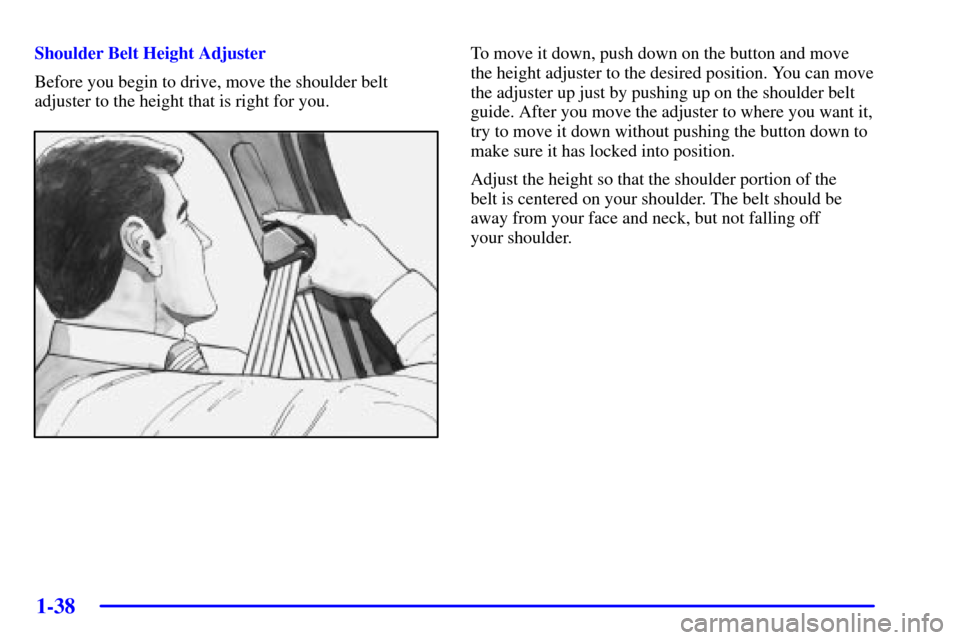
3. Pick up the latch plate and pull the belt across you.
Don't let it get twisted.
The shoulder belt may lock if you pull the belt across
you very quickly. If this happens, let the belt go back
slightly to unlock it. Then pull the belt across you
more slowly.
Page 43 of 486
1-37
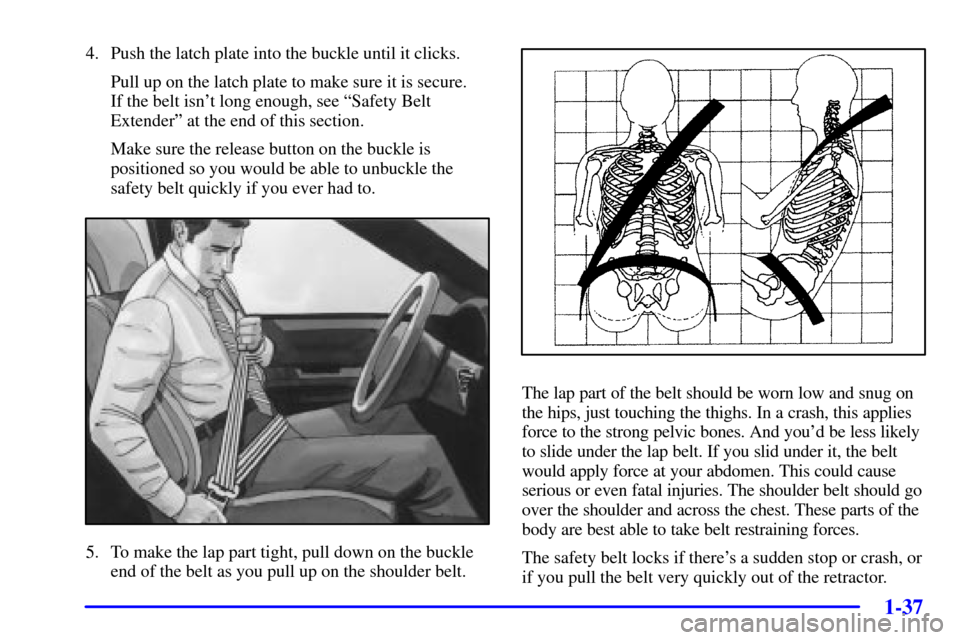
4. Push the latch plate into the buckle until it clicks.
Pull up on the latch plate to make sure it is secure.
If the belt isn't long enough, see ªSafety Belt
Extenderº at the end of this section.
Make sure the release button on the buckle is
positioned so you would be able to unbuckle the
safety belt quickly if you ever had to.
5. To make the lap part tight, pull down on the buckle
end of the belt as you pull up on the shoulder belt.
The lap part of the belt should be worn low and snug on
the hips, just touching the thighs. In a crash, this applies
force to the strong pelvic bones. And you'd be less likely
to slide under the lap belt. If you slid under it, the belt
would apply force at your abdomen. This could cause
serious or even fatal injuries. The shoulder belt should go
over the shoulder and across the chest. These parts of the
body are best able to take belt restraining forces.
The safety belt locks if there's a sudden stop or crash, or
if you pull the belt very quickly out of the retractor.
Page 44 of 486
1-38
Shoulder Belt Height Adjuster
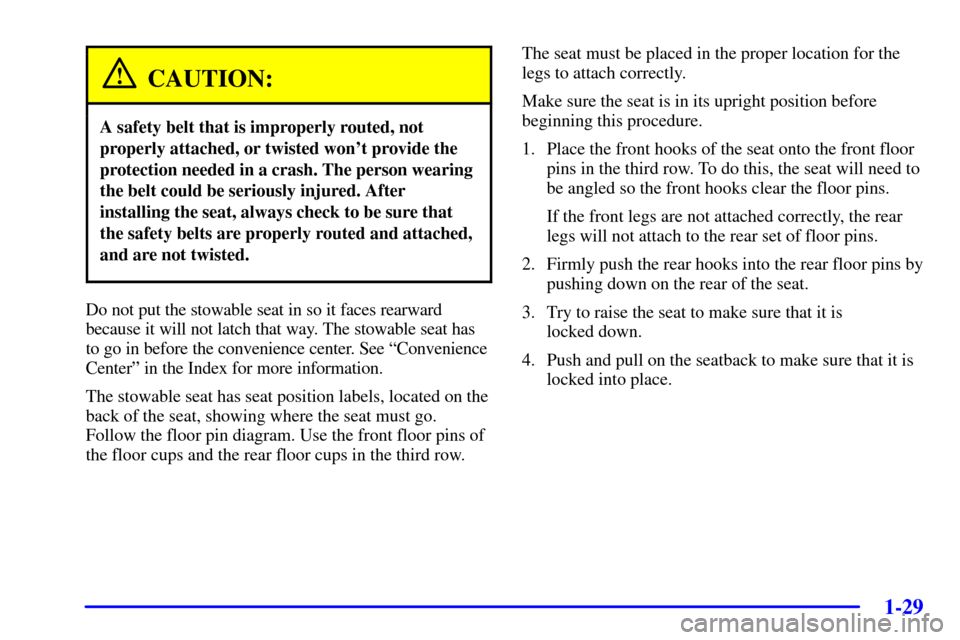
Before you begin to drive, move the shoulder belt
adjuster to the height that is right for you.To move it down, push down on the button and move
the height adjuster to the desired position. You can move
the adjuster up just by pushing up on the shoulder belt
guide. After you move the adjuster to where you want it,
try to move it down without pushing the button down to
make sure it has locked into position.
Adjust the height so that the shoulder portion of the
belt is centered on your shoulder. The belt should be
away from your face and neck, but not falling off
your shoulder.