Page 197 of 497
2-117
Trans Hot...Idle Engine
If you have an automatic transmission, you have a
transmission over
-temperature display contained in the
message center.
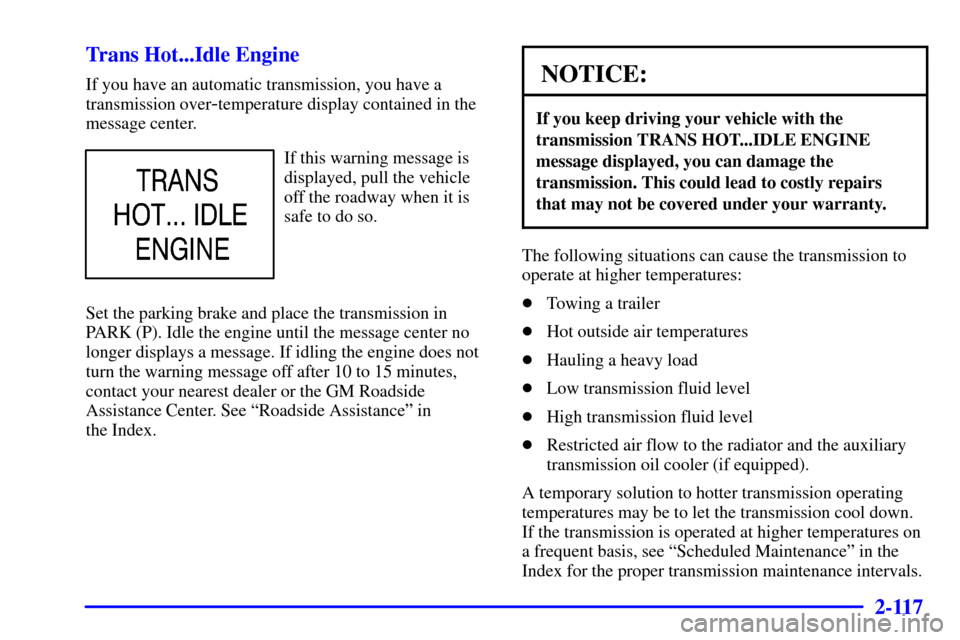
If this warning message is
displayed, pull the vehicle
off the roadway when it is
safe to do so.
Set the parking brake and place the transmission in
PARK (P). Idle the engine until the message center no
longer displays a message. If idling the engine does not
turn the warning message off after 10 to 15 minutes,
contact your nearest dealer or the GM Roadside
Assistance Center. See ªRoadside Assistanceº in
the Index.
NOTICE:
If you keep driving your vehicle with the
transmission TRANS HOT...IDLE ENGINE
message displayed, you can damage the
transmission. This could lead to costly repairs
that may not be covered under your warranty.
The following situations can cause the transmission to
operate at higher temperatures:
�Towing a trailer
�Hot outside air temperatures
�Hauling a heavy load
�Low transmission fluid level
�High transmission fluid level
�Restricted air flow to the radiator and the auxiliary
transmission oil cooler (if equipped).
A temporary solution to hotter transmission operating
temperatures may be to let the transmission cool down.
If the transmission is operated at higher temperatures on
a frequent basis, see ªScheduled Maintenanceº in the
Index for the proper transmission maintenance intervals.
Page 204 of 497
3-2
Comfort Controls
Standard Comfort Controls
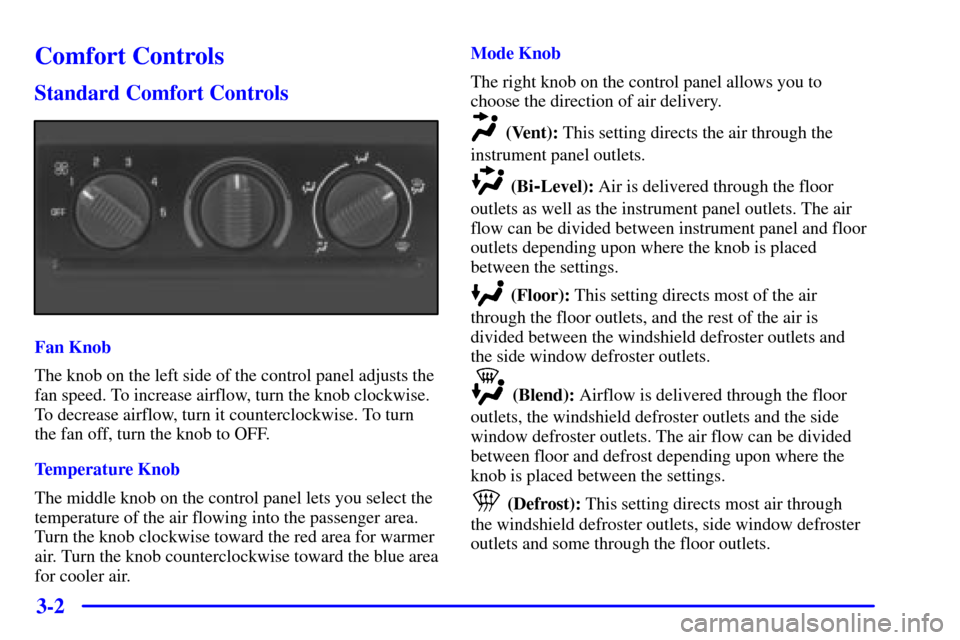
Fan Knob
The knob on the left side of the control panel adjusts the
fan speed. To increase airflow, turn the knob clockwise.
To decrease airflow, turn it counterclockwise. To turn
the fan off, turn the knob to OFF.
Temperature Knob
The middle knob on the control panel lets you select the
temperature of the air flowing into the passenger area.
Turn the knob clockwise toward the red area for warmer
air. Turn the knob counterclockwise toward the blue area
for cooler air.Mode Knob
The right knob on the control panel allows you to
choose the direction of air delivery.
(Vent): This setting directs the air through the
instrument panel outlets.
(Bi-Level): Air is delivered through the floor
outlets as well as the instrument panel outlets. The air
flow can be divided between instrument panel and floor
outlets depending upon where the knob is placed
between the settings.
(Floor): This setting directs most of the air
through the floor outlets, and the rest of the air is
divided between the windshield defroster outlets and
the side window defroster outlets.
(Blend): Airflow is delivered through the floor
outlets, the windshield defroster outlets and the side
window defroster outlets. The air flow can be divided
between floor and defrost depending upon where the
knob is placed between the settings.
(Defrost): This setting directs most air through
the windshield defroster outlets, side window defroster
outlets and some through the floor outlets.
Page 205 of 497
3-3 Heater and Air Conditioning Comfort
Controls (If Equipped)
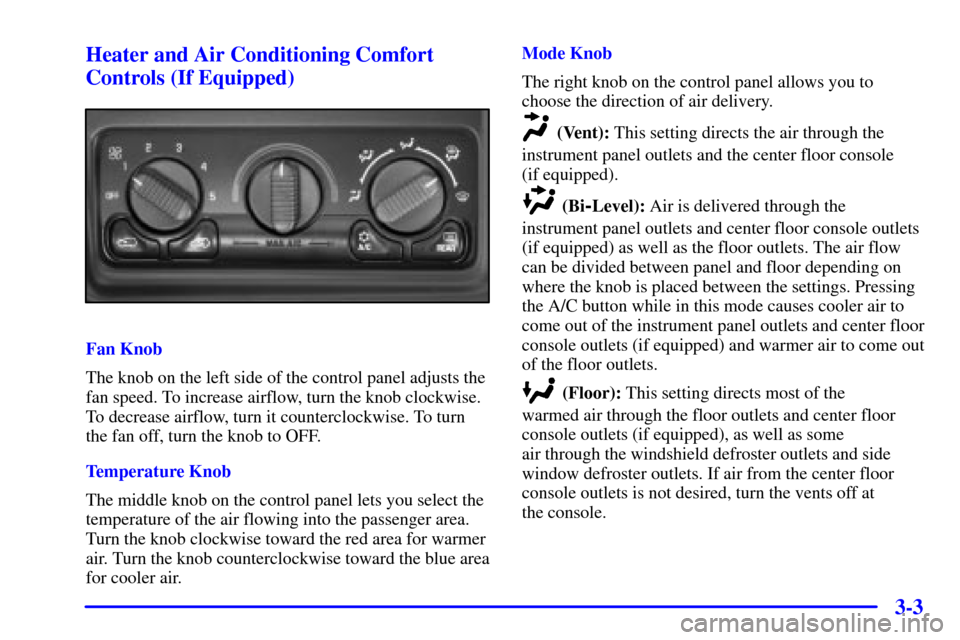
Fan Knob
The knob on the left side of the control panel adjusts the
fan speed. To increase airflow, turn the knob clockwise.
To decrease airflow, turn it counterclockwise. To turn
the fan off, turn the knob to OFF.
Temperature Knob
The middle knob on the control panel lets you select the
temperature of the air flowing into the passenger area.
Turn the knob clockwise toward the red area for warmer
air. Turn the knob counterclockwise toward the blue area
for cooler air.Mode Knob
The right knob on the control panel allows you to
choose the direction of air delivery.
(Vent): This setting directs the air through the
instrument panel outlets and the center floor console
(if equipped).
(Bi-Level): Air is delivered through the
instrument panel outlets and center floor console outlets
(if equipped) as well as the floor outlets. The air flow
can be divided between panel and floor depending on
where the knob is placed between the settings. Pressing
the A/C button while in this mode causes cooler air to
come out of the instrument panel outlets and center floor
console outlets (if equipped) and warmer air to come out
of the floor outlets.
(Floor): This setting directs most of the
warmed air through the floor outlets and center floor
console outlets (if equipped), as well as some
air through the windshield defroster outlets and side
window defroster outlets. If air from the center floor
console outlets is not desired, turn the vents off at
the console.
Page 208 of 497

3-6
AUTO: If the knob is in AUTO, the fan speed will vary
as the system maintains the selected temperature.
When both the fan control and mode knobs are in the
AUTO position, the system will then automatically
maintain the last selected temperature setting. Manual
control of functions is also available.
Temperature Knob
The middle knob on the control panel lets you select the
desired air temperature in your vehicle. This knob will
allow you to adjust the interior air temperature setting.
Move the knob clockwise toward 82�F (28�C) for
warmer air. Move the knob counterclockwise toward
66�F (19�C) for cooler air. When the system is set for
automatic operation, sensors will control the fan speed.
Full Hot: If you turn the temperature knob past 82�F
(28�C), the system will go into the ªfull hotº mode.
The system will remain at that maximum heating setting
and the fan will blow at the speed the fan knob is set to.
If the fan is in AUTO, it will run at full speed.Full Cold: If you turn the temperature knob past 66�F
(19�C), the system will go into the ªfull coldº mode.
The system will remain at that maximum cooling setting
and the fan will blow at the speed the fan knob is set to.
If the fan is in AUTO, it will run at full speed.
Mode Knob
-- Manual Operation
The right knob on the control panel allows you to
choose the direction of air delivery.
You can choose to set the climate control system
yourself, or let the system work for you by placing the
system in AUTO mode. See ªMode Knob
-- Automatic
Operationº later in this section.
(Vent): This setting directs most of the air through
the instrument panel outlets and a small amount through
the floor outlets.
(Bi-Level): Air is delivered through the floor
outlets as well as the instrument panel outlets.
(Floor): This setting directs most of the air
through the floor outlets and some air through the
windshield defroster outlets.
Page 212 of 497
3-10 Heating
The heater works best if you keep your windows closed
while using it. On cold days, use the floor or bi
-level
setting with the temperature knob in the red area.
On cold days, approximately 32�F (
-0�C) or lower, if
your vehicle is equipped with an automatic transmission,
you may experience differences in how the transmission
shifts until the engine is warm. This feature
automatically reduces the time it takes for the engine to
reach normal operating temperature and shortens the
time it takes the heater to reach full output.
If you use the engine coolant heater before starting your
engine in cold weather, 20�F (
-8�C) or lower, the
heating system will produce warmer air faster to heat the
passenger compartment.
The use of an engine coolant heater also reduces the
time it takes for the engine to reach normal operating
temperature. For more information, see ªEngine Coolant
Heaterº in the Index.
Defogging and Defrosting
On cool, humid days, use defrost to keep the windshield
and side windows clear. Use defrost to remove fog or ice
from the windshield in extremely humid or cold
conditions. Use defrost with the temperature knob
toward the red area and the fan control turned all the
way to the right.
Rear Window Defogger (If Equipped)
If you see lines running across the rear window, your
vehicle has a rear window defogger. The lines warm
the glass.
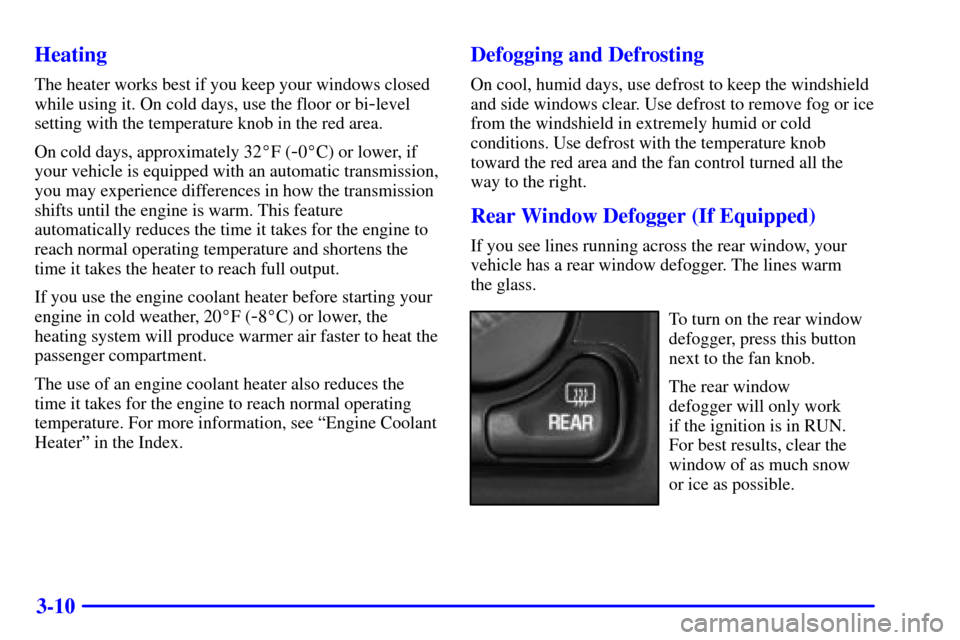
To turn on the rear window
defogger, press this button
next to the fan knob.
The rear window
defogger will only work
if the ignition is in RUN.
For best results, clear the
window of as much snow
or ice as possible.
Page 229 of 497
4-
4-1
Section 4 Your Driving and the Road
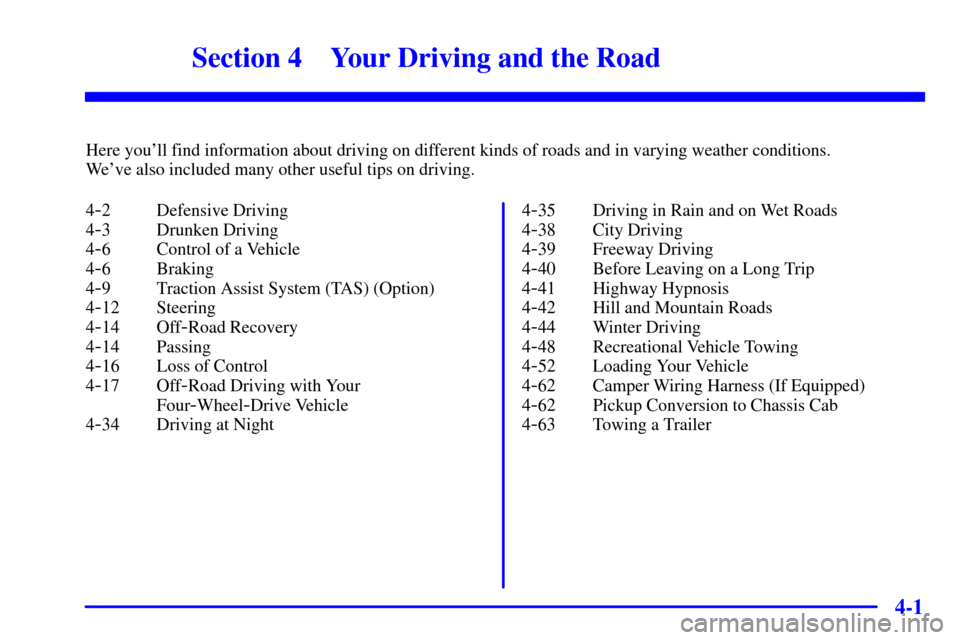
Here you'll find information about driving on different kinds of roads and in varying weather conditions.
We've also included many other useful tips on driving.
4
-2 Defensive Driving
4
-3 Drunken Driving
4
-6 Control of a Vehicle
4
-6 Braking
4
-9 Traction Assist System (TAS) (Option)
4
-12 Steering
4
-14 Off-Road Recovery
4
-14 Passing
4
-16 Loss of Control
4
-17 Off-Road Driving with Your
Four
-Wheel-Drive Vehicle
4
-34 Driving at Night4
-35 Driving in Rain and on Wet Roads
4
-38 City Driving
4
-39 Freeway Driving
4
-40 Before Leaving on a Long Trip
4
-41 Highway Hypnosis
4
-42 Hill and Mountain Roads
4
-44 Winter Driving
4
-48 Recreational Vehicle Towing
4
-52 Loading Your Vehicle
4
-62 Camper Wiring Harness (If Equipped)
4
-62 Pickup Conversion to Chassis Cab
4
-63 Towing a Trailer
Page 246 of 497
4-18
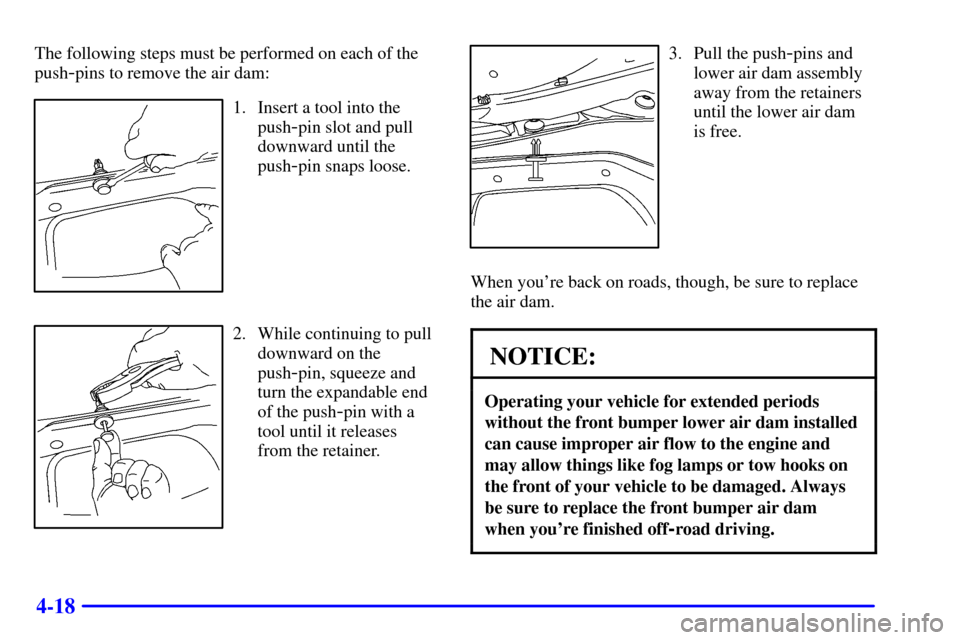
The following steps must be performed on each of the
push
-pins to remove the air dam:
1. Insert a tool into the
push
-pin slot and pull
downward until the
push
-pin snaps loose.
2. While continuing to pull
downward on the
push
-pin, squeeze and
turn the expandable end
of the push
-pin with a
tool until it releases
from the retainer.
3. Pull the push-pins and
lower air dam assembly
away from the retainers
until the lower air dam
is free.
When you're back on roads, though, be sure to replace
the air dam.
NOTICE:
Operating your vehicle for extended periods
without the front bumper lower air dam installed
can cause improper air flow to the engine and
may allow things like fog lamps or tow hooks on
the front of your vehicle to be damaged. Always
be sure to replace the front bumper air dam
when you're finished off
-road driving.
Page 247 of 497
4-19
To reinstall the lower air dam, do the following:
1. Line up each push-pin
with its intended retainer
and push the washer
portion of the push
-pin
towards the retainer until
it locks into place.
2. Push the flat end of the
push
-pin towards the
retainer until it locks
into place, making sure
each is secure.
Before You Go Off-Roading
There are some things to do before you go out.
For example, be sure to have all necessary maintenance
and service work done. Check to make sure all
underbody shields (if so equipped) are properly
attached. Be sure you read all the information about
your four
-wheel-drive vehicle in this manual. Is there
enough fuel? Is the spare tire fully inflated? Are the
fluid levels up where they should be? What are the local
laws that apply to off
-roading where you'll be driving?
If you don't know, you should check with law
enforcement people in the area. Will you be on
someone's private land? If so, be sure to get the
necessary permission.