Page 108 of 497
2-28
PARK (P): This position locks your rear wheels. It's the
best position to use when you start your engine because
your vehicle can't move easily. If your vehicle is equipped
with the Allison
� Transmission, use park for stationary
operation of the Power Takeoff (PTO) (if equipped).
CAUTION:
It is dangerous to get out of your vehicle if the
shift lever is not fully in PARK (P) with the
parking brake firmly set. Your vehicle can roll.
Don't leave your vehicle when the engine is
running unless you have to. If you have left the
engine running, the vehicle can move suddenly.
You or others could be injured. To be sure your
vehicle won't move, even when you're on fairly
level ground, always set your parking brake and
move the shift lever to PARK (P).
CAUTION: (Continued)
CAUTION: (Continued)
If you have four-wheel drive, your vehicle will
be free to roll
-- even if your shift lever is in
PARK (P)
-- if your transfer case is in
NEUTRAL. So, be sure the transfer case is in a
drive gear, two
-wheel high (2H) or four-wheel
high (4H) or four
-wheel low (4L) -- not in
NEUTRAL. See ªShifting Into PARK (P)º in
the Index.
See ªShifting Into PARK (P)º in the Index.
If you're pulling a trailer, see ªTowing a Trailerº
in the Index.
Page 109 of 497
2-29
REVERSE (R): Use this gear to back up. If your
vehicle is equipped with the Allison Transmission, the
R may blink on the PRNDL if the shift inhibitor
is active.
NOTICE:
Shifting to REVERSE (R) while your vehicle is
moving forward could damage your
transmission. Shift to REVERSE (R) only after
your vehicle is stopped. If your vehicle is
equipped with the Allison Transmission, do not
idle in REVERSE (R) for more than five minutes.
Extended idling in REVERSE (R) may cause
transmission overheating and damage. Always
select PARK (P) whenever idle time exceeds
five minutes.
To rock your vehicle back and forth to get out of snow,
ice or sand without damaging your transmission, see
ªStuck: In Sand, Mud, Ice or Snowº in the Index.NEUTRAL (N): In this position, your engine doesn't
connect with the wheels. To restart when you're already
moving, use NEUTRAL (N) only. Also, use
NEUTRAL (N) when your vehicle is being towed.
CAUTION:
Shifting out of PARK (P) or NEUTRAL (N) while
your engine is ªracingº (running at high speed) is
dangerous. Unless your foot is firmly on the
brake pedal, your vehicle could move very
rapidly. You could lose control and hit people or
objects. Don't shift out of PARK (P) or
NEUTRAL (N) while your engine is racing.
NOTICE:
Damage to your transmission caused by shifting
out of PARK (P) or NEUTRAL (N) with the
engine racing isn't covered by your warranty.
Page 110 of 497
2-30
DRIVE (D): This position is for normal driving. If you
need more power for passing, and you're:
�Going less than about 35 mph (55 km/h), push your
accelerator pedal about halfway down.
�Going about 35 mph (55 km/h) or more, push the
accelerator all the way down.
You'll shift down to the next gear and have more power.
DRIVE (D) can be used when towing a trailer, carrying
a heavy load, driving on steep hills or for off
-road
driving. You may want to shift the transmission to
THIRD (3) or, if necessary, a lower gear selection if the
transmission shifts too often.
NOTICE:
If your vehicle is equipped with the Allison
Transmission, do not idle in DRIVE (D) for more
than five minutes. Extended idling in DRIVE (D)
may cause transmission overheating and damage.
Always select PARK (P) if idle time is longer than
five minutes.
If your vehicle is equipped with the Allison
Transmission, it will initially attain first range when
DRIVE (D) is selected. As vehicle speed increases, the
transmission will upshift automatically through each
available range up to FIFTH (5). As the vehicle slows,
the transmission will downshift automatically.
THIRD (3): This position is also used for normal
driving, however it offers more power and lower fuel
economy than DRIVE (D).
SECOND (2): This position gives you more power but
lower fuel economy. You can use SECOND (2) on hills.
It can help control your speed as you go down steep
mountain roads, but then you would also want to use
your brakes off and on.
If you manually select SECOND (2) in a light duty
automatic transmission, the transmission will drive in
second gear. You may use this feature for reducing the
speed of the rear wheels when you are trying to start
your vehicle from a stop on slippery road surfaces.
Page 111 of 497
2-31
FIRST (1): This position gives you even more power
(but lower fuel economy) than SECOND (2). You can
use it on very steep hills, or in deep snow or mud. If the
selector lever is put in FIRST (1) while the vehicle is
moving forward, the transmission won't shift into first
gear until the vehicle is going slowly enough.
NOTICE:
If your rear wheels can't rotate, don't try to
drive. This might happen if you were stuck in
very deep sand or mud or were up against a solid
object. You could damage your transmission.
Also, if you stop when going uphill, don't hold
your vehicle there with only the accelerator
pedal. This could overheat and damage the
transmission. Use your brakes or shift into
PARK (P) to hold your vehicle in position
on a hill.
On cold days, approximately 32�F (0�C) or colder, your
transmission is designed to shift differently until the
engine reaches normal operating temperature. This is
intended to improve heater performance.
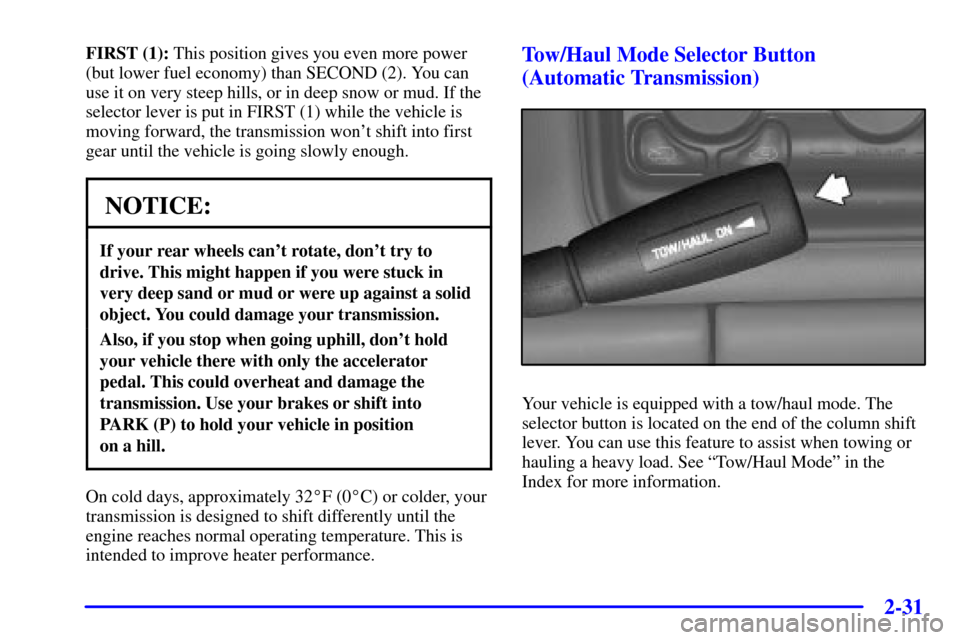
Tow/Haul Mode Selector Button
(Automatic Transmission)
Your vehicle is equipped with a tow/haul mode. The
selector button is located on the end of the column shift
lever. You can use this feature to assist when towing or
hauling a heavy load. See ªTow/Haul Modeº in the
Index for more information.
Page 112 of 497
2-32
Manual Transmission Operation
Five-Speed (VORTEC 6000 V8 Engine)
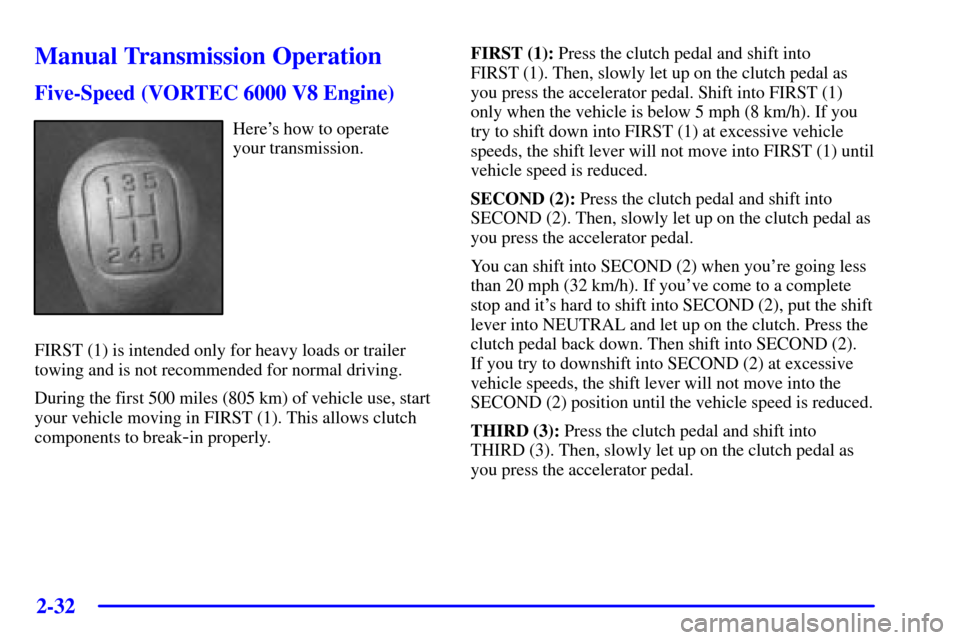
Here's how to operate
your transmission.
FIRST (1) is intended only for heavy loads or trailer
towing and is not recommended for normal driving.
During the first 500 miles (805 km) of vehicle use, start
your vehicle moving in FIRST (1). This allows clutch
components to break
-in properly.FIRST (1): Press the clutch pedal and shift into
FIRST (1). Then, slowly let up on the clutch pedal as
you press the accelerator pedal. Shift into FIRST (1)
only when the vehicle is below 5 mph (8 km/h). If you
try to shift down into FIRST (1) at excessive vehicle
speeds, the shift lever will not move into FIRST (1) until
vehicle speed is reduced.
SECOND (2): Press the clutch pedal and shift into
SECOND (2). Then, slowly let up on the clutch pedal as
you press the accelerator pedal.
You can shift into SECOND (2) when you're going less
than 20 mph (32 km/h). If you've come to a complete
stop and it's hard to shift into SECOND (2), put the shift
lever into NEUTRAL and let up on the clutch. Press the
clutch pedal back down. Then shift into SECOND (2).
If you try to downshift into SECOND (2) at excessive
vehicle speeds, the shift lever will not move into the
SECOND (2) position until the vehicle speed is reduced.
THIRD (3): Press the clutch pedal and shift into
THIRD (3). Then, slowly let up on the clutch pedal as
you press the accelerator pedal.
Page 114 of 497
2-34
NEUTRAL: Use this position when you start or idle
your engine.
REVERSE (R): To back up, first press down the clutch
pedal. Wait for the vehicle to stop moving and then, shift
into REVERSE (R). Let up on the clutch pedal slowly
while pressing the accelerator pedal.
NOTICE:
Shift to REVERSE (R) only after your vehicle is
stopped. Shifting to REVERSE (R) while your
vehicle is moving could damage your transmission.
Also, use REVERSE (R), along with the parking brake,
when turning off your engine and parking your vehicle.
Six-Speed (VORTEC 8100 V8 and
DURAMAX� 6600 V8 Engines)
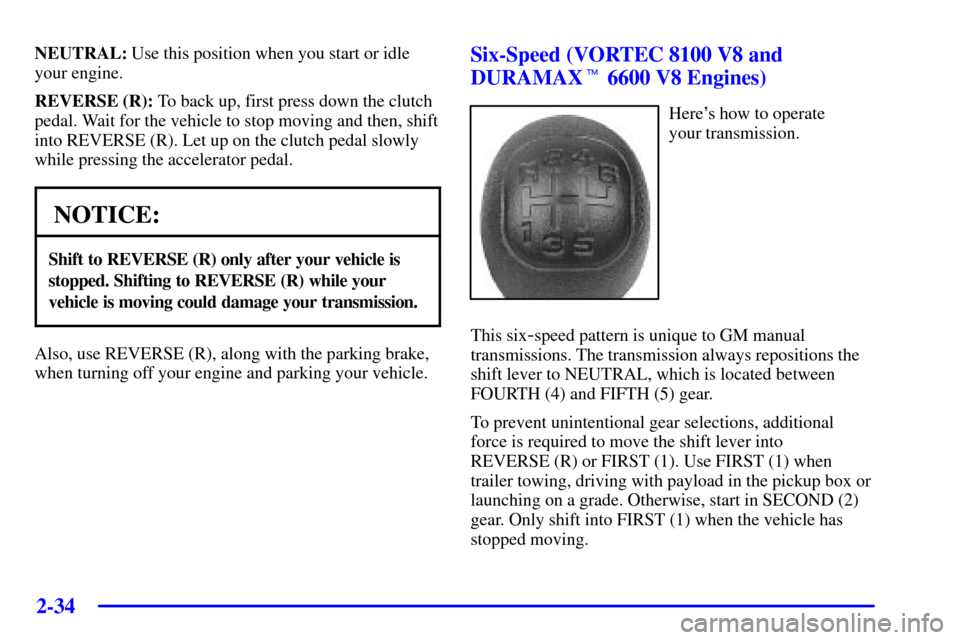
Here's how to operate
your transmission.
This six
-speed pattern is unique to GM manual
transmissions. The transmission always repositions the
shift lever to NEUTRAL, which is located between
FOURTH (4) and FIFTH (5) gear.
To prevent unintentional gear selections, additional
force is required to move the shift lever into
REVERSE (R) or FIRST (1). Use FIRST (1) when
trailer towing, driving with payload in the pickup box or
launching on a grade. Otherwise, start in SECOND (2)
gear. Only shift into FIRST (1) when the vehicle has
stopped moving.
Page 118 of 497
2-38
To release the parking brake, hold the regular brake
pedal down. Pull the bottom edge of the lever, located
above the parking brake pedal, marked BRAKE
RELEASE, to release the parking brake.
If the ignition is on when the parking brake is released,
the brake system warning light will go off.
NOTICE:
Driving with the parking brake on can cause
your rear brakes to overheat. You may have to
replace them, and you could also damage other
parts of your vehicle.
If you are towing a trailer and are parking on any hill,
see ªTowing a Trailerº in the Index.
Shifting Into PARK (P)
(Automatic Transmission Only)
CAUTION:
It can be dangerous to get out of your vehicle if
the shift lever is not fully in PARK (P) with the
parking brake firmly set. Your vehicle can roll. If
you have left the engine running, the vehicle can
move suddenly. You or others could be injured.
To be sure your vehicle won't move, even when
you're on fairly level ground, use the steps that
follow. With four
-wheel drive if your transfer
case is in NEUTRAL, your vehicle will be free to
roll, even if your shift lever is in PARK (P). So, be
sure the transfer case is in a drive gear
-- not in
NEUTRAL. If you're pulling a trailer, see
ªTowing a Trailerº in the Index.
1. Hold the brake pedal down with your right foot and
set the parking brake.
Page 119 of 497
2-39
2. Move the shift lever into PARK (P) position
like this:
�Pull the shift lever toward you.
�Move the lever up as far as it will go.
3. Be sure the transfer case is in a drive gear
-- not
in NEUTRAL (N).
4. Turn the ignition key to LOCK.
5. Remove the key and take it with you. If you can
leave your vehicle with the ignition key in your
hand, your vehicle is in PARK (P).