Page 320 of 497
4-92
Heavy-Duty Trailer Wiring Package (If Equipped)
Your pickup may be equipped with the eight-wire trailer
towing harness. This harness with a seven
-pin universal
heavy
-duty trailer connector is attached to a bracket on
the platform hitch.*
* The Center High
-Mounted Stoplamp (CHMSL) wire
is tied next to the trailer wiring harness for use with a
trailer, slide
-in camper or cap.The eight
-wire harness contains the following
trailer circuits:
�Yellow: Left Stop/Turn Signal
�Dark Green: Right Stop/Turn Signal
�Brown: Taillamps
�White: Ground
�Light Green: Back
-up Lamps
�Light Blue: CHMSL
�Red: Battery Feed
�Dark Blue: Trailer Brake
A jumper harness for an electric trailer brake controller
and a trailer battery feed fuse are included with this
trailering package. (See ªInstrument Panel Jumper
Wiring Harnessº later in this section.)
If you need to tow a light
-duty trailer with a standard
four
-way round pin connector, an adapter connector is
included with your vehicle.
Page 322 of 497
4-94
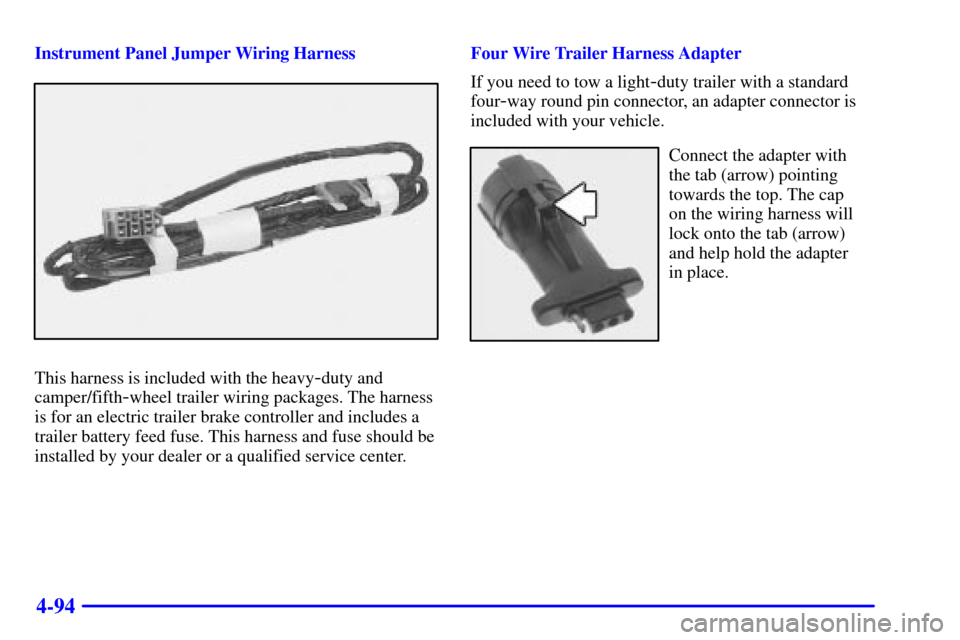
Instrument Panel Jumper Wiring Harness
This harness is included with the heavy-duty and
camper/fifth
-wheel trailer wiring packages. The harness
is for an electric trailer brake controller and includes a
trailer battery feed fuse. This harness and fuse should be
installed by your dealer or a qualified service center.Four Wire Trailer Harness Adapter
If you need to tow a light
-duty trailer with a standard
four
-way round pin connector, an adapter connector is
included with your vehicle.
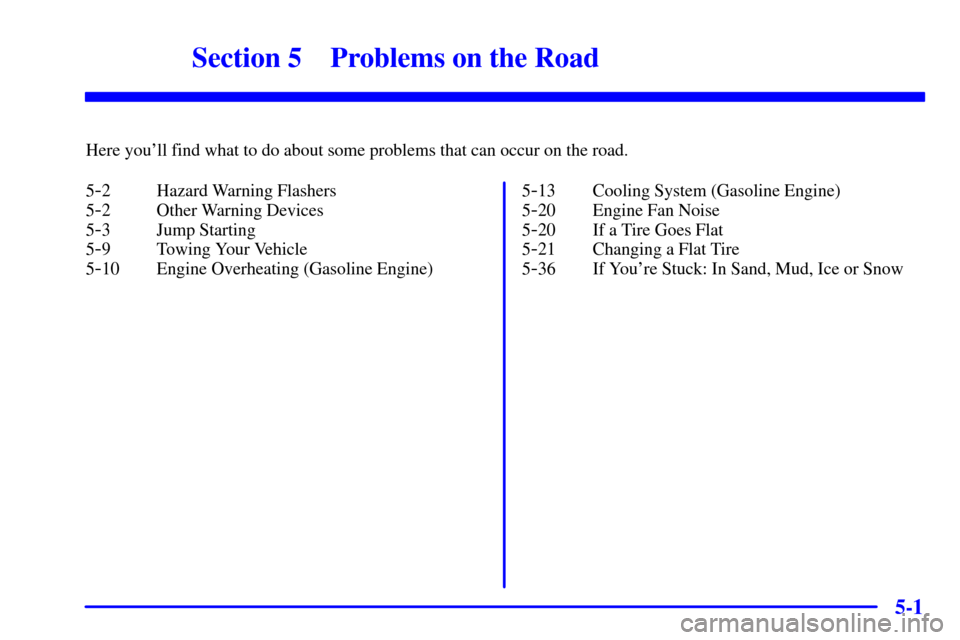
Connect the adapter with
the tab (arrow) pointing
towards the top. The cap
on the wiring harness will
lock onto the tab (arrow)
and help hold the adapter
in place.
Page 326 of 497
4-98
To use PTO speed control in variable mode
(while stationary) do the following:
1. Engage the PTO.
2. Vehicle speed must be less than 5 mph.
3. Make sure your foot is off the brake pedal
(and off the clutch for vehicles equipped with
a manual transmission).
4. Select the desired engine speed by using the foot
pedal, and select SET on the PTO switch or the
cruise control.
Variable Mode: PTO speed control mode can be used
for both stationary and mobile applications. This mode
allows PTO to be controlled in a fashion similar to how
cruise control sets vehicle speed. The operator can set to
an rpm (between 800 and 2200) with the cruise control
feature or with the SET position on the PTO switch.
The operator is then able to increase rpm in increments
of 100, or ªtap upº, with the resume position on the
cruise control. Or, the operator can decrease rpm in
increments of 100 with the SET switch on the PTO or
the cruise control. Vehicles not equipped with cruise
control will not have the ªtap upº capability.All engine speed values listed above are factory preset
values. With the exception of the TCC lockup speed
(1100 rpm) and the ªtapº increment (100 rpm), all
of these values are programmable and can be adjusted
by your dealer or body upfitter. If the PTO software
settings do not match the settings shown here, then
they may have already been altered in order to satisfy
the requirements of the installed PTO system and
body equipment.
Step-Bumper Pad
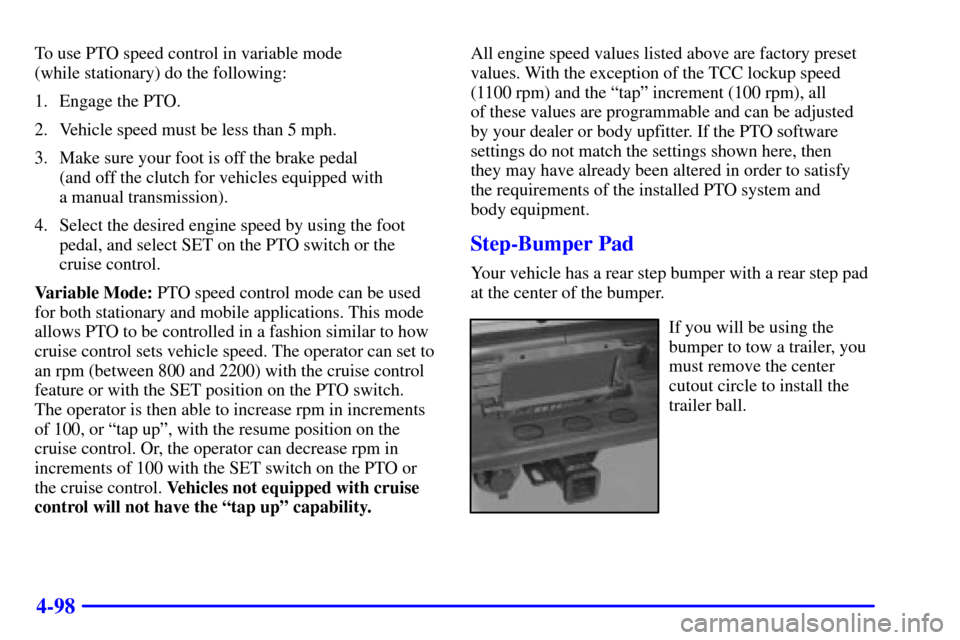
Your vehicle has a rear step bumper with a rear step pad
at the center of the bumper.
If you will be using the
bumper to tow a trailer, you
must remove the center
cutout circle to install the
trailer ball.
Page 327 of 497
5-
5-1
Section 5 Problems on the Road
Here you'll find what to do about some problems that can occur on the road.
5
-2 Hazard Warning Flashers
5
-2 Other Warning Devices
5
-3 Jump Starting
5
-9 Towing Your Vehicle
5
-10 Engine Overheating (Gasoline Engine)5
-13 Cooling System (Gasoline Engine)
5
-20 Engine Fan Noise
5
-20 If a Tire Goes Flat
5
-21 Changing a Flat Tire
5
-36 If You're Stuck: In Sand, Mud, Ice or Snow
Page 335 of 497

5-9
Jumper Cable Removal
A. Heavy, Unpainted Metal Engine Part or Remote
Negative (
-) Terminal
B. Good Battery or Remote Positive (+) and Remote
Negative (
-) Terminals
C. Dead Battery or Remote Positive (+) TerminalTo disconnect the jumper cables from both vehicles do
the following:
1. Disconnect the black negative (
-) cable from the
vehicle that had the bad battery.
2. Disconnect the black negative (
-) cable from the
vehicle with the good battery.
3. Disconnect the red positive (+) cable from the
vehicle with the good battery.
4. Disconnect the red positive (+) cable from the
other vehicle.
5. Return the positive (+) remote terminal cover to its
original position.
Towing Your Vehicle
Consult your dealer or a professional towing service if
you need to have your disabled vehicle towed. See
ªRoadside Assistanceº in the Index. If you want to
tow your vehicle behind another vehicle for recreational
purposes (such as behind a motorhome), see
ªRecreational Vehicle Towingº in the Index.
Page 336 of 497
5-10
Engine Overheating
You will find a coolant temperature gage on your
vehicle's instrument panel. See ªEngine Coolant
Temperature Gageº in the Index. In addition, you will
find a LOW COOLANT, CHECK COOLANT TEMP,
ENGINE OVERHEATED and a REDUCED ENGINE
POWER message in the message center on the
instrument panel. See ªMessage Centerº in the Index.
Overheated Engine Protection Operating
Mode (V8 Engines Only)
If an overheated engine condition exists and the
REDUCED ENGINE POWER message is displayed, an
overheat protection mode which alternates firing groups
of cylinders helps prevent engine damage. In this mode,
you will notice a loss in power and engine performance.
This operating mode allows your vehicle to be driven to
a safe place in an emergency. Driving extended miles
(km) and/or towing a trailer in the overheat protection
mode should be avoided.
NOTICE:
After driving in the overheated engine protection
operating mode, to avoid engine damage, allow
the engine to cool before attempting any repair.
The engine oil will be severely degraded. Repair
the cause of coolant loss, change the oil and reset
the oil life system. Repair the cause of coolant
loss and change the oil. See ªEngine Oilº in
the Index.
Page 338 of 497

5-12 If No Steam Is Coming From Your Engine
An overheat warning, along with a low coolant message,
can indicate a serious problem. See ªLow Coolant
Messageº in the Index.
If you get an engine overheat warning with no low
coolant message, but see or hear no steam, the problem
may not be too serious. Sometimes the engine can get a
little too hot when you:
�Climb a long hill on a hot day.
�Stop after high
-speed driving.
�Idle for long periods in traffic.
�Tow a trailer. See ªDriving on Gradesº in the Index.
If you get the overheat warning with no sign of steam,
try this for a minute or so:
1. If you have an air conditioner and it's on, turn it off.
2. Turn on your heater to full hot at the highest fan
speed and open the window as necessary.
3. If you're in a traffic jam, shift to NEUTRAL (N);
otherwise, shift to the highest gear while
driving
-- AUTOMATIC OVERDRIVE (�) or
DRIVE (D) for automatic transmissions.If you no longer have the overheat warning, you can
drive. Just to be safe, drive slower for about 10 minutes.
If the warning doesn't come back on, you can
drive normally.
If the warning continues, pull over, stop, and park your
vehicle right away.
If there's still no sign of steam, push down the
accelerator until the engine speed is about twice as fast
as normal idle speed for at least three minutes while
you're parked. If you still have the warning, turn off the
engine and get everyone out of the vehicle until it cools
down. Also, see ªOverheated Engine Protection
Operating Modeº listed previously in this section.
You may decide not to lift the hood but to get service
help right away.
Page 346 of 497

5-20
Engine Fan Noise
Your vehicle has a clutched engine cooling fan. When
the clutch is engaged, the fan spins faster to provide
more air to cool the engine. In most everyday driving
conditions, the fan is spinning slower and the clutch is
not fully engaged. This improves fuel economy and
reduces fan noise. Under heavy vehicle loading, trailer
towing and/or high outside temperatures, the fan speed
increases as the clutch more fully engages. So you may
hear an increase in fan noise. This is normal and should
not be mistaken as the transmission slipping or making
extra shifts. It is merely the cooling system functioning
properly. The fan will slow down when additional
cooling is not required and the clutch disengages.
You may also hear this fan noise when you start
the engine. It will go away as the fan clutch
partially disengages.
If a Tire Goes Flat
It's unusual for a tire to ªblow outº while you're driving,
especially if you maintain your tires properly. If air goes
out of a tire, it's much more likely to leak out slowly.
But if you should ever have a ªblowout,º here are a few
tips about what to expect and what to do:
If a front tire fails, the flat tire will create a drag that
pulls the vehicle toward that side. Take your foot off the
accelerator pedal and grip the steering wheel firmly.
Steer to maintain lane position, and then gently brake to
a stop well out of the traffic lane.
A rear blowout, particularly on a curve, acts much like a
skid and may require the same correction you'd use in a
skid. In any rear blowout, remove your foot from the
accelerator pedal. Get the vehicle under control by
steering the way you want the vehicle to go. It may be
very bumpy and noisy, but you can still steer. Gently
brake to a stop
-- well off the road if possible.
If a tire goes flat, the next part shows how to use your
jacking equipment to change a flat tire safely.