2002 BMW Z3 brake
[x] Cancel search: brakePage 74 of 187

74n
ASC+T Dynamic Stability Control (DSC)*Reactivate the ASC+TPress the button again; the indicator
lamp goes out.
The laws of physics cannot be
repealed, even with ASC+T. It will
always be the driver's responsibility to
drive in a manner that matches road
conditions. We therefore urge you to
avoid using the additional safety margin
of the system as an excuse for taking
risks.<
For additional details concerning
ASC+T, please refer to the chapter,
"Advanced technology," page 165.
The conceptDSC maintains vehicle stability, even in
critical driving situations.
The system optimizes vehicle stability
during acceleration and when starting
from a full stop, as well as optimizing
traction. In addition, it recognizes
unstable vehicle conditions, such as
understeering or oversteering, and, as
far as is possible within the laws of
physics, helps keep the vehicle on a
steady course by reducing the engine
speed and brake applications to the
individual wheels.
The DSC is operational every time you
start the engine. DSC includes the
functions of ADB and CBC, refer to
page 102.
The ADB (Automatic Differential
Braking) copies the function of conven-
tional differential and transverse locks
through brake intervention, and
increases traction whenever conditions
merit, e. g. when driving on snow-
covered roads.
If the DSC is deactivated the ADB is in
ready mode.
Indicator lamp
The indicator lamp in the instru-
ment cluster goes out shortly
after you switch on the ignition,
refer to page 22.
The indicator lamp flashes:
DSC controls the drive and braking
forces.
The indicator lamp stays lit:
DSC has been switched off via the
button; ADB is in ready mode.
ADB control intervention is not indi-
cated.
The indicator lamp and the
brake warning lamp remain on:
The DSC, ADB and DBC have
been switched off via the button
or are defective.
The vehicle will remain completely
operational, however without DSC. In
the event of a fault, please see your
BMW center.
Indicator and warning lamps for
Canadian models.
Page 75 of 187

75n
IndexDataTechnologyRepairsMaintenanceControlsOverview
Dynamic Stability Control (DSC)*Switch off DSC/activate ADBPress the DSC switch (arrow) Ð the indi-
cator lamp comes on and remains on.
DSC has been switched off; ADB is in
ready mode.
In the following exceptional circum-
stances, it may be effective to activate
the ADB for a short period:
>When rocking the vehicle or starting
off in deep snow or on loose surfaces
>When driving on snow-covered
grades, in deep snow, or on a snow-
covered surface that has been
packed down from being driven on
>When driving with snow chains.367de739
Switch off DSC and ADBHold the DSC switch down for at least
3 seconds. The indicator lamp and the
red warning lamp for the brake
hydraulic system remain on.
In this case, no interventions to
increase stability and traction for engine
and brakes are carried out.
To maintain vehicle stability, drive
with the DSC switched on when-
ever possible.<
Reactivate DSC and ADBPress the button again; the indicator
lamp or the indicator lamps will go out.
The laws of physics cannot be
repealed, even with DSC. It will
always be the driver's responsibility to
drive in a manner that matches road
conditions. We therefore urge you to
avoid using the additional safety margin
of the system as an excuse for taking
risks.
The DSC is deactivated and will not
carry out any stabilizing intervention
when the ADB is in ready mode.
Do not make any modifications to the
DSC system. Allow only authorized
technicians to perform service proce-
dures on the DSC.<
You will find additional details
concerning DSC in the chapter
"Advanced technology" on page 165.
Page 91 of 187
91n
IndexDataTechnologyRepairsMaintenanceControlsOverview
Beverage holder
*
Ashtray
*
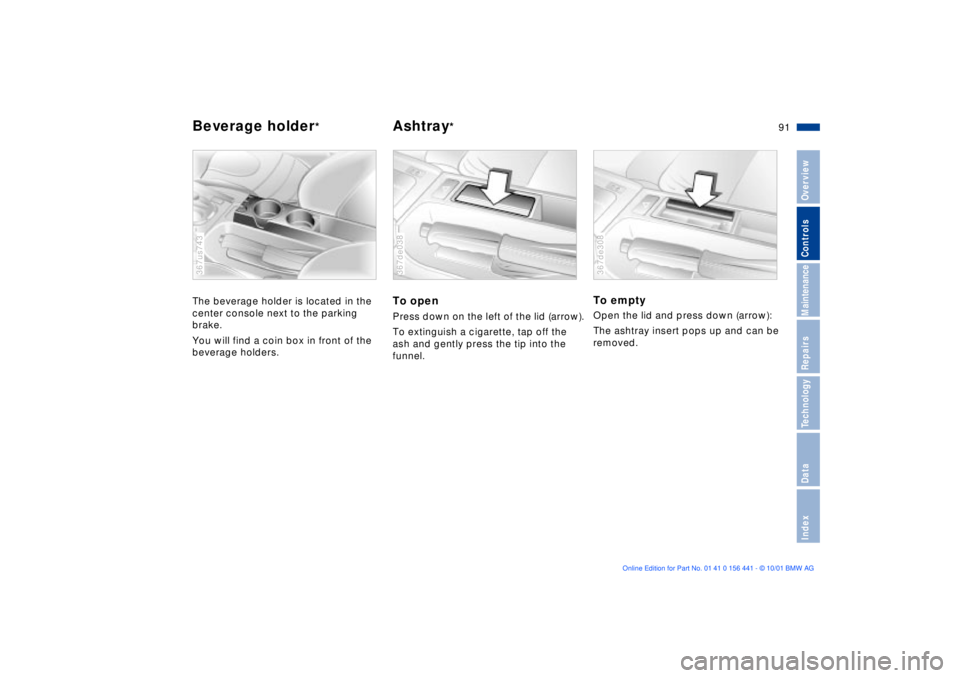
The beverage holder is located in the
center console next to the parking
brake.
You will find a coin box in front of the
beverage holders.367us743
To openPress down on the left of the lid (arrow).
To extinguish a cigarette, tap off the
ash and gently press the tip into the
funnel.367de038
To emptyOpen the lid and press down (arrow):
The ashtray insert pops up and can be
removed.367de308
Page 93 of 187
93n
IndexDataTechnologyRepairsMaintenanceControlsOverview
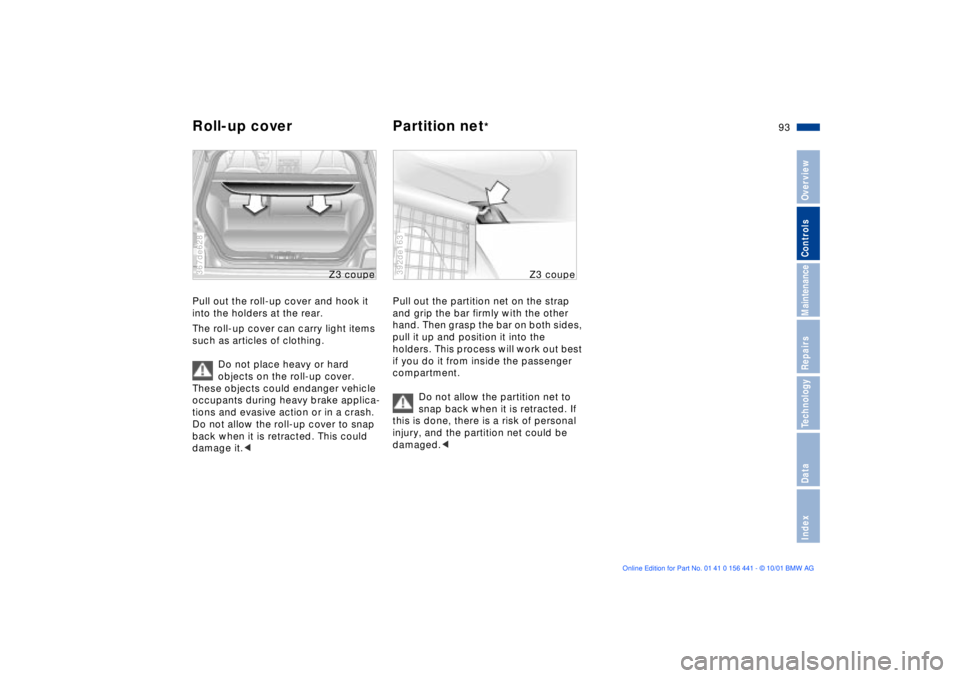
Pull out the roll-up cover and hook it
into the holders at the rear.
The roll-up cover can carry light items
such as articles of clothing.
Do not place heavy or hard
objects on the roll-up cover.
These objects could endanger vehicle
occupants during heavy brake applica-
tions and evasive action or in a crash.
Do not allow the roll-up cover to snap
back when it is retracted. This could
damage it.< 367de628
Z3 cou
pe
Pull out the partition net on the strap
and grip the bar firmly with the other
hand. Then grasp the bar on both sides,
pull it up and position it into the
holders. This process will work out best
if you do it from inside the passenger
compartment.
Do not allow the partition net to
snap back when it is retracted. If
this is done, there is a risk of personal
injury, and the partition net could be
damaged.< 392de163
Z3 cou
pe
Roll-up cover Partition net
*
Page 97 of 187

Overview
Controls and features
Operation, maintenance
Owner service procedures
Technical data
Index Advanced technology
97n
IndexDataTechnologyRepairsMaintenanceControlsOverview
Special operating instructions:
Break-in procedure98
Driving notes99
Catalytic converter100
Antilock Brake System
(ABS)101
Disc brakes103
Brake system104
Winter operation105
Power steering106
Cellular phone107
Car radio reception107
Hardtop Ð roadster108
Wheels and tires:
Notes on inflation pressures110
Tire condition110
Tire replacement111
Tire rotation113
Wheel and tire
combinations114
Special features of winter
tires115
Snow chains115
Approved wheel and tire
specifications116In the engine compartment:
Hood118
Engine compartment120
Fluids for the washer
systems122
Washer nozzles122
Engine oil123
Coolant125
Brake fluid126
Vehicle Identification127
Care and maintenance:
The BMW Maintenance
System128
Airbags130
Storing your vehicle130
Laws and regulations:
Technical modifications132
California Proposition
65 Warning132
OBD interface socket133
Maintenance
Page 98 of 187

98n
To ensure that your vehicle provides
maximum economy throughout a long
service life, we request that you
observe the following:
Engine and differentialUp to 1,200 miles (2,000 km):
Drive with varying engine and road
speeds, but do not exceed 4,500 rpm
or 100 mph (150 km/h).
Comply with local and state maximum
speed limits.
Refrain from using full throttle and avoid
pressing the accelerator beyond the
kickdown point.
After you have driven 1,200 miles
(2,000 km), you can gradually increase
the engine and road speeds.
You should also comply with these
break-in procedures if the engine or
differential is replaced later in the
course of the vehicle's service life.
TiresDue to technical factors associated with
their manufacture, tires do not achieve
their full traction potential until an initial
break-in period has elapsed. You should
therefore drive with extra caution during
the initial 200 miles (300 km).
Comply with local and state maximum
speed limits.
When the vehicle is operated on
wet or slushy roads, a wedge of
water may form between the tire and
the road surface. This phenomenon is
referred to as aquaplaning or hydro-
planing, and can lead to partial or
complete loss of traction, vehicle
control and braking effectiveness.
Reduce your speed on wet roads.<
Brake systemApprox. 300 miles (500 km) must
elapse before the brake pads and
rotors achieve the optimal surface and
wear pattern.
To break-in the separate parking brake
drums, apply the parking brake lightly
when coasting to a standstill (at a traffic
signal, for instance), provided that
traffic conditions allow you to do so.
To avoid corrosion, repeat this proce-
dure from time to time.
The brake lamps do not light up
when the parking brake is applied.
Vacuum for the brake system booster
on your BMW is available only when the
engine is running. When you move the vehicle with the engine off Ð for instance
,
by towing Ð substantially higher levels
of pedal force will be required to brake
the vehicle.<
ClutchThe clutch will reach optimal function
after approx. 300 miles (500 km). Shift
gears carefully during the break-in
period.
Break-in procedure
Page 99 of 187

99n
IndexDataTechnologyRepairsMaintenanceControlsOverview
Driving notes
Brakes:
Do not drive with your foot resting
on the brake pedal. Even light but
consistent pedal pressure can lead to
high temperatures, brake wear and
possibly even brake failure.
Aquaplaning:
When driving on wet or slushy roads,
reduce vehicle speed. If you do not, a
wedge of water may form between the
tires and the road surface. This
phenomenon is referred to as aqua-
planing or hydroplaning. It is character-
ized by a partial or complete loss of
contact between the tires and the road
surface. The ultimate results are loss of
steering and braking control.
Driving through water:
When there is water on the roads, do
not drive in it if it is deeper than 1 ft
(30 cm). If the water is at that depth,
drive only at walking speed, otherwise
the vehicle can sustain damage to the
engine, the electrical systems and the
transmission.
Clothes hooks (coupe):
Hang items of clothing on the hooks in
such a manner that they do not obstruct
the driver's vision. Do not hang heavy
objects on the hooks. If you do so, they
could cause personal injury during
braking or evasive maneuvers.<
Page 101 of 187

101n
IndexDataTechnologyRepairsMaintenanceControlsOverview
Antilock Brake System (ABS)The conceptThe Antilock Brake System (ABS) keeps
the wheels from locking during braking,
thereby enhancing active driving safety.
The reason: locked wheels are
dangerous. When the front wheels
slide, the driver loses steering control
over the vehicle. Traction loss at the
rear wheels can cause the rear end to
break into an uncontrolled skid.
The system can achieve the shortest
braking distances possible under most
conditions (on straight-aways or in
curves, on the various road surfaces).
ABS is designed to meet two essential
requirements during every brake appli-
cation:
>To help provide vehicle stability
>Assured ability to steer and maneuver
on the various road surfaces (asphalt,
concrete, dirt, wet conditions, snow
and ice).
Braking with ABSThe system is operative once the
vehicle exceeds a speed of approx.
6 mph (10 km/h). It is inactive once
again below approx. 4 mph (6 km/h).
Therefore, the wheels could theoreti-
cally tend to lock in the final phase of a
braking action, but this is insignificant in
actual practice.
If you are in a situation which requires
full braking, you will exploit the full
benefits of the ABS system if you apply
maximum brake pressure ("panic stop").
Since the vehicle maintains steering
responsiveness, you can avoid possible
obstacles with a minimum of steering
effort, despite the full brake application.The ABS closed-loop control circuit
cycles in fractions of a second. The
pulsation at the brake pedal, together
with sounds generated by the hydraulic
control system, indicate to you that the
vehicle is approaching its maximum
braking range. It is a reminder to you
that you must adapt the vehicle's road
speed to existing road conditions.
On road surfaces that have a loose
surface layer on a firm base with good
traction (on gravel, deep sand or snow,
for example), braking distances may be
longer than with locked wheels. This
also applies for driving with snow
chains. However, ABS continues to
provide enhanced vehicle stability and
steering response under these condi-
tions.