2002 BMW Z3 brake
[x] Cancel search: brakePage 45 of 187
45n
IndexDataTechnologyRepairsMaintenanceControlsOverview
Power convertible top, roadster
*
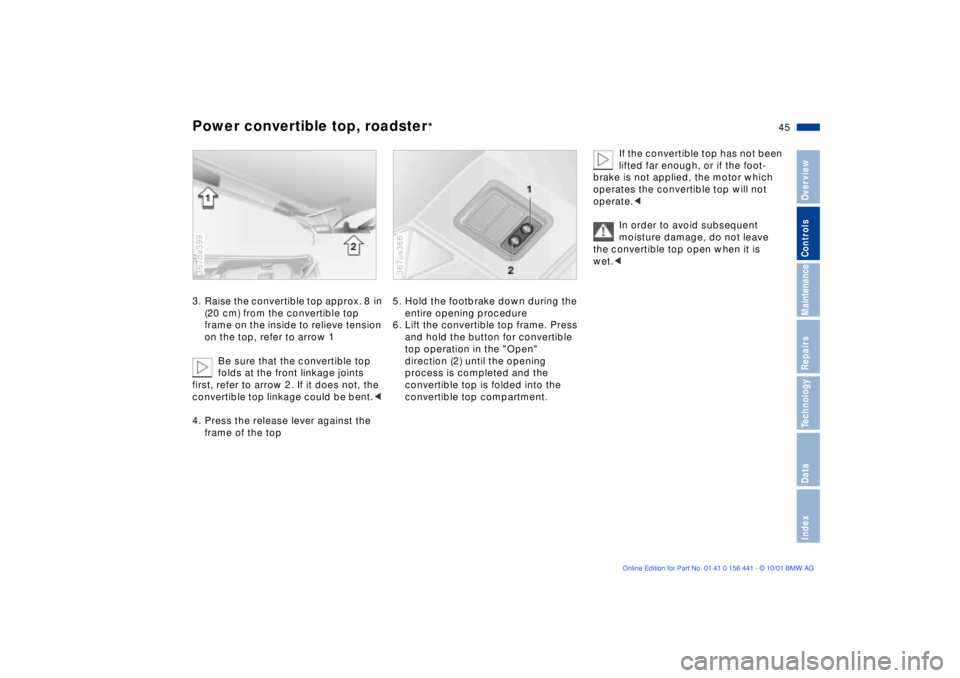
3. Raise the convertible top approx. 8 in
(20 cm) from the convertible top
frame on the inside to relieve tension
on the top, refer to arrow 1
Be sure that the convertible top
folds at the front linkage joints
first, refer to arrow 2. If it does not, the
convertible top linkage could be bent.<
4. Press the release lever against the
frame of the top367de399
5. Hold the footbrake down during the
entire opening procedure
6. Lift the convertible top frame. Press
and hold the button for convertible
top operation in the "Open"
direction (2) until the opening
process is completed and the
convertible top is folded into the
convertible top compartment.367us366
If the convertible top has not been
lifted far enough, or if the foot-
brake is not applied, the motor which
operates the convertible top will not
operate.<
In order to avoid subsequent
moisture damage, do not leave
the convertible top open when it is
wet.<
Page 48 of 187
48n
Power convertible top, roadster
*
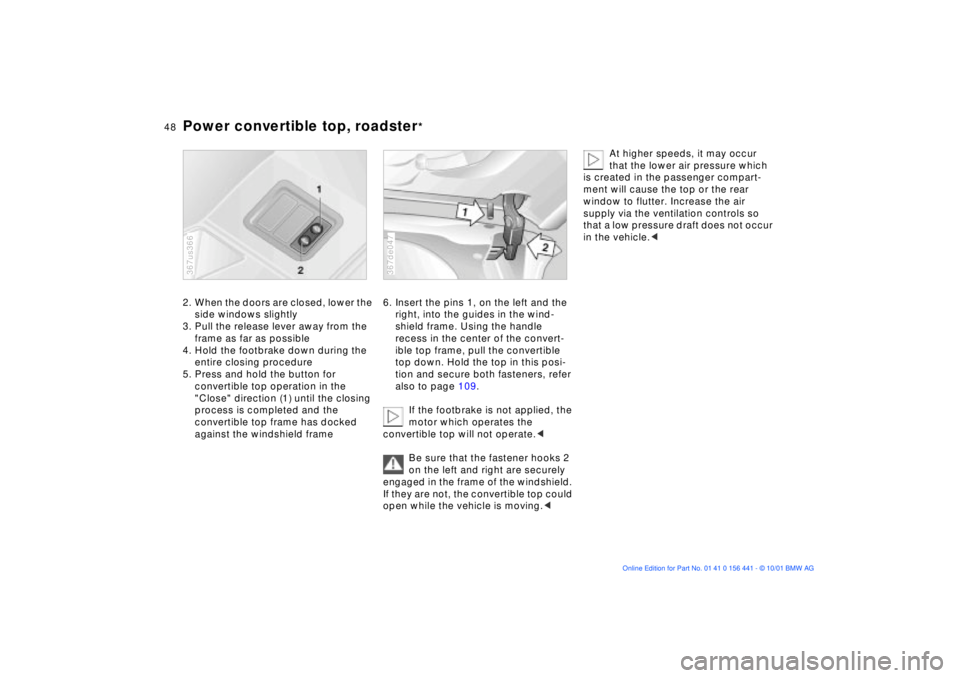
2. When the doors are closed, lower the
side windows slightly
3. Pull the release lever away from the
frame as far as possible
4. Hold the footbrake down during the
entire closing procedure
5. Press and hold the button for
convertible top operation in the
"Close" direction (1) until the closing
process is completed and the
convertible top frame has docked
against the windshield frame367us366
6. Insert the pins 1, on the left and the
right, into the guides in the wind-
shield frame. Using the handle
recess in the center of the convert-
ible top frame, pull the convertible
top down. Hold the top in this posi-
tion and secure both fasteners, refer
also to page 109.
If the footbrake is not applied, the
motor which operates the
convertible top will not operate.<
Be sure that the fastener hooks 2
on the left and right are securely
engaged in the frame of the windshield.
If they are not, the convertible top could
open while the vehicle is moving.< 367de047
At higher speeds, it may occur
that the lower air pressure which
is created in the passenger compart-
ment will cause the top or the rear
window to flutter. Increase the air
supply via the ventilation controls so
that a low pressure draft does not occur
in the vehicle.<
Page 59 of 187
59n
IndexDataTechnologyRepairsMaintenanceControlsOverview
Starting the engineBefore starting>Engage the parking brake
>Be sure that the gearshift lever is in
"Neutral" (or the selector lever in "P"
if the vehicle is equipped with auto-
matic transmission)
>Depress the clutch pedal.
Do not run the engine in enclosed
spaces. The exhaust gases
contain carbon monoxide, an odorless
and colorless, but highly toxic gas.
Breathing the exhaust gases poses an
extreme health risk, and can lead to
unconsciousness and death.
Do not leave the vehicle unattended
with the engine running. An unattended
vehicle with a running engine repre-
sents a potential safety hazard.<
Starting the engine>Do not press the accelerator pedal
while starting the engine.
Do not actuate the starter for too
short a time. Do not turn it for
more than approx. 20 seconds. Release
the ignition key immediately after the
engine starts.
Do not allow the engine to warm up
by leaving it running while the vehicle
remains stationary. Instead, begin to
drive immediately at a moderate engine
speed.<
Should the engine fail to start on the
first attempt (if it is very hot or cold, for
instance):
>Press the accelerator pedal halfway
down while engaging the starter.
Cold starts at very low temperatures,
from approx. +5 7 (Ð15 6) and at
altitudes above approx. 3,300 ft
(1,000 m):
>On the first start attempt, engage the
starter for a longer period (approx.
10 seconds).
If these temperature conditions are
anticipated for a longer period, have the
engine oil changed to a special oil, refer
to page 124. Please contact your BMW
center for additional information.
Usually, it is not necessary to depress
the accelerator pedal. However, at high
altitudes or in very hot or very cold
weather, depress the pedal halfway
down when starting the engine.
Engine idle speed is controlled by the
engine computer system. Increased
speeds at start-up are normal and
should decrease as the engine warms
up. If engine speed does not decrease,
service is required.
To prevent the battery from
discharging, always switch off any
accessories which are not required.
Switch off the ignition when the vehicle
is not being driven.
Page 60 of 187
60n
Switching off the engine Parking brakeTurn the ignition key to position 1 or 0.
Do not remove the ignition key
while the vehicle is rolling. The
steering locks and it is impossible to
steer the vehicle.
Always remove the ignition key and
engage the steering lock before leaving
the vehicle.
Vehicles with manual transmission:
Always engage the parking brake when
parking on slopes and inclined
surfaces, since even placing the gear-
shift lever in 1st gear or reverse may not
provide adequate resistance to rolling.
Vehicles with automatic transmission:
Place the selector lever in "P".<
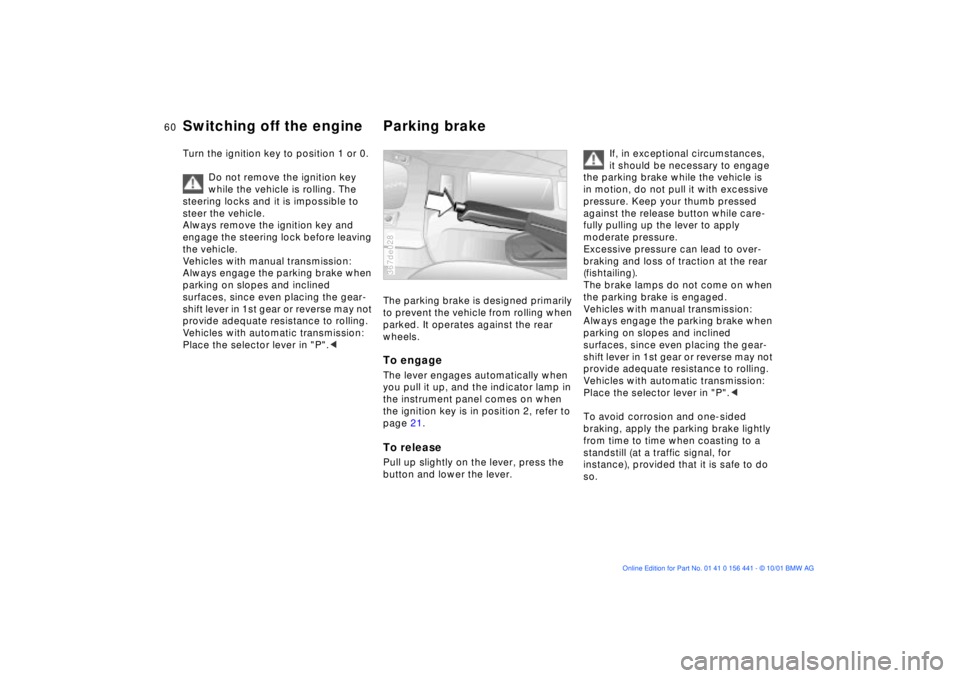
The parking brake is designed primarily
to prevent the vehicle from rolling when
parked. It operates against the rear
wheels.To engageThe lever engages automatically when
you pull it up, and the indicator lamp in
the instrument panel comes on when
the ignition key is in position 2, refer to
page 21.To releasePull up slightly on the lever, press the
button and lower the lever.367de028
If, in exceptional circumstances,
it should be necessary to engage
the parking brake while the vehicle is
in motion, do not pull it with excessive
pressure. Keep your thumb pressed
against the release button while care-
fully pulling up the lever to apply
moderate pressure.
Excessive pressure can lead to over-
braking and loss of traction at the rear
(fishtailing).
The brake lamps do not come on when
the parking brake is engaged.
Vehicles with manual transmission:
Always engage the parking brake when
parking on slopes and inclined
surfaces, since even placing the gear-
shift lever in 1st gear or reverse may not
provide adequate resistance to rolling.
Vehicles with automatic transmission:
Place the selector lever in "P".<
To avoid corrosion and one-sided
braking, apply the parking brake lightly
from time to time when coasting to a
standstill (at a traffic signal, for
instance), provided that it is safe to do
so.
Page 61 of 187
61n
IndexDataTechnologyRepairsMaintenanceControlsOverview
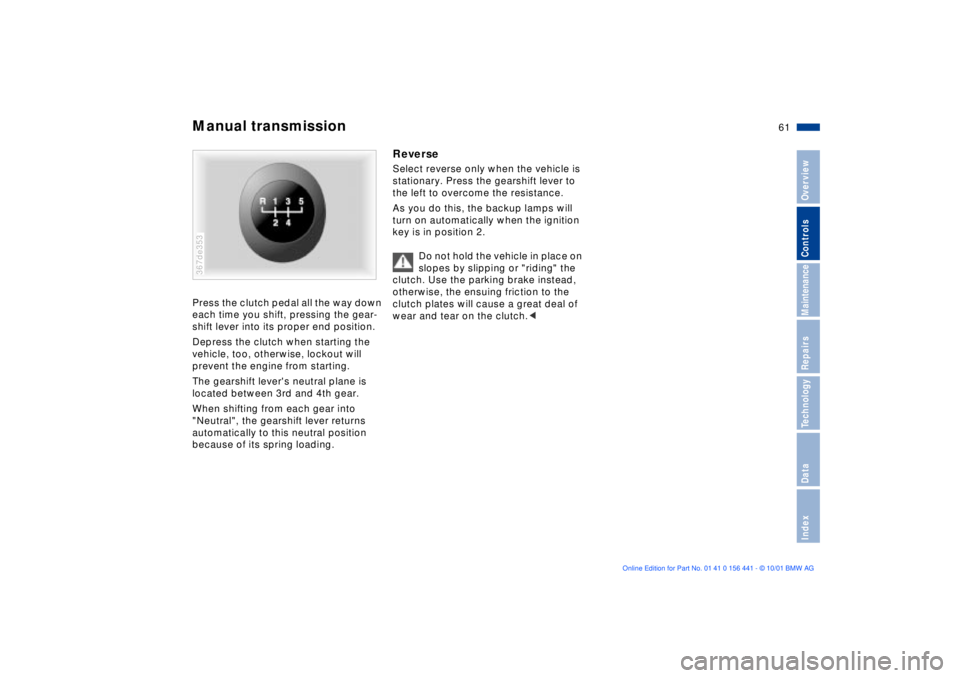
Manual transmissionPress the clutch pedal all the way down
each time you shift, pressing the gear-
shift lever into its proper end position.
Depress the clutch when starting the
vehicle, too, otherwise, lockout will
prevent the engine from starting.
The gearshift lever's neutral plane is
located between 3rd and 4th gear.
When shifting from each gear into
"Neutral", the gearshift lever returns
automatically to this neutral position
because of its spring loading.367de353
ReverseSelect reverse only when the vehicle is
stationary. Press the gearshift lever to
the left to overcome the resistance.
As you do this, the backup lamps will
turn on automatically when the ignition
key is in position 2.
Do not hold the vehicle in place on
slopes by slipping or "riding" the
clutch. Use the parking brake instead,
otherwise, the ensuing friction to the
clutch plates will cause a great deal of
wear and tear on the clutch.<
Page 62 of 187
62n
Automatic transmission with Steptronic
*
You can drive as with a normal auto-
matic transmission. In addition, you can
also shift manually.
When you move the selector lever from
the "D" position to the left into the M/S
range, the performance-oriented shift
programs of the automatic transmission
are engaged. As soon as you briefly tab
the selector lever in the "+" or "Ð" direc-
tion, Steptronic changes the gear. The
manual mode is engaged. When you
wish to use the automatic transmission
mode again, move the selector lever to
the right into the "D" position.
The automatic transmission of your
BMW is equipped with Adaptive Trans-
mission Control (ATC), a system which
reacts with precision to your individual
driving style and the driving conditions.
To achieve this, different shift programs
are automatically engaged.
For additional details concerning the
ATC, please refer to the chapter
"Advanced technology" on page 164.
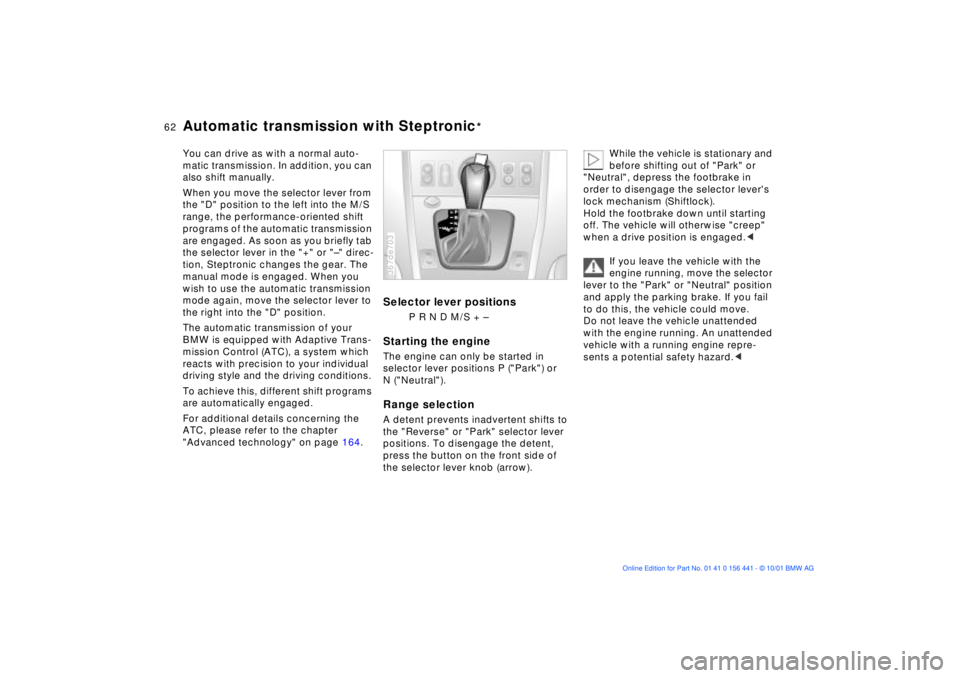
Selector lever positions
P R N D M/S + Ð
Starting the engine The engine can only be started in
selector lever positions P ("Park") or
N ("Neutral"). Range selection A detent prevents inadvertent shifts to
the "Reverse" or "Park" selector lever
positions. To disengage the detent,
press the button on the front side of
the selector lever knob (arrow). 367de703
While the vehicle is stationary and
before shifting out of "Park" or
"Neutral", depress the footbrake in
order to disengage the selector lever's
lock mechanism (Shiftlock).
Hold the footbrake down until starting
off. The vehicle will otherwise "creep"
when a drive position is engaged.<
If you leave the vehicle with the
engine running, move the selector
lever to the "Park" or "Neutral" position
and apply the parking brake. If you fail
to do this, the vehicle could move.
Do not leave the vehicle unattended
with the engine running. An unattended
vehicle with a running engine repre-
sents a potential safety hazard.<
Page 67 of 187
67n
IndexDataTechnologyRepairsMaintenanceControlsOverview
Cruise control
*
You can maintain and store any desired
vehicle speed above approx. 25 mph
(40 km/h).
The system is switched off and the
stored speed deleted from its memory
when you turn the ignition key to posi-
tion 0.
Do not use the cruise control on
winding roads, when high traffic
density prevents driving at a constant
speed, when the road surface is slick
(snow, rain, ice) or when the road
surface is loose (rocks or gravel,
sand).< 365us059
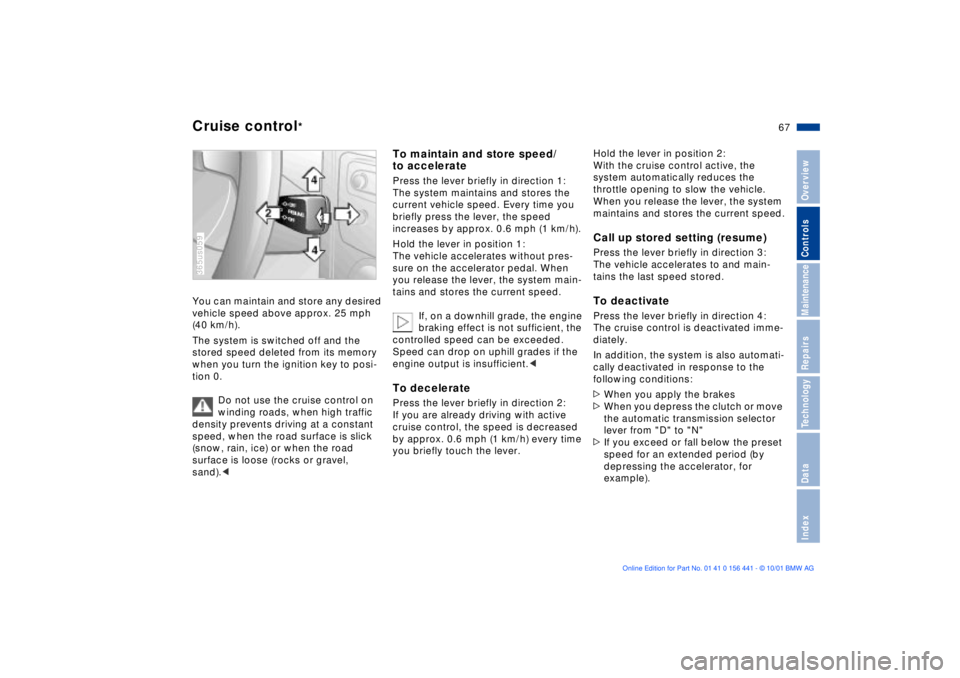
To maintain and store speed/
to acceleratePress the lever briefly in direction 1:
The system maintains and stores the
current vehicle speed. Every time you
briefly press the lever, the speed
increases by approx. 0.6 mph (1 km/h).
Hold the lever in position 1:
The vehicle accelerates without pres-
sure on the accelerator pedal. When
you release the lever, the system main-
tains and stores the current speed.
If, on a downhill grade, the engine
braking effect is not sufficient, the
controlled speed can be exceeded.
Speed can drop on uphill grades if the
engine output is insufficient.< To deceleratePress the lever briefly in direction 2:
If you are already driving with active
cruise control, the speed is decreased
by approx. 0.6 mph (1 km/h) every time
you briefly touch the lever.
Hold the lever in position 2:
With the cruise control active, the
system automatically reduces the
throttle opening to slow the vehicle.
When you release the lever, the system
maintains and stores the current speed.Call up stored setting (resume)Press the lever briefly in direction 3:
The vehicle accelerates to and main-
tains the last speed stored.To deactivatePress the lever briefly in direction 4:
The cruise control is deactivated imme-
diately.
In addition, the system is also automati-
cally deactivated in response to the
following conditions:
>When you apply the brakes
>When you depress the clutch or move
the automatic transmission selector
lever from "D" to "N"
>If you exceed or fall below the preset
speed for an extended period (by
depressing the accelerator, for
example).
Page 73 of 187
73n
IndexDataTechnologyRepairsMaintenanceControlsOverview
The conceptThis system helps provide additional
dynamic stability, particularly when
starting off, accelerating and cornering.
ASC+T recognizes the danger present
in traction loss and will increase driving
stability and traction by reducing the
engine's output, and if necessary, by
applying the brakes individually to the
rear wheels.
ASC+T is available as soon as the
engine starts up.
Indicator lamp
The indicator lamp in the instru-
ment cluster goes out shortly
after you switch on the ignition,
refer to page 22.
The indicator lamp flashes:
ASC+T controls the drive and braking
forces.
If the indicator lamp fails to go out after
the engine is started, or if it comes on
during normal driving and stays on:
There is a system malfunction or the
system was switched off with the
button. Consequently, interventions to
increase driving stability (as described
in the preceding column) are not avail-
able. You can still drive the vehicle
normally without ASC+T.
In the event of a malfunction, please
consult your BMW center.
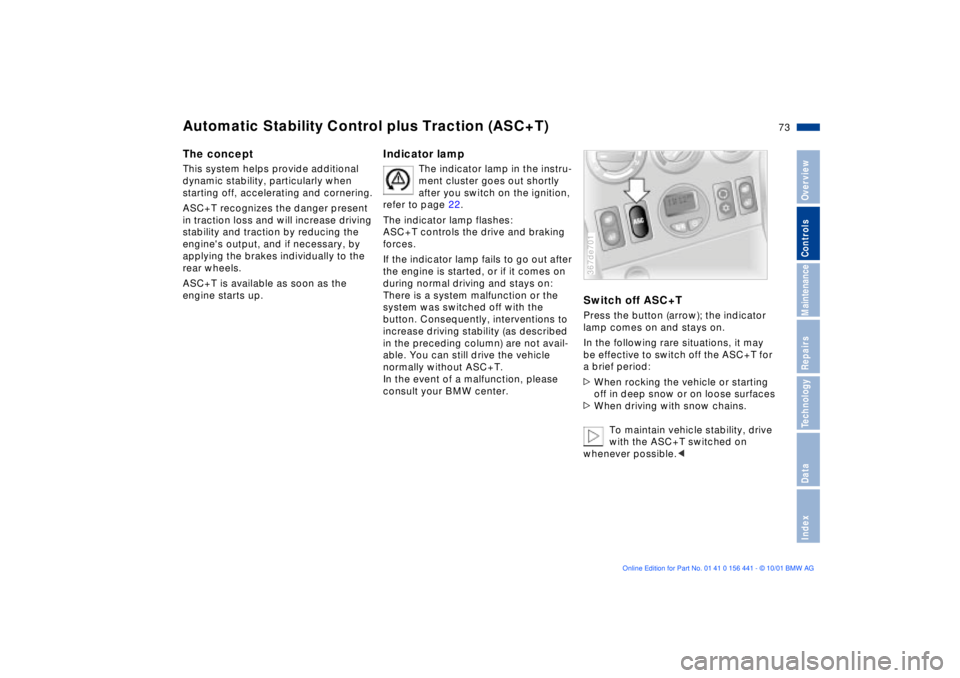
Switch off ASC+TPress the button (arrow); the indicator
lamp comes on and stays on.
In the following rare situations, it may
be effective to switch off the ASC+T for
a brief period:
>When rocking the vehicle or starting
off in deep snow or on loose surfaces
>When driving with snow chains.
To maintain vehicle stability, drive
with the ASC+T switched on
whenever possible.<367de701
Automatic Stability Control plus Traction (ASC+T)