Page 131 of 187

131n
IndexDataTechnologyRepairsMaintenanceControlsOverview
Storing your vehicle5. Fill the fuel tank completely to
prevent the formation of condensa-
tion
6. Increase the tire inflation pressure to
51 psi (350 kPa).Before parking the vehicle for
storage1. Dry the parking brake and footbrake
by brake applications to prevent the
brake rotors and drums from
corroding
2. Park the vehicle in a covered, dry,
and well-ventilated room. Place the
transmission in 1st gear or set the
selector lever to the "P" position.
Chock the wheels to prevent the
vehicle from rolling if necessary. Do
not set the parking brake
3. Remove the battery, charge it
completely and store it in a cool (but
frost-free) room
Z3 roadster:
4. Remove the hardtop
* and store it
separately, refer to page 109
5. Close the convertible top.
During storageRecharge the battery every six months.
If it is not recharged, it will not be
serviceable. Every time the battery is
discharged, especially over extended
periods, its service life is reduced.
Removing the vehicle from
storageRecharge the battery if the "Magic Eye"
turns black, refer to page 154.
Then have Inspection I performed by
your BMW center, including a brake
fluid replacement if necessary, refer to
the Service Manual.
Page 139 of 187
139n
IndexDataTechnologyRepairsMaintenanceControlsOverview
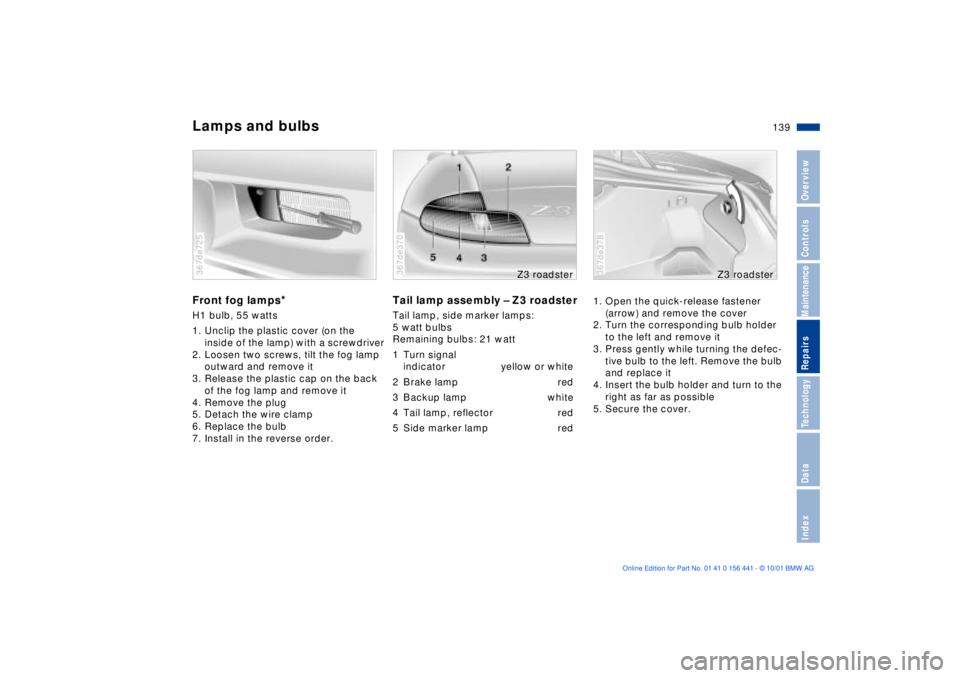
Lamps and bulbsFront fog lamps
*
H1 bulb, 55 watts
1. Unclip the plastic cover (on the
inside of the lamp) with a screwdriver
2. Loosen two screws, tilt the fog lamp
outward and remove it
3. Release the plastic cap on the back
of the fog lamp and remove it
4. Remove the plug
5. Detach the wire clamp
6. Replace the bulb
7. Install in the reverse order.367de725
Tail lamp assembly Ð Z3 roadsterTail lamp, side marker lamps:
5 watt bulbs
Remaining bulbs: 21 watt
1 Turn signal
indicator yellow or white
2 Brake lamp red
3 Backup lamp white
4 Tail lamp, reflector red
5 Side marker lamp red367de370
Z3 roadster
1. Open the quick-release fastener
(arrow) and remove the cover
2. Turn the corresponding bulb holder
to the left and remove it
3. Press gently while turning the defec-
tive bulb to the left. Remove the bulb
and replace it
4. Insert the bulb holder and turn to the
right as far as possible
5. Secure the cover.367de378
Z3 roadster
Page 140 of 187
140n
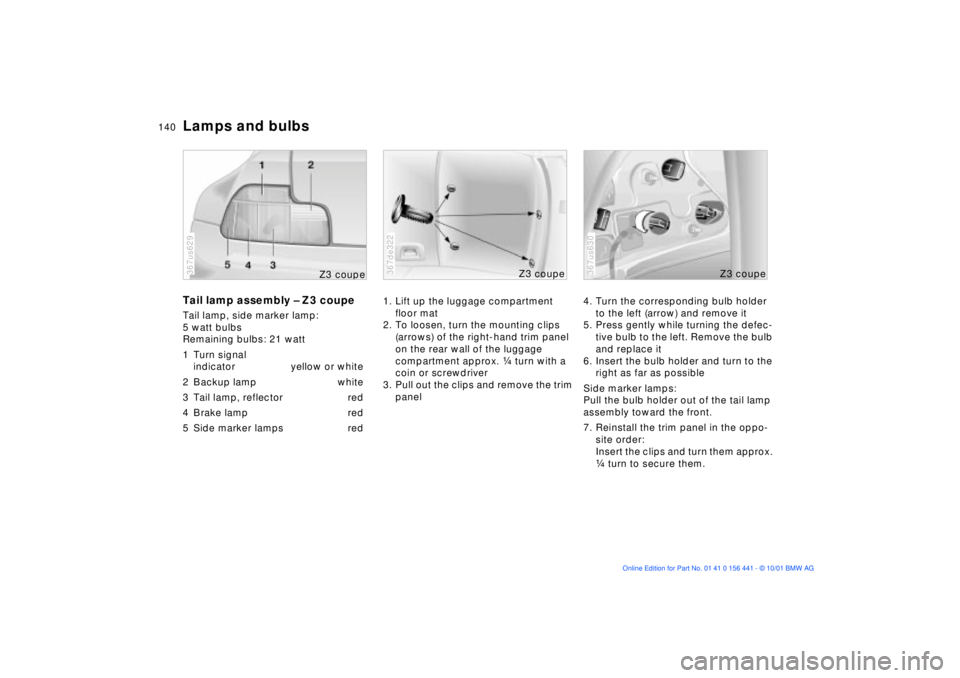
Lamps and bulbsTail lamp assembly Ð Z3 coupeTail lamp, side marker lamp:
5 watt bulbs
Remaining bulbs: 21 watt
1 Turn signal
indicator yellow or white
2 Backup lamp white
3 Tail lamp, reflector red
4 Brake lamp red
5 Side marker lamps red367us629
Z3 cou
pe
1. Lift up the luggage compartment
floor mat
2. To loosen, turn the mounting clips
(arrows) of the right-hand trim panel
on the rear wall of the luggage
compartment approx. f turn with a
coin or screwdriver
3. Pull out the clips and remove the trim
panel367de322
Z3 coupe
4. Turn the corresponding bulb holder
to the left (arrow) and remove it
5. Press gently while turning the defec-
tive bulb to the left. Remove the bulb
and replace it
6. Insert the bulb holder and turn to the
right as far as possible
Side marker lamps:
Pull the bulb holder out of the tail lamp
assembly toward the front.
7. Reinstall the trim panel in the oppo-
site order:
Insert the clips and turn them approx.
f turn to secure them.367us630
Z3 coupe
Page 141 of 187
141n
IndexDataTechnologyRepairsMaintenanceControlsOverview
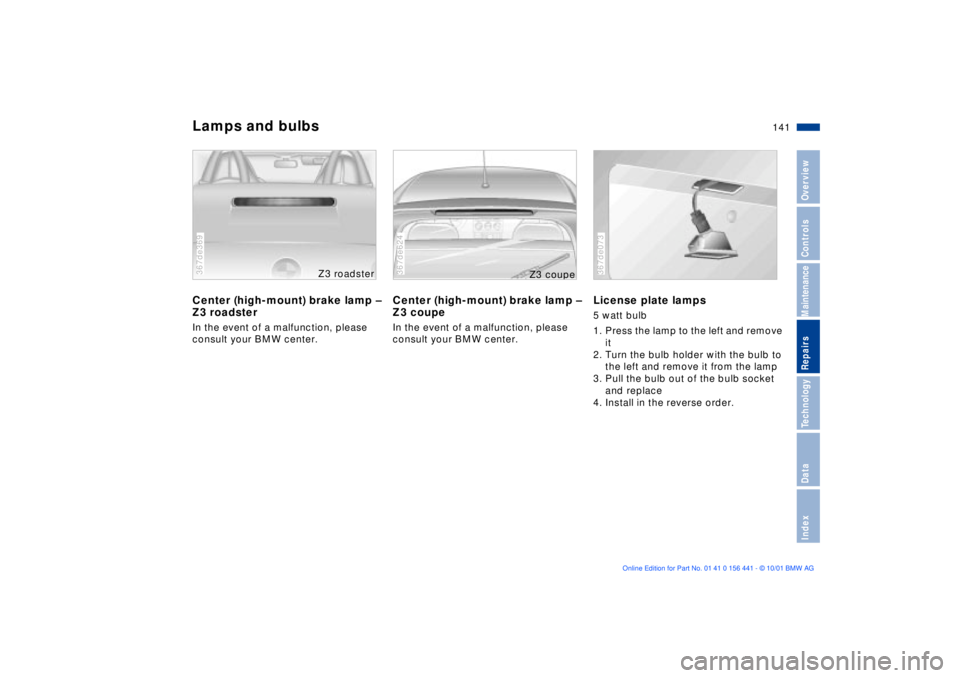
Lamps and bulbsCenter (high-mount) brake lamp Ð
Z3 roadsterIn the event of a malfunction, please
consult your BMW center.367de369
Z3 roadster
Center (high-mount) brake lamp Ð
Z3 coupeIn the event of a malfunction, please
consult your BMW center.367de624
Z3 cou
pe
License plate lamps5 watt bulb
1. Press the lamp to the left and remove
it
2. Turn the bulb holder with the bulb to
the left and remove it from the lamp
3. Pull the bulb out of the bulb socket
and replace
4. Install in the reverse order.367de073
Page 146 of 187
146n
Wheel change
Safety measures in the event of a
flat tire or a wheel change:
Stop the vehicle on a firm, level surface
as far as possible from the flow of
traffic. Turn on the hazard warning
flashers.
Turn the steering wheel to the straight-
ahead position and engage the steering
lock, engage the parking brake and
shift into 1st or reverse gear (selector
lever in "Park" with automatic transmis-
sion).
All passengers should be outside the
vehicle and well away from your imme-
diate working area (for instance, behind
the guardrail).
If a warning triangle or portable hazard
warning lamp is available, set it up on
the roadside at an appropriate distance
from the rear of the vehicle. Comply
with all safety guidelines and regula-
tions.
Change the wheel only on a level, firm
surface which is not slippery. Avoid
jacking the vehicle on a soft or slippery
support surface (snow, ice, tiles, loose
gravel, etc.), since it could slide side-
ways.
Place the jack on a firm support
surface.
Do not place wooden blocks or similar
objects under the jack. If this is done,
the jack might not be able to reach its
full support capacity because of the
limited height.
Do not lie under the vehicle or start the
engine when the vehicle is supported
by the jack. This creates the risk of fatal
injury.<
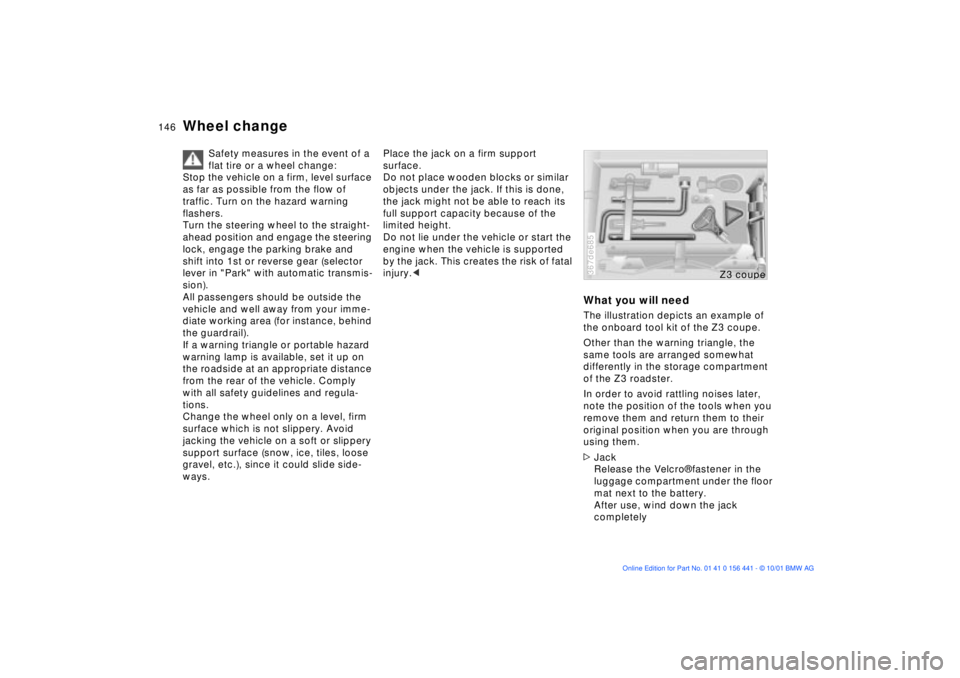
What you will needThe illustration depicts an example of
the onboard tool kit of the Z3 coupe.
Other than the warning triangle, the
same tools are arranged somewhat
differently in the storage compartment
of the Z3 roadster.
In order to avoid rattling noises later,
note the position of the tools when you
remove them and return them to their
original position when you are through
using them.
>Jack
Release the Velcro¨ fastener in the
luggage compartment under the floor
mat next to the battery.
After use, wind down the jack
completely367de685
Z3 coupe
Page 152 of 187

152n
Wheel change13. Wheels with full wheel covers:
Place the wheel cover with the
valve opening over the valve. Use
both hands to press the cover
securely onto the rim
14. Check and correct the inflation
pressure at the earliest opportunity.
Use only the full wheel cover
installed by the factory. Other
wheel covers may not fit securely. The
full wheel cover may not be installed on
the spare wheel because the cover
could be damaged.<
The jack is designed for changing
wheels only. Do not attempt to lift
a different vehicle model or any other
type of load with the jack. To do so
could lead to property damage or
personal injury.
To ensure continued safety, check the
tightness of the lug bolts at the earliest
opportunity (torque specification:
72 lbs ft [100 Nm]).<
If light-alloy wheels other than Original
BMW light-alloy wheels have been
mounted, it may be necessary to use
different lug bolts for those wheels.
Replace the defective tire as soon as
possible and have the new wheel/tire
balanced.
Driving with the spare wheelDrive cautiously and do not exceed a
speed of 50 mph (80 km/h).
Be aware that vehicle handling will be
altered. Slower brake response time,
longer braking distances and changed
steering characteristics may be antici-
pated when approaching limit condi-
tions.
Only one spare wheel may be
mounted at any time. Mount a
wheel and tire with the same size and
specifications as the others at the
earliest possible opportunity. Maintain
the specified tire inflation pressures,
refer to the table on page 27.<
Page 160 of 187
160n
Towing the vehicle
The towed vehicle should always
be the lighter of the two vehicles.
If this is not the case, it will not be
possible to control vehicle handling.<
Tow-startingIt is not possible to start the engine of a
vehicle with an automatic transmission
by towing or pushing the vehicle.
For instructions on jump-starting, refer
to page 158.
Never attempt to use your vehicle to
push another vehicle. This could result
in damage to the energy-absorbing
bumpers.
Towing a vehicle with automatic
transmission1. Place the selector lever in
position "N"
2. Towing speed:
max. 45 mph (70 km/h)
3. Towing distance:
max. 95 miles (150 km)
4. Leave the ignition key in position 1 to
ensure that brake lamps, turn signal
indicators, horn and windshield
wipers remain operative, and to
prevent the steering lock from
engaging
5. Switch on the hazard-warning
flashers (observe applicable legal
regulations).
Find some means of identifying the
vehicle in tow. Place a sign or warning
triangle in the rear window, for
instance.
Even when the electrical system
has failed, make sure that the igni-
tion key remains in position 1 to prevent
the steering lock from engaging.
The steering and brakes are without
power assist when the engine is off.
This means that increased effort is
required for steering and braking.<
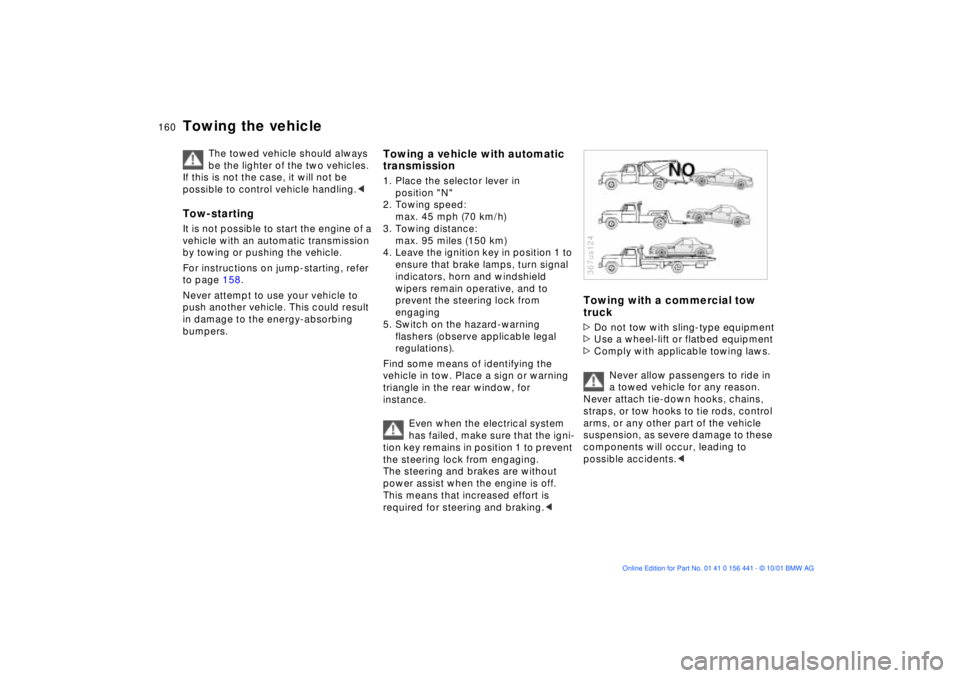
Towing with a commercial tow
truck>Do not tow with sling-type equipment
>Use a wheel-lift or flatbed equipment
>Comply with applicable towing laws.
Never allow passengers to ride in
a towed vehicle for any reason.
Never attach tie-down hooks, chains,
straps, or tow hooks to tie rods, control
arms, or any other part of the vehicle
suspension, as severe damage to these
components will occur, leading to
possible accidents.< 367us124
Page 164 of 187

164n
For vehicles with automatic transmis-
sion, Adaptive Transmission Control
(ATC) performs the optimum gear selec-
tion based on a number of factors. This
system reacts to your individual driving
style and the current driving conditions.
The ATC recognizes your individual
driving style from the positions and
movements of the accelerator pedal,
delays during braking, and the vehicle's
lateral acceleration when cornering.
ATC makes the appropriate selection
from different shift characteristics
which range from comfort-oriented to
performance-oriented.
367us358
In order to take driving conditions into
account, ATC registers corners and
both uphill and downhill gradients. For
example, if you maintain speed through
a curve, the transmission does not
upshift.
On uphill gradients, it shifts only when
the engine speed increases in order to
make more efficient use of power
reserves. On downhill gradients ATC
downshifts when the speed of the vehi-
cles increases causing the driver to
step on the brakes.
Deceleration sensors continuously
monitor the physical forces acting upon
the vehicle. In the event of a severe
frontal impact, the gas generators of
the driver and passenger-side front
airbags are ignited simultaneously.
However, the passenger-side airbag is
only triggered if an additional sensor
has recognized that the passenger seat
is occupied.
If it is necessary during a side impact, a
side airbag will be triggered on the side
where the collision occurs.
390de012
ATC
*
Airbags