Page 2916 of 4323
CH0M3±02
B00809
CH±16
± CHARGINGGENERATOR
2908 Author�: Date�:
2005 SEQUOIA (RM1146U)
INSTALLATION
1. INSTALL GENERATOR
(a) Install the generator with the bolt and the 2 nuts.
Torque:
Bolt: 39 N´m (400 kgf´cm, 29 ft´lbf)
Nut 10 mm: 39 N´m (400 kgf´cm, 29 ft´lbf)
Nut 8 mm: 15.5 N´m (158 kgf´cm, 11 ft´lbf)
(b) Connect the generator connector.
(c) Connect the generator wire with the nut.
Torque: 9.8 N´m (100 kgf´cm, 87 in.´lbf)
(d) Install the terminal cap.
(e) Install the wire clamp to the cord clip on the generator.
2. INSTALL PS VANE PUMP (See page SR±36)
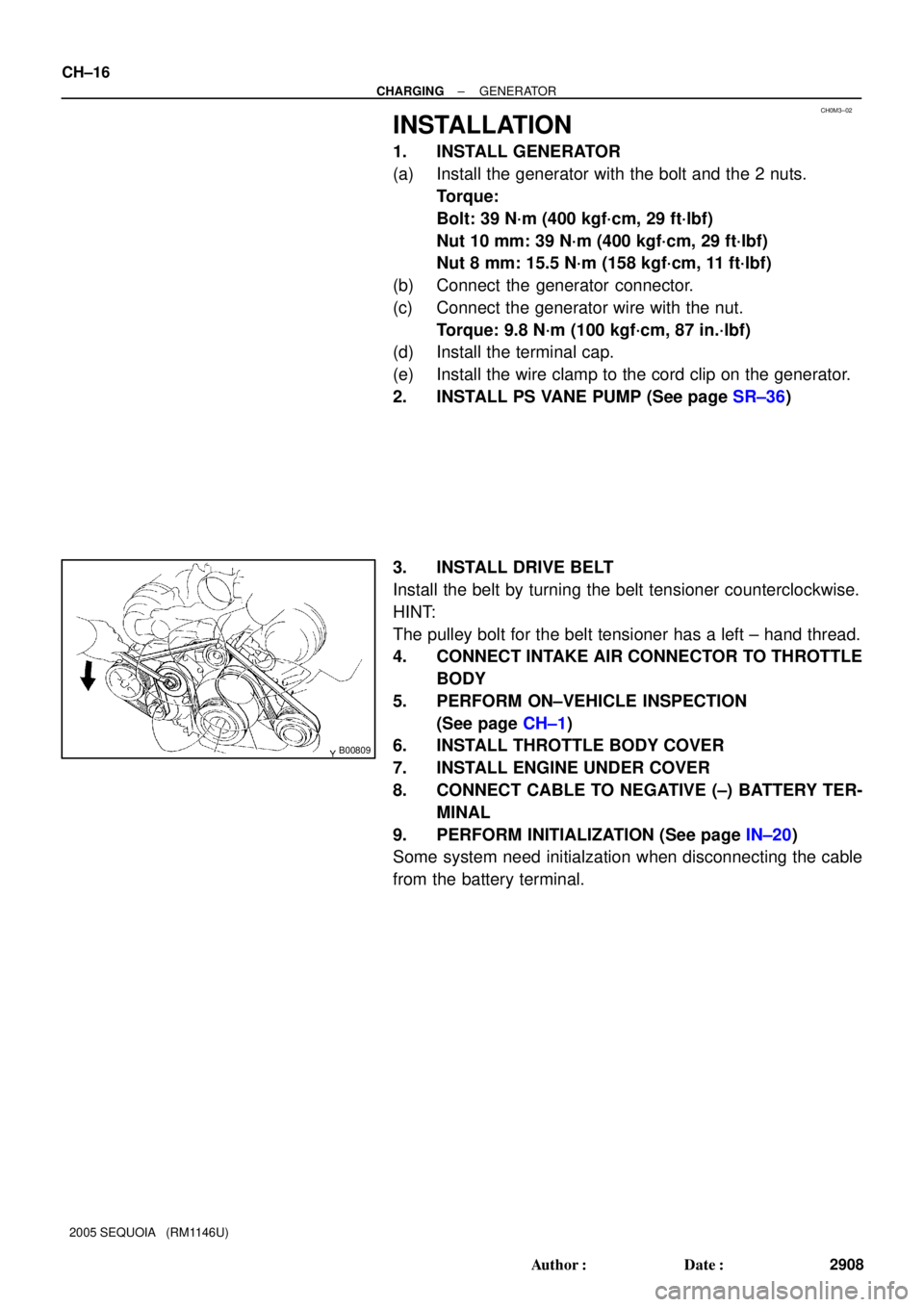
3. INSTALL DRIVE BELT
Install the belt by turning the belt tensioner counterclockwise.
HINT:
The pulley bolt for the belt tensioner has a left ± hand thread.
4. CONNECT INTAKE AIR CONNECTOR TO THROTTLE
BODY
5. PERFORM ON±VEHICLE INSPECTION
(See page CH±1)
6. INSTALL THROTTLE BODY COVER
7. INSTALL ENGINE UNDER COVER
8. CONNECT CABLE TO NEGATIVE (±) BATTERY TER-
MINAL
9. PERFORM INITIALIZATION (See page IN±20)
Some system need initialzation when disconnecting the cable
from the battery terminal.
Page 3736 of 4323

AC2810
AC1JS±06
AC2811
N11084
Wrong Okay
HI LO HILO
± AIR CONDITIONINGAIR CONDITIONING SYSTEM
AC±1
3728 Author�: Date�:
2005 SEQUOIA (RM1146U)
AIR CONDITIONING SYSTEM
PRECAUTION
1. DO NOT HANDLE REFRIGERANT IN AN ENCLOSED
AREA OR NEAR AN OPEN FLAME
2. ALWAYS WEAR EYE PROTECTION
3. BE CAREFUL NOT TO GET LIQUID REFRIGERANT IN
YOUR EYES OR ON YOUR SKIN
If liquid refrigerant gets in your eyes or on your skin.
(a) Wash the area with lots of cool water.
CAUTION:
Do not rub your eyes or skin.
(b) Apply clean petroleum jelly to the skin.
(c) Go immediately to a physician or hospital for professional
treatment.
4. NEVER HEAT CONTAINER OR EXPOSE IT TO OPEN
FLAME
5. BE CAREFUL NOT TO DROP CONTAINER OR NOT TO
APPLY PHYSICAL SHOCKS TO IT
6. DO NOT OPERATE COMPRESSOR WITHOUT
ENOUGH REFRIGERANT IN REFRIGERATION SYS-
TEM
If there is not enough refrigerant in the refrigerant system, oil lu-
brication will be insufficient and compressor burnout may occur.
Necessary care should be taken to avoid this.
7. DO NOT OPEN PRESSURE MANIFOLD VALVE WHILE
COMPRESSOR IS OPERATING
If the high pressure valve is opened, refrigerant flows in the re-
verse direction and could cause the charging cylinder to rup-
ture, so open and close only the low pressure valve.
8. BE CAREFUL NOT TO OVERCHARGE SYSTEM WITH
REFRIGERANT
If refrigerant is overcharged, it causes problems such as insuffi-
cient cooling, poor fuel economy, engine overheating, etc.
Page 3745 of 4323

AC1JU±07
N13795
Quick Disconnect
Adapter
Charging
Service ValveHose
N13794
Vacuum Pump
Vacuum Pump Adapter
N13791
Low Pressure
Service Valve
Vacuum Pump Adapter High Pressure
Service ValveManifold
Gauge
Set
AC±10
± AIR CONDITIONINGAIR CONDITIONING SYSTEM
3737 Author�: Date�:
2005 SEQUOIA (RM1146U)
EVACUATING
1. CONNECT QUICK DISCONNECT ADAPTER TO
CHARGING HOSES
2. REMOVE CAPS FROM SERVICE VALVES ON RE-
FRIGERANT LINES
3. SET MANIFOLD GAUGE SET
(a) Close both valves of the manifold gauge set.
(b) Connect the quick disconnect adapters to the service
valves.
4. EVACUATE AIR FROM REFRIGERATION SYSTEM
(a) Connect the vacuum pump adapter to the vacuum pump.
(b) Connect the center hose of the manifold gauge set to the
vacuum pump adapter.
(c) Open both the high and low side valves and run the vacu-
um pump.
(d) After 10 minutes or more, check that the low pressure
gauge indicates 750 mmHg (30 in. Hg) or more.
HINT:
If the reading is 750 mmHg (30 in. Hg) or more, close both
valves of the manifold gauge set and stop the vacuum pump.
Check the system for leaks and repair if necessary.
(e) Close both the high and low side valves and stop the vac-
uum pump.
(f) Leave the system in this condition for 5 minutes or more
and check that there is no change in gauge indication.
Page 3746 of 4323

AC1JV±05
N13793
Charging Cylinder High Pressure
Service Valve Low Pressure
Service ValvePush
Air
N13792
Gas Leak
Detector
± AIR CONDITIONINGAIR CONDITIONING SYSTEM
AC±11
3738 Author�: Date�:
2005 SEQUOIA (RM1146U)
CHARGING
1. INSTALL CHARGING CYLINDER
HINT:
When handling the charging cylinder, always follow the direc-
tions given in the instruction manual.
(a) Charge the proper amount of refrigerant into the charging
cylinder.
(b) Connect the center hose to the charging cylinder.
CAUTION:
Do not open either the high or low side valve of the manifold
gauge set.
(c) Open the valve of the charging cylinder.
(d) Press the valve core on the side of the manifold gauge
and expel the air from the center hose.
2. INSPECT REFRIGERATION SYSTEM FOR LEAKS
(a) Open the high pressure side valve and charge refrigerant.
(b) When the low pressure gauge indicates 98 kPa
(1 kgf/cm
2, 14 psi), close the high pressure side valve.
(c) Using a gas leak detector, check the system for leakage.
CAUTION:
Use a refrigerant recovery/recycling machine to recover
the refrigerant whenever replacing parts.
Page 3747 of 4323

N13790
Low Pressure
Service Valve
High Pressure
Service Valve
I21358
Properly
Charged
Insufficiently
Charged AC±12
± AIR CONDITIONINGAIR CONDITIONING SYSTEM
3739 Author�: Date�:
2005 SEQUOIA (RM1146U)
3. CHARGE REFRIGERANT INTO REFRIGERANT SYS-
TEM
If there is no leak after refrigerant leak check, charge the proper
amount of refrigerant into the refrigeration system.
CAUTION:
�Never run the engine when charging the system
through the high pressure side.
�Do not open the low pressure side valve when the
system is being charged with liquid refrigerant.
(a) Open the high pressure side valve fully.
(b) Charge specified amount of refrigerant, then close the
high pressure side valve.
HINT:
The system is fully charged if bubbles cannot be seen through
the sight glass.
(c) Partially charge the refrigeration system with refrigerant.
(1) Prepare the vehicle:
�Running engine at 1,500 rpm
�Single A/C:
Front blower speed control dial at ºHIº posi-
tion
�Dual A/C:
Front and rear blower speed set at ºHIº posi-
tion
�Single A/C:
Front temperature control dial at ºMAX.
COOLº position
�Dual A/C:
Front temperature control dial at ºMAX.
COOLº position
Rear temperature control set at 18.5°C
(65°F)
�Air inlet control set at ºRECIRCº
�Fully open doors (Sliding roof: closed)
(2) Open the low pressure side valve.
CAUTION:
Do not open the high pressure side valve.
(d) Charge refrigerant until bubbles disappear and check the
pressure on the gauge through the sight glass.
Page 3753 of 4323
I21359
Low
Pressure
Charging
HoseSingle A/C:
Dual A/C:
High Pressure
Charging HoseAC1K0±04
N04392
Sleeve AC±18
± AIR CONDITIONINGMANIFOLD GAUGE SET
3745 Author�: Date�:
2005 SEQUOIA (RM1146U)
MANIFOLD GAUGE SET
SET ON
1. CONNECT CHARGE HOSE TO MANIFOLD GAUGE
SET
Tighten the nuts by hand.
CAUTION:
Do not connect the wrong hoses.
2. CONNECT QUICK DISCONNECT ADAPTERS TO
CHARGING HOSES
Tighten the nuts by hand.
3. CLOSE BOTH VALVES OF MANIFOLD GAUGE SET
4. REMOVE CAPS FROM SERVICE VALVES ON RE-
FRIGERANT LINE
5. CONNECT QUICK DISCONNECT ADAPTERS TO SER-
VICE VALVES
HINT:
Push the quick disconnect adapter onto the service valve, then
slide. Slide the sleeve of the quick disconnect adapter down-
ward to lock it.
Page 4019 of 4323
05_SEQUOIA_U (L/O 0408)
160
2005 SEQUOIA from Aug. '04 Prod. (OM34424U)
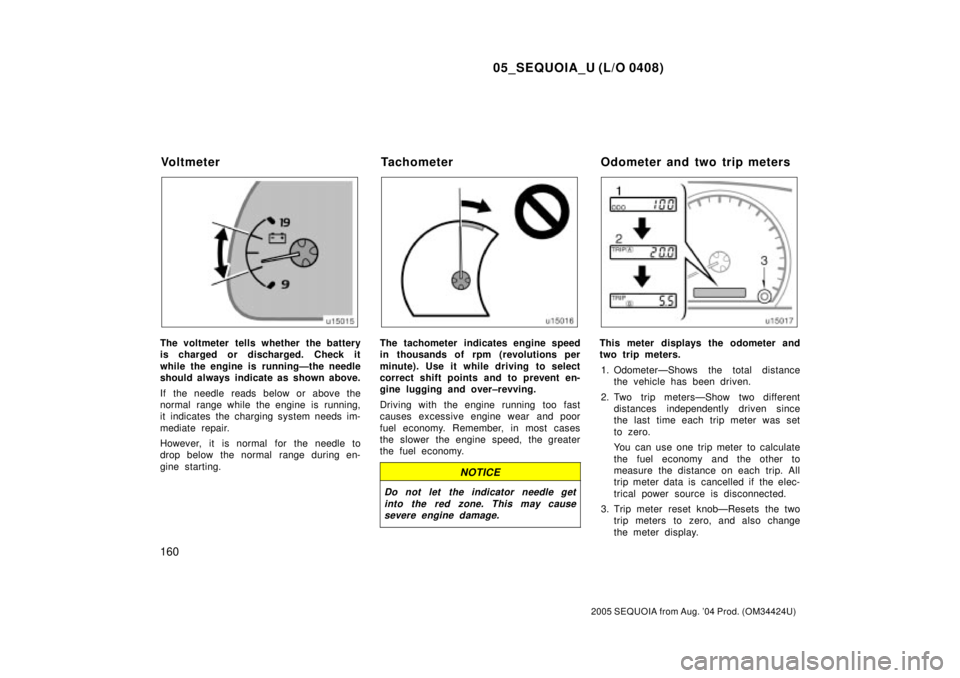
The voltmeter tells whether the battery
is charged or discharged. Check it
while the engine is runningÐthe needle
should always indicate as shown above.
If the needle reads below or above the
normal range while the engine is running,
it indicates the charging system needs im-
mediate repair.
However, it is normal for the needle to
drop below the normal range during en-
gine starting.The tachometer indicates engine speed
in thousands of rpm (revolutions per
minute). Use it while driving to select
correct shift points and to prevent en-
gine lugging and over±revving.
Driving with the engine running too fast
causes excessive engine wear and poor
fuel economy. Remember, in most cases
the slower the engine speed, the greater
the fuel economy.
NOTICE
Do not let the indicator needle get
into the red zone. This may cause
severe engine damage.
This meter displays the odometer and
two trip meters.
1. OdometerÐShows the total distance
the vehicle has been driven.
2. Two trip metersÐShow two different
distances independently driven since
the last time each trip meter was set
to zero.
You can use one trip meter to calculate
the fuel economy and the other to
measure the distance on each trip. All
trip meter data is cancelled if the elec-
trical power source is disconnected.
3. Trip meter reset knobÐResets the two
trip meters to zero, and also change
the meter display.
Voltmeter Tachometer Odometer and two trip meters
Page 4025 of 4323
05_SEQUOIA_U (L/O 0408)
166
2005 SEQUOIA from Aug. '04 Prod. (OM34424U)
(d) Discharge Warning Light
This light warns that the battery is being
discharged.
If it comes on while you are driving, there
is a problem somewhere in the charging
system.
The engine ignition will continue to oper-
ate, however, until the battery is dis-
charged. Turn off the air conditioning,
blower, radio, etc., and drive directly to
the nearest Toyota dealer or repair shop.
NOTICE
Do not continue driving if the engine
drive belt is broken or loose.
(e) Malfunction Indicator Lamp
This lamp comes on when the ignition
key is turned to the ªONº position and
goes off after the engine starts. This
means that the warning light system is
operating properly.
If the lamp remains on or the lamp
comes on while driving, first check the
followings.
�Empty fuel tank
If the fuel tank is empty, refuel immedi-
ately.
�Loose fuel tank cap
If the fuel tank cap is loose, securely
tighten it.
These cases are temporary malfunctions.
The malfunction indicator lamp will go off
after taking several driving trips.
If the lamp does not go off even after
several trips, contact your Toyota dealer
as soon as possible.
If the fuel tank is not empty or the fuel
tank cap is not loose...
�There is a problem somewhere in the
engine, emission control system, elec-
tronic throttle control system, automatic
transmission electrical system or warn-
ing light system itself.
Contact your Toyota dealer as soon as
possible to service the vehicle.
If engine speed does not increase when
the accelerator pedal is depressed, there
may be a problem somewhere in the elec-
tronic throttle control system.
At this time, vibration may occur. Howev-
er, if you depress the accelerator pedal
more firmly and slowly, you can drive your
vehicle at low speeds. Have your vehicle
checked by your Toyota dealer as soon as
possible.Even if the abnormality of the electronic
throttle control system is corrected during
low speed driving, the system may not be
recovered until the engine is stopped and
the ignition key is turned to ªACCº or
ªLOCKº position.
CAUTION
Be especially careful to prevent erro-
neous pedal operation.
Emissions inspection and maintenance
(I/M) programs
We recommend you to contact your
Toyota dealer to check your vehicle's
emission control system and OBD
(On±Board Diagnostics) system before
taking your vehicle for a state emission
inspection.
For details, see ªEmissions Inspection and
Maintenance (I/M) programsº on page 416
in Section 6.