Page 411 of 4323

A23538
20 msec./DIV (idling) 2 V/DIV
Ground VV1
VV2
NE VV1, VV2 and NE Signal Waveforms
Ground
Ground
± DIAGNOSTICSENGINE
DI±217
411 Author�: Date�:
2005 SEQUOIA (RM1146U)
Reference: Inspection using the oscilloscope.
The correct waveform is as shown.
Tester ConnectionSpecified Condition
G2+ (E5±27) ± G2± (E5±32)Ct fi hNE+ (E5±25) ± NE± (E5±24)Correct waveform is as shown
MONITOR DESCRIPTION
If there are no signals from the camshaft position sensor even though the engine is turning, or if the rotation
of the camshaft and the crankshaft is not synchronized, the ECM interprets this as a malfunction of the sen-
sor.
MONITOR STRATEGY
P0340VVT sensor (Bank 1) range check or rationality
RltdDTCP0341VVT sensor (Bank 1) range check or rationalityRelated DTCsP0345VVT sensor (Bank 2) range check or rationality
P0346VVT sensor (Bank 2) range check or rationality
Rid / tMain sensors/componentsVVT sensorRequired sensors/componentsRelated sensors/componentsCrankshaft position sensor, Engine speed sensor
Frequency of operationContinuous
Duration5 sec.
MIL operationP0340, P0345 case 1: 2 driving cycles
P0340, P0345 case 2, P0341, P0346: Immediate
Sequence of operationNone
TYPICAL ENABLING CONDITIONS
ItSpecificationItemMinimumMaximum
The monitor will run whenever these
DTCs are not presentSee page DI±18
P0340, P0345 Case 1:
StarterON
Minimum battery voltage while starter ON±11 V
P0340, P0345 Case 2:
Engine RPM600 rpm±
StarterOFF
Battery voltage8 V±
Ignition switchON
P0341, P0346:
StarterAfter OFF to ON timing
Engine revolution720�CA
Page 412 of 4323
DI±218
± DIAGNOSTICSENGINE
412 Author�: Date�:
2005 SEQUOIA (RM1146U)
TYPICAL MALFUNCTION THRESHOLDS
Detection CriteriaThreshold
P0340, P0345 Case 1:
VVT sensor signalNo signal
P0340, P0345 Case 2:
VVT sensor signalNo signal
P0341, P0346:
VVT sensor count12 or more / 720�CA (= Engine 2 revolutions)
COMPONENT OPERATING RANGE
ParameterStandard Value
VVT sensor signal input during every 720�CA3
WIRING DIAGRAM
Refer to DTC P0335 on page DI±210.
INSPECTION PROCEDURE
HINT:
Read freeze frame data using the hand-held tester. Freeze frame data records the engine conditions when
a malfunction is detected. When troubleshooting, freeze frame data can help determine if the vehicle was
running or stopped, if the engine was warmed up or not, if the air±fuel ratio was lean or rich, as well as other
data from the time when a malfunction occurred.
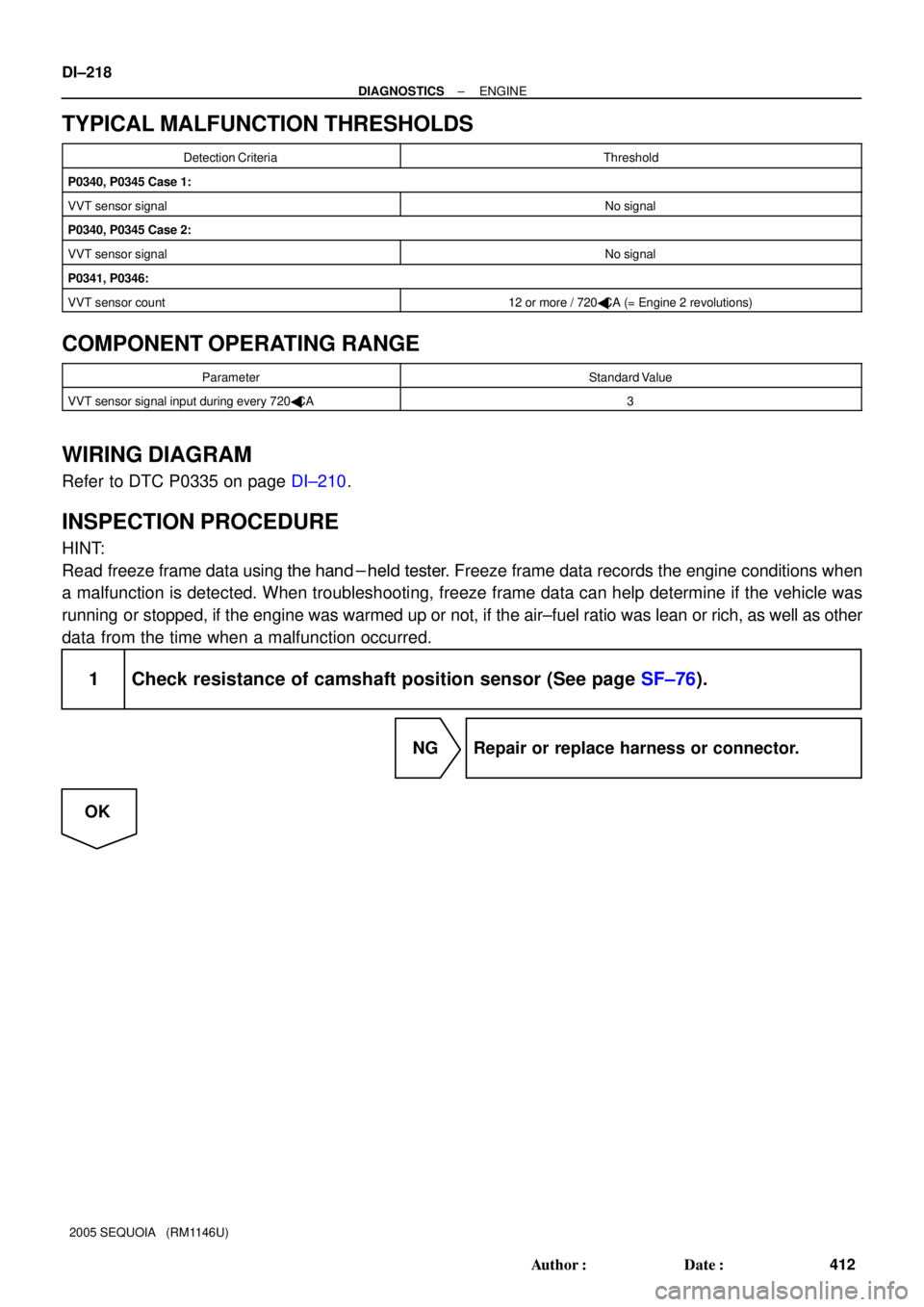
1 Check resistance of camshaft position sensor (See page SF±76).
NG Repair or replace harness or connector.
OK
Page 414 of 4323
DI±220
± DIAGNOSTICSENGINE
414 Author�: Date�:
2005 SEQUOIA (RM1146U)
4 Inspect teeth of camshaft.
PREPARATION:
Remove the cylinder head cover (See page EM±29).
CHECK:
Check the camshaft.
NG Replace camshaft.
OK
Replace Camshaft position sensor
(See page IG±7).
Page 416 of 4323

A21429
ECM
No.1 Ignition Coil with Igniter
No. 2 Ignition
Coil with Igniter Crankshaft
Position
Sensor
Camshaft
Position
Sensor
Other Sensors:
No. 3 Ignition
Coil with Igniter
No. 4 Ignition
Coil with Igniter
No. 5 Ignition
Coil with Igniter
No. 6 Ignition
Coil with Igniter
No. 7 Ignition
Coil with Igniter
No. 8 Ignition
Coil with Igniter
TA C
To TachometerFrom Battery
Igniter
Ignition CoilSpark Plug
No. 1 Cylinder
No. 4 Cylinder
No. 5 Cylinder
No. 6 Cylinder No. 2 Cylinder
No. 3 Cylinder
No. 7 Cylinder
No. 8 Cylinder IGT1
IGF1
IGT2
IGF2
IGT3
IGT4
IGT5
IGT6
IGT7
IGT8 (Engine Coolant Temp.
Sensor, Mass Air Flow
Sensor, Throttle Position
Sensor, etc.)
DI±222
± DIAGNOSTICSENGINE
416 Author�: Date�:
2005 SEQUOIA (RM1146U)
CIRCUIT DESCRIPTION
These DTCs indicate a malfunction related to primary circuit.
The DIS is a 1±cylinder ignition system which ignites one cylinder with one ignition coil. In the 1±cylinder
ignition system, the one spark plug is connected to the end of the secondary winding. High voltage generated
in the secondary winding is applied directly to the spark plug. The spark of the spark plug passes from the
center electrode to the ground electrode.
The ECM determines the ignition timing and outputs the ignition signals (IGTs) for each cylinder. Using the
IGT, the ECM turns on and off the power transistor inside the igniter and this switches on and off the current
to the primary coil. When the current to the primary coil is cut off, high±voltage is generated in the secondary
coil and this voltage is applied to the spark plugs to create sparks inside the cylinders. As the ECM cuts the
current to the primary coil, the igniter sends back the ignition confirmation signal (IGF) for each cylinder igni-
tion to the ECM.
Page 506 of 4323

DI±304
± DIAGNOSTICSENGINE
498 Author�: Date�:
2005 SEQUOIA (RM1146U)
DTC P1340, P1341 Camshaft Position Sensor ºAº (Bank
Sensor 1)
CIRCUIT DESCRIPTION
Camshaft position sensor (G signal) consists of a magnet, iron core and pickup coil.
The camshaft drive gear (LH) has 3 teeth on its inner circumference. When the camshaft gear rotates, air
gap changes between the protrusion on the gear and the pickup coil. The change affects the magnetic field
and result in change in the resistance of the MRE element.
The crankshaft signal plate has 32 teeth and is mounted on the crankshaft. The crankshaft position sensor
generates 32 signals at every engine revolution. The ECM detects the standard crankshaft angle based on
the G signal and the actual crankshaft angle and the engine speed by the NE signal.
DTC No.DTC Detecting ConditionTrouble Area
P1340
No camshaft position sensor signal to ECM during cranking
(2 trip detection logic)�Open or short in camshaft position sensor circuit
�Camshaft position sensor
P1340
P1341No camshaft position sensor signal to ECM with engine speed
600 rpm or more
�Camshaft osition sensor
�LH camshaft timing pulley
�ECM
MONITOR DESCRIPTION
The camshaft position sensor (G signal) consists of a magnet and MRE element.
The camshaft drive gear has 5 teeth on its inner circumference. When the camshaft gear rotates, air gap
changes between the protrusion on the gear and the pickup coil. The change affects the magnetic field and
result in change in the resistance of the MRE element. The crankshaft angle sensor plate has 32 teeth and
output 32 signals every engine revolution. The ECM detects the standard crankshaft angle based on the
G signal and actual crankshaft angle and engine speed by NE signal.
MONITOR STRATEGY
RltdDTC
P1340Camshaft position sensor (Bank 1) range check
or rationality
Related DTCs
P1341Camshaft position sensor (Bank 1) range check
or rationality
Rid / tMain sensors/componentsCamshaft position sensorRequired sensors/componentsRelated sensors/componentsCrankshaft position sensor, Engine speed sensor
Frequency of operationContinuous
Duration5 sec.
MIL operationP1340 case 1 (no signal): 2 driving cycles
P1340 case 2 (mis±aligned), P1341: Immediate
Sequence of operationNone
TYPICAL ENABLING CONDITIONS
ItSpecificationItemMinimumMaximum
The monitor will run whenever these
DTCs are not presentSee page DI±18
P1340 Case 1 (No signal):
StarterON
Minimum battery voltage while starter ON±11 V
DID8F±01
Page 507 of 4323
A23558
C2
Crankshaft Position Sensor
*1: Shielded C1
Crankshaft Position Sensor
ECM
G±B
(*1)
(*1)VC
E2
EC
BRJ42
J/C
D
DBR 2
Y
1
2L
G
RG2+
G2±
NE+
NE± 123
E8
19
E6
29
E6
21
E6
20
E6 E
EEJ42 J/C
± DIAGNOSTICSENGINE
DI±305
499 Author�: Date�:
2005 SEQUOIA (RM1146U) P1340 Case 2 (Mis±aligned):
Engine RPM600 rpm±
StarterOFF
P1341:
StarterAfter OFF to ON timing
TYPICAL MALFUNCTION THRESHOLDS
Detection CriteriaThreshold
P1340 Case 1 (No signal):
Camshaft position sensor signalNo signal
P1340 Case 2 (Mis±aligned):
Crankshaft/camshaft alignment is mis±aligned (judged by comparing the crankshaft position to the camshaft position)
Camshaft position sensor signal: No input in appropriate timing.
P1341:
Crankshaft/Camshaft alignmentMis±aligned
Camshaft position sensor count12 or more / 720�CA (= Engine 2 revolutions)
COMPONENT OPERATING RANGE
ParameterStandard Value
Camshaft position sensor signal input at every 720�CA3
WIRING DIAGRAM
Page 508 of 4323
B17445
Wire Harness Side:
Camshaft Position Sensor
A23559
2 V / DIV
GND
Crank Angle
120°120° 180°
180°
60°60°
200 ms /DIV
B17414
E6ECM Connector
G2+
G2±
DI±306
± DIAGNOSTICSENGINE
500 Author�: Date�:
2005 SEQUOIA (RM1146U)
INSPECTION PROCEDURE
HINT:
Read freeze frame data using hand±held tester. Because freeze frame records the engine conditions when
the malfunction is detected. When troubleshooting, it is useful for determining whether the vehicle was run-
ning or stopped, the engine was warmed up or not, the air±fuel ratio was lean or rich, etc. at the time of the
malfunction.
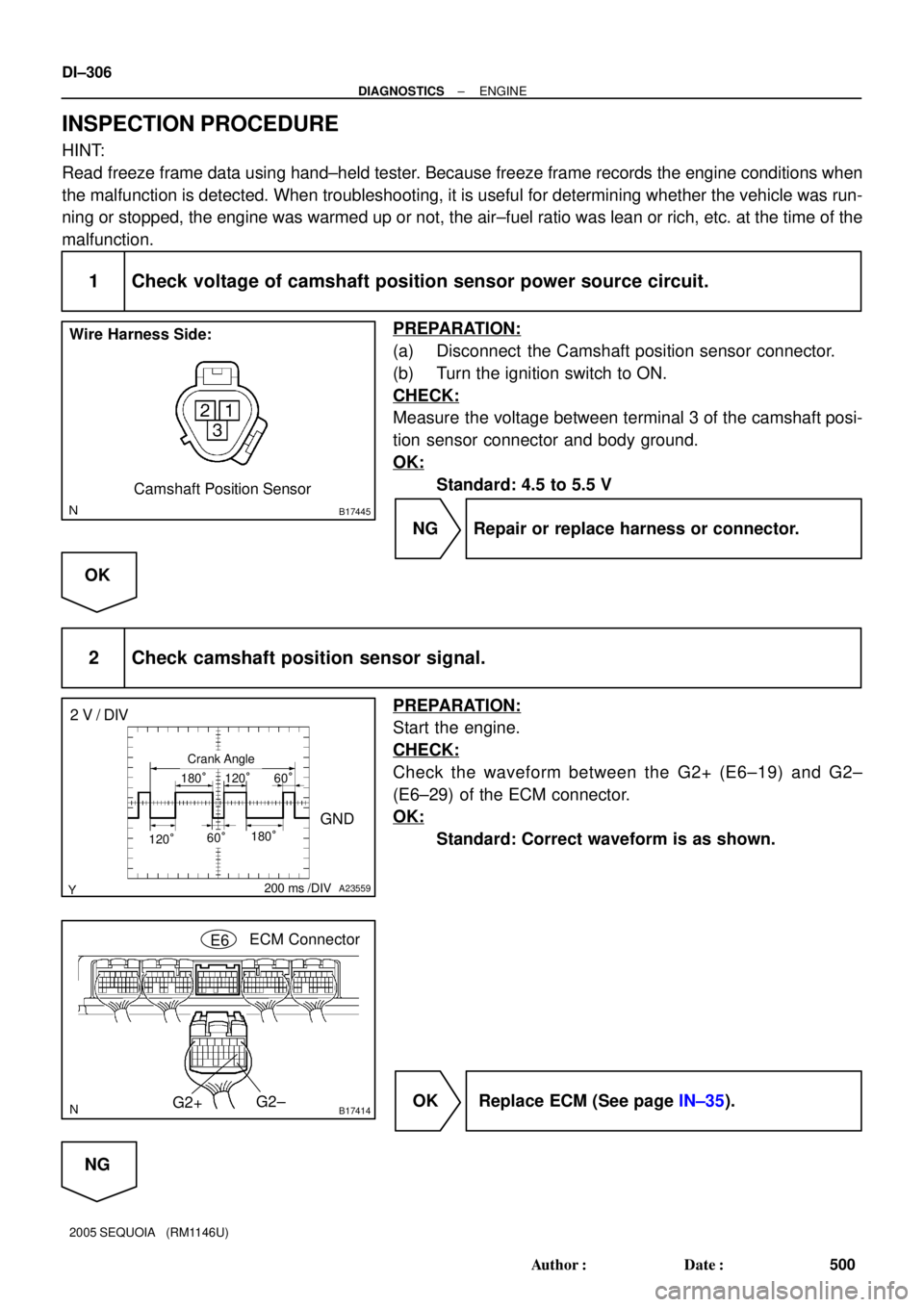
1 Check voltage of camshaft position sensor power source circuit.
PREPARATION:
(a) Disconnect the Camshaft position sensor connector.
(b) Turn the ignition switch to ON.
CHECK:
Measure the voltage between terminal 3 of the camshaft posi-
tion sensor connector and body ground.
OK:
Standard: 4.5 to 5.5 V
NG Repair or replace harness or connector.
OK
2 Check camshaft position sensor signal.
PREPARATION:
Start the engine.
CHECK:
Check the waveform between the G2+ (E6±19) and G2±
(E6±29) of the ECM connector.
OK:
Standard: Correct waveform is as shown.
OK Replace ECM (See page IN±35).
NG
Page 509 of 4323

B17414
E6ECM Connector
G2+
G2±
B17445
Wire Harness Side:
Camshaft Position Sensor C1
BR3795OK NGClearance
± DIAGNOSTICSENGINE
DI±307
501 Author�: Date�:
2005 SEQUOIA (RM1146U)
3 Check for open and short in harness and connector between ECM and camshaft
position sensor.
PREPARATION:
(a) Disconnect the Camshaft position sensor connector.
(b) Disconnect the E6 ECM connector.
CHECK:
Measure the resistance between wire harness side connectors.
OK:
Standard:
Tester ConnectionSpecified Condition
Camshaft position sensor (C1±2) ±
G2+ (E6±19)Below 1 W
Camshaft position sensor (C1±1) ±
G2± (E6±29)Below 1 W
Camshaft position sensor (C1±2) or
G2+ (E6±19) ± Body ground10 kW or higher
Camshaft position sensor (C1±1) or
G2± (E6±29) ± Body ground10 kW or higher
NG Repair or replace harness or connector.
OK
4 Inspect sensor installation and signal plate tooth of LH camshaft timing pulley.
CHECK:
Check the camshaft position sensor installation.
OK:
The camshaft position sensor is installed properly.
NG Tighten sensor installation bolt.
OK