2001 TOYOTA LAND CRUISER check engine light
[x] Cancel search: check engine lightPage 28 of 142
’01 L/C U (L/O 0008)
26
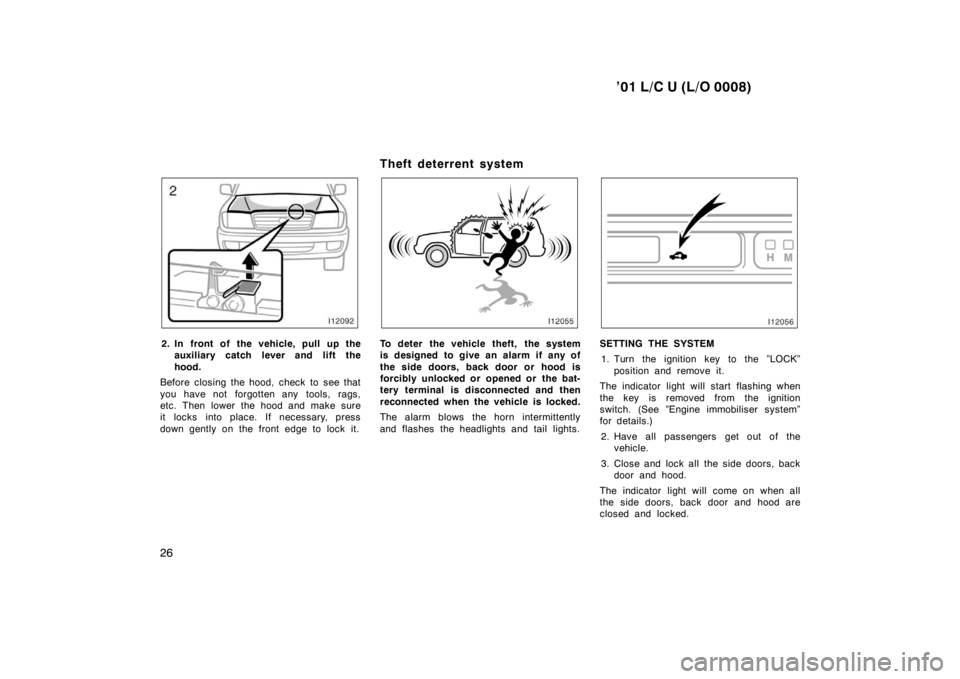
2. In front of the vehicle, pull up the auxiliary catch l ever and lift the
hood.
Before closing the hood, check to see that
you have not forgotten any tools, rags,
etc. Then lower the hood and make sure
it locks into place. If necessary, press
down gently on the front edge to lock it. Theft deterrent systemTo deter the vehicle theft, the system
is designed to give an alarm if any of
the side doors, back door or hood is
forcibly unlocked or opened or the bat-
tery terminal is disconnected and then
reconnected when the vehicle is locked.
The alarm blows the horn intermittently
and flashes the headlights and tail lights.SETTING THE SYSTEM
1. Turn the ignition key to the ”LOCK” position and remove it.
The indicator light will start flashing when
the key is removed from the ignition
switch. (See ”Engine immobiliser system”
for details.)
2. Have all passengers get out of the vehicle.
3. Close and lock all the side doors, back door and hood.
The indicator light will come on when all
the side doors, back door and hood are
closed and locked.
Page 45 of 142

’01 L/C U (L/O 0008)125
If you need acceleration—for example,
when passing—depress the accelerator
pedal enough for the vehicle to exceed
the set speed. When you release it, the
vehicle will return to the speed set prior
to the acceleration.
CANCELLING THE PRESET SPEED
You can cancel the preset speed by:
a. Pulling the control lever in the ”CANCEL” direction and releasing it.
b. Depressing the brake pedal.
If the vehicle speed falls below about 40
km/h (25 mph), the preset speed will auto-
matically cancel out.
If the vehicle speed drops 16 km/h (10
mph) below the preset speed, the preset
speed will also automatically cancel out.
If the preset speed automatically cancels
out other than for the above cases, have
your vehicle checked by your Toyota deal-
er at the earliest opportunity. RESETTING TO A FASTER SPEED
Push the lever up in the ”RES/ACC” direc-
tion and hold it. Release the lever when
the desired speed is attained. While the
lever is held up, the vehicle will gradually
gain speed.
However, a faster way to reset is to ac-
celerate the vehicle and then push the
control lever down in the ”SET/COAST”
direction.
RESETTING TO A SLOWER SPEED
Push the lever down in the ”SET/COAST”
direction and hold it. Release the lever
when the desired speed is attained. While
the lever is held down, the vehicle speed
will gradually decrease.
However, a faster way to reset is to de-
press the brake pedal and then push the
control lever down in the ”SET/COAST”
direction.
Even if you downshift the transmission by
turning off the overdrive switch, with the
cruise control on, engine braking will not
be applied because the cruise control is
not cancelled. To decrease the vehicle
speed, reset to a slower speed with the
cruise control lever or depress the brake
pedal. If you use the brake pedal, cruise
control is cancelled.RESUMING THE PRESET SPEED
If the preset speed is cancelled by pulling
the control lever or by depressing the
brake pedal, pushing the lever up in the
”RES/ACC” direction will restore the speed
set prior to cancellation.
However, once the vehicle speed falls be-
low about 40 km/h (25 mph), the preset
speed will not be resumed.
CRUISE CONTROL FAILURE WARNING
If the ”CRUISE” indicator light in the
instrument cluster flashes when using the
cruise control, press the ”CRUISE
ON·OFF” button to turn the system off and
then press it again to turn it on.
If any of the following conditions then oc-
curs, there is some trouble in the cruise
control system.
The indicator light does not come on.
The indicator light flashes again.
The indicator light goes out after it
comes on.
If this is the case, contact your Toyota
dealer and have your vehicle inspected.
Page 46 of 142
’01 L/C U (L/O 0008)
126
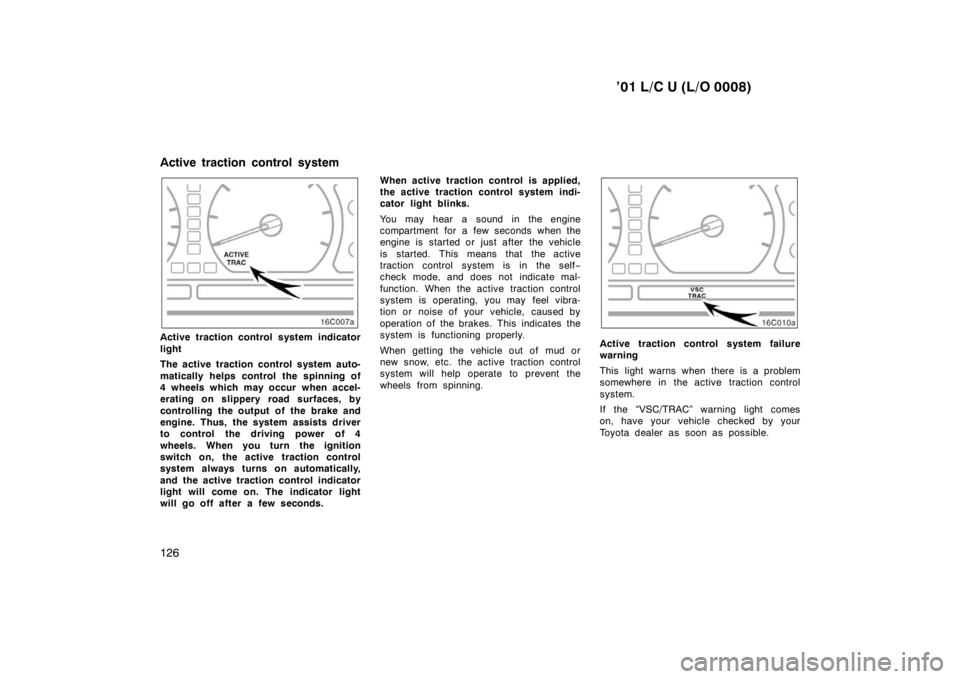
Active traction control system indicator
light
The active traction control system auto-
matically helps control the spinning of
4 wheels which may occur when accel-
erating on slippery road surfaces, by
controlling the output of the brake and
engine. Thus, the system assists driver
to control the driving power of 4
wheels. When you turn the ignition
switch on, the active traction control
system always turns on automatically,
and the active traction control indicator
light will come on. The indicator light
will go off after a few seconds. When active traction control is applied,
the active traction control system indi-
cator light blinks.
You may hear a sound in the engine
compartment for a few seconds when the
engine is started or just after the vehicle
is started. This means that the active
traction control system is in the self
−
check mode, and does not indicate mal-
function. When the active traction control
system is operating, you may feel vibra-
tion or noise of your vehicle, caused by
operation of the brakes. This indicates the
system is functioning properly.
When getting the vehicle out of mud or
new snow, etc. the active traction control
system will help operate to prevent the
wheels from spinning.Active traction control system failure
warning
This light warns when there is a problem
somewhere in the active traction control
system.
If the “VSC/TRAC” warning light comes
on, have your vehicle checked by your
Toyota dealer as soon as possible.
Active traction control system
Page 48 of 142
’01 L/C U (L/O 0008)
128
The vehicle skid control system helps
provide comprehensive control of sys-
tems such as anti −lock brake, traction
control, engine control, etc. This sys-
tem automatically controls the output of
the brakes or engine to help prevent
the vehicle from skidding under adverse
conditions.
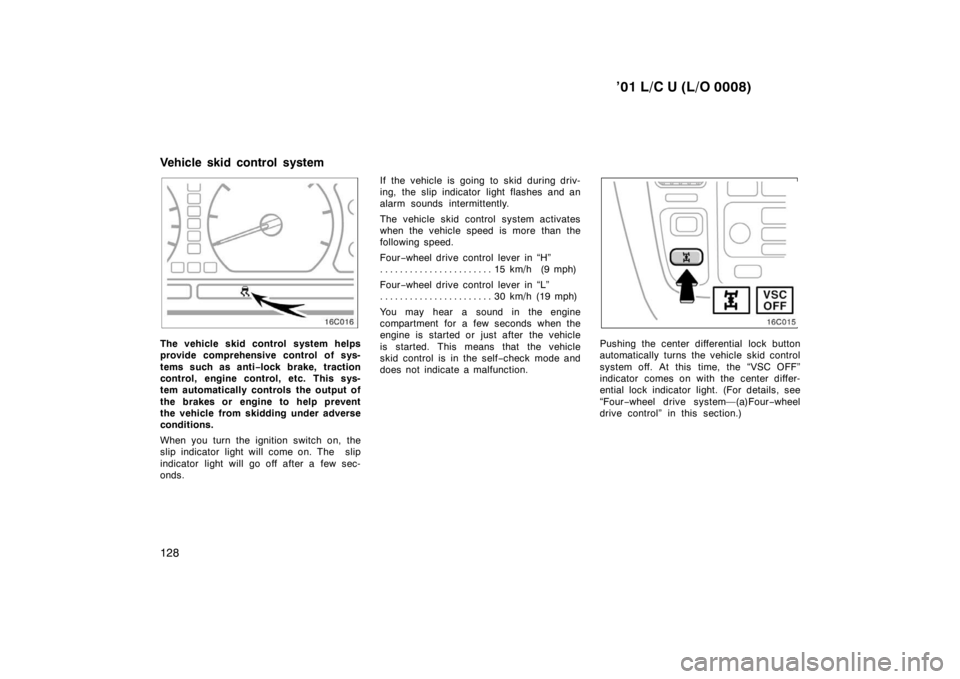
When you turn the ignition switch on, the
slip indicator light will come on. The slip
indicator light will go off after a few sec-
onds. If the vehicle is going to skid during driv-
ing, the slip indicator light flashes and an
alarm sounds intermittently.
The vehicle skid control system activates
when the vehicle speed is more than the
following speed. Four
−wheel drive control lever in “H”
15 km/h (9 mph)
. . . . . . . . . . . . . . . . . . . . . . . Four −wheel drive control lever in “L”
30 km/h (19 mph)
. . . . . . . . . . . . . . . . . . . . . . .
You may hear a sound in the engine
compartment for a few seconds when the
engine is started or just after the vehicle
is started. This means that the vehicle
skid control is in the self −check mode and
does not indicate a malfunction.Pushing the center differential lock button
automatically turns the vehicle skid control
system off. At this time, the “VSC OFF”
indicator comes on with the center differ-
ential lock indicator light. (For details, see
“Four −wheel drive system—(a)Four −wheel
drive control” in this section.)
Vehicle skid control system
Page 94 of 142
’01 L/C U (L/O 0008)
186
DRUM
−IN −DISC TYPE PARKING BRAKE
SYSTEM
Your vehicle has a drum −in −disc type
parking brake system. This type of brake
system n eeds bedding −down of the brake
shoes periodically or whenever the parking
brake shoes and/or drums are replaced.
Have your Toyota dealer perform the bed-
ding −down.
BRAKE ASSIST SYSTEM
When you slam the brakes on, the
brake assist system judges as an emer-
gency stop and provides more powerful
braking for a driver who cannot hold
down the brake pedal firmly.
When you slam the brakes on, more pow-
erful braking will be applied. At this time,
you may hear a sound in the engine
compartment and feel the vibrations of the
brake pedal. This does not indicate a mal-
function.
The brake assist system becomes opera-
tive after the vehicle has accelerated to
a speed in excess of approximately 10
km/h (6 mph). It stops operating when the
vehicle decelerates to a speed below
approximately 5 km/h (3 mph). The brake assist system may not work for
about 60 seconds after the engine is
started.
For an explanation of this system’s warn-
ing light, see “Service reminder indicators
and warning buzzers” in Section 1
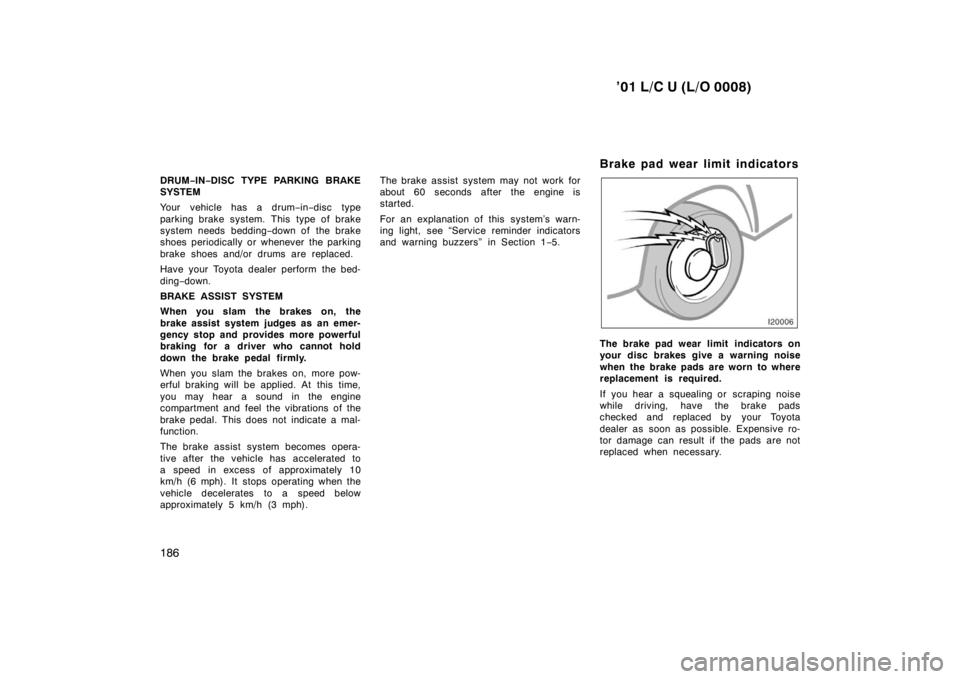
−5. Brake pad wear limit indicators
The brake pad wear limit indicators on
your disc brakes give a warning noise
when the brake pads are worn to where
replacement is required.
If you hear a squealing or scraping noise
while driving, have the brake pads
checked and replaced by your Toyota
dealer as soon as possible. Expensive ro-
tor damage can result if the pads are not
replaced when necessary.
Page 109 of 142

’01 L/C U (L/O 0008)
238
INSIDE THE VEHICLE
Items listed below should be checked
regularly, e.g. while performing periodic
services, cleaning the vehicle, etc.
Lights
Make sure the headlights, stop lights, tail
lights, turn signal lights, and other lights
are all working. Check headlight aim.
Service reminder indicators and warning
buzzers
Check that all service reminder indicators
and warning buzzers function properly.
Steering wheel
Be alert for changes in steering condition,
such as hard steering or strange noise.
Seats
Check that all front seat controls such as
seat adjusters, seatback recliner, etc. op-
erate smoothly and that all latches lock
securely in any position. Check that the
head restraint move up and down smooth-
ly and that the locks hold securely in any
latched position. For folding
−down rear
seatbacks, swing −up rear seat cushions
and detachable third seats, check that the
latches lock securely. Seat belts
Check that the seat belt system such as
buckles, retractors and anchors operate
properly and smoothly. Make sure the belt
webbing is not cut, frayed, worn or dam-aged.
Accelerator pedal
Check the pedal for smooth operation and
uneven pedal effort or catching.
Brake pedal
Check the pedal for smooth operation and
that the pedal has the proper clearance.
Check the brake booster function.
Brakes
At a safe place, check that the brakes do
not pull to one side when applied.
Parking brake
Check that the lever has the proper travel
and that, on a safe incline, your vehicle
is held securely with only the parking
brake applied.
Automatic transmission ”Park” mecha-
nism
Check the lock release button of the se-
lector lever for proper and smooth opera-
tion. On a safe incline, check that your
vehicle is held securely with the selector
lever in ”P” position and all brakes re-
leased.
IN THE ENGINE COMPARTMENT
Items listed below should be checked
from time to time, e.g. each time when
refueling.
Washer fluid
Make sure there is sufficient fluid in the
tank. See Section 7
−3 for additional in-
formation.
Engine coolant level
Make sure the coolant level is between
the ”FULL” and ”LOW” lines on the see −
through reservoir when the engine is cold.
See Section 7 −2 for additional information.
Battery electrolyte level
Make sure the electrolyte level of all bat-
tery cells is between upper and lower lev-
el lines on the case. Add only distilled
water when replenishing. See Section 7 −3
for additional information.
Page 121 of 142
’01 L/C U (L/O 0008)263
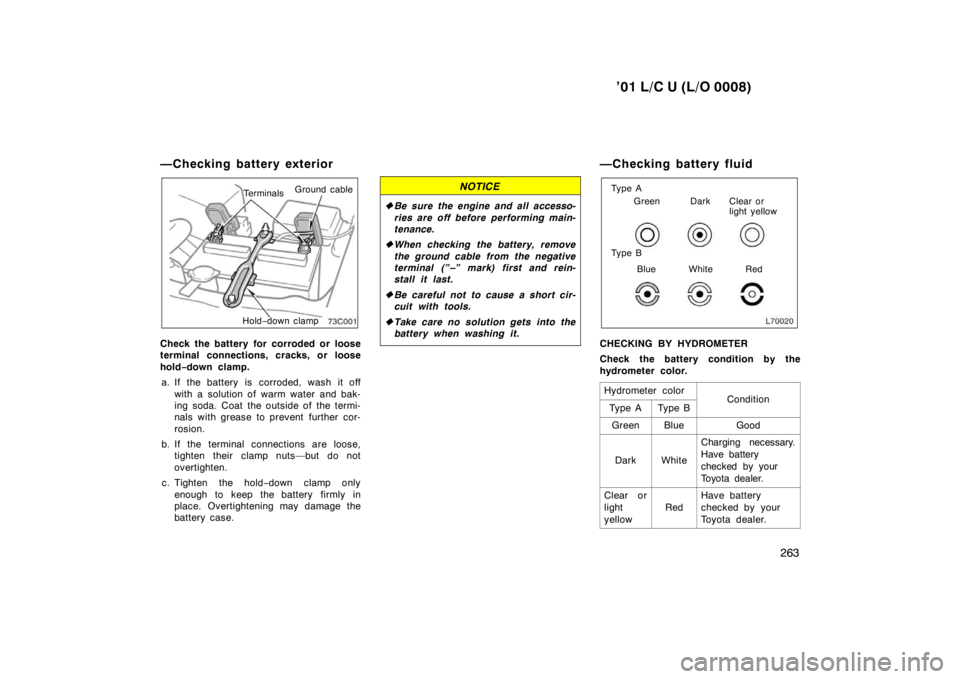
—Checking battery exterior
Terminals
Ground cable
Hold −down clamp
Check the battery for corroded or loose
terminal connections, cracks, or loose
hold −down clamp.
a. If the battery is corroded, wash it off with a solution of warm water and bak-
ing soda. Coat the outside of the termi-
nals with grease to prevent further cor-
rosion.
b. If the terminal connections are loose, tighten their clamp nuts—but do not
overtighten.
c. Tighten the hold −down clamp only
enough to keep the battery firmly in
place. Overtightening may damage the
battery case.NOTICE
Be sure the engine and all accesso-
ries are off before performing main-
tenance.
When checking the battery, remove
the ground cable from the negative
terminal (”–” mark) first and rein-
stall it last.
Be careful not to cause a short cir-
cuit with tools.
Take care no solution gets into the
battery when washing it.
—Checking battery fluid
Ty p e A
Ty p e B Green Dark Clear or
light yellow
Blue White Red
CHECKING BY HYDROMETER
Check the battery condition by the
hydrometer color. Hydrometer color
ConditionTy p e ATy p e B
GreenBlueGood
DarkWhite
Charging necessary.
Have battery checked by your
Toyota dealer.
Clear or
light
yellow
Red
Have battery
checked by your
Toyota dealer.
Page 133 of 142
’01 L/C U (L/O 0008)275
Service specifications
ENGINE
Valve clearance (engine cold), mm (in.):
Intake 0.15—0.25 (0.006—0.010)
Exhaust 0.25—0.35 (0.010—0.014)
Spark plug type: DENSO SK20R11
NGK IFR6A11
Spark plug gap, mm (in.): 1.1 (0.043)
ENGINE LUBRICATION
Oil capacity (drain and ref ill), L (qt., Imp.
qt.)
With filter 6.8 (7.2, 6.0)
Without filter 6.4 (6.8, 5.6)
Oil grade: API grade SJ, ”Energy −Conserving” mul-
tigrade engine oil or ILSAC multigrade
engine oil is recommended.
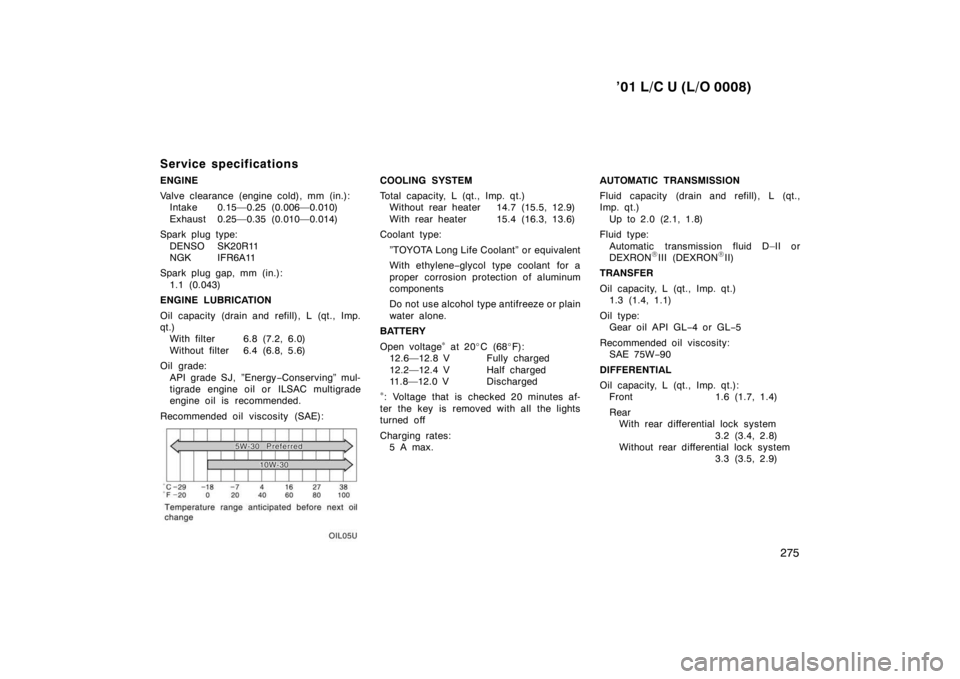
Recommended oil viscosity (SAE):
COOLING SYSTEM
Total capacity, L (qt., Imp. qt.) Without rear heater 14.7 (15.5, 12.9)
With rear heater 15.4 (16.3, 13.6)
Coolant type:
”TOYOTA Long Life Coolant” or equivalent
With ethylene −glycol type coolant for a
proper corrosion protection of aluminum
components
Do not use alcohol type antifreeze or plain
water alone.
BATTERY
Open voltage
at 20 C (68 F):
12.6—12.8 V Fully charged
12.2—12.4 V Half charged
11.8—12.0 V Discharged
: Voltage that is checked 20 minutes af-
ter the key is removed with all the lights
turned off
Charging rates: 5 A max. AUTOMATIC TRANSMISSION
Fluid capacity (drain and refill), L (qt.,
Imp. qt.)
Up to 2.0 (2.1, 1.8)
Fluid type: Automatic transmission fluid D–II orDEXRON
III (DEXRON
II)
TRANSFER
Oil capacity, L (qt., Imp. qt.) 1.3 (1.4, 1.1)
Oil type: Gear oil API GL −4 or GL −5
Recommended oil viscosity: SAE 75W −90
DIFFERENTIAL
Oil capacity, L (qt., Imp. qt.): Front 1.6 (1.7, 1.4) Rear
With rear differential lock system
3.2 (3.4, 2.8)
Without rear differential lock system 3.3 (3.5, 2.9)