2001 TOYOTA LAND CRUISER tires
[x] Cancel search: tiresPage 47 of 142
’01 L/C U (L/O 0008)127
The brake actuator temperature increases
during the active traction control system
or vehicle stability control system operat-
ing. If the brake actuator temperature be-
comes too high while the active traction
control system or vehicle stability control
system is operating, a buzzer will start to
sound intermittently to indicate that the
active traction control system can no lon-
ger operate. In this case, immediately stop
your vehicle at a safe place. If the system
continues to operate, the buzzer sound
changes from intermittent to continuous.
(The continuous buzzer sounds for about
3 seconds.) At the time, the “VSC/TRAC”
warning light will come on and the traction
control system temporarily stops operating
in order to protect the brake actuator. (Al-
though the active traction control system
does not operate, there is no problem to
continue your driving.) The system will be
automatically restored after a short time
and “VSC/TRAC” warning light goes off if
the accelerator pedal is released.
When the “ABS” warning light come on,
the active traction control system is not
operating.
The “VSC/TRAC” warning light will come
on when the ignition key is turned “ON”,
and will go off after a few seconds.
The “VSC/TRAC” warning light may stay
on for 60 seconds after the ignition key
is turned to “ON” position. It is normal if
it goes off after a few seconds.
Depressing the brake pedal repeatedly
may turn on the “VSC/TRAC” warning
light. It is normal if it goes off after a few
seconds.
When the “VSC/TRAC” warning light
comes on the active traction control sys-
tem is not operating, but there is no prob-
lem if you continue to drive.
In the following cases, contact your Toyota
dealer:
The “VSC/TRAC” warning light does not
come on after the ignition key is turned
“ON”.
The “VSC/TRAC” remains on after the
ignition key is turned “ON”.
CAUTION
Under certain slippery road condi-
tions, full traction of the vehicles and
power to 4 wheels may not be main-
tained, even though the active trac-
tion control system is in operation.
Do not drive the vehicle under any
speed or maneuvering conditions
which will cause the vehicle to lose
traction. In situations where the road
surface is covered with ice or snow,
your vehicle should be fitted with
snow tires or tire chains. Always
drive at an appropriate and cautious
speed for the road conditions pres-
ent.
Page 49 of 142
’01 L/C U (L/O 0008)129
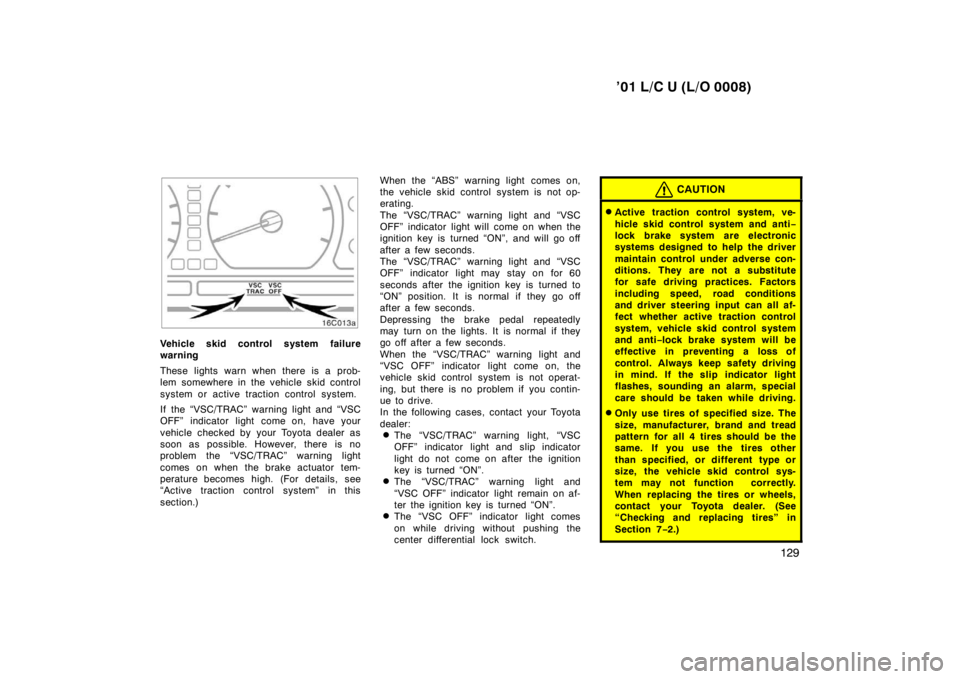
Vehicle skid control system failure
warning
These lights warn when there is a prob-
lem somewhere in the vehicle skid control
system or active traction control system.
If the “VSC/TRAC” warning light and “VSC
OFF” indicator light come on, have your
vehicle checked by your Toyota dealer as
soon as possible. However, there is no
problem the “VSC/TRAC” warning light
comes on when the brake actuator tem-
perature becomes high. (For details, see
“Active traction control system” in this
section.) When the “ABS” warning light comes on,
the vehicle skid control system is not op-
erating.
The “VSC/TRAC” warning light and “VSC
OFF” indicator light will come on when the
ignition key is turned “ON”, and will go off
after a few seconds.
The “VSC/TRAC” warning light and “VSC
OFF” indicator light may stay on for 60
seconds after the ignition key is turned to
“ON” position. It is normal if they go off
after a few seconds.
Depressing the brake pedal repeatedly
may turn on the lights. It is normal if they
go off after a few seconds.
When the “VSC/TRAC” warning light and
“VSC OFF” indicator light come on, the
vehicle skid control system is not operat-
ing, but there is no problem if you contin-
ue to drive.
In the following cases, contact your Toyota
dealer:
The “VSC/TRAC” warning light, “VSC
OFF” indicator light and slip indicator
light do not come on after the ignition
key is turned “ON”.
The “VSC/TRAC” warning light and
“VSC OFF” indicator light remain on af-
ter the ignition key is turned “ON”.
The “VSC OFF” indicator light comes
on while driving without pushing the
center differential lock switch.
CAUTION
Active traction control system, ve-
hicle skid control system and anti −
lock brake system are electronic
systems designed to help the driver
maintain control under adverse con-
ditions. They are not a substitute
for safe driving practices. Factors
including speed, road conditions
and driver steering input can all af-
fect whether active traction control
system, vehicle skid control system
and anti −lock brake system will be
effective in preventing a loss of
control. Always keep safety driving
in mind. If the slip indicator light
flashes, sounding an alarm, special
care should be taken while driving.
Only use tires of specified size. The
size, manufacturer, brand and tread
pattern for all 4 tires should be the
same. If you use the tires other
than specified, or different type or
size, the vehicle skid control sys-
tem may not function correctly.
When replacing the tires or wheels,
contact your Toyota dealer. (See
“Checking and replacing tires” in
Section 7 −2.)
Page 82 of 142

’01 L/C U (L/O 0008)
174 INFORMATION BEFORE DRIVING
YOUR TOYOTA
Off
−road vehicle precautions175
. . . . . . . . . . . . . . . . . . . . . . . . . . . . . . . . .
Break −in period176
. . . . . . . . . . . . . . . . . . . . . . . . . . . . . . . . . . . . . . . . . . . .
Fuel176
. . . . . . . . . . . . . . . . . . . . . . . . . . . . . . . . . . . . . . . . . . . . . . . . . . . . . . .
Operation in foreign countries178
. . . . . . . . . . . . . . . . . . . . . . . . . . . . . . . .
Three −way catalytic converter179
. . . . . . . . . . . . . . . . . . . . . . . . . . . . . . .
Engine exhaust cautions180
. . . . . . . . . . . . . . . . . . . . . . . . . . . . . . . . . . . .
Facts about engine oil consumption181
. . . . . . . . . . . . . . . . . . . . . . . . . .
Iridium −tipped spark plugs182
. . . . . . . . . . . . . . . . . . . . . . . . . . . . . . . . . . .
Brake system183
. . . . . . . . . . . . . . . . . . . . . . . . . . . . . . . . . . . . . . . . . . . . . .
Brake pad wear limit indicators186
. . . . . . . . . . . . . . . . . . . . . . . . . . . . . . .
Luggage stowage precautions187
. . . . . . . . . . . . . . . . . . . . . . . . . . . . . . .
Rear step bumper188
. . . . . . . . . . . . . . . . . . . . . . . . . . . . . . . . . . . . . . . . . .
Limited −slip differential188
. . . . . . . . . . . . . . . . . . . . . . . . . . . . . . . . . . . . . .
Your Toyota’s identification188
. . . . . . . . . . . . . . . . . . . . . . . . . . . . . . . . . .
Theft prevention labels189
. . . . . . . . . . . . . . . . . . . . . . . . . . . . . . . . . . . . . .
Suspension and chassis190
. . . . . . . . . . . . . . . . . . . . . . . . . . . . . . . . . . . .
Types of tires190
. . . . . . . . . . . . . . . . . . . . . . . . . . . . . . . . . . . . . . . . . . . . . . . SECTION
2
Page 92 of 142
’01 L/C U (L/O 0008)
184
Depressing the brake pedal on slippery
road surfaces such as on the manhole
cover, the steel plate under the construc-
tion, joints in the bridge, etc. on a rainy
day tends to activate the anti
−lock brake
system.
You may hear a click or motor sound in
the engine compartment for a few seconds
when the engine is started or just after
the vehicle is started. This means that the
anti −lock brake system is in the self
check mode, and does not indicate a mal-
function.
When the anti −lock brake system is ac-
tivated, the following conditions may
occur. They do not indicate a malfunc-
tion of the system:
You may hear the anti −lock brake sys-
tem operating and feel the brake pedal
pulsating and the vibrations of the body
and steering wheel. You may also hear
the motor sound in the engine compart-
ment even after the vehicle is stopped.
At the end of the anti −lock brake sys-
tem activation, the brake pedal may
move a little forward.
CAUTION
Do not overestimate the anti −lock
brake system: Although the anti −lock
brake system assists in providing ve-
hicle control, it is still important to
drive with all due care and maintain
a moderate speed and safe distance
from the vehicle in front of you, be-
cause there are limits to the vehicle
stability and effectiveness of steering
wheel operation even with the anti −
lock brake system on.
If tires grip performance exceeds its
capability, or if hydroplaning occurs
during high speed driving in the rain,
the anti −lock brake system does not
provide vehicle control.
Anti −lock brake system is not de-
signed to shorten the stopping dis-
tance: Always drive at the moderate
speed and maintain a safe distance
from the vehicle in front of you.
Compared with vehicles without an
anti −lock brake system, your vehicle
may require a longer stopping dis-
tance in the following cases: Driving on rough, gravel or snow −
covered roads.
Driving with tire chains installed.
Driving over the steps such as the
joints on the road.
Driving on roads where the road
surface is pitted or has other differ-
ences in surface height.
Install all 4 tires of specified size at
appropriate pressure: The anti −lock
brake system detects vehicle speeds
using the speed sensors for respec-
tive wheels’ turning speeds. The use
of tires other than specified may fail
to detect the accurate turning speed,
resulting in a longer stopping dis-
tance.
Page 96 of 142
’01 L/C U (L/O 0008)
188
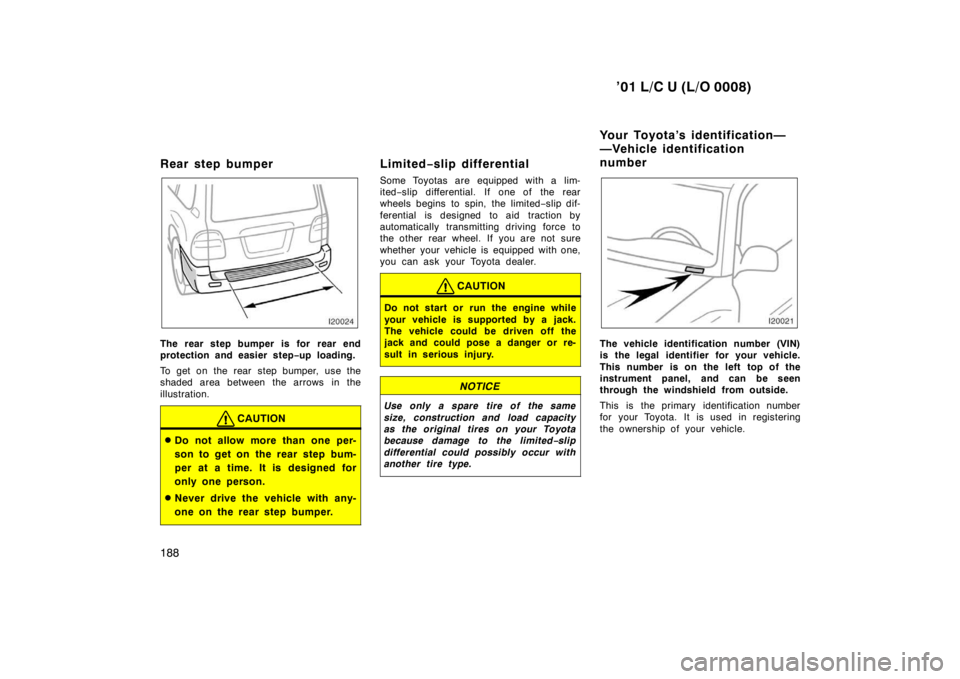
Rear step bumper
The rear step bumper is for rear end
protection and easier step
−up loading.
To get on the rear step bumper, use the
shaded area between the arrows in the
illustration.
CAUTION
Do not allow more than one per-
son to get on the rear step bum-
per at a time. It is designed for
only one person.
Never drive the vehicle with any-
one on the rear step bumper.
Limited −slip differential
Some Toyotas are equipped with a lim-
ited −slip differential. If one of the rear
wheels begins to spin, the limited −slip dif-
ferential is designed to aid traction by
automatically transmitting driving force to
the other rear wheel. If you are not sure
whether your vehicle is equipped with one,
you can ask your Toyota dealer.
CAUTION
Do not start or run the engine while
your vehicle is supported by a jack.
The vehicle could be driven off the
jack and could pose a danger or re-
sult in serious injury.
NOTICE
Use only a spare tire of the same
size, construction and load capacity
as the original tires on your Toyota
because damage to the limited −slip
differential could possibly occur with
another tire type.
The vehicle identification number (VIN)
is the legal identifier for your vehicle.
This number is on the left top of the
instrument panel, and can be seen
through the windshield from outside.
This is the primary identification number
for your Toyota. It is used in registering
the ownership of your vehicle.
Your Toyota’s identification—
—Vehicle identification
number
Page 98 of 142
’01 L/C U (L/O 0008)
190
Suspension and chassis
CAUTION
Do not modify the suspension/chassis
with lift kits, spacers, springs, etc. It
can cause dangerous handling charac-
teristics, resulting in loss of control.
Types of tires
Determine what kind of tires your ve-
hicle is originally equipped with.
1. Summer tires
Summer tires are high −speed capability
tires best suited to highway driving under
dry conditions.
Since summer tires do not have the same
traction performance as snow tires, sum-
mer tires are inadequate for driving on
snow −covered or icy roads. For driving on
snow −covered or icy roads, we recom-
mend using snow tires. If installing snow
tires, be sure to replace all four tires.
2. All season tires
All season tires are designed to provide
better traction in snow and to be adequate
for driving in most winter conditions, as
well as for use all year round.
All season tires, however, do not have
adequate traction performance compared
with snow tires in heavy or loose snow.
Also, all season tires fall short in accel-
eration and handling performance
compared with summer tires in highway
driving.
CAUTION
Do not mix summer and all sea-
son tires on your vehicle as this
can cause dangerous handling
characteristics, resulting in loss
of control.
Do not use tire other than the
manufacturer’s designated tires,
and never mix tires or wheels of
the sizes different from the origi-
nally equipped tires and wheels.
Page 108 of 142
’01 L/C U (L/O 0008)237
If you are a skilled do
−it−yourself
mechanic, the Toyota service manuals are
recommended. Please be aware that do −it−yourself maintenance can affect your
warranty coverage. See ”Owner ’s Warranty
Information Booklet” or ”Owner ’s Manual
Supplement” for the details. General maintenance
Listed below are the general maintenance
items that should be performed as fre-
quently as specified. In addition to check-
ing the items listed, if you notice any
unusual noise, smell or vibration, you
should investigate the cause or take your
vehicle to your Toyota dealer or a quali-
fied service shop immediately. It is recom-
mended that any problem you notice be
brought to the attention of your dealer or
the qualified service shop for their advice.
CAUTION
Make these checks only where ade-
quate ventilation can be obtained if
you run the engine.
OUTSIDE THE VEHICLE
Items listed below should be performed
from time to time, unless otherwise
specified.
Tire pressure
Check the pressure with a gauge every
two weeks, or at least once a month. See
Section 7
−2 for additional information. Tire surface and wheel nuts
Check the tires carefully for cuts, damage
or excessive wear. See Section 7
−2 for
additional information. When checking the
tires, make sure no nuts are missing, and
check the nuts for looseness. Tighten
them if necessary.
Tire rotation
Rotate the tires according to the mainte-
nance schedule. (For scheduled mainte-
nance information, please refer to the
”Scheduled Maintenance Guide” or ”Own-
er ’s Manual Supplement”.) See Section 7 −2 for additional information.
Fluid leaks
Check underneath for leaking fuel, oil, wa-
ter or other fluid after the vehicle has
been parked for a while. If you smell fuel
fumes or notice any leak, have the cause
found and corrected immediately.
Doors and engine hood
Check that all doors and back door oper-
ate smoothly and all latches lock securely.
Make sure the engine hood secondary
latch secures the hood from opening when
the primary latch is released.
Page 131 of 142

’01 L/C U (L/O 0008)273
SPECIFICATIONS
Dimensions and weight274
. . . . . . . . . . . . . . . . . . . . . . . . . . . . . . . . . . . . . .
Engine274
. . . . . . . . . . . . . . . . . . . . . . . . . . . . . . . . . . . . . . . . . . . . . . . . . . . .
Fuel274
. . . . . . . . . . . . . . . . . . . . . . . . . . . . . . . . . . . . . . . . . . . . . . . . . . . . . . .
Service specifications275
. . . . . . . . . . . . . . . . . . . . . . . . . . . . . . . . . . . . . . .
Tires276
. . . . . . . . . . . . . . . . . . . . . . . . . . . . . . . . . . . . . . . . . . . . . . . . . . . . . .
Fuses277
. . . . . . . . . . . . . . . . . . . . . . . . . . . . . . . . . . . . . . . . . . . . . . . . . . . . . SECTION
8