2001 SUZUKI GRAND VITARA Power
[x] Cancel search: PowerPage 513 of 656
8C-2 INSTRUMENTATION/DRIVER INFORMATION
General Description
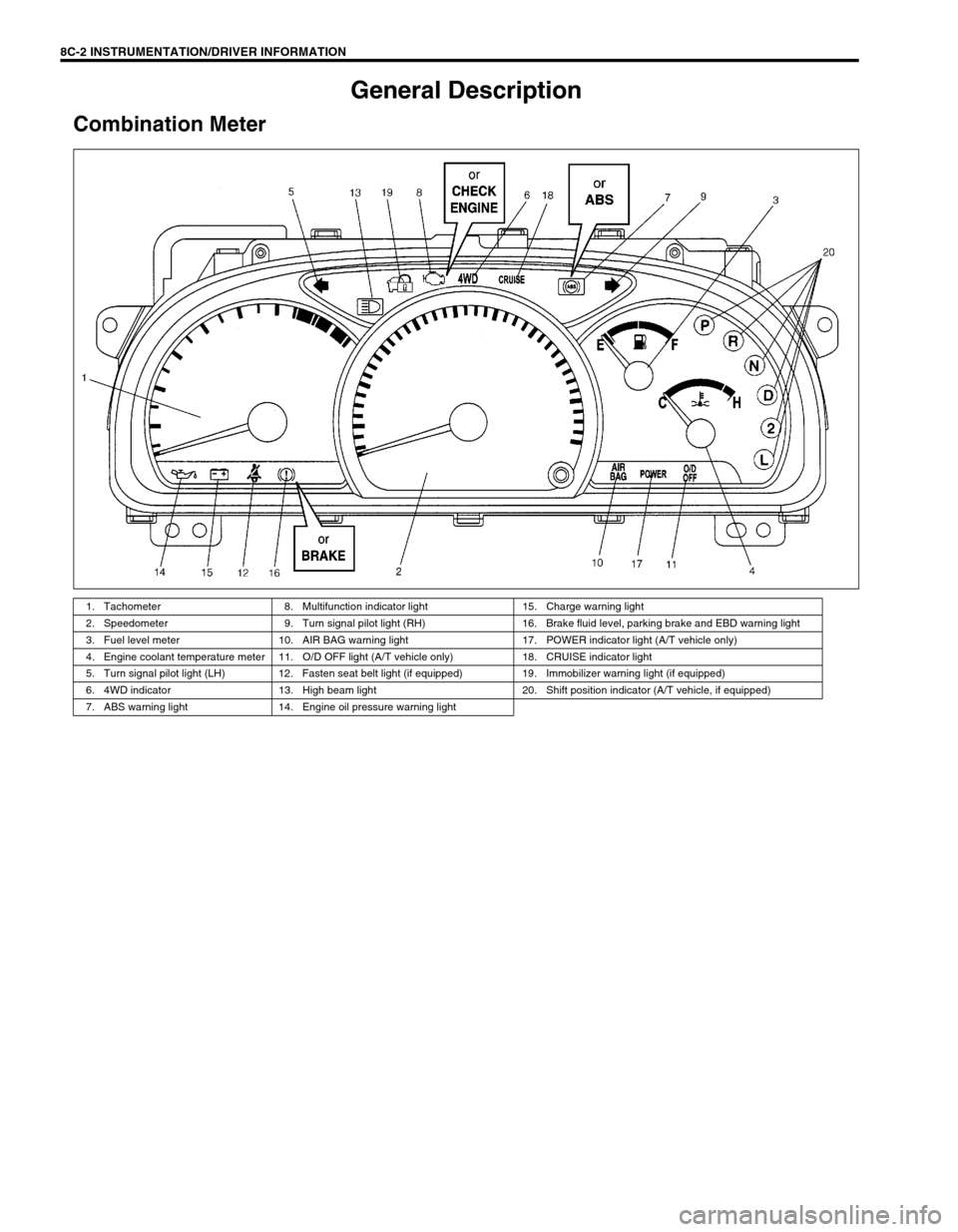
Combination Meter
1. Tachometer 8. Multifunction indicator light 15. Charge warning light
2. Speedometer 9. Turn signal pilot light (RH) 16. Brake fluid level, parking brake and EBD warning light
3. Fuel level meter 10. AIR BAG warning light 17. POWER indicator light (A/T vehicle only)
4. Engine coolant temperature meter 11. O/D OFF light (A/T vehicle only) 18. CRUISE indicator light
5. Turn signal pilot light (LH) 12. Fasten seat belt light (if equipped) 19. Immobilizer warning light (if equipped)
6. 4WD indicator 13. High beam light 20. Shift position indicator (A/T vehicle, if equipped)
7. ABS warning light 14. Engine oil pressure warning light
Page 514 of 656
![SUZUKI GRAND VITARA 2001 2.G Owners Manual INSTRUMENTATION/DRIVER INFORMATION 8C-3
COMBINATION METER INTERNAL CIRCUITS
COMBINATION METER COUPLERS
[A] : Coupler A [B] : Coupler B [C] : Coupler C
1. To Cruise control module (if equipped) GRY/YE](/manual-img/20/7584/w960_7584-513.png "SUZUKI GRAND VITARA 2001 2.G Owners Manual INSTRUMENTATION/DRIVER INFORMATION 8C-3
COMBINATION METER INTERNAL CIRCUITS
COMBINATION METER COUPLERS
[A] : Coupler A [B] : Coupler B [C] : Coupler C
1. To Cruise control module (if equipped) GRY/YE")
INSTRUMENTATION/DRIVER INFORMATION 8C-3
COMBINATION METER INTERNAL CIRCUITS
COMBINATION METER COUPLERS
[A] : Coupler A [B] : Coupler B [C] : Coupler C
1. To Cruise control module (if equipped) GRY/YEL 1. To door switch (drive side) BLK/BLU 1. To ground BLK
2. Blank–2. To transmission range switch
(A/T vehicle only, if equipped) LGRN/BLU 2. To ECM (PCM for A/T vehicle) BRN
3. To ignition switch BLK/WHT 3. To transmission range switch
(A/T vehicle only, if equipped) 2GRN/ORN 3. To ignition switch PPL/RED
4. Blank–4. To transmission range switch
(A/T vehicle only, if equipped) DYEL/GRN 4. To brake fluid level switch RED/BLK
5. To ABS control module (if equipped) BLU/ORN 5. To transmission range switch
(A/T vehicle only, if equipped) NORN/BLU 5. To parking brake switch PPL
6. To PCM (A/T vehicle only) GRY/BLU 6. To transmission range switch
(A/T vehicle only, if equipped) PORN/GRN 6. To seat belt switch GRY/RED
7. To ABS control module (if equipped) BRN 7. To transmission range switch
(A/T vehicle only, if equipped) RRED 7. To generator WHT/RED
8. To VSS BLU/YEL 8. To illumination control module RED/GRN 8. To engine oil pressure switch YEL/BLK
9. To combination switch GRN/RED 9. To PCM (A/T vehicle only) WHT/BLK 9. To combination switch RED/YEL
10. To air bag SDM BLU 10. To ECT sensor YEL/WHT 10. To ignition switch BLU/RED
11. To main fuse WHT/BLU 11. To fuel level gauge BLU/WHT
12. To fuse box WHT 12. To ground BLU/YEL
13. To combination switch RED 13. To combination switch GRN/YEL
14. To immobilizer control module
(if equipped)PPL
15. To ECM (PCM for A/T vehicle) PPL/YEL
16. To ECM (PCM for A/T vehicle) ORN/BLK
P R N D 2 LCRUISEPOWER4WDSPEED
METERTACHO
METERFUEL
METERTEMP.
METER
A-11
A-13 A-8 B-12 B-11 C-8 A-15 A-6 A-1 B-9 A-16 A-14 C-7 C-1 A-10 C-3 C-4 C-5 A-7 A-5 B-8 B-1B-10 C-2 A-12 A-3B-13 B-2 B-3 B-4 B-5 B- B-6 C-9 C-10 A-9ABS circuit EBD circuit Air bag circuit
or ABS or BRAKE
if equipped
or CHECK
ENGINE
NOTE:
Terminal arrangement of coupler viewed from harness side.
Page 522 of 656
CRUISE CONTROL SYSTEM 8E-1
6F1
6F2
6G
6H
6K
7A
7A1
7B1
7C1
7D
7E
8E
8A
8B
8C
8D
8B
9
10
10A
10B
SECTION 8E
CRUISE CONTROL SYSTEM
CONTENTS
General Description ....................................... 8E-2
Cautions in Servicing ................................... 8E-2
Symbols and Marks ...................................... 8E-2
Abbreviations ............................................... 8E-2
Wiring Color Symbols ................................... 8E-2
Joint Connector ............................................ 8E-2
Fuse Box and Relay ..................................... 8E-2
Power Supply Diagram ................................ 8E-2
Cruise Control System ................................. 8E-3
Cruise control system circuit .................... 8E-3
Components and functions....................... 8E-4
Cancel Conditions .................................... 8E-5
Diagnosis ........................................................ 8E-5
Diagnosis Table ........................................... 8E-5
Note on System Circuit Inspection ............... 8E-7
Cruise Main Switch Indicator Lamp
Circuit Check ................................................ 8E-8
“Cruise” Indicator Lamp Circuit Check ......... 8E-9
Cruise Main Switch, Coast/Set,
Resume/Accel and Cancel Switches
Circuits Check ............................................ 8E-10
VSS Circuit Check ...................................... 8E-11
Stop Lamp Switch (with Pedal Position
Switch) Circuits Check ............................... 8E-12Transmission Range Switch Circuit Check 8E-13
Clutch Pedal Position Switch Circuit Check 8E-14
Throttle Valve Opening Signal Circuit
Check ......................................................... 8E-15
Overdrive and TCC off Command Signal
Circuit Check.............................................. 8E-16
Cruise Control Module Power and Ground
Circuits Check ............................................ 8E-16
Cruise Control Module and Its Circuit
Inspection................................................... 8E-17
Cruise Cable Play Inspection and
Adjustment ................................................. 8E-19
On-Vehicle Service ...................................... 8E-19
Cruise Main Switch .................................... 8E-19
Coast/Set, Resume/Accel and Cancel
Switches..................................................... 8E-20
Vehicle Speed Sensor (VSS) ..................... 8E-20
Transmission Range Switch ...................... 8E-20
Clutch Pedal Position (CPP) Switch .......... 8E-21
Stop Lamp Switch (with Pedal Position
Switch) ....................................................... 8E-22
Cruise Control Actuator Assembly
(with Control Module) ................................. 8E-23
Cruise Cable .............................................. 8E-24
WARNING:
For vehicles equipped with Supplemental Restraint (Air Bag) System:
Service on and around the air bag system components or wiring must be performed only by an
authorized SUZUKI dealer. Refer to “Air Bag System Components and Wiring Location View” under
“General Description” in air bag system section in order to confirm whether you are performing ser-
vice on or near the air bag system components or wiring. Please observe all WARNINGS and “Ser-
vice Precautions” under “On-Vehicle Service” in air bag system section before performing service
on or around the air bag system components or wiring. Failure to follow WARNINGS could result in
unintentional activation of the system or could render the system inoperative. Either of these two
conditions may result in severe injury.
Technical service work must be started at least 90 seconds after the ignition switch is turned to the
“LOCK” position and the negative cable is disconnected from the battery. Otherwise, the system
may be activated by reserve energy in the Sensing and Diagnostic Module (SDM).
Page 523 of 656

8E-2 CRUISE CONTROL SYSTEM
General Description
Cautions in Servicing
Refer to Section 8.
Symbols and Marks
Refer to Section 8A.
Abbreviations
Refer to Section 8A.
Wiring Color Symbols
Refer to Section 8.
Joint Connector
Refer to Section 8.
Fuse Box and Relay
Refer to Section 8A.
Power Supply Diagram
Refer to Section 8A.
Page 525 of 656

8E-4 CRUISE CONTROL SYSTEM
Components and functions
Component Function
Cruise control actuator
assembly with control mod-
uleCruise control module:
Executes centralized control by means of a microcomputer over all functions
including setting a constant speed, resuming it, setting coast, limiting minimum
speed and cancelling cruise control.
Cruise control actuator (stepping motor & clutch) :
Actuates accelerator pedal through cruise cable and arm according to a signal
from cruise control module to control vehicle speed.
Cruise main switch This switch has a momentary contact type button to turn the cruise control
system ON and OFF.
SET COAST switch When this switch is rotated (ON) and then released (OFF) while vehicle is run-
ning at a speed 40 km/h (25 mile/h) or higher, vehicle speed at that OFF
moment is stored in memory and it is maintained (constant cruising).
Rotating this switch (ON) continuously during constant cruising keeps slowing
down vehicle speed as long as it is ON. When it is released (OFF), vehicle
speed at that moment is stored in memory and vehicle starts constant cruising.
ACCEL RESUME switch When this switch is rotated (ON) during constant cruising, vehicle speed keeps
increasing as long as it is ON. When it is released (OFF), vehicle speed at that
moment is stored in memory and vehicle starts constant cruising. If vehicle
speed is higher than 40 km/h (25 mile/h) after cruise control is cancelled, turn-
ing this switch ON momentarily will resume the speed at which vehicle was run-
ning before cancellation.
CANCEL switch When this switch is pressed (ON), cruise control (accelerator pedal control) is
cancelled.
Vehicle speed sensor (VSS) The vehicle speed sensor (VSS) is mounted on the transfer or transmission.
The VSS converts vehicle speed into pulse signal and send it to the cruise con-
trol module.
Stop lamp switch The stop lamp switch has 2 contact points. One contact point closes when the
brake pedal is depressed to light the stop lamp and provides a voltage signal to
the cruise control module. This signal, when inputted cancels cruise control
(sets the accelerator pedal free).
The other contact point (brake pedal position switch) opens when the brake
pedal is depressed, to shut off the power to the magnetic clutch in the actuator,
thereby cancelling cruise control (setting the accelerator pedal free).
This switch is installed to cancel cruise control (constant cruising) without fail.
Clutch pedal position switch
(M/T vehicle only)When the clutch pedal is depressed, the clutch pedal position switch closes and
provides a ground signal to cruise control module.
The cruise control module cancels cruise control (accelerator pedal control)
when this signal is inputted.
Transmission range switch
(Park/Neutral position switch)
(A/T vehicle only)When the selector lever is places in either “P” or “N” position, the transmission
range switch closes and provides a ground signal to cruise control module. The
cruise control module cancels cruise control (accelerator pedal control) when
this signal is inputted.
PCM – Throttle opening sig-
nal (4 A/T vehicle only)Throttle opening signal is inputted from PCM.
From this signal, the cruise control module detects the throttle opening and
uses it as one of the factors to output the overdrive and TCC OFF command sig-
nal to PCM.
Page 526 of 656

CRUISE CONTROL SYSTEM 8E-5
Cancel Conditions
Constant cruising is cancelled under the following conditions.
•Ignition switch is turned OFF.
•Cruise main switch is turned OFF.
•Vehicle speed has slowed down to lower than minimum operating speed (40 km/h (25 mile/h)).
•*Vehicle speed varies beyond cancel speed range (–15 km/h, –9 mile/h) from preset speed.
•*Brake pedal is depressed. (Stop lamp switch is turned ON).
•*Clutch pedal is depressed (Clutch pedal position switch is turned ON) (For M/T vehicle).
•*Selector lever is shifted to N range (Park/Neutral position switch in transmission range switch is turned ON).
•*CANCEL switch is turned ON.
Diagnosis
Diagnosis Table
PCM – Overdrive and TCC
off command signal outputWhen the throttle opening for the vehicle speed exceeds the specified value
during cruise control, the cruise control module sends this signal to PCM. PCM
uses this signal as one of signals to control 4-A/T.
Cruise main switch indicator
lampIn the state with the ignition switch ON and the cruise control system OFF,
pressing this switch once and releasing it will activate the cruise control system
and the cruise control module will cause the indicator lamp to light up.
“CRUISE” indicator lamp It lights up when cruise control (accelerator pedal control) is functioning. Component Function
NOTE:
When constant cruising is cancelled under above any condition with * (asterisk), vehicle speed before
cancellation can be resumed by operating ACCEL RESUME switch, provided that vehicle speed is
higher than 40 km/h (25 miles/h).
Condition Possible Cause Correction
Main switch indicator
lamp fails to light up
or remains ON.Main switch indicator lamp circuit faulty Refer to “CRUISE MAIN SWITCH INDI-
CATOR LAMP CIRCUIT CHECK” in this
section.
Cruise control module power and ground
circuits faultyRefer to “CRUISE CONTROL MODULE
POWER AND GROUND CIRCUIT
CHECK” in this section.
Actuator assembly faulty Replace actuator assembly.
“CRUISE” indicator
lamp fails to light up
or remains ON.“CRUISE” indicator lamp circuit Refer to ““CRUISE” INDICATOR LAMP
CIRCUIT CHECK” in this section.
Cruise control module power and ground
circuitsRefer to “CRUISE CONTROL MODULE
POWER AND GROUND CIRCUIT
CHECK” in this section.
Actuator assembly faulty Replace actuator assembly.
Page 527 of 656

8E-6 CRUISE CONTROL SYSTEM
Vehicle speed can not
be set.Actuator cable play maladjusted or actua-
tor cable faultyRefer to “CRUISE CABLE PLAY
INSPECTION AND ADJUSTMENT” in
this section.
Main switch, “COAST/SET”, “RESUME/
ACCEL” and “CANCEL” switch circuits
faultyRefer to “CRUISE MAIN SWITCH,
COAT/SET, RESUME/ACCEL AND
CANCEL SWITCHES CIRCUITS
CHECK” in this section.
VSS circuit faulty Refer to “VSS CIRCUIT CHECK” in this
section.
Stop lamp switch circuit faulty Refer to “STOP LAMP SWITCH (WITH
PEDAL POSITION SWITCH) CIRCUITS
CHECK” in this section.
Transmission range switch circuit (4 A/T
model only) faultyRefer to “TRANSMISSION RANGE
SWITCH CIRCUIT CHECK” in this sec-
tion.
Clutch pedal position switch circuit faulty Refer to “CLUTCH PEDAL POSITION
SWITCH CIRCUIT CHECK” in this sec-
tion.
Cruise control module power and ground
circuits faultyRefer to “CRUISE CONTROL MODULE
POWER AND GROUND CIRCUIT
CHECK” in this section.
Actuator assembly faulty Replace actuator assembly.
Vehicle set speed is
unstable.Actuator cable play maladjusted or actua-
tor cable faultyRefer to “CRUISE CABLE PLAY
INSPECTION AND ADJUSTMENT” in
this section.
VSS circuit faulty Refer to “VSS CIRCUIT CHECK” in this
section.
Throttle valve opening signal circuit faulty Refer to “THROTTLE VALVE OPENING
SIGNAL CIRCUIT CHECK” in this sec-
tion.
Actuator assembly faulty Replace actuator assembly.
Actual vehicle speed
deviates above or
below set speed.Actuator cable play maladjusted or actua-
tor cable faultyRefer to “CRUISE CABLE PLAY
INSPECTION AND ADJUSTMENT” in
this section.
Throttle valve opening signal circuit faulty Refer to “THROTTLE VALVE OPENING
SIGNAL CIRCUIT CHECK” in this sec-
tion.
Actuator assembly faulty Replace actuator assembly.
Acceleration or decel-
eration by using
“RESUME/ACCEL” or
“COAST/SET” switch
is not attained.Main switch, “COAST/SET”, “RESUME/
ACCEL” and “CANCEL” switch circuits
faultyRefer to “CRUISE MAIN SWITCH,
COAT/SET, RESUME/ACCEL AND
CANCEL SWITCHES CIRCUITS
CHECK” in this section.
Actuator assembly faulty Replace actuator assembly.
Cruise control is not
cancelled even when
“CANCEL” switch is
operated.Main switch, “COAST/SET”, “RESUME/
ACCEL” and “CANCEL” switch circuits
faultyRefer to “CRUISE MAIN SWITCH,
COAT/SET, RESUME/ACCEL AND
CANCEL SWITCHES CIRCUITS
CHECK” in this section.
Actuator assembly faulty Replace actuator assembly. Condition Possible Cause Correction
Page 536 of 656

CRUISE CONTROL SYSTEM 8E-15
Throttle Valve Opening Signal Circuit Check
Fig. for Step 2Step Action Yes No
1 Powertrain Control Module (PCM) Diagnostic Trouble Code
Check
1) Check PCM for DTC.
Is there a DTC related to throttle position sensor?Check and repair
TP sensor refer-
ring to Section 6-1.Go to Step 2.
2 Throttle Valve Opening Signal Circuit Check
1) Turn ignition switch ON.
2) Check voltage between terminal E61-4 of PCM connector
connected and ground.
Does voltage vary linearly according to throttle opening?Throttle valve
opening signal cir-
cuit is OK.Go to Step 3.
3 Supply Voltage Check
1) Disconnect connector from PCM with ignition switch OFF.
2) Check for proper connection to PCM at terminal E61-4.
3) If OK, connect “BLU” wire terminal of main relay to ground
with service wire.
4) Turn ignition switch ON.
5) Check voltage between E61-4 of PCM connector and
ground.
Is it 10 – 14 V?Check TP sensor
and circuits refer-
ring to Section 6-1.
If OK, substitute a
known-good PCM
and recheck.Check “GRY”
wire for open
and short. If OK,
proceed to
cruise control
module power
and ground cir-
cuits check.