2001 LAND ROVER FREELANDER light
[x] Cancel search: lightPage 693 of 1007

SCREENS
76-4-2 REPAIRS
Refit
1.Carefully remove excess sealer from body
leaving a smooth surface.
2.Use a vacuum cleaner to clear away any waste.
3.Original glass: Carefully cut back old sealer to
obtain a smooth surface without damaging
obscuration band on glass.
4.Fit spacer blocks to body.
5.With assistance, locate screen to body.
6.Apply masking tape reference marks to aid
fitment.
7.With assistance, remove screen and place
aside.
8.Clean frame and edge of screen with solvent.
Do not touch cleaned or primed surfaces
with fingers.
9.Apply etch primer to any bare metal on frame.
10.Apply bonding agent to screen and allow to
cure.
11.Apply primer over etch primer on frame.
12.Apply activator over old sealer on frame.
13.Allow activator to cure.
14.Fit pre-cut nozzle to sealer cartridge, remove lid
and shake out crystals, and install in applicator
gun.
Nozzle will need modification to achieve
required bead section.15.Apply a continuous bead of sealer around edge
of frame as shown.
16.Check for breaks and air bubbles in sealer.
17.With assistance, lift screen into place and align
to screen supports and tape. Raise screen up
to roof on ratchet support blocks. Lightly press
glass to fully seat sealer.
18.Remove protective covers and tape.
19.Test sealer for leaks, apply additional sealer if
necessary. If water is used, allow sealer to dry
before testing. Spray water around glass and
check for leaks. Mark any area that leaks. Dry
glass and sealer then apply additional sealer.
20.Fit 'A' post upper trim casings.
+ INTERIOR TRIM COMPONENTS,
REPAIRS, Trim finisher - 'A' post - upper -
renew.
21.Fit headlining retaining stud.
22.Fit sun visor retaining clips and sun visors.
23.Fit interior mirror.
24.Fit air intake panel.
+ HEATING AND VENTILATION,
REPAIRS, Plenum - air intake.
A curing time of 6 hours is desirable, during
this time leave a window open and do not
slam the doors. If the car must be used,
drive slowly.
Page 695 of 1007

SCREENS
76-4-4 REPAIRS
Refit
1.Carefully remove excess sealer from body
leaving a smooth surface.
2.Use a vacuum cleaner to clear away any waste.
3.Original glass: Carefully cut back old sealer to
obtain a smooth surface without damaging
obscuration band on glass.
4.Fit rubber spacer blocks to body.
5.With assistance, locate screen to body.
6.Apply masking tape reference marks to aid
fitment.
7.Remove screen and place aside.
8.Clean frame and edge of screen with solvent.
Do not touch cleaned or primed surfaces
with fingers.
9.Apply etch primer to any bare metal on frame.
10.Apply bonding agent to screen and allow to
cure.
11.Apply primer over etch primer on frame.
12.Apply activator over old sealer on frame.
13.Allow activator to cure.
14.Fit pre-cut nozzle to sealer cartridge, remove lid
and shake out crystals. Install cartridge in
applicator gun.
Nozzle will need modification to achieve
required bead section.15.Apply a continuous bead of sealer around edge
of frame as shown. Make bead slightly thicker
at each corner.
16.Check for breaks and air bubbles in sealer.
17.Position glass to body and align to reference
tape.
18.Lightly press glass to fully seat sealer.
19.Secure glass with tape until sealer has cured.
20.Remove protective covers and tape.
21.Test sealer for leaks, apply additional sealer if
necessary. If water is used, allow sealer to dry
before testing. Spray water around glass and
check for leaks. Mark leakage points and apply
additional sealer as necessary when area is
completely dry.
22.Fit rear quarter upper casing.
+ INTERIOR TRIM COMPONENTS,
REPAIRS, Trim casing - rear quarter - upper
- 5 door.
Page 715 of 1007

SUNROOF
76-6-2 REPAIRS
11.Using suitable cutting wire, cut through PU
sealer securing sun roof to roof.
NOTE: If multi-strand cutting wire is used, a
sawing action can be used to cut through heavy
sealant deposits around corners.
12.Remove sun roof.
Refit
1.Clean surrounding area with solvent.
WARNING: Wear protective gloves when
handling glass, solvents and primers.
2.Use a vacuum cleaner to clear away any waste.
3.Cut sealer on roof flange down to a smooth
even finish.
4.Etch prime and paint any damaged areas.
5.Apply primer over etch primer on flange.
6.Apply activator over old sealer on flange.
7.Allow activator to cure.
8.Fit pre-cut nozzle to sealer cartridge, remove
lid, shake out crystals and fit cartridge to
applicator gun. If necessary modify the nozzle
to achieve required bead section.
9.Apply a continuous bead of sealer around roof
flange. Make bead slightly thicker at the
corners.
10.Check for breaks and air bubbles in sealer.
11.With assistance position sunroof and align to
roof aperture.
12.Fit sunroof tray seal.
+ SUNROOF, REPAIRS, Seal - tray -
sun /sliding roof - front.
13.Position sunroof clamping plates, fit and tighten
screws.
14.Connect drain tubes and secure with new cable
ties.
15.Remove body and trim protection.
16.Position wind deflectors, fit and tighten screws.
17.Fit 'T' bar and glass panels.
18.Fit headlining.
+ INTERIOR TRIM COMPONENTS,
REPAIRS, Headlining - 3 door.
Wind deflector - sun/sliding roof - 3 door
$% 76.83.28
Remove
1.Release and remove sun roof glass panel.
2.Remove 4 screws securing hinges, remove
wind deflector and collect hinges.
Refit
1.Locate hinges to wind deflector, position wind
deflector, fit and tighten screws.
2.Position glass panel and secure catch.
Page 720 of 1007

SUNROOF
REPAIRS 76-6-7
Drive cables & slide assemblies - sun/
sliding roof - front - 5 door
$% 76.84.09
Remove
1.Remove glass panel.
+ SUNROOF, REPAIRS, Glass panel -
sun/sliding roof - front - 5 door.
2.Open sun roof.
3.Release and remove wind deflector.
4.Position sun roof in tilt mode.
If sun roof motor is inoperative, use a tool to
manually tilt sun roof.
5.Remove sun roof motor.
+ SUNROOF, REPAIRS, Motor - sun/
sliding roof - front - 5 door.
6.Remove 4 Torx screws securing lifting
assembly to roof.
7.Collect rear cam guide.
8.Slide assembly forward, remove cable guide
clamp.
9.Remove lifting assembly and cable.Refit
1.Ensure cable tubes are in position, lightly
grease the end of cable tube.
2.Engage cable in tube and fit lifting assembly to
roof.
3.Fit cable guide clamp, place lifting assembly in
tilt mode.
4.Fit rear cam guide.
5.Fit and tighten Torx screws securing lifting
assembly to roof.
6.Fit sun roof motor.
+ SUNROOF, REPAIRS, Motor - sun/
sliding roof - front - 5 door.
7.Open sun roof.
8.Position wind deflector and secure to sun roof.
9.Fit glass panel.
+ SUNROOF, REPAIRS, Glass panel -
sun/sliding roof - front - 5 door.
Page 732 of 1007
HOOD
REPAIRS 76-7-7
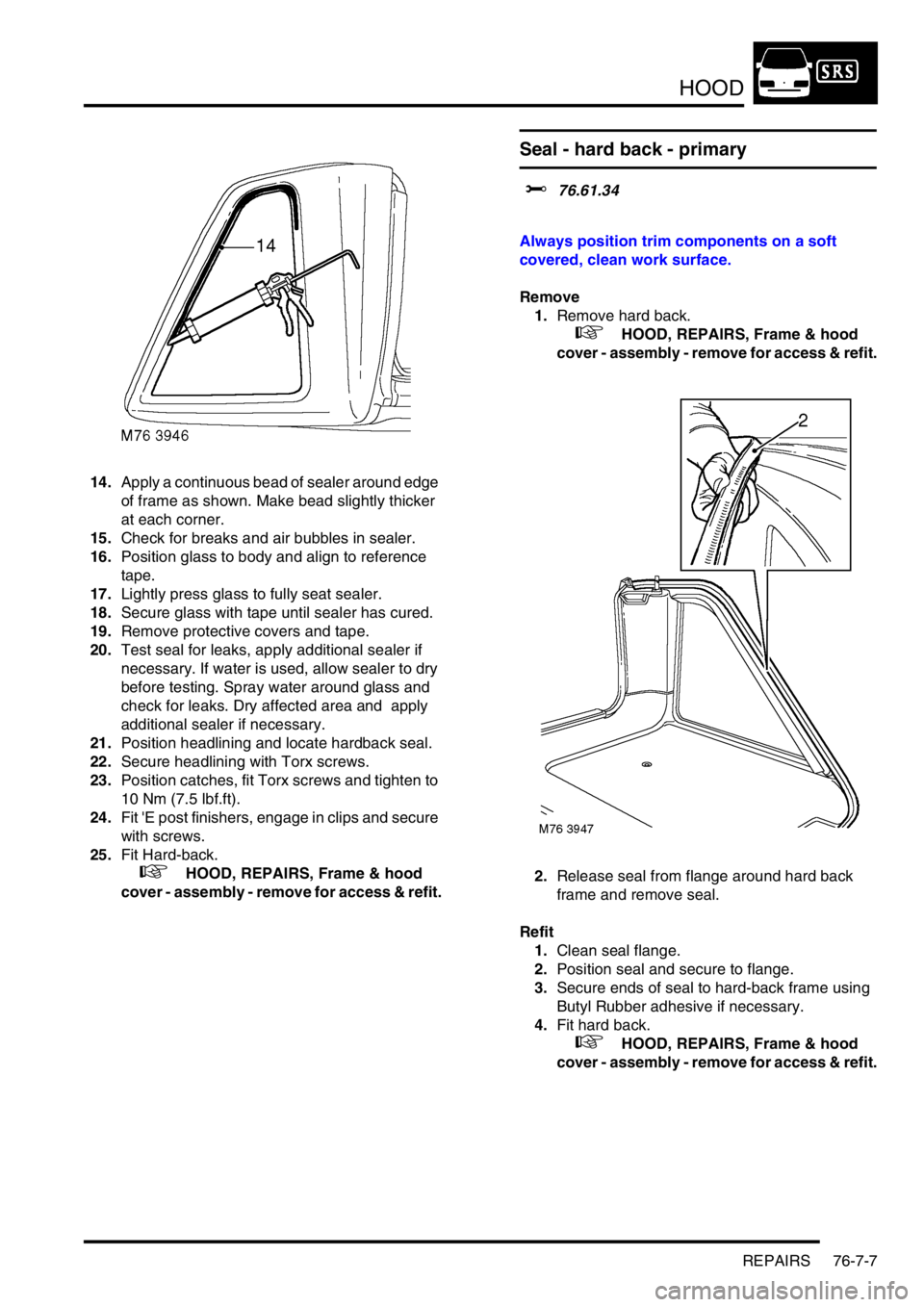
14.Apply a continuous bead of sealer around edge
of frame as shown. Make bead slightly thicker
at each corner.
15.Check for breaks and air bubbles in sealer.
16.Position glass to body and align to reference
tape.
17.Lightly press glass to fully seat sealer.
18.Secure glass with tape until sealer has cured.
19.Remove protective covers and tape.
20.Test seal for leaks, apply additional sealer if
necessary. If water is used, allow sealer to dry
before testing. Spray water around glass and
check for leaks. Dry affected area and apply
additional sealer if necessary.
21.Position headlining and locate hardback seal.
22.Secure headlining with Torx screws.
23.Position catches, fit Torx screws and tighten to
10 Nm (7.5 lbf.ft).
24.Fit 'E post finishers, engage in clips and secure
with screws.
25.Fit Hard-back.
+ HOOD, REPAIRS, Frame & hood
cover - assembly - remove for access & refit.
Seal - hard back - primary
$% 76.61.34
Always position trim components on a soft
covered, clean work surface.
Remove
1.Remove hard back.
+ HOOD, REPAIRS, Frame & hood
cover - assembly - remove for access & refit.
2.Release seal from flange around hard back
frame and remove seal.
Refit
1.Clean seal flange.
2.Position seal and secure to flange.
3.Secure ends of seal to hard-back frame using
Butyl Rubber adhesive if necessary.
4.Fit hard back.
+ HOOD, REPAIRS, Frame & hood
cover - assembly - remove for access & refit.
Page 756 of 1007

PANEL REPAIRS
BODY REPAIRS 77-2-1
PANEL REPAIRS
General
Body shells are of monocoque construction. Front and rear sections of the shell are designed as 'energy absorbing'
zones. This means they are designed to deform progressively when subjected to impact in order to minimise the
likelihood of injury to vehicle occupants.
It is essential that design dimensions and strength are restored in accident rectification. It is important that neither
structural weakness nor excessive local stiffness are introduced into the vehicle during body repair.
Repairs usually involve a combination of operations ranging from straightening procedures to renewal of individual
panels or panel assemblies. The repairer will determine the repair method and this decision will take into account a
balance of economics between labour and material costs and the availability of repair facilities in both equipment and
skills. It may also involve considerations of the vehicles' downtime, replacement vehicle availability and repair turn-
around time.
It is expected that a repairer will select the best and most economic repair method possible, making use of the facilities
available. The instructions given are intended to assist a skilled body repairer by expanding approved procedures for
panel replacement. The objective is to restore the vehicle to a safe running condition by carrying out a repair which is
as close as is feasible to original standard. The results should not advertise to the experienced eye that the vehicle
has been damaged, although the repair might not be identical in all respects to the original factory build. Commercial
bodyshop repair facilities cannot always duplicate methods of construction used during production.
Operations covered in this Manual do not include reference to testing the vehicle after repair. It is essential that work
is inspected and suspension geometry checked after completion. Where necessary a road test of the vehicle should
be carried out, particularly where safety-related items are concerned.
Where major units have been disconnected or removed it is necessary to ensure that fluid levels are checked and
topped up where necessary. It is also necessary to ensure that the repaired vehicle is in a roadworthy condition in
respect of tyre pressures, lights, washer fluid etc.
Body repairs often involve the removal of mechanical and electrical units and associated wiring. Where necessary,
refer to the relevant section of the Workshop Manual for removal and refitting instructions.
Body components
Taking into consideration the differences in body styles, suspension systems and engine and transmission layouts,
the location of the following components as applicable to a particular vehicle is critical:
lFront suspension upper damper mountings.
lFront suspension or sub frame mountings.
lRear suspension upper damper mountings.
lRear suspension mountings or lower pivots.
Additional points which can be used to check alignment and assembly are:
lInner holes in crossmember - side - main floor.
lHoles in front longitudinals.
lHoles in side members.
lHoles in rear longitudinals.
lHoles in rear lower panels or extension rear floor.
Apertures for windscreen, backlight, bonnet and doors can be measured and checked using the dimensional
information provided and also by offering up an undamaged component as a gauge.
Straightening
Whenever possible, structural members should be cold straightened under tension. Do not attempt to straighten with
a single pull but rework the damaged area using a series of pulls, releasing tension between each stage and using
the opportunity to check alignment.
Page 774 of 1007

PANEL REPAIRS
PROCEDURES 77-2-19
PROCEDURES
Panel replacement procedure
This information is designed to explain the basic
panel removal and replacement method. This
standard method might vary slightly from one vehicle
to another. The main criterion in removable and
replacement of body panels is that Land Rover`s
original standard is maintained as far as possible.
Remove panel
1.Expose resistance spot welds. For those spot
welds which are not obviously visible, use a
rotary drum sander or wire brush fitted to an air
drill, or alternatively a hand held wire brush.
NOTE: In wheel arch areas it may be necessary
to soften underbody coating, using a hot air
gun, prior to exposing spot welds.2.Cut out welds using a cobalt drill.
3.Alternatively, use a clamp-type spot weld
remover.
Page 780 of 1007

PANEL REPAIRS
REPAIRS 77-2-25
REPAIRS
Front bulkhead assembly
In this procedure, the crossmember gusset plates
are replaced in conjunction with the front bulkhead
assembly.
Remove
1.Disconnect battery earth lead.
2.Disconnect alternator.
3.Disconnect all ECUs.
4.Remove front bumper valance.
+ EXTERIOR FITTINGS, REPAIRS,
Bumper - assembly - front - up to 04MY.
5.Remove front bumper armature.
6.Remove radiator.
+ COOLING SYSTEM - K SERIES KV6,
REPAIRS, Radiator assembly.
7.Remove PAS fluid cooler.
+ STEERING, REPAIRS, Oil cooler -
Td4 & K1.8 models.
8.Remove LH and RH headlamps.
+ LIGHTING, REPAIRS, Headlamp
assembly - up to 04MY.
9.Release wiring to headlamps and position
aside.
10.Remove LH and RH engine bay shields.
11.Remove bumper valance LH and RH
attachment brackets.
12.Remove battery.
+ CHARGING AND STARTING,
REPAIRS, Battery.
13.Remove air intake hose.
14.Remove horn.
+ SECURITY, REPAIRS, Horn.
15.Remove windscreen washer reservoir.
+ WIPERS AND WASHERS, REPAIRS,
Reservoir - washer.
16.Remove bonnet lock.
17.Support bonnet in open position.
18.Remove bonnet stay. Repair
1.Remove existing panel(s), prepare panel joint
faces and install new panel(s) in accordance
with Panel Replacement Procedure. Punch or
drill holes in new panel for plug welding as
shown.