2001 LAND ROVER FREELANDER fuel
[x] Cancel search: fuelPage 28 of 1007

INTRODUCTION
01-3
Abbreviations and Symbols
A Amperes
AAP Ambient Air Pressure
AAT Ambient Air Temperature
ABDC After Bottom Dead Centre
ABS Anti-Lock Brake System
ABS / TC Anti-lock Brake System / Traction
Control
ac Alternating current
A/C Air Conditioning
ACE Active Cornering Enhancement
ACEA Association of Constructors of
European Automobiles
AFR Air Fuel Ratio
AP Ambient Pressure
ASC Anti-shunt Control
ATC Air Temperature Control
ATDC After Top Dead Centre
AUX Auxiliary
AVC Automatic Volume Control
BBDC Before Bottom Dead Centre
BBUS Battery Backed Up Sounder
BCU Body Control Unit
BDC Bottom Dead Centre
bhp Brake Horse Power
BP Boost Pressure
BPP Brake Pedal Position
BS British Standard
BTDC Before Top Dead Centre
BWD Backward
C Celsius
CAN Controller Area Network
CD Compact Disc
CDC Centre Differential Control
CDL Central Door Locking
CD - ROM Compact Disc - Read Only
Memory
CFC Chlorofluorocarbon
CHMSL Centre High Mounted Stop Lamp
CKP Crankshaft Position
CLV Calculated Load Value
cm Centimetre
cm
2Square centimetre
cm3Cubic centimetre
CMP Camshaft Position
CPP Clutch Pedal Position
CO Carbon Monoxide
CO
2Carbon Dioxide
COB Clear Over Base
CR Common Rail
CVS Canister Vent Solenoid
dB Decibels
DDM Driver's Door Module
deg. Degree, angle or temperature
DI Direct Injection
dia. DiameterDIN Deutsche Industrie Normen
(German Industrial Standards)
dc Direct current
DCV Directional Control Valve
DOHC Double Overhead Camshaft
DSP Digital Signal Processing
DTI Dial Test Indicator
DMF Dual Mass Flywheel
DVD Digital Versatile Disc
EACV Electronic Air Control Valve
EAT Electronic Automatic
Transmission
EBD Electronic Brake pressure
Distribution
ECD European Community Directive
ECM Engine Control Module
ECT Engine Coolant Temperature
ECU Electronic Control Unit
EDC Electronic Diesel Control
EEPROM Electronic Erasable
Programmable Read Only
Memory
EGR Exhaust Gas Recirculation
EKA Emergency Key Access
ELR Emergency Locking Retractor
EN European Norm
EOBD European On Board Diagnostics
EON Enhanced Other Network
ERL Electrical Reference Library
ETC Electronic Traction Control
EUI Electronic Unit Injector
EVAP Evaporative Emission
EVR Electronic Vacuum Regulator
F Fahrenheit
ft. Feet
FBH Fuel Burning Heater
FET Field Effect Transistor
FIP Fuel Injection Pump
FTC Fast Throttle Control
FWD Forward
> Greater than
g Gramme or Gravity
gal. Gallons
GMT Greenwich Mean Time
GPS Global Positioning System
hHour
hc High compression
HC Hydro Carbons
HDC Hill Descent Control
HDOP Height Dilation Of Precision
HDPE High Density Polyethylene
HFS Heated Front Screen
Hg Mercury
HO
2S Heated Oxygen Sensor
HMW High Molecular Weight
Page 32 of 1007

GENERAL INFORMATION
03-1
GENERAL INFORMATION
General precautions
Dangerous substances
Modern vehicles contain many materials and liquids
which if not handled with care can be hazardous to
both personal health and the environment.
WARNING: Many liquids and other substances
used in motor vehicles are poisonous and should
under no circumstances be consumed and
should, as far as possible, be kept from contact
with the skin. These liquids and substances
include acid, anti-freeze, asbestos, brake fluid,
fuel, windscreen washer additives, lubricants,
refrigerants and various adhesives.
Always read carefully the instructions printed on
labels or stamped on components and obey them
implicitly. Such instructions are included for
reasons of your health and personal safety.
Never disregard them.
WARNING: Many of the fluids used in motor
vehicles, such as coolant, brake fluid and power
steering fluid, are inflammable. Take care not to
spill fluids when topping-up, a fire may result. If
spillage does occur, ensure the area is
thoroughly cleaned before starting the engine.
Synthetic rubber
Many 'O' rings, seals, hoses, flexible pipes and other
similar items which appear to be natural rubber, are
in fact, made of synthetic materials called
Fluoroelastomers.
Under normal operating conditions this material is
safe and does not present a health hazard. However,
if the material is damaged by fire or excessive
heating, it can break down and produce highly
corrosive Hydrofluoric acid which can cause serious
burns on contact with skin.
If skin contact does occur:
lRemove any contaminated clothing
immediately.
lIrrigate effected area of skin with a copious
amount of cold water or limewater for 15 to 60
minutes.
lObtain medical assistance immediately.
Should any material be in a burnt or over-heated
condition, handle with extreme caution and wear
protective clothing (seamless industrial gloves,
protective apron etc.). Decontaminate and dispose of
gloves immediately after use.Lubricating oils
WARNING: Avoid excessive skin contact with used
engine oil. Used engine oil contains potentially
harmful contaminants which may cause skin cancer
or other serious skin disorders.
WARNING: Avoid excessive skin contact with
mineral oil. Mineral oils remove the natural fats from
the skin, leading to dryness, irritation and dermatitis.
Health protection precautions
The following precautions should be observed at all
times:
lAvoid prolonged and repeated contact with oils,
particularly used engine oils.
lWear protective clothing, including impervious
gloves where practicable.
lDo not put oily rags in pockets.
lAvoid contaminating clothes (particularly those
next to the skin) with oil.
lOveralls must be cleaned regularly. Discard
heavily soiled clothing and oil impregnated
footwear.
lFirst aid treatment should be obtained
immediately for open cuts and wounds.
lUse barrier creams: apply before each work
period to help prevent lubricating oil from
contaminating the skin.
lWash with soap and water to ensure all oil is
removed (propriety skin cleansers and nail
brushes will help).
lUse moisturisers after cleaning; preparations
containing lanolin help replace the skin's natural
oils which have been removed.
lDo not use petrol, kerosene, diesel fuel, gas, oil,
thinners or solvents for cleaning skin.
lIf skin disorders develop, obtain medical advice
without delay.
lWhere practicable, degrease components prior
to handling.
lWear eye protection (e.g. goggles or face
shield) if there is a risk of eye contamination.
Eye wash facilities should be provided in the
close vicinity of the work area.
Page 35 of 1007

GENERAL INFORMATION
03-4
Materials –
lkeep lids on containers of solvents;
lonly use the minimum quantity;
lconsider alternative materials;
lminimise over-spray when painting.
Gases –
luse the correct equipment for collecting
refrigerants;
ldon't burn rubbish on site.
Discharges to water
Most sites will have two systems for discharging
water: storm drains and foul drains. Storm drains
should only receive clean water, foul drains will take
dirty water.
The foul drain will accept many of the normal waste
waters such as washing water, detergents and
domestic type wastes, but oil, petrol, solvent, acids,
hydraulic oil, antifreeze and other such substances
should never be poured down the drain. If in any
doubt, speak to the local Water Company first.
Every precaution must be taken to prevent spillage of
oil, fuel, solvents etc. reaching the drains. All
handling of such materials must take place well away
from the drains and preferably in an area with a kerb
or wall around it, to prevent discharge into the drain.
If a spillage occurs, it should be soaked up
immediately. Having a spill kit available will make this
easier.
Additional precautions
Check whether the surface water drains are
connected to an oil/water separator, this could
reduce the pollution if an incident was to occur. Oil/
water separators require regular maintenance to
ensure effectiveness.
Checklist
Always adhere to the following:
Disposal –
lnever pour anything down a drain without first
checking that it is environmentally safe to do so,
and that it does not contravene any local
regulations or bye-laws;
lhave oil traps emptied regularly.
Spillage prevention –
lstore liquids in a walled area;
lmake sure the taps on liquid containers are
secure and cannot be accidentally turned on;
lprotect bulk storage tanks from vandalism by
locking the valves;
ltransfer liquids from one container to another in
an area away from open drains;
lensure lids are replaced securely on containers;
lhave spill kits available near to points of storage
and handling of liquids.Spill kits
Special materials are available to absorb a number of
different substances. They can be in granular form,
ready to use and bought in convenient containers for
storage. Disposal of used spill-absorbing material is
dealt with in the 'Waste Management' section.
Land contamination
Oils, fuels and solvents etc. can contaminate any soil
that they are allowed to contact. Such materials
should never be disposed of by pouring onto soil and
every precaution must be taken to prevent spillage
reaching soil. Waste materials stored on open
ground could also leak, or have polluting substances
washed off them that would contaminate the land.
Always store these materials in suitable skips or
other similarly robust containers.
Checklist
Always adhere to the following:
ldon't pour or spill anything onto the soil or bare
ground;
ldon't store waste materials on bare ground, see
'Spillage prevention' list.
Legal compliance
Some sites may have a discharge consent for
effluent discharge to the foul drain for a car wash etc.
It is important to know what materials are allowed in
the drain and to check the results of any monitoring
carried out by the Water Company.
Where paint spraying operations are carried out it
may be necessary to apply to the Local Authority for
an air emissions licence to operate the plant. If such
a licence is in operation, additional precautions will
be necessary to comply with the requirements, and
the results of any air quality monitoring must be
checked regularly.
Checklist
Always adhere to the following:
lknow what legal consents and licences apply to
the operations;
lcheck that the emissions and discharges
comply with legal requirements.
Page 36 of 1007

GENERAL INFORMATION
03-5
Local issues
A number of environmental issues will be of
particular concern to residents and other neighbours
close to the site. The sensitivity of these issues will
depend on the proximity of the site and the layout
and amount of activity carried on at the site.
Noise is a major concern and therefore consideration
should be given to the time spent carrying out noisy
activities and the location of those activities that can
cause excessive noise.
Car alarm testing, panel beating, hammering and
other such noisy activities should, whenever
possible, be carried out indoors with doors and
windows shut, or as far away from houses as
possible.
Running vehicle engines may be an outside activity
which could cause nuisance to neighbours because
of both noise and smell.
Be sensitive to the time of day when these activities
are carried out and minimise the time of the noisy
operation, particularly in the early morning and late
evening.
Another local concern will be the smell from the
various materials used. Using less solvent, paint and
petrol could help prevent this annoyance.
Local residents and other business users will also be
concerned about traffic congestion, noise and
exhaust fumes, be sensitive to these concerns and
try to minimise inconvenience from deliveries,
customers and servicing operations.
Checklist
Always adhere to the following:
lidentify where the neighbours who are likely to
be affected are situated;
lminimise noise, smells and traffic nuisance;
lprevent litter by putting waste in the correct
containers;
lhave waste skips emptied regularly.Use of resource
Another environmental concern is the waste of
materials and energy that can occur in day to day
activities.
Electricity for heating, lighting and compressed air
uses resources and releases pollution during its
generation.
Fuel used for heating, running cars or vans and
mobile plant is another limited resource which
consumes large amounts of energy during its
extraction and refining processes.
Water has to be cleaned, piped to site and disposed
of, all of which creates more potential pollution;
Oil, spares, paint etc., have all produced pollution in
the process of manufacture and they become a
waste disposal problem if discarded.
Checklist
Always adhere to the following:
Electricity and heating –
lkeep doors and windows closed in the winter;
lswitch off machinery or lights when not needed;
luse energy efficient heating systems;
lswitch off computers and photocopiers when
not needed.
Fuel –
ldon't run engines unnecessarily;
lthink about whether journeys are necessary and
drive to conserve fuel.
Water –
ldon't leave taps and hose pipes running;
lmend leaks quickly, don't be wasteful.
Compressed air –
ldon't leave valves open;
lmend leaks quickly;
ldon't leave the compressor running when not
needed.
Use of environmentally damaging materials –
lcheck whether a less toxic material is available.
Handling and storage of materials –
lhave the correct facilities available for handling
liquids to prevent spillage and wastage as listed
above;
lprovide suitable locations for storage to prevent
frost damage or other deterioration.
Page 37 of 1007

GENERAL INFORMATION
03-6
Waste Management
One of the major ways that pollution can be reduced
is by the careful handling, storage and disposal of all
waste materials that occur on sites. Legislation
makes it illegal to dispose of waste materials other
than to licensed waste carriers and disposal sites.
This means that it is necessary to not only know what
the waste materials are, but also to have the
necessary documentation and licenses.
Handling and storage of waste
Ensure that waste materials are not poured down the
drain or onto soils. They should be stored in such a
way as to prevent the escape of material to land,
water or air.
They must also be segregated into different types of
waste e.g. oil, metals, batteries, used vehicle
components. This will prevent any reaction between
different materials and assist in disposal.
Disposal of waste
Disposal of waste materials must only be to waste
carriers who are licensed to carry those particular
waste materials and all the necessary
documentation must be completed. The waste
carrier is responsible for ensuring that the waste is
taken to the correct disposal sites.Dispose of waste in accordance with the following
guidelines:
lFuel, hydraulic fluid, anti-freeze and oil –
keep separate and dispose of to specialist
contractor.
lRefrigerant – collect using specialist
equipment and containers, and reuse.
lDetergents – safe to pour down the foul drain
if diluted.
lPaint, thinners – keep separate and dispose of
to specialist contractor.
lComponents – send back to supplier for
refurbishment, or disassemble and reuse any
suitable parts. Dispose of the remainder in
ordinary waste.
lSmall parts – reuse any suitable parts, dispose
of the remainder in ordinary waste.
lMetals – can be sold if kept separate from
general waste.
lTyres – keep separate and dispose of to
specialist contractor.
lPackaging – compact as much as possible and
dispose of in ordinary waste.
lAsbestos-containing – keep separate and
dispose of to specialist contractor.
lOily and fuel wastes (e.g. rags, used spill kit
material) – keep separate and dispose of to
specialist contractor.
lAir filters – keep separate and dispose of to
specialist contractor.
lRubber/plastics – dispose of in ordinary
waste.
lHoses – dispose of in ordinary waste.
lBatteries – keep separate and dispose of to
specialist contractor.
lAirbags (explosives) – keep separate and
dispose of to specialist contractor.
lElectrical components – send back to
supplier for refurbishment, or disassemble and
reuse any suitable parts. Dispose of the
remainder in ordinary waste.
lElectronic components – send back to
supplier for refurbishment, or disassemble and
reuse any suitable parts. Dispose of the
remainder in ordinary waste.
lCatalysts – can be sold if kept separate from
general waste.
lUsed spill-absorbing material – keep
separate and dispose of to specialist contractor.
lOffice waste – recycle paper and toner/ink
cartridges, dispose of the remainder in ordinary
waste.
Page 38 of 1007

GENERAL INFORMATION
03-7
General fitting instructions
Precautions against damage
To avoid damage to the vehicle when carrying out
repairs, always adhere to the following:
lAlways fit wing and seat covers before
commencing work. Avoid spilling brake fluid or
battery acid on paintwork; immediately wash off
with water if this occurs.
lDisconnect the battery earth lead before starting
work, see ELECTRICAL PRECAUTIONS.
lAlways use the recommended service tool or a
satisfactory equivalent where specified.
lProtect exposed bearing surfaces, sealing
surfaces and screw threads from damage.
Component removal
Whenever possible, clean components and
surrounding area before removal.
lBlank off openings exposed by component
removal.
lImmediately seal fuel, oil or hydraulic lines when
apertures are exposed; use plastic caps or
plugs to prevent loss of fluid and ingress of dirt.
lClose open ends of oilways exposed by
component removal with tapered hardwood
plugs or conspicuous plastic plugs.
lImmediately a component is removed, place it in
a suitable container; use a separate container
for each component and its associated parts.
lClean bench and provide marking materials,
labels, containers and locking wire before
dismantling a component.
Dismantling
Observe scrupulous cleanliness when dismantling
components, particularly when brake, fuel or
hydraulic system parts are being worked on. A
particle of dirt or a cloth fragment could cause a
serious malfunction if trapped in these systems.Use the following procedures:
lBlow out all tapped holes, crevices, oilways and
fluid passages with an air line. Ensure that any
O-rings used for sealing are correctly replaced
or renewed if disturbed during the process.
lUse marking ink to identify mating parts and
ensure correct reassembly. Do not use a centre
punch or scriber to mark parts, they could
initiate cracks or distortion in marked
components.
lWire together mating parts where necessary to
prevent accidental interchange (e.g. roller
bearing components).
lWire labels on to all parts which are to be
renewed, and to parts requiring further
inspection before being passed for reassembly;
place these parts in separate containers from
those containing parts for rebuild.
lDo not discard a part due for renewal until after
comparing it with a new part to ensure that its
correct replacement has been obtained.
Cleaning components
Always use the recommended cleaning agent or
equivalent. Ensure that adequate ventilation is
provided when volatile degreasing agents are being
used. Do not use degreasing equipment for
components containing items which could be
damaged by the use of this process.
When washing under bonnet, never direct water onto
ECM, as water ingress may occur resulting in
damage to electrical components inside.
General Inspection
All components should be inspected for wear or
damage before being reassembled.
lNever inspect a component for wear or
dimensional check unless it is absolutely clean;
a slight smear of grease can conceal an
incipient failure.
lWhen a component is to be checked
dimensionally against recommended values,
use the appropriate measuring equipment
(surface plates, micrometers, dial gauges etc.).
Ensure the measuring equipment is calibrated
and in good serviceable condition.
lReject a component if its dimensions are
outside the specified tolerances, or if it appears
to be damaged.
lA part may be refitted if its critical dimension is
exactly to its tolerance limit and it appears to be
in satisfactory condition.
lUse 'Plastigauge' 12 Type PG-1 for checking
bearing surface clearances.
Page 41 of 1007

GENERAL INFORMATION
03-10
Joints and joint faces
General
Fit joints dry unless specified otherwise.
lAlways use the correct gaskets as specified.
lWhen joining compound is used, apply in a thin
uniform film to metal surfaces; take care to
prevent joining compound from entering
oilways, pipes or blind tapped holes.
lIf gaskets and/or joining compound is
recommended for use; remove all traces of old
joining material prior to reassembly. Do not use
a tool which will damage the joint faces and
smooth out any scratches or burrs using an oil
stone. Do not allow dirt or joining material to
enter any tapped holes or enclosed parts.
lPrior to reassembly, blow through any pipes,
channels or crevices with compressed air.
Locking devices
General
Always replace locking devices with one of the same
design.
Tab Washers
Always release locking tabs and fit new locking
washers, do not re-use locking tabs. Ensure the new
tab washer is the same design as that replaced.
Locking Nuts
Always use a backing spanner when loosening or
tightening locking nuts, brake and fuel pipe unions.
Roll Pins
Always fit new roll pins of an interference fit in the
hole.
Circlips
Always fit new circlips of the correct size for the
groove.
Locking wire
Always fit locking wire of the correct type. Arrange
wire so that its tension tends to tighten the bolt heads
or nuts to which it is fitted.
Keys and Keyways
Remove burrs from edges of keyways with a fine file
and clean thoroughly before attempting to refit key.
Clean and inspect key closely; keys are suitable for
refitting only if indistinguishable from new, as any
indentation may indicate the onset of wear.
Page 46 of 1007
GENERAL INFORMATION
03-15
Fuel System Hoses
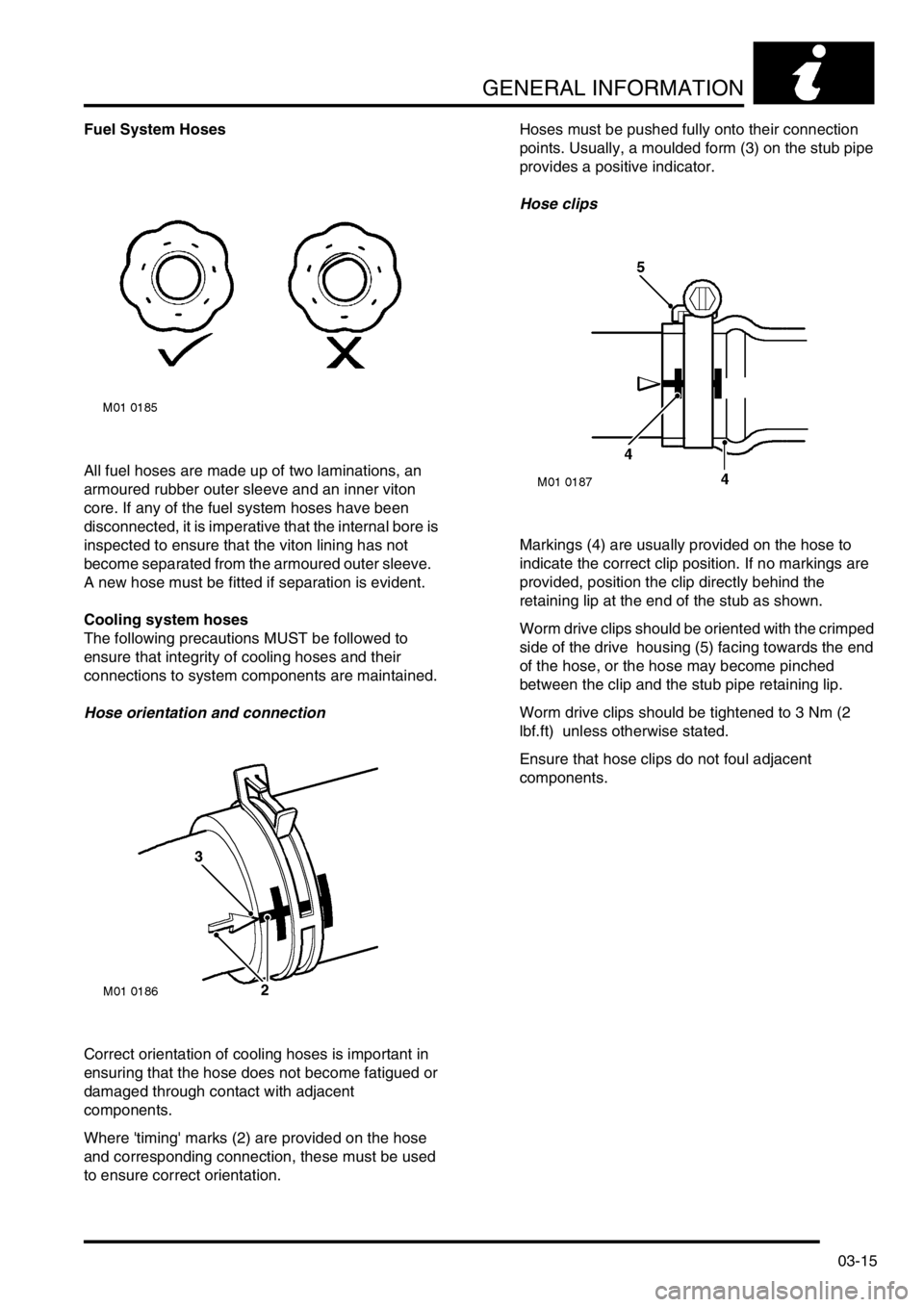
All fuel hoses are made up of two laminations, an
armoured rubber outer sleeve and an inner viton
core. If any of the fuel system hoses have been
disconnected, it is imperative that the internal bore is
inspected to ensure that the viton lining has not
become separated from the armoured outer sleeve.
A new hose must be fitted if separation is evident.
Cooling system hoses
The following precautions MUST be followed to
ensure that integrity of cooling hoses and their
connections to system components are maintained.
Hose orientation and connection
Correct orientation of cooling hoses is important in
ensuring that the hose does not become fatigued or
damaged through contact with adjacent
components.
Where 'timing' marks (2) are provided on the hose
and corresponding connection, these must be used
to ensure correct orientation.Hoses must be pushed fully onto their connection
points. Usually, a moulded form (3) on the stub pipe
provides a positive indicator.
Hose clips
Markings (4) are usually provided on the hose to
indicate the correct clip position. If no markings are
provided, position the clip directly behind the
retaining lip at the end of the stub as shown.
Worm drive clips should be oriented with the crimped
side of the drive housing (5) facing towards the end
of the hose, or the hose may become pinched
between the clip and the stub pipe retaining lip.
Worm drive clips should be tightened to 3 Nm (2
lbf.ft) unless otherwise stated.
Ensure that hose clips do not foul adjacent
components.