2001 HONDA ODYSSEY light
[x] Cancel search: lightPage 4 of 363

This section gives you important
inf ormation about how to protect
yourself and your passengers. It
shows you how to use seat belts
properly. It explains your Supple-
mental Restraint System. And it tells
you how to properly restrain inf ants
and children in your vehicle..........
Important Safety Precautions . 6
.......
Your Vehicle’s Saf ety Features . 7
.......................................
Seat Belts . 8
...........................................
Airbags . 9
.....................
Seats & Seat-Backs . 10 ..........................
Head Restraints . 10
..................................
Door Locks . 10
........
Pre-Drive Saf ety Checklist . 11
............................
Protecting Adults . 12
.....
1. Close and Lock the Doors . 12
...........
2. Adjust the Front Seats . 12
............
3. Adjust the Seat-Backs . 13
...
4. Adjust the Head Restraints . 14
5. Fasten and Position the Seat
.....................................
Belts . 15
....
6. Adjust the Steering Wheel . 19
7. Maintain a Proper Sitting
................................
Position . 19
.....
Advice f or Pregnant Women . 20
...
Additional Safety Precautions . 20
........................
Protecting Children . 22
All Children Must Be ...............................
Restrained . 22
Children Should Sit in the Back ...........................................
Seat . 23
The Passenger’s Airbag Poses ......
Serious Risks to Children . 24
If You Must Drive with Several ...................................
Children . 26
If a Child Requires Close ..................................
Attention . 26 ...
Additional Safety Precautions . 27
General Guidelines f or Using
...............................
Child Seats . 28
.......................
Protecting Inf ants . 32
.........
Protecting Small Children . 37
.......
Protecting Larger Children . 41
Using Child Seats with
.....................................
Tethers . 45
...
Using the Lower Anchorages . 47
Additional Inf ormation About Your .................................
Seat Belts . 49
..
Seat Belt System Components . 49
......................
Lap/Shoulder Belt . 49
...............
Seat Belt Maintenance . 51
Additional Inf ormation About Your
...........................................
SRS . 52
........................
SRS Components . 52
...........
How Your Airbags Work . 52
How the Automatic Seat Belt
....................
Tensioners Work . 54
How the SRS Indicator Light .......................................
Works . 54
..................................
SRS Service . 55
...
Additional Safety Precautions . 56
.............
Carbon Monoxide Hazard . 57
...................................
Saf ety Labels . 58
Driver and Passenger Saf ety
Driver and Passenger Saf ety 5
Page 7 of 363

Your seat belt system also
includes a light on the
instrument panel to remind you and
your passengers to f asten your seat
belts.
Seat belts are the single most
effectivesafetydeviceforadultsand
larger children. (Inf ants and smaller
children must be properly restrained
in child seats.)
Not wearing a seat belt properly
increases the chance of serious
injury or death in a crash, even
though your vehicle has airbags.
Foryoursafety,andthesafetyof
your passengers, your vehicle is
equipped with seat belts in all seating
positions.
In addition, most states and all
Canadian provinces require you to
wear seat belts.
Help protect you in almost every
type of crash, including side and
rear impacts and rollovers. (Your
airbag can only be helpful in a
moderate to severe frontal collision.)
Keep you connected to the vehicle
so you can take advantage of the
vehicle’s built-in saf ety f eatures.
When properly worn, seat belts:
Always wear
your seat belt, and make sure you
wear it properly.
Of course, seat belts cannot
completely protect you in every
crash.Butinmostcases,seatbelts
can reduce your risk of serious
injury. Help keep you in a good position
should the airbags ever deploy. A
good position reduces the risk of
injury f rom an inf lating airbag, and
allows you to get the best
advantage f rom the airbag.
Keep you f rom being thrown out
of the vehicle.
Help keep you f rom being thrown
against the inside of the vehicle
and against other occupants.
Driver and Passenger Saf ety
Seat Belts
Why Wear Seat Belt s
What you should do:
Your Vehicle’s Saf ety Features
8Not wearing a seat belt properly
increases the chance of serious
injury or death in a crash, even
if you have airbags.
Be sure you and your
passengers always wear seat
belts and wear them properly.
Page 8 of 363
The most important things you need
to know about your airbags are:
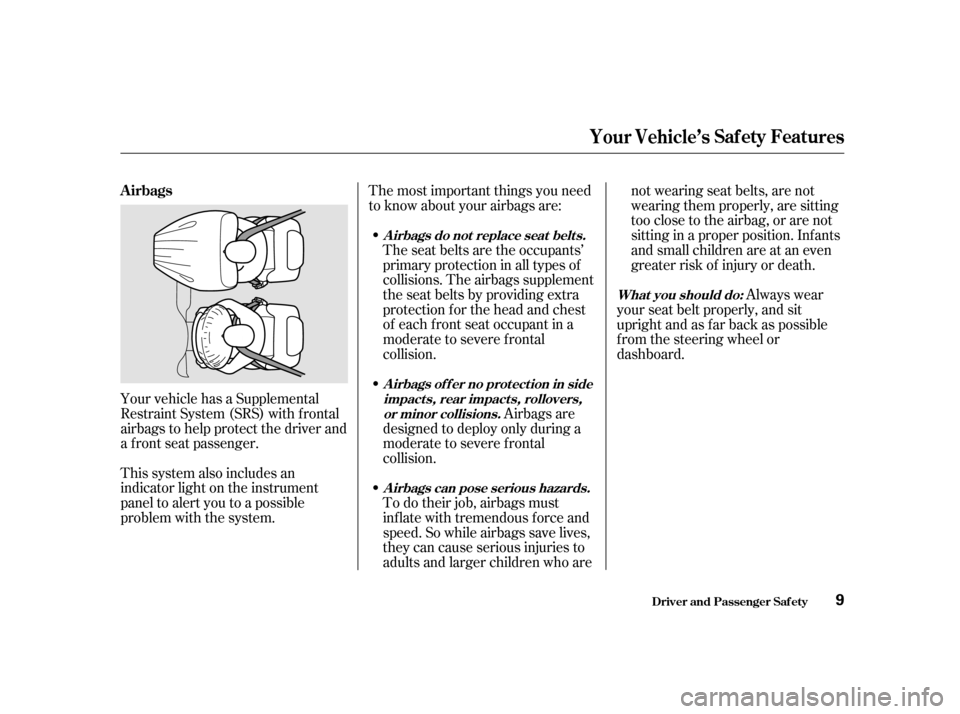
Your vehicle has a Supplemental
Restraint System (SRS) with frontal
airbags to help protect the driver and
a f ront seat passenger.
This system also includes an
indicator light on the instrument
paneltoalertyoutoapossible
problem with the system. The seat belts are the occupants’
primary protection in all types of
collisions. The airbags supplement
the seat belts by providing extra
protection f or the head and chest
of each f ront seat occupant in a
moderate to severe frontal
collision.
Airbags are
designed to deploy only during a
moderate to severe frontal
collision.
To do their job, airbags must
inf late with tremendous f orce and
speed. So while airbags save lives,
they can cause serious injuries to
adults and larger children who are not wearing seat belts, are not
wearing them properly, are sitting
too close to the airbag, or are not
sitting in a proper position. Inf ants
and small children are at an even
greater risk of injury or death.
Always wear
your seat belt properly, and sit
upright and as f ar back as possible
f rom the steering wheel or
dashboard.
Driver and Passenger Saf ety
Airbags
Your Vehicle’s Saf ety Features
Airbags do not replace seat belts.
Airbags of f er no protection in sideimpact s, rear impact s, rollovers,or minor collisions.
Airbags can pose serious hazards. What you should do:
9
Page 11 of 363
The f ollowing pages provide
instructions on how to properly
protect the driver and other adult
occupants.
These instructions also apply to
children who have outgrown child
seats and are large enough to wear
lap/shoulder belts. (See page f or
important additional guidelines on
how to properly protect larger
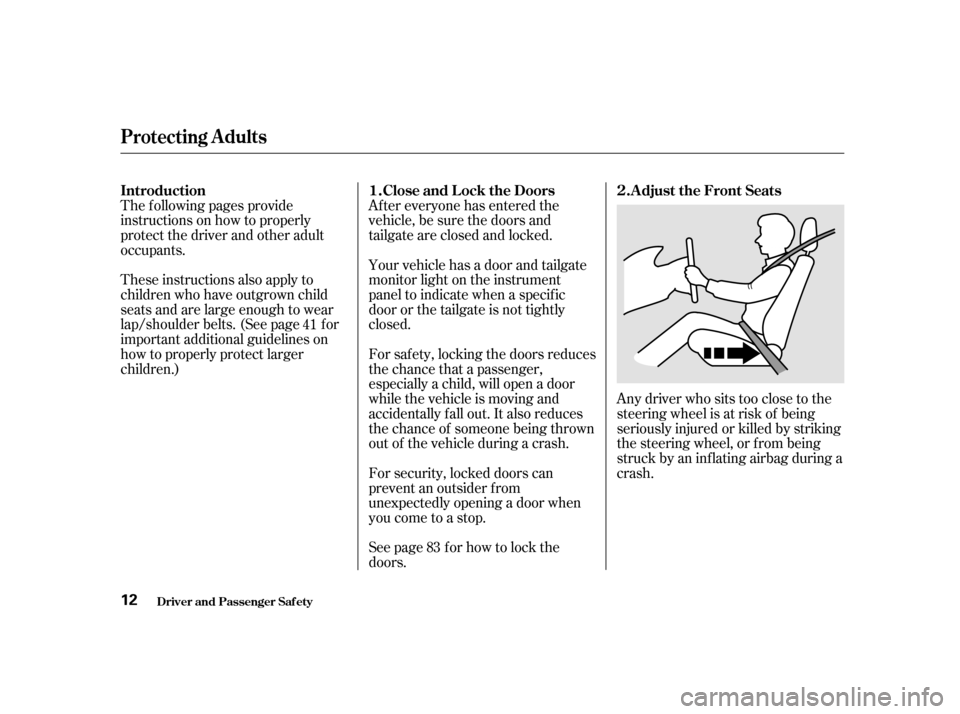
children.)Any driver who sits too close to the
steering wheel is at risk of being
seriously injured or killed by striking
the steering wheel, or f rom being
struck by an inf lating airbag during a
crash.
Your vehicle has a door and tailgate
monitor light on the instrument
panel to indicate when a specif ic
door or the tailgate is not tightly
closed.
Af ter everyone has entered the
vehicle, be sure the doors and
tailgate are closed and locked.
For security, locked doors can
prevent an outsider f rom
unexpectedly opening a door when
you come to a stop.
See page f or how to lock the
doors.
For saf ety, locking the doors reduces
the chance that a passenger,
especially a child, will open a door
while the vehicle is moving and
accidentally f all out. It also reduces
the chance of someone being thrown
out of the vehicle during a crash.
41
83
Driver and Passenger Saf ety
Protecting Adults
Introduction A djust the Front Seats
Close and L ock the Doors
1. 2.
12
Page 48 of 363
CONT INUED
To unlock the belt, push the red
PRESSbuttononthebuckle.
To fasten the belt, insert the latch
plate into the buckle, then tug on the
belt to make sure the buckle is
latched.
Guide the belt across your body so
that it retracts completely. After
exiting the vehicle, be sure the belt
is out of the way and will not get
closed in the door.
All seat belts have an emergency
locking retractor. In normal driving,
the retractor lets you move f reely in
your seat while it keeps some
tension on the belt. During a collision
or sudden stop, the retractor
automatically locks the belt to help
restrain your body.
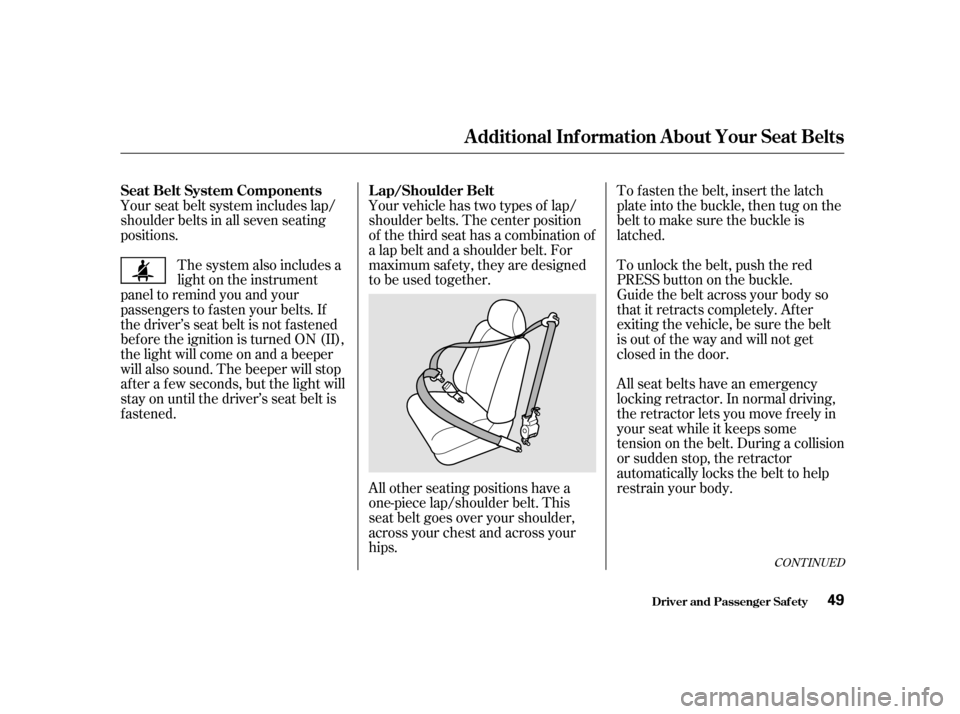
Your vehicle has two types of lap/
shoulder belts. The center position
of the third seat has a combination of
a lap belt and a shoulder belt. For
maximum saf ety, they are designed
to be used together.
All other seating positions have a
one-piece lap/shoulder belt. This
seat belt goes over your shoulder,
across your chest and across yourhips.
Your seat belt system includes lap/
shoulder belts in all seven seating
positions.
The system also includes a
light on the instrument
panel to remind you and your
passengers to f asten your belts. If
the driver’s seat belt is not f astened
before the ignition is turned ON (II),
the light will come on and a beeper
will also sound. The beeper will stop
af ter a f ew seconds, but the light will
stay on until the driver’s seat belt is
f astened.
Seat Belt System Components L ap/Shoulder Belt
Additional Inf ormation About Your Seat Belts
Driver and Passenger Saf ety
49
Page 51 of 363
Your Supplemental Restraint System
(SRS) includes:Two f ront airbags. The driver’s
airbag is stored in the center of
the steering wheel; the f ront
passenger’sairbagisstoredinthe
dashboard. Both are marked ‘‘SRS
AIRBAG.’’
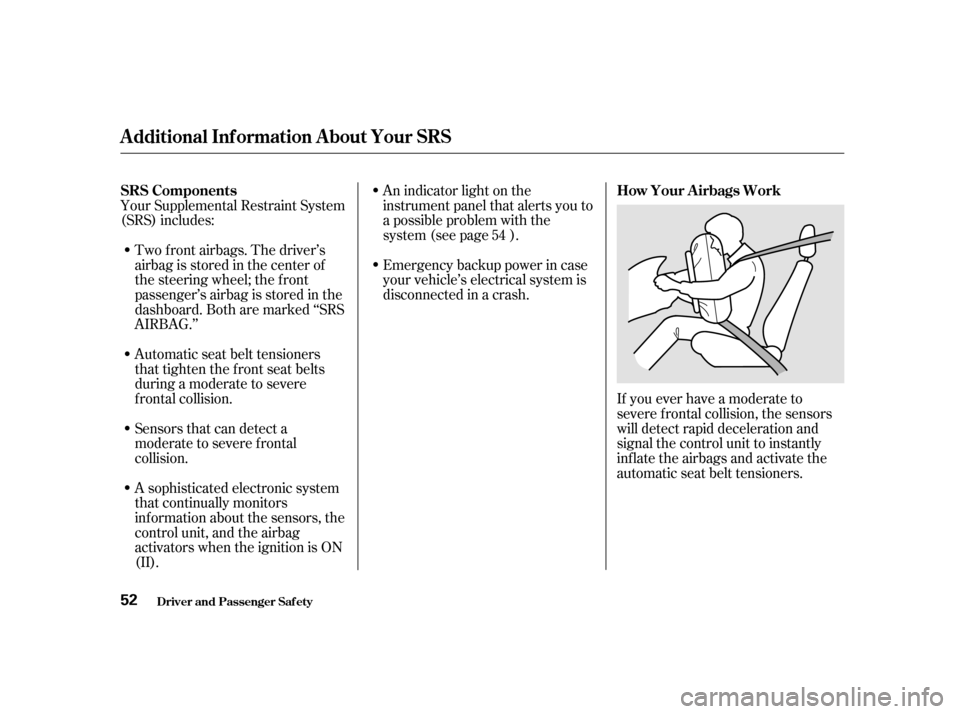
If you ever have a moderate to
severe f rontal collision, the sensors
will detect rapid deceleration and
signal the control unit to instantly
inflate the airbags and activate the
automatic seat belt tensioners.
Automatic seat belt tensioners
that tighten the front seat belts
during a moderate to severe
f rontal collision.
Sensors that can detect a
moderate to severe frontal
collision.
A sophisticated electronic system
that continually monitors
inf ormation about the sensors, the
control unit, and the airbag
activators when the ignition is ON
(II). An indicator light on the
instrument panel that alerts you to
a possible problem with the
system (see page ).
Emergency backup power in case
your vehicle’s electrical system is
disconnected in a crash.
54
SRS Components
How Your A irbags Work
Additional Inf ormation About Your SRS
Driver and Passenger Saf ety
52
Page 53 of 363

Thepurposeof theSRS
light is to alert you to a
potential problem with your
Supplemental Restraint System.
This light will also alert you to a
potential problem with your
automatic seat belt tensioners.
When you turn the ignition ON (II),
this indicator will light brief ly then
go out. This tells you that the system
is working properly.
If the light comes on at any other
time, or does not come on at all, you
should have the system checked by
your dealer. For example:
If the SRS indicator light does not
come on after you turn the ignition
ON (II).
If the light stays on after the
engine starts.
If your airbags inf late, the tensioners
immediately tighten the f ront seat
belts to help hold the occupants in
place. The belts will remain tight
until you unbuckle them in the
normal way.
Your Honda has automatic seat belt
tensioners f or added protection
during a moderate to severe frontal
collision. How the SRS Indicator L ight
Works
How the Automatic Seat Belt
T ensioners Work
Additional Inf ormation About Your SRS
Driver and Passenger Saf ety
54
Page 54 of 363

Your Supplemental Restraint System
is virtually maintenance-f ree, and
there are no parts you can saf ely
service. However, you must have
your vehicle serviced if :The
airbags, seat belt tensioners, and
control unit must be replaced. Do
not try to remove or replace the
airbags yourself .
This must be done by a Honda
dealer or a knowledgeable body
shop.
Take your vehicle to
an authorized Honda dealer as
soon as possible. If you ignore this
indication, the airbags might not
inf late when you need them (see
page ).
If the light comes on or f lashes on
andoff whileyoudrive.
If you see any of these indications,
your airbags and seat belt tensioners
may not deploy when you need them.
See your Honda dealer as soon as
possible.
54
SRS Service
Your airbags ever inf late.
T he SRS indicat or light alert s yout o a problem.
Additional Inf ormation About Your SRS
Driver and Passenger Saf ety 55
Ignoring the SRS indicator light
can result in serious injury or
death if the airbags do not
inflate when needed.
Have your vehicle checked by a
dealer as soon as possible if
the SRS light alerts you to a
potential problem.