Page 199 of 363
Wipe the dipstick with a clean
cloth or paper towel.
Check the engine oil level every time
you f ill the vehicle with f uel. Wait a
f ew minutes af ter turning the engine
of f bef ore you check the oil.
Remove the dipstick (orange
handle).
To close the hood, lif t it up slightly to
remove the support rod f rom the
hole. Put the support rod back into
its holding clip. Lower the hood to
about a f oot (30 cm) above the
fender,thenletitdrop.
Afterclosingthehood,makesureit
is securely latched.
2.
1.
Service Station Procedures
Bef ore Driving
Oil Check
200
DDIIPPSSTTIICCKK
Page 205 of 363

Store or secure all items that could
be thrown around and hurt
someone during a crash.
Besureitemsplacedonthefloor
behind the f ront seats cannot roll
under the seats and interf ere with
the driver’s ability to operate the
pedals, or with the proper
operation of the seats.
Keep the glove box closed while
driving. If the lid is open, a
passenger could injure their knees
during a crash or sudden stop.
This f igure includes the total weight
of all occupants, cargo, accessories,
and the tongue weight if you are
towing a trailer.
The f inal number is the total weight
of cargo you can carry.
If you are towing a trailer, add the
tongue weight to the number
above.
Add up the weight of all occupants.
To f igure out how much cargo you
can carry: When you load luggage, the total
weight of the vehicle, all passengers,
cargo, and trailer tongue load must
not exceed the Gross Vehicle
Weight Rating (GVWR). The load
for the front and rear axles also must
not exceed the Gross Axle Weight
Rating (GAWR). The GVWR and
GAWRareprintedonthetire
information label attached to the
driver’s doorjamb (see page ).
The maximum load f or your vehicle
is 1,277 lbs (580 kg).
Subtract the total f rom 1,277 lbs
(580 kg). 334Carrying Items in the Passenger
Compartment
Load Limit
Carrying Cargo
Bef ore Driving
206 Overloading or improper
loading can affect handling and
stability and cause a crash in
which you can be hurt or killed.
Follow all load limits and other
loading guidelines in thismanual.
Page 206 of 363
Distribute cargo evenly on the
f loor of the cargo area, placing the
heaviest items on the bottom and
as far forward as possible. Tie
down items that could be thrown
about the vehicle during a crash or
sudden stop.
If you carry large items that
prevent you f rom closing the
tailgate, exhaust gas can enter the
passenger area. To avoid the
possibility of, f ollow the instructions
on page . The side cargo net can be installed
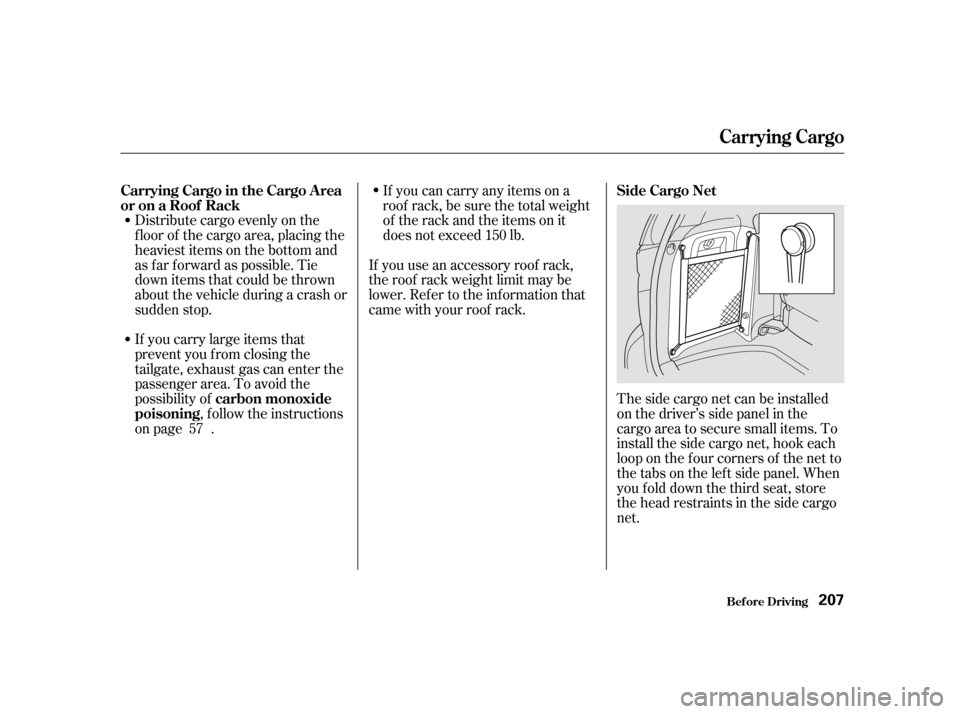
on the driver’s side panel in the
cargo area to secure small items. To
install the side cargo net, hook each
loop on the f our corners of the net to
the tabs on the lef t side panel. When
youfolddownthethirdseat,store
the head restraints in the side cargo
net.
If you can carry any items on a
roof rack,besurethetotalweight
of the rack and the items on it
does not exceed 150 lb.
If you use an accessory roof rack,
the roof rack weight limit may be
lower. Ref er to the inf ormation that
came with your roof rack.
57
Carrying Cargo in the Cargo A rea
or on a Roof Rack
carbon monoxide
poisoning Side Cargo Net
Carrying Cargo
Bef ore Driving
207
Page 207 of 363
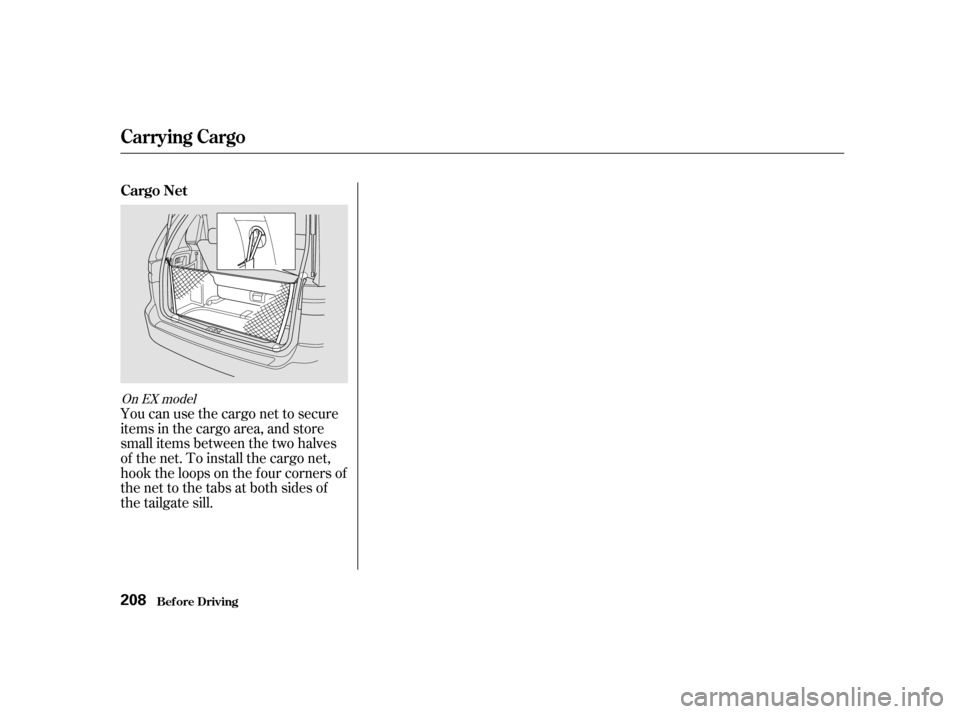
You can use the cargo net to secure
items in the cargo area, and store
small items between the two halves
of the net. To install the cargo net,
hook the loops on the f our corners of
the net to the tabs at both sides of
the tailgate sill.
On EX model
Carrying Cargo
Cargo NetBef ore Driving
208
Page 209 of 363

Youshoulddothefollowingchecks
and adjustments every day bef ore
you drive your vehicle.Make sure all windows, mirrors,
and outside lights are clean and
unobstructed. Remove f rost, snow,
or ice. Check the adjustment of the seat
(see page ).
Check the adjustment of the
inside and outside mirrors (see
page ).
Check the adjustment of the
steering wheel (see page ).
Fasten your seat belt. Check that
your passengers have f astened
their seat belts (see page ).Turn the ignition switch ON (II).
Check the indicator lights in the
instrument panel.
Start the engine (see page ).
Check the gauges and indicator
lights in the instrument panel (see
page ).
Check that any items you may be
carrying with you inside are stored
properly or f astened down
securely.
Visually check the tires. If a tire
looks low, use a gauge to check its
pressure.
Check that the hood and tailgate
arefullyclosed. Makesurethedoorsandtailgate
are securely closed and locked.
3. 2.
1.
4. 5.
6. 7. 8. 9. 11.
12. 10.
15
105
121 76 211
61
Preparing to Drive
Driving
210
Page 228 of 363

Towing can require a variety of
equipment, depending on the size of
your trailer, how it will be used, and
how much load you are towing.
Discuss your needs with your trailer
sales or rental agency, and f ollow the
guidelines in the rest of this section.
Also make sure that all equipment is
properly installed and that it meets
f ederal, state, province, and local
regulations.
Any hitch used on your vehicle must
be properly bolted to the underbody,
using the six threaded holes
provided. A hitch designed especially
foryourOdysseycanbeobtained
f rom your Honda dealer.Always use a saf ety chain. Make
sure that it is secured to both the
trailer and hitch, and that it cross
under the tongue so it can catch the
trailer if it becomes unhitched.
Leave enough slack to allow the
trailer to turn corners easily, but do
not let the chain drag on the ground.
If the total trailer weight is more
than 2,000 lbs (900 kg), you must
also use a weight distributing hitch.
This device transf ers weight f rom
the vehicle’s rear wheels to the f ront
wheels, and to the trailer’s wheels.
Caref ully f ollow the hitch maker’s
instructions f or proper installation
and adjustment.
If the total trailer weight exceeds
2,000 lbs (900 kg), you should install
a sway control device to minimize
swaying that can occur in crosswinds
and in normal and emergency
driving maneuvers. Your trailer
makercantellyouwhatkindof sway
control you need and how to install it.
If the total trailer weight is more
than 2,000 lbs (900 kg), you must
also have a transmission fluid cooler
installed. This device will help
prevent transmission overheating,
which could cause serious damage.
A transmission f luid cooler designed
foryourOdysseycanbeobtained
f rom your Honda dealer.
CONT INUED
T owing Equipment and
A ccessories
HitchesWeight Distributing Hitch
Saf ety Chain Sway Cont rol
T ransmission Fluid Cooler
Towing a Trailer
Driving 229
Page 230 of 363

Your vehicle tires and spare are
properly inf lated (see page ),
and the trailer tires and spare are
inf lated as recommended by the
trailer maker.
When towing a trailer, you should
carry a f ull-size wheel and tire as a
spare in case you have a flat. If you
use the compact spare tire that came
with the vehicle, it may adversely
af f ect vehicle handling. See page
f or inf ormation on proper tire
size, and page f or inf ormation on
how to store a f ull-size tire. When
storing a f ull-size spare tire in the
trailer, f ollow the trailer maker’s
instructions.
Many states and Canadian provinces
require special outside mirrors when
towing a trailer. Even if they don’t,
you should install special mirrors if
you cannot clearly see behind you, or
if the trailer creates a blind spot.
Askyourtrailersalesorrental
agency if any other items are
recommended or required f or your
towing situation. When preparing to tow, and bef ore
driving away, be sure to check the
f ollowing:
The vehicle has been properly
serviced, and the tires, brakes,
suspension, and cooling system
are in good operating condition.
All weights and loads are within
limits (see pages and ).
Thehitch,safetychains,andany
other attachments are secure.
Allitemsonandinthetrailerare
properly secured and cannot shif t
while you drive.
The lights and brakes on your
vehicle and the trailer are working
properly. You may want to fill the fuel tank
with premium f uel. Premium f uel
provides improved perf ormance.
323
309
227 228 335
CONT INUED
Spare Vehicle T ire
Additional Trailer EquipmentPre-T ow Checklist
Towing a Trailer
Driving231
Page 248 of 363
Oil is a major contributor to your
engine’s perf ormance and longevity.
Always use a premium-grade deter-
gent oil. It is highly recommended
that you use genuine Honda Motor
Oil in your vehicle f or as long as you
own it.
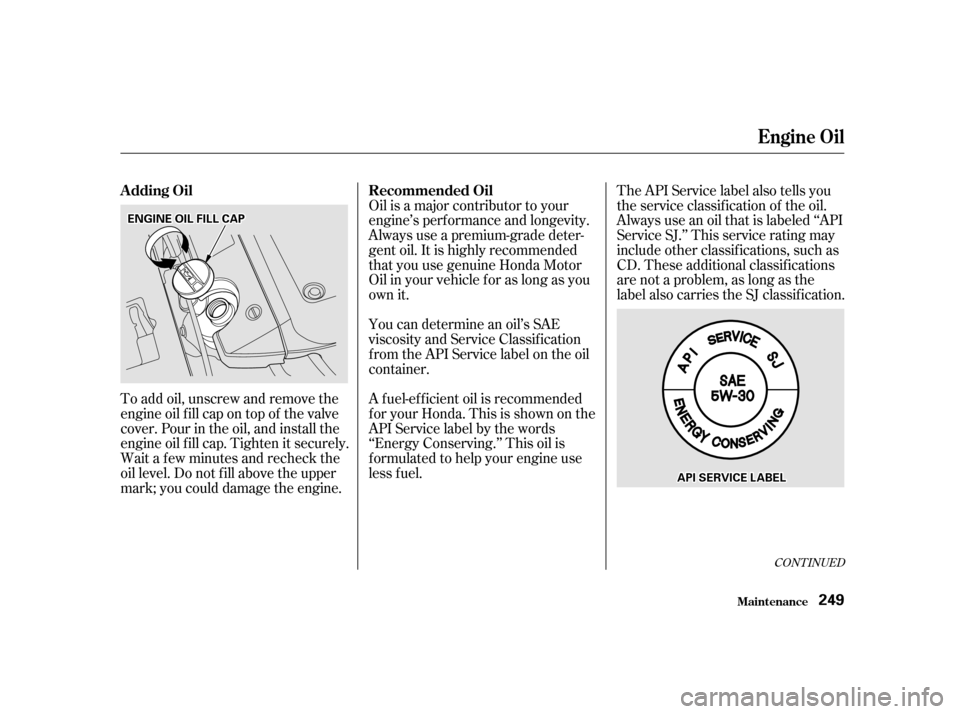
To add oil, unscrew and remove the
engine oil f ill cap on top of the valve
cover. Pour in the oil, and install the
engine oil f ill cap. Tighten it securely.
Wait a f ew minutes and recheck the
oil level. Do not f ill above the upper
mark; you could damage the engine. The API Service label also tells you
the service classif ication of the oil.
Always use an oil that is labeled ‘‘API
Service SJ.’’ This service rating may
include other classif ications, such as
CD. These additional classifications
are not a problem, as long as the
label also carries the SJ classif ication.
Youcandetermineanoil’sSAE
viscosity and Service Classif ication
fromtheAPIServicelabelontheoil
container.
A f uel-ef f icient oil is recommended
f or your Honda. This is shown on the
API Service label by the words
‘‘Energy Conserving.’’ This oil is
f ormulated to help your engine use
less f uel.
CONT INUED
Recommended Oil
A dding Oil
Engine Oil
Maint enance 249
EENNGGIINNEEOOIILLFFIILLLLCCAAPP
AAPPIISSEERRVVIICCEELLAABBEELL