2001 DODGE RAM torque
[x] Cancel search: torquePage 2715 of 2889
SEAT TRACK - SPLIT BENCH
REMOVAL
(1) Remove seat from vehicle. (Refer to 23 -
BODY/SEATS/SEAT - SPLIT BENCH - REMOVAL)
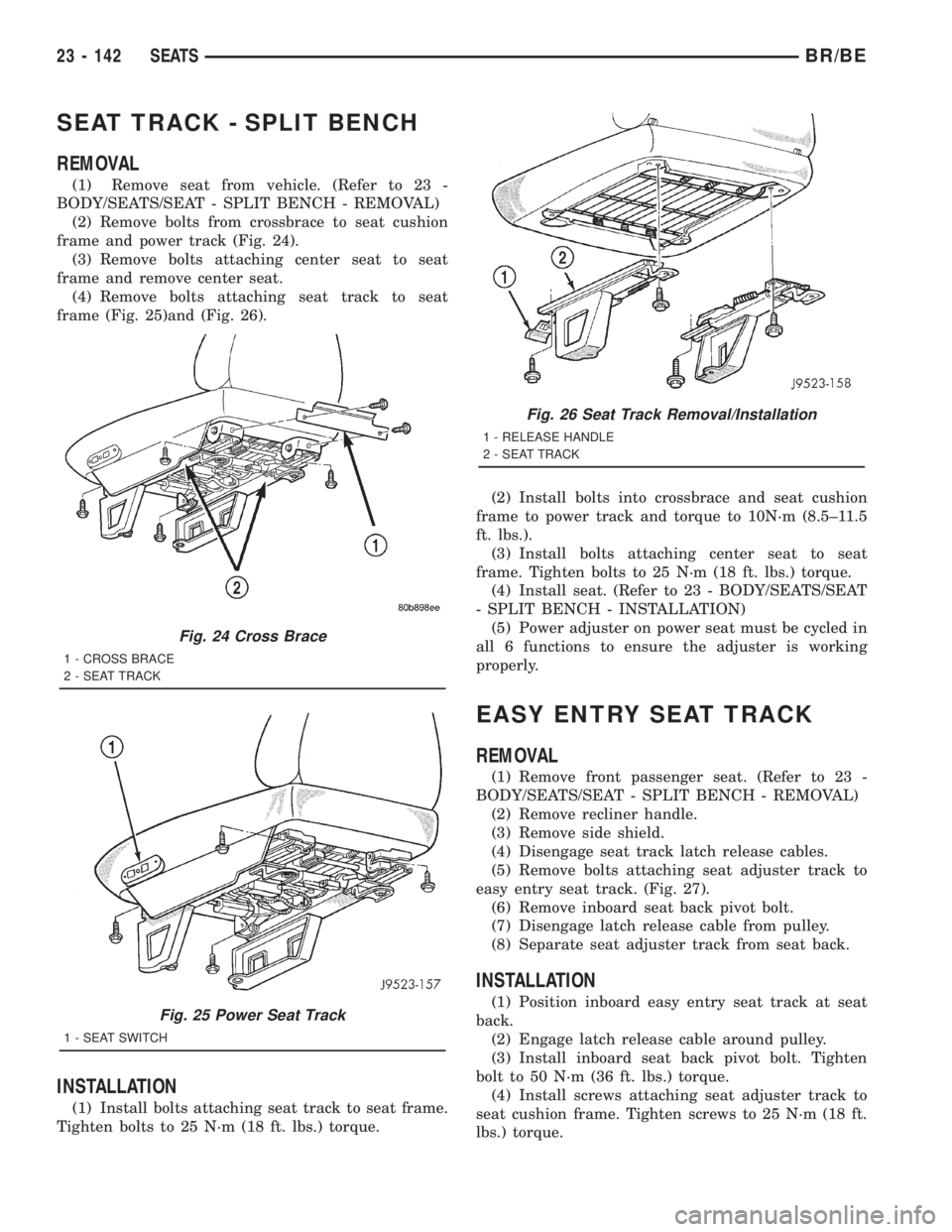
(2) Remove bolts from crossbrace to seat cushion
frame and power track (Fig. 24).
(3) Remove bolts attaching center seat to seat
frame and remove center seat.
(4) Remove bolts attaching seat track to seat
frame (Fig. 25)and (Fig. 26).
INSTALLATION
(1) Install bolts attaching seat track to seat frame.
Tighten bolts to 25 N´m (18 ft. lbs.) torque.(2) Install bolts into crossbrace and seat cushion
frame to power track and torque to 10N´m (8.5±11.5
ft. lbs.).
(3) Install bolts attaching center seat to seat
frame. Tighten bolts to 25 N´m (18 ft. lbs.) torque.
(4) Install seat. (Refer to 23 - BODY/SEATS/SEAT
- SPLIT BENCH - INSTALLATION)
(5) Power adjuster on power seat must be cycled in
all 6 functions to ensure the adjuster is working
properly.
EASY ENTRY SEAT TRACK
REMOVAL
(1) Remove front passenger seat. (Refer to 23 -
BODY/SEATS/SEAT - SPLIT BENCH - REMOVAL)
(2) Remove recliner handle.
(3) Remove side shield.
(4) Disengage seat track latch release cables.
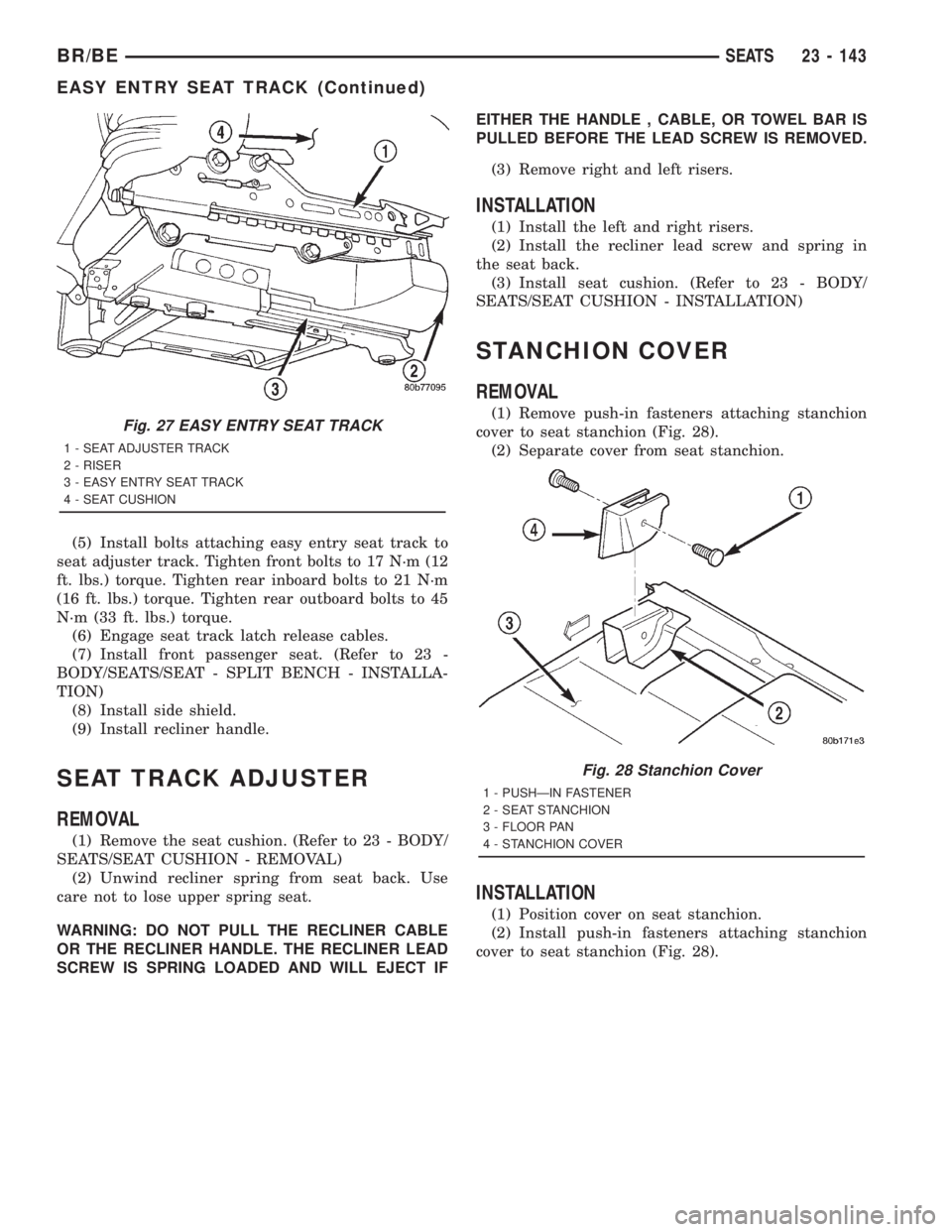
(5) Remove bolts attaching seat adjuster track to
easy entry seat track. (Fig. 27).
(6) Remove inboard seat back pivot bolt.
(7) Disengage latch release cable from pulley.
(8) Separate seat adjuster track from seat back.
INSTALLATION
(1) Position inboard easy entry seat track at seat
back.
(2) Engage latch release cable around pulley.
(3) Install inboard seat back pivot bolt. Tighten
bolt to 50 N´m (36 ft. lbs.) torque.
(4) Install screws attaching seat adjuster track to
seat cushion frame. Tighten screws to 25 N´m (18 ft.
lbs.) torque.
Fig. 24 Cross Brace
1 - CROSS BRACE
2 - SEAT TRACK
Fig. 25 Power Seat Track
1 - SEAT SWITCH
Fig. 26 Seat Track Removal/Installation
1 - RELEASE HANDLE
2 - SEAT TRACK
23 - 142 SEATSBR/BE
Page 2716 of 2889
(5) Install bolts attaching easy entry seat track to
seat adjuster track. Tighten front bolts to 17 N´m (12
ft. lbs.) torque. Tighten rear inboard bolts to 21 N´m
(16 ft. lbs.) torque. Tighten rear outboard bolts to 45
N´m (33 ft. lbs.) torque.
(6) Engage seat track latch release cables.
(7) Install front passenger seat. (Refer to 23 -
BODY/SEATS/SEAT - SPLIT BENCH - INSTALLA-
TION)
(8) Install side shield.
(9) Install recliner handle.
SEAT TRACK ADJUSTER
REMOVAL
(1) Remove the seat cushion. (Refer to 23 - BODY/
SEATS/SEAT CUSHION - REMOVAL)
(2) Unwind recliner spring from seat back. Use
care not to lose upper spring seat.
WARNING: DO NOT PULL THE RECLINER CABLE
OR THE RECLINER HANDLE. THE RECLINER LEAD
SCREW IS SPRING LOADED AND WILL EJECT IFEITHER THE HANDLE , CABLE, OR TOWEL BAR IS
PULLED BEFORE THE LEAD SCREW IS REMOVED.
(3) Remove right and left risers.
INSTALLATION
(1) Install the left and right risers.
(2) Install the recliner lead screw and spring in
the seat back.
(3) Install seat cushion. (Refer to 23 - BODY/
SEATS/SEAT CUSHION - INSTALLATION)
STANCHION COVER
REMOVAL
(1) Remove push-in fasteners attaching stanchion
cover to seat stanchion (Fig. 28).
(2) Separate cover from seat stanchion.
INSTALLATION
(1) Position cover on seat stanchion.
(2) Install push-in fasteners attaching stanchion
cover to seat stanchion (Fig. 28).
Fig. 27 EASY ENTRY SEAT TRACK
1 - SEAT ADJUSTER TRACK
2 - RISER
3 - EASY ENTRY SEAT TRACK
4 - SEAT CUSHION
Fig. 28 Stanchion Cover
1 - PUSHÐIN FASTENER
2 - SEAT STANCHION
3 - FLOOR PAN
4 - STANCHION COVER
BR/BESEATS 23 - 143
EASY ENTRY SEAT TRACK (Continued)
Page 2717 of 2889
REAR SEAT
REMOVAL
(1) Move front seat track to full forward position.
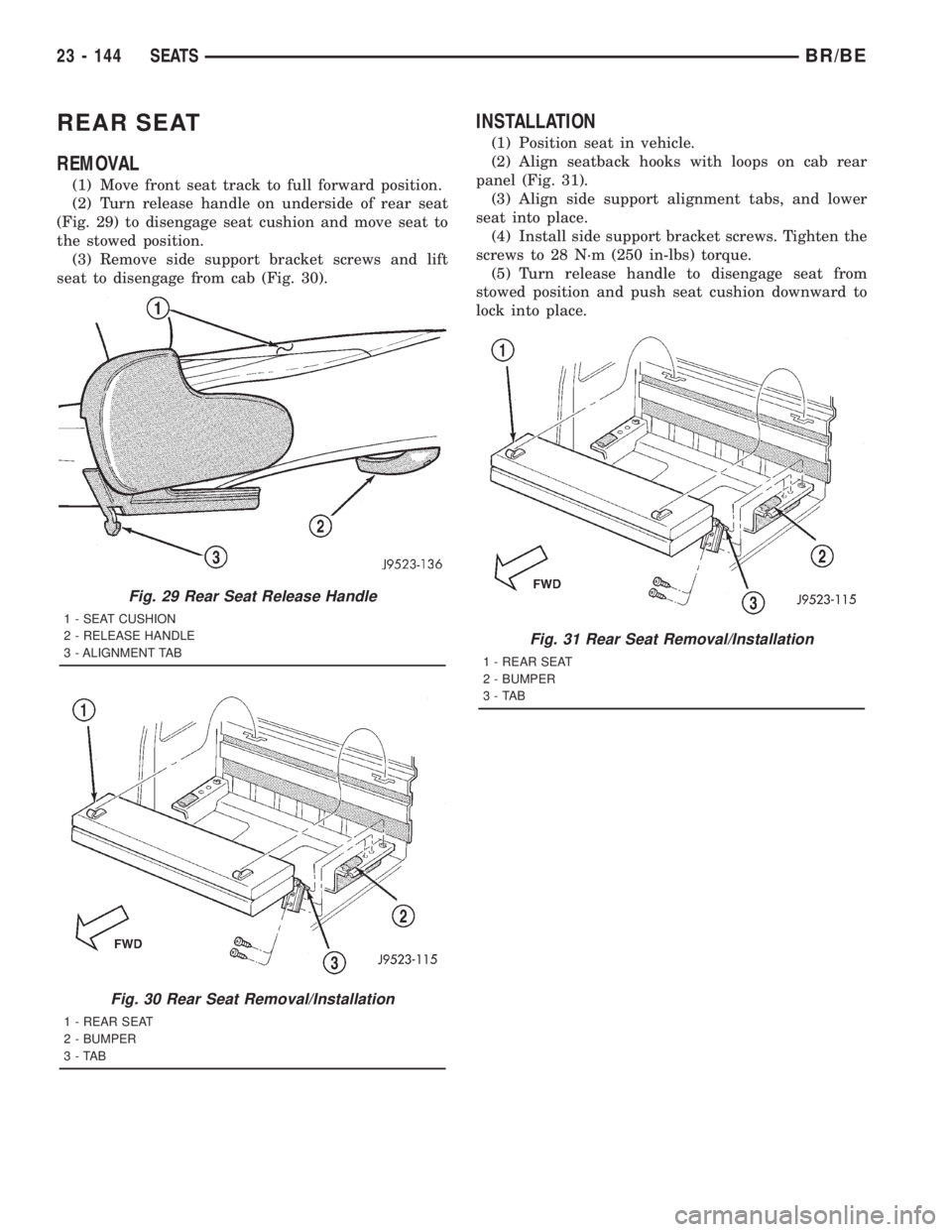
(2) Turn release handle on underside of rear seat
(Fig. 29) to disengage seat cushion and move seat to
the stowed position.
(3) Remove side support bracket screws and lift
seat to disengage from cab (Fig. 30).
INSTALLATION
(1) Position seat in vehicle.
(2) Align seatback hooks with loops on cab rear
panel (Fig. 31).
(3) Align side support alignment tabs, and lower
seat into place.
(4) Install side support bracket screws. Tighten the
screws to 28 N´m (250 in-lbs) torque.
(5) Turn release handle to disengage seat from
stowed position and push seat cushion downward to
lock into place.
Fig. 29 Rear Seat Release Handle
1 - SEAT CUSHION
2 - RELEASE HANDLE
3 - ALIGNMENT TAB
Fig. 30 Rear Seat Removal/Installation
1 - REAR SEAT
2 - BUMPER
3-TAB
Fig. 31 Rear Seat Removal/Installation
1 - REAR SEAT
2 - BUMPER
3-TAB
23 - 144 SEATSBR/BE
Page 2719 of 2889
(2) If necessary, apply black-out primer to outer
edge of replacement backlite frame.
(3) If black-out primer was pre-applied on backlite,
clean bonding surface with Isopropyl alcohol and
clean lint free cloth. Allow 3 minutes for drying time.
(4) Apply black-out primer to backlite opening
fence.
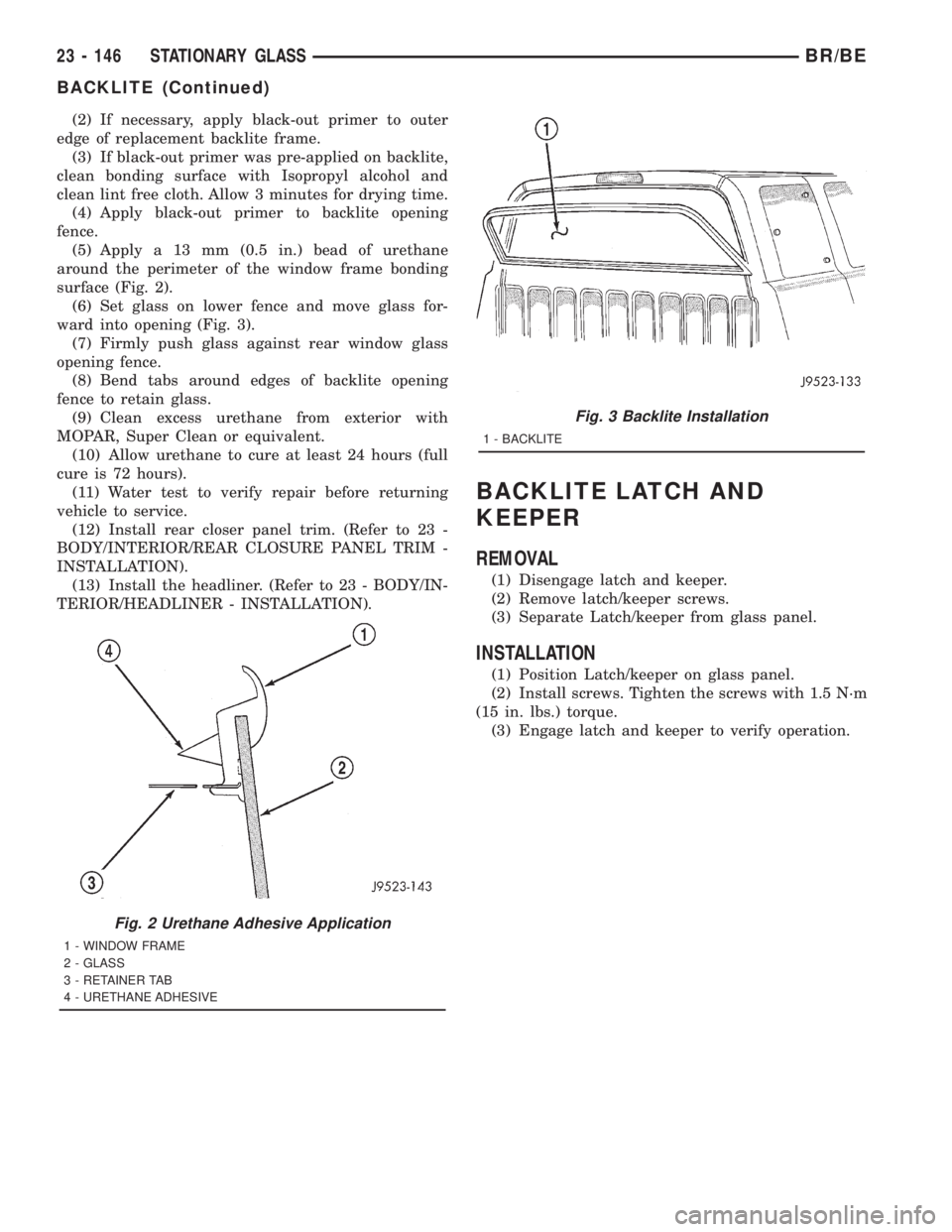
(5) Apply a 13 mm (0.5 in.) bead of urethane
around the perimeter of the window frame bonding
surface (Fig. 2).
(6) Set glass on lower fence and move glass for-
ward into opening (Fig. 3).
(7) Firmly push glass against rear window glass
opening fence.
(8) Bend tabs around edges of backlite opening
fence to retain glass.
(9) Clean excess urethane from exterior with
MOPAR, Super Clean or equivalent.
(10) Allow urethane to cure at least 24 hours (full
cure is 72 hours).
(11) Water test to verify repair before returning
vehicle to service.
(12) Install rear closer panel trim. (Refer to 23 -
BODY/INTERIOR/REAR CLOSURE PANEL TRIM -
INSTALLATION).
(13) Install the headliner. (Refer to 23 - BODY/IN-
TERIOR/HEADLINER - INSTALLATION).
BACKLITE LATCH AND
KEEPER
REMOVAL
(1) Disengage latch and keeper.
(2) Remove latch/keeper screws.
(3) Separate Latch/keeper from glass panel.
INSTALLATION
(1) Position Latch/keeper on glass panel.
(2) Install screws. Tighten the screws with 1.5 N´m
(15 in. lbs.) torque.
(3) Engage latch and keeper to verify operation.
Fig. 2 Urethane Adhesive Application
1 - WINDOW FRAME
2 - GLASS
3 - RETAINER TAB
4 - URETHANE ADHESIVE
Fig. 3 Backlite Installation
1 - BACKLITE
23 - 146 STATIONARY GLASSBR/BE
BACKLITE (Continued)
Page 2724 of 2889
QUARTER WINDOW
REMOVAL
(1) Remove quarter trim panel.
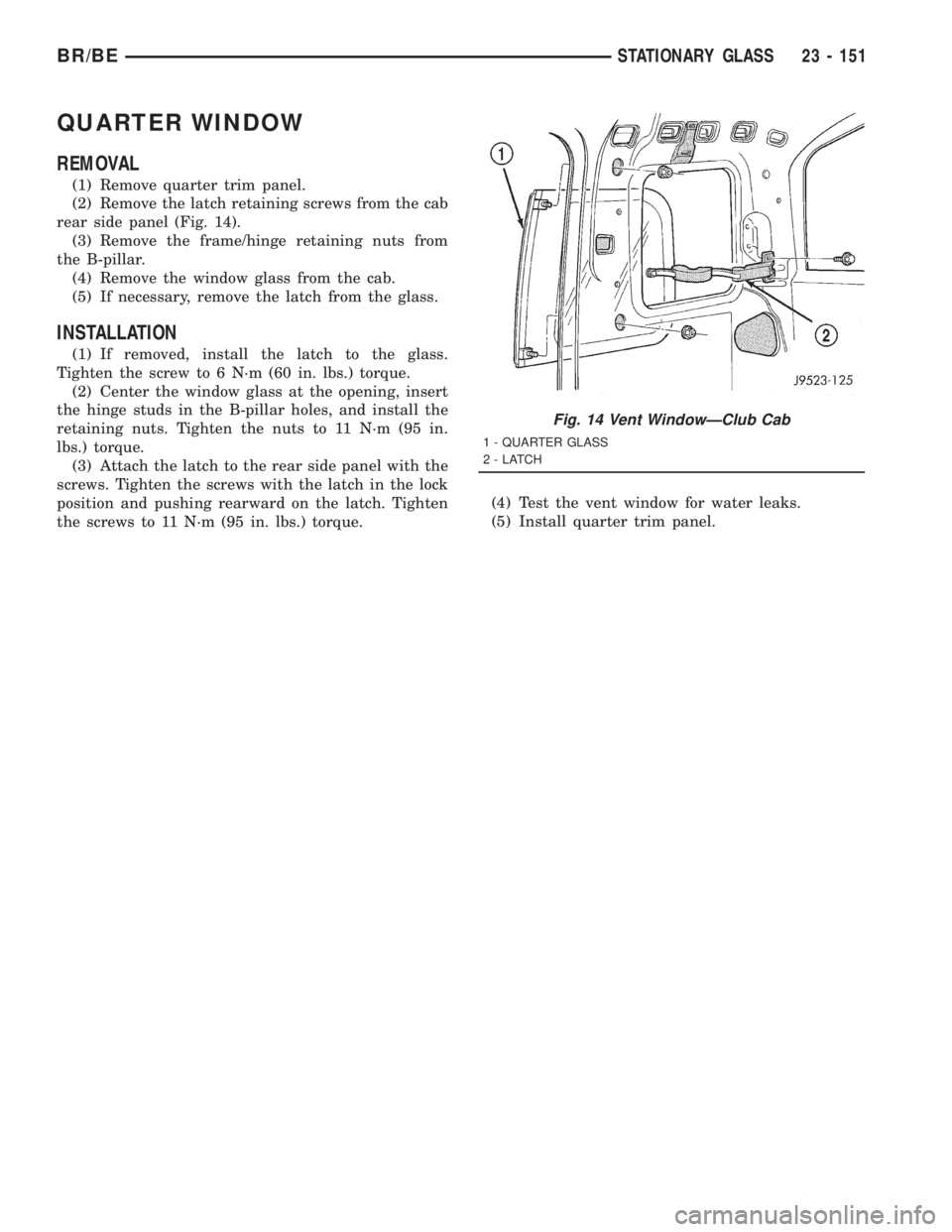
(2) Remove the latch retaining screws from the cab
rear side panel (Fig. 14).
(3) Remove the frame/hinge retaining nuts from
the B-pillar.
(4) Remove the window glass from the cab.
(5) If necessary, remove the latch from the glass.
INSTALLATION
(1) If removed, install the latch to the glass.
Tighten the screw to 6 N´m (60 in. lbs.) torque.
(2) Center the window glass at the opening, insert
the hinge studs in the B-pillar holes, and install the
retaining nuts. Tighten the nuts to 11 N´m (95 in.
lbs.) torque.
(3) Attach the latch to the rear side panel with the
screws. Tighten the screws with the latch in the lock
position and pushing rearward on the latch. Tighten
the screws to 11 N´m (95 in. lbs.) torque.(4) Test the vent window for water leaks.
(5) Install quarter trim panel.
Fig. 14 Vent WindowÐClub Cab
1 - QUARTER GLASS
2-LATCH
BR/BESTATIONARY GLASS 23 - 151
Page 2737 of 2889
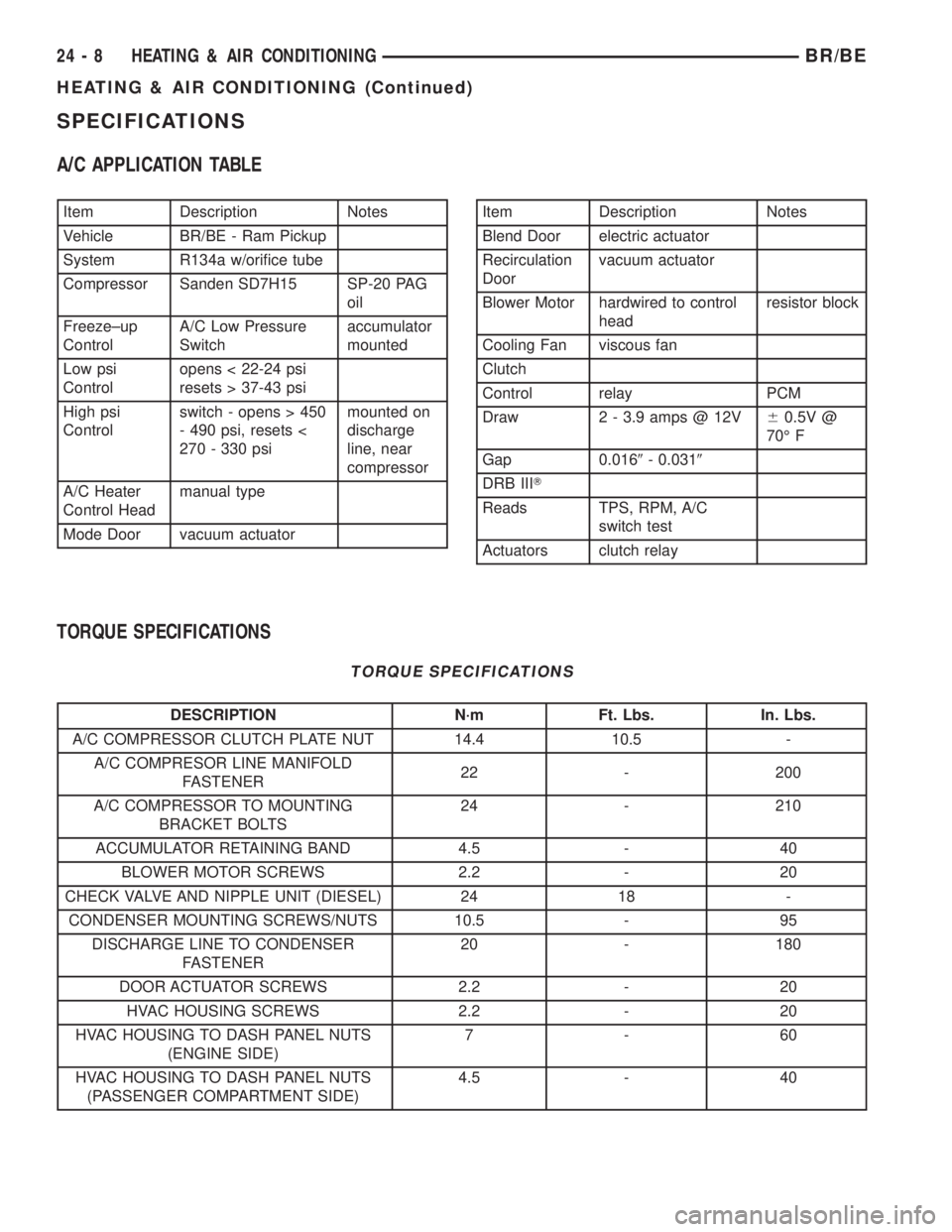
SPECIFICATIONS
A/C APPLICATION TABLE
Item Description Notes
Vehicle BR/BE - Ram Pickup
System R134a w/orifice tube
Compressor Sanden SD7H15 SP-20 PAG
oil
Freeze±up
ControlA/C Low Pressure
Switchaccumulator
mounted
Low psi
Controlopens < 22-24 psi
resets > 37-43 psi
High psi
Controlswitch - opens > 450
- 490 psi, resets <
270 - 330 psimounted on
discharge
line, near
compressor
A/C Heater
Control Headmanual type
Mode Door vacuum actuatorItem Description Notes
Blend Door electric actuator
Recirculation
Doorvacuum actuator
Blower Motor hardwired to control
headresistor block
Cooling Fan viscous fan
Clutch
Control relay PCM
Draw 2 - 3.9 amps @ 12V60.5V @
70É F
Gap 0.0169- 0.0319
DRB IIIT
Reads TPS, RPM, A/C
switch test
Actuators clutch relay
TORQUE SPECIFICATIONS
TORQUE SPECIFICATIONS
DESCRIPTION N´m Ft. Lbs. In. Lbs.
A/C COMPRESSOR CLUTCH PLATE NUT 14.4 10.5 -
A/C COMPRESOR LINE MANIFOLD
FASTENER22 - 200
A/C COMPRESSOR TO MOUNTING
BRACKET BOLTS24 - 210
ACCUMULATOR RETAINING BAND 4.5 - 40
BLOWER MOTOR SCREWS 2.2 - 20
CHECK VALVE AND NIPPLE UNIT (DIESEL) 24 18 -
CONDENSER MOUNTING SCREWS/NUTS 10.5 - 95
DISCHARGE LINE TO CONDENSER
FASTENER20 - 180
DOOR ACTUATOR SCREWS 2.2 - 20
HVAC HOUSING SCREWS 2.2 - 20
HVAC HOUSING TO DASH PANEL NUTS
(ENGINE SIDE)7-60
HVAC HOUSING TO DASH PANEL NUTS
(PASSENGER COMPARTMENT SIDE)4.5 - 40
24 - 8 HEATING & AIR CONDITIONINGBR/BE
HEATING & AIR CONDITIONING (Continued)
Page 2743 of 2889
the opposing friction surfaces and provide a higher
compressor clutch torque capability.
REMOVAL
The refrigerant system can remain fully-charged
during compressor clutch, pulley, or coil replacement.
The compressor clutch can be serviced in the vehicle.
(1) Disconnect and isolate the battery negative
cable.
(2) On models with the diesel engine option,
remove the compressor from the engine. Do not
remove the refrigerant lines or fittings. (Refer to 24 -
HEATING & AIR CONDITIONING/PLUMBING/A/C
COMPRESSOR - REMOVAL)
(3) Unplug the compressor clutch coil wire harness
connector.
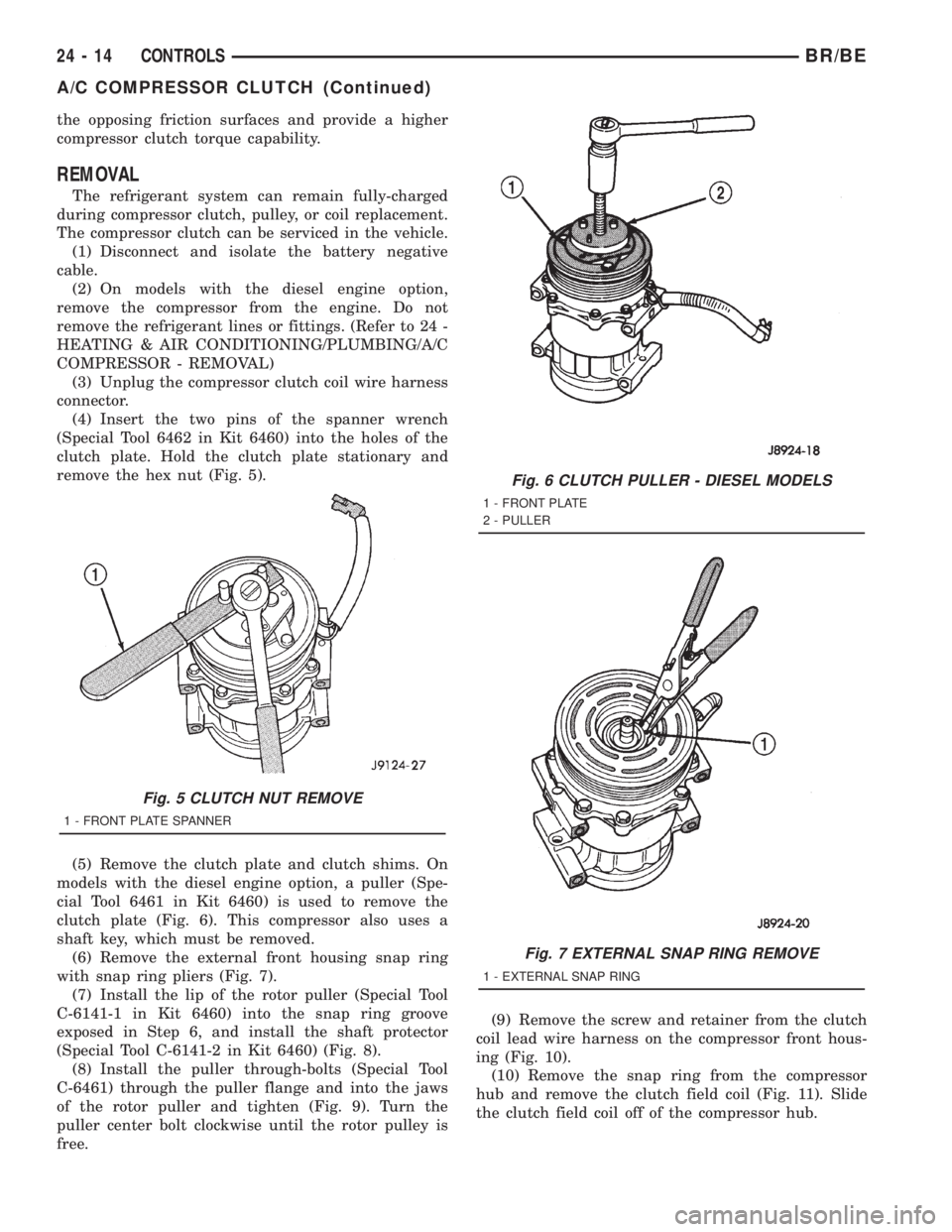
(4) Insert the two pins of the spanner wrench
(Special Tool 6462 in Kit 6460) into the holes of the
clutch plate. Hold the clutch plate stationary and
remove the hex nut (Fig. 5).
(5) Remove the clutch plate and clutch shims. On
models with the diesel engine option, a puller (Spe-
cial Tool 6461 in Kit 6460) is used to remove the
clutch plate (Fig. 6). This compressor also uses a
shaft key, which must be removed.
(6) Remove the external front housing snap ring
with snap ring pliers (Fig. 7).
(7) Install the lip of the rotor puller (Special Tool
C-6141-1 in Kit 6460) into the snap ring groove
exposed in Step 6, and install the shaft protector
(Special Tool C-6141-2 in Kit 6460) (Fig. 8).
(8) Install the puller through-bolts (Special Tool
C-6461) through the puller flange and into the jaws
of the rotor puller and tighten (Fig. 9). Turn the
puller center bolt clockwise until the rotor pulley is
free.(9) Remove the screw and retainer from the clutch
coil lead wire harness on the compressor front hous-
ing (Fig. 10).
(10) Remove the snap ring from the compressor
hub and remove the clutch field coil (Fig. 11). Slide
the clutch field coil off of the compressor hub.
Fig. 5 CLUTCH NUT REMOVE
1 - FRONT PLATE SPANNER
Fig. 6 CLUTCH PULLER - DIESEL MODELS
1 - FRONT PLATE
2 - PULLER
Fig. 7 EXTERNAL SNAP RING REMOVE
1 - EXTERNAL SNAP RING
24 - 14 CONTROLSBR/BE
A/C COMPRESSOR CLUTCH (Continued)
Page 2771 of 2889
CAUTION:
Liquid refrigerant is corrosive to metal surfaces.
Follow the operating instructions supplied with the
service equipment being used.
Never add R-12 to a refrigerant system designed to
use R-134a. Damage to the system will result.
R-12 refrigerant oil must not be mixed with R-134a
refrigerant oil. They are not compatible.
Do not use R-12 equipment or parts on the R-134a
system. Damage to the system will result.
Do not overcharge the refrigerant system. This will
cause excessive compressor head pressure and
can cause noise and system failure.
Recover the refrigerant before opening any fitting
or connection. Open the fittings with caution, even
after the system has been discharged. Never open
or loosen a connection before recovering the refrig-
erant.
Do not remove the secondary retention clip from
any spring-lock coupler connection while the refrig-
erant system is under pressure. Recover the refrig-
erant before removing the secondary retention clip.
Open the fittings with caution, even after the sys-
tem has been discharged. Never open or loosen a
connection before recovering the refrigerant.
The refrigerant system must always be evacuated
before charging.
Do not open the refrigerant system or uncap a
replacement component until you are ready to ser-
vice the system. This will prevent contamination in
the system.
Before disconnecting a component, clean the out-
side of the fittings thoroughly to prevent contami-
nation from entering the refrigerant system.
Immediately after disconnecting a component from
the refrigerant system, seal the open fittings with a
cap or plug.
Before connecting an open refrigerant fitting,
always install a new seal or gasket. Coat the fitting
and seal with clean refrigerant oil before connect-
ing.
Do not remove the sealing caps from a replacement
component until it is to be installed.
When installing a refrigerant line, avoid sharp
bends that may restrict refrigerant flow. Position the
refrigerant lines away from exhaust system compo-
nents or any sharp edges, which may damage the
line.
Tighten refrigerant fittings only to the specified
torque. The aluminum fittings used in the refriger-
ant system will not tolerate overtightening.
When disconnecting a refrigerant fitting, use a
wrench on both halves of the fitting. This will pre-
vent twisting of the refrigerant lines or tubes.
Refrigerant oil will absorb moisture from the atmo-
sphere if left uncapped. Do not open a container ofrefrigerant oil until you are ready to use it. Replace
the cap on the oil container immediately after using.
Store refrigerant oil only in a clean, airtight, and
moisture-free container.
Keep service tools and the work area clean. Con-
tamination of the refrigerant system through care-
less work habits must be avoided.
CAUTION - REFRIGERANT HOSES/LINES/
TUBES PRECAUTIONS
Kinks or sharp bends in the refrigerant plumbing
will reduce the capacity of the entire system. High
pressures are produced in the system when it is oper-
ating. Extreme care must be exercised to make sure
that all refrigerant system connections are pressure
tight.
A good rule for the flexible hose refrigerant lines is
to keep the radius of all bends at least ten times the
diameter of the hose. Sharp bends will reduce the
flow of refrigerant. The flexible hose lines should be
routed so they are at least 80 millimeters (3 inches)
from the exhaust manifold. It is a good practice to
inspect all flexible refrigerant system hose lines at
least once a year to make sure they are in good con-
dition and properly routed.
There are two types of refrigerant fittings:
²All fittings with O-rings need to be coated with
refrigerant oil before installation. Use only O-rings
that are the correct size and approved for use with
R-134a refrigerant. Failure to do so may result in a
leak.
²Unified plumbing connections with gaskets can-
not be serviced with O-rings. The gaskets are not
reusable and new gaskets do not require lubrication
before installing.
Using the proper tools when making a refrigerant
plumbing connection is very important. Improper
tools or improper use of the tools can damage the
refrigerant fittings. Always use two wrenches when
loosening or tightening tube fittings. Use one wrench
to hold one side of the connection stationary, while
loosening or tightening the other side of the connec-
tion with a second wrench.
The refrigerant must be recovered completely from
the system before opening any fitting or connection.
Open the fittings with caution, even after the refrig-
erant has been recovered. If any pressure is noticed
as a fitting is loosened, tighten the fitting and
recover the refrigerant from the system again.
Do not discharge refrigerant into the atmosphere.
Use an R-134a refrigerant recovery/recycling device
that meets SAE Standard J2210.
24 - 42 PLUMBINGBR/BE
PLUMBING (Continued)