2001 DODGE RAM key
[x] Cancel search: keyPage 1058 of 2889
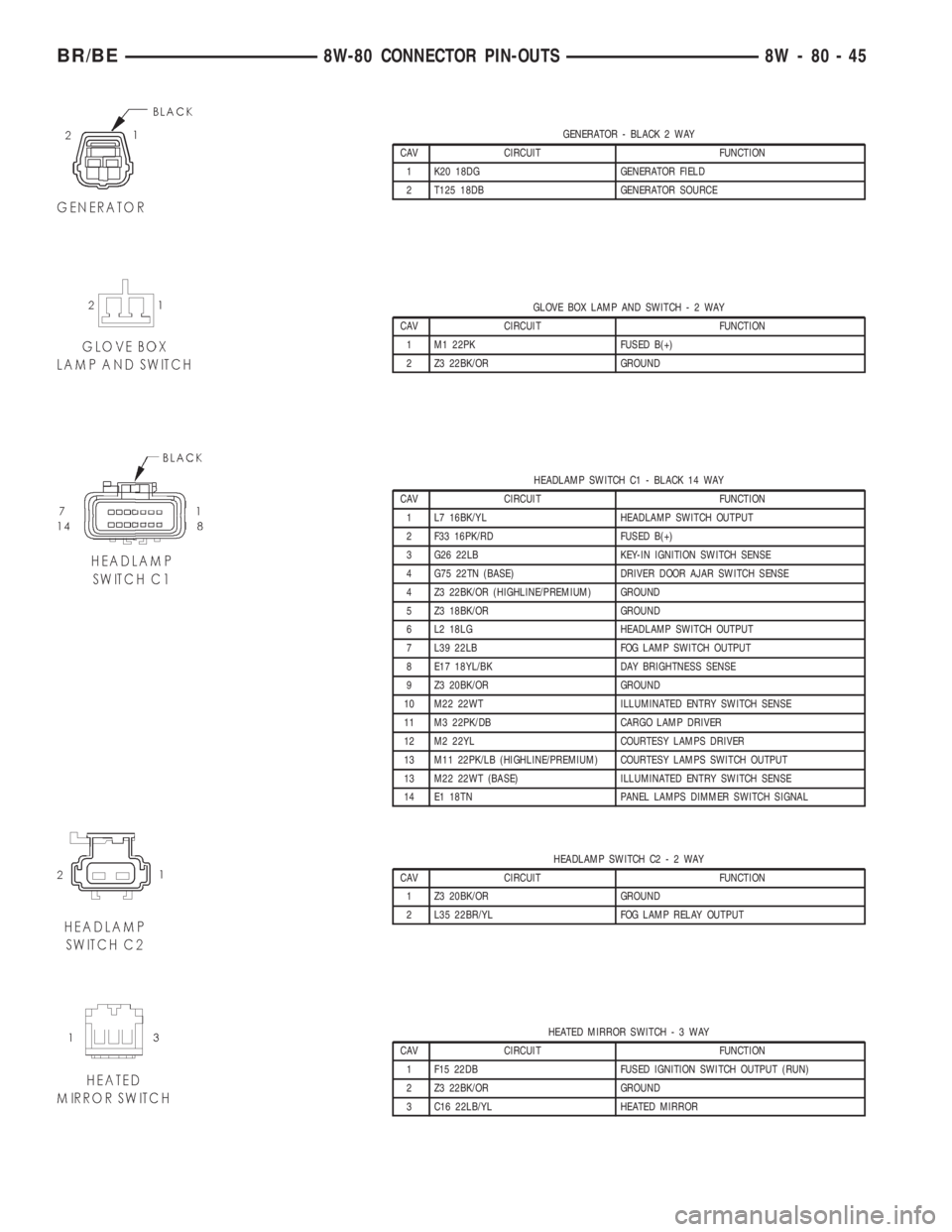
GENERATOR - BLACK 2 WAY
CAV CIRCUIT FUNCTION
1 K20 18DG GENERATOR FIELD
2 T125 18DB GENERATOR SOURCE
GLOVE BOX LAMP AND SWITCH-2WAY
CAV CIRCUIT FUNCTION
1 M1 22PK FUSED B(+)
2 Z3 22BK/OR GROUND
HEADLAMP SWITCH C1 - BLACK 14 WAY
CAV CIRCUIT FUNCTION
1 L7 16BK/YL HEADLAMP SWITCH OUTPUT
2 F33 16PK/RD FUSED B(+)
3 G26 22LB KEY-IN IGNITION SWITCH SENSE
4 G75 22TN (BASE) DRIVER DOOR AJAR SWITCH SENSE
4 Z3 22BK/OR (HIGHLINE/PREMIUM) GROUND
5 Z3 18BK/OR GROUND
6 L2 18LG HEADLAMP SWITCH OUTPUT
7 L39 22LB FOG LAMP SWITCH OUTPUT
8 E17 18YL/BK DAY BRIGHTNESS SENSE
9 Z3 20BK/OR GROUND
10 M22 22WT ILLUMINATED ENTRY SWITCH SENSE
11 M3 22PK/DB CARGO LAMP DRIVER
12 M2 22YL COURTESY LAMPS DRIVER
13 M11 22PK/LB (HIGHLINE/PREMIUM) COURTESY LAMPS SWITCH OUTPUT
13 M22 22WT (BASE) ILLUMINATED ENTRY SWITCH SENSE
14 E1 18TN PANEL LAMPS DIMMER SWITCH SIGNAL
HEADLAMP SWITCH C2-2WAY
CAV CIRCUIT FUNCTION
1 Z3 20BK/OR GROUND
2 L35 22BR/YL FOG LAMP RELAY OUTPUT
HEATED MIRROR SWITCH-3WAY
CAV CIRCUIT FUNCTION
1 F15 22DB FUSED IGNITION SWITCH OUTPUT (RUN)
2 Z3 22BK/OR GROUND
3 C16 22LB/YL HEATED MIRROR
BR/BE8W-80 CONNECTOR PIN-OUTS 8W - 80 - 45
Page 1060 of 2889
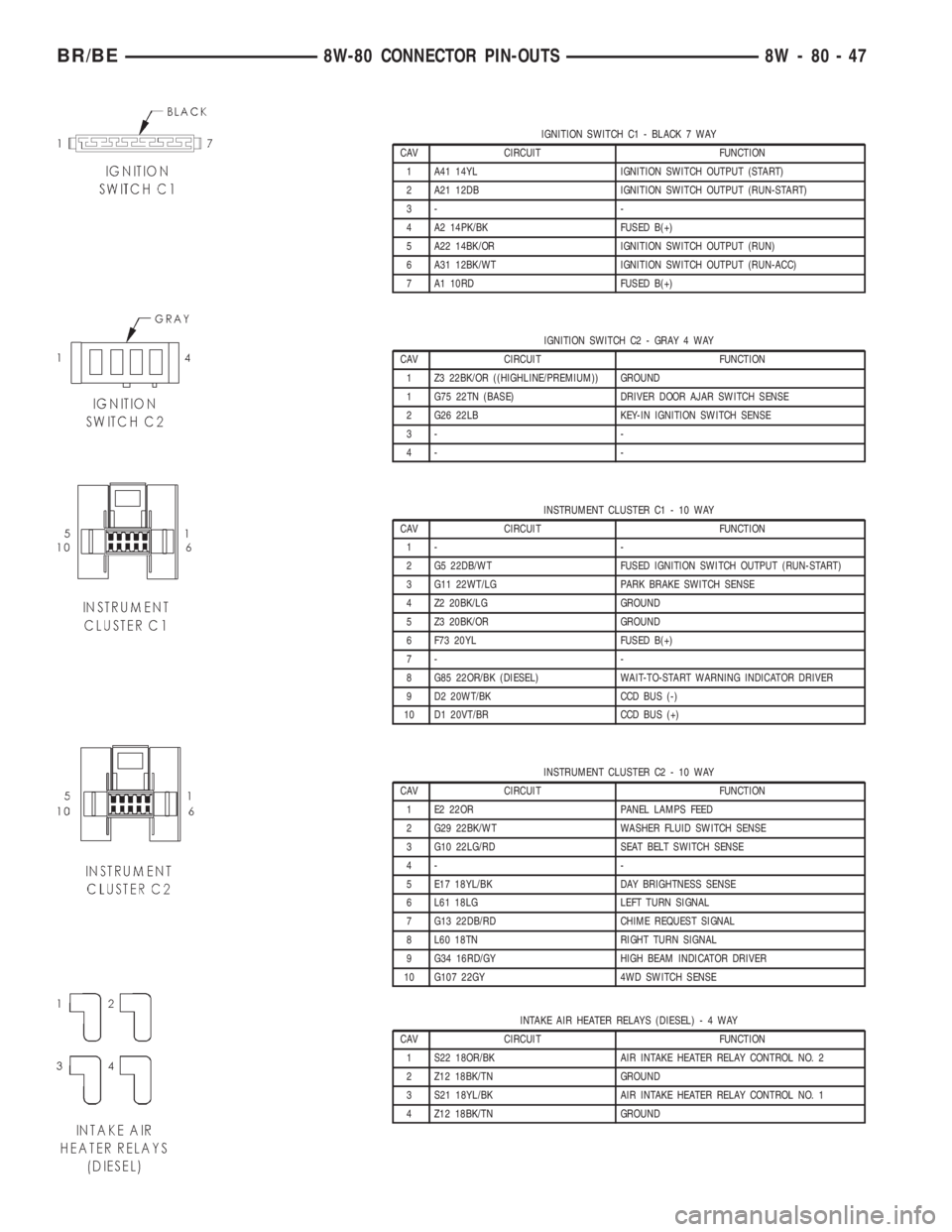
IGNITION SWITCH C1 - BLACK 7 WAY
CAV CIRCUIT FUNCTION
1 A41 14YL IGNITION SWITCH OUTPUT (START)
2 A21 12DB IGNITION SWITCH OUTPUT (RUN-START)
3- -
4 A2 14PK/BK FUSED B(+)
5 A22 14BK/OR IGNITION SWITCH OUTPUT (RUN)
6 A31 12BK/WT IGNITION SWITCH OUTPUT (RUN-ACC)
7 A1 10RD FUSED B(+)
IGNITION SWITCH C2 - GRAY 4 WAY
CAV CIRCUIT FUNCTION
1 Z3 22BK/OR ((HIGHLINE/PREMIUM)) GROUND
1 G75 22TN (BASE) DRIVER DOOR AJAR SWITCH SENSE
2 G26 22LB KEY-IN IGNITION SWITCH SENSE
3- -
4- -
INSTRUMENT CLUSTER C1 - 10 WAY
CAV CIRCUIT FUNCTION
1- -
2 G5 22DB/WT FUSED IGNITION SWITCH OUTPUT (RUN-START)
3 G11 22WT/LG PARK BRAKE SWITCH SENSE
4 Z2 20BK/LG GROUND
5 Z3 20BK/OR GROUND
6 F73 20YL FUSED B(+)
7- -
8 G85 22OR/BK (DIESEL) WAIT-TO-START WARNING INDICATOR DRIVER
9 D2 20WT/BK CCD BUS (-)
10 D1 20VT/BR CCD BUS (+)
INSTRUMENT CLUSTER C2 - 10 WAY
CAV CIRCUIT FUNCTION
1 E2 22OR PANEL LAMPS FEED
2 G29 22BK/WT WASHER FLUID SWITCH SENSE
3 G10 22LG/RD SEAT BELT SWITCH SENSE
4- -
5 E17 18YL/BK DAY BRIGHTNESS SENSE
6 L61 18LG LEFT TURN SIGNAL
7 G13 22DB/RD CHIME REQUEST SIGNAL
8 L60 18TN RIGHT TURN SIGNAL
9 G34 16RD/GY HIGH BEAM INDICATOR DRIVER
10 G107 22GY 4WD SWITCH SENSE
INTAKE AIR HEATER RELAYS (DIESEL)-4WAY
CAV CIRCUIT FUNCTION
1 S22 18OR/BK AIR INTAKE HEATER RELAY CONTROL NO. 2
2 Z12 18BK/TN GROUND
3 S21 18YL/BK AIR INTAKE HEATER RELAY CONTROL NO. 1
4 Z12 18BK/TN GROUND
BR/BE8W-80 CONNECTOR PIN-OUTS 8W - 80 - 47
Page 1063 of 2889
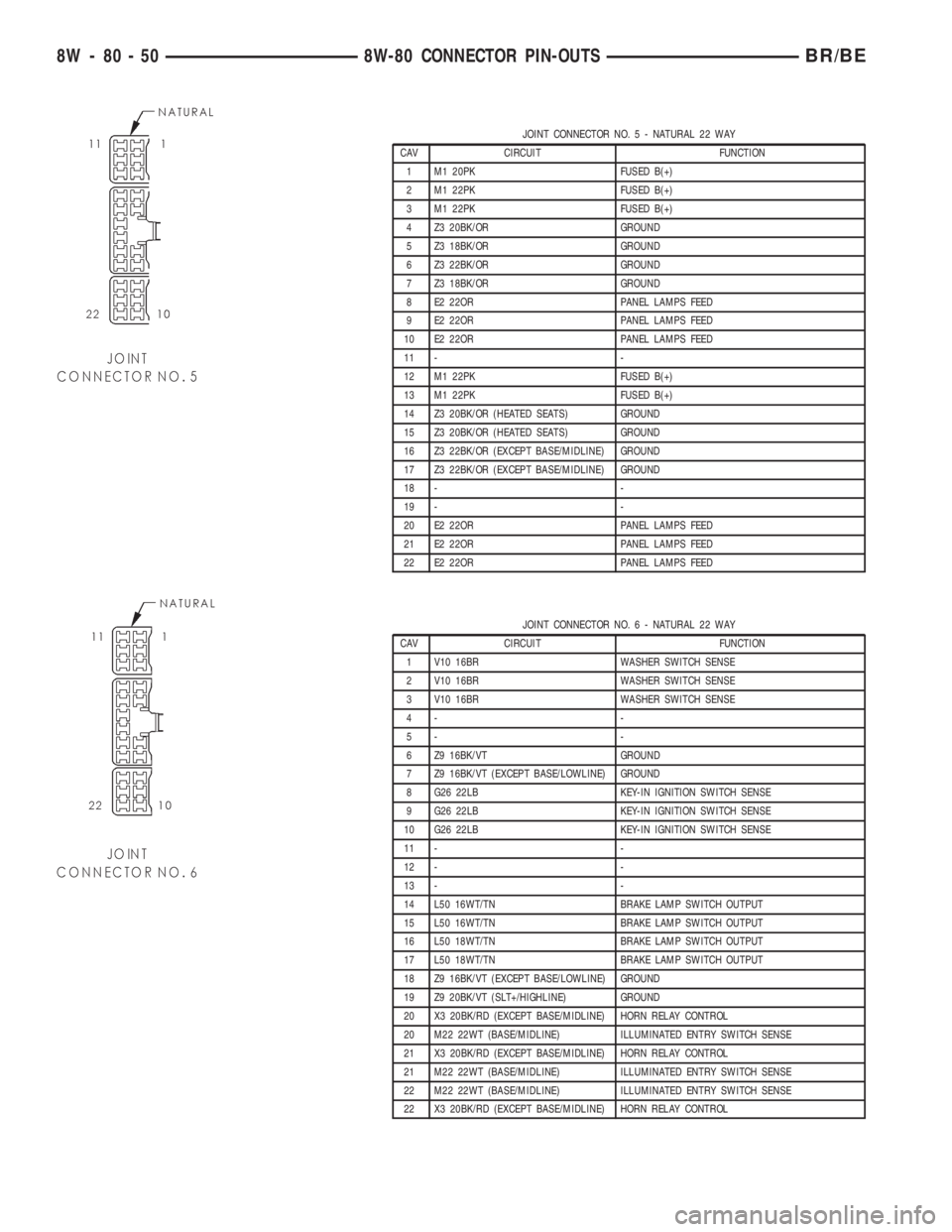
JOINT CONNECTOR NO.5-NATURAL 22 WAY
CAV CIRCUIT FUNCTION
1 M1 20PK FUSED B(+)
2 M1 22PK FUSED B(+)
3 M1 22PK FUSED B(+)
4 Z3 20BK/OR GROUND
5 Z3 18BK/OR GROUND
6 Z3 22BK/OR GROUND
7 Z3 18BK/OR GROUND
8 E2 22OR PANEL LAMPS FEED
9 E2 22OR PANEL LAMPS FEED
10 E2 22OR PANEL LAMPS FEED
11 - -
12 M1 22PK FUSED B(+)
13 M1 22PK FUSED B(+)
14 Z3 20BK/OR (HEATED SEATS) GROUND
15 Z3 20BK/OR (HEATED SEATS) GROUND
16 Z3 22BK/OR (EXCEPT BASE/MIDLINE) GROUND
17 Z3 22BK/OR (EXCEPT BASE/MIDLINE) GROUND
18 - -
19 - -
20 E2 22OR PANEL LAMPS FEED
21 E2 22OR PANEL LAMPS FEED
22 E2 22OR PANEL LAMPS FEED
JOINT CONNECTOR NO.6-NATURAL 22 WAY
CAV CIRCUIT FUNCTION
1 V10 16BR WASHER SWITCH SENSE
2 V10 16BR WASHER SWITCH SENSE
3 V10 16BR WASHER SWITCH SENSE
4- -
5- -
6 Z9 16BK/VT GROUND
7 Z9 16BK/VT (EXCEPT BASE/LOWLINE) GROUND
8 G26 22LB KEY-IN IGNITION SWITCH SENSE
9 G26 22LB KEY-IN IGNITION SWITCH SENSE
10 G26 22LB KEY-IN IGNITION SWITCH SENSE
11 - -
12 - -
13 - -
14 L50 16WT/TN BRAKE LAMP SWITCH OUTPUT
15 L50 16WT/TN BRAKE LAMP SWITCH OUTPUT
16 L50 18WT/TN BRAKE LAMP SWITCH OUTPUT
17 L50 18WT/TN BRAKE LAMP SWITCH OUTPUT
18 Z9 16BK/VT (EXCEPT BASE/LOWLINE) GROUND
19 Z9 20BK/VT (SLT+/HIGHLINE) GROUND
20 X3 20BK/RD (EXCEPT BASE/MIDLINE) HORN RELAY CONTROL
20 M22 22WT (BASE/MIDLINE) ILLUMINATED ENTRY SWITCH SENSE
21 X3 20BK/RD (EXCEPT BASE/MIDLINE) HORN RELAY CONTROL
21 M22 22WT (BASE/MIDLINE) ILLUMINATED ENTRY SWITCH SENSE
22 M22 22WT (BASE/MIDLINE) ILLUMINATED ENTRY SWITCH SENSE
22 X3 20BK/RD (EXCEPT BASE/MIDLINE) HORN RELAY CONTROL
8W - 80 - 50 8W-80 CONNECTOR PIN-OUTSBR/BE
Page 1178 of 2889
(8) Turn crankshaft and camshaft to line up with
keyway location in crankshaft sprocket and in cam-
shaft sprocket.
(9) Lift sprockets and chain (keep sprockets tight
against the chain in position as described).
(10) Slide both sprockets evenly over their respec-
tive shafts and use a straightedge to check alignment
of timing marks (Fig. 22).
(11) Install the camshaft bolt/cup washer. Tighten
bolt to 68 N´m (50 ft. lbs.) torque.
(12) Measure camshaft end play (Fig. 23). (Refer to
9 - ENGINE - SPECIFICATIONS) for proper clear-
ance. If not within limits, install a new timing chain
tensioner.
(13) Each tappet reused must be installed in the
same position at which it was removed.When cam-
shaft is replaced, all of the tappets must be
replaced.Install hydraulic tappets (Refer to 9 -
ENGINE/ENGINE BLOCK/HYDRAULIC LIFTERS
(CAM IN BLOCK) - INSTALLATION).
(14) Install timing chain cover (Refer to 9 -
ENGINE/VALVE TIMING/TIMING BELT / CHAIN
COVER(S) - INSTALLATION).
(15) Install intake manifold (Refer to 9 - ENGINE/
MANIFOLDS/INTAKE MANIFOLD - INSTALLA-
TION).
(16) Install distributor.
(17) Install cylinder head covers (Refer to 9 -
ENGINE/CYLINDER HEAD/CYLINDER HEAD
COVER(S) - INSTALLATION).
(18) Install radiator (Refer to 7 - COOLING/EN-
GINE/RADIATOR - INSTALLATION).
(19) Fill cooling system (Refer to 7 - COOLING -
STANDARD PROCEDURE).
(20) Connect battery negative cable.
(21) Start engine and check for leaks.
CONNECTING ROD BEARINGS
STANDARD PROCEDURE-CONNECTING ROD
BEARING FITTING
Fit all rods on a bank until completed. DO NOT
alternate from one bank to another, because connect-
ing rods and pistons are not interchangeable from
one bank to another.
The bearing caps are not interchangeable and
should be marked at removal to ensure correct
assembly.
Each bearing cap has a small V-groove across the
parting face. When installing the lower bearing shell,
be certain that the V-groove in the shell is in line
with the V-groove in the cap. This provides lubrica-
tion of the cylinder wall in the opposite bank.The bearing shells must be installed so that the
tangs are in the machined grooves in the rods and
caps.
Limits of taper or out-of-round on any crankshaft
journals should be held to 0.025 mm (0.001 in.).
Bearings are available in 0.025 mm (0.001 in.), 0.051
mm (0.002 in.), 0.076 mm (0.003 in.), 0.254 mm
(0.010 in.) and 0.305 mm (0.012 in.) undersize.
Install the bearings in pairs. DO NOT use a new
bearing half with an old bearing half. DO NOT
file the rods or bearing caps.
CRANKSHAFT
DESCRIPTION
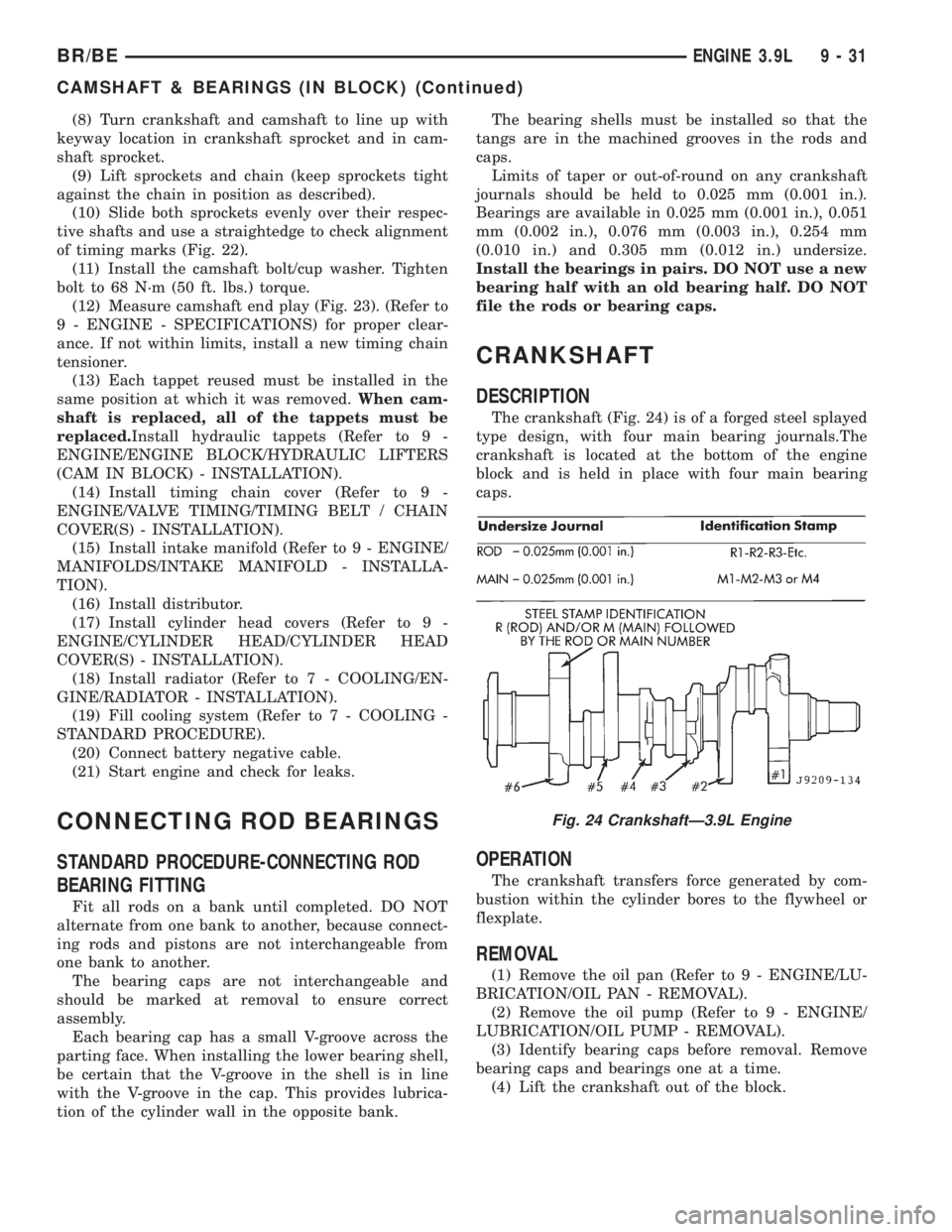
The crankshaft (Fig. 24) is of a forged steel splayed
type design, with four main bearing journals.The
crankshaft is located at the bottom of the engine
block and is held in place with four main bearing
caps.
OPERATION
The crankshaft transfers force generated by com-
bustion within the cylinder bores to the flywheel or
flexplate.
REMOVAL
(1) Remove the oil pan (Refer to 9 - ENGINE/LU-
BRICATION/OIL PAN - REMOVAL).
(2) Remove the oil pump (Refer to 9 - ENGINE/
LUBRICATION/OIL PUMP - REMOVAL).
(3) Identify bearing caps before removal. Remove
bearing caps and bearings one at a time.
(4) Lift the crankshaft out of the block.
Fig. 24 CrankshaftÐ3.9L Engine
BR/BEENGINE 3.9L 9 - 31
CAMSHAFT & BEARINGS (IN BLOCK) (Continued)
Page 1199 of 2889
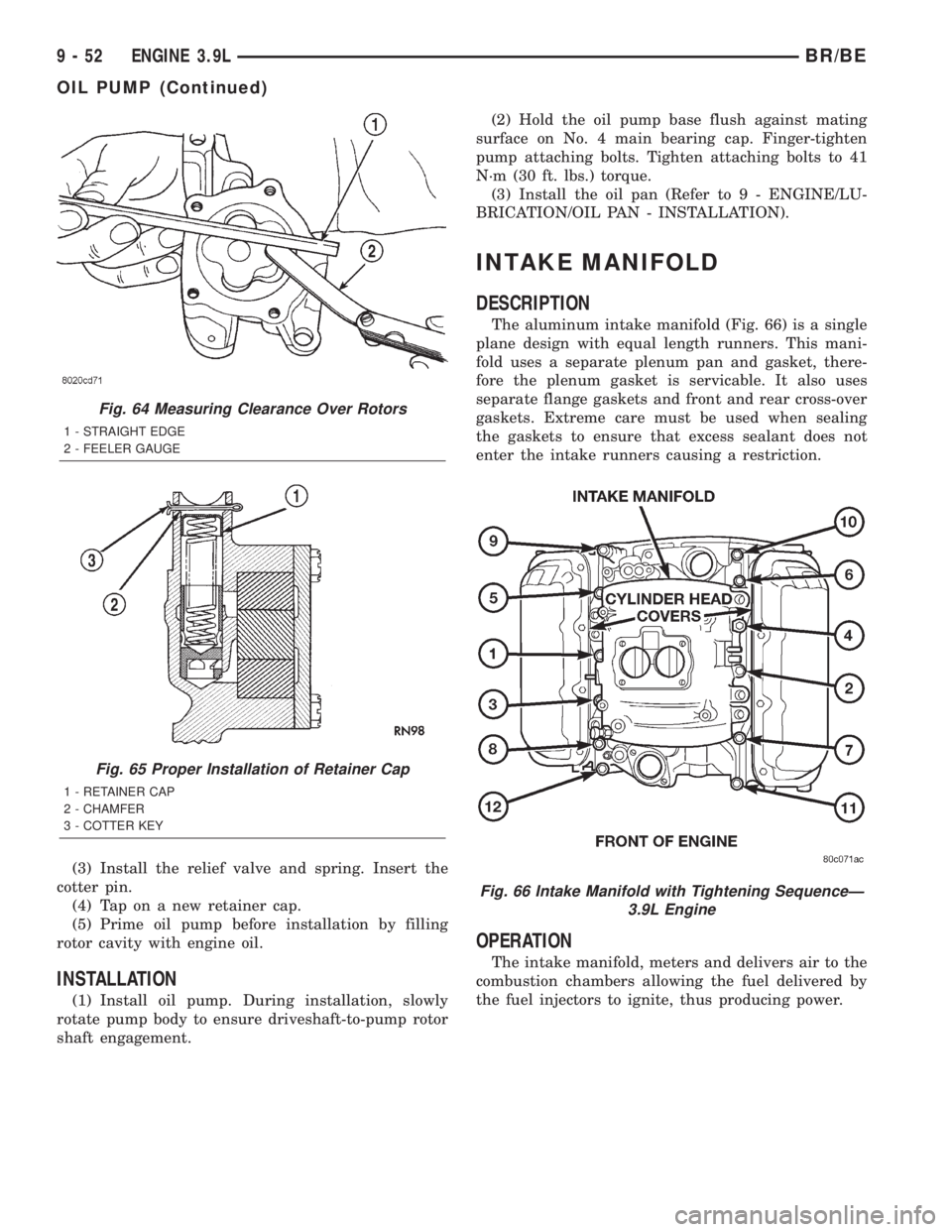
(3) Install the relief valve and spring. Insert the
cotter pin.
(4) Tap on a new retainer cap.
(5) Prime oil pump before installation by filling
rotor cavity with engine oil.
INSTALLATION
(1) Install oil pump. During installation, slowly
rotate pump body to ensure driveshaft-to-pump rotor
shaft engagement.(2) Hold the oil pump base flush against mating
surface on No. 4 main bearing cap. Finger-tighten
pump attaching bolts. Tighten attaching bolts to 41
N´m (30 ft. lbs.) torque.
(3) Install the oil pan (Refer to 9 - ENGINE/LU-
BRICATION/OIL PAN - INSTALLATION).
INTAKE MANIFOLD
DESCRIPTION
The aluminum intake manifold (Fig. 66) is a single
plane design with equal length runners. This mani-
fold uses a separate plenum pan and gasket, there-
fore the plenum gasket is servicable. It also uses
separate flange gaskets and front and rear cross-over
gaskets. Extreme care must be used when sealing
the gaskets to ensure that excess sealant does not
enter the intake runners causing a restriction.
OPERATION
The intake manifold, meters and delivers air to the
combustion chambers allowing the fuel delivered by
the fuel injectors to ignite, thus producing power.
Fig. 64 Measuring Clearance Over Rotors
1 - STRAIGHT EDGE
2 - FEELER GAUGE
Fig. 65 Proper Installation of Retainer Cap
1 - RETAINER CAP
2 - CHAMFER
3 - COTTER KEY
Fig. 66 Intake Manifold with Tightening SequenceÐ
3.9L Engine
9 - 52 ENGINE 3.9LBR/BE
OIL PUMP (Continued)
Page 1256 of 2889
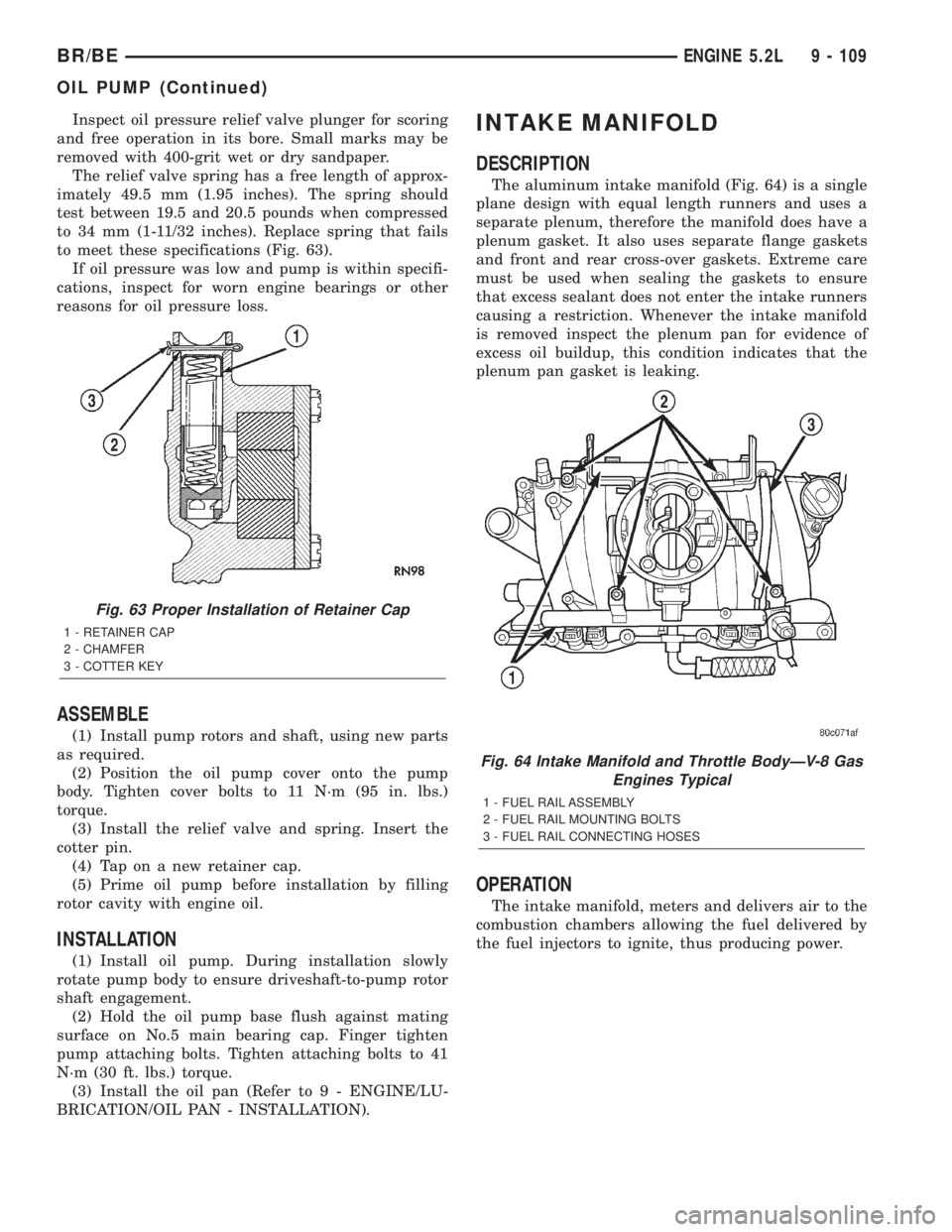
Inspect oil pressure relief valve plunger for scoring
and free operation in its bore. Small marks may be
removed with 400-grit wet or dry sandpaper.
The relief valve spring has a free length of approx-
imately 49.5 mm (1.95 inches). The spring should
test between 19.5 and 20.5 pounds when compressed
to 34 mm (1-11/32 inches). Replace spring that fails
to meet these specifications (Fig. 63).
If oil pressure was low and pump is within specifi-
cations, inspect for worn engine bearings or other
reasons for oil pressure loss.
ASSEMBLE
(1) Install pump rotors and shaft, using new parts
as required.
(2) Position the oil pump cover onto the pump
body. Tighten cover bolts to 11 N´m (95 in. lbs.)
torque.
(3) Install the relief valve and spring. Insert the
cotter pin.
(4) Tap on a new retainer cap.
(5) Prime oil pump before installation by filling
rotor cavity with engine oil.
INSTALLATION
(1) Install oil pump. During installation slowly
rotate pump body to ensure driveshaft-to-pump rotor
shaft engagement.
(2) Hold the oil pump base flush against mating
surface on No.5 main bearing cap. Finger tighten
pump attaching bolts. Tighten attaching bolts to 41
N´m (30 ft. lbs.) torque.
(3) Install the oil pan (Refer to 9 - ENGINE/LU-
BRICATION/OIL PAN - INSTALLATION).
INTAKE MANIFOLD
DESCRIPTION
The aluminum intake manifold (Fig. 64) is a single
plane design with equal length runners and uses a
separate plenum, therefore the manifold does have a
plenum gasket. It also uses separate flange gaskets
and front and rear cross-over gaskets. Extreme care
must be used when sealing the gaskets to ensure
that excess sealant does not enter the intake runners
causing a restriction. Whenever the intake manifold
is removed inspect the plenum pan for evidence of
excess oil buildup, this condition indicates that the
plenum pan gasket is leaking.
OPERATION
The intake manifold, meters and delivers air to the
combustion chambers allowing the fuel delivered by
the fuel injectors to ignite, thus producing power.
Fig. 63 Proper Installation of Retainer Cap
1 - RETAINER CAP
2 - CHAMFER
3 - COTTER KEY
Fig. 64 Intake Manifold and Throttle BodyÐV-8 Gas
Engines Typical
1 - FUEL RAIL ASSEMBLY
2 - FUEL RAIL MOUNTING BOLTS
3 - FUEL RAIL CONNECTING HOSES
BR/BEENGINE 5.2L 9 - 109
OIL PUMP (Continued)
Page 1262 of 2889
INSTALLATION
(1) Place both camshaft sprocket and crankshaft
sprocket on the bench with timing marks on exact
imaginary center line through both camshaft and
crankshaft bores.
(2) Place timing chain around both sprockets.
(3) Turn crankshaft and camshaft to line up with
keyway location in crankshaft sprocket and in cam-
shaft sprocket.
(4) Lift sprockets and chain (keep sprockets tight
against the chain in position as described).
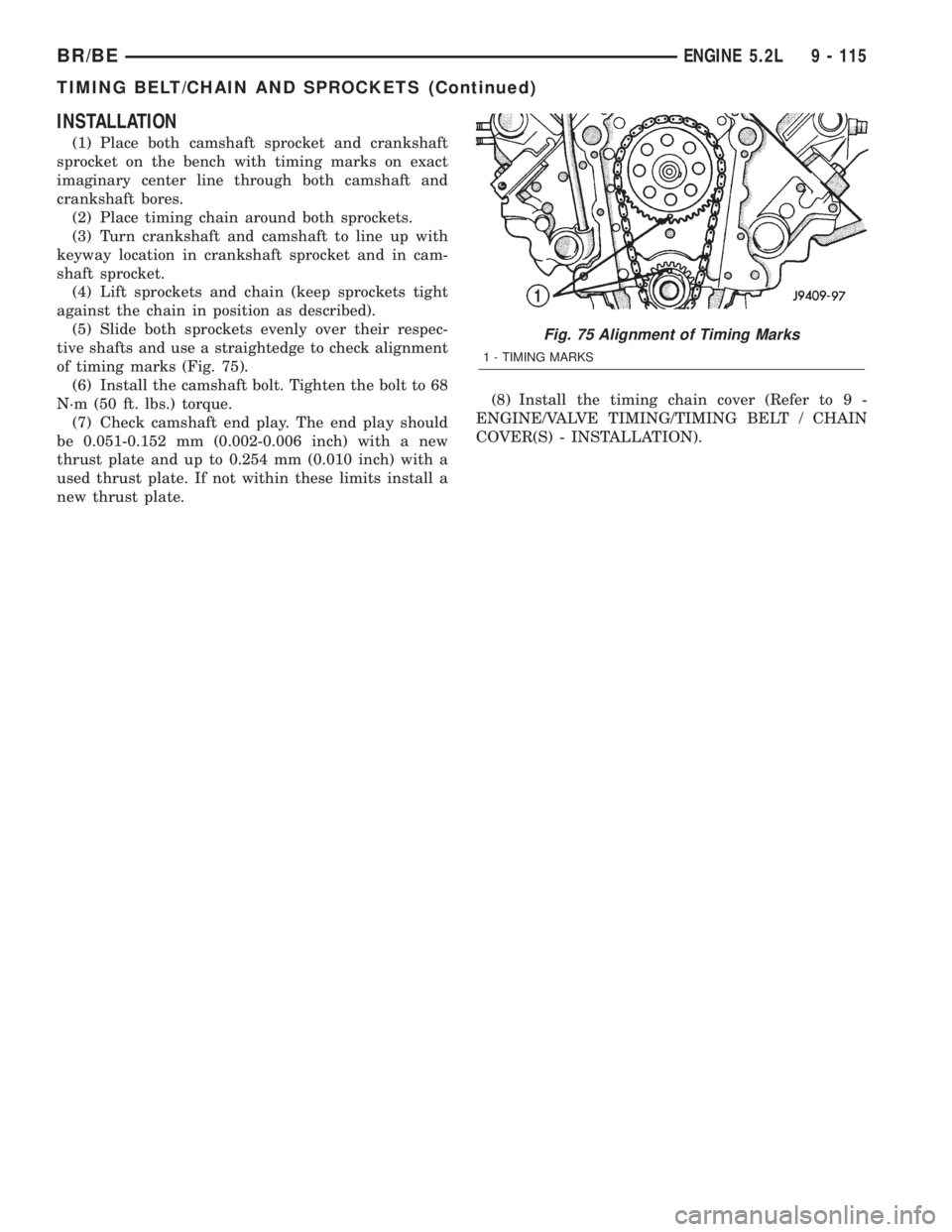
(5) Slide both sprockets evenly over their respec-
tive shafts and use a straightedge to check alignment
of timing marks (Fig. 75).
(6) Install the camshaft bolt. Tighten the bolt to 68
N´m (50 ft. lbs.) torque.
(7) Check camshaft end play. The end play should
be 0.051-0.152 mm (0.002-0.006 inch) with a new
thrust plate and up to 0.254 mm (0.010 inch) with a
used thrust plate. If not within these limits install a
new thrust plate.(8) Install the timing chain cover (Refer to 9 -
ENGINE/VALVE TIMING/TIMING BELT / CHAIN
COVER(S) - INSTALLATION).
Fig. 75 Alignment of Timing Marks
1 - TIMING MARKS
BR/BEENGINE 5.2L 9 - 115
TIMING BELT/CHAIN AND SPROCKETS (Continued)
Page 1312 of 2889
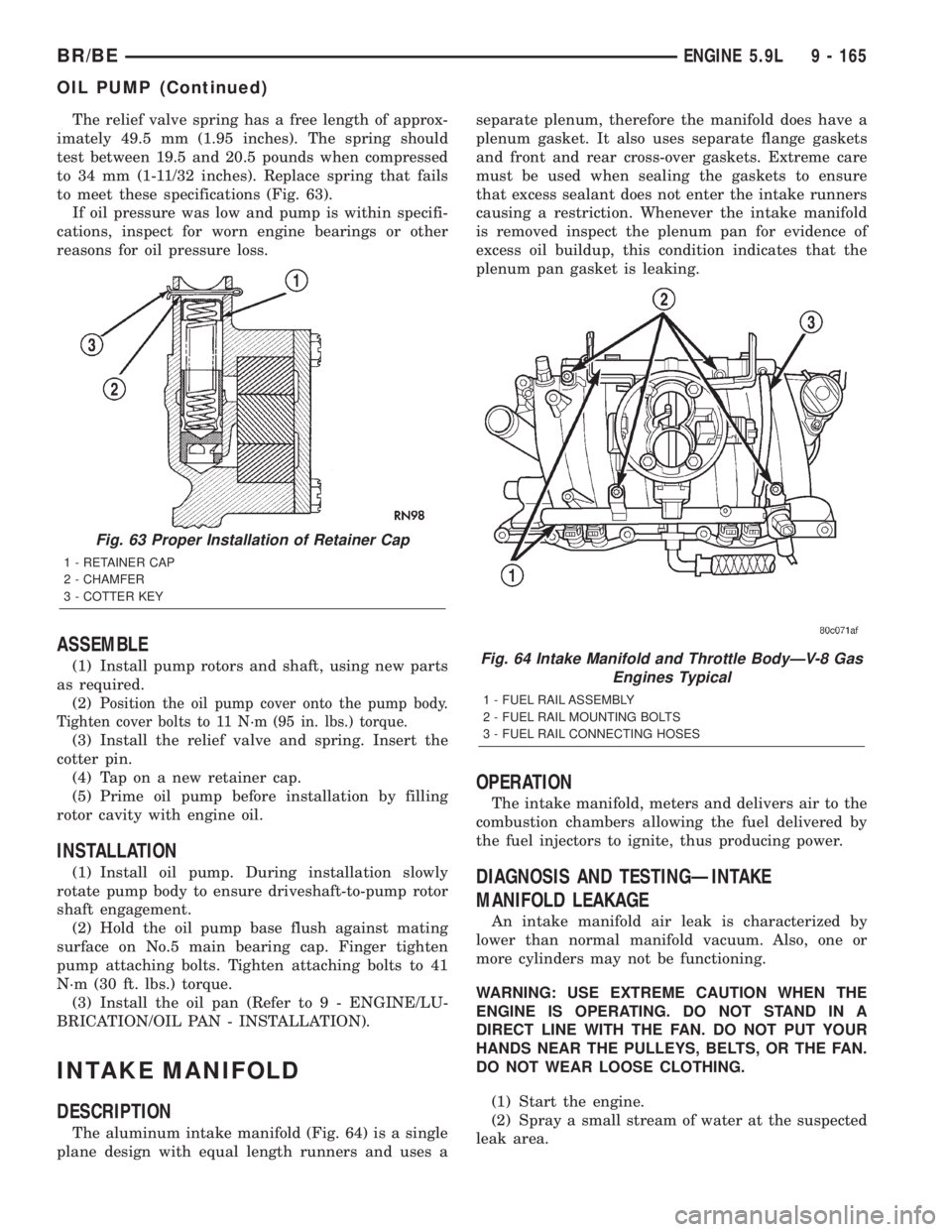
The relief valve spring has a free length of approx-
imately 49.5 mm (1.95 inches). The spring should
test between 19.5 and 20.5 pounds when compressed
to 34 mm (1-11/32 inches). Replace spring that fails
to meet these specifications (Fig. 63).
If oil pressure was low and pump is within specifi-
cations, inspect for worn engine bearings or other
reasons for oil pressure loss.
ASSEMBLE
(1) Install pump rotors and shaft, using new parts
as required.
(2)
Position the oil pump cover onto the pump body.
Tighten cover bolts to 11 N´m (95 in. lbs.) torque.
(3) Install the relief valve and spring. Insert the
cotter pin.
(4) Tap on a new retainer cap.
(5) Prime oil pump before installation by filling
rotor cavity with engine oil.
INSTALLATION
(1) Install oil pump. During installation slowly
rotate pump body to ensure driveshaft-to-pump rotor
shaft engagement.
(2) Hold the oil pump base flush against mating
surface on No.5 main bearing cap. Finger tighten
pump attaching bolts. Tighten attaching bolts to 41
N´m (30 ft. lbs.) torque.
(3) Install the oil pan (Refer to 9 - ENGINE/LU-
BRICATION/OIL PAN - INSTALLATION).
INTAKE MANIFOLD
DESCRIPTION
The aluminum intake manifold (Fig. 64) is a single
plane design with equal length runners and uses aseparate plenum, therefore the manifold does have a
plenum gasket. It also uses separate flange gaskets
and front and rear cross-over gaskets. Extreme care
must be used when sealing the gaskets to ensure
that excess sealant does not enter the intake runners
causing a restriction. Whenever the intake manifold
is removed inspect the plenum pan for evidence of
excess oil buildup, this condition indicates that the
plenum pan gasket is leaking.
OPERATION
The intake manifold, meters and delivers air to the
combustion chambers allowing the fuel delivered by
the fuel injectors to ignite, thus producing power.
DIAGNOSIS AND TESTINGÐINTAKE
MANIFOLD LEAKAGE
An intake manifold air leak is characterized by
lower than normal manifold vacuum. Also, one or
more cylinders may not be functioning.
WARNING: USE EXTREME CAUTION WHEN THE
ENGINE IS OPERATING. DO NOT STAND IN A
DIRECT LINE WITH THE FAN. DO NOT PUT YOUR
HANDS NEAR THE PULLEYS, BELTS, OR THE FAN.
DO NOT WEAR LOOSE CLOTHING.
(1) Start the engine.
(2) Spray a small stream of water at the suspected
leak area.
Fig. 63 Proper Installation of Retainer Cap
1 - RETAINER CAP
2 - CHAMFER
3 - COTTER KEY
Fig. 64 Intake Manifold and Throttle BodyÐV-8 Gas
Engines Typical
1 - FUEL RAIL ASSEMBLY
2 - FUEL RAIL MOUNTING BOLTS
3 - FUEL RAIL CONNECTING HOSES
BR/BEENGINE 5.9L 9 - 165
OIL PUMP (Continued)