2001 DODGE RAM ECU
[x] Cancel search: ECUPage 2574 of 2889
BODY
TABLE OF CONTENTS
page page
BODY
DESCRIPTION............................1
WARNING...............................1
DIAGNOSIS AND TESTING..................2
WATER LEAKS..........................2
WIND NOISE...........................3
SPECIFICATIONS.........................4
DECKLID/HATCH/LIFTGATE/TAILGATE........62
DOOR - FRONT..........................67DOOR - CARGO.........................77
EXTERIOR..............................86
HOOD.................................99
INSTRUMENT PANEL SYSTEM.............104
INTERIOR.............................118
PAINT................................129
SEATS................................131
STATIONARY GLASS.....................145
WEATHERSTRIP/SEALS..................152
BODY
DESCRIPTION ± PUSH-IN FASTENERS
DaimlerChrysler Corporation uses many different
types of push-in fasteners to secure the interior and
exterior trim to the body. Most of these fasteners can
be reused to assemble the trim during various repair
procedures. At times, a push-in fastener cannot be
removed without damaging the fastener or the com-
ponent it is holding. If it is not possible to remove a
fastener without damaging a component or body, cut
or break the fastener and use a new one when
installing the component. Never pry or pound on a
plastic or pressed-board trim component. Using a
suitable fork-type prying device, pry the fastener
from the retaining hole behind the component being
removed. When installing, verify fastener alignment
with the retaining hole by hand. Push directly on or
over the fastener until it seats. Apply a low-force pull
to the panel to verify that it is secure.
When it is necessary to remove components to ser-
vice another, it should not be necessary to apply
excessive force or bend a component to remove it.
Before damaging a trim component, verify hidden
fasteners or captured edges holding the component in
place.
DESCRIPTION ± LOCK CYLINDERS
Ignition, door, deck lid, and rear hatch lock cylin-
ders are all codable to the key. Lock barrels, tum-
blers, and tumbler springs are available to allow the
technician to change replacement locks cylinders to
match the customer's original key set. See the appro-
priate section in this manual for lock cylinder
removal. See the Moparž catalogue for part numbers
and lock coding procedures.
SAFETY PRECAUTIONS AND WARNINGS
WARNING: USE A OSHA APPROVED BREATHING
FILTER WHEN SPRAYING PAINT OR SOLVENTS IN
A CONFINED AREA. PERSONAL INJURY CAN
RESULT.
AVOID PROLONGED SKIN CONTACT WITH PETRO-
LEUM OR ALCOHOL ± BASED CLEANING SOL-
VENTS. PERSONAL INJURY CAN RESULT.
DO NOT STAND UNDER A HOISTED VEHICLE THAT
IS NOT PROPERLY SUPPORTED ON SAFETY
STANDS. PERSONAL INJURY CAN RESULT.
CAUTION: When holes must be drilled or punched
in an inner body panel, verify depth of space to the
outer body panel, electrical wiring, or other compo-
nents. Damage to vehicle can result.
Do not weld exterior panels unless combustible
material on the interior of vehicle is removed from
the repair area. Fire or hazardous conditions, can
result.
Always have a fire extinguisher ready for use when
welding.
Disconnect the negative (-) cable clamp from the
battery when servicing electrical components that
are live when the ignition is OFF. Damage to electri-
cal system can result.
Do not use abrasive chemicals or compounds on
painted surfaces. Damage to finish can result.
Do not use harsh alkaline based cleaning solvents
on painted or upholstered surfaces. Damage to fin-
ish or color can result.
Do not hammer or pound on plastic trim panel
when servicing interior trim. Plastic panels can
break.
BR/BEBODY 23 - 1
Page 2636 of 2889
INSTALLATION
(1) Position check cable on tailgate.
(2) Install screw attaching small end of cable to
tailgate.
(3) Position large end of cable onto stud head and
slide downward to secure lock tab.
DECALS
REMOVAL
(1) Warm the panel to approximately 38ÉC (100ÉF)
using a suitable heat lamp or heat gun.
(2) Peel tape stripe from body panel using an even
pressure pull.
(3) Remove adhesive residue from body panel
using a suitable adhesive removing solvent.
INSTALLATION
(1) Clean painted body surface with Moparž Super
Clean solvent or equivalent and a lint free cloth.
(2) Remove protective cover from back side of
decal.
(3) Position decal properly on body.
(4) Press decal firmly to body with palm of hand.
(5) If temperature is below 21ÉC (70ÉF) warm decal
with a heat lamp or gun to assure adhesion. Do not
exceed 65ÉC (150ÉF) when heating emblem.
HANDLE ESCUTCHEON
REMOVAL
(1) Lift and hold tailgate latch release handle.
(2) Using a trim stick (C±4755), pry bottom of
escutcheon outward to disengage clips.
(3) Rotate escutcheon upward to disengage clip
above release handle.
(4) Push escutcheon downward from behind to
clear handle.
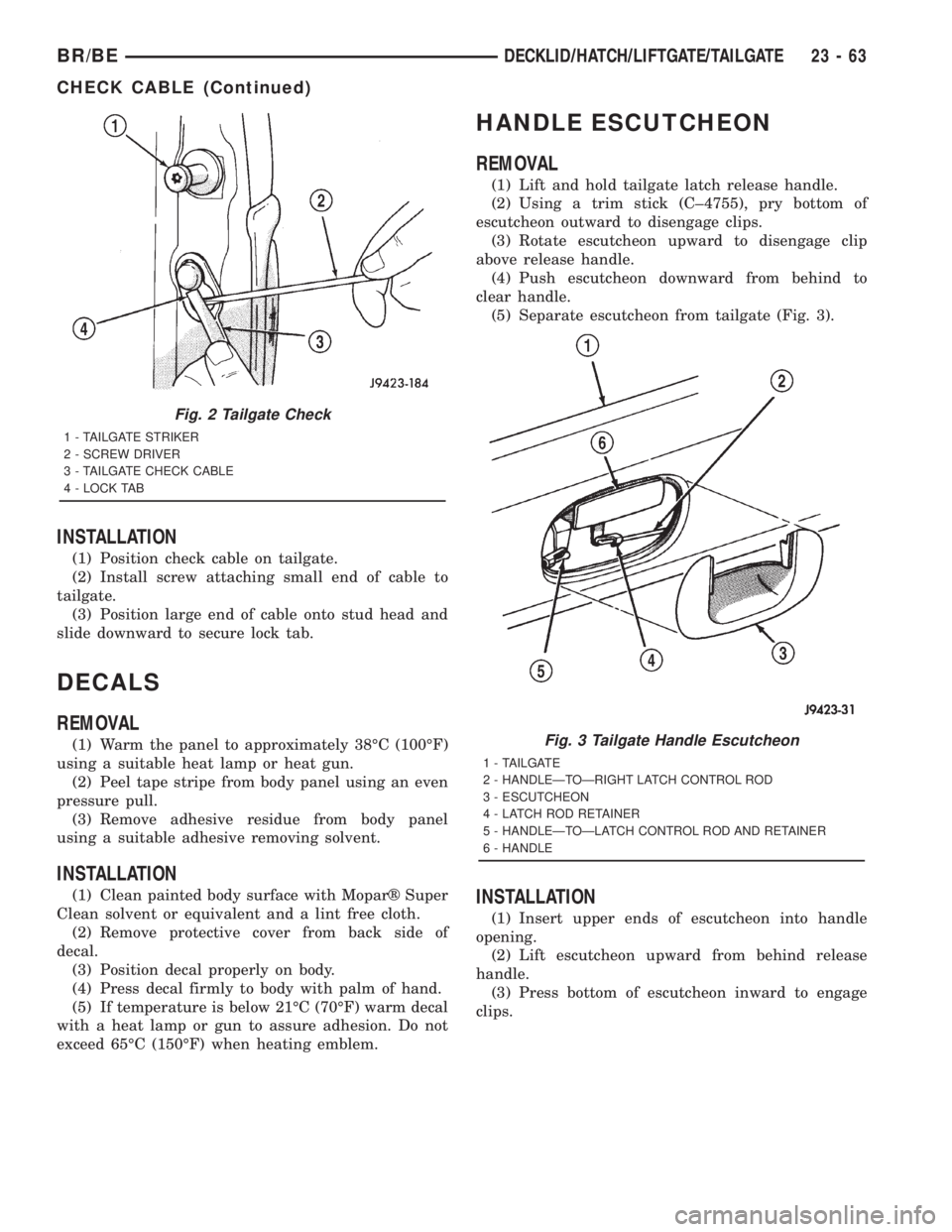
(5) Separate escutcheon from tailgate (Fig. 3).
INSTALLATION
(1) Insert upper ends of escutcheon into handle
opening.
(2) Lift escutcheon upward from behind release
handle.
(3) Press bottom of escutcheon inward to engage
clips.
Fig. 2 Tailgate Check
1 - TAILGATE STRIKER
2 - SCREW DRIVER
3 - TAILGATE CHECK CABLE
4 - LOCK TAB
Fig. 3 Tailgate Handle Escutcheon
1 - TAILGATE
2 - HANDLEÐTOÐRIGHT LATCH CONTROL ROD
3 - ESCUTCHEON
4 - LATCH ROD RETAINER
5 - HANDLEÐTOÐLATCH CONTROL ROD AND RETAINER
6 - HANDLE
BR/BEDECKLID/HATCH/LIFTGATE/TAILGATE 23 - 63
CHECK CABLE (Continued)
Page 2640 of 2889
DOOR - FRONT
TABLE OF CONTENTS
page page
APPLIQUE
REMOVAL..............................67
INSTALLATION...........................67
DOOR
REMOVAL..............................68
INSTALLATION...........................68
ADJUSTMENTS..........................68
DOOR GLASS
REMOVAL..............................69
INSTALLATION...........................69
EXTERIOR HANDLE
REMOVAL..............................70
INSTALLATION...........................70
GLASS RUN CHANNEL
REMOVAL..............................70
INSTALLATION...........................70
HINGE
REMOVAL..............................70
INSTALLATION...........................71
INSIDE HANDLE ACTUATOR
REMOVAL..............................71
INSTALLATION...........................71LATCH
REMOVAL..............................72
INSTALLATION...........................72
ADJUSTMENTS..........................72
LATCH STRIKER
REMOVAL..............................73
INSTALLATION...........................73
LOCK CYLINDER
REMOVAL..............................73
INSTALLATION...........................73
SIDE VIEW MIRROR FLAG
REMOVAL..............................74
INSTALLATION...........................74
TRIM PANEL
REMOVAL..............................74
INSTALLATION...........................74
WATERDAM
REMOVAL..............................75
INSTALLATION...........................75
WINDOW REGULATOR
REMOVAL..............................75
INSTALLATION...........................76
APPLIQUE
REMOVAL
(1) Using a heat lamp, warm B-pillar to 38É C
(100É F).
(2) Remove glass run weatherstrip (Refer to 23 -
BODY/WEATHERSTRIP/SEALS/FDR GLASS RUN
WEATHERSTRIP - REMOVAL).
(3) Remove outer belt weatherstrip (Refer to 23 -
BODY/WEATHERSTRIP/SEALS/FDR OUTER BELT
WEATHERSTRIP - REMOVAL).
(4) Using an even pressure pull, peel B-pillar
applique away from the B-pillar.
INSTALLATION
Installation equipment needed:
²Lint free applicator cloth
²six inch applicator squeegee
²Piercing pin
(1) Clean B-pillar using Mopar Super Kleen or
equivalent.
(2) Wipe surface with a lint free cloth.
(3) Using a heat gun, warm surface to 22É C (70É
F).(4) Fold down, up/down locator tab (1a or 1b) (Fig.
1)along crease.
(5) Remove carrier from adhesion strip (2).
(6) Using up/down locator tab (1a or 1b) and fore/
aft locator tab (3a or 3b), position the applique on the
upper portion of the B-pillar.
(7) Using the lower edge locator (4), position the
applique on the lower portion of the B-pillar.
(8) Verify the applique is positioned correctly and
press the adhesion strip (2) to the door to tempo-
rarily secure it in place.
(9) Remove the carrier for the applique.
(10) Holding the applique from the surface, apply
firm downward pressure with a six inch applicator
squeegee. Ensure the lower rear edge (4) is aligned
correctly.
(11) Wrap edges around door to at least a 90É
angle.
(12) Remove premask by pulling in a firm contin-
uous manner from top down at 180É.
(13) Complete wrapping applique around the door
edges.
(14) Inspect for air bubbles. Small bubbles can be
pierced with a sharp pin and smoothed out.
BR/BEDOOR - FRONT 23 - 67
Page 2646 of 2889
LATCH STRIKER
REMOVAL
(1) Mark outline of striker base on B-pillar with a
grease pencil or equivalent to aid installation.
(2) Remove screws attaching striker to B-pillar
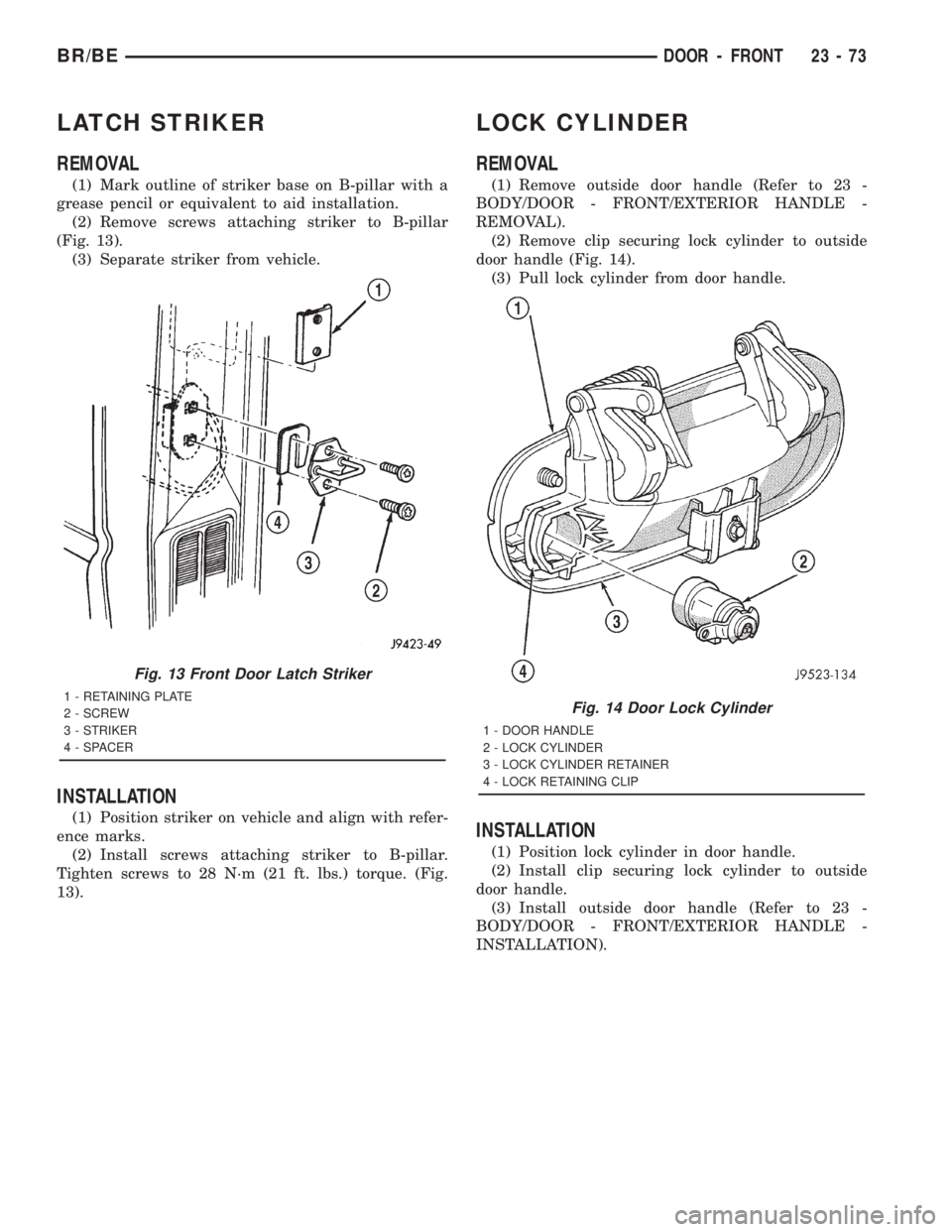
(Fig. 13).
(3) Separate striker from vehicle.
INSTALLATION
(1) Position striker on vehicle and align with refer-
ence marks.
(2) Install screws attaching striker to B-pillar.
Tighten screws to 28 N´m (21 ft. lbs.) torque. (Fig.
13).
LOCK CYLINDER
REMOVAL
(1) Remove outside door handle (Refer to 23 -
BODY/DOOR - FRONT/EXTERIOR HANDLE -
REMOVAL).
(2) Remove clip securing lock cylinder to outside
door handle (Fig. 14).
(3) Pull lock cylinder from door handle.
INSTALLATION
(1) Position lock cylinder in door handle.
(2) Install clip securing lock cylinder to outside
door handle.
(3) Install outside door handle (Refer to 23 -
BODY/DOOR - FRONT/EXTERIOR HANDLE -
INSTALLATION).
Fig. 13 Front Door Latch Striker
1 - RETAINING PLATE
2 - SCREW
3 - STRIKER
4 - SPACERFig. 14 Door Lock Cylinder
1 - DOOR HANDLE
2 - LOCK CYLINDER
3 - LOCK CYLINDER RETAINER
4 - LOCK RETAINING CLIP
BR/BEDOOR - FRONT 23 - 73
Page 2648 of 2889
WATERDAM
REMOVAL
(1) Remove door trim panel (Refer to 23 - BODY/
DOOR - FRONT/TRIM PANEL - REMOVAL).
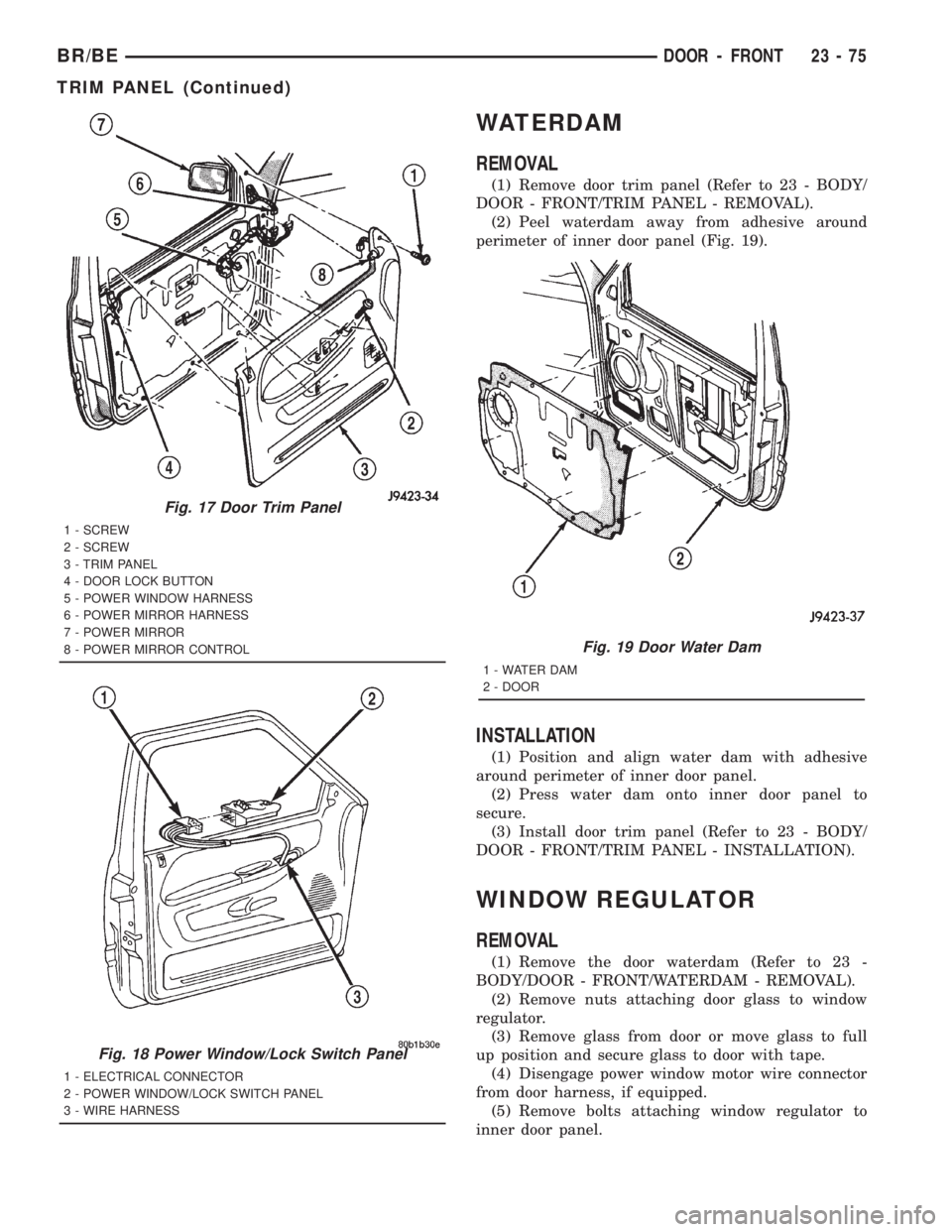
(2) Peel waterdam away from adhesive around
perimeter of inner door panel (Fig. 19).
INSTALLATION
(1) Position and align water dam with adhesive
around perimeter of inner door panel.
(2) Press water dam onto inner door panel to
secure.
(3) Install door trim panel (Refer to 23 - BODY/
DOOR - FRONT/TRIM PANEL - INSTALLATION).
WINDOW REGULATOR
REMOVAL
(1) Remove the door waterdam (Refer to 23 -
BODY/DOOR - FRONT/WATERDAM - REMOVAL).
(2) Remove nuts attaching door glass to window
regulator.
(3) Remove glass from door or move glass to full
up position and secure glass to door with tape.
(4) Disengage power window motor wire connector
from door harness, if equipped.
(5) Remove bolts attaching window regulator to
inner door panel.
Fig. 17 Door Trim Panel
1 - SCREW
2 - SCREW
3 - TRIM PANEL
4 - DOOR LOCK BUTTON
5 - POWER WINDOW HARNESS
6 - POWER MIRROR HARNESS
7 - POWER MIRROR
8 - POWER MIRROR CONTROL
Fig. 18 Power Window/Lock Switch Panel
1 - ELECTRICAL CONNECTOR
2 - POWER WINDOW/LOCK SWITCH PANEL
3 - WIRE HARNESS
Fig. 19 Door Water Dam
1 - WATER DAM
2 - DOOR
BR/BEDOOR - FRONT 23 - 75
TRIM PANEL (Continued)
Page 2653 of 2889
(4) Install cargo door (Refer to 23 - BODY/DOOR -
CARGO/DOOR - INSTALLATION).
INSIDE HANDLE ACTUATOR
REMOVAL
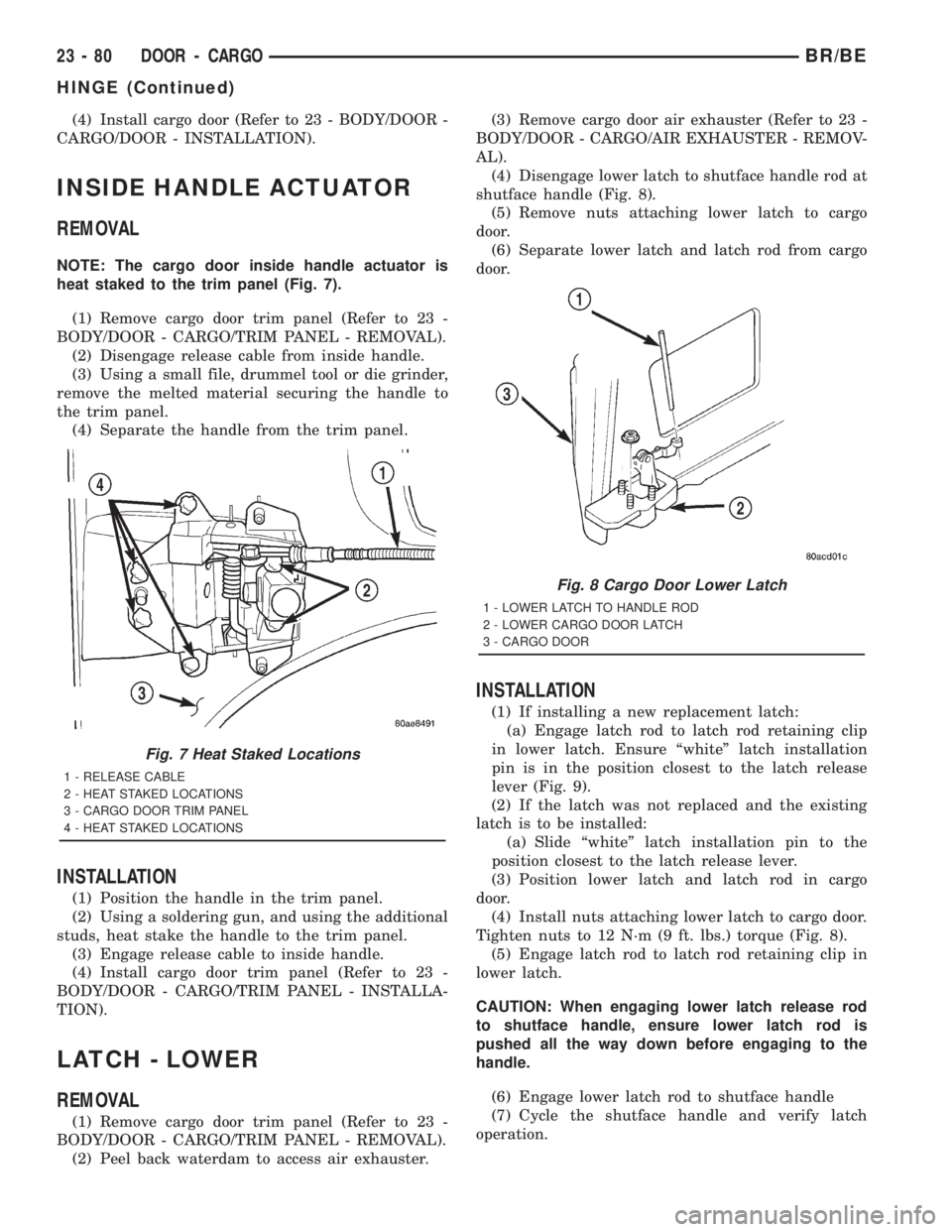
NOTE: The cargo door inside handle actuator is
heat staked to the trim panel (Fig. 7).
(1) Remove cargo door trim panel (Refer to 23 -
BODY/DOOR - CARGO/TRIM PANEL - REMOVAL).
(2) Disengage release cable from inside handle.
(3) Using a small file, drummel tool or die grinder,
remove the melted material securing the handle to
the trim panel.
(4) Separate the handle from the trim panel.
INSTALLATION
(1) Position the handle in the trim panel.
(2) Using a soldering gun, and using the additional
studs, heat stake the handle to the trim panel.
(3) Engage release cable to inside handle.
(4) Install cargo door trim panel (Refer to 23 -
BODY/DOOR - CARGO/TRIM PANEL - INSTALLA-
TION).
LATCH - LOWER
REMOVAL
(1) Remove cargo door trim panel (Refer to 23 -
BODY/DOOR - CARGO/TRIM PANEL - REMOVAL).
(2) Peel back waterdam to access air exhauster.(3) Remove cargo door air exhauster (Refer to 23 -
BODY/DOOR - CARGO/AIR EXHAUSTER - REMOV-
AL).
(4) Disengage lower latch to shutface handle rod at
shutface handle (Fig. 8).
(5) Remove nuts attaching lower latch to cargo
door.
(6) Separate lower latch and latch rod from cargo
door.
INSTALLATION
(1) If installing a new replacement latch:
(a) Engage latch rod to latch rod retaining clip
in lower latch. Ensure ªwhiteº latch installation
pin is in the position closest to the latch release
lever (Fig. 9).
(2) If the latch was not replaced and the existing
latch is to be installed:
(a) Slide ªwhiteº latch installation pin to the
position closest to the latch release lever.
(3) Position lower latch and latch rod in cargo
door.
(4) Install nuts attaching lower latch to cargo door.
Tighten nuts to 12 N´m (9 ft. lbs.) torque (Fig. 8).
(5) Engage latch rod to latch rod retaining clip in
lower latch.
CAUTION: When engaging lower latch release rod
to shutface handle, ensure lower latch rod is
pushed all the way down before engaging to the
handle.
(6) Engage lower latch rod to shutface handle
(7) Cycle the shutface handle and verify latch
operation.
Fig. 7 Heat Staked Locations
1 - RELEASE CABLE
2 - HEAT STAKED LOCATIONS
3 - CARGO DOOR TRIM PANEL
4 - HEAT STAKED LOCATIONS
Fig. 8 Cargo Door Lower Latch
1 - LOWER LATCH TO HANDLE ROD
2 - LOWER CARGO DOOR LATCH
3 - CARGO DOOR
23 - 80 DOOR - CARGOBR/BE
HINGE (Continued)
Page 2657 of 2889
TRIM PANEL
REMOVAL
(1) Remove the screws attaching the cargo door
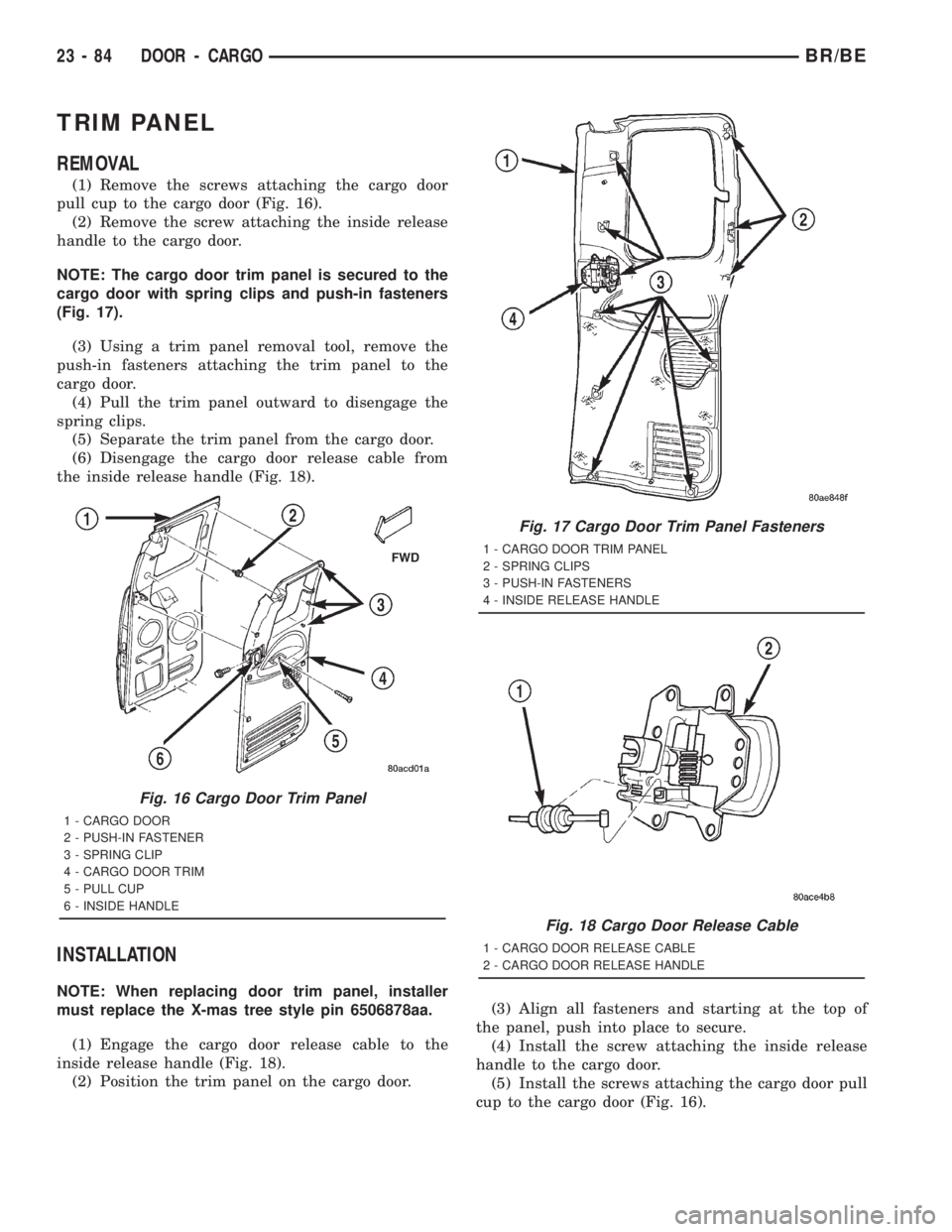
pull cup to the cargo door (Fig. 16).
(2) Remove the screw attaching the inside release
handle to the cargo door.
NOTE: The cargo door trim panel is secured to the
cargo door with spring clips and push-in fasteners
(Fig. 17).
(3) Using a trim panel removal tool, remove the
push-in fasteners attaching the trim panel to the
cargo door.
(4) Pull the trim panel outward to disengage the
spring clips.
(5) Separate the trim panel from the cargo door.
(6) Disengage the cargo door release cable from
the inside release handle (Fig. 18).
INSTALLATION
NOTE: When replacing door trim panel, installer
must replace the X-mas tree style pin 6506878aa.
(1) Engage the cargo door release cable to the
inside release handle (Fig. 18).
(2) Position the trim panel on the cargo door.(3) Align all fasteners and starting at the top of
the panel, push into place to secure.
(4) Install the screw attaching the inside release
handle to the cargo door.
(5) Install the screws attaching the cargo door pull
cup to the cargo door (Fig. 16).
Fig. 16 Cargo Door Trim Panel
1 - CARGO DOOR
2 - PUSH-IN FASTENER
3 - SPRING CLIP
4 - CARGO DOOR TRIM
5 - PULL CUP
6 - INSIDE HANDLE
Fig. 17 Cargo Door Trim Panel Fasteners
1 - CARGO DOOR TRIM PANEL
2 - SPRING CLIPS
3 - PUSH-IN FASTENERS
4 - INSIDE RELEASE HANDLE
Fig. 18 Cargo Door Release Cable
1 - CARGO DOOR RELEASE CABLE
2 - CARGO DOOR RELEASE HANDLE
23 - 84 DOOR - CARGOBR/BE
Page 2666 of 2889
(2) Remove air cleaner from wheelhouse (DIESEL
ONLY).
(3) Remove coolant overflow bottle (V-10 ONLY).
(4) Remove battery tray (Refer to 8 - ELECTRI-
CAL/BATTERY SYSTEM/TRAY - REMOVAL).
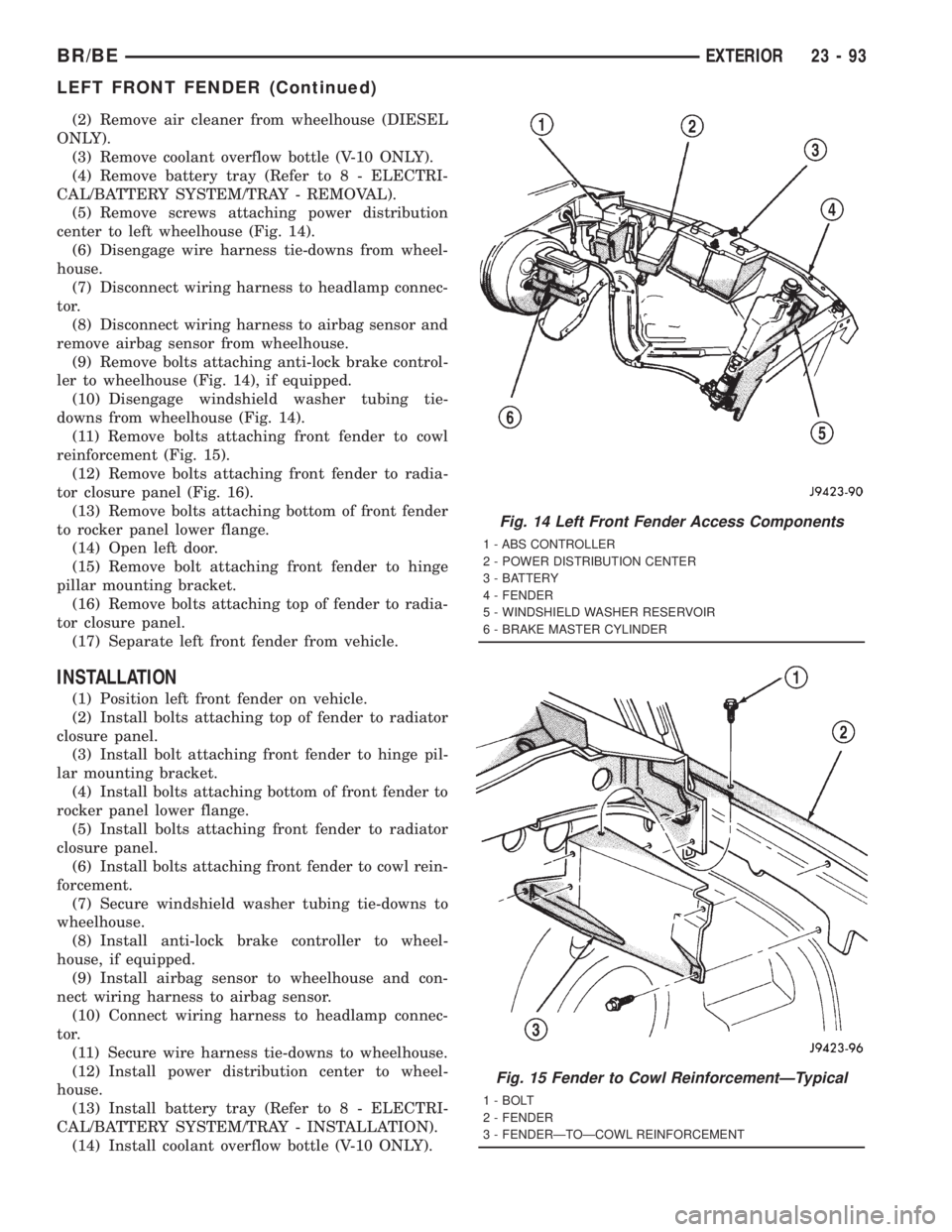
(5) Remove screws attaching power distribution
center to left wheelhouse (Fig. 14).
(6) Disengage wire harness tie-downs from wheel-
house.
(7) Disconnect wiring harness to headlamp connec-
tor.
(8) Disconnect wiring harness to airbag sensor and
remove airbag sensor from wheelhouse.
(9) Remove bolts attaching anti-lock brake control-
ler to wheelhouse (Fig. 14), if equipped.
(10) Disengage windshield washer tubing tie-
downs from wheelhouse (Fig. 14).
(11) Remove bolts attaching front fender to cowl
reinforcement (Fig. 15).
(12) Remove bolts attaching front fender to radia-
tor closure panel (Fig. 16).
(13) Remove bolts attaching bottom of front fender
to rocker panel lower flange.
(14) Open left door.
(15) Remove bolt attaching front fender to hinge
pillar mounting bracket.
(16) Remove bolts attaching top of fender to radia-
tor closure panel.
(17) Separate left front fender from vehicle.
INSTALLATION
(1) Position left front fender on vehicle.
(2) Install bolts attaching top of fender to radiator
closure panel.
(3) Install bolt attaching front fender to hinge pil-
lar mounting bracket.
(4) Install bolts attaching bottom of front fender to
rocker panel lower flange.
(5) Install bolts attaching front fender to radiator
closure panel.
(6) Install bolts attaching front fender to cowl rein-
forcement.
(7) Secure windshield washer tubing tie-downs to
wheelhouse.
(8) Install anti-lock brake controller to wheel-
house, if equipped.
(9) Install airbag sensor to wheelhouse and con-
nect wiring harness to airbag sensor.
(10) Connect wiring harness to headlamp connec-
tor.
(11) Secure wire harness tie-downs to wheelhouse.
(12) Install power distribution center to wheel-
house.
(13) Install battery tray (Refer to 8 - ELECTRI-
CAL/BATTERY SYSTEM/TRAY - INSTALLATION).
(14) Install coolant overflow bottle (V-10 ONLY).
Fig. 14 Left Front Fender Access Components
1 - ABS CONTROLLER
2 - POWER DISTRIBUTION CENTER
3 - BATTERY
4 - FENDER
5 - WINDSHIELD WASHER RESERVOIR
6 - BRAKE MASTER CYLINDER
Fig. 15 Fender to Cowl ReinforcementÐTypical
1 - BOLT
2 - FENDER
3 - FENDERÐTOÐCOWL REINFORCEMENT
BR/BEEXTERIOR 23 - 93
LEFT FRONT FENDER (Continued)