2001 DODGE RAM lock
[x] Cancel search: lockPage 1201 of 2889
(3) Apply MopartGEN II Silicone Rubber Adhe-
sive Sealant, or equivalent, to the four corner joints.
An excessive amount of sealant is not required to
ensure a leak proof seal. However, an excessive
amount of sealant may reduce the effectiveness of
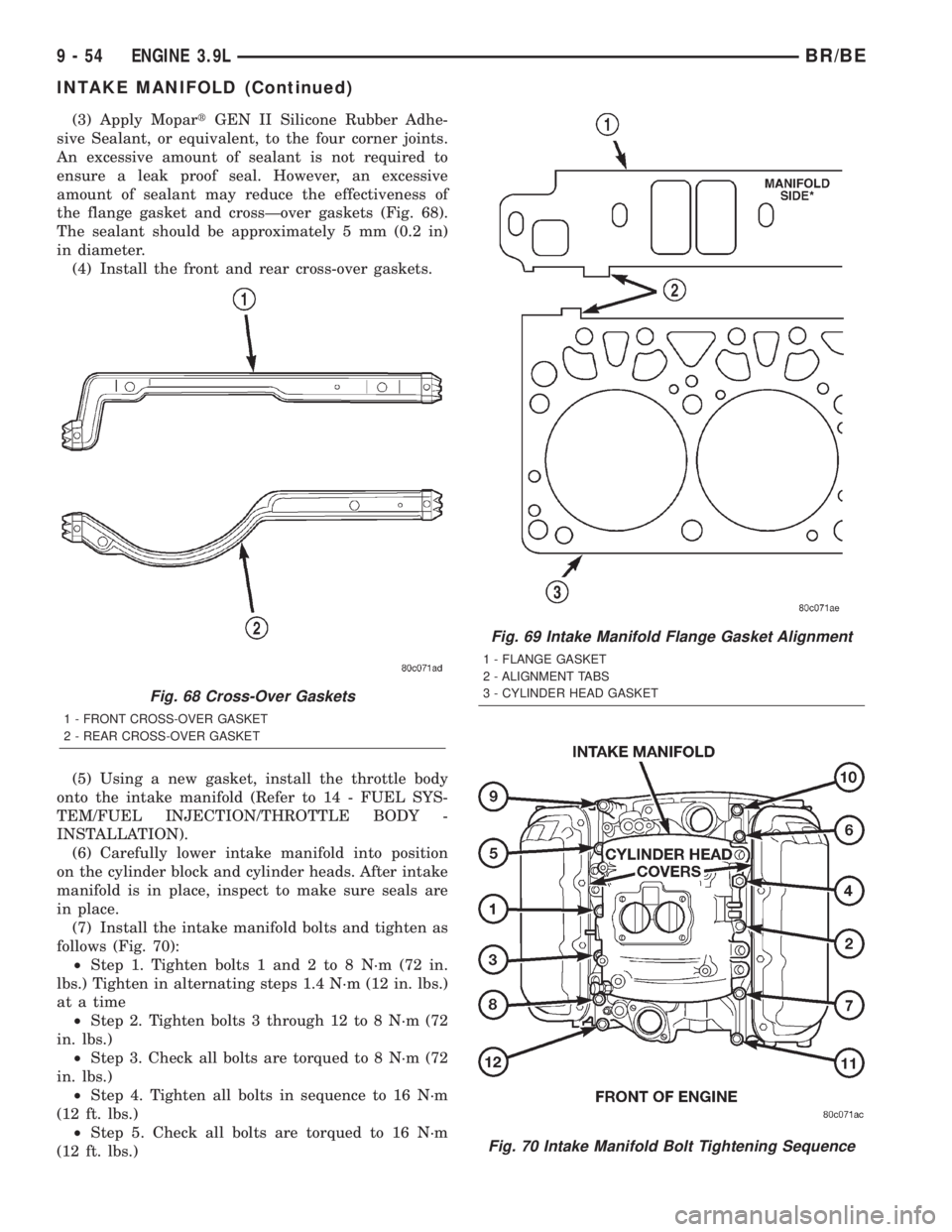
the flange gasket and crossÐover gaskets (Fig. 68).
The sealant should be approximately 5 mm (0.2 in)
in diameter.
(4) Install the front and rear cross-over gaskets.
(5) Using a new gasket, install the throttle body
onto the intake manifold (Refer to 14 - FUEL SYS-
TEM/FUEL INJECTION/THROTTLE BODY -
INSTALLATION).
(6) Carefully lower intake manifold into position
on the cylinder block and cylinder heads. After intake
manifold is in place, inspect to make sure seals are
in place.
(7) Install the intake manifold bolts and tighten as
follows (Fig. 70):
²Step 1. Tighten bolts 1 and 2 to 8 N´m (72 in.
lbs.) Tighten in alternating steps 1.4 N´m (12 in. lbs.)
at a time
²Step 2. Tighten bolts 3 through 12 to 8 N´m (72
in. lbs.)
²Step 3. Check all bolts are torqued to 8 N´m (72
in. lbs.)
²Step 4. Tighten all bolts in sequence to 16 N´m
(12 ft. lbs.)
²Step 5. Check all bolts are torqued to 16 N´m
(12 ft. lbs.)
Fig. 68 Cross-Over Gaskets
1 - FRONT CROSS-OVER GASKET
2 - REAR CROSS-OVER GASKET
Fig. 69 Intake Manifold Flange Gasket Alignment
1 - FLANGE GASKET
2 - ALIGNMENT TABS
3 - CYLINDER HEAD GASKET
Fig. 70 Intake Manifold Bolt Tightening Sequence
9 - 54 ENGINE 3.9LBR/BE
INTAKE MANIFOLD (Continued)
Page 1203 of 2889
(5) Assemble exhaust pipe to manifold and secure
with bolts, nuts and retainers. Tighten the bolts and
nuts to 34 N´m (25 ft. lbs.) torque.
(6) Lower the vehicle.
(7) Connect the negative cable to the battery.
TIMING BELT / CHAIN
COVER(S)
REMOVAL
(1) Disconnect the battery negative cable.
(2) Drain cooling system (Refer to 7 - COOLING -
STANDARD PROCEDURE).
(3) Remove the serpentine belt (Refer to 7 - COOL-
ING/ACCESSORY DRIVE/DRIVE BELTS - REMOV-
AL).
(4) Remove water pump (Refer to 7 - COOLING/
ENGINE/WATER PUMP - REMOVAL).
(5) Remove power steering pump (Refer to 19 -
STEERING/PUMP - REMOVAL).
(6) Remove vibration damper (Refer to 9 -
ENGINE/ENGINE BLOCK/VIBRATION DAMPER -
REMOVAL).
(7) Loosen oil pan bolts and remove the front bolt
at each side.
(8) Remove the cover bolts.
(9) Remove chain case cover and gasket using
extreme caution to avoid damaging oil pan gasket.
(10) From the inside of the cover tap the front
crankshaft oil seal outward. Be careful not to damage
the timing cover sealing surface.
INSTALLATION
(1) Be sure mating surfaces of chain case cover
and cylinder block are clean and free from burrs.
(2) Using a new cover gasket, carefully install
chain case cover to avoid damaging oil pan gasket.
Use a small amount of MopartGEN II Silicone Rub-
ber Adhesive Sealant, or equivalent, at the joint
between timing chain cover gasket and the oil pan
gasket. Finger tighten the timing chain cover bolts at
this time.
CAUTION: If chain cover is replaced for any reason,
be sure the oil hole (passenger side of cover) is
plugged.
NOTE: Special Tool 6635 must be used to align
cover and seal with crankshaft.
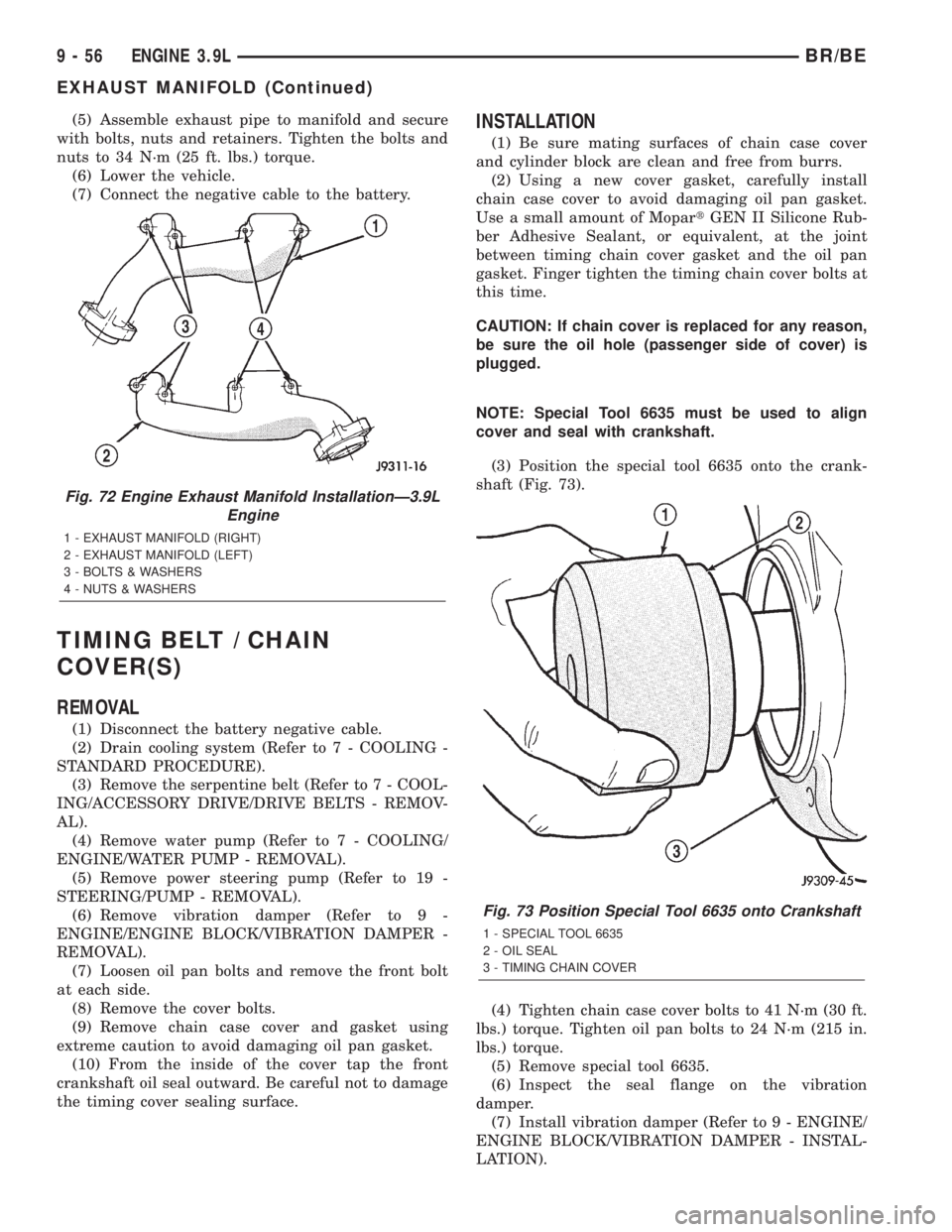
(3) Position the special tool 6635 onto the crank-
shaft (Fig. 73).
(4) Tighten chain case cover bolts to 41 N´m (30 ft.
lbs.) torque. Tighten oil pan bolts to 24 N´m (215 in.
lbs.) torque.
(5) Remove special tool 6635.
(6) Inspect the seal flange on the vibration
damper.
(7) Install vibration damper (Refer to 9 - ENGINE/
ENGINE BLOCK/VIBRATION DAMPER - INSTAL-
LATION).
Fig. 72 Engine Exhaust Manifold InstallationÐ3.9L
Engine
1 - EXHAUST MANIFOLD (RIGHT)
2 - EXHAUST MANIFOLD (LEFT)
3 - BOLTS & WASHERS
4 - NUTS & WASHERS
Fig. 73 Position Special Tool 6635 onto Crankshaft
1 - SPECIAL TOOL 6635
2 - OIL SEAL
3 - TIMING CHAIN COVER
9 - 56 ENGINE 3.9LBR/BE
EXHAUST MANIFOLD (Continued)
Page 1204 of 2889
(8) Install water pump (Refer to 7 - COOLING/EN-
GINE/WATER PUMP - INSTALLATION).
(9) Install power steering pump (Refer to 19 -
STEERING/PUMP - INSTALLATION).
(10) Install the serpentine belt (Refer to 7 - COOL-
ING/ACCESSORY DRIVE/DRIVE BELTS - INSTAL-
LATION).
(11) Install the cooling system fan (Refer to 7 -
COOLING/ENGINE/FAN DRIVE VISCOUS
CLUTCH - INSTALLATION).
(12) Position the fan shroud and install the bolts.
Tighten the bolts to 11 N´m (95 in. lbs.) torque.
(13) Fill cooling system (Refer to 7 - COOLING -
STANDARD PROCEDURE).
(14) Connect the negative cable to the battery.
TIMING BELT/CHAIN
TENSIONER
DESCRIPTION
The timing chain tensioner is a stamped steel con-
stant tension mechanical design. It is mounted to the
front of the engine, behind the timing chain drive.
OPERATION
The timing chain tension is maintained by routing
the timing chain through the tensioner assembly. A
nylon covered spring steel arm presses on the timing
chain maintaining the correct chain tension.
TIMING BELT/CHAIN AND
SPROCKETS
REMOVAL
(1) Disconnect battery negative cable.
(2) Drain cooling system (Refer to 7 - COOLING -
STANDARD PROCEDURE).
(3) Remove timing chain cover (Refer to 9 -
ENGINE/VALVE TIMING/TIMING BELT / CHAIN
COVER(S) - REMOVAL).
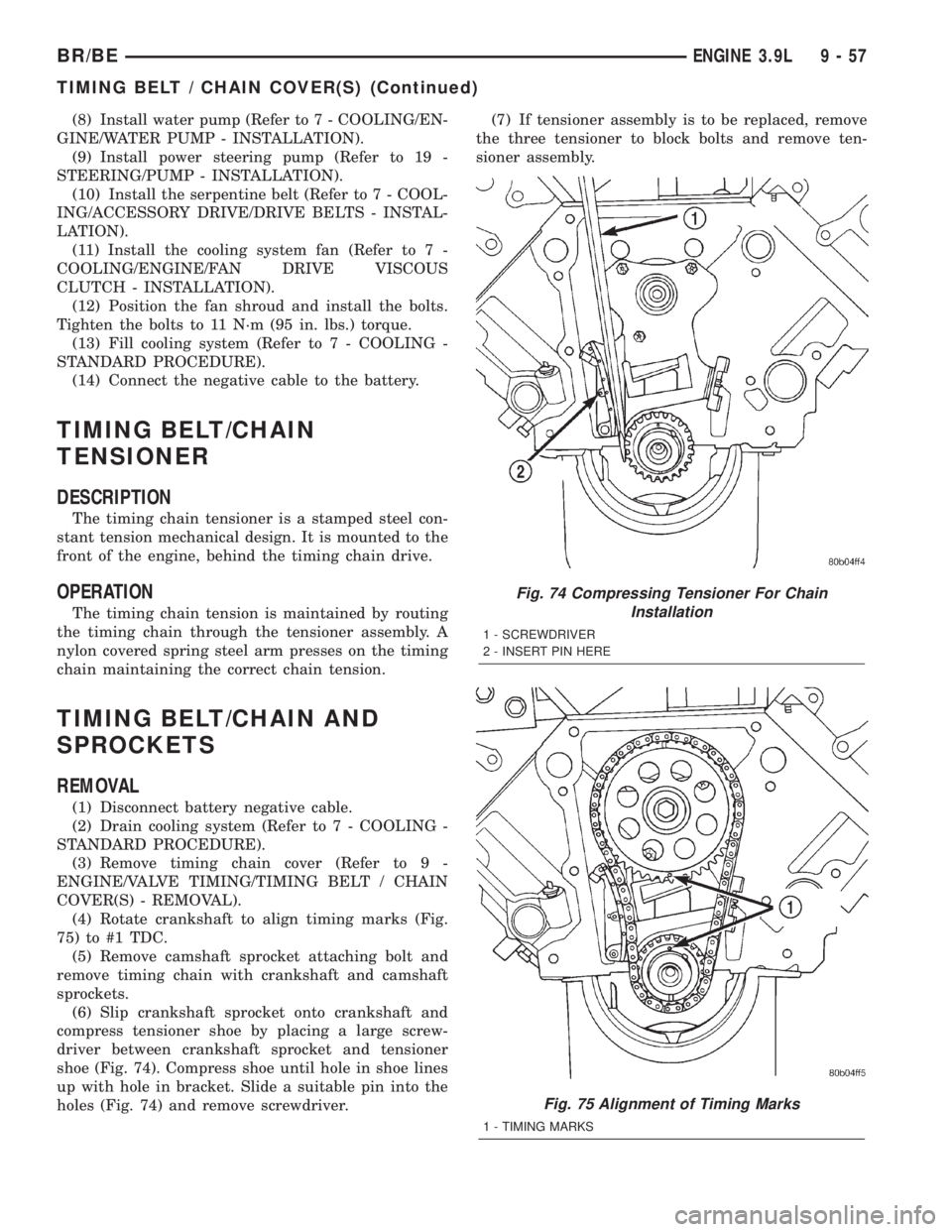
(4) Rotate crankshaft to align timing marks (Fig.
75) to #1 TDC.
(5) Remove camshaft sprocket attaching bolt and
remove timing chain with crankshaft and camshaft
sprockets.
(6) Slip crankshaft sprocket onto crankshaft and
compress tensioner shoe by placing a large screw-
driver between crankshaft sprocket and tensioner
shoe (Fig. 74). Compress shoe until hole in shoe lines
up with hole in bracket. Slide a suitable pin into the
holes (Fig. 74) and remove screwdriver.(7) If tensioner assembly is to be replaced, remove
the three tensioner to block bolts and remove ten-
sioner assembly.
Fig. 74 Compressing Tensioner For Chain
Installation
1 - SCREWDRIVER
2 - INSERT PIN HERE
Fig. 75 Alignment of Timing Marks
1 - TIMING MARKS
BR/BEENGINE 3.9L 9 - 57
TIMING BELT / CHAIN COVER(S) (Continued)
Page 1205 of 2889
INSPECTIONÐMEASURING TIMING CHAIN
STRETCH
NOTE: Timing chain tensioner must be removed for
this operation.
(1) Place a scale next to the timing chain so that
any movement of the chain can be measured.
(2) Place a torque wrench and socket over cam-
shaft sprocket attaching bolt. Apply torque in the
direction of crankshaft rotation to take up slack; 41
N´m (30 ft. lbs.) torque with cylinder head installed
or 20 N´m (15 ft. lbs.) torque with cylinder head
removed. With torque applied to the camshaft
sprocket bolt, crankshaft should not be permitted to
move. It may be necessary to block the crankshaft to
prevent rotation.
(3) Hold a scale with dimensional reading even
with the edge of a chain link. With cylinder heads
installed, apply 14 N´m (30 ft. lbs.) torque in the
reverse direction. With the cylinder heads removed,
apply 20 N´m (15 ft. lbs.) torque in the reverse direc-
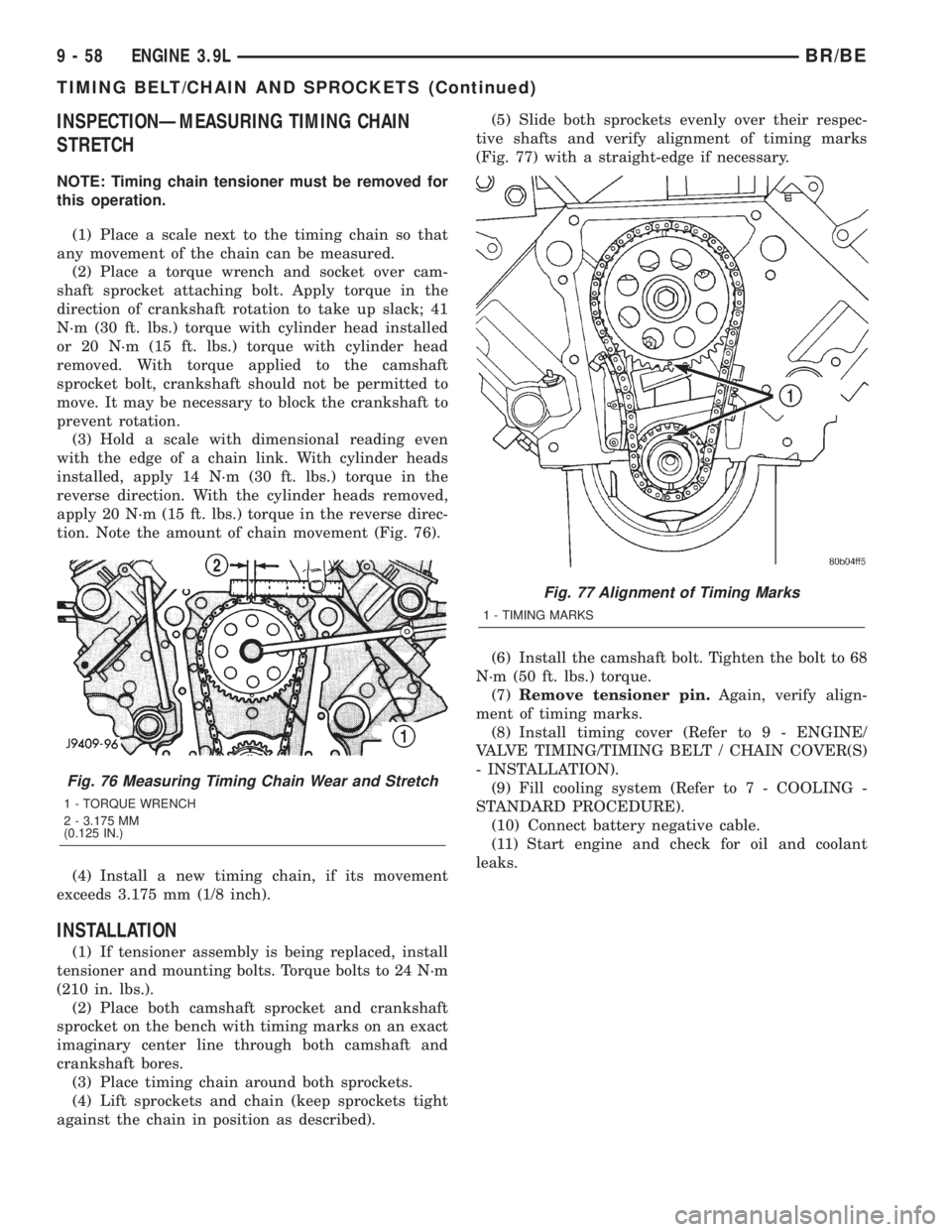
tion. Note the amount of chain movement (Fig. 76).
(4) Install a new timing chain, if its movement
exceeds 3.175 mm (1/8 inch).
INSTALLATION
(1) If tensioner assembly is being replaced, install
tensioner and mounting bolts. Torque bolts to 24 N´m
(210 in. lbs.).
(2) Place both camshaft sprocket and crankshaft
sprocket on the bench with timing marks on an exact
imaginary center line through both camshaft and
crankshaft bores.
(3) Place timing chain around both sprockets.
(4) Lift sprockets and chain (keep sprockets tight
against the chain in position as described).(5) Slide both sprockets evenly over their respec-
tive shafts and verify alignment of timing marks
(Fig. 77) with a straight-edge if necessary.
(6) Install the camshaft bolt. Tighten the bolt to 68
N´m (50 ft. lbs.) torque.
(7)Remove tensioner pin.Again, verify align-
ment of timing marks.
(8) Install timing cover (Refer to 9 - ENGINE/
VALVE TIMING/TIMING BELT / CHAIN COVER(S)
- INSTALLATION).
(9) Fill cooling system (Refer to 7 - COOLING -
STANDARD PROCEDURE).
(10) Connect battery negative cable.
(11) Start engine and check for oil and coolant
leaks.
Fig. 76 Measuring Timing Chain Wear and Stretch
1 - TORQUE WRENCH
2 - 3.175 MM
(0.125 IN.)
Fig. 77 Alignment of Timing Marks
1 - TIMING MARKS
9 - 58 ENGINE 3.9LBR/BE
TIMING BELT/CHAIN AND SPROCKETS (Continued)
Page 1206 of 2889
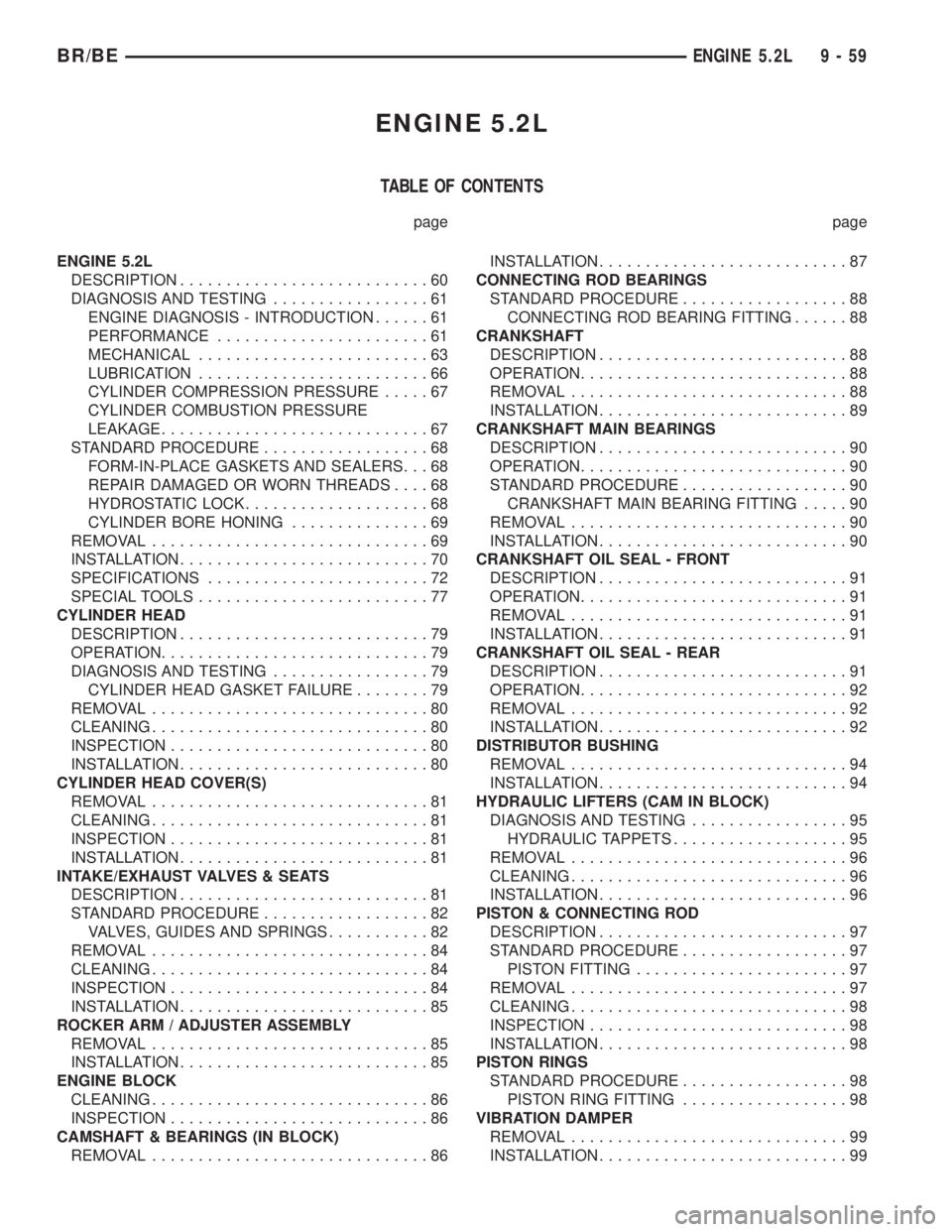
ENGINE 5.2L
TABLE OF CONTENTS
page page
ENGINE 5.2L
DESCRIPTION...........................60
DIAGNOSIS AND TESTING.................61
ENGINE DIAGNOSIS - INTRODUCTION......61
PERFORMANCE.......................61
MECHANICAL.........................63
LUBRICATION.........................66
CYLINDER COMPRESSION PRESSURE.....67
CYLINDER COMBUSTION PRESSURE
LEAKAGE.............................67
STANDARD PROCEDURE..................68
FORM-IN-PLACE GASKETS AND SEALERS. . . 68
REPAIR DAMAGED OR WORN THREADS....68
HYDROSTATIC LOCK....................68
CYLINDER BORE HONING...............69
REMOVAL..............................69
INSTALLATION...........................70
SPECIFICATIONS........................72
SPECIAL TOOLS.........................77
CYLINDER HEAD
DESCRIPTION...........................79
OPERATION.............................79
DIAGNOSIS AND TESTING.................79
CYLINDER HEAD GASKET FAILURE........79
REMOVAL..............................80
CLEANING..............................80
INSPECTION............................80
INSTALLATION...........................80
CYLINDER HEAD COVER(S)
REMOVAL..............................81
CLEANING..............................81
INSPECTION............................81
INSTALLATION...........................81
INTAKE/EXHAUST VALVES & SEATS
DESCRIPTION...........................81
STANDARD PROCEDURE..................82
VALVES, GUIDES AND SPRINGS...........82
REMOVAL..............................84
CLEANING..............................84
INSPECTION............................84
INSTALLATION...........................85
ROCKER ARM / ADJUSTER ASSEMBLY
REMOVAL..............................85
INSTALLATION...........................85
ENGINE BLOCK
CLEANING..............................86
INSPECTION............................86
CAMSHAFT & BEARINGS (IN BLOCK)
REMOVAL..............................86INSTALLATION...........................87
CONNECTING ROD BEARINGS
STANDARD PROCEDURE..................88
CONNECTING ROD BEARING FITTING......88
CRANKSHAFT
DESCRIPTION...........................88
OPERATION.............................88
REMOVAL..............................88
INSTALLATION...........................89
CRANKSHAFT MAIN BEARINGS
DESCRIPTION...........................90
OPERATION.............................90
STANDARD PROCEDURE..................90
CRANKSHAFT MAIN BEARING FITTING.....90
REMOVAL..............................90
INSTALLATION...........................90
CRANKSHAFT OIL SEAL - FRONT
DESCRIPTION...........................91
OPERATION.............................91
REMOVAL..............................91
INSTALLATION...........................91
CRANKSHAFT OIL SEAL - REAR
DESCRIPTION...........................91
OPERATION.............................92
REMOVAL..............................92
INSTALLATION...........................92
DISTRIBUTOR BUSHING
REMOVAL..............................94
INSTALLATION...........................94
HYDRAULIC LIFTERS (CAM IN BLOCK)
DIAGNOSIS AND TESTING.................95
HYDRAULIC TAPPETS...................95
REMOVAL..............................96
CLEANING..............................96
INSTALLATION...........................96
PISTON & CONNECTING ROD
DESCRIPTION...........................97
STANDARD PROCEDURE..................97
PISTON FITTING.......................97
REMOVAL..............................97
CLEANING..............................98
INSPECTION............................98
INSTALLATION...........................98
PISTON RINGS
STANDARD PROCEDURE..................98
PISTON RING FITTING..................98
VIBRATION DAMPER
REMOVAL..............................99
INSTALLATION...........................99
BR/BEENGINE 5.2L 9 - 59
Page 1207 of 2889
FRONT MOUNT
REMOVAL.............................100
INSTALLATION..........................100
REAR MOUNT
REMOVAL.............................101
INSTALLATION..........................101
LUBRICATION
DESCRIPTION..........................102
OPERATION............................102
DIAGNOSIS AND TESTING................104
ENGINE OIL LEAKS....................104
ENGINE OIL PRESSURE................104
OIL
STANDARD PROCEDURE.................104
ENGINE OIL..........................104
OIL FILTER
REMOVAL.............................105
INSTALLATION..........................105
OIL PAN
REMOVAL.............................105
CLEANING.............................106
INSPECTION...........................106
INSTALLATION..........................106
OIL PUMP
REMOVAL.............................107
DISASSEMBLY..........................107INSPECTION...........................107
ASSEMBLY............................109
INSTALLATION..........................109
INTAKE MANIFOLD
DESCRIPTION..........................109
OPERATION............................109
DIAGNOSIS AND TESTING................110
INTAKE MANIFOLD LEAKAGE............110
REMOVAL.............................110
CLEANING.............................110
INSPECTION...........................110
INSTALLATION..........................111
EXHAUST MANIFOLD
DESCRIPTION..........................112
OPERATION............................112
REMOVAL.............................112
CLEANING.............................112
INSPECTION...........................112
INSTALLATION..........................113
TIMING BELT / CHAIN COVER(S)
REMOVAL.............................113
INSTALLATION..........................113
TIMING BELT/CHAIN AND SPROCKETS
REMOVAL.............................114
INSPECTION...........................114
INSTALLATION..........................115
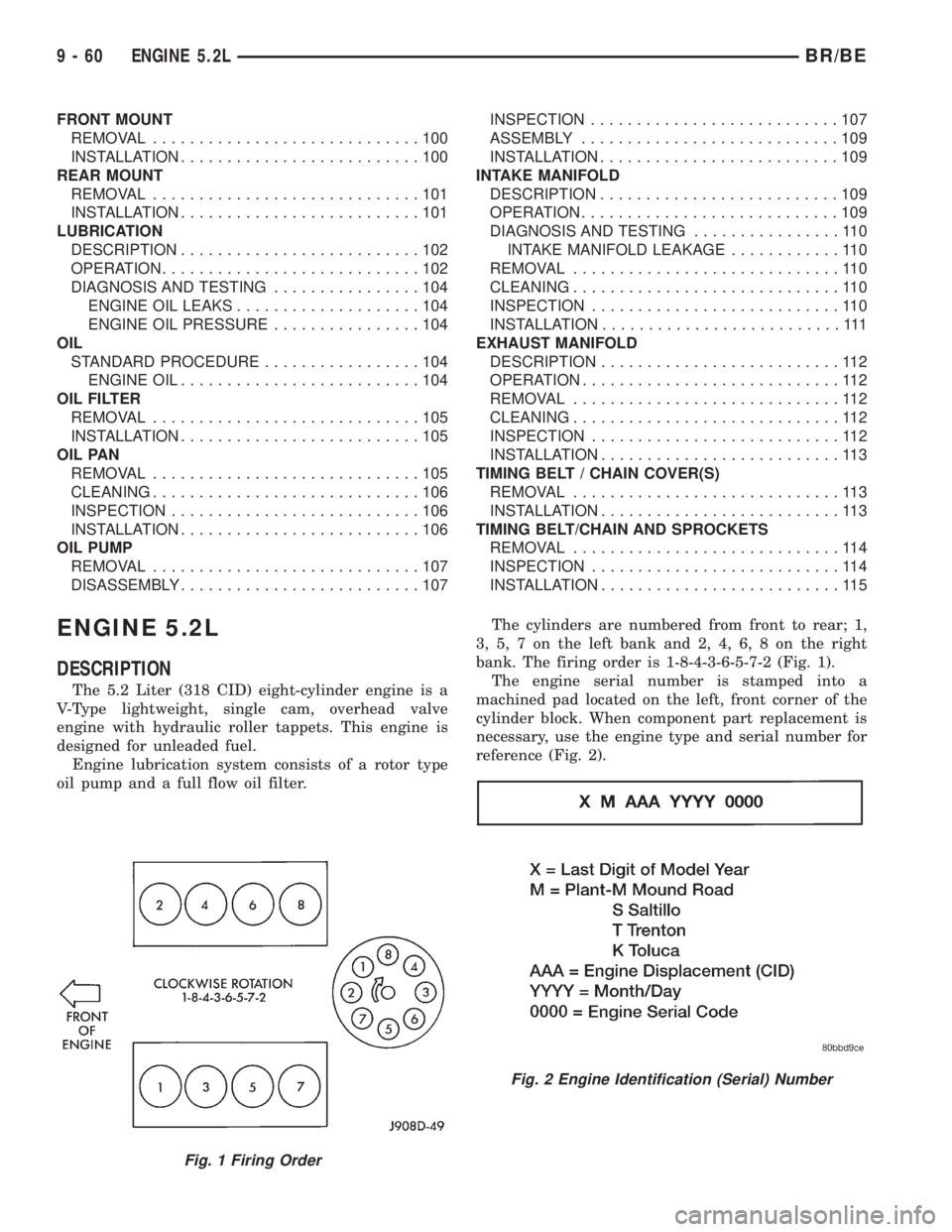
ENGINE 5.2L
DESCRIPTION
The 5.2 Liter (318 CID) eight-cylinder engine is a
V-Type lightweight, single cam, overhead valve
engine with hydraulic roller tappets. This engine is
designed for unleaded fuel.
Engine lubrication system consists of a rotor type
oil pump and a full flow oil filter.The cylinders are numbered from front to rear; 1,
3, 5, 7 on the left bank and 2, 4, 6, 8 on the right
bank. The firing order is 1-8-4-3-6-5-7-2 (Fig. 1).
The engine serial number is stamped into a
machined pad located on the left, front corner of the
cylinder block. When component part replacement is
necessary, use the engine type and serial number for
reference (Fig. 2).
Fig. 1 Firing Order
Fig. 2 Engine Identification (Serial) Number
9 - 60 ENGINE 5.2LBR/BE
Page 1208 of 2889
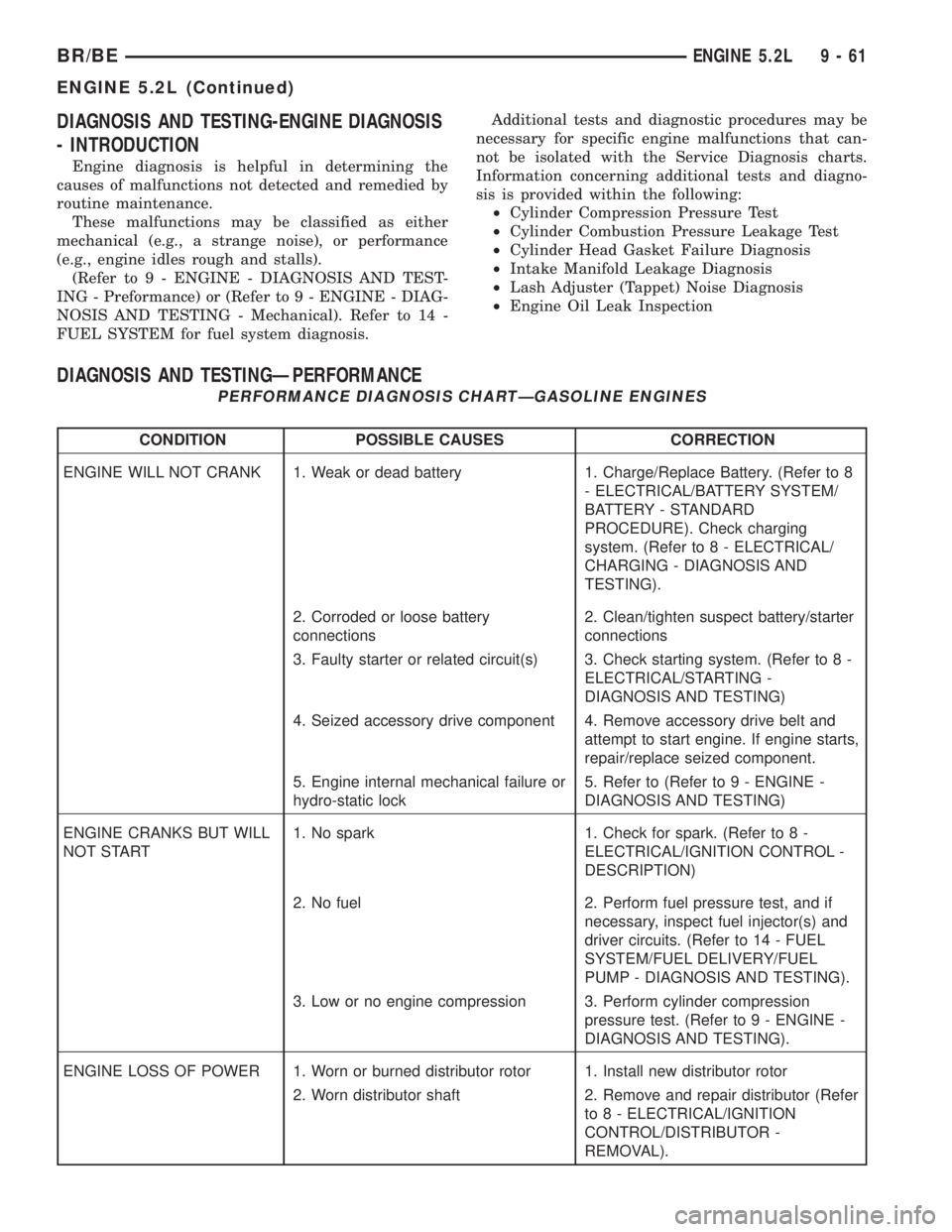
DIAGNOSIS AND TESTING-ENGINE DIAGNOSIS
- INTRODUCTION
Engine diagnosis is helpful in determining the
causes of malfunctions not detected and remedied by
routine maintenance.
These malfunctions may be classified as either
mechanical (e.g., a strange noise), or performance
(e.g., engine idles rough and stalls).
(Refer to 9 - ENGINE - DIAGNOSIS AND TEST-
ING - Preformance) or (Refer to 9 - ENGINE - DIAG-
NOSIS AND TESTING - Mechanical). Refer to 14 -
FUEL SYSTEM for fuel system diagnosis.Additional tests and diagnostic procedures may be
necessary for specific engine malfunctions that can-
not be isolated with the Service Diagnosis charts.
Information concerning additional tests and diagno-
sis is provided within the following:
²Cylinder Compression Pressure Test
²Cylinder Combustion Pressure Leakage Test
²Cylinder Head Gasket Failure Diagnosis
²Intake Manifold Leakage Diagnosis
²Lash Adjuster (Tappet) Noise Diagnosis
²Engine Oil Leak Inspection
DIAGNOSIS AND TESTINGÐPERFORMANCE
PERFORMANCE DIAGNOSIS CHARTÐGASOLINE ENGINES
CONDITION POSSIBLE CAUSES CORRECTION
ENGINE WILL NOT CRANK 1. Weak or dead battery 1. Charge/Replace Battery. (Refer to 8
- ELECTRICAL/BATTERY SYSTEM/
BATTERY - STANDARD
PROCEDURE). Check charging
system. (Refer to 8 - ELECTRICAL/
CHARGING - DIAGNOSIS AND
TESTING).
2. Corroded or loose battery
connections2. Clean/tighten suspect battery/starter
connections
3. Faulty starter or related circuit(s) 3. Check starting system. (Refer to 8 -
ELECTRICAL/STARTING -
DIAGNOSIS AND TESTING)
4. Seized accessory drive component 4. Remove accessory drive belt and
attempt to start engine. If engine starts,
repair/replace seized component.
5. Engine internal mechanical failure or
hydro-static lock5. Refer to (Refer to 9 - ENGINE -
DIAGNOSIS AND TESTING)
ENGINE CRANKS BUT WILL
NOT START1. No spark 1. Check for spark. (Refer to 8 -
ELECTRICAL/IGNITION CONTROL -
DESCRIPTION)
2. No fuel 2. Perform fuel pressure test, and if
necessary, inspect fuel injector(s) and
driver circuits. (Refer to 14 - FUEL
SYSTEM/FUEL DELIVERY/FUEL
PUMP - DIAGNOSIS AND TESTING).
3. Low or no engine compression 3. Perform cylinder compression
pressure test. (Refer to 9 - ENGINE -
DIAGNOSIS AND TESTING).
ENGINE LOSS OF POWER 1. Worn or burned distributor rotor 1. Install new distributor rotor
2. Worn distributor shaft 2. Remove and repair distributor (Refer
to 8 - ELECTRICAL/IGNITION
CONTROL/DISTRIBUTOR -
REMOVAL).
BR/BEENGINE 5.2L 9 - 61
ENGINE 5.2L (Continued)
Page 1214 of 2889
DIAGNOSIS AND TESTINGÐCYLINDER
COMPRESSION PRESSURE
The results of a cylinder compression pressure test
can be utilized to diagnose several engine malfunc-
tions.
Ensure the battery is completely charged and the
engine starter motor is in good operating condition.
Otherwise, the indicated compression pressures may
not be valid for diagnosis purposes.
(1) Clean the spark plug recesses with compressed
air.
(2) Remove the spark plugs (Refer to 8 - ELEC-
TRICAL/IGNITION CONTROL/SPARK PLUG -
REMOVAL).
(3) Secure the throttle in the wide-open position.
(4) Disconnect the ignition coil.
(5) Insert a compression pressure gauge and rotate
the engine with the engine starter motor for three
revolutions.
(6) Record the compression pressure on the third
revolution. Continue the test for the remaining cylin-
ders.
(Refer to 9 - ENGINE - SPECIFICATIONS) for the
correct engine compression pressures.
DIAGNOSIS AND TESTINGÐCYLINDER
COMBUSTION PRESSURE LEAKAGE
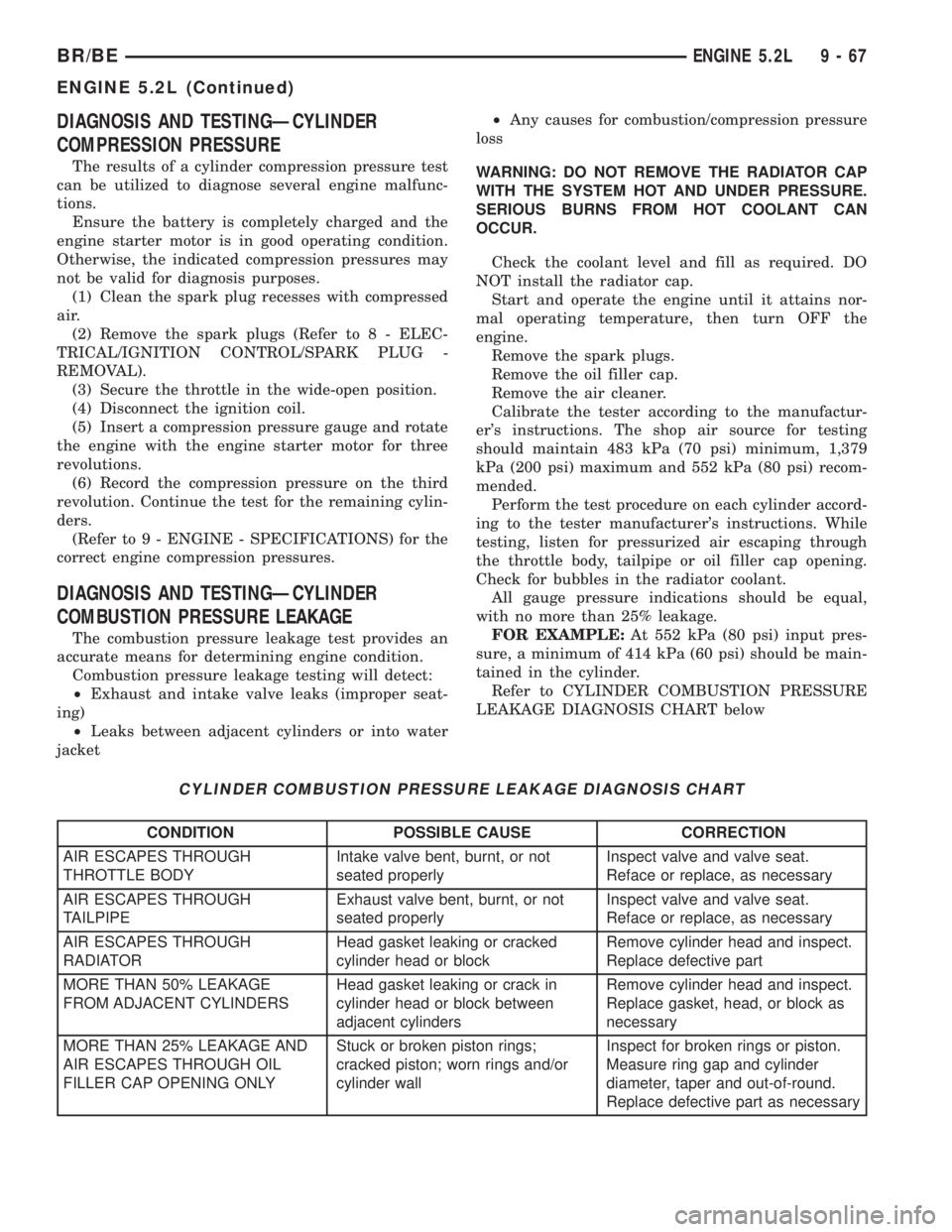
The combustion pressure leakage test provides an
accurate means for determining engine condition.
Combustion pressure leakage testing will detect:
²Exhaust and intake valve leaks (improper seat-
ing)
²Leaks between adjacent cylinders or into water
jacket²Any causes for combustion/compression pressure
loss
WARNING: DO NOT REMOVE THE RADIATOR CAP
WITH THE SYSTEM HOT AND UNDER PRESSURE.
SERIOUS BURNS FROM HOT COOLANT CAN
OCCUR.
Check the coolant level and fill as required. DO
NOT install the radiator cap.
Start and operate the engine until it attains nor-
mal operating temperature, then turn OFF the
engine.
Remove the spark plugs.
Remove the oil filler cap.
Remove the air cleaner.
Calibrate the tester according to the manufactur-
er's instructions. The shop air source for testing
should maintain 483 kPa (70 psi) minimum, 1,379
kPa (200 psi) maximum and 552 kPa (80 psi) recom-
mended.
Perform the test procedure on each cylinder accord-
ing to the tester manufacturer's instructions. While
testing, listen for pressurized air escaping through
the throttle body, tailpipe or oil filler cap opening.
Check for bubbles in the radiator coolant.
All gauge pressure indications should be equal,
with no more than 25% leakage.
FOR EXAMPLE:At 552 kPa (80 psi) input pres-
sure, a minimum of 414 kPa (60 psi) should be main-
tained in the cylinder.
Refer to CYLINDER COMBUSTION PRESSURE
LEAKAGE DIAGNOSIS CHART below
CYLINDER COMBUSTION PRESSURE LEAKAGE DIAGNOSIS CHART
CONDITION POSSIBLE CAUSE CORRECTION
AIR ESCAPES THROUGH
THROTTLE BODYIntake valve bent, burnt, or not
seated properlyInspect valve and valve seat.
Reface or replace, as necessary
AIR ESCAPES THROUGH
TAILPIPEExhaust valve bent, burnt, or not
seated properlyInspect valve and valve seat.
Reface or replace, as necessary
AIR ESCAPES THROUGH
RADIATORHead gasket leaking or cracked
cylinder head or blockRemove cylinder head and inspect.
Replace defective part
MORE THAN 50% LEAKAGE
FROM ADJACENT CYLINDERSHead gasket leaking or crack in
cylinder head or block between
adjacent cylindersRemove cylinder head and inspect.
Replace gasket, head, or block as
necessary
MORE THAN 25% LEAKAGE AND
AIR ESCAPES THROUGH OIL
FILLER CAP OPENING ONLYStuck or broken piston rings;
cracked piston; worn rings and/or
cylinder wallInspect for broken rings or piston.
Measure ring gap and cylinder
diameter, taper and out-of-round.
Replace defective part as necessary
BR/BEENGINE 5.2L 9 - 67
ENGINE 5.2L (Continued)