2001 DODGE RAM Valve
[x] Cancel search: ValvePage 1369 of 2889
(2) Position the oil pump cover onto the timing
chain cover. Tighten cover screws to 14 N´m (125 in.
lbs.) torque.
(3) Make sure that inner ring moves freely after
cover is installed.
(4) Install the timing chain cover (Refer to 9 -
ENGINE/VALVE TIMING/TIMING BELT / CHAIN
COVER(S) - INSTALLATION).
(5) Squirt oil into relief valve hole until oil runs
out.
(6) Install the relief valve and spring.
(7) Using a new pressure relief valve gasket,
install the relief valve plug. Tighten the plug to 20
N´m (15 ft. lbs.) torque.
(8) Install oil filter that has been filled with oil.
INTAKE MANIFOLD
DESCRIPTION
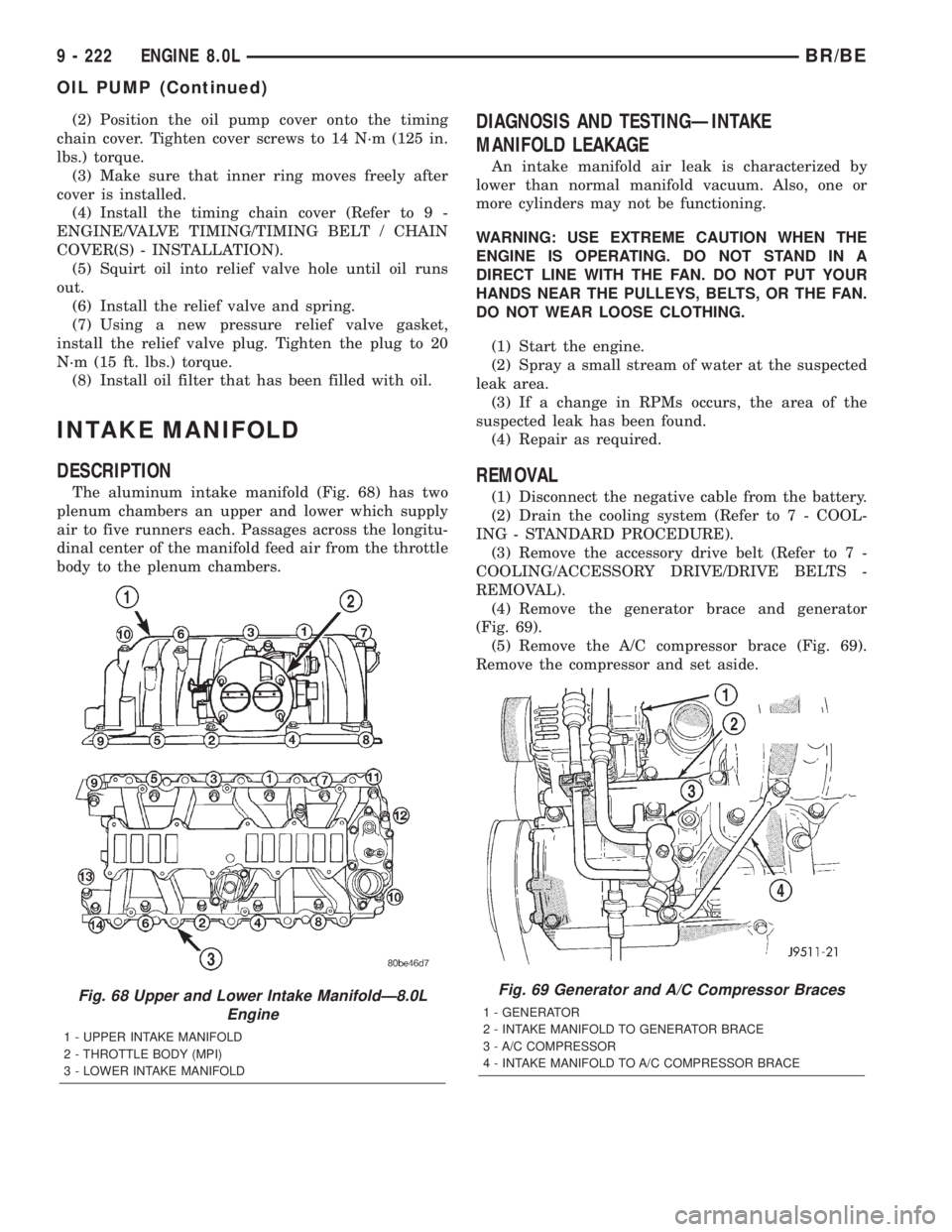
The aluminum intake manifold (Fig. 68) has two
plenum chambers an upper and lower which supply
air to five runners each. Passages across the longitu-
dinal center of the manifold feed air from the throttle
body to the plenum chambers.
DIAGNOSIS AND TESTINGÐINTAKE
MANIFOLD LEAKAGE
An intake manifold air leak is characterized by
lower than normal manifold vacuum. Also, one or
more cylinders may not be functioning.
WARNING: USE EXTREME CAUTION WHEN THE
ENGINE IS OPERATING. DO NOT STAND IN A
DIRECT LINE WITH THE FAN. DO NOT PUT YOUR
HANDS NEAR THE PULLEYS, BELTS, OR THE FAN.
DO NOT WEAR LOOSE CLOTHING.
(1) Start the engine.
(2) Spray a small stream of water at the suspected
leak area.
(3) If a change in RPMs occurs, the area of the
suspected leak has been found.
(4) Repair as required.
REMOVAL
(1) Disconnect the negative cable from the battery.
(2) Drain the cooling system (Refer to 7 - COOL-
ING - STANDARD PROCEDURE).
(3) Remove the accessory drive belt (Refer to 7 -
COOLING/ACCESSORY DRIVE/DRIVE BELTS -
REMOVAL).
(4) Remove the generator brace and generator
(Fig. 69).
(5) Remove the A/C compressor brace (Fig. 69).
Remove the compressor and set aside.
Fig. 68 Upper and Lower Intake ManifoldÐ8.0L
Engine
1 - UPPER INTAKE MANIFOLD
2 - THROTTLE BODY (MPI)
3 - LOWER INTAKE MANIFOLD
Fig. 69 Generator and A/C Compressor Braces
1 - GENERATOR
2 - INTAKE MANIFOLD TO GENERATOR BRACE
3 - A/C COMPRESSOR
4 - INTAKE MANIFOLD TO A/C COMPRESSOR BRACE
9 - 222 ENGINE 8.0LBR/BE
OIL PUMP (Continued)
Page 1373 of 2889
(10) Loosen oil pan bolts and remove the front oil
pan bolts that mount the pan to the timing chain
cover.
(11) Remove the cover bolts.
(12) Remove timing chain cover and gasket using
extreme caution to avoid damaging oil pan gasket.
(13) Inspect surface of cover. Remove any burrs or
high spots.
INSTALLATION
(1) Be sure mating surfaces of timing chain cover
and cylinder block are clean and free from burrs.
(2) Lubricate the pump rotors using petroleum
jelly or lubriplate (Refer to 9 - ENGINE/LUBRICA-
TION/OIL PUMP - INSTALLATION).
(3) Using a new cover gasket, carefully install tim-
ing chain cover to avoid damaging oil pan gasket.
Use a small amount of MopartSilicone Rubber Adhe-
sive Sealant, or equivalent, at the joint between tim-
ing chain cover gasket and the oil pan gasket. Finger
tighten the timing chain cover bolts at this time.
(4) Tighten timing chain cover bolts to 47 N´m (35
ft. lbs.) torque. Tighten oil pan bolts to 24 N´m (215
in. lbs.) torque.
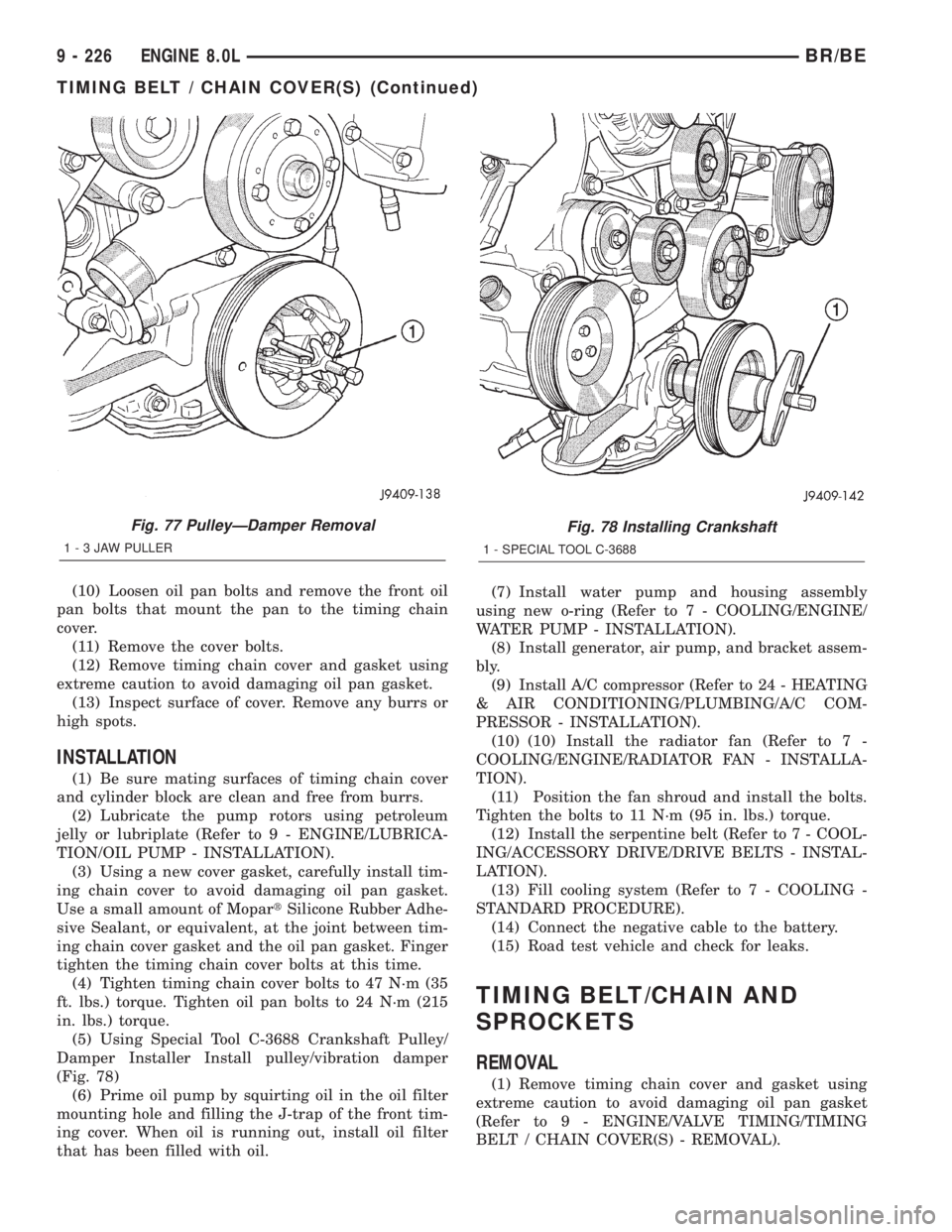
(5) Using Special Tool C-3688 Crankshaft Pulley/
Damper Installer Install pulley/vibration damper
(Fig. 78)
(6) Prime oil pump by squirting oil in the oil filter
mounting hole and filling the J-trap of the front tim-
ing cover. When oil is running out, install oil filter
that has been filled with oil.(7) Install water pump and housing assembly
using new o-ring (Refer to 7 - COOLING/ENGINE/
WATER PUMP - INSTALLATION).
(8) Install generator, air pump, and bracket assem-
bly.
(9) Install A/C compressor (Refer to 24 - HEATING
& AIR CONDITIONING/PLUMBING/A/C COM-
PRESSOR - INSTALLATION).
(10) (10) Install the radiator fan (Refer to 7 -
COOLING/ENGINE/RADIATOR FAN - INSTALLA-
TION).
(11) Position the fan shroud and install the bolts.
Tighten the bolts to 11 N´m (95 in. lbs.) torque.
(12) Install the serpentine belt (Refer to 7 - COOL-
ING/ACCESSORY DRIVE/DRIVE BELTS - INSTAL-
LATION).
(13) Fill cooling system (Refer to 7 - COOLING -
STANDARD PROCEDURE).
(14) Connect the negative cable to the battery.
(15) Road test vehicle and check for leaks.
TIMING BELT/CHAIN AND
SPROCKETS
REMOVAL
(1) Remove timing chain cover and gasket using
extreme caution to avoid damaging oil pan gasket
(Refer to 9 - ENGINE/VALVE TIMING/TIMING
BELT / CHAIN COVER(S) - REMOVAL).
Fig. 77 PulleyÐDamper Removal
1-3JAWPULLER
Fig. 78 Installing Crankshaft
1 - SPECIAL TOOL C-3688
9 - 226 ENGINE 8.0LBR/BE
TIMING BELT / CHAIN COVER(S) (Continued)
Page 1375 of 2889
(2) Turn crankshaft to line up the timing mark
with the crankshaft and camshaft centerline.
(3) Put chain on camshaft sprocket.
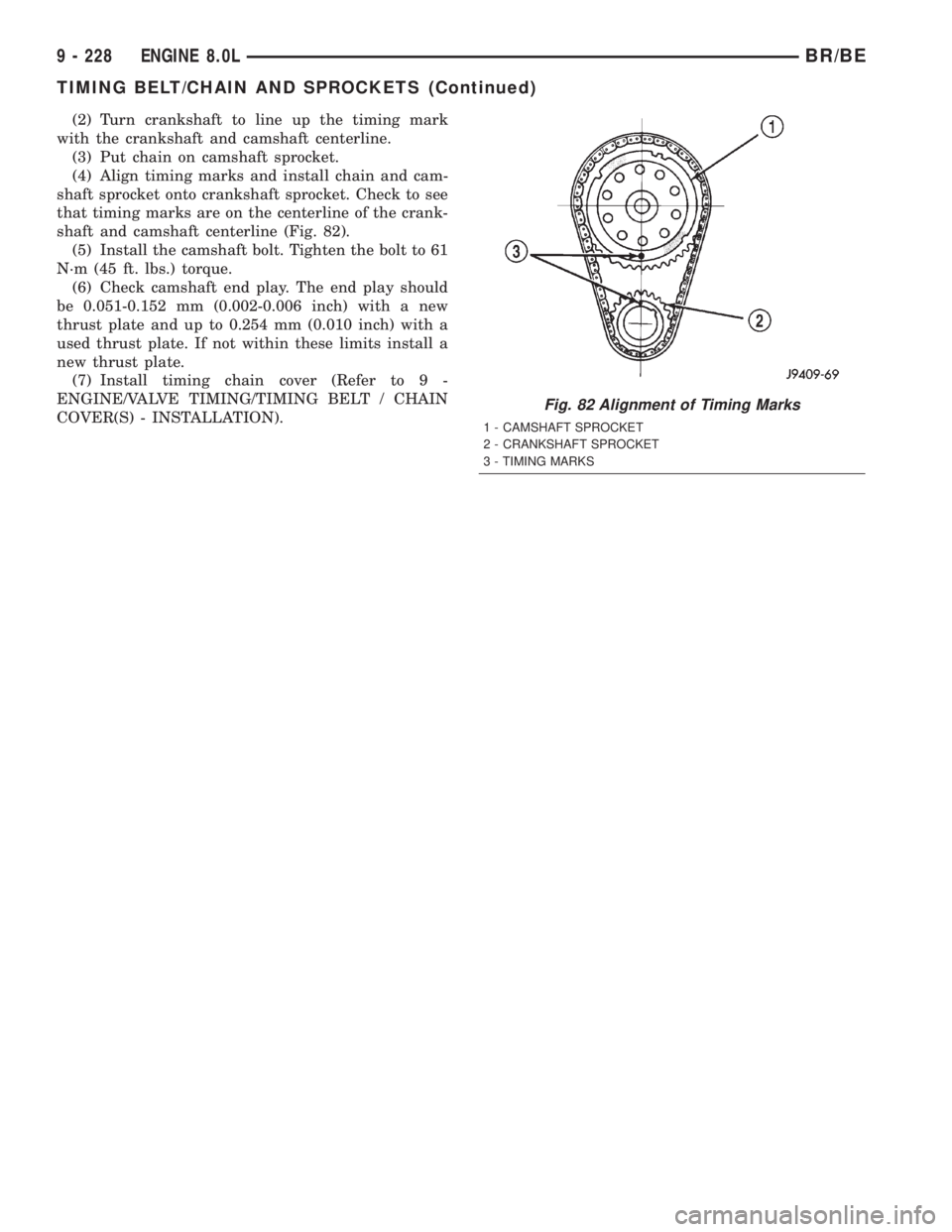
(4) Align timing marks and install chain and cam-
shaft sprocket onto crankshaft sprocket. Check to see
that timing marks are on the centerline of the crank-
shaft and camshaft centerline (Fig. 82).
(5) Install the camshaft bolt. Tighten the bolt to 61
N´m (45 ft. lbs.) torque.
(6) Check camshaft end play. The end play should
be 0.051-0.152 mm (0.002-0.006 inch) with a new
thrust plate and up to 0.254 mm (0.010 inch) with a
used thrust plate. If not within these limits install a
new thrust plate.
(7) Install timing chain cover (Refer to 9 -
ENGINE/VALVE TIMING/TIMING BELT / CHAIN
COVER(S) - INSTALLATION).
Fig. 82 Alignment of Timing Marks
1 - CAMSHAFT SPROCKET
2 - CRANKSHAFT SPROCKET
3 - TIMING MARKS
9 - 228 ENGINE 8.0LBR/BE
TIMING BELT/CHAIN AND SPROCKETS (Continued)
Page 1376 of 2889
ENGINE 5.9L DIESEL
TABLE OF CONTENTS
page page
ENGINE 5.9L DIESEL
DESCRIPTION..........................231
DIAGNOSIS AND TESTING................232
ENGINE DIAGNOSIS - MECHANICAL.......232
SMOKE DIAGNOSIS CHARTS............234
STANDARD PROCEDURE.................237
FORM-IN-PLACE GASKETS AND SEALERS . . 237
REPAIR DAMAGED OR WORN THREADS . . . 238
HYDROSTATIC LOCK...................238
REMOVAL.............................238
INSTALLATION..........................241
SPECIFICATIONS........................242
SPECIAL TOOLS........................244
ENGINE DATA PLATE
DESCRIPTION..........................244
AIR CLEANER ELEMENT
REMOVAL.............................244
INSTALLATION..........................245
CYLINDER HEAD
DESCRIPTION..........................246
REMOVAL.............................246
CLEANING.............................248
INSPECTION...........................250
INSTALLATION..........................250
CYLINDER HEAD COVER(S)
REMOVAL.............................253
CLEANING.............................253
INSPECTION...........................253
INSTALLATION..........................253
INTAKE/EXHAUST VALVES & SEATS
DESCRIPTION..........................253
STANDARD PROCEDURE.................253
VALVES, GUIDES AND SPRINGS..........253
VALVE LASH ADJUSTMENT AND
VERIFICATION........................256
REMOVAL.............................258
INSTALLATION..........................260
ROCKER ARM / ADJUSTER ASSY
DESCRIPTION..........................261
REMOVAL.............................261
CLEANING.............................262
INSPECTION...........................262
INSTALLATION..........................263
ENGINE BLOCK
STANDARD PROCEDURE.................263
CYLINDER BORE REFACING.............263
CYLINDER BORE DE-GLAZE.............264
CYLINDER BORE REPAIR...............265
CAM BORE REPAIR....................267INSPECTION...........................267
CAMSHAFT & BEARINGS (IN BLOCK)
REMOVAL.............................268
INSPECTION...........................272
INSTALLATION..........................273
CONNECTING ROD BEARINGS
STANDARD PROCEDURE.................274
CONNECTING ROD BEARING AND
CRANKSHAFT JOURNAL CLEARANCE......274
CRANKSHAFT
DESCRIPTION..........................275
CRANKSHAFT MAIN BEARINGS
STANDARD PROCEDURE.................275
MAIN BEARING CLEARANCE............275
CRANKSHAFT OIL SEAL - FRONT
REMOVAL.............................276
INSTALLATION..........................277
CRANKSHAFT OIL SEAL - REAR
REMOVAL.............................278
INSTALLATION..........................278
CRANKSHAFT REAR OIL SEAL RETAINER
REMOVAL.............................278
INSTALLATION..........................279
SOLID LIFTERS/TAPPETS
REMOVAL.............................280
CLEANING.............................281
INSPECTION...........................281
INSTALLATION..........................281
PISTON & CONNECTING ROD
DESCRIPTION..........................282
STANDARD PROCEDURE.................282
PISTON GRADING....................282
REMOVAL.............................285
CLEANING.............................285
INSPECTION...........................285
INSTALLATION..........................287
PISTON RINGS
STANDARD PROCEDURE.................288
PISTON RINGS - FITTING...............288
VIBRATION DAMPER
REMOVAL.............................289
INSPECTION...........................289
INSTALLATION..........................289
FRONT MOUNT
REMOVAL.............................290
INSTALLATION..........................290
REAR MOUNT
REMOVAL.............................291
INSTALLATION..........................291
BR/BEENGINE 5.9L DIESEL 9 - 229
Page 1377 of 2889
LUBRICATION
DESCRIPTION..........................292
OPERATION............................292
DIAGNOSIS AND TESTING................295
ENGINE OIL PRESSURE................295
OIL
STANDARD PROCEDURE.................295
ENGINE OIL LEVEL....................295
ENGINE OIL SERVICE..................295
OIL COOLER & LINES
CLEANING.............................296
OIL FILTER
REMOVAL.............................296
INSTALLATION..........................296
OIL PAN
REMOVAL.............................296
CLEANING.............................297
INSPECTION...........................297
INSTALLATION..........................297
OIL PRESSURE RELIEF VALVE
REMOVAL.............................297
CLEANING.............................297
INSPECTION...........................297
INSTALLATION..........................298
OIL PRESSURE SENSOR/SWITCH
DESCRIPTION..........................298OPERATION............................298
REMOVAL.............................298
INSTALLATION..........................299
OIL PUMP
REMOVAL.............................299
CLEANING.............................299
INSPECTION...........................299
INSTALLATION..........................300
INTAKE MANIFOLD
REMOVAL.............................301
CLEANING.............................302
INSPECTION...........................302
INSTALLATION..........................302
EXHAUST MANIFOLD
REMOVAL.............................303
CLEANING.............................304
INSPECTION...........................304
INSTALLATION..........................304
GEAR HOUSING
REMOVAL.............................304
INSTALLATION..........................305
GEAR HOUSING COVER
REMOVAL.............................306
INSTALLATION..........................307
9 - 230 ENGINE 5.9L DIESELBR/BE
Page 1378 of 2889
ENGINE 5.9L DIESEL
DESCRIPTION
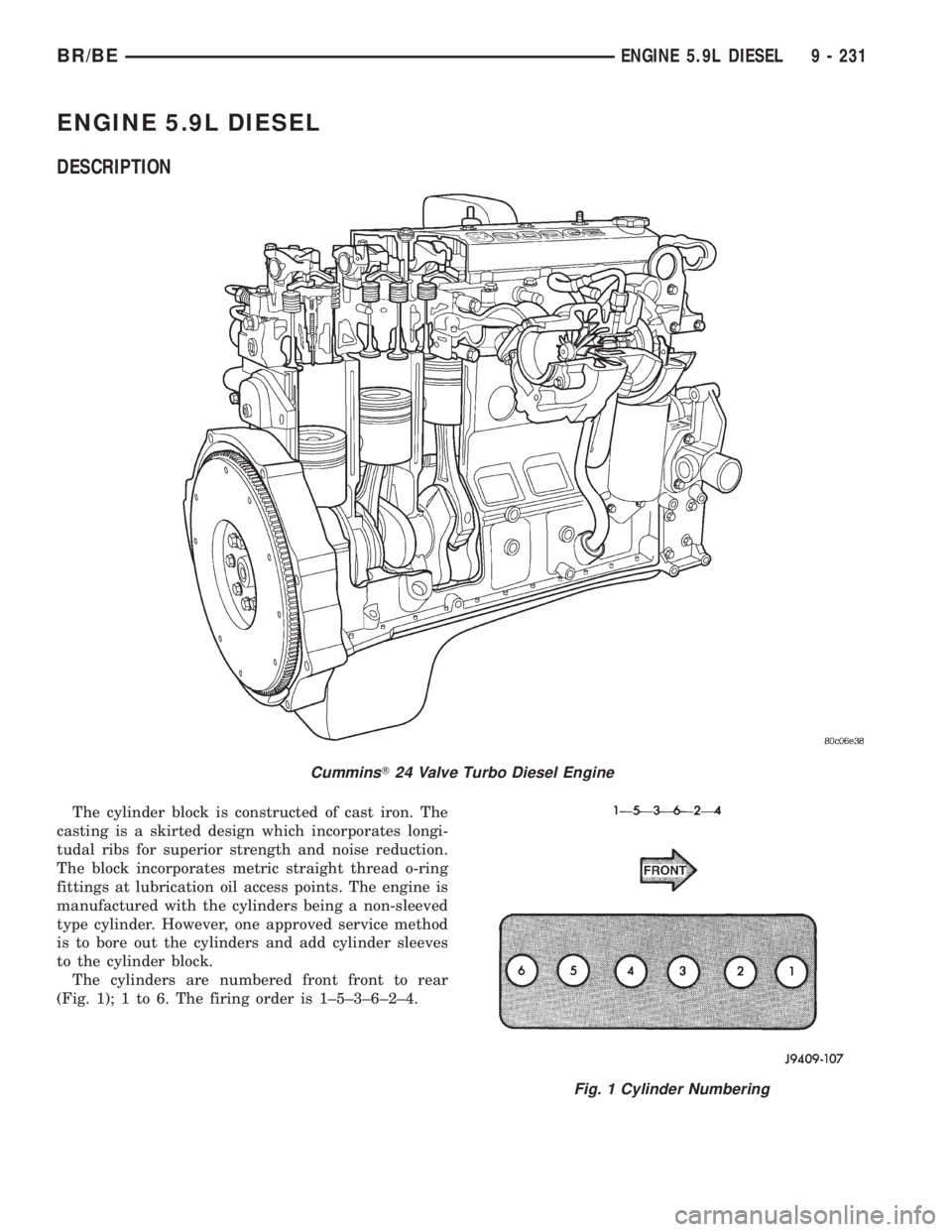
The cylinder block is constructed of cast iron. The
casting is a skirted design which incorporates longi-
tudal ribs for superior strength and noise reduction.
The block incorporates metric straight thread o-ring
fittings at lubrication oil access points. The engine is
manufactured with the cylinders being a non-sleeved
type cylinder. However, one approved service method
is to bore out the cylinders and add cylinder sleeves
to the cylinder block.
The cylinders are numbered front front to rear
(Fig. 1); 1 to 6. The firing order is 1±5±3±6±2±4.
CumminsT24 Valve Turbo Diesel Engine
Fig. 1 Cylinder Numbering
BR/BEENGINE 5.9L DIESEL 9 - 231
Page 1379 of 2889
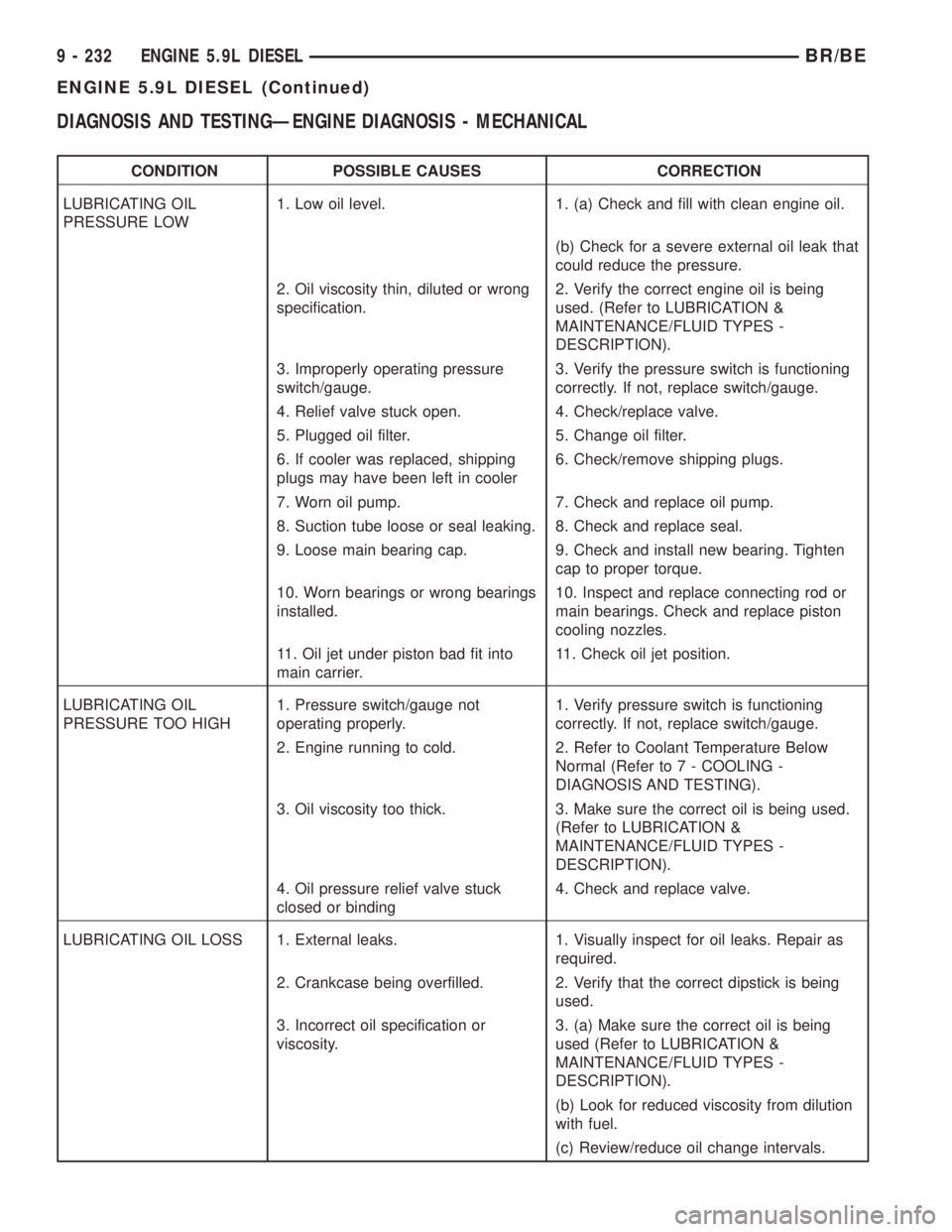
DIAGNOSIS AND TESTINGÐENGINE DIAGNOSIS - MECHANICAL
CONDITION POSSIBLE CAUSES CORRECTION
LUBRICATING OIL
PRESSURE LOW1. Low oil level. 1. (a) Check and fill with clean engine oil.
(b) Check for a severe external oil leak that
could reduce the pressure.
2. Oil viscosity thin, diluted or wrong
specification.2. Verify the correct engine oil is being
used. (Refer to LUBRICATION &
MAINTENANCE/FLUID TYPES -
DESCRIPTION).
3. Improperly operating pressure
switch/gauge.3. Verify the pressure switch is functioning
correctly. If not, replace switch/gauge.
4. Relief valve stuck open. 4. Check/replace valve.
5. Plugged oil filter. 5. Change oil filter.
6. If cooler was replaced, shipping
plugs may have been left in cooler6. Check/remove shipping plugs.
7. Worn oil pump. 7. Check and replace oil pump.
8. Suction tube loose or seal leaking. 8. Check and replace seal.
9. Loose main bearing cap. 9. Check and install new bearing. Tighten
cap to proper torque.
10. Worn bearings or wrong bearings
installed.10. Inspect and replace connecting rod or
main bearings. Check and replace piston
cooling nozzles.
11. Oil jet under piston bad fit into
main carrier.11. Check oil jet position.
LUBRICATING OIL
PRESSURE TOO HIGH1. Pressure switch/gauge not
operating properly.1. Verify pressure switch is functioning
correctly. If not, replace switch/gauge.
2. Engine running to cold. 2. Refer to Coolant Temperature Below
Normal (Refer to 7 - COOLING -
DIAGNOSIS AND TESTING).
3. Oil viscosity too thick. 3. Make sure the correct oil is being used.
(Refer to LUBRICATION &
MAINTENANCE/FLUID TYPES -
DESCRIPTION).
4. Oil pressure relief valve stuck
closed or binding4. Check and replace valve.
LUBRICATING OIL LOSS 1. External leaks. 1. Visually inspect for oil leaks. Repair as
required.
2. Crankcase being overfilled. 2. Verify that the correct dipstick is being
used.
3. Incorrect oil specification or
viscosity.3. (a) Make sure the correct oil is being
used (Refer to LUBRICATION &
MAINTENANCE/FLUID TYPES -
DESCRIPTION).
(b) Look for reduced viscosity from dilution
with fuel.
(c) Review/reduce oil change intervals.
9 - 232 ENGINE 5.9L DIESELBR/BE
ENGINE 5.9L DIESEL (Continued)
Page 1380 of 2889
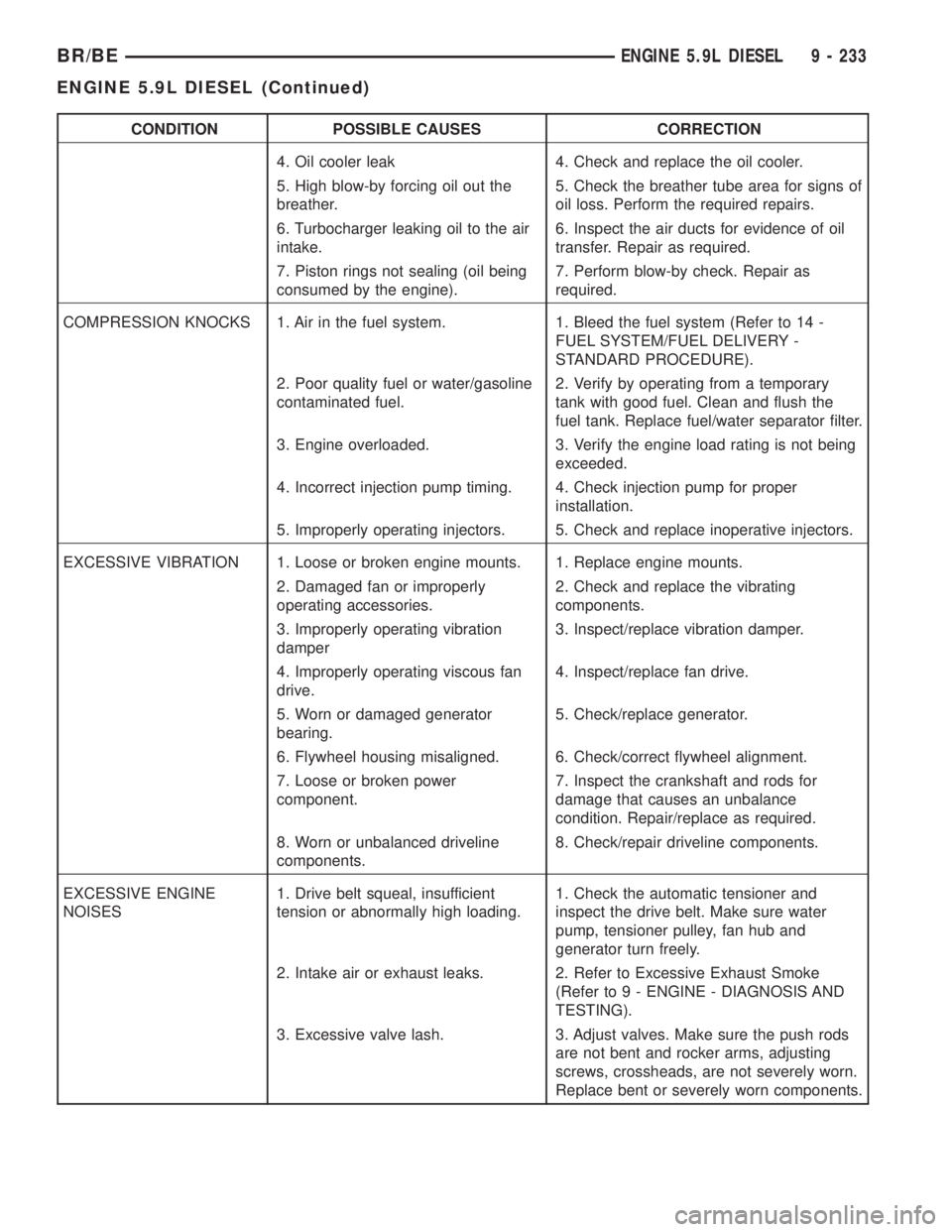
CONDITION POSSIBLE CAUSES CORRECTION
4. Oil cooler leak 4. Check and replace the oil cooler.
5. High blow-by forcing oil out the
breather.5. Check the breather tube area for signs of
oil loss. Perform the required repairs.
6. Turbocharger leaking oil to the air
intake.6. Inspect the air ducts for evidence of oil
transfer. Repair as required.
7. Piston rings not sealing (oil being
consumed by the engine).7. Perform blow-by check. Repair as
required.
COMPRESSION KNOCKS 1. Air in the fuel system. 1. Bleed the fuel system (Refer to 14 -
FUEL SYSTEM/FUEL DELIVERY -
STANDARD PROCEDURE).
2. Poor quality fuel or water/gasoline
contaminated fuel.2. Verify by operating from a temporary
tank with good fuel. Clean and flush the
fuel tank. Replace fuel/water separator filter.
3. Engine overloaded. 3. Verify the engine load rating is not being
exceeded.
4. Incorrect injection pump timing. 4. Check injection pump for proper
installation.
5. Improperly operating injectors. 5. Check and replace inoperative injectors.
EXCESSIVE VIBRATION 1. Loose or broken engine mounts. 1. Replace engine mounts.
2. Damaged fan or improperly
operating accessories.2. Check and replace the vibrating
components.
3. Improperly operating vibration
damper3. Inspect/replace vibration damper.
4. Improperly operating viscous fan
drive.4. Inspect/replace fan drive.
5. Worn or damaged generator
bearing.5. Check/replace generator.
6. Flywheel housing misaligned. 6. Check/correct flywheel alignment.
7. Loose or broken power
component.7. Inspect the crankshaft and rods for
damage that causes an unbalance
condition. Repair/replace as required.
8. Worn or unbalanced driveline
components.8. Check/repair driveline components.
EXCESSIVE ENGINE
NOISES1. Drive belt squeal, insufficient
tension or abnormally high loading.1. Check the automatic tensioner and
inspect the drive belt. Make sure water
pump, tensioner pulley, fan hub and
generator turn freely.
2. Intake air or exhaust leaks. 2. Refer to Excessive Exhaust Smoke
(Refer to 9 - ENGINE - DIAGNOSIS AND
TESTING).
3. Excessive valve lash. 3. Adjust valves. Make sure the push rods
are not bent and rocker arms, adjusting
screws, crossheads, are not severely worn.
Replace bent or severely worn components.
BR/BEENGINE 5.9L DIESEL 9 - 233
ENGINE 5.9L DIESEL (Continued)