2001 DODGE RAM engine oil capacity
[x] Cancel search: engine oil capacityPage 2187 of 2889
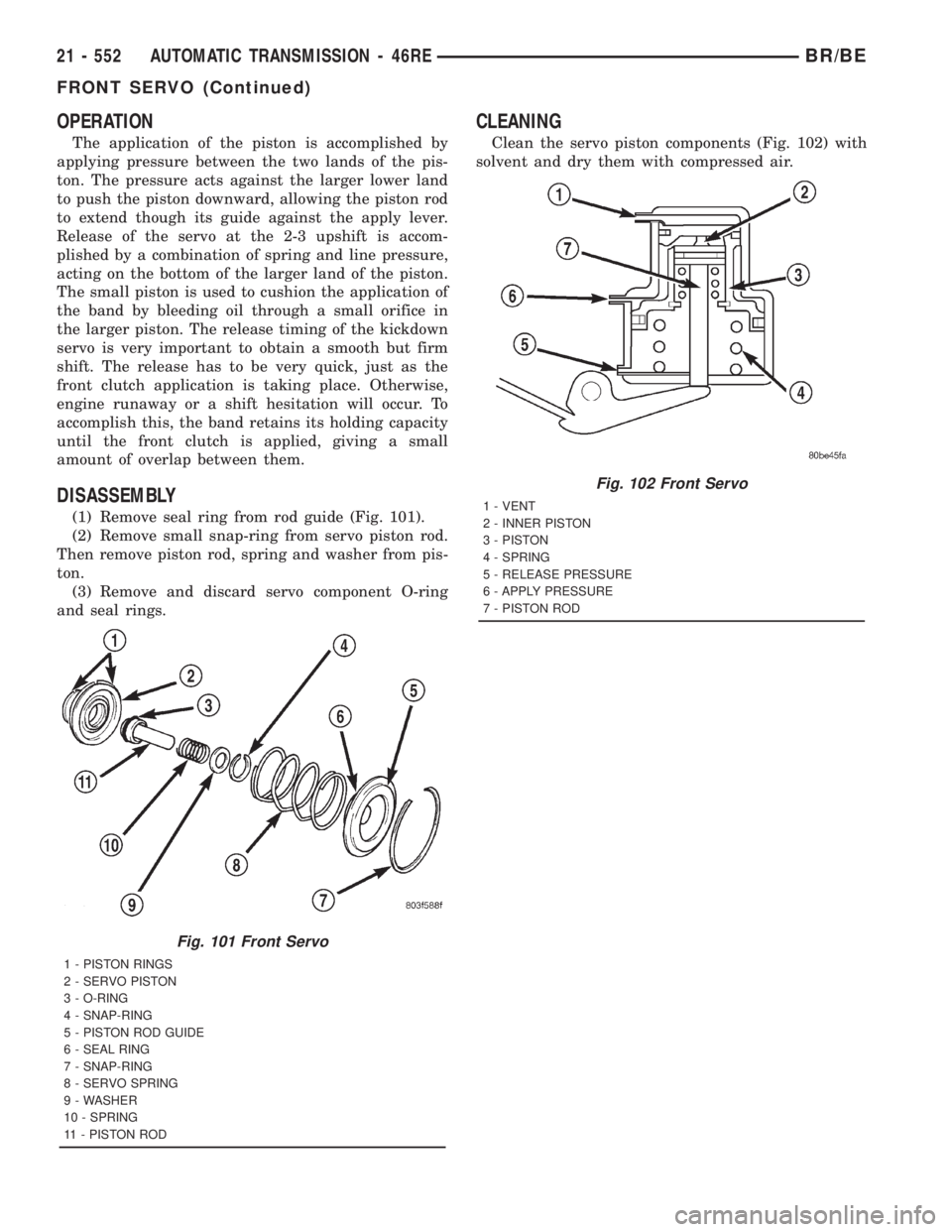
OPERATION
The application of the piston is accomplished by
applying pressure between the two lands of the pis-
ton. The pressure acts against the larger lower land
to push the piston downward, allowing the piston rod
to extend though its guide against the apply lever.
Release of the servo at the 2-3 upshift is accom-
plished by a combination of spring and line pressure,
acting on the bottom of the larger land of the piston.
The small piston is used to cushion the application of
the band by bleeding oil through a small orifice in
the larger piston. The release timing of the kickdown
servo is very important to obtain a smooth but firm
shift. The release has to be very quick, just as the
front clutch application is taking place. Otherwise,
engine runaway or a shift hesitation will occur. To
accomplish this, the band retains its holding capacity
until the front clutch is applied, giving a small
amount of overlap between them.
DISASSEMBLY
(1) Remove seal ring from rod guide (Fig. 101).
(2) Remove small snap-ring from servo piston rod.
Then remove piston rod, spring and washer from pis-
ton.
(3) Remove and discard servo component O-ring
and seal rings.
CLEANING
Clean the servo piston components (Fig. 102) with
solvent and dry them with compressed air.
Fig. 101 Front Servo
1 - PISTON RINGS
2 - SERVO PISTON
3 - O-RING
4 - SNAP-RING
5 - PISTON ROD GUIDE
6 - SEAL RING
7 - SNAP-RING
8 - SERVO SPRING
9 - WASHER
10 - SPRING
11 - PISTON ROD
Fig. 102 Front Servo
1 - VENT
2 - INNER PISTON
3 - PISTON
4 - SPRING
5 - RELEASE PRESSURE
6 - APPLY PRESSURE
7 - PISTON ROD
21 - 552 AUTOMATIC TRANSMISSION - 46REBR/BE
FRONT SERVO (Continued)
Page 2358 of 2889
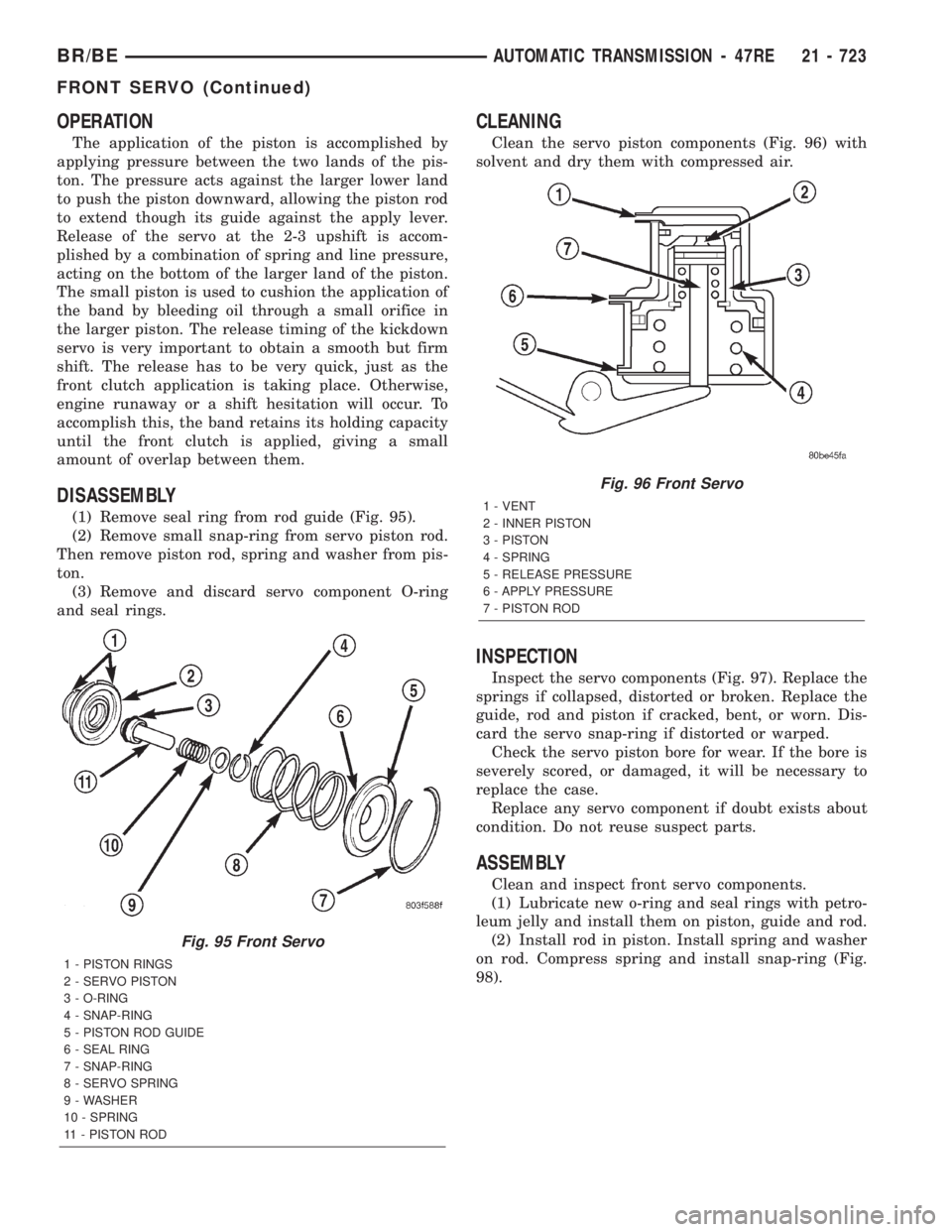
OPERATION
The application of the piston is accomplished by
applying pressure between the two lands of the pis-
ton. The pressure acts against the larger lower land
to push the piston downward, allowing the piston rod
to extend though its guide against the apply lever.
Release of the servo at the 2-3 upshift is accom-
plished by a combination of spring and line pressure,
acting on the bottom of the larger land of the piston.
The small piston is used to cushion the application of
the band by bleeding oil through a small orifice in
the larger piston. The release timing of the kickdown
servo is very important to obtain a smooth but firm
shift. The release has to be very quick, just as the
front clutch application is taking place. Otherwise,
engine runaway or a shift hesitation will occur. To
accomplish this, the band retains its holding capacity
until the front clutch is applied, giving a small
amount of overlap between them.
DISASSEMBLY
(1) Remove seal ring from rod guide (Fig. 95).
(2) Remove small snap-ring from servo piston rod.
Then remove piston rod, spring and washer from pis-
ton.
(3) Remove and discard servo component O-ring
and seal rings.
CLEANING
Clean the servo piston components (Fig. 96) with
solvent and dry them with compressed air.
INSPECTION
Inspect the servo components (Fig. 97). Replace the
springs if collapsed, distorted or broken. Replace the
guide, rod and piston if cracked, bent, or worn. Dis-
card the servo snap-ring if distorted or warped.
Check the servo piston bore for wear. If the bore is
severely scored, or damaged, it will be necessary to
replace the case.
Replace any servo component if doubt exists about
condition. Do not reuse suspect parts.
ASSEMBLY
Clean and inspect front servo components.
(1) Lubricate new o-ring and seal rings with petro-
leum jelly and install them on piston, guide and rod.
(2) Install rod in piston. Install spring and washer
on rod. Compress spring and install snap-ring (Fig.
98).
Fig. 95 Front Servo
1 - PISTON RINGS
2 - SERVO PISTON
3 - O-RING
4 - SNAP-RING
5 - PISTON ROD GUIDE
6 - SEAL RING
7 - SNAP-RING
8 - SERVO SPRING
9 - WASHER
10 - SPRING
11 - PISTON ROD
Fig. 96 Front Servo
1 - VENT
2 - INNER PISTON
3 - PISTON
4 - SPRING
5 - RELEASE PRESSURE
6 - APPLY PRESSURE
7 - PISTON ROD
BR/BEAUTOMATIC TRANSMISSION - 47RE 21 - 723
FRONT SERVO (Continued)
Page 2731 of 2889
heated air. This air conditioning system uses a fixed ori-
fice tube in the middle of the liquid line to meter refrig-
erant flow to the evaporator coil. To maintain minimum
evaporator temperature and prevent evaporator freez-
ing, the a/c low pressure switch on the accumulator
cycles the compressor clutch.
OPERATION - REFRIGERANT SYSTEM SERVICE
PORT
The high pressure service port is located on the liq-
uid line between the condenser and the evaporator,
near the front of the engine compartment. The low
pressure service port is located on the suction line,
near the accumulator outlet.
Each of the service ports has a threaded plastic
protective cap installed over it from the factory. After
servicing the refrigerant system, always reinstall
both of the service port caps.
DIAGNOSIS AND TESTING - A/C
PERFORMANCE
The air conditioning system is designed to provide
the passenger compartment with low temperature
and low humidity air. The evaporator, located in the
HVAC housing on the dash panel below the instru-
ment panel, is cooled to temperatures near the freez-
ing point. As warm damp air passes through the
cooled evaporator, the air transfers its heat to the
refrigerant in the evaporator tubes and the moisture
in the air condenses on the evaporator fins. During
periods of high heat and humidity, an air condition-
ing system will be more effective in the recirculation
mode (Max-A/C). With the system in the recirculation
mode, only air from the passenger compartment
passes through the evaporator. As the passenger com-
partment air dehumidifies, the air conditioning sys-
tem performance levels improve.
Humidity has an important bearing on the temper-
ature of the air delivered to the interior of the vehi-
cle. It is important to understand the effect that
humidity has on the performance of the air condition-
ing system. When humidity is high, the evaporator
has to perform a double duty. It must lower the air
temperature, and it must lower the temperature of
the moisture in the air that condenses on the evapo-
rator fins. Condensing the moisture in the air trans-
fers heat energy into the evaporator fins and tubing.
This reduces the amount of heat the evaporator can
absorb from the air. High humidity greatly reduces
the ability of the evaporator to lower the temperature
of the air.
However, evaporator capacity used to reduce the
amount of moisture in the air is not wasted. Wring-
ing some of the moisture out of the air entering the
vehicle adds to the comfort of the passengers.
Although, an owner may expect too much from theirair conditioning system on humid days. A perfor-
mance test is the best way to determine whether the
system is performing up to standard. This test also
provides valuable clues as to the possible cause of
trouble with the air conditioning system.
Before proceeding, (Refer to 24 - HEATING & AIR
CONDITIONING/PLUMBING - WARNING) and
(Refer to 24 - HEATING & AIR CONDITIONING/
PLUMBING - CAUTION). The air temperature in
the test room and in the vehicle must be a minimum
of 21É C (70É F) for this test.
(1)
Connect a tachometer and a manifold gauge set.
(2) Set the a/c heater mode control switch knob to
the recirculation mode (Max-A/C) position, the tem-
perature control knob to the full cool position, and
the blower motor switch to the highest speed posi-
tion.
(3) Start the engine and hold the idle speed at
1,000 rpm with the compressor clutch engaged. If the
compressor clutch does not engage, (Refer to 24 -
HEATING & AIR CONDITIONING/CONTROLS/A/C
COMPRESSOR CLUTCH COIL - DIAGNOSIS AND
TESTING).
(4) The engine should be at operating temperature.
The doors and windows must be closed and the hood
must be mostly closed.
(5)
Insert a thermometer in the driver side center
A/C (panel) outlet. Operate the engine for five minutes.
(6) The compressor clutch may cycle, depending
upon the ambient temperature and humidity. If the
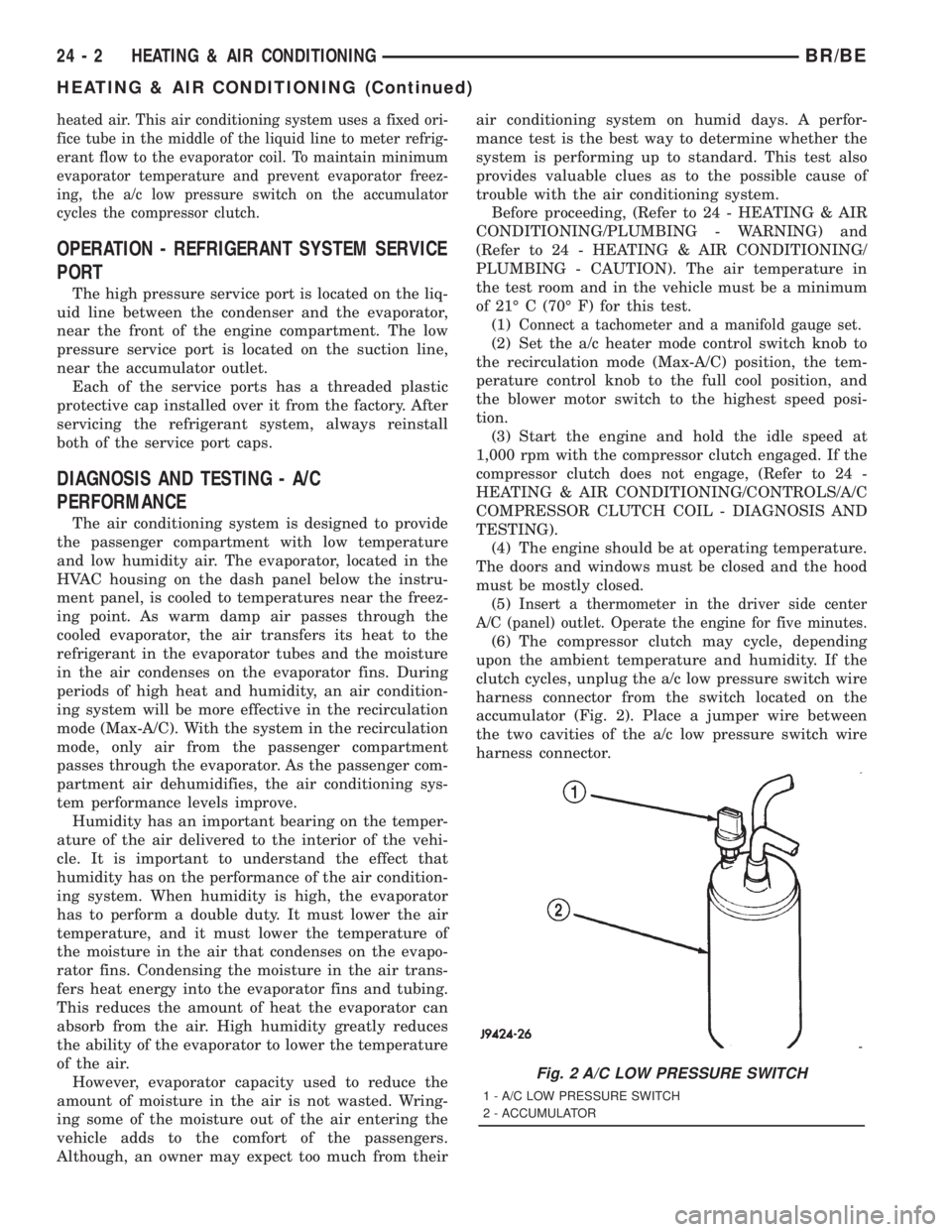
clutch cycles, unplug the a/c low pressure switch wire
harness connector from the switch located on the
accumulator (Fig. 2). Place a jumper wire between
the two cavities of the a/c low pressure switch wire
harness connector.
Fig. 2 A/C LOW PRESSURE SWITCH
1 - A/C LOW PRESSURE SWITCH
2 - ACCUMULATOR
24 - 2 HEATING & AIR CONDITIONINGBR/BE
HEATING & AIR CONDITIONING (Continued)
Page 2746 of 2889
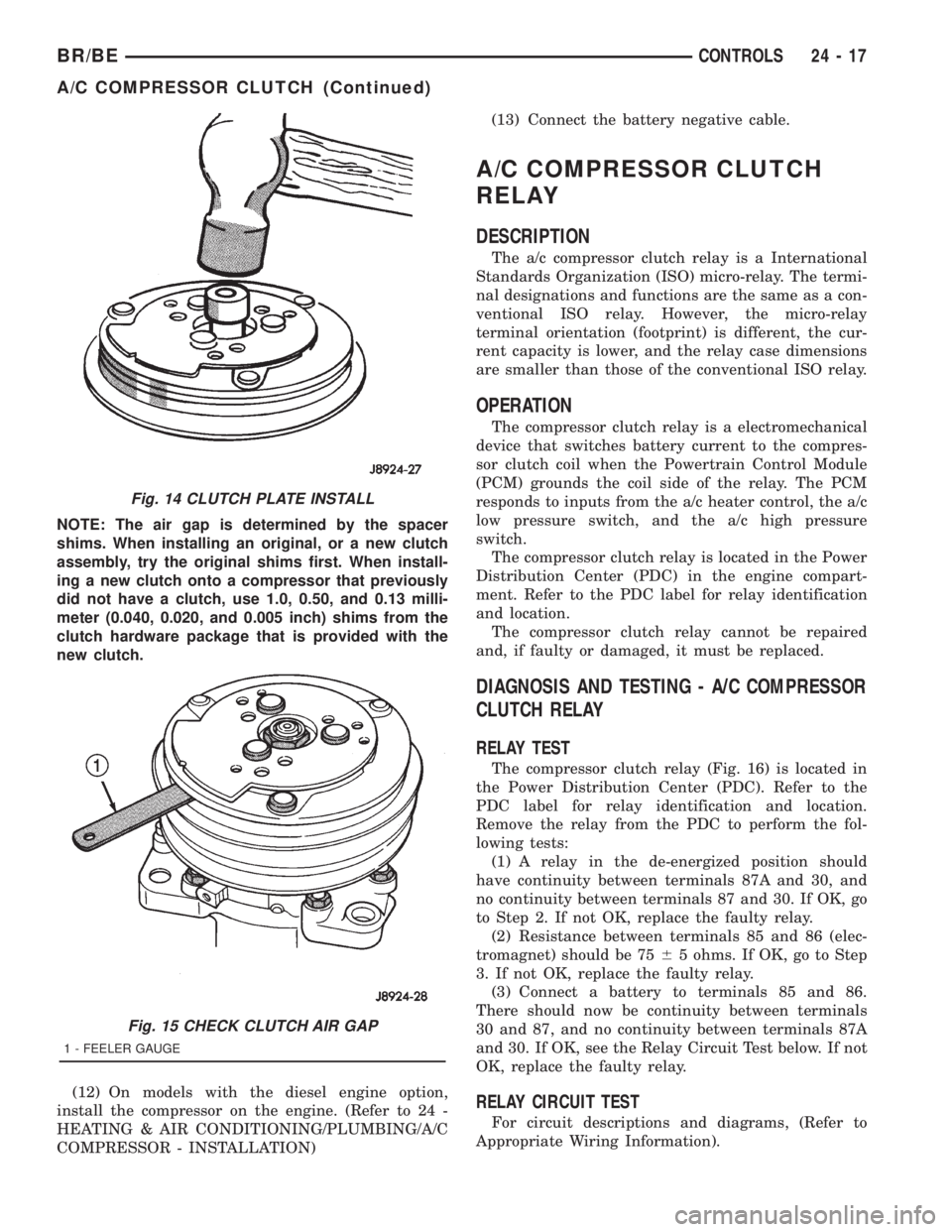
NOTE: The air gap is determined by the spacer
shims. When installing an original, or a new clutch
assembly, try the original shims first. When install-
ing a new clutch onto a compressor that previously
did not have a clutch, use 1.0, 0.50, and 0.13 milli-
meter (0.040, 0.020, and 0.005 inch) shims from the
clutch hardware package that is provided with the
new clutch.
(12) On models with the diesel engine option,
install the compressor on the engine. (Refer to 24 -
HEATING & AIR CONDITIONING/PLUMBING/A/C
COMPRESSOR - INSTALLATION)(13) Connect the battery negative cable.
A/C COMPRESSOR CLUTCH
RELAY
DESCRIPTION
The a/c compressor clutch relay is a International
Standards Organization (ISO) micro-relay. The termi-
nal designations and functions are the same as a con-
ventional ISO relay. However, the micro-relay
terminal orientation (footprint) is different, the cur-
rent capacity is lower, and the relay case dimensions
are smaller than those of the conventional ISO relay.
OPERATION
The compressor clutch relay is a electromechanical
device that switches battery current to the compres-
sor clutch coil when the Powertrain Control Module
(PCM) grounds the coil side of the relay. The PCM
responds to inputs from the a/c heater control, the a/c
low pressure switch, and the a/c high pressure
switch.
The compressor clutch relay is located in the Power
Distribution Center (PDC) in the engine compart-
ment. Refer to the PDC label for relay identification
and location.
The compressor clutch relay cannot be repaired
and, if faulty or damaged, it must be replaced.
DIAGNOSIS AND TESTING - A/C COMPRESSOR
CLUTCH RELAY
RELAY TEST
The compressor clutch relay (Fig. 16) is located in
the Power Distribution Center (PDC). Refer to the
PDC label for relay identification and location.
Remove the relay from the PDC to perform the fol-
lowing tests:
(1) A relay in the de-energized position should
have continuity between terminals 87A and 30, and
no continuity between terminals 87 and 30. If OK, go
to Step 2. If not OK, replace the faulty relay.
(2) Resistance between terminals 85 and 86 (elec-
tromagnet) should be 7565 ohms. If OK, go to Step
3. If not OK, replace the faulty relay.
(3) Connect a battery to terminals 85 and 86.
There should now be continuity between terminals
30 and 87, and no continuity between terminals 87A
and 30. If OK, see the Relay Circuit Test below. If not
OK, replace the faulty relay.
RELAY CIRCUIT TEST
For circuit descriptions and diagrams, (Refer to
Appropriate Wiring Information).
Fig. 14 CLUTCH PLATE INSTALL
Fig. 15 CHECK CLUTCH AIR GAP
1 - FEELER GAUGE
BR/BECONTROLS 24 - 17
A/C COMPRESSOR CLUTCH (Continued)
Page 2775 of 2889
STANDARD PROCEDURE - REFRIGERANT
SYSTEM CHARGE
WARNING: REVIEW THE WARNINGS AND CAU-
TIONS IN THE FRONT OF THIS SECTION BEFORE
PERFORMING THE FOLLOWING OPERATION.
(Refer to 24 - HEATING & AIR CONDITIONING/
PLUMBING - WARNING) (Refer to 24 - HEATING &
AIR CONDITIONING/PLUMBING - CAUTION)
After the refrigerant system has been tested for
leaks and evacuated, a refrigerant charge can be
injected into the system. (Refer to 24 - HEATING &
AIR CONDITIONING/PLUMBING - SPECIFICA-
TIONS - CHARGE CAPACITY)
A R-134a refrigerant recovery/recycling/charging
station that meets SAE Standard J2210 must be
used to charge the refrigerant system with R-134a
refrigerant. Refer to the operating instructions sup-
plied by the equipment manufacturer for proper care
and use of this equipment.
SPECIFICATIONS
SPECIFICATIONS
The R-134a refrigerant system charge capacity for
this vehicle is: 0.907 kilograms (32 ounces).
A/C COMPRESSOR
DESCRIPTION - A/C COMPRESSOR
The air conditioning system uses a Sanden
SD7H15 seven cylinder, reciprocating wobble plate-
type compressor on all models. This compressor has a
fixed displacement of 150 cubic centimeters (9.375
cubic inches), and has both the suction and discharge
ports located on the cylinder head. A label identifying
the use of R-134a refrigerant is located on the com-
pressor.
DESCRIPTION - HIGH PRESSURE RELIEF
VALVE
A high pressure relief valve is located on the com-
pressor cylinder head, which is at the rear of the
compressor. This mechanical valve is designed to
vent refrigerant from the system to protect against
damage to the compressor and other system compo-
nents, caused by condenser air flow restriction or an
overcharge of refrigerant.
OPERATION - A/C COMPRESSOR
The compressor is driven by the engine through an
electric clutch, drive pulley and belt arrangement.
The compressor is lubricated by refrigerant oil that iscirculated throughout the refrigerant system with the
refrigerant.
The compressor draws in low-pressure refrigerant
vapor from the evaporator through its suction port. It
then compresses the refrigerant into a high-pressure,
high-temperature refrigerant vapor, which is then
pumped to the condenser through the compressor dis-
charge port.
The compressor cannot be repaired. If faulty or
damaged, the entire compressor assembly must be
replaced. The compressor clutch, pulley and clutch
coil are available for service.
OPERATION - HIGH PRESSURE RELIEF VALVE
The high pressure relief valve vents the system
when a discharge pressure of 3445 to 4135 kPa (500
to 600 psi) or above is reached. The valve closes with
a minimum discharge pressure of 2756 kPa (400 psi)
is reached.
The high pressure relief valve vents only enough
refrigerant to reduce the system pressure, and then
re-seats itself. The majority of the refrigerant is con-
served in the system. If the valve vents refrigerant, it
does not mean the valve is faulty.
The high pressure relief valve is a factory-cali-
brated unit. The valve cannot be adjusted or
repaired, and must not be removed or otherwise dis-
turbed. The valve is only serviced as a part of the
compressor assembly.
DIAGNOSIS AND TESTING - A/C COMPRESSOR
When investigating an air conditioning related
noise, you must first know the conditions under
which the noise occurs. These conditions include:
weather, vehicle speed, transmission in gear or neu-
tral, engine speed, engine temperature, and any
other special conditions. Noises that develop during
air conditioning operation can often be misleading.
For example: What sounds like a failed front bearing
or connecting rod, may be caused by loose bolts, nuts,
mounting brackets, or a loose compressor clutch
assembly.
Drive belts are speed sensitive. At different engine
speeds and depending upon belt tension, belts can
develop noises that are mistaken for a compressor
noise. Improper belt tension can cause a misleading
noise when the compressor clutch is engaged, which
may not occur when the compressor clutch is disen-
gaged. Check the serpentine drive belt condition and
tension as described in Cooling before beginning this
procedure.
(1) Select a quiet area for testing. Duplicate the
complaint conditions as much as possible. Switch the
compressor on and off several times to clearly iden-
tify the compressor noise. Listen to the compressor
while the clutch is engaged and disengaged. Probe
24 - 46 PLUMBINGBR/BE
PLUMBING (Continued)
Page 2776 of 2889
the compressor with an engine stethoscope or a long
screwdriver with the handle held to your ear to bet-
ter localize the source of the noise.
(2) Loosen all of the compressor mounting hard-
ware and retighten. Tighten the compressor clutch
mounting nut. Be certain that the clutch coil is
mounted securely to the compressor, and that the
clutch plate and pulley are properly aligned and have
the correct air gap. (Refer to 24 - HEATING & AIR
CONDITIONING/CONTROLS/A/C COMPRESSOR
CLUTCH - INSTALLATION)
(3) To duplicate a high-ambient temperature condi-
tion (high head pressure), restrict the air flow
through the condenser. Install a manifold gauge set
to be certain that the discharge pressure does not
exceed 2760 kPa (400 psi).
(4) Check the refrigerant system plumbing for
incorrect routing, rubbing or interference, which can
cause unusual noises. Also check the refrigerant lines
for kinks or sharp bends that will restrict refrigerant
flow, which can cause noises. (Refer to 24 - HEAT-
ING & AIR CONDITIONING/PLUMBING - CAU-
TION)
(5) If the noise is from opening and closing of the
high pressure relief valve, recover, evacuate, and
recharge the refrigerant system. (Refer to 24 - HEAT-
ING & AIR CONDITIONING/PLUMBING - STAN-
DARD PROCEDURE - REFRIGERANT RECOVERY)
(Refer to 24 - HEATING & AIR CONDITIONING/
PLUMBING - STANDARD PROCEDURE - REFRIG-
ERANT SYSTEM EVACUATE) (Refer to 24 -
HEATING & AIR CONDITIONING/PLUMBING -
STANDARD PROCEDURE - REFRIGERANT SYS-
TEM CHARGE) If the high pressure relief valve still
does not seat properly, replace the compressor.
(6) If the noise is from liquid slugging on the suc-
tion line, replace the accumulator. (Refer to 24 -
HEATING & AIR CONDITIONING/PLUMBING/AC-
CUMULATOR - REMOVAL) Check the refrigerant oil
level and the refrigerant system charge. (Refer to 24
- HEATING & AIR CONDITIONING/PLUMBING/
REFRIGERANT OIL - STANDARD PROCEDURE -
REFRIGERANT OIL LEVEL) (Refer to 24 - HEAT-
ING & AIR CONDITIONING/PLUMBING - SPECI-
FICATIONS - CHARGE CAPACITY) If the liquid
slugging condition continues following accumulator
replacement, replace the compressor.
(7) If the noise continues, replace the compressor
and repeat Step 1.
REMOVAL
WARNING: REVIEW THE WARNINGS AND CAU-
TIONS IN THE FRONT OF THIS SECTION BEFORE
PERFORMING THE FOLLOWING OPERATION.
(Refer to 24 - HEATING & AIR CONDITIONING/PLUMBING - WARNING) (Refer to 24 - HEATING &
AIR CONDITIONING/PLUMBING - CAUTION)
The compressor may be removed and repositioned
without disconnecting the refrigerant lines or dis-
charging the refrigerant system. Discharging is not
necessary if servicing the compressor clutch or clutch
coil, the engine, the cylinder head, or the generator.
(1) Recover the refrigerant from the refrigerant
system. (Refer to 24 - HEATING & AIR CONDI-
TIONING/PLUMBING - STANDARD PROCEDURE -
REFRIGERANT RECOVERY)
(2) Disconnect and isolate the battery negative
cable.
(3) Remove the serpentine drive belt. Refer to
Cooling for the procedures.
(4) Unplug the compressor clutch coil wire harness
connector.
(5) Remove the bolt that secures the refrigerant
line manifold to the compressor. Install plugs in, or
tape over all of the opened refrigerant line fittings.
(6) Remove the four bolts that secure the compres-
sor to the mounting bracket (Fig. 4) or (Fig. 5).
(7) Remove the a/c compressor from the mounting
bracket.
INSTALLATION
WARNING: REVIEW THE WARNINGS AND CAU-
TIONS IN THE FRONT OF THIS SECTION BEFORE
PERFORMING THE FOLLOWING OPERATION.
(Refer to 24 - HEATING & AIR CONDITIONING/
PLUMBING - WARNING) (Refer to 24 - HEATING &
AIR CONDITIONING/PLUMBING - CAUTION)(Refer to
24 - HEATING & AIR CONDITIONING/PLUMBING -
CAUTION - REFRIGERANT HOSES/LINES/TUBES
PRECAUTIONS)
NOTE: If a replacement compressor is being
installed, be certain to check the refrigerant oil
level. (Refer to 24 - HEATING & AIR CONDITIONING/
PLUMBING/REFRIGERANT OIL - STANDARD PRO-
CEDURE) Use only refrigerant oil of the type
recommended for the compressor in the vehicle.
(Refer to 24 - HEATING & AIR CONDITIONING/
PLUMBING/REFRIGERANT OIL - DESCRIPTION)
(1) Install the compressor to the mounting bracket.
Tighten the four mounting bolts to 24 N´m (210 in.
lbs.).
(2) Remove the tape or plugs from all of the
opened refrigerant line fittings. Install the suction
and discharge line manifold to the compressor. (Refer
to 24 - HEATING & AIR CONDITIONING/PLUMB-
ING/A/C SUCTION AND DISCHARGE LINE -
INSTALLATION)
BR/BEPLUMBING 24 - 47
A/C COMPRESSOR (Continued)
Page 2862 of 2889
FRONT AXLE - 248FBI - REMOVAL........3-50
FRONT AXLE, 216FBI..................3-25
FRONT AXLE, 248FBI..................3-58
FRONT AXLE, SPECIAL TOOLS...........3-58
FRONT AXLES, SPECIAL TOOLS..........3-25
FRONT BEARING - INSTALLATION,
OUTPUT SHAFT . . . 21-213,21-384,21-560,21-730
FRONT BEARING - REMOVAL, OUTPUT
SHAFT..........21-213,21-384,21-559,21-730
FRONT BUMPER - INSTALLATION.........13-4
FRONT BUMPER - REMOVAL............13-3
FRONT BUMPER-SPORT - INSTALLATION . . 13-4
FRONT BUMPER-SPORT - REMOVAL......13-4
FRONT CLUTCH - ASSEMBLY....21-206,21-376,
21-550,21-721
FRONT CLUTCH - DESCRIPTION . 21-202,21-373,
21-548,21-718
FRONT CLUTCH - DISASSEMBLY . 21-202,21-373,
21-549,21-719
FRONT CLUTCH - INSPECTION . . 21-205,21-376,
21-550,21-721
FRONT CLUTCH - OPERATION . . . 21-202,21-373,
21-548,21-718
FRONT COVER INSTALLED -
INSTALLATION, FRONT OIL SEAL........9-205
FRONT COVER INSTALLED - REMOVAL,
FRONT OIL SEAL.....................9-204
FRONT COVER REMOVED -
INSTALLATION, FRONT OIL SEAL........9-205
FRONT COVER REMOVED - REMOVAL,
FRONT OIL SEAL......................9-204
FRONT DOOR FORE/AFT - ADJUSTMENT . . 23-68
FRONT DOOR GLASS RUN
WEATHERSTRIP - INSTALLATION.......23-154
FRONT DOOR GLASS RUN
WEATHERSTRIP - REMOVAL...........23-153
FRONT DOOR INNER BELT
WEATHERSTRIP - INSTALLATION.......23-154
FRONT DOOR INNER BELT
WEATHERSTRIP - REMOVAL...........23-154
FRONT DOOR IN/OUT - ADJUSTMENT....23-69
FRONT DOOR LATCH - ADJUSTMENT.....23-72
FRONT DOOR OUTER BELT
WEATHERSTRIP - INSTALLATION.......23-154
FRONT DOOR OUTER BELT
WEATHERSTRIP - REMOVAL...........23-154
FRONT DOOR SECOND WEATHERSTRIP -
INSTALLATION......................23-155
FRONT DOOR SECOND WEATHERSTRIP -
REMOVAL.........................23-154
FRONT DOOR SPEAKER - INSTALLATION . . 8A-20
FRONT DOOR SPEAKER - REMOVAL.....8A-20
FRONT DOOR UP/DOWN - ADJUSTMENT . . 23-69
FRONT DOOR UPPER CORNER SEAL -
INSTALLATION......................23-154
FRONT DOOR UPPER CORNER SEAL -
REMOVAL.........................23-154
FRONT END SPLASH SHIELDS -
INSTALLATION.......................23-92
FRONT END SPLASH SHIELDS -
REMOVAL..........................23-92
FRONT FASCIA - ADJUSTMENT..........13-2
FRONT FASCIA - INSTALLATION..........13-2
FRONT FASCIA - REMOVAL..............13-2
FRONT FASCIA-SPORT - INSTALLATION....13-3
FRONT FASCIA-SPORT - REMOVAL.......13-3
FRONT FENDER - INSTALLATION, LEFT . . . 23-93
FRONT FENDER - INSTALLATION, RIGHT . . 23-94
FRONT FENDER - REMOVAL, LEFT.......23-92
FRONT FENDER - REMOVAL, RIGHT......23-94
FRONT LOWER FASCIA - INSTALLATION . . . 13-3
FRONT LOWER FASCIA - REMOVAL.......13-3
FRONT MOUNT - INSTALLATION . . . 9-100,9-156,
9-213,9-290,9-43
FRONT MOUNT - REMOVAL . . 9-100,9-156,9-213,
9-290,9-43
FRONT OIL SEAL - FRONT COVER
INSTALLED - INSTALLATION............9-205
FRONT OIL SEAL - FRONT COVER
INSTALLED - REMOVAL
...............9-204
FRONT OIL SEAL - FRONT COVER
REMOVED - INSTALLATION
.............9-205
FRONT OIL SEAL - FRONT COVER
REMOVED - REMOVAL
................9-204
FRONT OUTPUT SHAFT SEAL -
INSTALLATION
..........21-852,21-886,21-922
FRONT OUTPUT SHAFT SEAL -
REMOVAL
.............21-851,21-886,21-922FRONT PARKING BRAKE CABLE -
INSTALLATION........................5-39
FRONT PARKING BRAKE CABLE -
REMOVAL...........................5-37
FRONT SEAT BELT BUCKLE -
INSTALLATION......................8O-20
FRONT SEAT BELT BUCKLE - REMOVAL . . 8O-20
FRONT SERVO - ASSEMBLY.....21-208,21-379,
21-553,21-723
FRONT SERVO - CLEANING.....21-207,21-378,
21-552,21-723
FRONT SERVO - DESCRIPTION . . 21-206,21-377,
21-551,21-722
FRONT SERVO - DISASSEMBLY . . 21-207,21-378,
21-552,21-723
FRONT SERVO - INSPECTION . . . 21-207,21-378,
21-553,21-723
FRONT SERVO - OPERATION....21-207,21-377,
21-552,21-723
FRONT SUSPENSION, SPECIAL TOOLS -
INDEPENDENT.........................2-9
FRONT TOW HOOK - INSTALLATION......13-10
FRONT TOW HOOK - REMOVAL..........13-9
FUEL - INSPECTION..................30-15
FUEL DELIVERY - DIESEL - OPERATION . . . 14-56
FUEL DELIVERY - SPECIFICATIONS,
TORQUE............................14-4
FUEL DELIVERY SYSTEM -
DESCRIPTION........................14-2
FUEL DELIVERY SYSTEM -
DESCRIPTION, DIESEL................14-54
FUEL DELIVERY SYSTEM - OPERATION.....14-2
FUEL DRAIN MANIFOLD - DESCRIPTION . . 14-86
FUEL DRAIN MANIFOLD - INSTALLATION . . 14-86
FUEL DRAIN MANIFOLD - OPERATION....14-86
FUEL DRAIN MANIFOLD - REMOVAL.....14-86
FUEL FILL DOOR - INSTALLATION.......23-95
FUEL FILL DOOR - REMOVAL...........23-95
FUEL FILLER CAP - DESCRIPTION.......25-33
FUEL FILLER CAP - OPERATION.........25-33
FUEL FILLER CAP - REMOVAL/
INSTALLATION.......................25-33
FUEL FILTER - STANDARD
PROCEDURES, WATER DRAINING AT.....14-56
FUEL FILTER / WATER SEPARATOR -
DESCRIPTION.......................14-59
FUEL FILTER / WATER SEPARATOR -
INSTALLATION.......................14-61
FUEL FILTER / WATER SEPARATOR -
OPERATION.........................14-59
FUEL FILTER / WATER SEPARATOR -
REMOVAL..........................14-60
FUEL FILTER/PRESSURE REGULATOR -
DESCRIPTION........................14-5
FUEL FILTER/PRESSURE REGULATOR -
INSTALLATION........................14-6
FUEL FILTER/PRESSURE REGULATOR -
OPERATION..........................14-5
FUEL FILTER/PRESSURE REGULATOR -
REMOVAL...........................14-5
FUEL GAUGE - DESCRIPTION...........8J-20
FUEL GAUGE - OPERATION.............8J-20
FUEL GAUGE SENDING UNIT -
DIAGNOSIS AND TESTING..............14-8
FUEL HEATER - DESCRIPTION..........14-62
FUEL HEATER - DIAGNOSIS AND
TESTING...........................14-62
FUEL HEATER - OPERATION............14-62
FUEL HEATER - REMOVAL/INSTALLATION . 14-63
FUEL HEATER RELAY - DESCRIPTION....14-63
FUEL HEATER RELAY - DIAGNOSIS AND
TESTING...........................14-64
FUEL HEATER RELAY - INSTALLATION....14-65
FUEL HEATER RELAY - OPERATION......14-63
FUEL HEATER RELAY - REMOVAL........14-65
FUEL INDICATOR - DESCRIPTION, LOW . . . 8J-23
FUEL INDICATOR - OPERATION, LOW.....8J-23
FUEL INJECTION - SPECIFICATIONS,
TORQUE - GAS......................14-35
FUEL INJECTION PUMP - INSTALLATION . . 14-71
FUEL INJECTION PUMP - OPERATION
....14-66
FUEL INJECTION PUMP - REMOVAL
......14-68
FUEL INJECTION PUMP DATA PLATE,
SPECIFICATIONS
.....................14-73
FUEL INJECTION PUMP RELAY -
DESCRIPTION
.......................14-99
FUEL INJECTION PUMP RELAY -
OPERATION
.........................14-99FUEL INJECTION PUMP TIMING -
DIAGNOSIS AND TESTING.............14-66
FUEL INJECTION SYSTEM -
DESCRIPTION, DIESEL................14-87
FUEL INJECTOR - DESCRIPTION....14-53,14-93
FUEL INJECTOR - INSTALLATION . . . 14-53,14-98
FUEL INJECTOR - OPERATION.....14-53,14-94
FUEL INJECTOR - REMOVAL.......14-53,14-96
FUEL INJECTOR FIRING ORDER, DIESEL . . 14-58
FUEL INJECTOR TEST - DIAGNOSIS AND
TESTING......................14-53,14-95
FUEL LEVEL SENDING UNIT / SENSOR -
DESCRIPTION...................14-7,14-73
FUEL LEVEL SENDING UNIT / SENSOR -
INSTALLATION........................14-9
FUEL LEVEL SENDING UNIT / SENSOR -
OPERATION.....................14-7,14-73
FUEL LEVEL SENDING UNIT / SENSOR -
REMOVAL...........................14-8
FUEL LINE LEAKS - DIAGNOSIS AND
TESTING, HIGH-PRESSURE.............14-74
FUEL LINES - DESCRIPTION........14-73,14-9
FUEL LINES - DESCRIPTION, HIGH
PRESSURE.........................14-74
FUEL LINES - INSTALLATION...........14-77
FUEL LINES - OPERATION, HIGH
PRESSURE.........................14-74
FUEL LINES - REMOVAL...............14-75
FUEL PRESSURE LEAK DOWN TEST -
DIAGNOSIS AND TESTING..............14-2
FUEL PUMP - DESCRIPTION..............14-9
FUEL PUMP - OPERATION..............14-9
FUEL PUMP 235 H.P. - DESCRIPTION....14-66
FUEL PUMP 245 H.P. - DESCRIPTION....14-65
FUEL PUMP AMPERAGE TEST -
DIAGNOSIS AND TESTING.............14-10
FUEL PUMP CAPACITY TEST -
DIAGNOSIS AND TESTING..............14-9
FUEL PUMP MODULE - DESCRIPTION....14-12
FUEL PUMP MODULE - INSTALLATION . . . 14-13
FUEL PUMP MODULE - OPERATION......14-13
FUEL PUMP MODULE - REMOVAL.......14-13
FUEL PUMP PRESSURE TEST -
DIAGNOSIS AND TESTING.............14-10
FUEL PUMP RELAY - DESCRIPTION......14-41
FUEL PUMP RELAY - INSTALLATION.....14-41
FUEL PUMP RELAY - OPERATION........14-41
FUEL PUMP RELAY - REMOVAL.........14-41
FUEL PUMP RELAYS - DIAGNOSIS AND
TESTING, ASD........................8I-3
FUEL REQUIREMENTS - DIESEL ENGINE
- DESCRIPTION........................0-2
FUEL REQUIREMENTS - GAS ENGINES -
DESCRIPTION.........................0-1
FUEL SENSOR - DESCRIPTION, WATER
IN ................................14-85
FUEL SENSOR - OPERATION, WATER IN . . 14-85
FUEL SENSOR - REMOVAL, WATER IN....14-85
FUEL SUPPLY RESTRICTIONS -
DIAGNOSIS AND TESTING.............14-56
FUEL SYSTEM - DIAGNOSIS AND
TESTING, AIR IN.....................14-56
FUEL SYSTEM PARTS - STANDARD
PROCEDURES, CLEANING..............14-57
FUEL SYSTEM PRESSURE - GAS
ENGINES - SPECIFICATIONS.............14-4
FUEL SYSTEM PRESSURE RELEASE -
STANDARD PROCEDURE................14-3
FUEL SYSTEM PRESSURES, DIESEL
ENGINES...........................14-58
FUEL SYSTEM, SPECIAL TOOLS.....14-36,14-4
FUEL SYSTEM, SPECIAL TOOLS -
DIESEL............................14-59
FUEL TANK - DESCRIPTION............14-19
FUEL TANK - DESCRIPTION, DIESEL.....14-78
FUEL TANK - INSTALLATION............14-20
FUEL TANK - OPERATION..............14-19
FUEL TANK - REMOVAL...............14-19
FUEL TANK MODULE - DESCRIPTION.....14-78
FUEL TANK MODULE - INSTALLATION....14-79
FUEL TANK MODULE - OPERATION......14-78
FUEL TANK MODULE - REMOVAL
........14-78
FUEL TEMPERATURE SENSOR -
DESCRIPTION
.......................14-99
FUEL TEMPERATURE SENSOR -
OPERATION
........................14-100
FUEL TRANSFER PUMP - DESCRIPTION
. . 14-79
FUEL TRANSFER PUMP - INSTALLATION
. . 14-83
BR/BEINDEX 15
Description Group-Page Description Group-Page Description Group-Page
Page 2882 of 2889
TANK MODULE - DESCRIPTION, FUEL....14-78
TANK MODULE - INSTALLATION, FUEL....14-79
TANK MODULE - OPERATION, FUEL......14-78
TANK MODULE - REMOVAL, FUEL.......14-78
TAPE STRIPE - INSTALLATION..........23-88
TAPE STRIPE - REMOVAL..............23-88
TAPPETS - DIAGNOSIS AND TESTING,
HYDRAULIC............9-151,9-206,9-38,9-95
TASK MANAGER - DESCRIPTION........25-15
TASK MANAGER - OPERATION..........25-19
TEMP SENSOR - 3.9L/5.2L/5.9L -
DESCRIPTION, ENGINE COOLANT.........7-48
TEMP SENSOR - 3.9L/5.2L/5.9L -
INSTALLATION, ENGINE COOLANT........7-48
TEMP SENSOR - 3.9L/5.2L/5.9L -
OPERATION, ENGINE COOLANT..........7-48
TEMP SENSOR - 3.9L/5.2L/5.9L -
REMOVAL, ENGINE COOLANT............7-48
TEMP SENSOR - DESCRIPTION,
AMBIENT..........................8M-11
TEMP SENSOR - INSTALLATION,
AMBIENT..........................8M-13
TEMP SENSOR - OPERATION, AMBIENT . . 8M-11
TEMP SENSOR - REMOVAL, AMBIENT . . . 8M-12
TEMPERATURE GAUGE - DESCRIPTION,
ENGINE............................8J-19
TEMPERATURE GAUGE - OPERATION,
ENGINE............................8J-19
TEMPERATURE SENSOR - DESCRIPTION,
BATTERY...........................8F-29
TEMPERATURE SENSOR - DESCRIPTION,
FUEL..............................14-99
TEMPERATURE SENSOR - DESCRIPTION,
TRANSMISSION . . . 21-262,21-433,21-606,21-779
TEMPERATURE SENSOR - DIAGNOSIS &
TESTING, AMBIENT..................8M-12
TEMPERATURE SENSOR -
INSTALLATION, BATTERY..............8F-29
TEMPERATURE SENSOR - OPERATION,
BATTERY...........................8F-29
TEMPERATURE SENSOR - OPERATION,
FUEL.............................14-100
TEMPERATURE SENSOR - OPERATION,
TRANSMISSION . . . 21-262,21-433,21-606,21-779
TEMPERATURE SENSOR - REMOVAL,
BATTERY...........................8F-29
TENSIONER - ADJUSTMENT, CABLE.......5-40
TENSIONER - DESCRIPTION, TIMING
BELT/CHAIN..........................9-57
TENSIONER - OPERATION, TIMING
BELT/CHAIN..........................9-57
TENSIONERS - 3.9L/5.2L/5.9L -
DESCRIPTION, BELT...................7-19
TENSIONERS - 3.9L/5.2L/5.9L -
INSTALLATION, BELT...................7-20
TENSIONERS - 3.9L/5.2L/5.9L -
OPERATION, BELT.....................7-19
TENSIONERS - 3.9L/5.2L/5.9L -
REMOVAL, BELT......................7-20
TENSIONERS - 5.9L DIESEL -
DESCRIPTION, BELT...................7-23
TENSIONERS - 5.9L DIESEL -
INSTALLATION, BELT...................7-23
TENSIONERS - 5.9L DIESEL -
OPERATION, BELT.....................7-23
TENSIONERS - 5.9L DIESEL - REMOVAL,
BELT ...............................7-23
TENSIONERS - 8.0L - DESCRIPTION,
BELT ...............................7-20
TENSIONERS - 8.0L - INSTALLATION,
BELT ...............................7-22
TENSIONERS - 8.0L - OPERATION, BELT . . . 7-20
TENSIONERS - 8.0L - REMOVAL, BELT.....7-21
TERMINAL - INSTALLATION.........8W-01-11
TERMINAL - REMOVAL.............8W-01-11
TEST - DIAGNOSIS AND TESTING, FUEL
INJECTOR.....................14-53,14-95
TEST - DIAGNOSIS AND TESTING, FUEL
PRESSURE LEAK DOWN
................14-2
TEST - DIAGNOSIS AND TESTING, FUEL
PUMP AMPERAGE
....................14-10
TEST - DIAGNOSIS AND TESTING, FUEL
PUMP CAPACITY
......................14-9
TEST - DIAGNOSIS AND TESTING, FUEL
PUMP PRESSURE
....................14-10
TEST - DIAGNOSIS AND TESTING,
HYDRAULIC PRESSURE
. . 21-144,21-315,21-487,
21-658TEST - DIAGNOSIS AND TESTING,
POWR-LOKY........................3-161
TEST - DIAGNOSIS AND TESTING, ROAD . . . 8P-3
TEST - INSPECTION WINDSHIELD
WIPERS/WASHERS, ROAD.............30-18
TEST - STANDARD PROCEDURE,
BUILT-IN INDICATOR..................8F-11
TEST - STANDARD PROCEDURE,
HYDROMETER.......................8F-12
TEST - STANDARD PROCEDURE,
IGNITION-OFF DRAW..................8F-15
TEST - STANDARD PROCEDURE, LOAD . . . 8F-14
TEST - STANDARD PROCEDURE,
OPEN-CIRCUIT VOLTAGE...............8F-13
TEST - STANDARD PROCEDURE,
VERIFICATION........................8O-5
TEST INSPECTION - DESCRIPTION,
ROAD..............................30-15
TEST MODE - DESCRIPTION, CIRCUIT
ACTUATION..........................25-1
TEST MODE - DESCRIPTION, STATE
DISPLAY............................25-1
TETHER - INSTALLATION, CHILD.........8O-9
TETHER - REMOVAL, CHILD.............8O-9
THEFT SECURITY - DESCRIPTION,
VEHICLE............................8Q-1
THEFT SECURITY - OPERATION, VEHICLE . . 8Q-2
THEFT SECURITY SYSTEM - DIAGNOSIS
AND TESTING, VEHICLE................8Q-3
THERMOSTAT - 3.9L/5.2L/5.9L -
DESCRIPTION, ENGINE COOLANT.........7-49
THERMOSTAT - 3.9L/5.2L/5.9L -
INSTALLATION, ENGINE COOLANT........7-50
THERMOSTAT - 3.9L/5.2L/5.9L -
OPERATION, ENGINE COOLANT..........7-49
THERMOSTAT - 3.9L/5.2L/5.9L -
REMOVAL, ENGINE COOLANT............7-49
THERMOSTAT - 5.9L DIESEL -
DESCRIPTION, ENGINE COOLANT.........7-54
THERMOSTAT - 5.9L DIESEL -
INSTALLATION, ENGINE COOLANT........7-55
THERMOSTAT - 5.9L DIESEL -
OPERATION, ENGINE COOLANT..........7-54
THERMOSTAT - 5.9L DIESEL -
REMOVAL, ENGINE COOLANT............7-55
THERMOSTAT - 8.0L - DESCRIPTION,
ENGINE COOLANT.....................7-52
THERMOSTAT - 8.0L - INSTALLATION,
ENGINE COOLANT.....................7-53
THERMOSTAT - 8.0L - OPERATION,
ENGINE COOLANT.....................7-52
THERMOSTAT - 8.0L - REMOVAL,
ENGINE COOLANT.....................7-52
THERMOSTAT - DIAGNOSIS AND
TESTING....................7-49,7-52,7-54
THOMAS AND BETTS - INSTALLATION,
CONNECTOR.....................8W-01-10
THOMAS AND BETTS - REMOVAL,
CONNECTOR......................8W-01-9
THREAD REPAIR - STANDARD
PROCEDURE, ALUMINUM......21-159,21-330,
21-502,21-673
THREADED HOLE REPAIR -
DESCRIPTION......................Intro.-6
THREADS - STANDARD PROCEDURE,
REPAIR DAMAGED OR WORN . 9-11,9-125,9-181,
9-238,9-68
THROTTLE BODY - DESCRIPTION........14-48
THROTTLE BODY - OPERATION.........14-48
THROTTLE CONTROL CABLE -
INSTALLATION.................14-105,14-50
THROTTLE CONTROL CABLE -
REMOVAL....................14-104,14-50
THROTTLE POSITION SENSOR -
DESCRIPTION.......................14-51
THROTTLE POSITION SENSOR -
OPERATION.........................14-51
THROTTLE VALVE CABLE -
ADJUSTMENTS, TRANSMISSION
. 21-254,21-425,
21-598,21-771
THROTTLE VALVE CABLE -
DESCRIPTION
....21-253,21-424,21-597,21-770
TIMER MODULE - DESCRIPTION, BODY
CONTROL/CENTRAL
...................8E-1
TIMER MODULE - DIAGNOSIS AND
TESTING, CENTRAL
....................8E-4
TIMER MODULE - INSTALLATION, BODY
CONTROL/CENTRAL
...................8E-6TIMER MODULE - OPERATION, BODY
CONTROL/CENTRAL...................8E-3
TIMER MODULE - REMOVAL, BODY
CONTROL/CENTRAL...................8E-5
TIMING - DIAGNOSIS AND TESTING,
FUEL INJECTION PUMP...............14-66
TIMING BELT / CHAIN COVER(S) -
INSTALLATION........9-113,9-169,9-226,9-56
TIMING BELT / CHAIN COVER(S) -
REMOVAL............9-113,9-169,9-225,9-56
TIMING BELT/CHAIN AND SPROCKETS -
INSTALLATION........9-115,9-170,9-227,9-58
TIMING BELT/CHAIN AND SPROCKETS -
REMOVAL............9-114,9-170,9-226,9-57
TIMING BELT/CHAIN TENSIONER -
DESCRIPTION........................9-57
TIMING BELT/CHAIN TENSIONER -
OPERATION..........................9-57
TIMING CHAIN STRETCH - INSPECTION,
MEASURING..........9-114,9-170,9-227,9-58
TIMING, SPECIFICATIONS - IGNITION......8I-3
TIPS - CLEANING, APPEARANCE........30-21
TIRE - DESCRIPTION, SPARE............22-9
TIRE AND WHEEL BALANCE -
STANDARD PROCEDURES...............22-4
TIRE AND WHEEL RUNOUT - DIAGNOSIS
AND TESTING........................22-1
TIRE NOISE OR VIBRATION - DIAGNOSIS
AND TESTING........................22-8
TIRE PRESSURES - INSPECTION.........30-8
TIRE REVOLUTIONS PER MILE,
SPECIFICATIONS......................22-9
TIRE ROTATION - STANDARD
PROCEDURES........................22-2
TIRE WEAR PATTERNS - DIAGNOSIS
AND TESTING........................22-7
TIRE WINCH - INSTALLATION, SPARE....13-10
TIRE WINCH - REMOVAL, SPARE........13-10
TIRES - DESCRIPTION.............22-5,22-6
TO GROUND - STANDARD PROCEDURE,
TESTING FOR A SHORT.............8W-01-6
TO GROUND ON FUSES POWERING
SEVERAL LOADS - STANDARD
PROCEDURE, TESTING FOR SHORT....8W-01-7
TO OIL COOLER - INSTALLATION, AIR.....7-88
TO OIL COOLER - REMOVAL, AIR.........7-87
TO OIL COOLER - REMOVAL, WATER......7-87
TO USE WIRING DIAGRAMS -
DESCRIPTION, HOW................8W-01-1
TOOLS - 5.2L ENGINE, SPECIAL..........9-77
TOOLS - 5.9L DIESEL ENGINE, SPECIAL . . 9-244
TOOLS - 5.9L ENGINE, SPECIAL.........9-134
TOOLS - 8.0L ENGINE, SPECIAL.........9-188
TOOLS - AUDIO SYSTEMS, SPECIAL......8A-4
TOOLS - BASE BRAKES, SPECIAL.........5-4
TOOLS - COOLING, SPECIAL.............7-18
TOOLS - DIESEL FUEL SYSTEM,
SPECIAL...........................14-59
TOOLS - FRONT AXLE, SPECIAL..........3-58
TOOLS - FRONT AXLES, SPECIAL.........3-25
TOOLS - FUEL SYSTEM, SPECIAL . . . 14-36,14-4
TOOLS - HEADLAMP ALIGNMENT,
SPECIAL............................8L-4
TOOLS - INDEPENDENT FRONT
SUSPENSION, SPECIAL..................2-9
TOOLS - LINK/COIL SUSPENSION,
SPECIAL
............................2-16
TOOLS - NV5600 MANUAL
TRANSMISSION, SPECIAL
.............21-127
TOOLS - OVERHEAD CONSOLE
SYSTEMS, SPECIAL
...................8M-8
TOOLS - POWER DISTRIBUTION
SYSTEMS, SPECIAL
................8W-97-2
TOOLS - POWER STEERING GEAR,
SPECIAL
...........................19-20
TOOLS - POWER STEERING PUMP,
SPECIAL
...........................19-36
TOOLS - PROPELLER SHAFT, SPECIAL
......3-8
TOOLS - RE TRANSMISSION, SPECIAL
. . 21-534,
21-704
TOOLS - RE TRANSMISSIONS, SPECIAL
. 21-188,
21-359
TOOLS - STEERING LINKAGE, SPECIAL
. . . 19-39,
19-42
TOOLS - SUSPENSION-REAR, SPECIAL
....2-28
TOOLS, AIRBAG SYSTEM - SPECIAL
......8O-6
TOOLS, WIRING/TERMINAL - SPECIAL
. 8W-01-8
BR/BEINDEX 35
Description Group-Page Description Group-Page Description Group-Page