2001 DODGE RAM differential
[x] Cancel search: differentialPage 263 of 2889
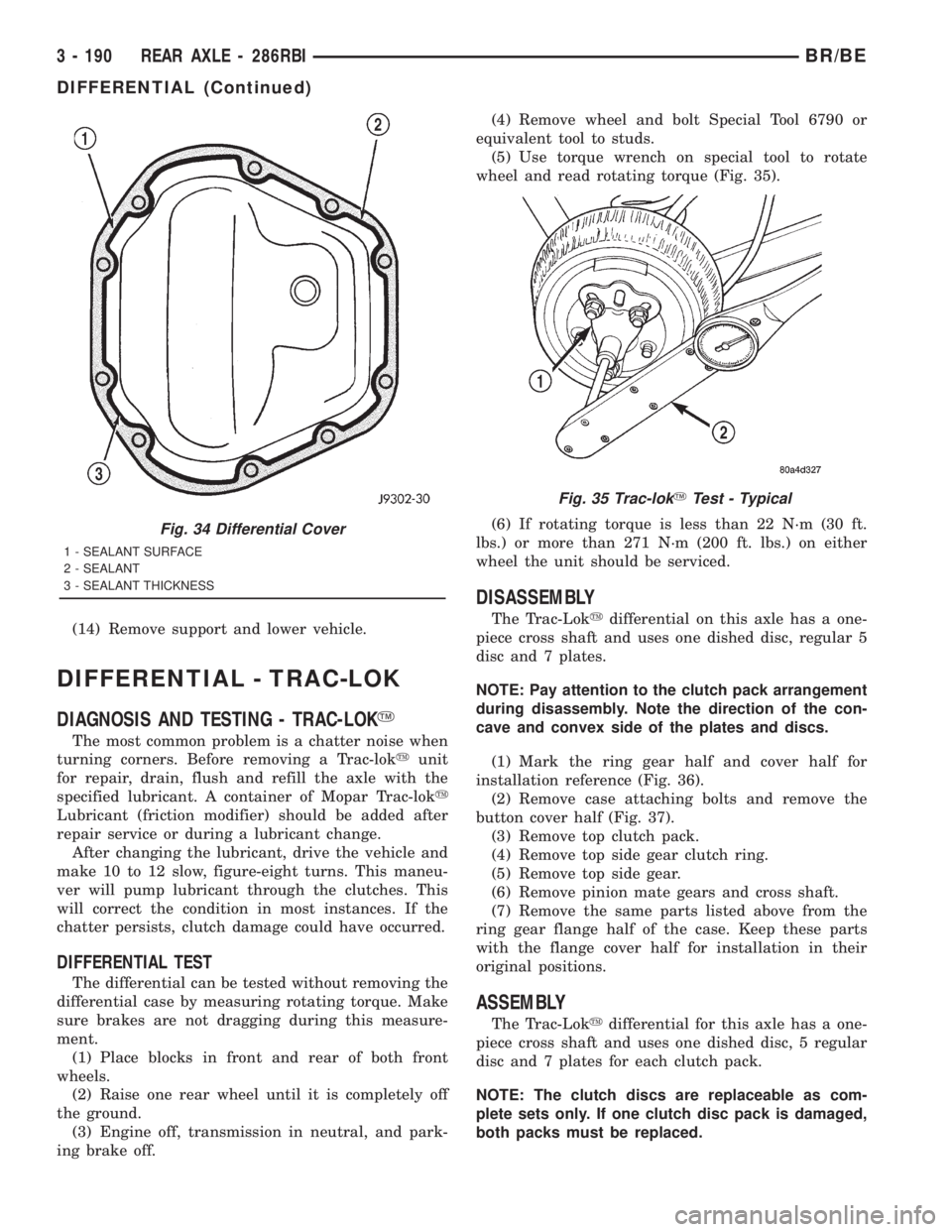
(14) Remove support and lower vehicle.
DIFFERENTIAL - TRAC-LOK
DIAGNOSIS AND TESTING - TRAC-LOKY
The most common problem is a chatter noise when
turning corners. Before removing a Trac-lokyunit
for repair, drain, flush and refill the axle with the
specified lubricant. A container of Mopar Trac-loky
Lubricant (friction modifier) should be added after
repair service or during a lubricant change.
After changing the lubricant, drive the vehicle and
make 10 to 12 slow, figure-eight turns. This maneu-
ver will pump lubricant through the clutches. This
will correct the condition in most instances. If the
chatter persists, clutch damage could have occurred.
DIFFERENTIAL TEST
The differential can be tested without removing the
differential case by measuring rotating torque. Make
sure brakes are not dragging during this measure-
ment.
(1) Place blocks in front and rear of both front
wheels.
(2) Raise one rear wheel until it is completely off
the ground.
(3) Engine off, transmission in neutral, and park-
ing brake off.(4) Remove wheel and bolt Special Tool 6790 or
equivalent tool to studs.
(5) Use torque wrench on special tool to rotate
wheel and read rotating torque (Fig. 35).
(6) If rotating torque is less than 22 N´m (30 ft.
lbs.) or more than 271 N´m (200 ft. lbs.) on either
wheel the unit should be serviced.
DISASSEMBLY
The Trac-Lokydifferential on this axle has a one-
piece cross shaft and uses one dished disc, regular 5
disc and 7 plates.
NOTE: Pay attention to the clutch pack arrangement
during disassembly. Note the direction of the con-
cave and convex side of the plates and discs.
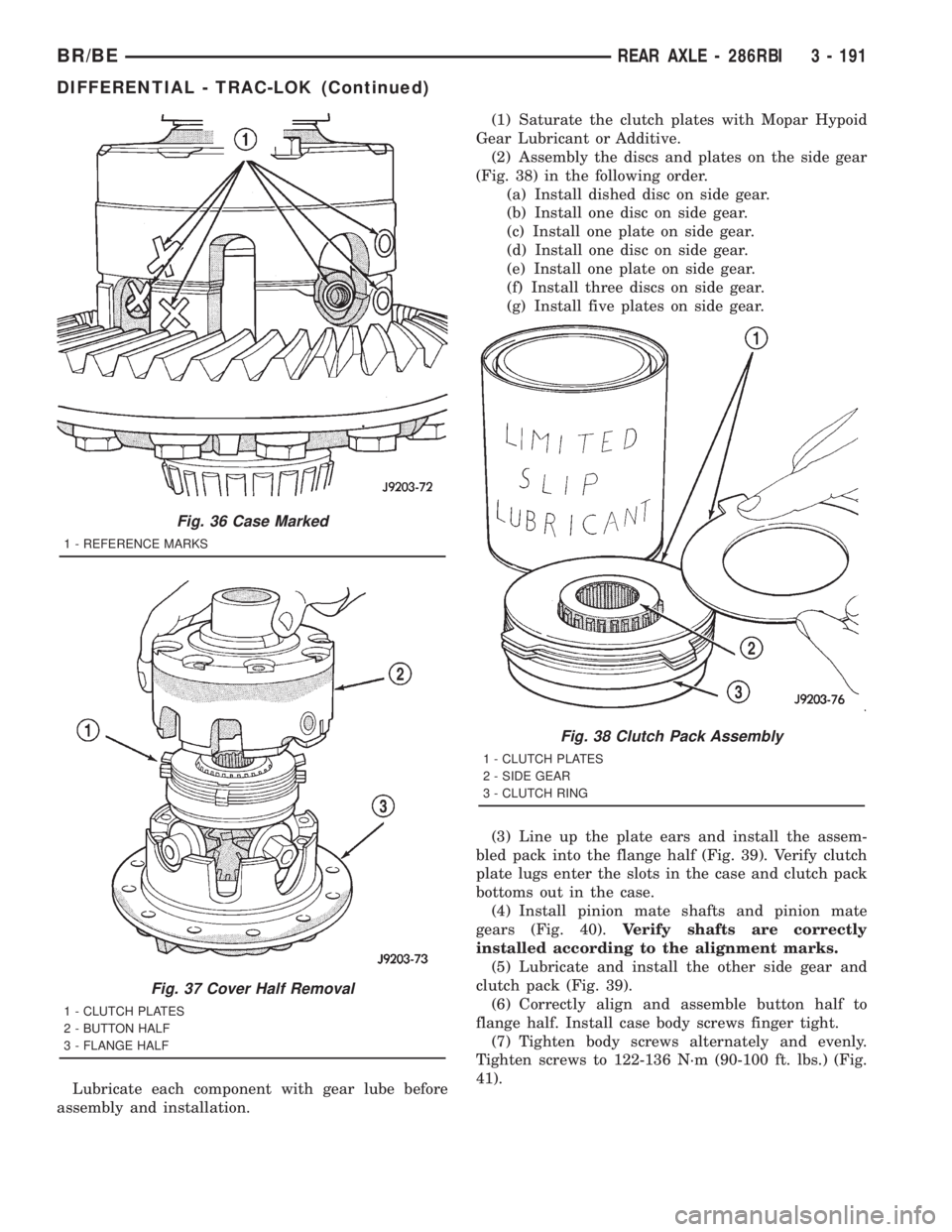
(1) Mark the ring gear half and cover half for
installation reference (Fig. 36).
(2) Remove case attaching bolts and remove the
button cover half (Fig. 37).
(3) Remove top clutch pack.
(4) Remove top side gear clutch ring.
(5) Remove top side gear.
(6) Remove pinion mate gears and cross shaft.
(7) Remove the same parts listed above from the
ring gear flange half of the case. Keep these parts
with the flange cover half for installation in their
original positions.
ASSEMBLY
The Trac-Lokydifferential for this axle has a one-
piece cross shaft and uses one dished disc, 5 regular
disc and 7 plates for each clutch pack.
NOTE: The clutch discs are replaceable as com-
plete sets only. If one clutch disc pack is damaged,
both packs must be replaced.
Fig. 34 Differential Cover
1 - SEALANT SURFACE
2 - SEALANT
3 - SEALANT THICKNESS
Fig. 35 Trac-lokYTest - Typical
3 - 190 REAR AXLE - 286RBIBR/BE
DIFFERENTIAL (Continued)
Page 264 of 2889
Lubricate each component with gear lube before
assembly and installation.(1) Saturate the clutch plates with Mopar Hypoid
Gear Lubricant or Additive.
(2) Assembly the discs and plates on the side gear
(Fig. 38) in the following order.
(a) Install dished disc on side gear.
(b) Install one disc on side gear.
(c) Install one plate on side gear.
(d) Install one disc on side gear.
(e) Install one plate on side gear.
(f) Install three discs on side gear.
(g) Install five plates on side gear.
(3) Line up the plate ears and install the assem-
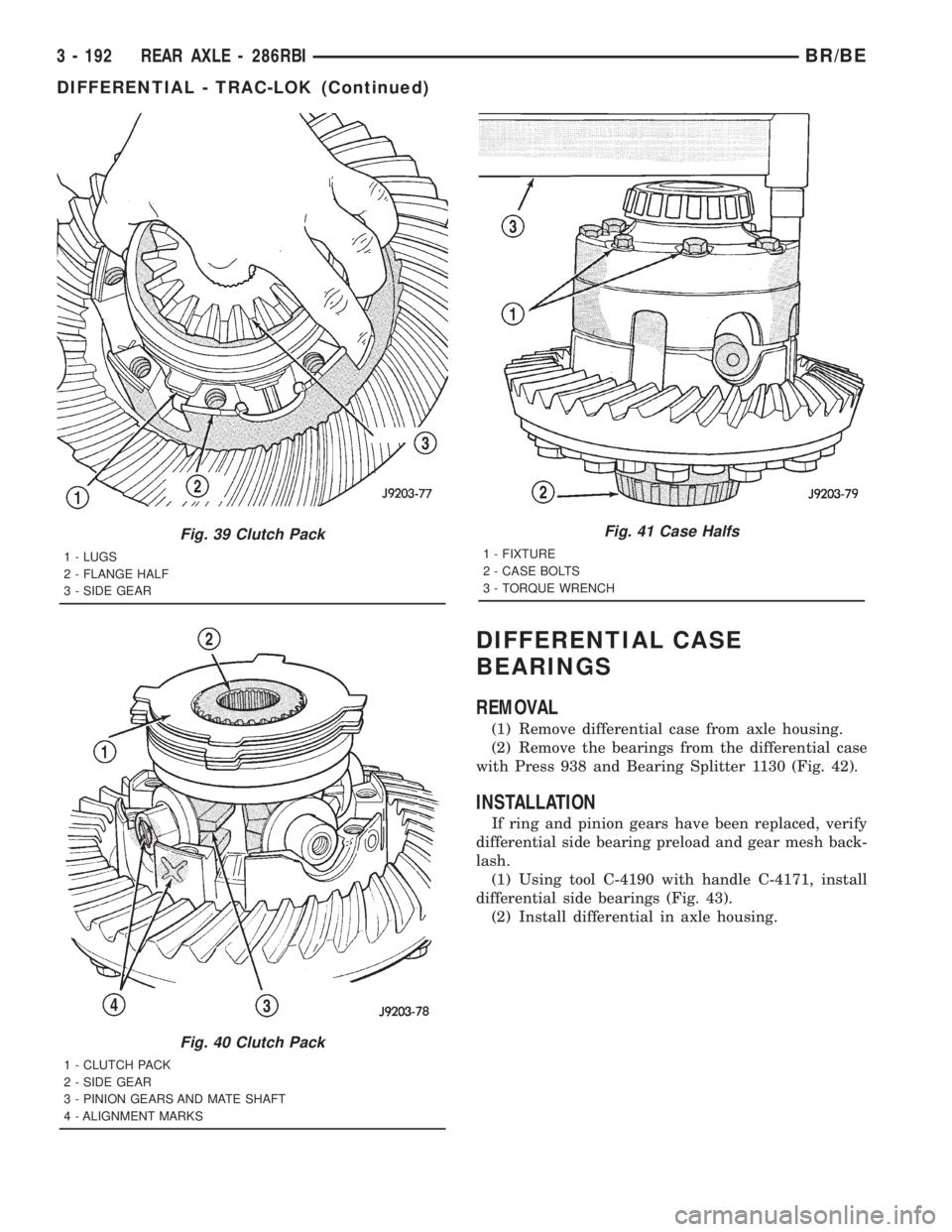
bled pack into the flange half (Fig. 39). Verify clutch
plate lugs enter the slots in the case and clutch pack
bottoms out in the case.
(4) Install pinion mate shafts and pinion mate
gears (Fig. 40).Verify shafts are correctly
installed according to the alignment marks.
(5) Lubricate and install the other side gear and
clutch pack (Fig. 39).
(6) Correctly align and assemble button half to
flange half. Install case body screws finger tight.
(7) Tighten body screws alternately and evenly.
Tighten screws to 122-136 N´m (90-100 ft. lbs.) (Fig.
41).
Fig. 36 Case Marked
1 - REFERENCE MARKS
Fig. 37 Cover Half Removal
1 - CLUTCH PLATES
2 - BUTTON HALF
3 - FLANGE HALF
Fig. 38 Clutch Pack Assembly
1 - CLUTCH PLATES
2 - SIDE GEAR
3 - CLUTCH RING
BR/BEREAR AXLE - 286RBI 3 - 191
DIFFERENTIAL - TRAC-LOK (Continued)
Page 265 of 2889
DIFFERENTIAL CASE
BEARINGS
REMOVAL
(1) Remove differential case from axle housing.
(2) Remove the bearings from the differential case
with Press 938 and Bearing Splitter 1130 (Fig. 42).
INSTALLATION
If ring and pinion gears have been replaced, verify
differential side bearing preload and gear mesh back-
lash.
(1) Using tool C-4190 with handle C-4171, install
differential side bearings (Fig. 43).
(2) Install differential in axle housing.
Fig. 39 Clutch Pack
1 - LUGS
2 - FLANGE HALF
3 - SIDE GEAR
Fig. 40 Clutch Pack
1 - CLUTCH PACK
2 - SIDE GEAR
3 - PINION GEARS AND MATE SHAFT
4 - ALIGNMENT MARKS
Fig. 41 Case Halfs
1 - FIXTURE
2 - CASE BOLTS
3 - TORQUE WRENCH
3 - 192 REAR AXLE - 286RBIBR/BE
DIFFERENTIAL - TRAC-LOK (Continued)
Page 266 of 2889
PINION GEAR/RING GEAR/
TONE RING
REMOVAL
NOTE: The ring and pinion gears are service in a
matched set. Do not replace the ring gear without
replacing the matched pinion gear.
(1) Remove differential from axle housing.
(2) Place differential case in a vise with soft metal
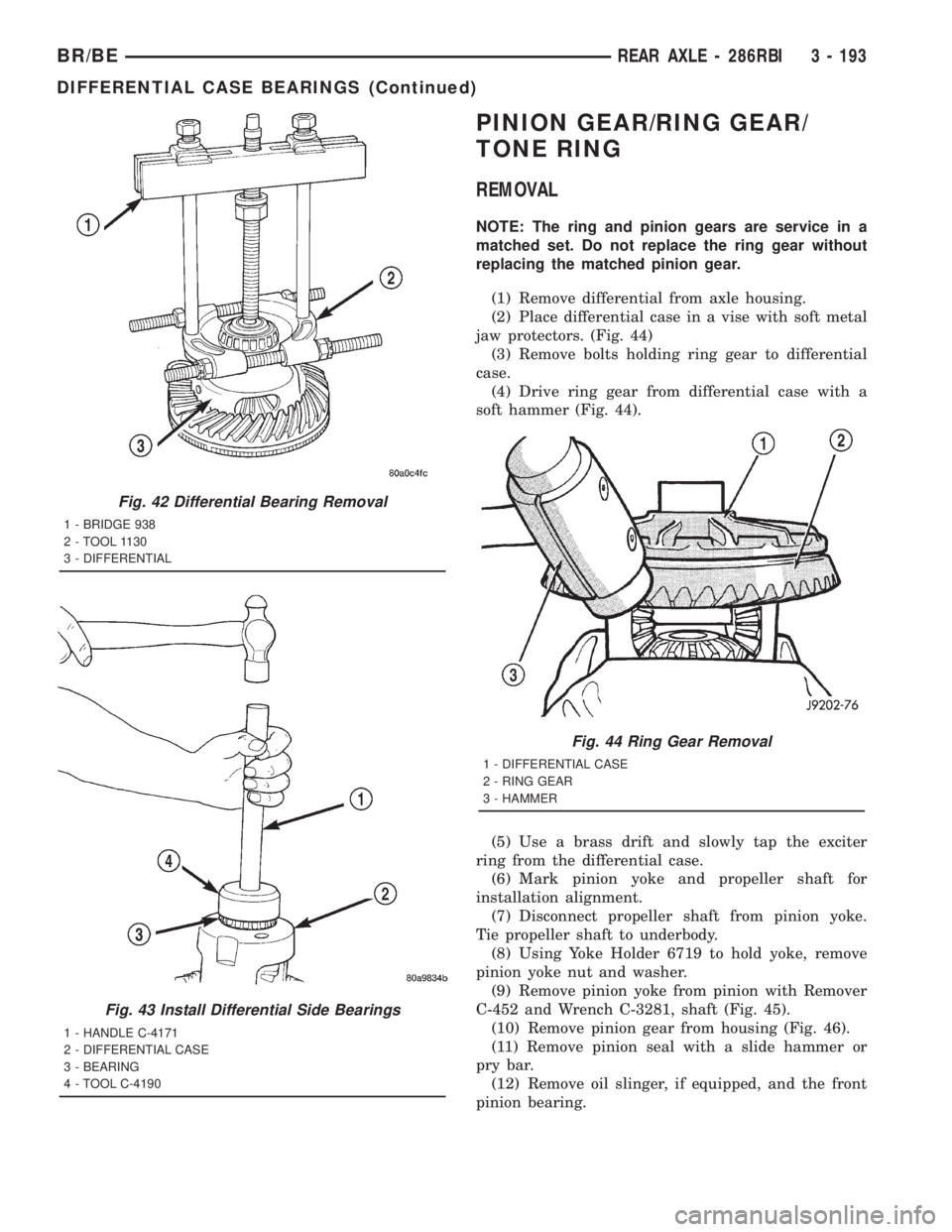
jaw protectors. (Fig. 44)
(3) Remove bolts holding ring gear to differential
case.
(4) Drive ring gear from differential case with a
soft hammer (Fig. 44).
(5) Use a brass drift and slowly tap the exciter
ring from the differential case.
(6) Mark pinion yoke and propeller shaft for
installation alignment.
(7) Disconnect propeller shaft from pinion yoke.
Tie propeller shaft to underbody.
(8) Using Yoke Holder 6719 to hold yoke, remove
pinion yoke nut and washer.
(9) Remove pinion yoke from pinion with Remover
C-452 and Wrench C-3281, shaft (Fig. 45).
(10) Remove pinion gear from housing (Fig. 46).
(11) Remove pinion seal with a slide hammer or
pry bar.
(12) Remove oil slinger, if equipped, and the front
pinion bearing.
Fig. 42 Differential Bearing Removal
1 - BRIDGE 938
2 - TOOL 1130
3 - DIFFERENTIAL
Fig. 43 Install Differential Side Bearings
1 - HANDLE C-4171
2 - DIFFERENTIAL CASE
3 - BEARING
4 - TOOL C-4190
Fig. 44 Ring Gear Removal
1 - DIFFERENTIAL CASE
2 - RING GEAR
3 - HAMMER
BR/BEREAR AXLE - 286RBI 3 - 193
DIFFERENTIAL CASE BEARINGS (Continued)
Page 269 of 2889
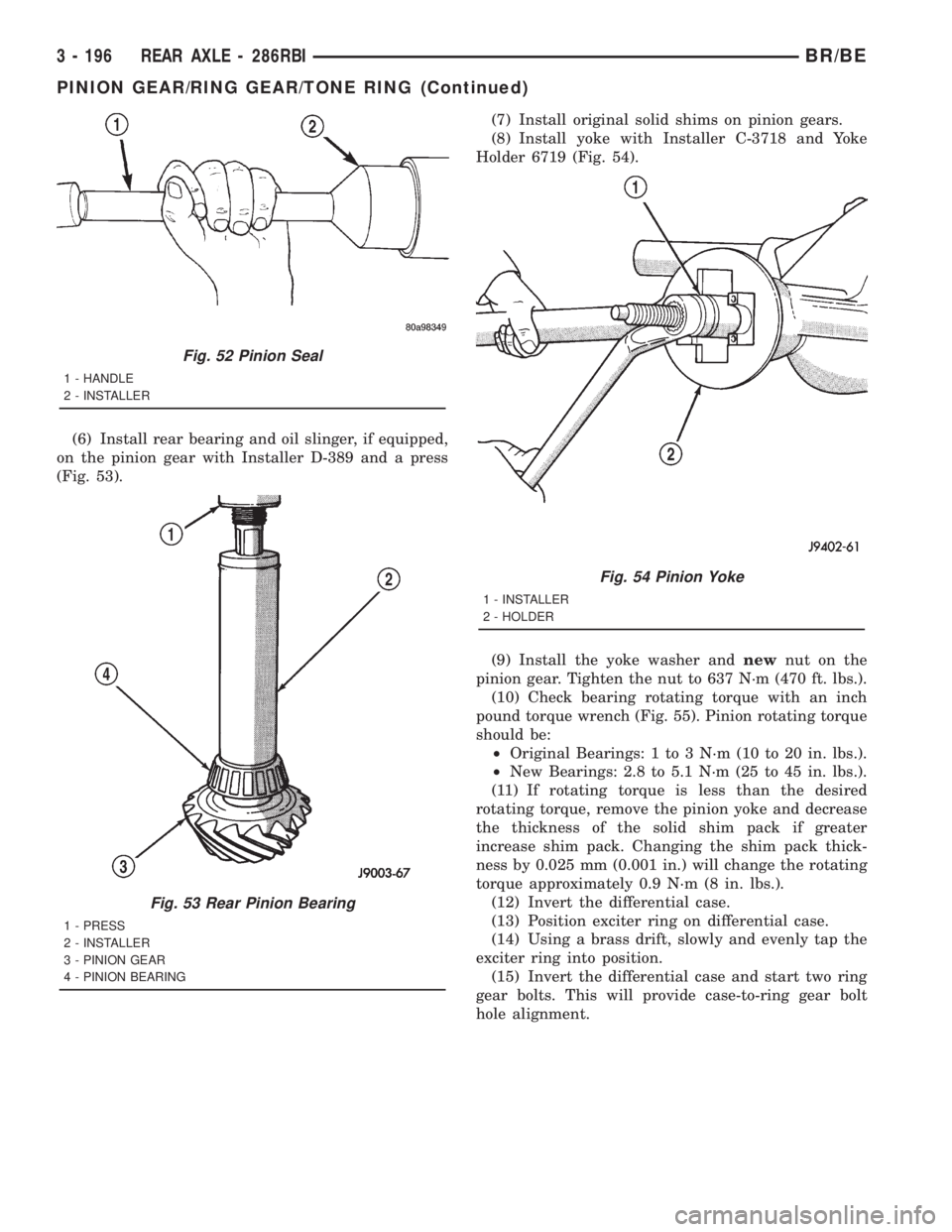
(6) Install rear bearing and oil slinger, if equipped,
on the pinion gear with Installer D-389 and a press
(Fig. 53).(7) Install original solid shims on pinion gears.
(8) Install yoke with Installer C-3718 and Yoke
Holder 6719 (Fig. 54).
(9) Install the yoke washer andnewnut on the
pinion gear. Tighten the nut to 637 N´m (470 ft. lbs.).
(10) Check bearing rotating torque with an inch
pound torque wrench (Fig. 55). Pinion rotating torque
should be:
²Original Bearings: 1 to 3 N´m (10 to 20 in. lbs.).
²New Bearings: 2.8 to 5.1 N´m (25 to 45 in. lbs.).
(11) If rotating torque is less than the desired
rotating torque, remove the pinion yoke and decrease
the thickness of the solid shim pack if greater
increase shim pack. Changing the shim pack thick-
ness by 0.025 mm (0.001 in.) will change the rotating
torque approximately 0.9 N´m (8 in. lbs.).
(12) Invert the differential case.
(13) Position exciter ring on differential case.
(14) Using a brass drift, slowly and evenly tap the
exciter ring into position.
(15) Invert the differential case and start two ring
gear bolts. This will provide case-to-ring gear bolt
hole alignment.
Fig. 52 Pinion Seal
1 - HANDLE
2 - INSTALLER
Fig. 53 Rear Pinion Bearing
1 - PRESS
2 - INSTALLER
3 - PINION GEAR
4 - PINION BEARING
Fig. 54 Pinion Yoke
1 - INSTALLER
2 - HOLDER
3 - 196 REAR AXLE - 286RBIBR/BE
PINION GEAR/RING GEAR/TONE RING (Continued)
Page 270 of 2889
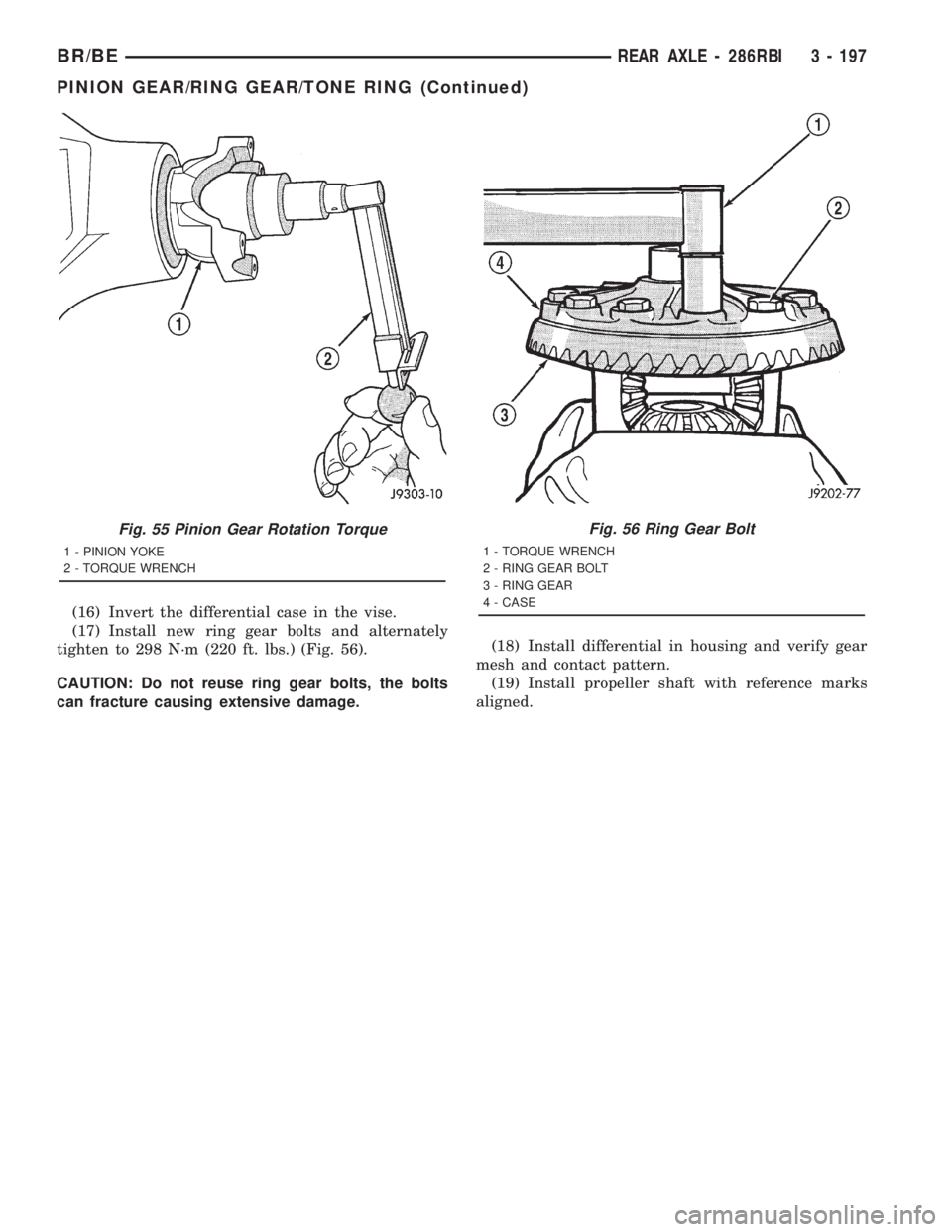
(16) Invert the differential case in the vise.
(17) Install new ring gear bolts and alternately
tighten to 298 N´m (220 ft. lbs.) (Fig. 56).
CAUTION: Do not reuse ring gear bolts, the bolts
can fracture causing extensive damage.(18) Install differential in housing and verify gear
mesh and contact pattern.
(19) Install propeller shaft with reference marks
aligned.
Fig. 55 Pinion Gear Rotation Torque
1 - PINION YOKE
2 - TORQUE WRENCH
Fig. 56 Ring Gear Bolt
1 - TORQUE WRENCH
2 - RING GEAR BOLT
3 - RING GEAR
4 - CASE
BR/BEREAR AXLE - 286RBI 3 - 197
PINION GEAR/RING GEAR/TONE RING (Continued)
Page 280 of 2889
tube can be used for emergency repair when factory
replacement parts are not readily available.
To make a ISO flare use an ISO flaring tool kit.
(1) Cut off damaged tube with Tubing Cutter.
(2) Remove any burrs from the inside of the tube.
(3) Install tube nut on the tube.
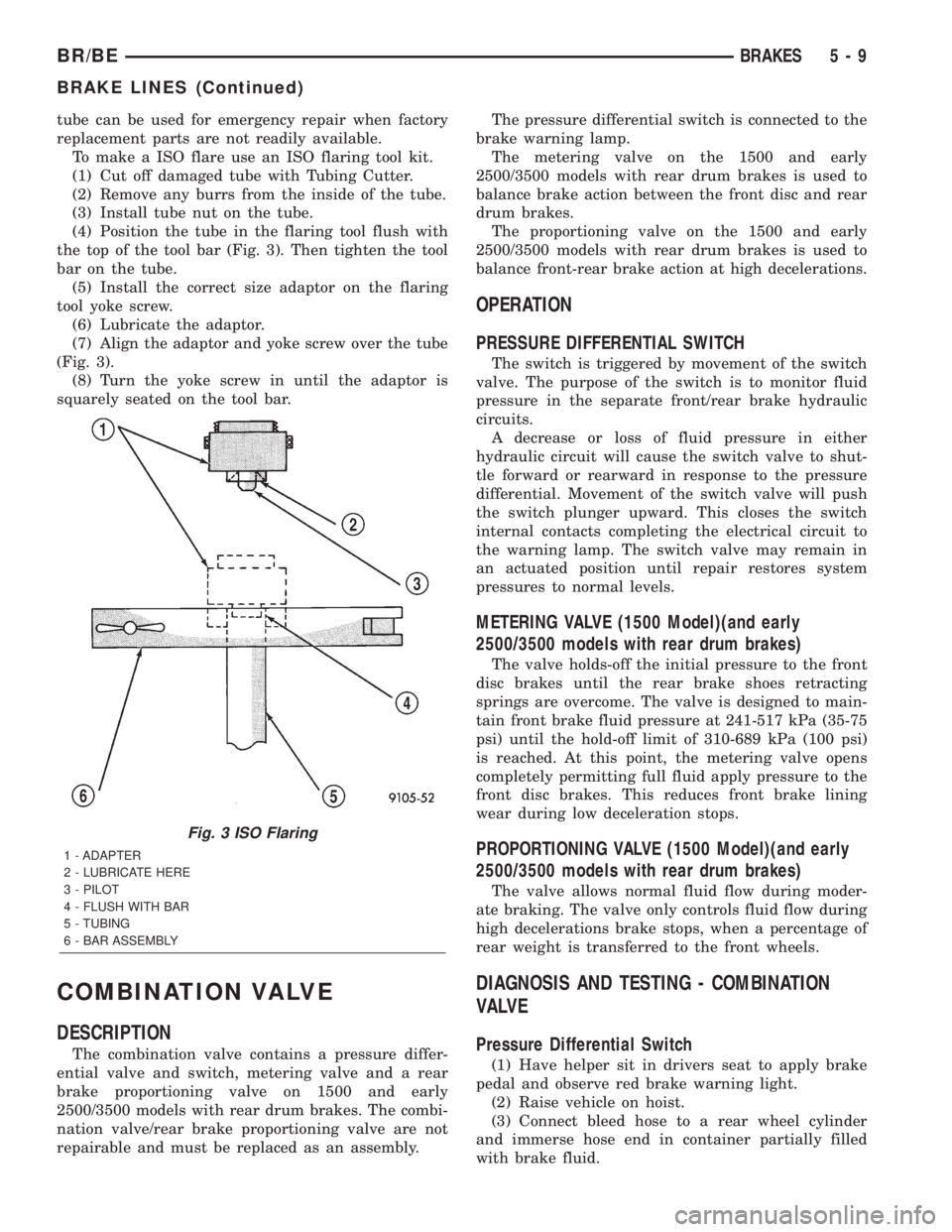
(4) Position the tube in the flaring tool flush with
the top of the tool bar (Fig. 3). Then tighten the tool
bar on the tube.
(5) Install the correct size adaptor on the flaring
tool yoke screw.
(6) Lubricate the adaptor.
(7) Align the adaptor and yoke screw over the tube
(Fig. 3).
(8) Turn the yoke screw in until the adaptor is
squarely seated on the tool bar.
COMBINATION VALVE
DESCRIPTION
The combination valve contains a pressure differ-
ential valve and switch, metering valve and a rear
brake proportioning valve on 1500 and early
2500/3500 models with rear drum brakes. The combi-
nation valve/rear brake proportioning valve are not
repairable and must be replaced as an assembly.The pressure differential switch is connected to the
brake warning lamp.
The metering valve on the 1500 and early
2500/3500 models with rear drum brakes is used to
balance brake action between the front disc and rear
drum brakes.
The proportioning valve on the 1500 and early
2500/3500 models with rear drum brakes is used to
balance front-rear brake action at high decelerations.
OPERATION
PRESSURE DIFFERENTIAL SWITCH
The switch is triggered by movement of the switch
valve. The purpose of the switch is to monitor fluid
pressure in the separate front/rear brake hydraulic
circuits.
A decrease or loss of fluid pressure in either
hydraulic circuit will cause the switch valve to shut-
tle forward or rearward in response to the pressure
differential. Movement of the switch valve will push
the switch plunger upward. This closes the switch
internal contacts completing the electrical circuit to
the warning lamp. The switch valve may remain in
an actuated position until repair restores system
pressures to normal levels.
METERING VALVE (1500 Model)(and early
2500/3500 models with rear drum brakes)
The valve holds-off the initial pressure to the front
disc brakes until the rear brake shoes retracting
springs are overcome. The valve is designed to main-
tain front brake fluid pressure at 241-517 kPa (35-75
psi) until the hold-off limit of 310-689 kPa (100 psi)
is reached. At this point, the metering valve opens
completely permitting full fluid apply pressure to the
front disc brakes. This reduces front brake lining
wear during low deceleration stops.
PROPORTIONING VALVE (1500 Model)(and early
2500/3500 models with rear drum brakes)
The valve allows normal fluid flow during moder-
ate braking. The valve only controls fluid flow during
high decelerations brake stops, when a percentage of
rear weight is transferred to the front wheels.
DIAGNOSIS AND TESTING - COMBINATION
VALVE
Pressure Differential Switch
(1) Have helper sit in drivers seat to apply brake
pedal and observe red brake warning light.
(2) Raise vehicle on hoist.
(3) Connect bleed hose to a rear wheel cylinder
and immerse hose end in container partially filled
with brake fluid.
Fig. 3 ISO Flaring
1 - ADAPTER
2 - LUBRICATE HERE
3 - PILOT
4 - FLUSH WITH BAR
5 - TUBING
6 - BAR ASSEMBLY
BR/BEBRAKES 5 - 9
BRAKE LINES (Continued)
Page 281 of 2889
(4) Have helper press and hold brake pedal to floor
and observe warning light.
(a) If warning light illuminates, switch is operat-
ing correctly.
(b) If light fails to illuminate, check circuit fuse,
bulb, and wiring. The parking brake switch can be
used to aid in identifying whether or not the brake
light bulb and fuse is functional. Repair or replace
parts as necessary and test differential pressure
switch operation again.
(5) If warning light still does not illuminate,
switch is faulty. Replace combination valve assembly,
bleed brake system and verify proper switch and
valve operation.
REMOVAL
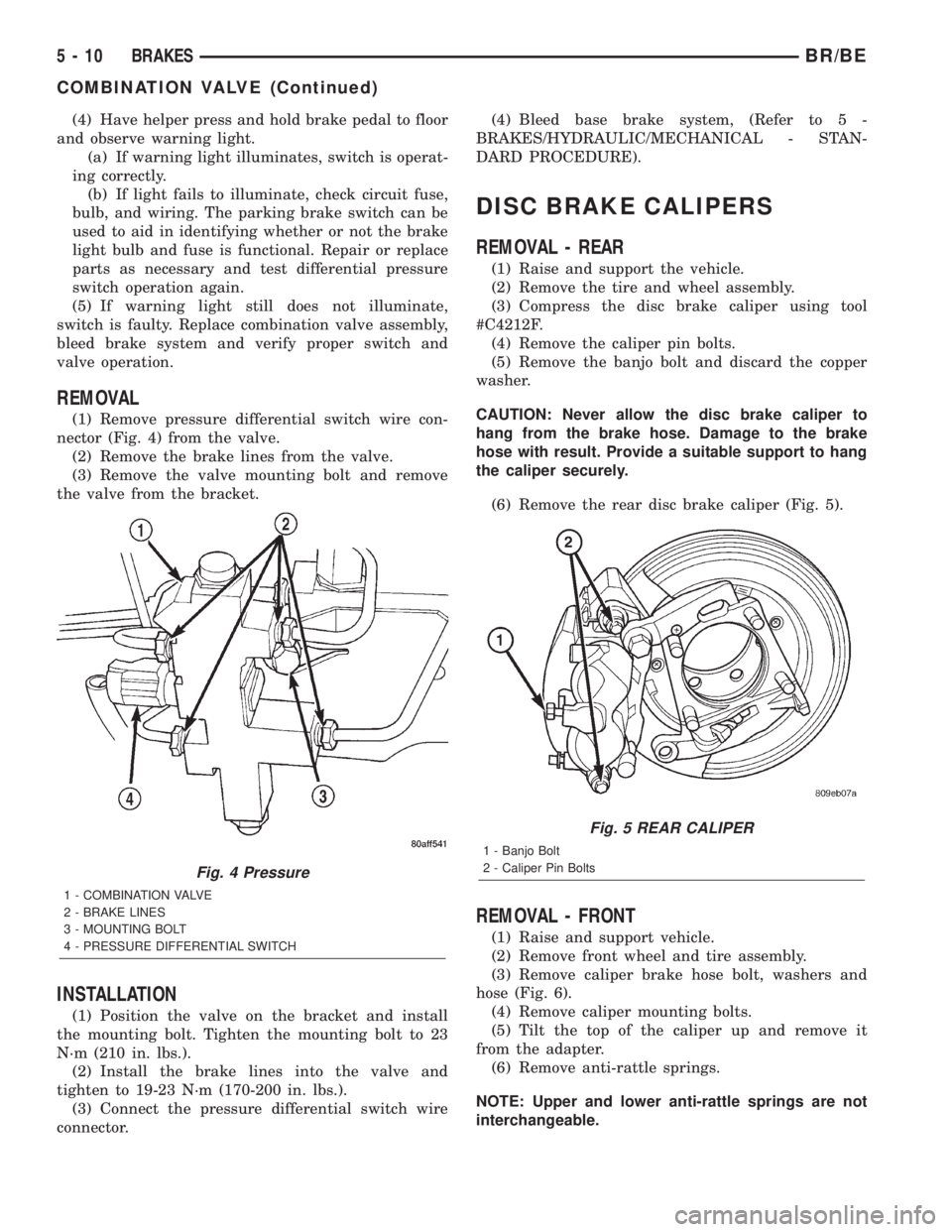
(1) Remove pressure differential switch wire con-
nector (Fig. 4) from the valve.
(2) Remove the brake lines from the valve.
(3) Remove the valve mounting bolt and remove
the valve from the bracket.
INSTALLATION
(1) Position the valve on the bracket and install
the mounting bolt. Tighten the mounting bolt to 23
N´m (210 in. lbs.).
(2) Install the brake lines into the valve and
tighten to 19-23 N´m (170-200 in. lbs.).
(3) Connect the pressure differential switch wire
connector.(4) Bleed base brake system, (Refer to 5 -
BRAKES/HYDRAULIC/MECHANICAL - STAN-
DARD PROCEDURE).
DISC BRAKE CALIPERS
REMOVAL - REAR
(1) Raise and support the vehicle.
(2) Remove the tire and wheel assembly.
(3) Compress the disc brake caliper using tool
#C4212F.
(4) Remove the caliper pin bolts.
(5) Remove the banjo bolt and discard the copper
washer.
CAUTION: Never allow the disc brake caliper to
hang from the brake hose. Damage to the brake
hose with result. Provide a suitable support to hang
the caliper securely.
(6) Remove the rear disc brake caliper (Fig. 5).
REMOVAL - FRONT
(1) Raise and support vehicle.
(2) Remove front wheel and tire assembly.
(3) Remove caliper brake hose bolt, washers and
hose (Fig. 6).
(4) Remove caliper mounting bolts.
(5) Tilt the top of the caliper up and remove it
from the adapter.
(6) Remove anti-rattle springs.
NOTE: Upper and lower anti-rattle springs are not
interchangeable.
Fig. 4 Pressure
1 - COMBINATION VALVE
2 - BRAKE LINES
3 - MOUNTING BOLT
4 - PRESSURE DIFFERENTIAL SWITCH
Fig. 5 REAR CALIPER
1 - Banjo Bolt
2 - Caliper Pin Bolts
5 - 10 BRAKESBR/BE
COMBINATION VALVE (Continued)