2001 CHRYSLER VOYAGER radiator cap
[x] Cancel search: radiator capPage 2786 of 4284
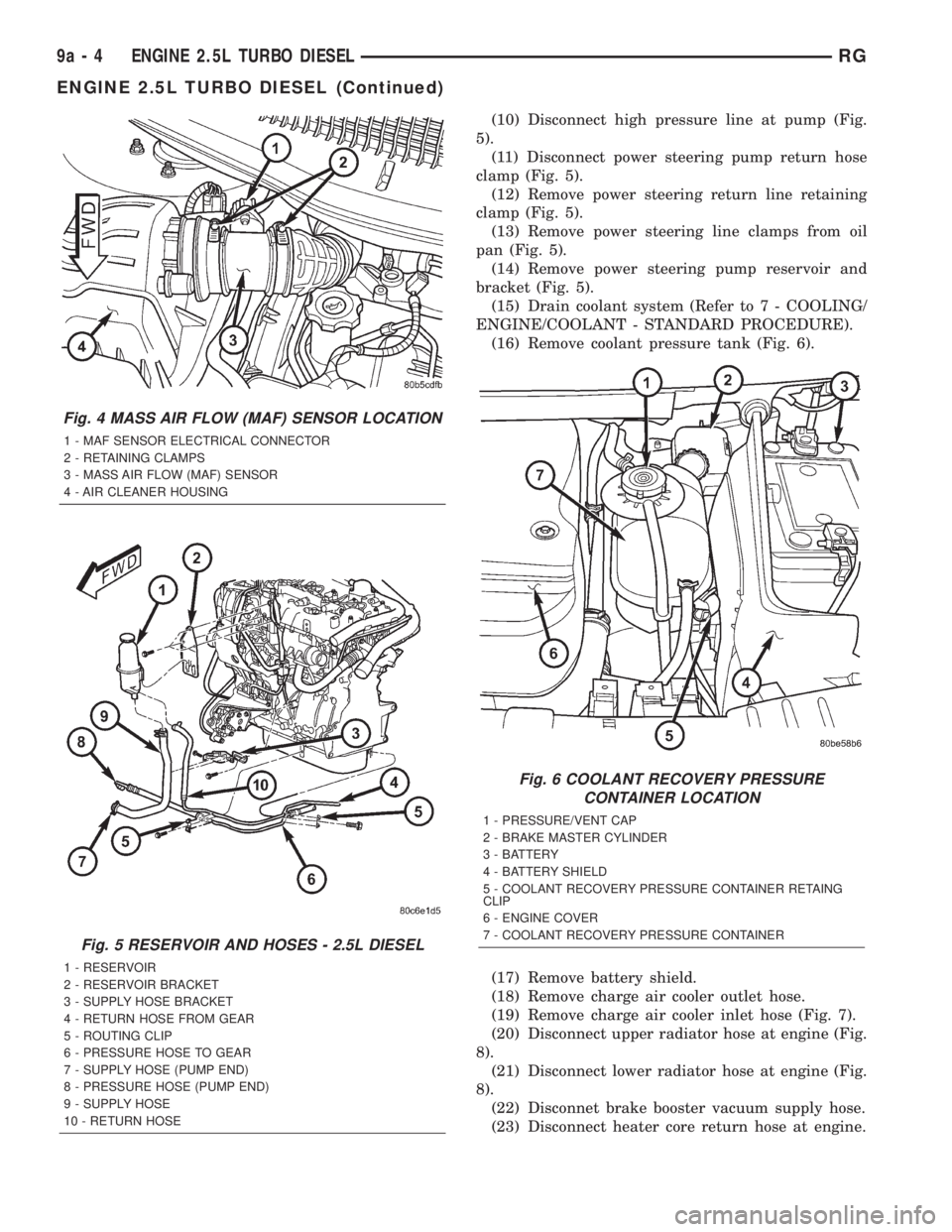
(10) Disconnect high pressure line at pump (Fig.
5).
(11) Disconnect power steering pump return hose
clamp (Fig. 5).
(12) Remove power steering return line retaining
clamp (Fig. 5).
(13) Remove power steering line clamps from oil
pan (Fig. 5).
(14) Remove power steering pump reservoir and
bracket (Fig. 5).
(15) Drain coolant system (Refer to 7 - COOLING/
ENGINE/COOLANT - STANDARD PROCEDURE).
(16) Remove coolant pressure tank (Fig. 6).
(17) Remove battery shield.
(18) Remove charge air cooler outlet hose.
(19) Remove charge air cooler inlet hose (Fig. 7).
(20) Disconnect upper radiator hose at engine (Fig.
8).
(21) Disconnect lower radiator hose at engine (Fig.
8).
(22) Disconnet brake booster vacuum supply hose.
(23) Disconnect heater core return hose at engine.
Fig. 4 MASS AIR FLOW (MAF) SENSOR LOCATION
1 - MAF SENSOR ELECTRICAL CONNECTOR
2 - RETAINING CLAMPS
3 - MASS AIR FLOW (MAF) SENSOR
4 - AIR CLEANER HOUSING
Fig. 5 RESERVOIR AND HOSES - 2.5L DIESEL
1 - RESERVOIR
2 - RESERVOIR BRACKET
3 - SUPPLY HOSE BRACKET
4 - RETURN HOSE FROM GEAR
5 - ROUTING CLIP
6 - PRESSURE HOSE TO GEAR
7 - SUPPLY HOSE (PUMP END)
8 - PRESSURE HOSE (PUMP END)
9 - SUPPLY HOSE
10 - RETURN HOSE
Fig. 6 COOLANT RECOVERY PRESSURE
CONTAINER LOCATION
1 - PRESSURE/VENT CAP
2 - BRAKE MASTER CYLINDER
3 - BATTERY
4 - BATTERY SHIELD
5 - COOLANT RECOVERY PRESSURE CONTAINER RETAING
CLIP
6 - ENGINE COVER
7 - COOLANT RECOVERY PRESSURE CONTAINER
9a - 4 ENGINE 2.5L TURBO DIESELRG
ENGINE 2.5L TURBO DIESEL (Continued)
Page 3692 of 4284
PLUMBING - FRONT
TABLE OF CONTENTS
page page
PLUMBING - FRONT
WARNING..............................62
CAUTION...............................63
COMPRESSOR
DESCRIPTION...........................64
OPERATION.............................65
DIAGNOSIS AND TESTING.................65
COMPRESSOR NOISE DIAGNOSIS.........65
REMOVAL..............................65
INSTALLATION...........................66
CONDENSER
DESCRIPTION...........................67
OPERATION.............................67
REMOVAL..............................68
INSTALLATION...........................69
DISCHARGE LINE
REMOVAL..............................70
INSTALLATION...........................70
EVAPORATOR
DESCRIPTION...........................71
OPERATION.............................71
REMOVAL..............................71
INSTALLATION...........................73
EXPANSION VALVE
DESCRIPTION...........................74
OPERATION.............................74
DIAGNOSIS AND TESTING.................74
EXPANSION VALVE.....................74
REMOVAL..............................75
INSTALLATION...........................75
HEATER CORE
DESCRIPTION...........................76
OPERATION.............................76
REMOVAL..............................76INSTALLATION...........................79
HEATER HOSE
REMOVAL..............................80
INSTALLATION...........................82
LIQUID LINE
REMOVAL..............................82
INSTALLATION...........................84
RECEIVER/DRIER
DESCRIPTION...........................85
OPERATION.............................86
REMOVAL..............................86
INSTALLATION...........................86
REFRIGERANT
DESCRIPTION...........................87
OPERATION.............................87
DIAGNOSIS AND TESTING.................87
REFRIGERANT SYSTEM CHARGE LEVEL....87
REFRIGERANT SYSTEM LEAKS...........89
STANDARD PROCEDURE..................89
SERVICE EQUIPMENT...................89
REFRIGERANT SYSTEM CHARGE.........90
REFRIGERANT SYSTEM EVACUATE........91
REFRIGERANT RECOVERY...............91
REFRIGERANT OIL
DESCRIPTION...........................91
OPERATION.............................92
STANDARD PROCEDURE..................92
REFRIGERANT OIL LEVEL................92
SUCTION LINE
REMOVAL..............................92
INSTALLATION...........................93
SERVICE PORTS
REMOVAL..............................94
INSTALLATION...........................95
PLUMBING - FRONT
WARNING
WARNING: THE ENGINE COOLING SYSTEM IS
DESIGNED TO DEVELOP INTERNAL PRESSURES
OF 97 TO 123 KILOPASCALS (14 TO 18 POUNDS
PER SQUARE INCH). DO NOT REMOVE OR
LOOSEN THE COOLANT PRESSURE CAP, CYLIN-
DER BLOCK DRAIN PLUGS, RADIATOR DRAIN,RADIATOR HOSES, HEATER HOSES, OR HOSE
CLAMPS WHILE THE SYSTEM IS HOT AND UNDER
PRESSURE. FAILURE TO OBSERVE THIS WARNING
CAN RESULT IN SERIOUS BURNS FROM THE
HEATED ENGINE COOLANT. ALLOW THE VEHICLE
TO COOL FOR A MINIMUM OF 15 MINUTES
BEFORE OPENING THE COOLING SYSTEM FOR
SERVICE.
24 - 62 PLUMBING - FRONTRS
Page 3730 of 4284
(2) Lubricate new rubber O-ring seals with clean
refrigerant oil and install them on the evaporator
tube fittings.
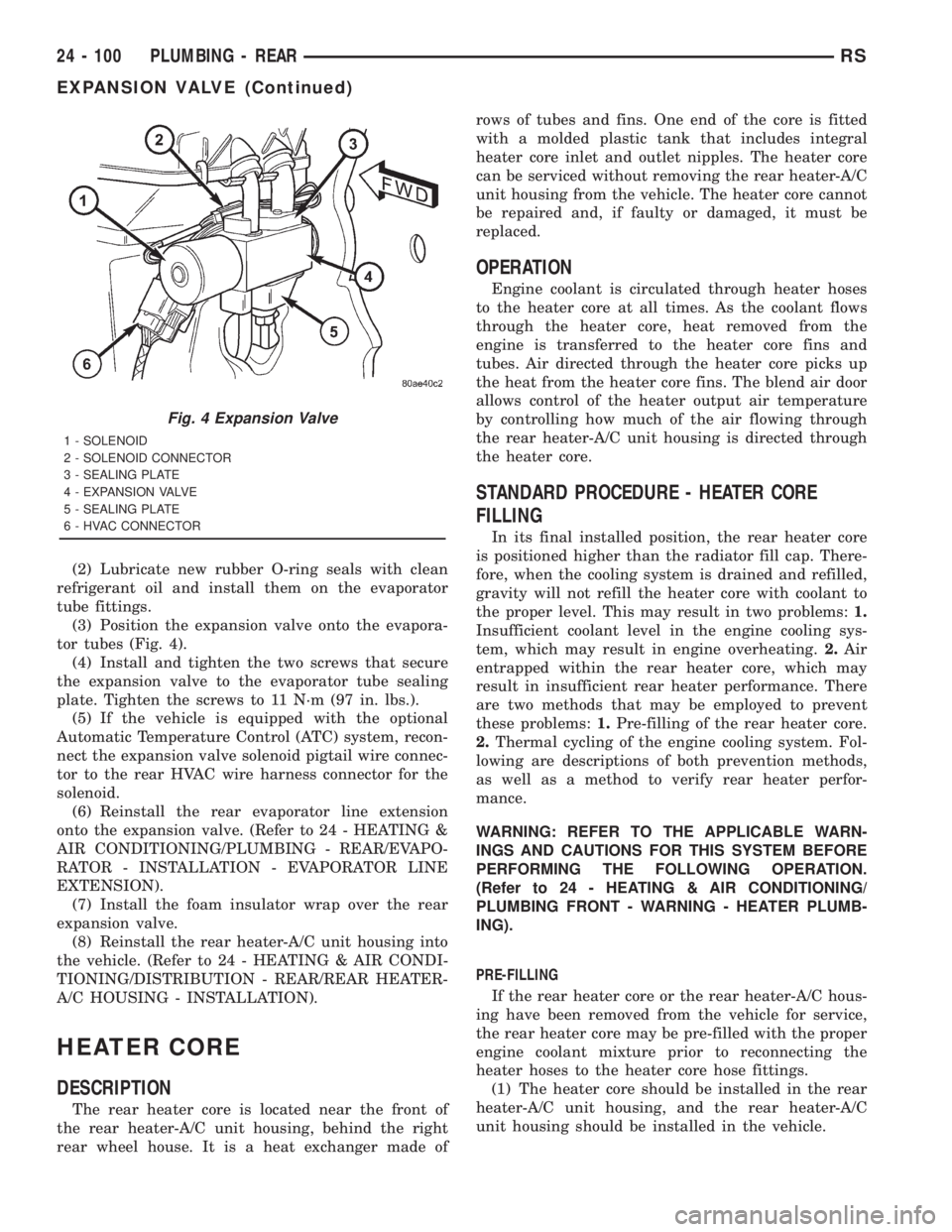
(3) Position the expansion valve onto the evapora-
tor tubes (Fig. 4).
(4) Install and tighten the two screws that secure
the expansion valve to the evaporator tube sealing
plate. Tighten the screws to 11 N´m (97 in. lbs.).
(5) If the vehicle is equipped with the optional
Automatic Temperature Control (ATC) system, recon-
nect the expansion valve solenoid pigtail wire connec-
tor to the rear HVAC wire harness connector for the
solenoid.
(6) Reinstall the rear evaporator line extension
onto the expansion valve. (Refer to 24 - HEATING &
AIR CONDITIONING/PLUMBING - REAR/EVAPO-
RATOR - INSTALLATION - EVAPORATOR LINE
EXTENSION).
(7) Install the foam insulator wrap over the rear
expansion valve.
(8) Reinstall the rear heater-A/C unit housing into
the vehicle. (Refer to 24 - HEATING & AIR CONDI-
TIONING/DISTRIBUTION - REAR/REAR HEATER-
A/C HOUSING - INSTALLATION).
HEATER CORE
DESCRIPTION
The rear heater core is located near the front of
the rear heater-A/C unit housing, behind the right
rear wheel house. It is a heat exchanger made ofrows of tubes and fins. One end of the core is fitted
with a molded plastic tank that includes integral
heater core inlet and outlet nipples. The heater core
can be serviced without removing the rear heater-A/C
unit housing from the vehicle. The heater core cannot
be repaired and, if faulty or damaged, it must be
replaced.
OPERATION
Engine coolant is circulated through heater hoses
to the heater core at all times. As the coolant flows
through the heater core, heat removed from the
engine is transferred to the heater core fins and
tubes. Air directed through the heater core picks up
the heat from the heater core fins. The blend air door
allows control of the heater output air temperature
by controlling how much of the air flowing through
the rear heater-A/C unit housing is directed through
the heater core.
STANDARD PROCEDURE - HEATER CORE
FILLING
In its final installed position, the rear heater core
is positioned higher than the radiator fill cap. There-
fore, when the cooling system is drained and refilled,
gravity will not refill the heater core with coolant to
the proper level. This may result in two problems:1.
Insufficient coolant level in the engine cooling sys-
tem, which may result in engine overheating.2.Air
entrapped within the rear heater core, which may
result in insufficient rear heater performance. There
are two methods that may be employed to prevent
these problems:1.Pre-filling of the rear heater core.
2.Thermal cycling of the engine cooling system. Fol-
lowing are descriptions of both prevention methods,
as well as a method to verify rear heater perfor-
mance.
WARNING: REFER TO THE APPLICABLE WARN-
INGS AND CAUTIONS FOR THIS SYSTEM BEFORE
PERFORMING THE FOLLOWING OPERATION.
(Refer to 24 - HEATING & AIR CONDITIONING/
PLUMBING FRONT - WARNING - HEATER PLUMB-
ING).
PRE-FILLING
If the rear heater core or the rear heater-A/C hous-
ing have been removed from the vehicle for service,
the rear heater core may be pre-filled with the proper
engine coolant mixture prior to reconnecting the
heater hoses to the heater core hose fittings.
(1) The heater core should be installed in the rear
heater-A/C unit housing, and the rear heater-A/C
unit housing should be installed in the vehicle.
Fig. 4 Expansion Valve
1 - SOLENOID
2 - SOLENOID CONNECTOR
3 - SEALING PLATE
4 - EXPANSION VALVE
5 - SEALING PLATE
6 - HVAC CONNECTOR
24 - 100 PLUMBING - REARRS
EXPANSION VALVE (Continued)
Page 3740 of 4284
INSTALLATION
(1) Install both flexible coolant lines to the heater
unit and install clamps.
(2) Install flexible coolant lines to the coolant pipes
and install clamps.
(3) Install heater unit into vehicle(Refer to 24 -
HEATING & AIR CONDITIONING/CABIN HEAT-
ER/HEATER UNIT - INSTALLATION).
(4) Lower vehicle.
(5) Refill cooling system(Refer to 7 - COOLING -
STANDARD PROCEDURE).
(6) Verify operation of heater unit.
HEATER PIPES - DIESEL
SUPPLEMENTAL HEATER
REMOVAL
CAUTION: Allow cooling system to cool completely
before removing radiator cap or draining cooling
system. Injury could result is system is opened
while system coolant is hot and under pressure.
NOTE: Steel heater lines from engine compartment
to heater unit are part of an assembly that includes
the air intake pipe. If the heater lines or air intake
pipe require removal or replacement the entire
assembly must be removed or replaced.
(1) Open hood.
(2) Drain the cooling system(Refer to 7 - COOL-
ING - STANDARD PROCEDURE).
(3) Remove clamps from both the EGR cooler and
the lower heater port. Separate hoses from the mat-
ing plumbing port. (Fig. 1).
(4) Remove retaining nut from heater line under
hood bracket.(5) Elevate vehicle on a lift.
NOTE: When supporting vehicle care should be
taken not to damage the heater exhaust tube.
(6) Remove clamps from heater lines to the rubber
connection nearest the tubes. Separate the hoses
from the tube assembly leaving the rubber hose
attached to the supplemental heater.
(7) Remove heater unit intake pipe from heater-
(Refer to 24 - HEATING & AIR CONDITIONING/
CABIN HEATER/INLET HOSE - REMOVAL) (Fig.
2).
(8) Remove heater pipe assembly retaining screws
and remove assembly from vehicle.
INSTALLATION
(1) With vehicle on a lift position the heater pipe
assembly and install the retaining screws.
(2) Install the heater unit intake pipe to the
heater unit(Refer to 24 - HEATING & AIR CONDI-
TIONING/CABIN HEATER/INLET HOSE - INSTAL-
LATION).
(3) Connect heater hoses to the heater unit and
tighten the clamps.
(4) Install heater unit intake pipe to heater uni-
t(Refer to 24 - HEATING & AIR CONDITIONING/
CABIN HEATER/INLET HOSE - INSTALLATION).
(5) Lower vehicle on lift.
(6) Install retaining nut to heater line under hood
bracket and tighten.
(7) Connect heater lines to heater hoses at heater
core and EGR port. Position spring clamps onto the
installed hoses.
(8) Refill cooling system(Refer to 7 - COOLING -
STANDARD PROCEDURE).
(9) Close hood.
24a - 2 HEATING & AIR CONDITIONINGRG
HEATER HOSES - DIESEL SUPPLEMENTAL HEATER (Continued)