2001 CHRYSLER VOYAGER alarm
[x] Cancel search: alarmPage 980 of 4284

Symptom:
*VTSS INDICATOR LAMP INOPERATIVE
POSSIBLE CAUSES
RKE/THATCHAM ALARM MODULE - INTERNAL MALFUNCTION
VTSS INDICATOR SUPPLY CIRCUIT OPEN
OPEN VTSS LED
VTSS INDICATOR DRIVER CIRCUIT OPEN
RKE/THATCHAM ALARM MODULE - INTERNAL MALFUNCTION
TEST ACTION APPLICABILITY
1 With the DRBIIIt, actuate the VTSS INDICATOR LAMP.
Does the VTSS Indicator Lamp flash while actuating.All
Ye s®Replace the RKE/Thatcham Alarm Module.
Perform VTSS VERIFICATION TEST - 1A.
No®Go To 2
2 Disconnect the VTSS Indicator Lamp harness connector.
Measure the voltage of the VTSS Indicator Supply circuit.
Is the voltage above 10.0 volts?All
Ye s®Go To 3
No®Repair the VTSS Indicator Supply circuit for an open.
Perform VTSS VERIFICATION TEST - 1A.
3 Disconnect the VTSS Indicator Lamp harness connector.
With a 12-volt test light connected to 12-volts, connect the test light probe to the
VTSS Indicator Driver circuit.
Turn the ignition on.
With the DRBIIItin Vehicle Theft, actuate the VTSS Indicator lamp.
Does the test light illuminate when the VTSS Indicator lamp is actuated?All
Ye s®Replace the VTSS Indicator LED Lamp.
Perform VTSS VERIFICATION TEST - 1A.
No®Go To 4
4 Disconnect the VTSS Indicator Lamp harness connector.
Disconnect the RKE/Thatcham Alarm Module C1 harness connector.
Measure the resistance of the VTSS Indicator Driver circuit.
Is the resistance below 5.0 ohms?All
Ye s®Replace the RKE/Thatcham Alarm Module.
Perform VTSS VERIFICATION TEST - 1A.
No®Repair the VTSS Indicator Driver circuit for an open.
Perform VTSS VERIFICATION TEST - 1A.
951
VEHICLE THEFT/SECURITY
Page 981 of 4284

Symptom:
*VTSS SIREN INOP
POSSIBLE CAUSES
INTERMITTENT CONDITION
SIREN SIGNAL CONTROL CIRCUIT OPEN
SIREN SIGNAL RETURN CIRCUIT OPEN
SIREN SUPPLY CIRCUIT OPEN
VTSS SIREN
RKE/THATCHAM ALARM MODULE - INTERNAL MALFUNCTION
RKE/THATCHAM ALARM MODULE - INTERNAL MALFUNCTION
RKE/THATCHAM ALARM MODULE - INTERNAL MALFUNCTON
VTSS SIREN - INTERNAL MALFUNCTION
VTSS SIREN - INTERNAL MALFUNCTION
VTSS SIREN - INTERNAL MALFUNCTION
TEST ACTION APPLICABILITY
1 With the DRBIIIt, actuate the VTSS Siren.
Does the Siren sound while actuating?All
Ye s®The condition that caused this symptom is currently not present.
Inspect the related wiring harness for a possible intermittent
condition. Look for any chafed, pierced, pinched or partially
broken wires.
Perform VTSS VERIFICATION TEST - 1A.
No®Go To 2
2 Gain access to the VTSS Siren.
Disconnect the VTSS Siren connector.
Turn the ignition on.
Measure the voltage of the Siren Supply circuit (cavity 3) in the VTSS Siren
connector.
Is the voltage above 10.0 volts?All
Ye s®Go To 3
No®Go To 9
3 With the VTSS Siren connector disconnected.
Measure the resistance of the Siren Signal Return circuit to ground.
Is the resistance below 5.0 ohms?All
Ye s®Go To 4
No®Go To 7
952
VEHICLE THEFT/SECURITY
Page 982 of 4284

TEST ACTION APPLICABILITY
4 With the VTSS Siren connector disconnected.
Turn the ignition on.
Measure the voltage of the Siren Signal Control circuit (cavity 2) in the VTSS Siren
connector.
Is the voltage approximately 5.0 volts?All
Ye s®Replace the VTSS Siren.
Perform VTSS VERIFICATION TEST - 1A.
No®Go To 5
5 Gain access to the RKE/Thatcham Alarm Module C1 harness connector.
While back probing, measure the voltage of the Siren Signal Control circuit.
Turn the ignition on.
Is the voltage approximately 5.0 volts?All
Ye s®Go To 6
No®Replace the RKE/Thatcham Alarm Module.
Perform VTSS VERIFICATION TEST - 1A.
6 Disconnect the RKE/Thatcham Alarm Module C1 harness connector.
Measure the resistance of the Siren Signal Control circuit between the RKE/
Thatcham Alarm Module and the VTSS Siren connector.
Is the resistance below 5.0 ohms?All
Ye s®Replace the VTSS Siren.
Perform VTSS VERIFICATION TEST - 1A.
No®Repair the Siren Signal Control circuit for an open.
Perform VTSS VERIFICATION TEST - 1A.
7 Gain access to the RKE/Thatcham Alarm Module C1 harness connector.
While back probing, measure the resistance of the Siren Signal Return circuit.
Is the resistance below 5.0 ohms?All
Ye s®Go To 8
No®Replace the RKE/Thatcham Alarm Module.
Perform VTSS VERIFICATION TEST - 1A.
8 Disconnect the RKE/Thatcham Alarm Module C1 harness connector.
Measure the resistance of the Siren Signal Return circuit between the RKE/
Thatcham Alarm Module and the VTSS Siren connector.
Is the resistance below 5.0 ohms?All
Ye s®Replace the VTSS Siren.
Perform VTSS VERIFICATION TEST - 1A.
No®Repair the Siren Signal Return circuit for an open.
Perform VTSS VERIFICATION TEST - 1A.
9 Gain access to the RKE/Thatcham Alarm Module C1 harness connector.
While back probing, measure the voltage of the Siren Supply circuit.
Turn the ignition on.
Is the voltage above 10.0 volts?All
Ye s®Go To 10
No®Replace the RKE/Thatcham Alarm Module.
Perform VTSS VERIFICATION TEST - 1A.
953
VEHICLE THEFT/SECURITY
*VTSS SIREN INOP ÐContinued
Page 983 of 4284

TEST ACTION APPLICABILITY
10 Disconnect the RKE/Thatcham Alarm Module C1 harness connector.
Measure the resistance of the Siren Supply circuit between the RKE/Thatcham
Alarm Module and the VTSS Siren connector.
Is the resistance below 5.0 ohms?All
Ye s®Replace the VTSS Siren.
Perform VTSS VERIFICATION TEST - 1A.
No®Repair the Siren Supply circuit for an open.
Perform VTSS VERIFICATION TEST - 1A.
954
VEHICLE THEFT/SECURITY
*VTSS SIREN INOP ÐContinued
Page 984 of 4284

Symptom:
*VTSS WILL NOT ARM
POSSIBLE CAUSES
CHECK THE VTSS STATUS
CHECK FOR DTCS AND VTSS ARMING INHIBITORS
BODY CONTROL MODULE
TEST ACTION APPLICABILITY
1 With the DRBIIIt, check that the Theft Alarm is enabled.
Was the Theft Alarm enabled?All
Ye s®Go To 2
No®With the DRBIIIt, enable the Vehicle Theft Security System
(VTSS).
Perform VTSS VERIFICATION TEST - 1A.
2 Ensure the liftgate, and all doors are closed.
With the DRBIIIt, read the active DTC's and the ajar switch states.
Does the DRBIIItdisplay any closed switches or VTSS related DTC's?All
Ye s®Refer to the Symptom List and diagnose the appropriate symp-
tom in the DOOR AJAR or VTSS category.
Perform VTSS VERIFICATION TEST - 1A.
No®Replace the Body Control Module.
Perform VTSS VERIFICATION TEST - 1A.
955
VEHICLE THEFT/SECURITY
Page 1019 of 4284
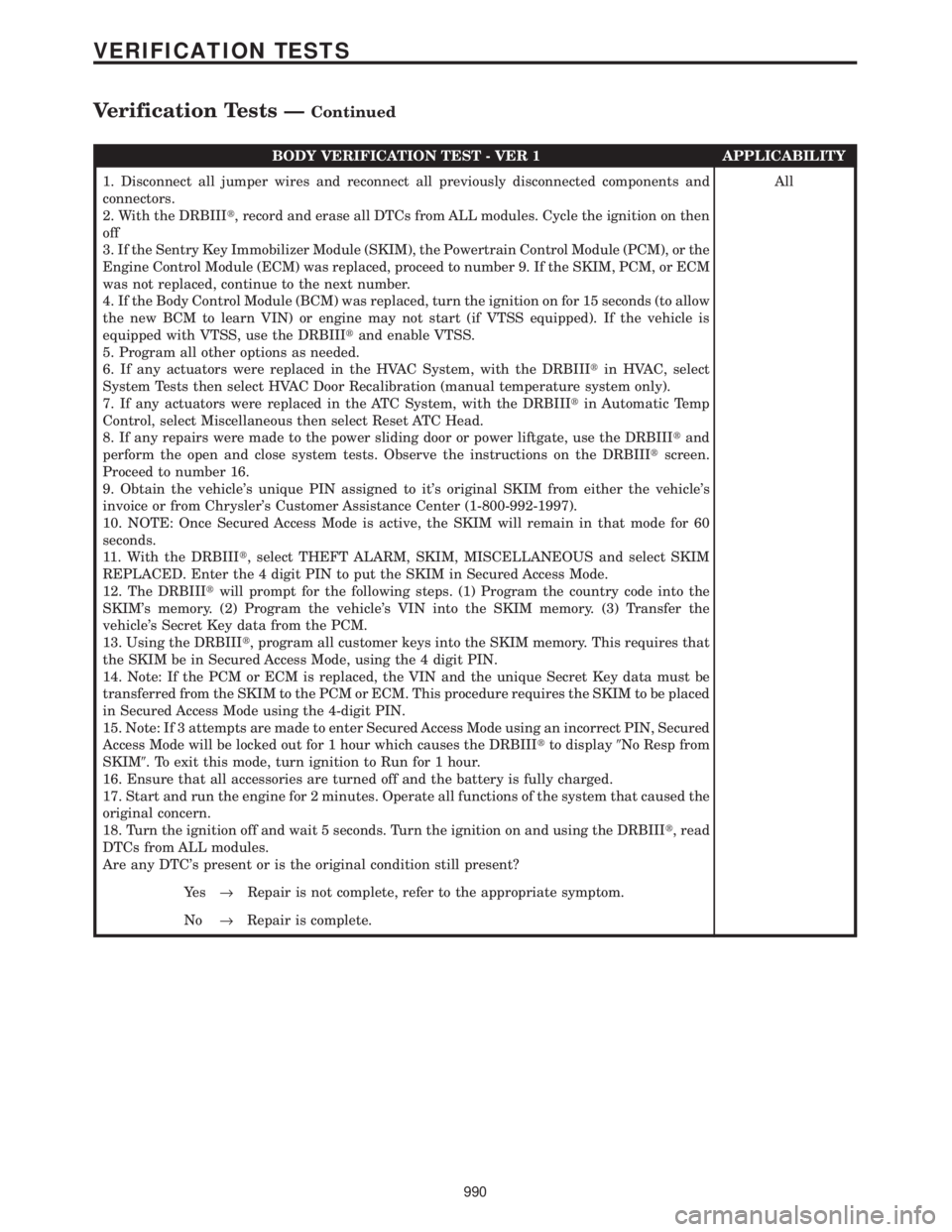
BODY VERIFICATION TEST - VER 1 APPLICABILITY
1. Disconnect all jumper wires and reconnect all previously disconnected components and
connectors.
2. With the DRBIIIt, record and erase all DTCs from ALL modules. Cycle the ignition on then
off
3. If the Sentry Key Immobilizer Module (SKIM), the Powertrain Control Module (PCM), or the
Engine Control Module (ECM) was replaced, proceed to number 9. If the SKIM, PCM, or ECM
was not replaced, continue to the next number.
4. If the Body Control Module (BCM) was replaced, turn the ignition on for 15 seconds (to allow
the new BCM to learn VIN) or engine may not start (if VTSS equipped). If the vehicle is
equipped with VTSS, use the DRBIIItand enable VTSS.
5. Program all other options as needed.
6. If any actuators were replaced in the HVAC System, with the DRBIIItin HVAC, select
System Tests then select HVAC Door Recalibration (manual temperature system only).
7. If any actuators were replaced in the ATC System, with the DRBIIItin Automatic Temp
Control, select Miscellaneous then select Reset ATC Head.
8. If any repairs were made to the power sliding door or power liftgate, use the DRBIIItand
perform the open and close system tests. Observe the instructions on the DRBIIItscreen.
Proceed to number 16.
9. Obtain the vehicle's unique PIN assigned to it's original SKIM from either the vehicle's
invoice or from Chrysler's Customer Assistance Center (1-800-992-1997).
10. NOTE: Once Secured Access Mode is active, the SKIM will remain in that mode for 60
seconds.
11. With the DRBIIIt, select THEFT ALARM, SKIM, MISCELLANEOUS and select SKIM
REPLACED. Enter the 4 digit PIN to put the SKIM in Secured Access Mode.
12. The DRBIIItwill prompt for the following steps. (1) Program the country code into the
SKIM's memory. (2) Program the vehicle's VIN into the SKIM memory. (3) Transfer the
vehicle's Secret Key data from the PCM.
13. Using the DRBIIIt, program all customer keys into the SKIM memory. This requires that
the SKIM be in Secured Access Mode, using the 4 digit PIN.
14. Note: If the PCM or ECM is replaced, the VIN and the unique Secret Key data must be
transferred from the SKIM to the PCM or ECM. This procedure requires the SKIM to be placed
in Secured Access Mode using the 4-digit PIN.
15. Note: If 3 attempts are made to enter Secured Access Mode using an incorrect PIN, Secured
Access Mode will be locked out for 1 hour which causes the DRBIIItto display9No Resp from
SKIM9. To exit this mode, turn ignition to Run for 1 hour.
16. Ensure that all accessories are turned off and the battery is fully charged.
17. Start and run the engine for 2 minutes. Operate all functions of the system that caused the
original concern.
18. Turn the ignition off and wait 5 seconds. Turn the ignition on and using the DRBIIIt, read
DTCs from ALL modules.
Are any DTC's present or is the original condition still present?All
Ye s®Repair is not complete, refer to the appropriate symptom.
No®Repair is complete.
990
VERIFICATION TESTS
Verification Tests ÐContinued
Page 1022 of 4284
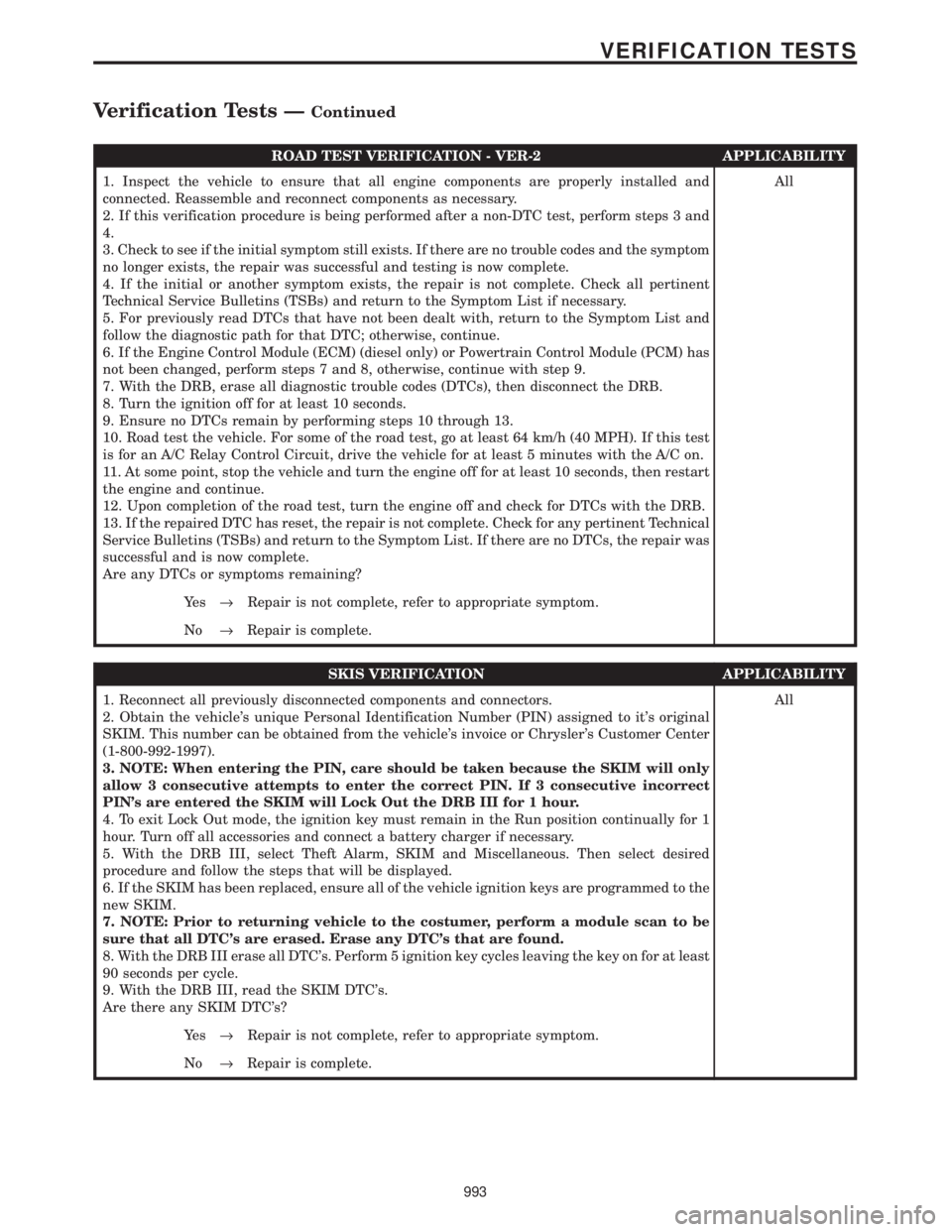
ROAD TEST VERIFICATION - VER-2 APPLICABILITY
1. Inspect the vehicle to ensure that all engine components are properly installed and
connected. Reassemble and reconnect components as necessary.
2. If this verification procedure is being performed after a non-DTC test, perform steps 3 and
4.
3. Check to see if the initial symptom still exists. If there are no trouble codes and the symptom
no longer exists, the repair was successful and testing is now complete.
4. If the initial or another symptom exists, the repair is not complete. Check all pertinent
Technical Service Bulletins (TSBs) and return to the Symptom List if necessary.
5. For previously read DTCs that have not been dealt with, return to the Symptom List and
follow the diagnostic path for that DTC; otherwise, continue.
6. If the Engine Control Module (ECM) (diesel only) or Powertrain Control Module (PCM) has
not been changed, perform steps 7 and 8, otherwise, continue with step 9.
7. With the DRB, erase all diagnostic trouble codes (DTCs), then disconnect the DRB.
8. Turn the ignition off for at least 10 seconds.
9. Ensure no DTCs remain by performing steps 10 through 13.
10. Road test the vehicle. For some of the road test, go at least 64 km/h (40 MPH). If this test
is for an A/C Relay Control Circuit, drive the vehicle for at least 5 minutes with the A/C on.
11. At some point, stop the vehicle and turn the engine off for at least 10 seconds, then restart
the engine and continue.
12. Upon completion of the road test, turn the engine off and check for DTCs with the DRB.
13. If the repaired DTC has reset, the repair is not complete. Check for any pertinent Technical
Service Bulletins (TSBs) and return to the Symptom List. If there are no DTCs, the repair was
successful and is now complete.
Are any DTCs or symptoms remaining?All
Ye s®Repair is not complete, refer to appropriate symptom.
No®Repair is complete.
SKIS VERIFICATION APPLICABILITY
1. Reconnect all previously disconnected components and connectors.
2. Obtain the vehicle's unique Personal Identification Number (PIN) assigned to it's original
SKIM. This number can be obtained from the vehicle's invoice or Chrysler's Customer Center
(1-800-992-1997).
3. NOTE: When entering the PIN, care should be taken because the SKIM will only
allow 3 consecutive attempts to enter the correct PIN. If 3 consecutive incorrect
PIN's are entered the SKIM will Lock Out the DRB III for 1 hour.
4. To exit Lock Out mode, the ignition key must remain in the Run position continually for 1
hour. Turn off all accessories and connect a battery charger if necessary.
5. With the DRB III, select Theft Alarm, SKIM and Miscellaneous. Then select desired
procedure and follow the steps that will be displayed.
6. If the SKIM has been replaced, ensure all of the vehicle ignition keys are programmed to the
new SKIM.
7. NOTE: Prior to returning vehicle to the costumer, perform a module scan to be
sure that all DTC's are erased. Erase any DTC's that are found.
8. With the DRB III erase all DTC's. Perform 5 ignition key cycles leaving the key on for at least
90 seconds per cycle.
9. With the DRB III, read the SKIM DTC's.
Are there any SKIM DTC's?All
Ye s®Repair is not complete, refer to appropriate symptom.
No®Repair is complete.
993
VERIFICATION TESTS
Verification Tests ÐContinued
Page 1023 of 4284
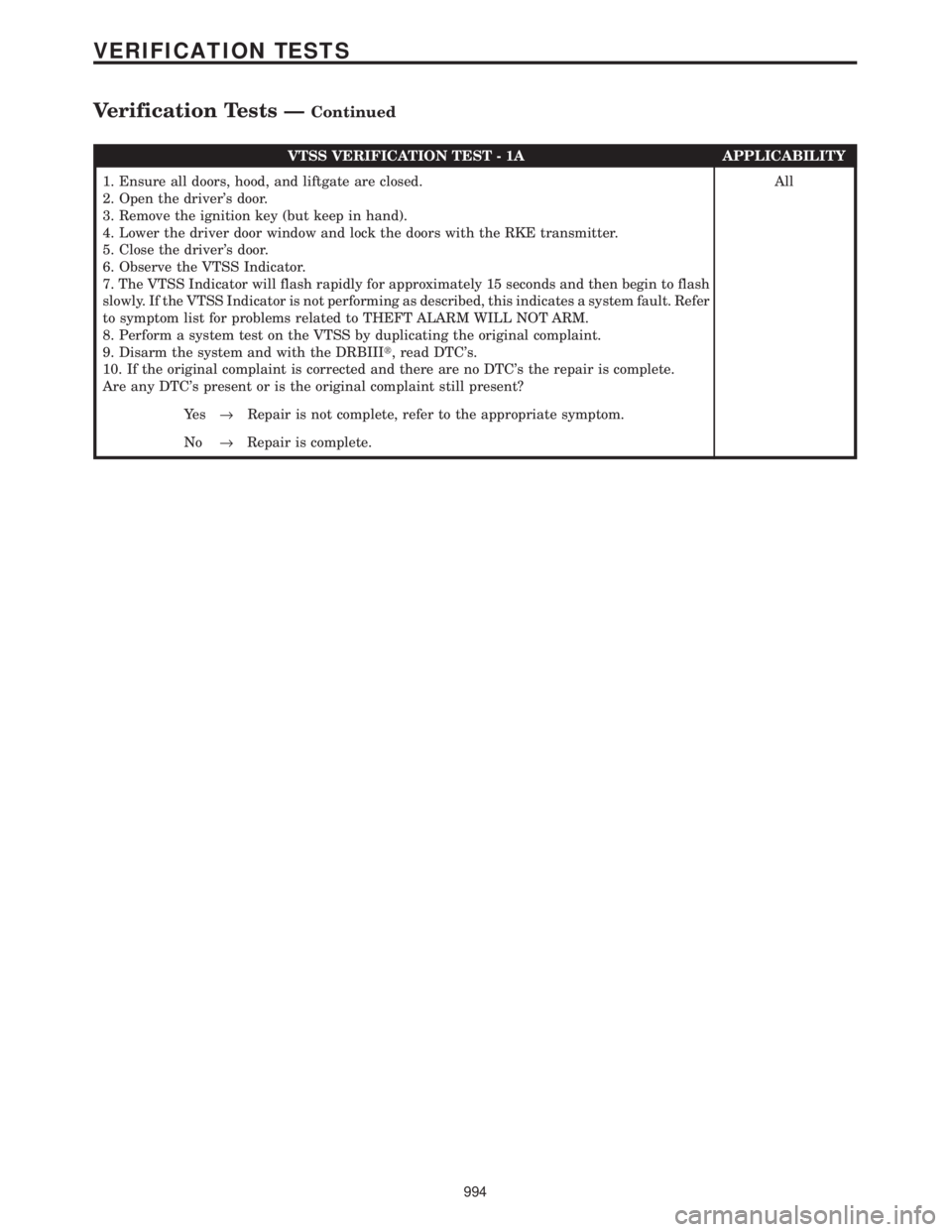
VTSS VERIFICATION TEST - 1A APPLICABILITY
1. Ensure all doors, hood, and liftgate are closed.
2. Open the driver's door.
3. Remove the ignition key (but keep in hand).
4. Lower the driver door window and lock the doors with the RKE transmitter.
5. Close the driver's door.
6. Observe the VTSS Indicator.
7. The VTSS Indicator will flash rapidly for approximately 15 seconds and then begin to flash
slowly. If the VTSS Indicator is not performing as described, this indicates a system fault. Refer
to symptom list for problems related to THEFT ALARM WILL NOT ARM.
8. Perform a system test on the VTSS by duplicating the original complaint.
9. Disarm the system and with the DRBIIIt, read DTC's.
10. If the original complaint is corrected and there are no DTC's the repair is complete.
Are any DTC's present or is the original complaint still present?All
Ye s®Repair is not complete, refer to the appropriate symptom.
No®Repair is complete.
994
VERIFICATION TESTS
Verification Tests ÐContinued