2001 CHRYSLER VOYAGER coolant
[x] Cancel search: coolantPage 3798 of 4284
3.2.3 OTHER CONTROLS
CHARGING SYSTEM
The charging system is turned on when the
engine is started and ASD relay energized. When
the ASD relay is on, ASD output voltage is supplied
to the ASD sense circuit at the PCM. This voltage is
connected in some cases, through the PCM and
supplied to one of the generator field terminals
(Gen Source +). All others, the Gen field is con-
nected directly to the ASD output voltage. The
amount of current produced by the generator is
controlled by the Electronic Voltage Regulator
(EVR) circuitry, in the PCM. Battery temperature is
determined from IAT. This temperature along with
sensed line voltage, is used by the PCM to vary the
battery charging rate. This is done by cycling the
ground path to the other generator field terminal
(Gen field driver).
SPEED CONTROL SYSTEM
The PCM controls vehicle speed by operation of
the speed control servo vacuum and vent solenoids.
Energizing the vacuum solenoid applies vacuum to
the servo to increase throttle position. Operation of
the vent solenoid slowly releases the vacuum allow-
ing throttle position to decrease. A special dump
solenoid allows immediate release of throttle posi-
tion caused by braking, cruise control switch turned
off, shifting into neutral, excessive RPM (tires spin-
ning) or ignition off.
LEAK DETECTION PUMP SYSTEM (IF EQUIPPED)
The leak detection pump is a device that pressur-
izes the evaporative system to determine if there
are any leaks. When certain conditions are met, the
PCM will activate the pump and start counting
pump strokes. If the pump stops within a calibrated
number of strokes, the system is determined to be
normal. If the pump does not stop or stops too soon,
a DTC will be set.
3.2.4 PCM OPERATING MODES
As input signals to the PCM change, the PCM
adjusts its response to output devices. For example,
the PCM must calculate a different injector pulse
width and ignition timing for idle than it does for
wide open throttle. There are several different
modes of operation that determine how the PCM
responds to the various input signals.
There are two types of engine control operation:
open loopandclosed loop.
Inopen loopoperation, the PCM receives input
signals and responds according to preset program-
ming. Inputs from the heated oxygen sensors are
not monitored.Inclosed loopoperation, the PCM monitors the
inputs from the heated oxygen sensors. This input
indicates to the PCM whether or not the calculated
injector pulse width results in the ideal air-fuel
ratio of 14.7 parts air to 1 part fuel. By monitoring
the exhaust oxygen content through the oxygen
sensor, the PCM can fine tune injector pulse width.
Fine tuning injector pulse width allows the PCM to
achieve the lowest emission levels while maintain-
ing optimum fuel economy.
The engine start-up (crank), engine warm-up,
and wide open throttle modes are open loop modes.
Under most operating conditions, closed loop modes
occur with the engine at operating temperature.
IGNITION SWITCH ON (ENGINE OFF) MODE
When the ignition switch activates the fuel injec-
tion system, the following actions occur:
1. The PCM determines atmospheric air pressure
from the MAP sensor input to determine basic
fuel strategy.
2. The PCM monitors the engine coolant tempera-
ture sensor and throttle position sensor input.
The PCM modifies fuel strategy based on this
input.
When the key is in the on position and the engine
is not running (zero rpm), the auto shutdown relay
and fuel pump relay are not energized. Therefore,
voltage is not supplied to the fuel pump, ignition
coil, and fuel injectors.
Engine Start-up ModeÐ This is an open loop
mode. The following actions occur when the starter
motor is engaged:
1. The auto shutdown and fuel pump relays are
energized. If the PCM does not receive the cam-
shaft and crankshaft signal within approxi-
mately one second, these relays are de-
energized.
2. The PCM energizes all fuel injectors until it
determines crankshaft position from the cam-
shaft and crankshaft signals. The PCM deter-
mines crankshaft position within one engine
revolution. After the camshaft position has been
determined, the PCM energizes the fuel injectors
in sequence. The PCM adjusts the injector pulse
width and synchronizes the fuel injectors by
controlling the fuel injectors' ground paths.
3. Once the engine idles within 64 rpm of its target
engine speed, the PCM compares the current
MAP sensor value with the value received dur-
ing the ignition switch on (zero rpm) mode. A
diagnostic trouble code is written to PCM mem-
ory if a minimum difference between the two
values is not found.
4
GENERAL INFORMATION
Page 3799 of 4284
Once the auto shutdown and fuel pump relays
have been energized, the PCM determines the fuel
injector pulse width based on the following:
± engine coolant temperature
± manifold absolute pressure
± intake air temperature
± engine revolutions
± throttle position
The PCM determines the spark advance based on
the following:
± engine coolant temperature
± crankshaft position
± intake air temperature
± manifold absolute pressure
± throttle position
Engine Warm-Up Modeþ This is an open loop
mode. The PCM adjusts injector pulse width and
controls injector synchronization by controlling the
fuel injectors' ground paths. The PCM adjusts igni-
tion timing and engine idle speed. The PCM adjusts
the idle speed by controlling the idle air control
motor.
Cruise or Idle Modeþ When the engine is at
normal operating temperature, this is a closed loop
mode.
Acceleration Modeþ This is a closed loop mode.
The PCM recognizes an increase in throttle position
and a decrease in Manifold Vacuum as engine load
increases. In response, the PCM increases the in-
jector pulse width to meet the increased load. The
A/C compressor may be de-energized for a short
period of time.
Decelerationþ This is a closed loop mode. The
PCM recognizes a decrease in throttle position and
an increase in Manifold Vacuum as engine load
decreases. In response, the PCM decreases the
injector pulse width to meet the decreased load.
Full injector shut off may be obtained during high
speed deceleration.
Wide Open Throttle Modeþ This is an open
loop mode. The throttle position sensor notifies the
PCM of a wide open throttle condition. Once a wide
open throttle is sensed, the PCM de-energizes the
A/C compressor clutch relay for 20 seconds.
3.2.5 NON-MONITORED CIRCUITS
The PCM does not monitor the following circuits,
systems, and conditions even though they could
have malfunctions that result in driveability prob-
lems. A diagnostic code may not be displayed for the
following conditions. However, problems with these
systems may cause a diagnostic code to be displayed
for other systems. For example, a fuel pressure
problem will not register a diagnostic code directly,
but could cause a rich or lean condition. This couldcause an oxygen sensor, fuel system, or misfire
monitor trouble code to be stored in the PCM.
Engine Timingþ The PCM cannot detect an
incorrectly indexed timing chain, camshaft
sprocket, or crankshaft sprocket. The PCM also
cannot detect an incorrectly indexed distributor.(*)
Fuel Pressureþ Fuel pressure is controlled by
the fuel pressure regulator. The PCM cannot detect
a clogged fuel pump inlet filter, clogged in-line filter,
or a pinched fuel supply.(*)
Fuel Injectorsþ The PCM cannot detect if a fuel
injector is clogged, the pintle is sticking, or the
wrong injectors are installed.(*)
Fuel Requirementsþ Poor quality gasoline can
cause problems such as hard starting, stalling, and
stumble. Use of methanol-gasoline blends may re-
sult in starting and driveability problems. See indi-
vidual symptoms and their definitions in Section
6.0 (Glossary of Terms).
PCM Groundsþ The PCM cannot detect a poor
system ground. However, a diagnostic trouble code
may be stored in the PCM as a result of this
condition.
Throttle Body Air Flowþ The PCM cannot
detect a clogged or restricted air cleaner inlet or
filter element.(*)
Exhaust Systemþ The PCM cannot detect a
plugged, restricted, or leaking exhaust system.(*)
Cylinder Compressionþ The PCM cannot de-
tect uneven, low, or high engine cylinder compres-
sion.(*)
Excessive Oil Consumptionþ Although the
PCM monitors the exhaust stream oxygen content
through the oxygen sensor when the system is in a
closed loop, it cannot determine excessive oil con-
sumption.
NOTE: ANY OF THESE CONDITIONS
COULD RESULT IN A RICH OR LEAN
CONDITION CAUSING AN OXYGEN SENSOR
TROUBLE CODE TO BE STORED IN THE
PCM, OR THE VEHICLE MAY EXHIBIT ONE
OR MORE OF THE DRIVEABILITY
SYMPTOMS LISTED IN THE TABLE OF
CONTENTS.
3.2.6 SKIS OVERVIEW
The Sentry Key Immobilizer System (SKIS) is
designed to prevent unauthorized vehicle opera-
tion. The system consists of a Sentry Key Immobi-
lizer Module (SKIM), ignition key(s) equipped with
a transponder chip and PCM. When the ignition
switch is turned on, the SKIM interrogates the
ignition key. If the ignition key is Valid or Invalid,
the SKIM sends a PCI Bus message to the PCM
indicating ignition key status. Upon receiving this
5
GENERAL INFORMATION
Page 3806 of 4284
When testing voltage or continuity at any control
module, use the terminal side (not the wire end) of
the connector. Do not probe a wire through the
insulation; this will damage it and eventually cause
it to fail because of corrosion.
Be careful when performing electrical tests so as
to prevent accidental shorting of terminals. Such
mistakes can damage fuses or components. Also, a
second DTC could be set, making diagnosis of the
original problem more difficult.
5.0 REQUIRED TOOLS AND
EQUIPMENT
DRBIIIt(diagnostic read-out box) scan tool
Evaporative System Diagnostic Kit #6917
fuel filler adapter #8382
fuel pressure adapter (C-6631) or #6539
fuel pressure kit (C-4799-B) or #5069
fuel release hose (C-4799-1)
Min Air flow fitting #6714
jumper wires
ohmmeter
oscilloscope
vacuum gauge
voltmeter
12 volt test light minimum 25 ohms resistance
with probe #6801
CAUTION: A 12 VOLT TEST LIGHT SHOULD
NOT BE USED FOR THE FOLLOWING
CIRCUITS, DAMAGE TO THE POWERTRAIN
CONTROLLER WILL OCCUR.
²5 Volt Supply
²8 Volt Supply
²J1850 PCI Bus
²CCD Bus
²CKP Sensor Signal
²CMP Sensor Signal
²Vehicle Speed Sensor Signal
²O2 Sensor Signal
6.0 GLOSSARY OF TERMS
ABSanti-lock brake system
backfire,
popbackfuel ignites in either the intake or
the exhaust system
CKPcrank position sensor
CMPcamshaft position sensorcuts out,
missesa steady pulsation or the inability of
the engine to maintain a consistent
rpm
DLCdata link connector (previously
called engine diagnostic connector)
detona-
tion,
spark
knocka mild to severe ping, especially un-
der loaded engine conditions
ECTengine coolant temperature sensor
EGRexhaust gas recirculation valve
genera-
torpreviously called alternator
hard
startThe engine takes longer than usual
to start, even though it is able to
crank normally.
hesita-
tion, sag,
stumbleThere is a momentary lack of re-
sponse when the throttle is opened.
This can occur at all vehicle speeds.
If it is severe enough, the engine
may stall.
IATintake air temperature sensor
IACidle air control motor
JTECCombined engine and transmission
control module
lack of
power,
sluggishThe engine has less than expected
power, with little or no increase in
vehicle speed when the throttle is
opened.
LDPleak detection pump
MAPmanifold absolute pressure sensor
MILmalfunction indicator lamp
MTVmanifold tuning valve
O2Soxygen sensor
PCIprogrammable communication inter-
face
PCMpowertrain control module
PCVpositive crankcase ventilation
PEPperipheral expansion port
poor fuel
economyThere is significantly less fuel mile-
age than other vehicles of the same
design ad configuration
12
GENERAL INFORMATION
Page 3837 of 4284
Symptom:
P0071 - AMBIENT TEMP SENSOR PERFORMANCE
When Monitored and Set Condition:
P0071 - AMBIENT TEMP SENSOR PERFORMANCE
When Monitored: With the ignition on. Coolant Temperature greater than 71ÉC (160ÉF)
No Inlet Air Temperature Sensor Faults present
Set Condition: After 5 warm cycles have occurred (coolant increases from great than
4.4ÉC (40ÉF) to a minimum of 71ÉC (160ÉF) and the odometer mileage has increased 196.6
miles and the Inlet Air Temperature has increased less than 3ÉC (5.4ÉF) change in
temperature. Two trip fault.
POSSIBLE CAUSES
INTERMITTENT CONDITION
IAT SENSOR VOLTAGE BELOW 1.0 VOLTS
SENSOR GROUND CIRCUIT VOLTAGE DROP
IAT SENSOR SIGNAL CIRCUIT VOLTAGE DROP
PCM
TEST ACTION APPLICABILITY
1NOTE: If DTC P1192 or P1193 have set along with P0071, diagnose P1192 or
P1193 first before continuing.
Turn the ignition on.
With the DRBIIIt, read DTC's.
Is the Good Trip displayed and equal to zero?All
Ye s®Go To 2
No®Go To 7
2 Turn the ignition off.
Disconnect the Inlet Air Temperature Sensor harness connector.
Turn the ignition on.
With the DRBIIIt, read the IAT voltage.
Is the voltage above 4.6 volts?All
Ye s®Go To 3
No®Go To 4
3 Turn the ignition off.
Disconnect the Inlet Air Temperature Sensor harness connector.
Using a jumper wire, jumper across the IAT Sensor harness connector.
Turn the ignition on.
With the DRBIIIt, read the IAT voltage.
Is the voltage below 1.0 volt?All
Ye s®Replace the Inlet Air Temperature Sensor.
Perform POWERTRAIN VERIFICATION TEST VER - 5.
No®Go To 4
43
DRIVEABILITY - GAS
Page 3848 of 4284
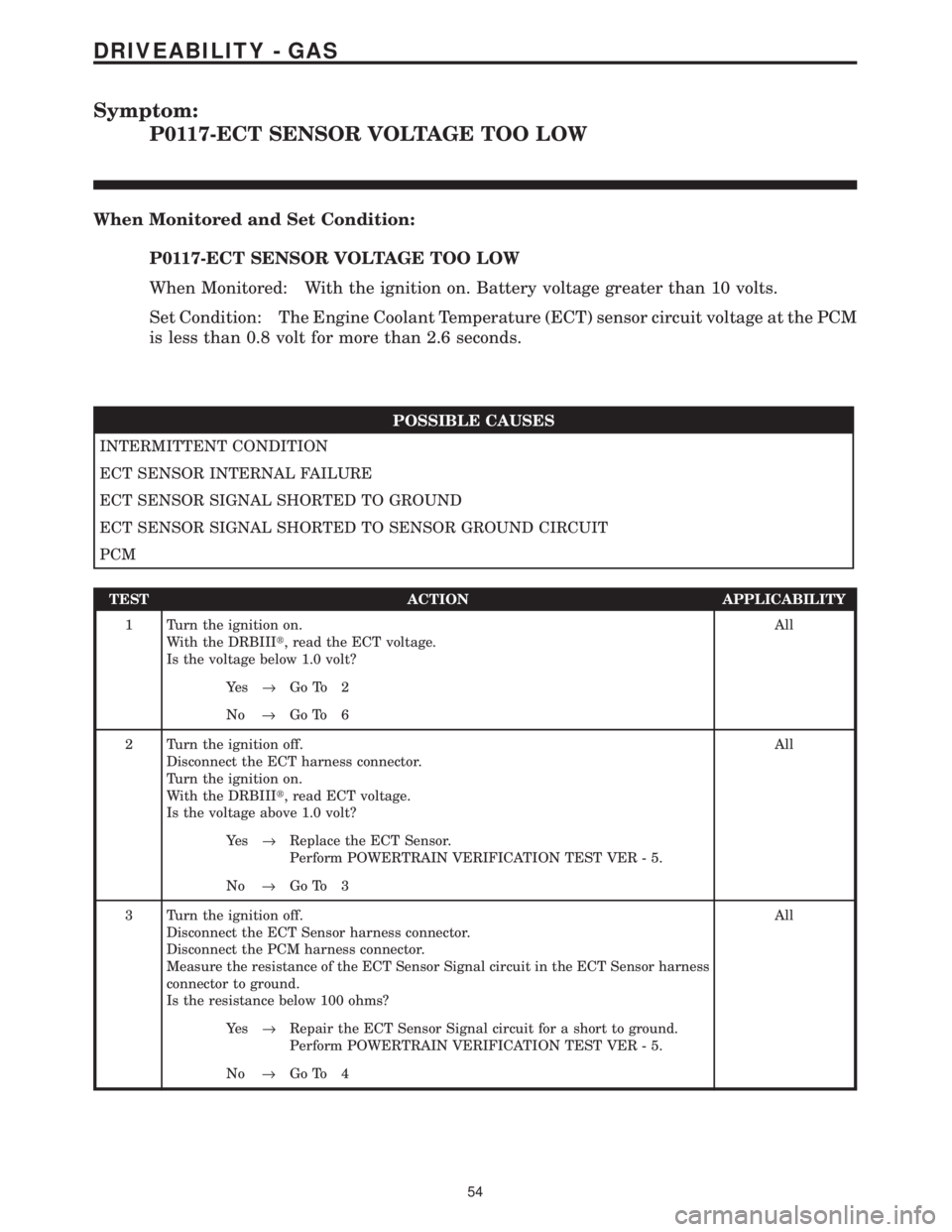
Symptom:
P0117-ECT SENSOR VOLTAGE TOO LOW
When Monitored and Set Condition:
P0117-ECT SENSOR VOLTAGE TOO LOW
When Monitored: With the ignition on. Battery voltage greater than 10 volts.
Set Condition: The Engine Coolant Temperature (ECT) sensor circuit voltage at the PCM
is less than 0.8 volt for more than 2.6 seconds.
POSSIBLE CAUSES
INTERMITTENT CONDITION
ECT SENSOR INTERNAL FAILURE
ECT SENSOR SIGNAL SHORTED TO GROUND
ECT SENSOR SIGNAL SHORTED TO SENSOR GROUND CIRCUIT
PCM
TEST ACTION APPLICABILITY
1 Turn the ignition on.
With the DRBIIIt, read the ECT voltage.
Is the voltage below 1.0 volt?All
Ye s®Go To 2
No®Go To 6
2 Turn the ignition off.
Disconnect the ECT harness connector.
Turn the ignition on.
With the DRBIIIt, read ECT voltage.
Is the voltage above 1.0 volt?All
Ye s®Replace the ECT Sensor.
Perform POWERTRAIN VERIFICATION TEST VER - 5.
No®Go To 3
3 Turn the ignition off.
Disconnect the ECT Sensor harness connector.
Disconnect the PCM harness connector.
Measure the resistance of the ECT Sensor Signal circuit in the ECT Sensor harness
connector to ground.
Is the resistance below 100 ohms?All
Ye s®Repair the ECT Sensor Signal circuit for a short to ground.
Perform POWERTRAIN VERIFICATION TEST VER - 5.
No®Go To 4
54
DRIVEABILITY - GAS
Page 3850 of 4284
Symptom:
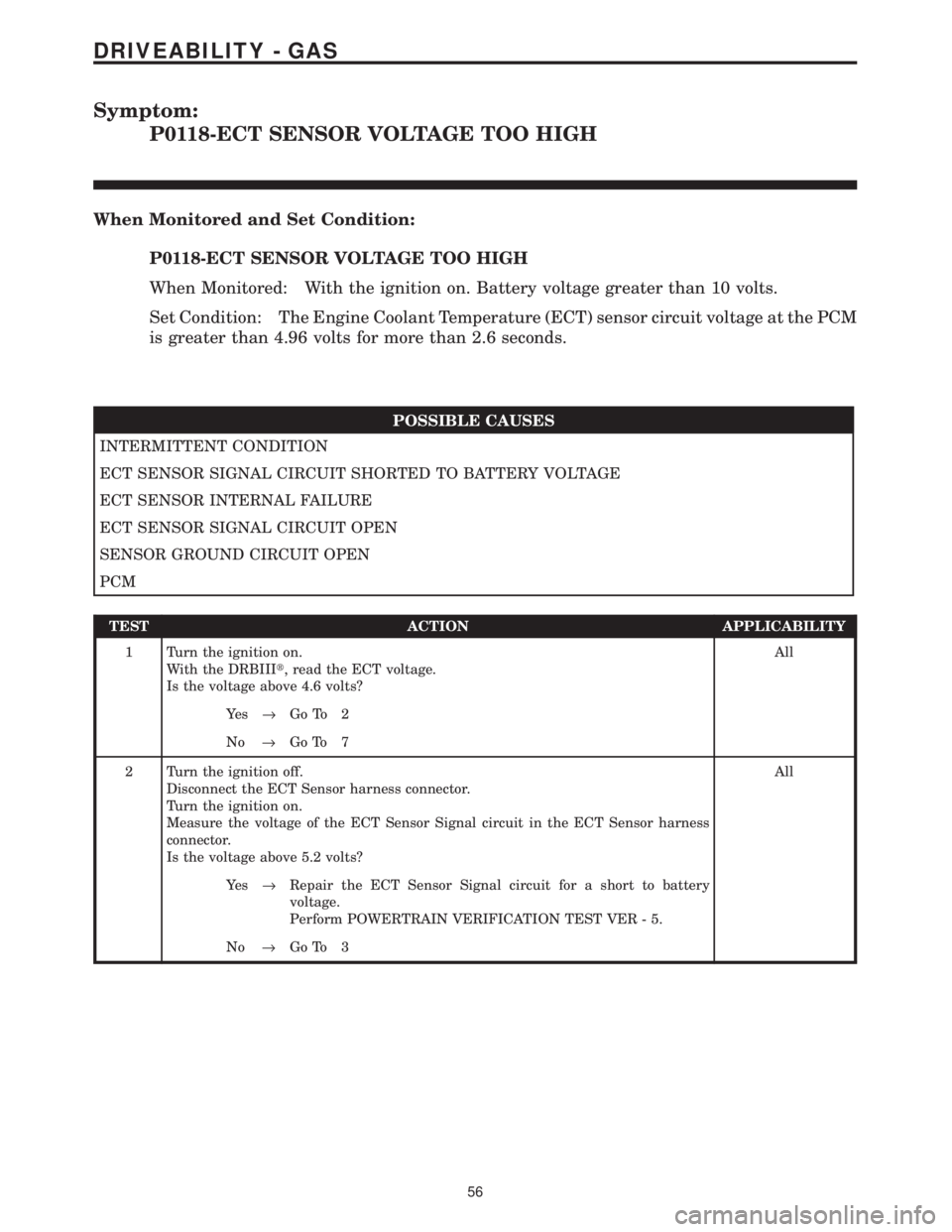
P0118-ECT SENSOR VOLTAGE TOO HIGH
When Monitored and Set Condition:
P0118-ECT SENSOR VOLTAGE TOO HIGH
When Monitored: With the ignition on. Battery voltage greater than 10 volts.
Set Condition: The Engine Coolant Temperature (ECT) sensor circuit voltage at the PCM
is greater than 4.96 volts for more than 2.6 seconds.
POSSIBLE CAUSES
INTERMITTENT CONDITION
ECT SENSOR SIGNAL CIRCUIT SHORTED TO BATTERY VOLTAGE
ECT SENSOR INTERNAL FAILURE
ECT SENSOR SIGNAL CIRCUIT OPEN
SENSOR GROUND CIRCUIT OPEN
PCM
TEST ACTION APPLICABILITY
1 Turn the ignition on.
With the DRBIIIt, read the ECT voltage.
Is the voltage above 4.6 volts?All
Ye s®Go To 2
No®Go To 7
2 Turn the ignition off.
Disconnect the ECT Sensor harness connector.
Turn the ignition on.
Measure the voltage of the ECT Sensor Signal circuit in the ECT Sensor harness
connector.
Is the voltage above 5.2 volts?All
Ye s®Repair the ECT Sensor Signal circuit for a short to battery
voltage.
Perform POWERTRAIN VERIFICATION TEST VER - 5.
No®Go To 3
56
DRIVEABILITY - GAS
Page 3865 of 4284
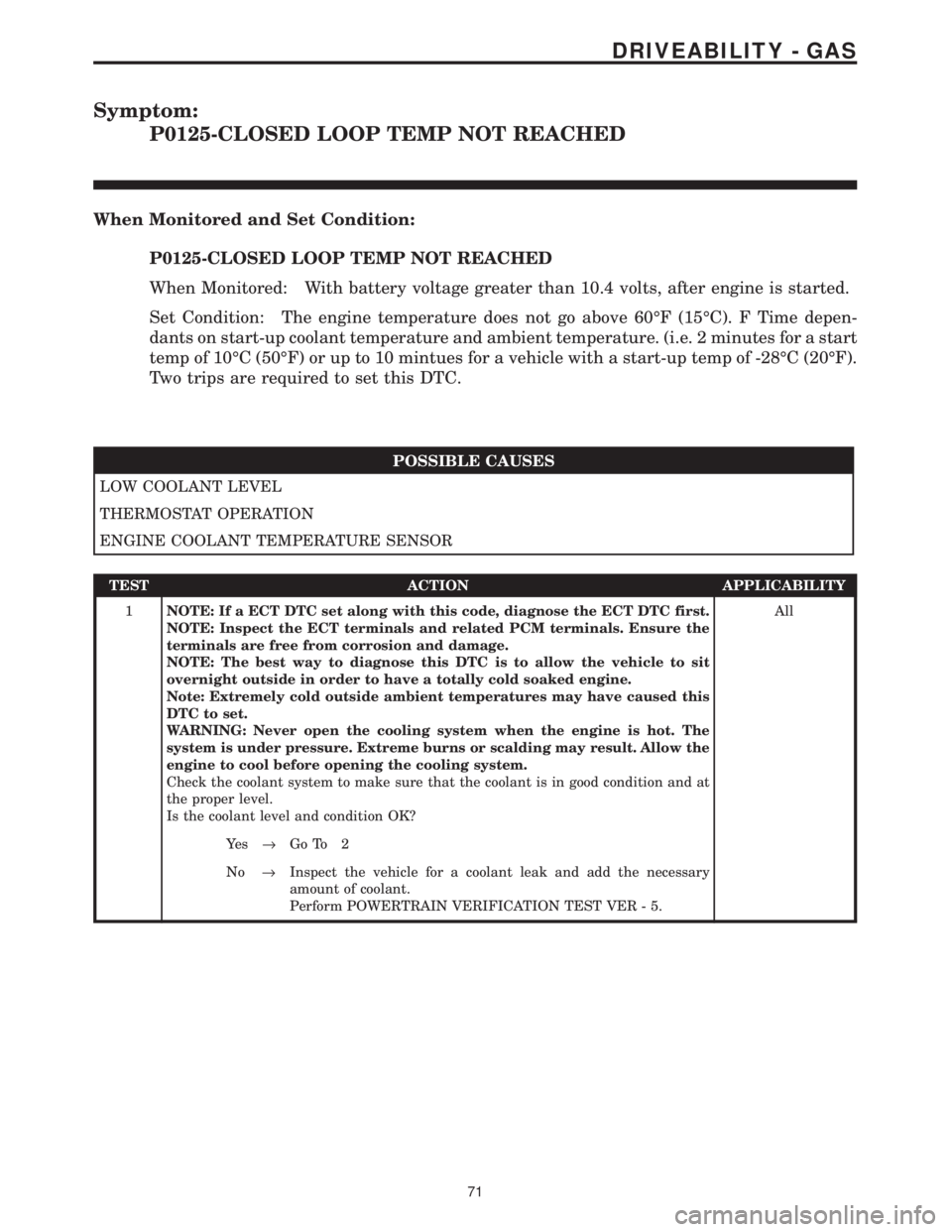
Symptom:
P0125-CLOSED LOOP TEMP NOT REACHED
When Monitored and Set Condition:
P0125-CLOSED LOOP TEMP NOT REACHED
When Monitored: With battery voltage greater than 10.4 volts, after engine is started.
Set Condition: The engine temperature does not go above 60ÉF (15ÉC). F Time depen-
dants on start-up coolant temperature and ambient temperature. (i.e. 2 minutes for a start
temp of 10ÉC (50ÉF) or up to 10 mintues for a vehicle with a start-up temp of -28ÉC (20ÉF).
Two trips are required to set this DTC.
POSSIBLE CAUSES
LOW COOLANT LEVEL
THERMOSTAT OPERATION
ENGINE COOLANT TEMPERATURE SENSOR
TEST ACTION APPLICABILITY
1NOTE: If a ECT DTC set along with this code, diagnose the ECT DTC first.
NOTE: Inspect the ECT terminals and related PCM terminals. Ensure the
terminals are free from corrosion and damage.
NOTE: The best way to diagnose this DTC is to allow the vehicle to sit
overnight outside in order to have a totally cold soaked engine.
Note: Extremely cold outside ambient temperatures may have caused this
DTC to set.
WARNING: Never open the cooling system when the engine is hot. The
system is under pressure. Extreme burns or scalding may result. Allow the
engine to cool before opening the cooling system.
Check the coolant system to make sure that the coolant is in good condition and at
the proper level.
Is the coolant level and condition OK?All
Ye s®Go To 2
No®Inspect the vehicle for a coolant leak and add the necessary
amount of coolant.
Perform POWERTRAIN VERIFICATION TEST VER - 5.
71
DRIVEABILITY - GAS
Page 3866 of 4284
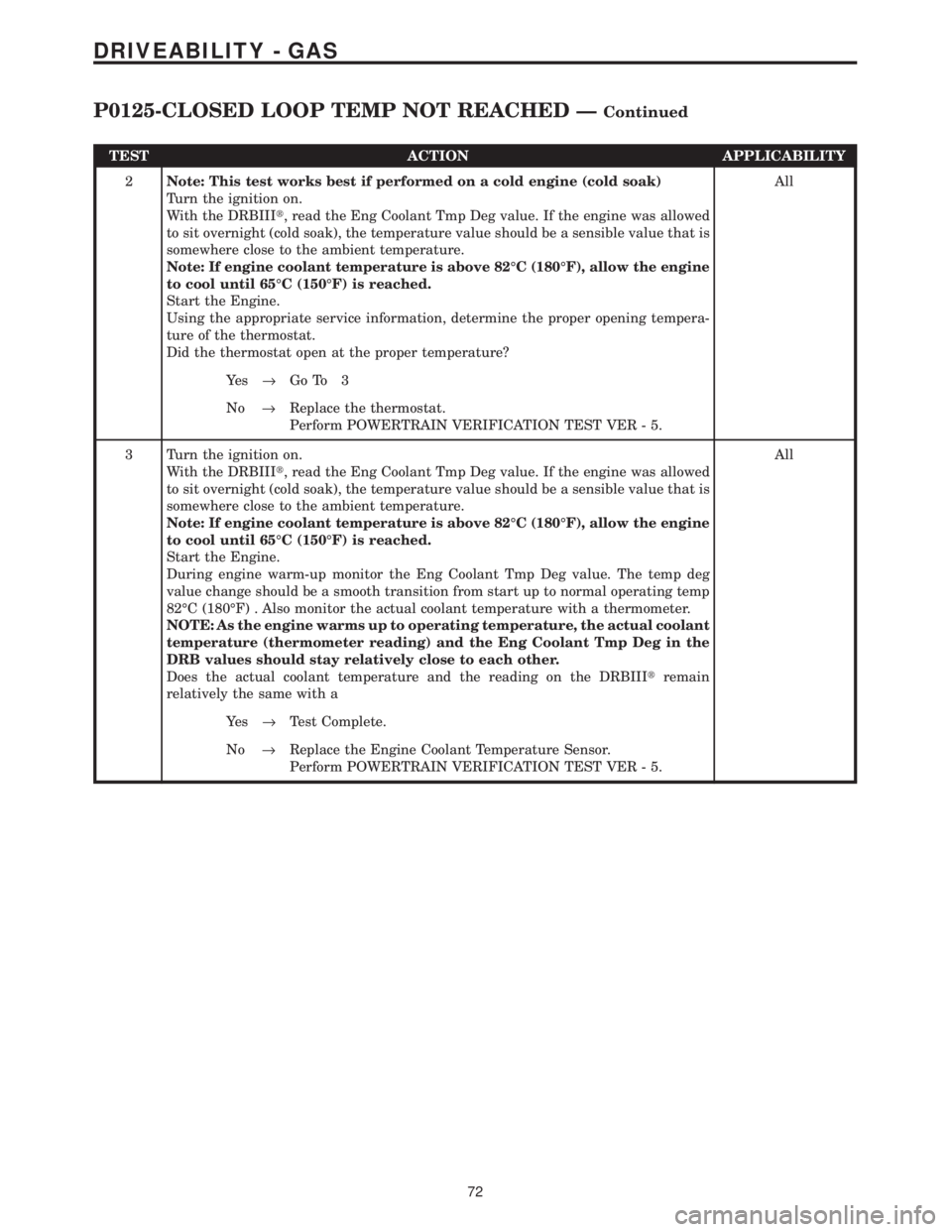
TEST ACTION APPLICABILITY
2Note: This test works best if performed on a cold engine (cold soak)
Turn the ignition on.
With the DRBIIIt, read the Eng Coolant Tmp Deg value. If the engine was allowed
to sit overnight (cold soak), the temperature value should be a sensible value that is
somewhere close to the ambient temperature.
Note: If engine coolant temperature is above 82ÉC (180ÉF), allow the engine
to cool until 65ÉC (150ÉF) is reached.
Start the Engine.
Using the appropriate service information, determine the proper opening tempera-
ture of the thermostat.
Did the thermostat open at the proper temperature?All
Ye s®Go To 3
No®Replace the thermostat.
Perform POWERTRAIN VERIFICATION TEST VER - 5.
3 Turn the ignition on.
With the DRBIIIt, read the Eng Coolant Tmp Deg value. If the engine was allowed
to sit overnight (cold soak), the temperature value should be a sensible value that is
somewhere close to the ambient temperature.
Note: If engine coolant temperature is above 82ÉC (180ÉF), allow the engine
to cool until 65ÉC (150ÉF) is reached.
Start the Engine.
During engine warm-up monitor the Eng Coolant Tmp Deg value. The temp deg
value change should be a smooth transition from start up to normal operating temp
82ÉC (180ÉF) . Also monitor the actual coolant temperature with a thermometer.
NOTE: As the engine warms up to operating temperature, the actual coolant
temperature (thermometer reading) and the Eng Coolant Tmp Deg in the
DRB values should stay relatively close to each other.
Does the actual coolant temperature and the reading on the DRBIIItremain
relatively the same with aAll
Ye s®Test Complete.
No®Replace the Engine Coolant Temperature Sensor.
Perform POWERTRAIN VERIFICATION TEST VER - 5.
72
DRIVEABILITY - GAS
P0125-CLOSED LOOP TEMP NOT REACHED ÐContinued