2001 CHRYSLER VOYAGER battery
[x] Cancel search: batteryPage 369 of 4284
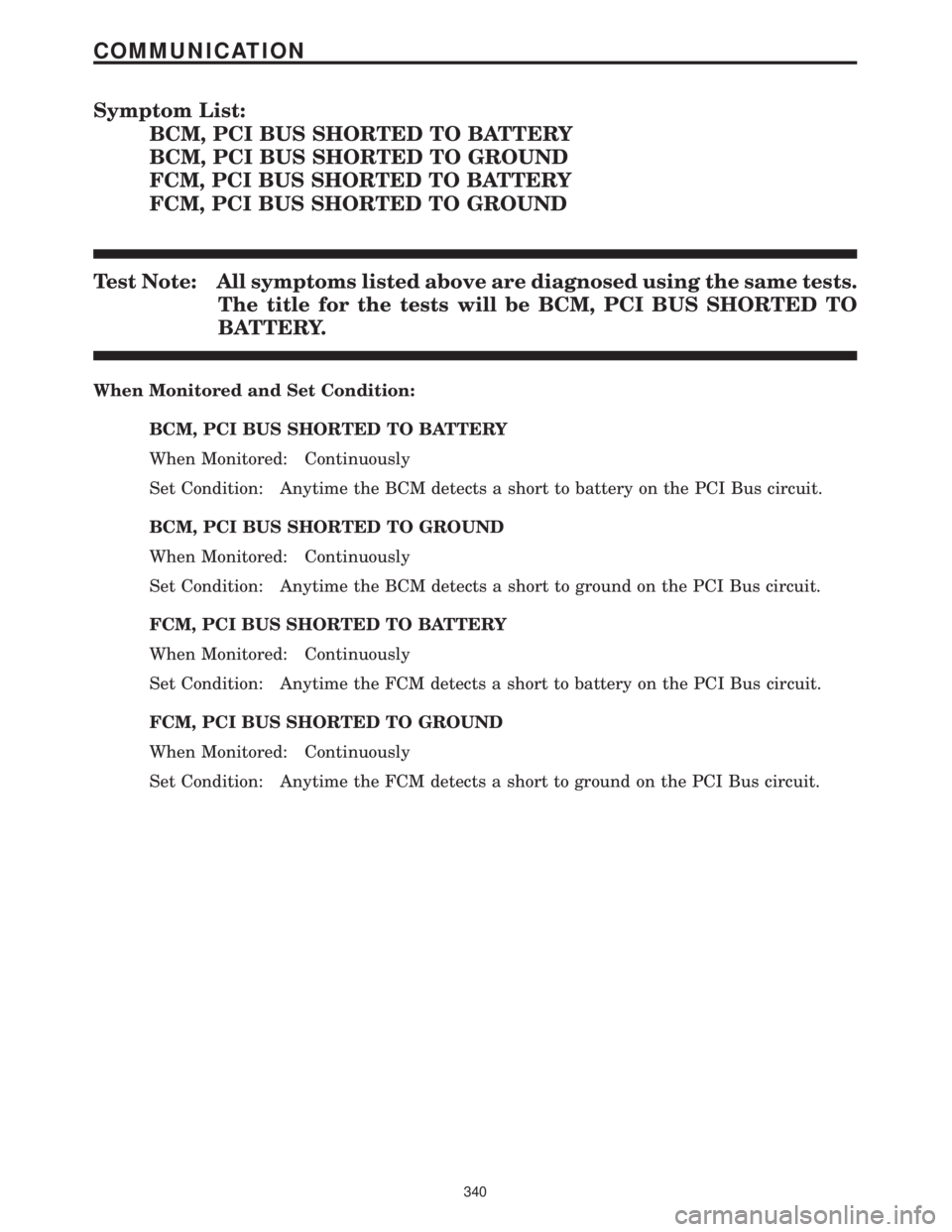
Symptom List:
BCM, PCI BUS SHORTED TO BATTERY
BCM, PCI BUS SHORTED TO GROUND
FCM, PCI BUS SHORTED TO BATTERY
FCM, PCI BUS SHORTED TO GROUND
Test Note: All symptoms listed above are diagnosed using the same tests.
The title for the tests will be BCM, PCI BUS SHORTED TO
BATTERY.
When Monitored and Set Condition:
BCM, PCI BUS SHORTED TO BATTERY
When Monitored: Continuously
Set Condition: Anytime the BCM detects a short to battery on the PCI Bus circuit.
BCM, PCI BUS SHORTED TO GROUND
When Monitored: Continuously
Set Condition: Anytime the BCM detects a short to ground on the PCI Bus circuit.
FCM, PCI BUS SHORTED TO BATTERY
When Monitored: Continuously
Set Condition: Anytime the FCM detects a short to battery on the PCI Bus circuit.
FCM, PCI BUS SHORTED TO GROUND
When Monitored: Continuously
Set Condition: Anytime the FCM detects a short to ground on the PCI Bus circuit.
340
COMMUNICATION
Page 370 of 4284

POSSIBLE CAUSES
INTERMITTENT CONDITION
TEST ACTION APPLICABILITY
1NOTE: For this code to be active, the DRB will not be able to communicate
with any modules on the vehicle (except the PCM).
NOTE: If this code is set and active it will be necessary to perform the PCI
Bus Communication Failure symptom.
WARNING: WHEN THE ENGINE IS OPERATING, DO NOT STAND IN A
DIRECT LINE WITH THE FAN. DO NOT PUT YOUR HANDS NEAR THE
PULLEYS, BELTS OR FAN. DO NOT WEAR LOOSE CLOTHING.
NOTE: The conditions that set the DTC are not present at this time. The
following list may help in identifying the intermittent condition.
With the engine running at normal operating temperature, wiggle the wiring
harnesses. This is to try and duplicate the complete bus failure condition.
Refer to any Technical Service Bulletins (TSB) that may apply.
Visually inspect the related wiring harness. Look for any chafed, pierced, pinched, or
partially broken wires.
Visually inspect the related wiring harness connectors. Look for broken, bent, pushed
out, or corroded terminals.
Were any of the above conditions present?All
Ye s®Repair as necessary
Perform BODY VERIFICATION TEST - VER 1.
No®Test Complete.
341
COMMUNICATION
BCM, PCI BUS SHORTED TO BATTERY ÐContinued
Page 379 of 4284

Symptom:
IGNITION MUX SWITCH INPUT OPEN
When Monitored and Set Condition:
IGNITION MUX SWITCH INPUT OPEN
When Monitored: With the ignition on and battery voltage greater than 10.4 volts.
Set Condition: The Ignition MUX sense circuit voltage at the BCM goes above 4.9 volts.
POSSIBLE CAUSES
IGNITION SWITCH
IGNITION SWITCH SENSE CIRCUIT OPEN
IGNITION SWITCH SENSE RETURN CIRCUIT OPEN
BODY CONTROL MODULE
BODY CONTROL MODULE
TEST ACTION APPLICABILITY
1 Turn the ignition off.
Disconnect the ignition switch 5-way connector.
Connect a jumper wire between the Ignition Switch Sense circuit and ground.
With the DRBIIItin Sensors, read the IGNITION SW voltage.
Does the DRBIIItdisplay IGNITION SW 0.0 volts?All
Ye s®Go To 2
No®Go To 3
2 Turn the ignition off.
Gain access to the Body Control Module C5 connector.
Backprobe a jumper wire between the Ignition Switch Sense circuit and ground.
With the DRBIIItin Sensors, read the IGNITION SW voltage.
Does the DRBIIItdisplay IGNITION SW 0.0 volts?All
Ye s®Repair the Ignition Switch Sense circuit for an open.
Perform BODY VERIFICATION TEST - VER 1.
No®Replace the Body Control Module.
Perform BODY VERIFICATION TEST - VER 1.
3 Turn the ignition off.
Disconnect the ignition switch connector.
Connect a jumper wire between the Ignition Switch Sense circuit and the Ignition
Switch Sense Return circuit.
With the DRBIIItin Sensors, read the IGNITION SW voltage.
Does the DRBIIItdisplay IGNITION SW 0.0 volts?All
Ye s®Replace the Ignition Switch.
Perform BODY VERIFICATION TEST - VER 1.
No®Go To 4
350
COMMUNICATION
Page 381 of 4284

Symptom:
IGNITION MUX SWITCH INPUT SHORT
When Monitored and Set Condition:
IGNITION MUX SWITCH INPUT SHORT
When Monitored: With the ignition on and battery voltage greater than 10.4 volts.
Set Condition: The Ignition MUX Sense circuit voltage at the BCM goes below 0.5 volt for
more than 2 seconds.
POSSIBLE CAUSES
IGNITION SWITCH SENSE CIRCUIT SHORTED
IGNITION SWITCH SENSE RETURN CIRCUIT OPEN
IGNITION SWITCH SHORTED
BODY CONTROL MODULE
TEST ACTION APPLICABILITY
1 Turn the ignition off.
Disconnect the ignition switch 5-way connector.
With the DRBIIItin Sensors, read the IGNITION SW voltage.
Does the DRBIIItdisplay IGNITION SW 0.0 volts?All
Ye s®Go To 2
No®Replace the Ignition Switch.
Perform BODY VERIFICATION TEST - VER 1.
2 Turn the ignition off.
Gain access to the Body Control Module.
Disconnect the Body Control Module C5 connector.
Measure the resistance of the Ignition Switch Sense circuit in the BCM C5 connector.
Is the resistance below 5.0 ohms?All
Ye s®Repair the Ignition Switch Sense circuit for a short to ground.
Perform BODY VERIFICATION TEST - VER 1.
No®Go To 3
3 Turn the ignition off.
Gain access to the Body Control Module.
Disconnect the Body Control Module C4 connector.
Measure the resistance of the Ignition Switch Sense Return circuit in the BCM C4
connector.
Is the resistance below 5.0 ohms?All
Ye s®Repair the Ignition Switch Sense Return circuit for an open.
Perform BODY VERIFICATION TEST - VER 1.
No®Replace the Body Control Module.
Perform BODY VERIFICATION TEST - VER 1.
352
COMMUNICATION
Page 382 of 4284

Symptom:
IGNITION RUN OUTPUT SHORT
When Monitored and Set Condition:
IGNITION RUN OUTPUT SHORT
When Monitored: With the ignition on and battery voltage greater than 10.4 volts.
Set Condition: The Ignition Switch Output circuit(s) from the BCM to the HVAC,
Overhead Console, or the ABS controller are open or go below 0.5 volt for more than 2
seconds.
POSSIBLE CAUSES
TEST FOR CURRENT DTC'S
BODY CONTROL MODULE IGNITION OUTPUT INOPERATIVE (HVAC)
BODY CONTROL MODULE IGNITION OUTPUT CIRCUIT OPEN (HVAC)
BODY CONTROL MODULE IGNITION OUTPUT CIRCUIT SHORTED (HVAC)
BODY CONTROL MODULE IGNITION OUTPUT INOPERATIVE (OVERHEAD)
BODY CONTROL MODULE IGNITION OUTPUT CIRCUIT OPEN (OVERHEAD)
BODY CONTROL MODULE IGNITION OUTPUT CIRCUIT SHORTED (OVERHEAD)
BODY CONTROL MODULE IGNITION OUTPUT INOPERATIVE (ABS)
BODY CONTROL MODULE IGNITION OUTPUT CIRCUIT OPEN (ABS)
BODY CONTROL MODULE IGNITION OUTPUT CIRCUIT SHORTED (ABS)
BODY CONTROL MODULE
TEST ACTION APPLICABILITY
1 With the DRBIIIt, record and erase DTC's.
Cycle the ignition from ON to OFF.
Start the vehicle and observe the DRBIIIt.
With the DRBIIIt, read DTC's.
Does the DRBIIItdisplay IGNITION RUN OUTPUT SHORT?All
Ye s®Go To 2
No®The condition that caused this DTC is currently not present. Use
the wiring diagram/schematic as a guide, and inspect the related
wiring harness for a possible intermittent condition.
2 A failure in the HVAC, Overhead Console, or the ABS system could cause this DTC
to set. The Ignition Switch Run (HVAC) circuit will be diagnosed first.
Continue to the HVAC circuit for further diagnosis.All
HVAC circuit diagnostics.
Go To 3
353
COMMUNICATION
Page 399 of 4284

Symptom:
RUN/START HARDWIRE INPUT FAILURE
When Monitored and Set Condition:
RUN/START HARDWIRE INPUT FAILURE
When Monitored: With the ignition on and battery voltage greater than 10.4 volts.
Set Condition: The Fused Ignition Switch Output circuit voltage at the BCM goes below
0.5 volts and the BCM detects a voltage mismatch between the two ignition switch inputs.
POSSIBLE CAUSES
TEST FOR CURRENT DTC'S
FUSED IGNITION SWITCH OUTPUT CIRCUIT OPEN
IGNITION SWITCH
BODY CONTROL MODULE
TEST ACTION APPLICABILITY
1 With the DRBIIIt, record and erase DTC's.
Cycle the ignition from ON to OFF.
Start the vehicle and observe the DRBIIIt.
With the DRBIIIt, read DTC's.
Does the DRBIIItdisplay RUN/START HARDWIRE INPUT FAILURE?All
Ye s®Go To 2
No®The condition that caused this DTC is currently not present. Use
the wiring diagram/schematic as a guide, and inspect the related
wiring harness for a possible intermittent condition.
Perform BODY VERIFICATION TEST - VER 1.
2 Turn the ignition off.
Gain access to the Ignition Switch connector.
Turn the ignition on.
While back probing, measure the voltage of the Fused Ignition Switch Output circuit.
Is the voltage above 10.0 volts?All
Ye s®Go To 3
No®Replace the Ignition Switch.
Perform BODY VERIFICATION TEST - VER 1.
3 Turn the ignition off.
Gain access to the Body Control Module C2 connector.
While back probing, measure the voltage of the Fused Ignition Switch Output circuit.
Is the voltage above 10.0 volts?All
Ye s®Repair the Fused Ignition Switch Output circuit for an open.
Perform BODY VERIFICATION TEST - VER 1.
No®Replace the Body Control Module.
Perform BODY VERIFICATION TEST - VER 1.
370
COMMUNICATION
Page 435 of 4284

Symptom:
*NO RESPONSE FROM LEFT SIACM
POSSIBLE CAUSES
INTERROGATE FCM
GROUND CIRCUIT OPEN
SIACM RUN/START DRIVER CIRCUIT OPEN
PCI BUS CIRCUIT OPEN
LEFT SIDE IMPACT AIRBAG CONTROL MODULE
TEST ACTION APPLICABILITY
1 Turn the ignition on.
With the DRBIIIt, check the FCM for any DTC's.
Are any FCM DTC's present?All
Ye s®Refer to the appropriate category and perform the symptom.
Perform AIRBAG VERIFICATION TEST - VER 1.
No®Go To 2
2Ensure that the battery is fully charged.
Warning: TURN IGNITION OFF, DISCONNECT THE BATTERY AND WAIT
TWO MINUTES BEFORE PROCEEDING.
Disconnect the Left Side Impact Airbag Control Module harness connector.
Measure the resistance between ground and both Ground circuits.
Is the resistance below 5.0 ohms for both measurements?All
Ye s®Go To 3
No®Repair the Ground circuit for an open.
Perform AIRBAG VERIFICATION TEST - VER 1.
Note: When reconnecting Airbag system components, the ignition must be
turned off and the battery must be disconnected.
3Warning: TURN IGNITION OFF, DISCONNECT THE BATTERY AND WAIT
TWO MINUTES BEFORE PROCEEDING.
Disconnect the Left Side Impact Airbag Control Module harness connector.
Turn the ignition on and then reconnect the Battery.
Measure the voltage of the SIACM Run/Start Driver circuit.
Is the voltage above 6.0 volts?All
Ye s®Go To 4
No®Repair the SIACM Run/Start Driver circuit for an open.
Perform AIRBAG VERIFICATION TEST - VER 1.
Note: When reconnecting Airbag system components, the ignition must be
turned off and the battery must be disconnected.
406
COMMUNICATION
Page 436 of 4284

TEST ACTION APPLICABILITY
4NOTE: Ensure there is PCI bus communication with other modules. If not,
refer to the PCI Bus Communication Failure symptom and repair as
necessary.
WARNING: TURN THE IGNITION OFF, DISCONNECT THE BATTERY AND
WAIT TWO MINUTES BEFORE PROCEEDING.
Disconnect the Left Side Impact Airbag Control Module harness connector.
Turn the ignition on and then reconnect the Battery.
Use Scope input cable CH7058, Cable to Probe adapter CH7062, and the red and
black test probes.
Connect the scope input cable to the channel one connector on the DRB. Attach the
red and black leads and the cable to probe adapter to the scope input cable.
With the DRBIIItselect Pep Module Tools.
Select lab scope.
Select Live Data.
Select 12 volt square wave.
Press F2 for Scope, then enter to select channel.
Press F2 and use the down arrow to set voltage range to 20 volts. Press F2 again
when complete.
Connect the Black lead to the chassis ground. Connect the Red lead to the PCI Bus
circuit in the Left Side Impact Airbag Control Module connector.
Observe the voltage display on the DRB Lab Scope.
Does the voltage pulse from 0 to approximately 7.5 volts?All
Ye s®Go To 5
No®Repair the PCI Bus circuit for an open.
Perform AIRBAG VERIFICATION TEST - VER 1.
5 If there are no possible causes remaining, view repair. All
Ye s®Replace the Left Side Impact Airbag Control Module (LSIACM) in
accordance with the Service Information. WARNING: Make sure
the battery is disconnected and wait 2 minutes before proceeding.
Perform AIRBAG VERIFICATION TEST - VER 1.
407
COMMUNICATION
*NO RESPONSE FROM LEFT SIACM ÐContinued