2001 CHRYSLER VOYAGER ignition
[x] Cancel search: ignitionPage 3906 of 4284
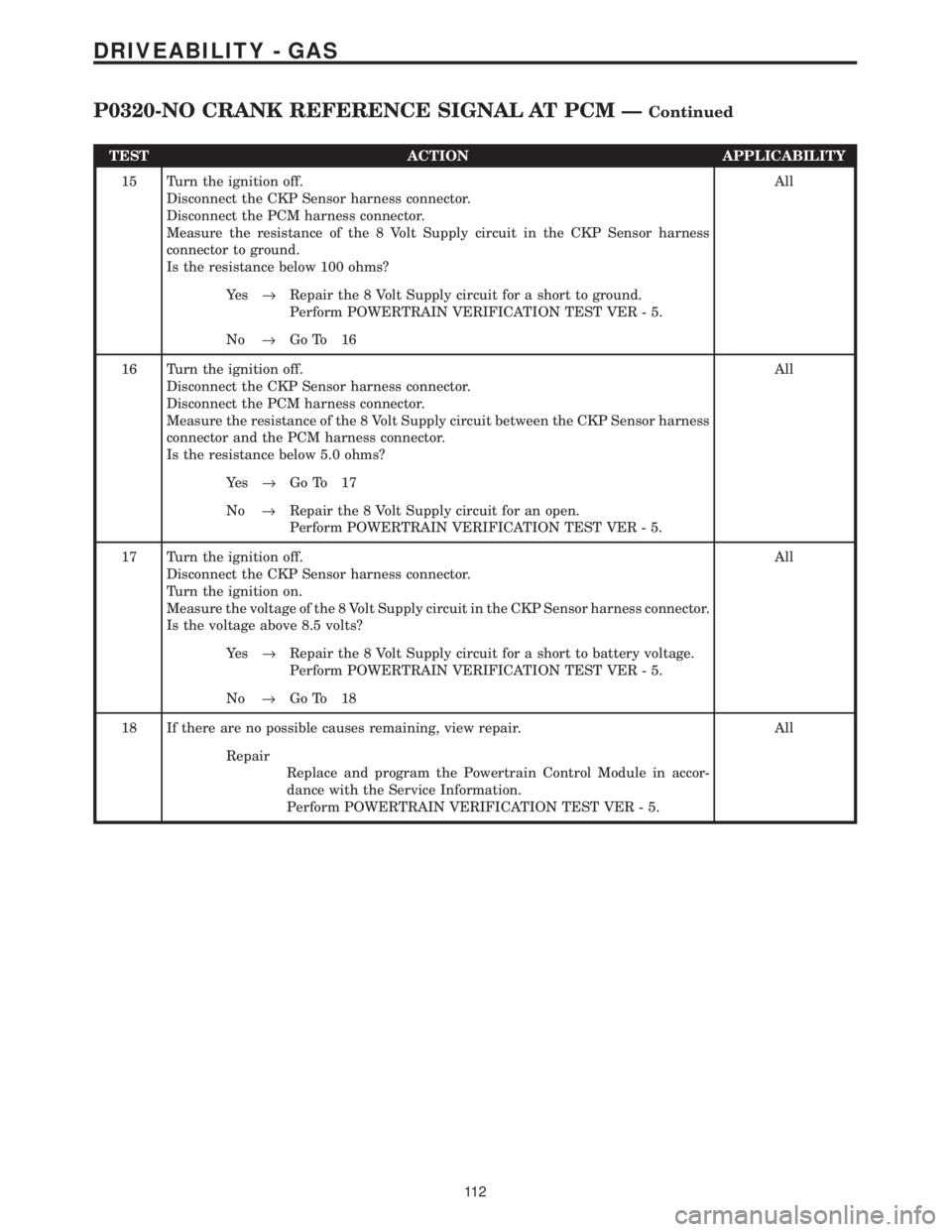
TEST ACTION APPLICABILITY
15 Turn the ignition off.
Disconnect the CKP Sensor harness connector.
Disconnect the PCM harness connector.
Measure the resistance of the 8 Volt Supply circuit in the CKP Sensor harness
connector to ground.
Is the resistance below 100 ohms?All
Ye s®Repair the 8 Volt Supply circuit for a short to ground.
Perform POWERTRAIN VERIFICATION TEST VER - 5.
No®Go To 16
16 Turn the ignition off.
Disconnect the CKP Sensor harness connector.
Disconnect the PCM harness connector.
Measure the resistance of the 8 Volt Supply circuit between the CKP Sensor harness
connector and the PCM harness connector.
Is the resistance below 5.0 ohms?All
Ye s®Go To 17
No®Repair the 8 Volt Supply circuit for an open.
Perform POWERTRAIN VERIFICATION TEST VER - 5.
17 Turn the ignition off.
Disconnect the CKP Sensor harness connector.
Turn the ignition on.
Measure the voltage of the 8 Volt Supply circuit in the CKP Sensor harness connector.
Is the voltage above 8.5 volts?All
Ye s®Repair the 8 Volt Supply circuit for a short to battery voltage.
Perform POWERTRAIN VERIFICATION TEST VER - 5.
No®Go To 18
18 If there are no possible causes remaining, view repair. All
Repair
Replace and program the Powertrain Control Module in accor-
dance with the Service Information.
Perform POWERTRAIN VERIFICATION TEST VER - 5.
11 2
DRIVEABILITY - GAS
P0320-NO CRANK REFERENCE SIGNAL AT PCM ÐContinued
Page 3907 of 4284
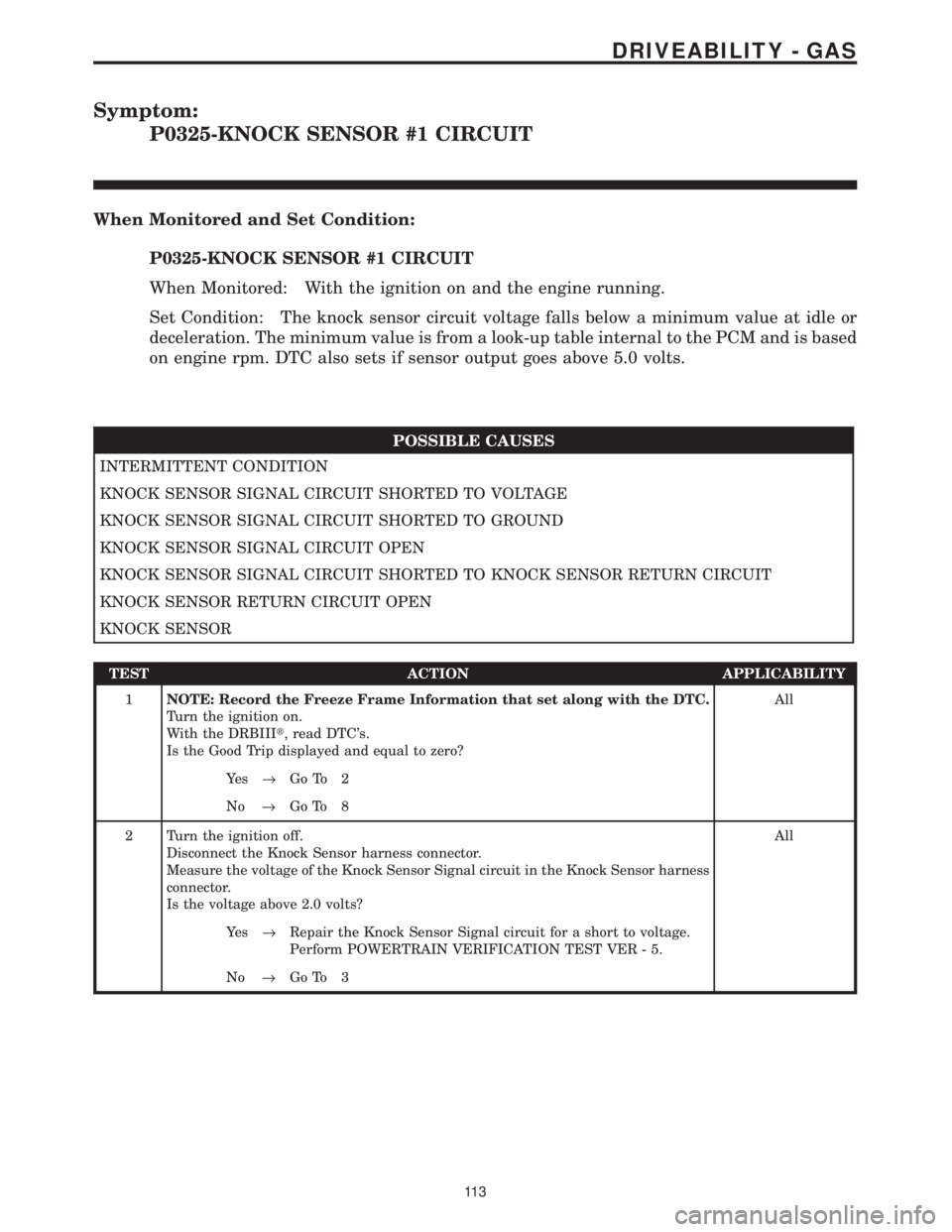
Symptom:
P0325-KNOCK SENSOR #1 CIRCUIT
When Monitored and Set Condition:
P0325-KNOCK SENSOR #1 CIRCUIT
When Monitored: With the ignition on and the engine running.
Set Condition: The knock sensor circuit voltage falls below a minimum value at idle or
deceleration. The minimum value is from a look-up table internal to the PCM and is based
on engine rpm. DTC also sets if sensor output goes above 5.0 volts.
POSSIBLE CAUSES
INTERMITTENT CONDITION
KNOCK SENSOR SIGNAL CIRCUIT SHORTED TO VOLTAGE
KNOCK SENSOR SIGNAL CIRCUIT SHORTED TO GROUND
KNOCK SENSOR SIGNAL CIRCUIT OPEN
KNOCK SENSOR SIGNAL CIRCUIT SHORTED TO KNOCK SENSOR RETURN CIRCUIT
KNOCK SENSOR RETURN CIRCUIT OPEN
KNOCK SENSOR
TEST ACTION APPLICABILITY
1NOTE: Record the Freeze Frame Information that set along with the DTC.
Turn the ignition on.
With the DRBIIIt, read DTC's.
Is the Good Trip displayed and equal to zero?All
Ye s®Go To 2
No®Go To 8
2 Turn the ignition off.
Disconnect the Knock Sensor harness connector.
Measure the voltage of the Knock Sensor Signal circuit in the Knock Sensor harness
connector.
Is the voltage above 2.0 volts?All
Ye s®Repair the Knock Sensor Signal circuit for a short to voltage.
Perform POWERTRAIN VERIFICATION TEST VER - 5.
No®Go To 3
11 3
DRIVEABILITY - GAS
Page 3908 of 4284
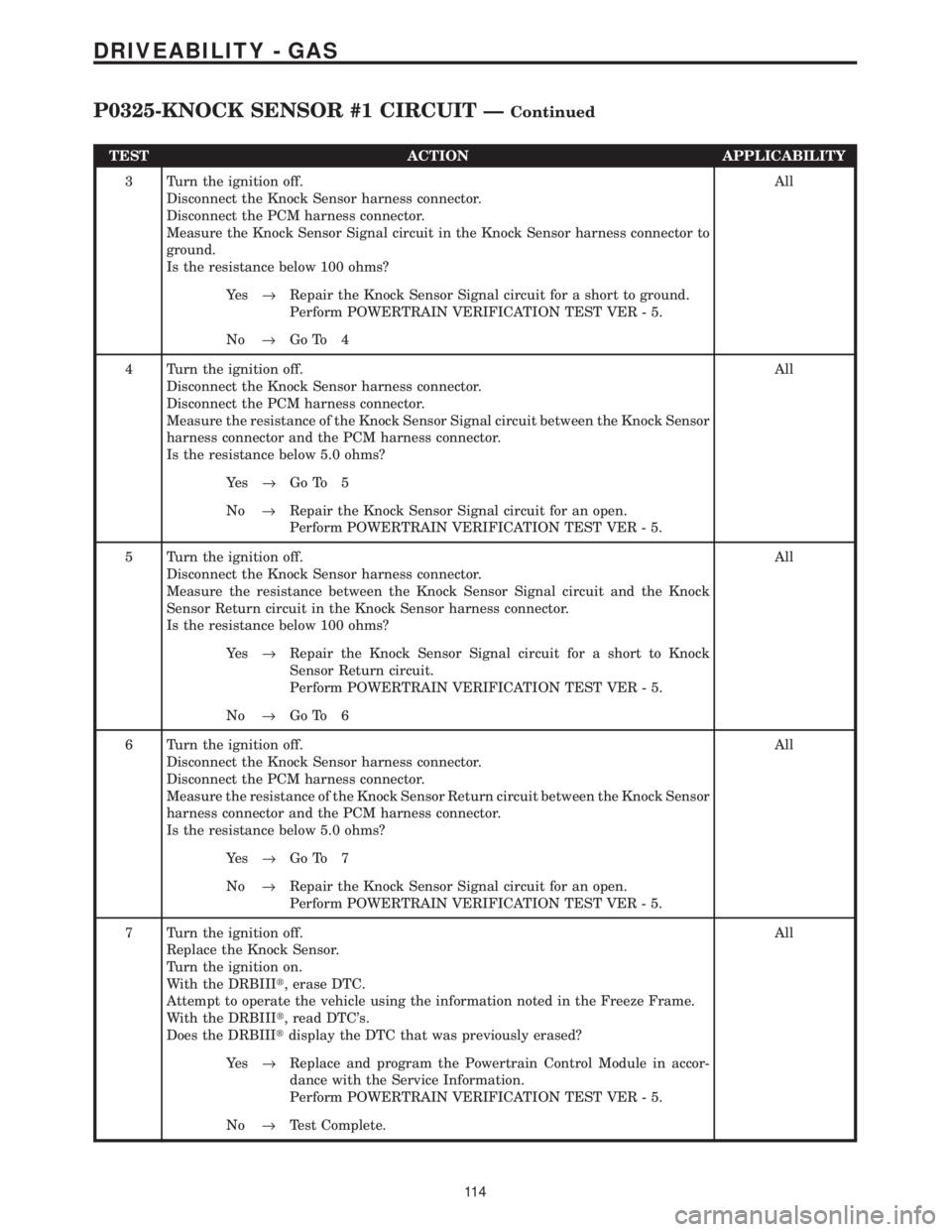
TEST ACTION APPLICABILITY
3 Turn the ignition off.
Disconnect the Knock Sensor harness connector.
Disconnect the PCM harness connector.
Measure the Knock Sensor Signal circuit in the Knock Sensor harness connector to
ground.
Is the resistance below 100 ohms?All
Ye s®Repair the Knock Sensor Signal circuit for a short to ground.
Perform POWERTRAIN VERIFICATION TEST VER - 5.
No®Go To 4
4 Turn the ignition off.
Disconnect the Knock Sensor harness connector.
Disconnect the PCM harness connector.
Measure the resistance of the Knock Sensor Signal circuit between the Knock Sensor
harness connector and the PCM harness connector.
Is the resistance below 5.0 ohms?All
Ye s®Go To 5
No®Repair the Knock Sensor Signal circuit for an open.
Perform POWERTRAIN VERIFICATION TEST VER - 5.
5 Turn the ignition off.
Disconnect the Knock Sensor harness connector.
Measure the resistance between the Knock Sensor Signal circuit and the Knock
Sensor Return circuit in the Knock Sensor harness connector.
Is the resistance below 100 ohms?All
Ye s®Repair the Knock Sensor Signal circuit for a short to Knock
Sensor Return circuit.
Perform POWERTRAIN VERIFICATION TEST VER - 5.
No®Go To 6
6 Turn the ignition off.
Disconnect the Knock Sensor harness connector.
Disconnect the PCM harness connector.
Measure the resistance of the Knock Sensor Return circuit between the Knock Sensor
harness connector and the PCM harness connector.
Is the resistance below 5.0 ohms?All
Ye s®Go To 7
No®Repair the Knock Sensor Signal circuit for an open.
Perform POWERTRAIN VERIFICATION TEST VER - 5.
7 Turn the ignition off.
Replace the Knock Sensor.
Turn the ignition on.
With the DRBIIIt, erase DTC.
Attempt to operate the vehicle using the information noted in the Freeze Frame.
With the DRBIIIt, read DTC's.
Does the DRBIIItdisplay the DTC that was previously erased?All
Ye s®Replace and program the Powertrain Control Module in accor-
dance with the Service Information.
Perform POWERTRAIN VERIFICATION TEST VER - 5.
No®Test Complete.
11 4
DRIVEABILITY - GAS
P0325-KNOCK SENSOR #1 CIRCUIT ÐContinued
Page 3911 of 4284
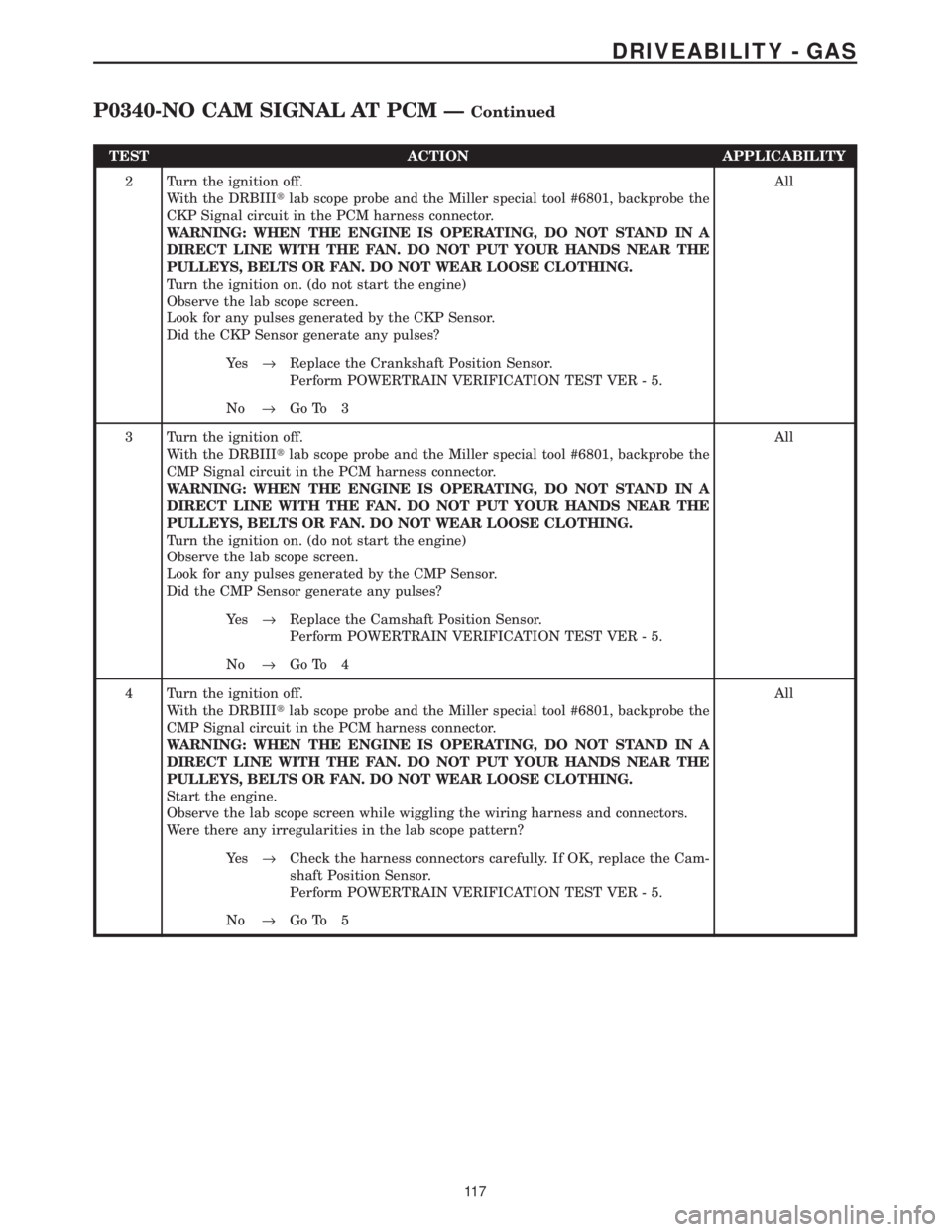
TEST ACTION APPLICABILITY
2 Turn the ignition off.
With the DRBIIItlab scope probe and the Miller special tool #6801, backprobe the
CKP Signal circuit in the PCM harness connector.
WARNING: WHEN THE ENGINE IS OPERATING, DO NOT STAND IN A
DIRECT LINE WITH THE FAN. DO NOT PUT YOUR HANDS NEAR THE
PULLEYS, BELTS OR FAN. DO NOT WEAR LOOSE CLOTHING.
Turn the ignition on. (do not start the engine)
Observe the lab scope screen.
Look for any pulses generated by the CKP Sensor.
Did the CKP Sensor generate any pulses?All
Ye s®Replace the Crankshaft Position Sensor.
Perform POWERTRAIN VERIFICATION TEST VER - 5.
No®Go To 3
3 Turn the ignition off.
With the DRBIIItlab scope probe and the Miller special tool #6801, backprobe the
CMP Signal circuit in the PCM harness connector.
WARNING: WHEN THE ENGINE IS OPERATING, DO NOT STAND IN A
DIRECT LINE WITH THE FAN. DO NOT PUT YOUR HANDS NEAR THE
PULLEYS, BELTS OR FAN. DO NOT WEAR LOOSE CLOTHING.
Turn the ignition on. (do not start the engine)
Observe the lab scope screen.
Look for any pulses generated by the CMP Sensor.
Did the CMP Sensor generate any pulses?All
Ye s®Replace the Camshaft Position Sensor.
Perform POWERTRAIN VERIFICATION TEST VER - 5.
No®Go To 4
4 Turn the ignition off.
With the DRBIIItlab scope probe and the Miller special tool #6801, backprobe the
CMP Signal circuit in the PCM harness connector.
WARNING: WHEN THE ENGINE IS OPERATING, DO NOT STAND IN A
DIRECT LINE WITH THE FAN. DO NOT PUT YOUR HANDS NEAR THE
PULLEYS, BELTS OR FAN. DO NOT WEAR LOOSE CLOTHING.
Start the engine.
Observe the lab scope screen while wiggling the wiring harness and connectors.
Were there any irregularities in the lab scope pattern?All
Ye s®Check the harness connectors carefully. If OK, replace the Cam-
shaft Position Sensor.
Perform POWERTRAIN VERIFICATION TEST VER - 5.
No®Go To 5
11 7
DRIVEABILITY - GAS
P0340-NO CAM SIGNAL AT PCM ÐContinued
Page 3912 of 4284
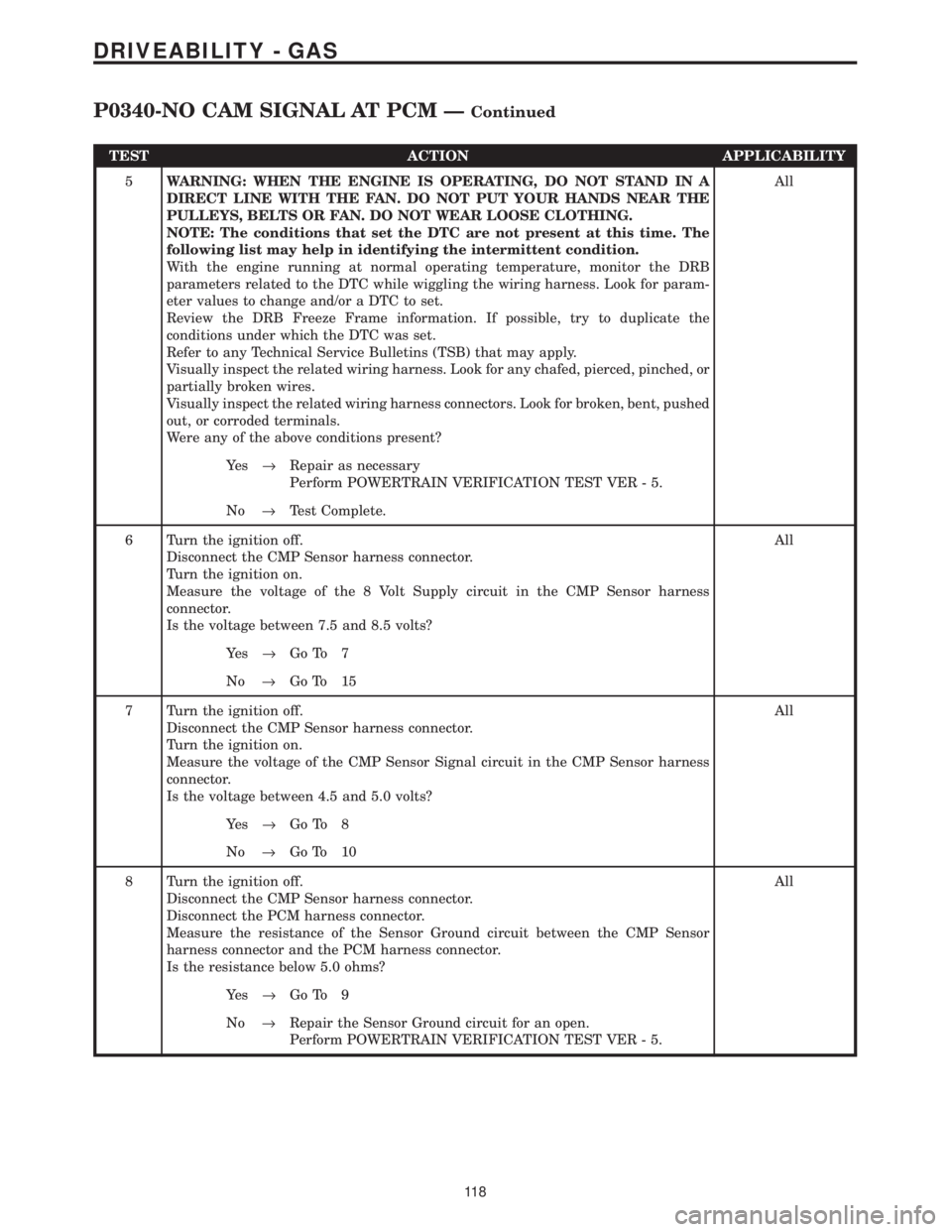
TEST ACTION APPLICABILITY
5WARNING: WHEN THE ENGINE IS OPERATING, DO NOT STAND IN A
DIRECT LINE WITH THE FAN. DO NOT PUT YOUR HANDS NEAR THE
PULLEYS, BELTS OR FAN. DO NOT WEAR LOOSE CLOTHING.
NOTE: The conditions that set the DTC are not present at this time. The
following list may help in identifying the intermittent condition.
With the engine running at normal operating temperature, monitor the DRB
parameters related to the DTC while wiggling the wiring harness. Look for param-
eter values to change and/or a DTC to set.
Review the DRB Freeze Frame information. If possible, try to duplicate the
conditions under which the DTC was set.
Refer to any Technical Service Bulletins (TSB) that may apply.
Visually inspect the related wiring harness. Look for any chafed, pierced, pinched, or
partially broken wires.
Visually inspect the related wiring harness connectors. Look for broken, bent, pushed
out, or corroded terminals.
Were any of the above conditions present?All
Ye s®Repair as necessary
Perform POWERTRAIN VERIFICATION TEST VER - 5.
No®Test Complete.
6 Turn the ignition off.
Disconnect the CMP Sensor harness connector.
Turn the ignition on.
Measure the voltage of the 8 Volt Supply circuit in the CMP Sensor harness
connector.
Is the voltage between 7.5 and 8.5 volts?All
Ye s®Go To 7
No®Go To 15
7 Turn the ignition off.
Disconnect the CMP Sensor harness connector.
Turn the ignition on.
Measure the voltage of the CMP Sensor Signal circuit in the CMP Sensor harness
connector.
Is the voltage between 4.5 and 5.0 volts?All
Ye s®Go To 8
No®Go To 10
8 Turn the ignition off.
Disconnect the CMP Sensor harness connector.
Disconnect the PCM harness connector.
Measure the resistance of the Sensor Ground circuit between the CMP Sensor
harness connector and the PCM harness connector.
Is the resistance below 5.0 ohms?All
Ye s®Go To 9
No®Repair the Sensor Ground circuit for an open.
Perform POWERTRAIN VERIFICATION TEST VER - 5.
11 8
DRIVEABILITY - GAS
P0340-NO CAM SIGNAL AT PCM ÐContinued
Page 3913 of 4284
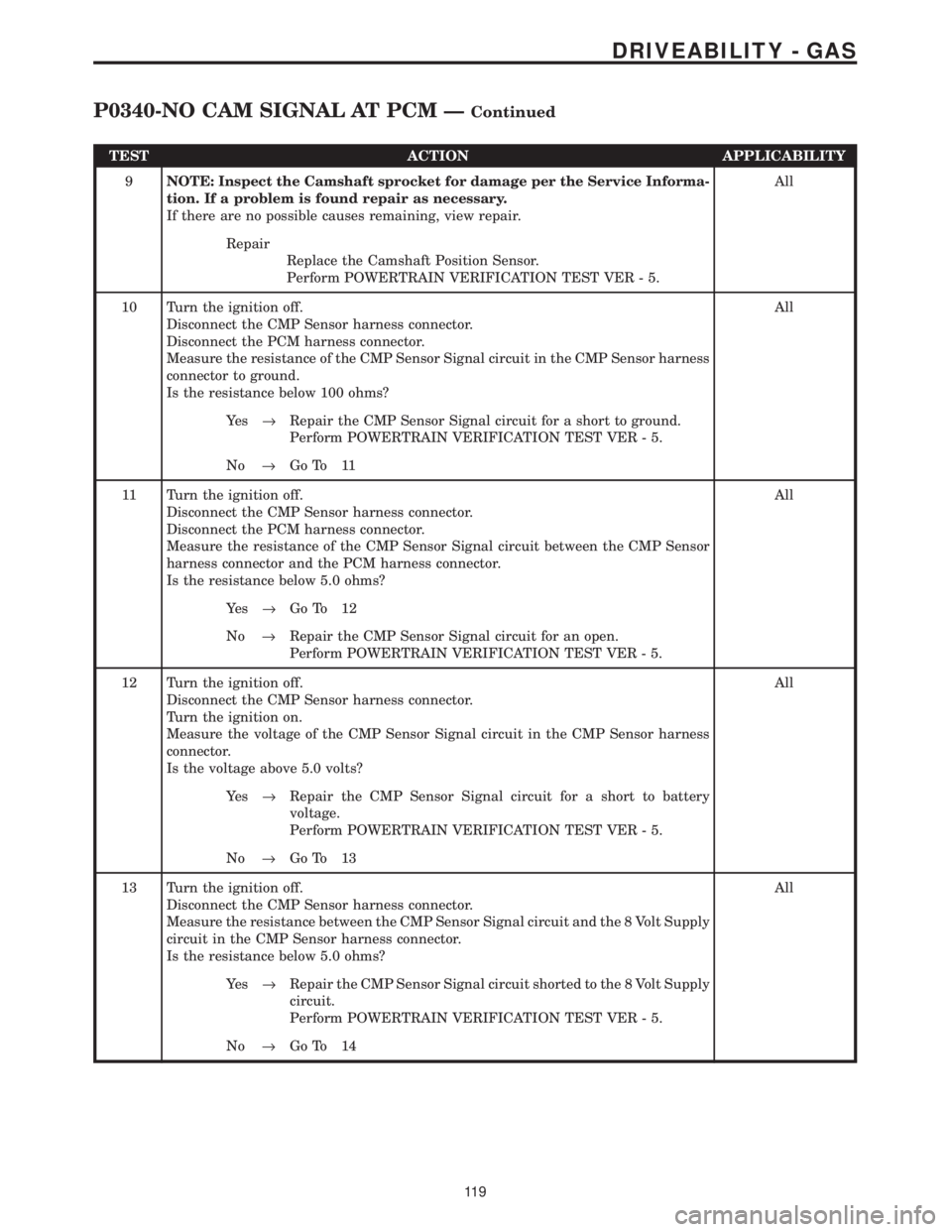
TEST ACTION APPLICABILITY
9NOTE: Inspect the Camshaft sprocket for damage per the Service Informa-
tion. If a problem is found repair as necessary.
If there are no possible causes remaining, view repair.All
Repair
Replace the Camshaft Position Sensor.
Perform POWERTRAIN VERIFICATION TEST VER - 5.
10 Turn the ignition off.
Disconnect the CMP Sensor harness connector.
Disconnect the PCM harness connector.
Measure the resistance of the CMP Sensor Signal circuit in the CMP Sensor harness
connector to ground.
Is the resistance below 100 ohms?All
Ye s®Repair the CMP Sensor Signal circuit for a short to ground.
Perform POWERTRAIN VERIFICATION TEST VER - 5.
No®Go To 11
11 Turn the ignition off.
Disconnect the CMP Sensor harness connector.
Disconnect the PCM harness connector.
Measure the resistance of the CMP Sensor Signal circuit between the CMP Sensor
harness connector and the PCM harness connector.
Is the resistance below 5.0 ohms?All
Ye s®Go To 12
No®Repair the CMP Sensor Signal circuit for an open.
Perform POWERTRAIN VERIFICATION TEST VER - 5.
12 Turn the ignition off.
Disconnect the CMP Sensor harness connector.
Turn the ignition on.
Measure the voltage of the CMP Sensor Signal circuit in the CMP Sensor harness
connector.
Is the voltage above 5.0 volts?All
Ye s®Repair the CMP Sensor Signal circuit for a short to battery
voltage.
Perform POWERTRAIN VERIFICATION TEST VER - 5.
No®Go To 13
13 Turn the ignition off.
Disconnect the CMP Sensor harness connector.
Measure the resistance between the CMP Sensor Signal circuit and the 8 Volt Supply
circuit in the CMP Sensor harness connector.
Is the resistance below 5.0 ohms?All
Ye s®Repair the CMP Sensor Signal circuit shorted to the 8 Volt Supply
circuit.
Perform POWERTRAIN VERIFICATION TEST VER - 5.
No®Go To 14
11 9
DRIVEABILITY - GAS
P0340-NO CAM SIGNAL AT PCM ÐContinued
Page 3914 of 4284
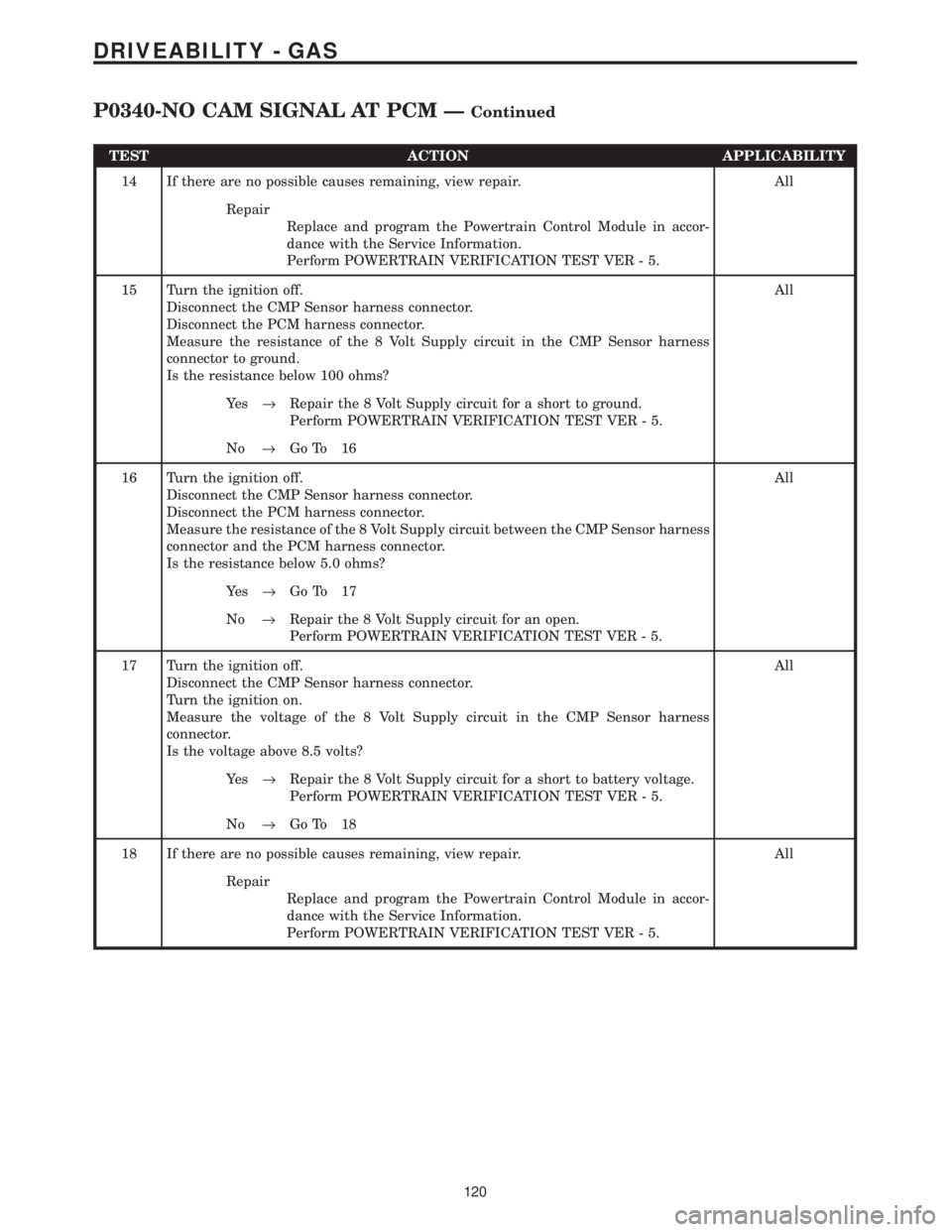
TEST ACTION APPLICABILITY
14 If there are no possible causes remaining, view repair. All
Repair
Replace and program the Powertrain Control Module in accor-
dance with the Service Information.
Perform POWERTRAIN VERIFICATION TEST VER - 5.
15 Turn the ignition off.
Disconnect the CMP Sensor harness connector.
Disconnect the PCM harness connector.
Measure the resistance of the 8 Volt Supply circuit in the CMP Sensor harness
connector to ground.
Is the resistance below 100 ohms?All
Ye s®Repair the 8 Volt Supply circuit for a short to ground.
Perform POWERTRAIN VERIFICATION TEST VER - 5.
No®Go To 16
16 Turn the ignition off.
Disconnect the CMP Sensor harness connector.
Disconnect the PCM harness connector.
Measure the resistance of the 8 Volt Supply circuit between the CMP Sensor harness
connector and the PCM harness connector.
Is the resistance below 5.0 ohms?All
Ye s®Go To 17
No®Repair the 8 Volt Supply circuit for an open.
Perform POWERTRAIN VERIFICATION TEST VER - 5.
17 Turn the ignition off.
Disconnect the CMP Sensor harness connector.
Turn the ignition on.
Measure the voltage of the 8 Volt Supply circuit in the CMP Sensor harness
connector.
Is the voltage above 8.5 volts?All
Ye s®Repair the 8 Volt Supply circuit for a short to battery voltage.
Perform POWERTRAIN VERIFICATION TEST VER - 5.
No®Go To 18
18 If there are no possible causes remaining, view repair. All
Repair
Replace and program the Powertrain Control Module in accor-
dance with the Service Information.
Perform POWERTRAIN VERIFICATION TEST VER - 5.
120
DRIVEABILITY - GAS
P0340-NO CAM SIGNAL AT PCM ÐContinued
Page 3915 of 4284
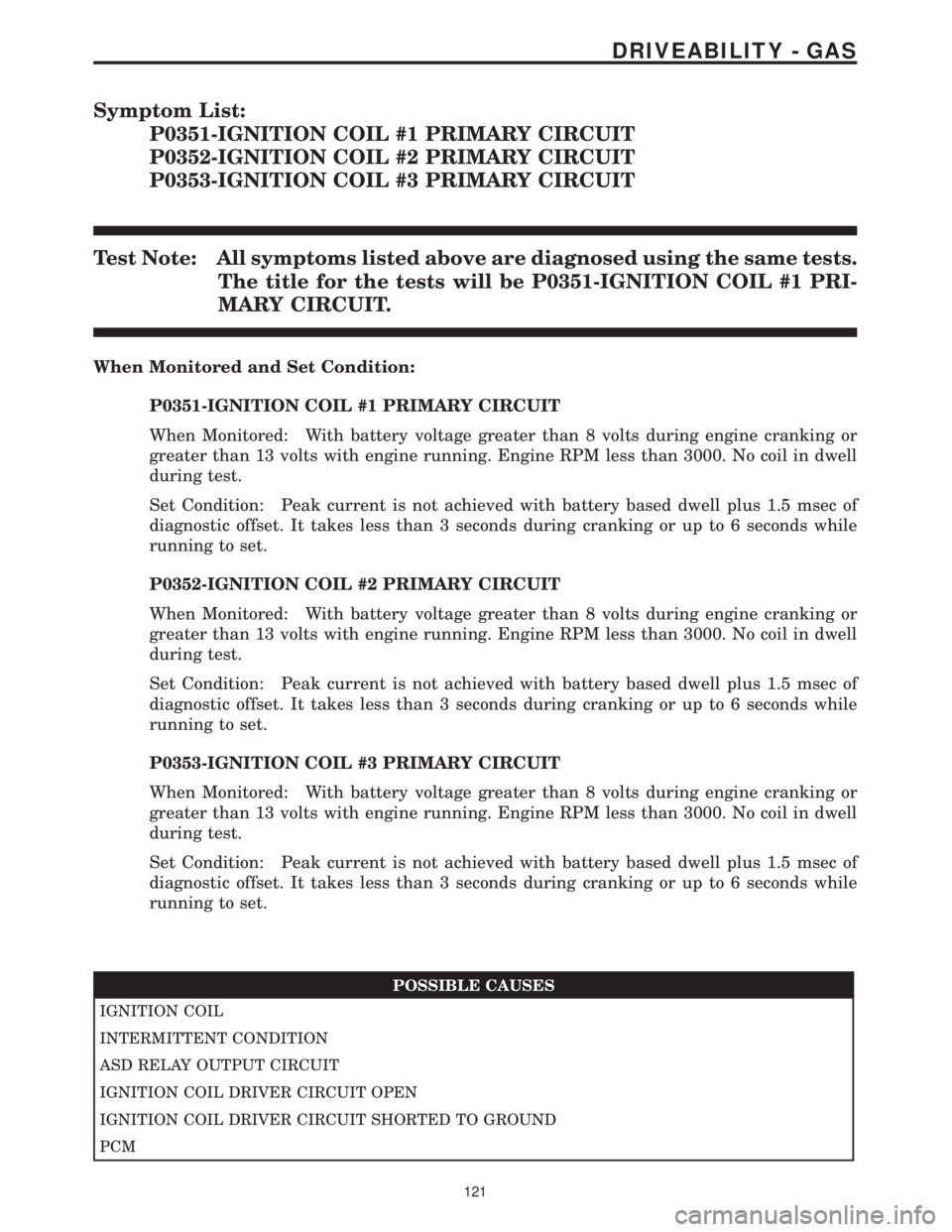
Symptom List:
P0351-IGNITION COIL #1 PRIMARY CIRCUIT
P0352-IGNITION COIL #2 PRIMARY CIRCUIT
P0353-IGNITION COIL #3 PRIMARY CIRCUIT
Test Note: All symptoms listed above are diagnosed using the same tests.
The title for the tests will be P0351-IGNITION COIL #1 PRI-
MARY CIRCUIT.
When Monitored and Set Condition:
P0351-IGNITION COIL #1 PRIMARY CIRCUIT
When Monitored: With battery voltage greater than 8 volts during engine cranking or
greater than 13 volts with engine running. Engine RPM less than 3000. No coil in dwell
during test.
Set Condition: Peak current is not achieved with battery based dwell plus 1.5 msec of
diagnostic offset. It takes less than 3 seconds during cranking or up to 6 seconds while
running to set.
P0352-IGNITION COIL #2 PRIMARY CIRCUIT
When Monitored: With battery voltage greater than 8 volts during engine cranking or
greater than 13 volts with engine running. Engine RPM less than 3000. No coil in dwell
during test.
Set Condition: Peak current is not achieved with battery based dwell plus 1.5 msec of
diagnostic offset. It takes less than 3 seconds during cranking or up to 6 seconds while
running to set.
P0353-IGNITION COIL #3 PRIMARY CIRCUIT
When Monitored: With battery voltage greater than 8 volts during engine cranking or
greater than 13 volts with engine running. Engine RPM less than 3000. No coil in dwell
during test.
Set Condition: Peak current is not achieved with battery based dwell plus 1.5 msec of
diagnostic offset. It takes less than 3 seconds during cranking or up to 6 seconds while
running to set.
POSSIBLE CAUSES
IGNITION COIL
INTERMITTENT CONDITION
ASD RELAY OUTPUT CIRCUIT
IGNITION COIL DRIVER CIRCUIT OPEN
IGNITION COIL DRIVER CIRCUIT SHORTED TO GROUND
PCM
121
DRIVEABILITY - GAS