2001 CHRYSLER VOYAGER brake
[x] Cancel search: brakePage 1218 of 4284
TABLE OF CONTENTS - Continued
SERIAL LINK EXTERNAL FAULT.........................................216
ROLLING CODE FAILURE...............................................218
VIN MISMATCH........................................................218
TRANSPONDER COMMUNICATION FAILURE..............................220
TRANSPONDER CYCLIC REDUNDANCY CHECK (CRC) FAILURE.............220
TRANSPONDER ID MISMATCH..........................................220
TRANSPONDER RESPONSE MISMATCH..................................220
VERIFICATION TESTS
VERIFICATION TESTS..................................................223
8.0 COMPONENT LOCATIONS..............................................227
8.1CONTROL MODULES.............................................227
8.2CONTROLS AND SOLENOIDS......................................227
8.3DATA LINK CONNECTOR..........................................227
8.4FUEL SYSTEM...................................................228
8.5RELAYS.........................................................228
8.6SENSORS.......................................................229
8.7SWITCHES......................................................230
9.0 CONNECTOR PINOUTS................................................231
A/C COMPRESSOR CLUTCH - LT. GRAY 2 WAY............................231
A/C PRESSURE SENSOR - GRAY 4 WAY..................................231
ACCELERATOR PEDAL POSITION SENSOR (DIESEL) - BLACK 10 WAY........231
BATTERY TEMPERATURE SENSOR (DIESEL) - BLACK 2 WAY................231
BOOST PRESSURE SENSOR (DIESEL) - BLACK 4 WAY.....................232
BRAKE LAMP SWITCH - BLACK 6 WAY...................................232
CAMSHAFT POSITION SENSOR (DIESEL) - BLACK 3 WAY...................232
CLUTCH PEDAL UPSTOP SWITCH (DIESEL) - RED 2 WAY...................232
CRANKSHAFT POSITION SENSOR (DIESEL) - BLACK 3 WAY................232
DATA LINK CONNECTOR - BLACK 16 WAY................................233
EGR SOLENOID (DIESEL) - LT. GRAY 2 WAY...............................233
ENGINE CONTROL MODULE C1 (DIESEL) - BLACK 81 WAY..................234
ENGINE CONTROL MODULE C1 (DIESEL) - BLACK 81 WAY..................235
ENGINE CONTROL MODULE C2 (DIESEL) - BLACK 40 WAY..................236
ENGINE COOLANT TEMP SENSOR (DIESEL) - BLUE 2 WAY.................236
ENGINE OIL PRESSURE SENSOR (DIESEL) - BLACK 3 WAY.................237
ENGINE OIL TEMPERATURE SENSOR (DIESEL) - BLACK 2 WAY.............237
FUEL HEATER (DIESEL) - BLACK 2 WAY..................................237
FUEL INJECTOR NO. 1 (DIESEL) - BLACK 2 WAY...........................237
FUEL INJECTOR NO. 2 (DIESEL) - BLACK 2 WAY...........................237
FUEL INJECTOR NO. 3 (DIESEL) - BLACK 2 WAY...........................238
FUEL INJECTOR NO. 4 (DIESEL) - BLACK 2 WAY...........................238
FUEL PRESSURE SENSOR (DIESEL) - BLACK 3 WAY.......................238
FUEL PRESSURE SOLENOID (DIESEL) - BLACK 2 WAY.....................238
GENERATOR - BLACK 2 WAY...........................................238
GLOW PLUG RELAY (DIESEL) - BLACK 4 WAY.............................239
INTELLIGENT POWER MODULE C3 (DIESEL) - YELLOW/RED 20 WAY.........239
LEFT SPEED CONTROL SWITCH - WHITE 2 WAY..........................239
LIFT PUMP MOTOR (DIESEL) - BLACK 2 WAY..............................239
MASS AIR FLOW SENSOR (DIESEL) - ORANGE 5 WAY......................240
v
Page 1224 of 4284
A/C PRESSURE SENSOR CIRCUIT SIGNAL
VOLTAGE TOO HIGH
A/C PRESSURE SENSOR CIRCUIT SIGNAL
VOLTAGE TOO LOW
A/C PRESSURE SENSOR CIRCUIT SUPPLY
VOLTAGE TOO HIGH OR LOW
A/C PRESSURE SENSOR CIRCUIT PLAUSI-
BILITY
SYSTEM VOLTAGE TOO HIGH
SYSTEM VOLTAGE TOO LOW
S/C SWITCH SIGNAL CIRCUIT SIGNAL VOLT-
AGE TOO HIGH
S/C SWITCH SIGNAL CIRCUIT SIGNAL VOLT-
AGE TOO LOW
S/C SWITCH SIGNAL CIRCUIT PLAUSIBILITY
ECM ERROR RECOVERY HAS OCCURRED
ECM ERROR REDUNDANT OVERRUN MONI-
TORING
ECM ERROR GATE ARRAY - QUANTITY STOP
ECM ERROR GATE ARRAY - COMMUNICA-
TION
ECM ERROR - COMMUNICATION NOT VERI-
FIED
STARTER RELAY CIRCUIT OPEN CIRCUIT
STARTER RELAY CIRCUIT SHORT CIRCUIT
GENERATOR FIELD CONTROL MALF BAT-
TERY VOLTAGE TOO HIGH
GENERATOR FIELD CONTROL MALF BAT-
TERY VOLTAGE TOO LOW
GENERATOR FIELD CONTROL MALF OPEN
CIRCUIT
GENERATOR FIELD CONTROL MALF SHORT
CIRCUIT
GENERATOR FIELD CONTROL MALF
CHARGING VOLTS TOO LOW
GENERATOR FIELD CONTROL MALF BAT-
TERY VOLTAGE DEVIATION TOO HIGH
GENERATOR FIELD CONTROL MALF BAT-
TERY VOLTAGE DEVIATION TOO LOW
GENERATOR FIELD CONTROL MALF UN-
STABLE CURRENT
SENSOR REFERENCE VOLTAGE A CKT VOLT-
AGE TOO HIGH
SENSOR REFERENCE VOLTAGE A CKT VOLT-
AGE TOO LOW
SENSOR REFERENCE VOLTAGE B CKT
VOLTAGE TOO HIGH
SENSOR REFERENCE VOLTAGE B CKT
VOLTAGE TOO LOW
A/C CLUTCH RELAY CIRCUIT OPEN CIRCUIT
A/C CLUTCH RELAY CIRCUIT SHORT CIR-
CUIT
ECM/PCM RELAY CONTROL CIRCUIT SHUTS
OFF TOO EARLY
ECM/PCM RELAY CONTROL CIRCUIT SHUTS
OFF TOO LATE
BRAKE SWITCH SIGNAL CIRCUITS INCOR-
RECT CAN MESSAGEBRAKE SWITCH SIGNAL CIRCUITS PLAUSI-
BILITY WITH REDUNDANT CONTACT
BRAKE SWITCH SIGNAL CIRCUITS PLAUSI-
BILITY WITH REDUNDANT CONTACT AFTER
INITIALIZATION
CLUTCH UPSTOP SWITCH PERF PLAUSIBIL-
ITY
CLUTCH UPSTOP SWITCH PERF PLAUSIBIL-
ITY WITH P/N SWITCH
FUEL RAIL PRESSURE MALFUNCTION
PRESSURE TOO HIGH - LIMITATION
FUEL RAIL PRESSURE MALFUNCTION
PRESSURE TOO LOW
FUEL RAIL PRESSURE MALFUNCTION SO-
LENOID OPEN
FUEL RAIL PRESSURE MALFUNCTION
LEAKAGE DETECTED
FUEL PRESSURE SOLENOID OPEN CIRCUIT
FUEL PRESSURE SOLENOID SHORT CIR-
CUIT
FUEL PRESSURE SOLENOID PLAUSIBILITY
IN AFTER-RUN
CALCULATED INJECTOR VOLTAGE - VOLT-
AGE 1 TOO LOW
CALCULATED INJECTOR VOLTAGE - VOLT-
AGE 2 TOO LOW
BATTERY SENSE LINE 1 VOLTAGE TOO
HIGH
BATTERY SENSE LINE 1 VOLTAGE TOO LOW
FUEL PRESS REG CURRENT CONTROL SIG-
NAL TOO HIGH
FUEL PRESS REG CURRENT CONTROL SIG-
NAL TOO LOW
GENERATOR FIELD CURRENT TOO HIGH
GENERATOR FIELD CURRENT TOO LOW
CAPACITOR VOLTAGE 1 VOLTAGE TOO HIGH
CAPACITOR VOLTAGE 1 VOLTAGE TOO LOW
CAPACITOR VOLTAGE 2 VOLTAGE TOO HIGH
CAPACITOR VOLTAGE 2 VOLTAGE TOO LOW
IGNITION SWITCH PLAUSIBILITY
AFTER RUN SHUT OFF ERROR - ZERO
QUANTITY
AFTERRUN SHUT OFF ERROR - INJ. POWER-
STAGE
VOLTAGE REGULATOR SIGNAL VOLTAGE
TOO HIGH
VOLTAGE REGULATOR SIGNAL VOLTAGE
TOO LOW
MIL/DIAG LAMP VIA J1850 BUS IN FRAME
RESPONSE ERROR
MIL/DIAG LAMP VIA J1850 BUS - STATUS
ERROR
J1850 COMMUNICATION BUS SHORT TO
VOLTAGE
J1850 COMMUNICATION BUS SHORT TO
GROUND
J1850 COMMUNICATION BUS TRANSMIT
BUFFER OVERRUN
5
GENERAL INFORMATION
Page 1225 of 4284
J1850 COMMUNICATION BUS SPI ERROR
J1850 COMMUNICATION BUS RECEIVE TIME-
OUT
J1850 COMMUNICATION BUS UNAUTHO-
RIZED RESET
EEPROM PLAUSIBILITY CHECKSUM ERROR
EEPROM PLAUSIBILITY VIN CHECKSUM
ERROR
EEPROM PLAUSIBILITY COMMUNICATION
ERROR
EEPROM PLAUSIBILITY WRITE ERROR
EEPROM PLAUSIBILITY VARIATION NUM-
BER ERROR
EEPROM PLAUSIBILITY CODE WORD IN-
CORRECT OR MISSING
SKIM SYSTEM SKIM ERROR
SKIM SYSTEM WRITE ACCESS TO EEPROM
FAILURE
SKIM SYSTEM INVALID SECRET KEY IN EE-
PROM
SKIM SYSTEM KEY COMMUNICATION
TIMED OUT
SKIM SYSTEM INVALID KEY CODE RE-
CEIVED
EEPROM RECOVERY OCCURRED
EEPROM REDUNDANT OVERRUN MONI-
TORING
EEPROM QUANTITY STOP
EEPROM COMMUNICATION ERROR
EEPROM COMMUNICATION NOT VERIFIED
ACC PEDAL POSITION SENSOR 1 CKT SIG-
NAL VOLTAGE TOO HIGH
ACC PEDAL POSITION SENSOR 1 CKT SIG-
NAL VOLTAGE TOO LOW
ACC PEDAL POSITION SENSOR 1 CKT SUP-
PLY VOLTAGE TOO HIGH OR LOW
ACC PEDAL POSITION SENSOR 1 CKT PLAU-
SIBILITY WITH POTENTIOMETER
ACC PEDAL POSITION SENSOR 1 CKT PLAU-
SIBILITY WITH BRAKE SWITCH
ACC PEDAL POSITION SENSOR 1 CKT PLAU-
SIBILITY
3.3.4 SKIM DIAGNOSTIC TROUBLE CODES
ANTENNA FAILURE
COP FAILURE
EEPROM FAILURE
PCM STATUS FAILURE
INTERNAL FAULT
RAM FAILURE
ROLLING CODE FAILURE
SERIAL LINK EXTERNAL FAULT
SERIAL LINK INTERNAL FAULT
STACK OVERFLOW FAILURE
TRANSPONDER COMMUNICATION FAILURE
TRANSPONDER CRC (CYCLIC REDUN-
DANCY CHECK) FAILURE
TRANSPONDER ID MISMATCHTRANSPONDER RESPONSE MISMATCH
VIN MISMATCH
3.3.5 HANDLING NO TROUBLE CODE
PROBLEMS
After reading Section 3.0 (System Description
and Functional Operation), you should have a bet-
ter understanding of the theory and operation of the
on-board diagnostics, and how this relates to the
diagnosis of a vehicle that may have a driveability-
related symptom or complaint.
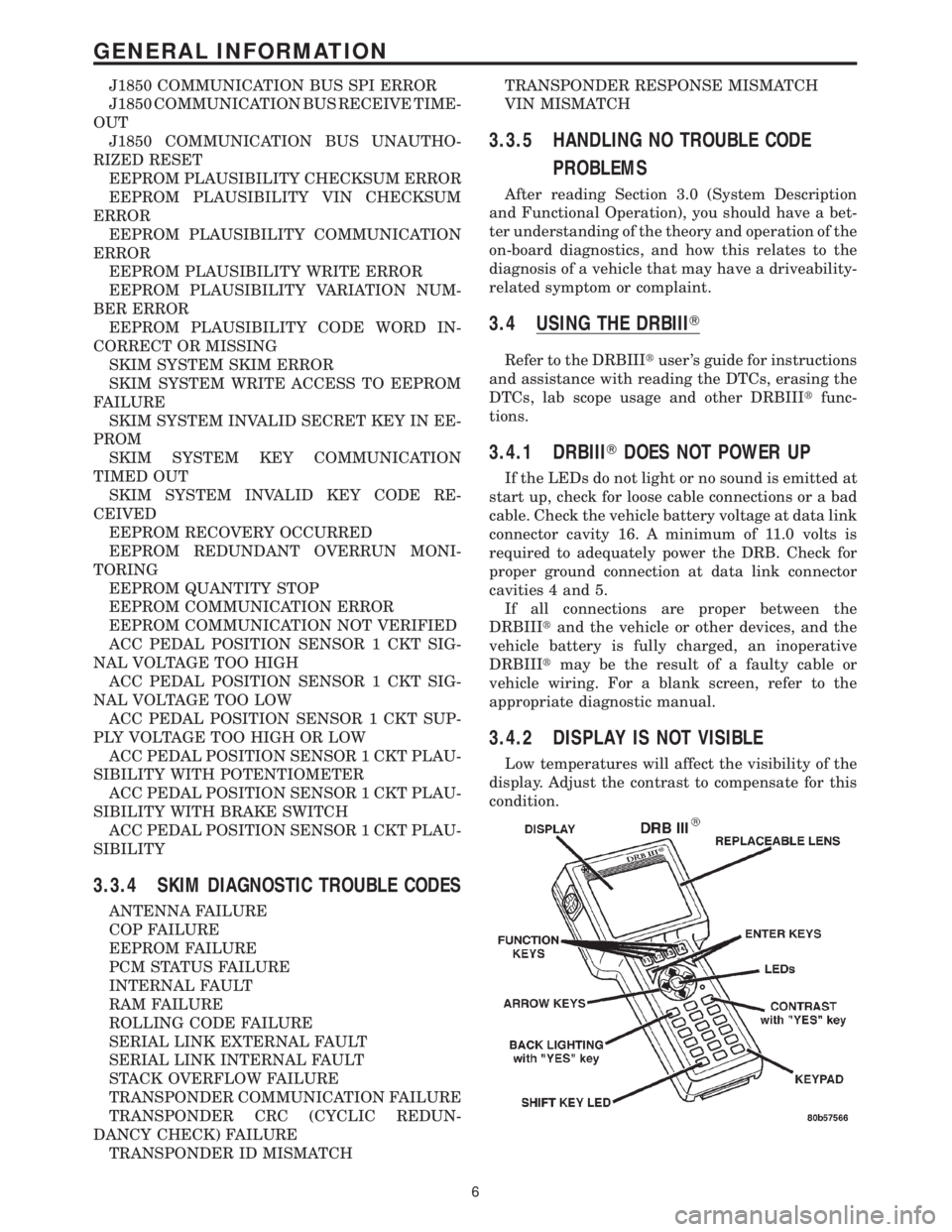
3.4 USING THE DRBIIIT
Refer to the DRBIIItuser 's guide for instructions
and assistance with reading the DTCs, erasing the
DTCs, lab scope usage and other DRBIIItfunc-
tions.
3.4.1 DRBIIITDOES NOT POWER UP
If the LEDs do not light or no sound is emitted at
start up, check for loose cable connections or a bad
cable. Check the vehicle battery voltage at data link
connector cavity 16. A minimum of 11.0 volts is
required to adequately power the DRB. Check for
proper ground connection at data link connector
cavities 4 and 5.
If all connections are proper between the
DRBIIItand the vehicle or other devices, and the
vehicle battery is fully charged, an inoperative
DRBIIItmay be the result of a faulty cable or
vehicle wiring. For a blank screen, refer to the
appropriate diagnostic manual.
3.4.2 DISPLAY IS NOT VISIBLE
Low temperatures will affect the visibility of the
display. Adjust the contrast to compensate for this
condition.
6
GENERAL INFORMATION
Page 1226 of 4284
4.0 DISCLAIMERS, SAFETY,
WARNINGS
4.1 DISCLAIMERS
All information, illustrations, and specifications
contained in this manual are based on the latest
information available at the time of publication.
The right is reserved to make changes at any time
without notice.
4.2 SAFETY
4.2.1 TECHNICIAN SAFETY INFORMATION
WARNING: ENGINES PRODUCE CARBON
MONOXIDE THAT IS ODORLESS, CAUSES
SLOWER REACTION TIME, AND CAN LEAD
TO SERIOUS INJURY. WHEN THE ENGINE IS
OPERATING, KEEP SERVICE AREAS WELL
VENTILATED OR ATTACH THE VEHICLE
EXHAUST SYSTEM TO THE SHOP EXHAUST
REMOVAL SYSTEM.
Set the parking brake and block the wheels before
testing or repairing the vehicle. It is especially
important to block the wheels on front wheel drive
vehicles; the parking brake does not hold the drive
wheels.
When servicing a vehicle, always wear eye pro-
tection, and remove any metal jewelry such as
watchbands or bracelets that might make electrical
contact.
When diagnosing a powertrain system problem,
it is important to follow approved procedures where
applicable. These procedures can be found in the
service manual. Following these procedures is very
important to the safety of individuals performing
diagnostic tests.
4.2.2 VEHICLE PREPARATION FOR
TESTING
Make sure the vehicle being tested has a fully
charged battery. If it does not, false diagnostic codes
or error messages may occur.
4.2.3 SERVICING SUB-ASSEMBLIES
Some components of the powertrain system are
intended to be serviced as an assembly only. At-
tempting to remove or repair certain system sub-
components may result in personal injury and/or
improper system operation. Only those components
with approved repair and installation procedures in
the service manual should be serviced.
4.2.4 DRBIIITSAFETY INFORMATION
WARNING: EXCEEDING THE LIMITS OF THE
DRBIIITMULTIMETER IS DANGEROUS. IT
CAN EXPOSE YOU TO SERIOUS OR
POSSIBLY FATAL INJURY. CAREFULLY
READ AND UNDERSTAND THE CAUTIONS
AND SPECIFICATION LIMITS.
Follow the vehicle manufacturer 's service specifi-
cations at all times.
²Do not use the DRBIIItif it has been damaged.
²Do not use the test leads if the insulation is
damaged or if metal is exposed.
²To avoid electrical shock, do not touch the test
leads, tip or the circuit being tested.
²Choose the proper range and function for the
measurement. Do not try voltage or current mea-
surements that may exceed the rated capacity.
²Do not exceed the limits shown in the table below:
FUNCTION INPUT LIMIT
Volts 0-500 peak volts AC
0-500 volts DC
Ohms (Resistance)* 0-1.12 megohms
Frequency Measure
Frequency Generated0-10 kHz
Temperature -58 - +1100ÉF
-50 - +600ÉC
* Ohms cannot be measured if voltage is present.
Ohms can be measured only in a non-powered
circuit.
²Voltage between any terminal and ground must
not exceed 500v DC or 500v peak AC.
²Use caution when measuring voltage above 25v
DC or 25v AC.
²The circuit being tested must be protected by a 10
amp fuse or circuit breaker.
²Use the low current shunt to measure circuits up
to 10 amps. Use the high current shunt to mea-
sure circuits exceeding 10 amps.
²When testing for the presence of voltage or cur-
rent, make sure the meter is functioning cor-
rectly. Take a reading of a known voltage or
current before accepting a zero reading.
²When measuring current, connect the meter in
series with the load.
²Disconnect the live test lead before disconnecting
the common test lead.
7
GENERAL INFORMATION
Page 1229 of 4284
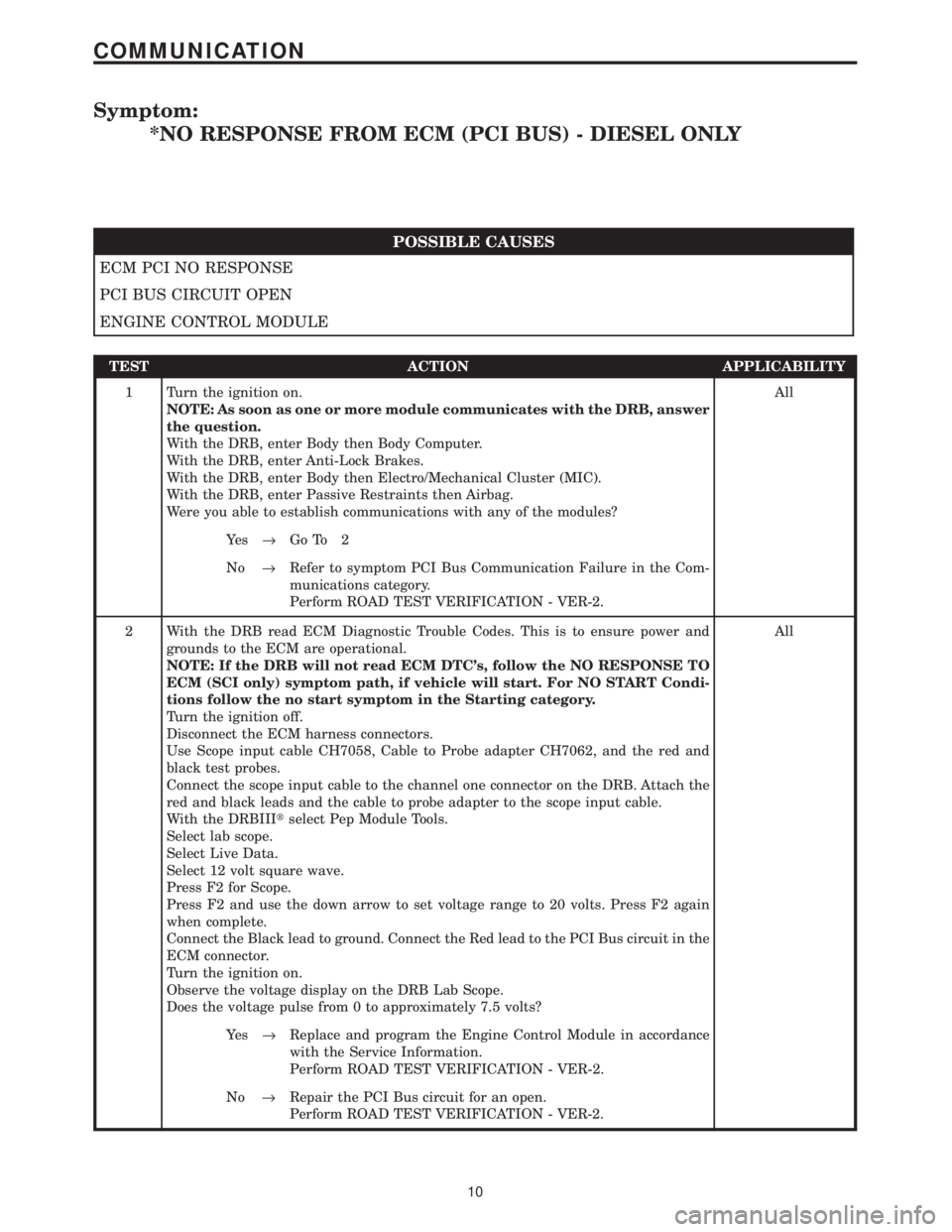
Symptom:
*NO RESPONSE FROM ECM (PCI BUS) - DIESEL ONLY
POSSIBLE CAUSES
ECM PCI NO RESPONSE
PCI BUS CIRCUIT OPEN
ENGINE CONTROL MODULE
TEST ACTION APPLICABILITY
1 Turn the ignition on.
NOTE: As soon as one or more module communicates with the DRB, answer
the question.
With the DRB, enter Body then Body Computer.
With the DRB, enter Anti-Lock Brakes.
With the DRB, enter Body then Electro/Mechanical Cluster (MIC).
With the DRB, enter Passive Restraints then Airbag.
Were you able to establish communications with any of the modules?All
Ye s®Go To 2
No®Refer to symptom PCI Bus Communication Failure in the Com-
munications category.
Perform ROAD TEST VERIFICATION - VER-2.
2 With the DRB read ECM Diagnostic Trouble Codes. This is to ensure power and
grounds to the ECM are operational.
NOTE: If the DRB will not read ECM DTC's, follow the NO RESPONSE TO
ECM (SCI only) symptom path, if vehicle will start. For NO START Condi-
tions follow the no start symptom in the Starting category.
Turn the ignition off.
Disconnect the ECM harness connectors.
Use Scope input cable CH7058, Cable to Probe adapter CH7062, and the red and
black test probes.
Connect the scope input cable to the channel one connector on the DRB. Attach the
red and black leads and the cable to probe adapter to the scope input cable.
With the DRBIIItselect Pep Module Tools.
Select lab scope.
Select Live Data.
Select 12 volt square wave.
Press F2 for Scope.
Press F2 and use the down arrow to set voltage range to 20 volts. Press F2 again
when complete.
Connect the Black lead to ground. Connect the Red lead to the PCI Bus circuit in the
ECM connector.
Turn the ignition on.
Observe the voltage display on the DRB Lab Scope.
Does the voltage pulse from 0 to approximately 7.5 volts?All
Ye s®Replace and program the Engine Control Module in accordance
with the Service Information.
Perform ROAD TEST VERIFICATION - VER-2.
No®Repair the PCI Bus circuit for an open.
Perform ROAD TEST VERIFICATION - VER-2.
10
COMMUNICATION
Page 1368 of 4284
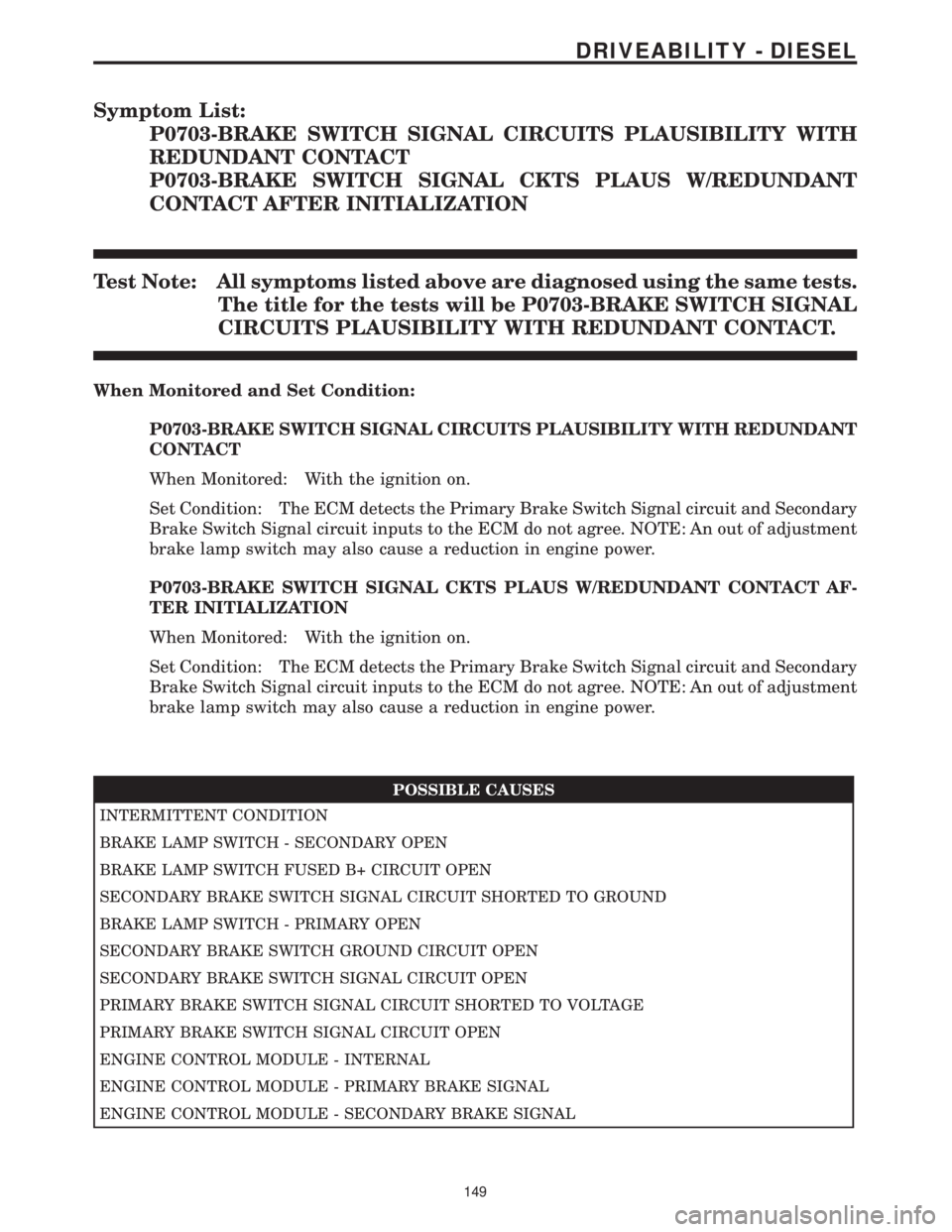
Symptom List:
P0703-BRAKE SWITCH SIGNAL CIRCUITS PLAUSIBILITY WITH
REDUNDANT CONTACT
P0703-BRAKE SWITCH SIGNAL CKTS PLAUS W/REDUNDANT
CONTACT AFTER INITIALIZATION
Test Note: All symptoms listed above are diagnosed using the same tests.
The title for the tests will be P0703-BRAKE SWITCH SIGNAL
CIRCUITS PLAUSIBILITY WITH REDUNDANT CONTACT.
When Monitored and Set Condition:
P0703-BRAKE SWITCH SIGNAL CIRCUITS PLAUSIBILITY WITH REDUNDANT
CONTACT
When Monitored: With the ignition on.
Set Condition: The ECM detects the Primary Brake Switch Signal circuit and Secondary
Brake Switch Signal circuit inputs to the ECM do not agree. NOTE: An out of adjustment
brake lamp switch may also cause a reduction in engine power.
P0703-BRAKE SWITCH SIGNAL CKTS PLAUS W/REDUNDANT CONTACT AF-
TER INITIALIZATION
When Monitored: With the ignition on.
Set Condition: The ECM detects the Primary Brake Switch Signal circuit and Secondary
Brake Switch Signal circuit inputs to the ECM do not agree. NOTE: An out of adjustment
brake lamp switch may also cause a reduction in engine power.
POSSIBLE CAUSES
INTERMITTENT CONDITION
BRAKE LAMP SWITCH - SECONDARY OPEN
BRAKE LAMP SWITCH FUSED B+ CIRCUIT OPEN
SECONDARY BRAKE SWITCH SIGNAL CIRCUIT SHORTED TO GROUND
BRAKE LAMP SWITCH - PRIMARY OPEN
SECONDARY BRAKE SWITCH GROUND CIRCUIT OPEN
SECONDARY BRAKE SWITCH SIGNAL CIRCUIT OPEN
PRIMARY BRAKE SWITCH SIGNAL CIRCUIT SHORTED TO VOLTAGE
PRIMARY BRAKE SWITCH SIGNAL CIRCUIT OPEN
ENGINE CONTROL MODULE - INTERNAL
ENGINE CONTROL MODULE - PRIMARY BRAKE SIGNAL
ENGINE CONTROL MODULE - SECONDARY BRAKE SIGNAL
149
DRIVEABILITY - DIESEL
Page 1369 of 4284
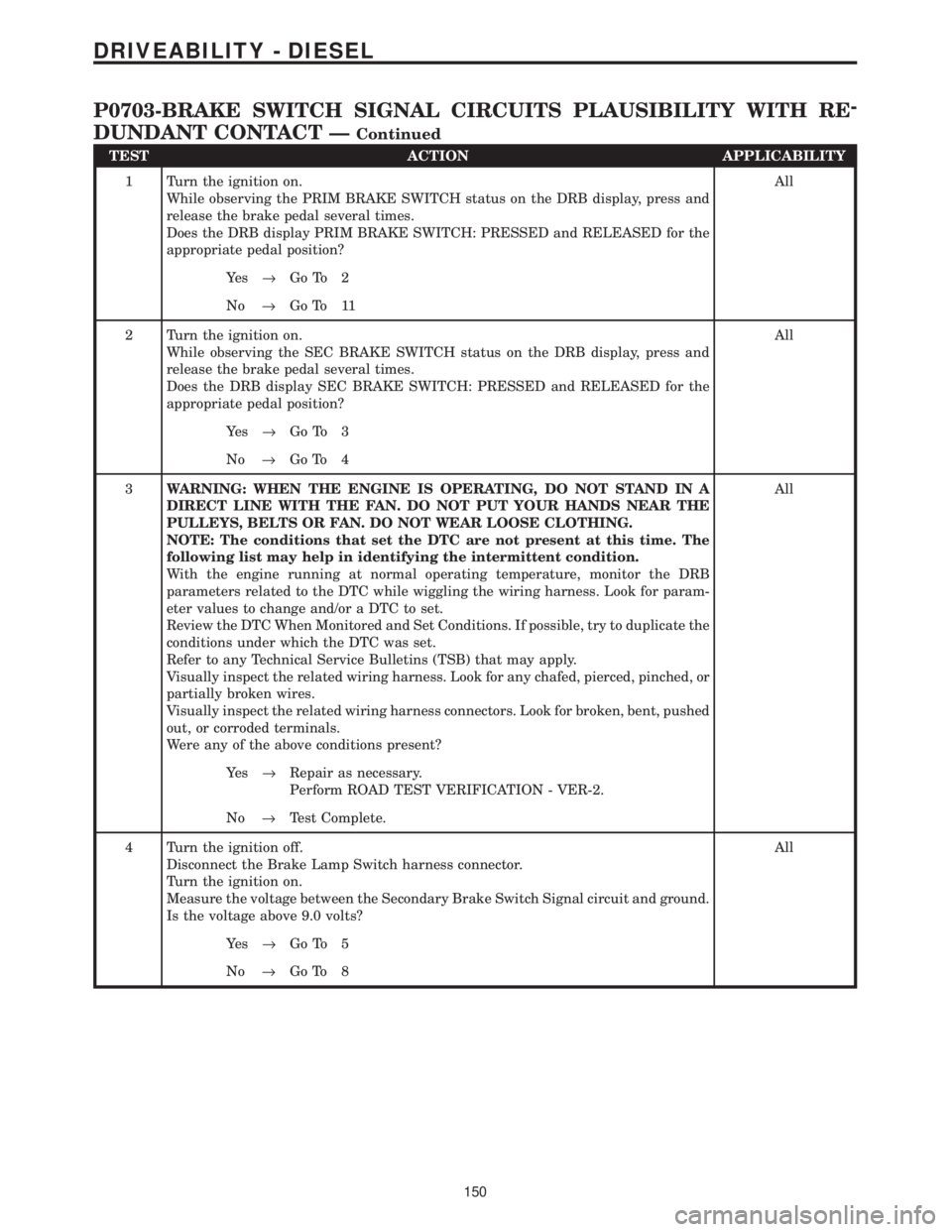
TEST ACTION APPLICABILITY
1 Turn the ignition on.
While observing the PRIM BRAKE SWITCH status on the DRB display, press and
release the brake pedal several times.
Does the DRB display PRIM BRAKE SWITCH: PRESSED and RELEASED for the
appropriate pedal position?All
Ye s®Go To 2
No®Go To 11
2 Turn the ignition on.
While observing the SEC BRAKE SWITCH status on the DRB display, press and
release the brake pedal several times.
Does the DRB display SEC BRAKE SWITCH: PRESSED and RELEASED for the
appropriate pedal position?All
Ye s®Go To 3
No®Go To 4
3WARNING: WHEN THE ENGINE IS OPERATING, DO NOT STAND IN A
DIRECT LINE WITH THE FAN. DO NOT PUT YOUR HANDS NEAR THE
PULLEYS, BELTS OR FAN. DO NOT WEAR LOOSE CLOTHING.
NOTE: The conditions that set the DTC are not present at this time. The
following list may help in identifying the intermittent condition.
With the engine running at normal operating temperature, monitor the DRB
parameters related to the DTC while wiggling the wiring harness. Look for param-
eter values to change and/or a DTC to set.
Review the DTC When Monitored and Set Conditions. If possible, try to duplicate the
conditions under which the DTC was set.
Refer to any Technical Service Bulletins (TSB) that may apply.
Visually inspect the related wiring harness. Look for any chafed, pierced, pinched, or
partially broken wires.
Visually inspect the related wiring harness connectors. Look for broken, bent, pushed
out, or corroded terminals.
Were any of the above conditions present?All
Ye s®Repair as necessary.
Perform ROAD TEST VERIFICATION - VER-2.
No®Test Complete.
4 Turn the ignition off.
Disconnect the Brake Lamp Switch harness connector.
Turn the ignition on.
Measure the voltage between the Secondary Brake Switch Signal circuit and ground.
Is the voltage above 9.0 volts?All
Ye s®Go To 5
No®Go To 8
150
DRIVEABILITY - DIESEL
P0703-BRAKE SWITCH SIGNAL CIRCUITS PLAUSIBILITY WITH RE-
DUNDANT CONTACT Ð
Continued
Page 1370 of 4284
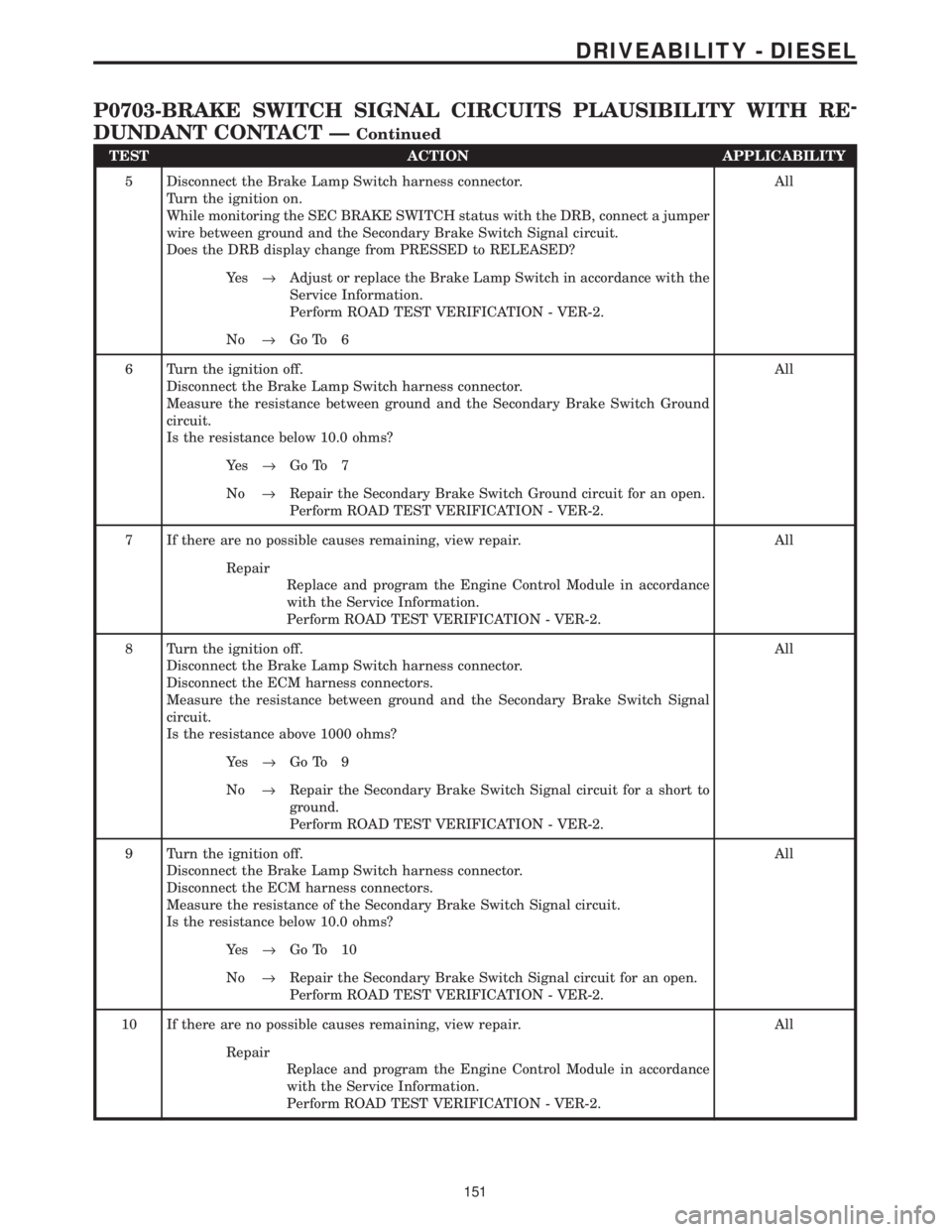
TEST ACTION APPLICABILITY
5 Disconnect the Brake Lamp Switch harness connector.
Turn the ignition on.
While monitoring the SEC BRAKE SWITCH status with the DRB, connect a jumper
wire between ground and the Secondary Brake Switch Signal circuit.
Does the DRB display change from PRESSED to RELEASED?All
Ye s®Adjust or replace the Brake Lamp Switch in accordance with the
Service Information.
Perform ROAD TEST VERIFICATION - VER-2.
No®Go To 6
6 Turn the ignition off.
Disconnect the Brake Lamp Switch harness connector.
Measure the resistance between ground and the Secondary Brake Switch Ground
circuit.
Is the resistance below 10.0 ohms?All
Ye s®Go To 7
No®Repair the Secondary Brake Switch Ground circuit for an open.
Perform ROAD TEST VERIFICATION - VER-2.
7 If there are no possible causes remaining, view repair. All
Repair
Replace and program the Engine Control Module in accordance
with the Service Information.
Perform ROAD TEST VERIFICATION - VER-2.
8 Turn the ignition off.
Disconnect the Brake Lamp Switch harness connector.
Disconnect the ECM harness connectors.
Measure the resistance between ground and the Secondary Brake Switch Signal
circuit.
Is the resistance above 1000 ohms?All
Ye s®Go To 9
No®Repair the Secondary Brake Switch Signal circuit for a short to
ground.
Perform ROAD TEST VERIFICATION - VER-2.
9 Turn the ignition off.
Disconnect the Brake Lamp Switch harness connector.
Disconnect the ECM harness connectors.
Measure the resistance of the Secondary Brake Switch Signal circuit.
Is the resistance below 10.0 ohms?All
Ye s®Go To 10
No®Repair the Secondary Brake Switch Signal circuit for an open.
Perform ROAD TEST VERIFICATION - VER-2.
10 If there are no possible causes remaining, view repair. All
Repair
Replace and program the Engine Control Module in accordance
with the Service Information.
Perform ROAD TEST VERIFICATION - VER-2.
151
DRIVEABILITY - DIESEL
P0703-BRAKE SWITCH SIGNAL CIRCUITS PLAUSIBILITY WITH RE-
DUNDANT CONTACT Ð
Continued