Page 359 of 460
6-8
When you put the cap back on, turn it to the right
(clockwise) until you hear a clicking sound. Make sure
you fully install the cap. The diagnostic system can
determine if the fuel cap has been left off or improperly
installed. This would allow fuel to evaporate into the
atmosphere. See ªMalfunction Indicator Lampº in
the Index.
The malfunction indicator lamp (SERVICE ENGINE
SOON or CHECK ENGINE light) will come on if the
fuel cap is not properly reinstalled.
NOTICE:
If you need a new cap, be sure to get the right
type. Your dealer can get one for you. If you get
the wrong type, it may not fit properly. This may
cause your malfunction indicator lamp to light
and your fuel tank and emissions system may be
damaged. See ªMalfunction Indicator Lampº in
the Index.
Filling a Portable Fuel Container
CAUTION:
Never fill a portable fuel container while it is in
your vehicle. Static electricity discharge from the
container can ignite the gasoline vapor. You can
be badly burned and your vehicle damaged if this
occurs. To help avoid injury to you and others:
�Dispense gasoline only into
approved containers.
�Do not fill a container while it is inside a
vehicle, in a vehicle's trunk, pickup bed or
on any surface other than the ground.
�Bring the fill nozzle in contact with the
inside of the fill opening before operating
the nozzle. Contact should be maintained
until the filling is complete.
�Don't smoke while pumping gasoline.
Page 388 of 460
6-37
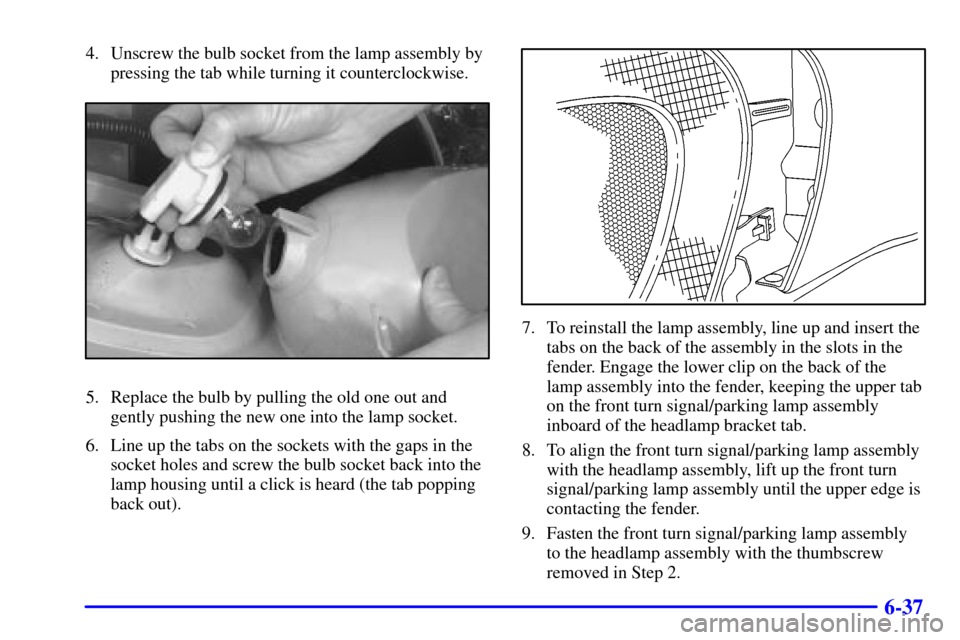
4. Unscrew the bulb socket from the lamp assembly by
pressing the tab while turning it counterclockwise.
5. Replace the bulb by pulling the old one out and
gently pushing the new one into the lamp socket.
6. Line up the tabs on the sockets with the gaps in the
socket holes and screw the bulb socket back into the
lamp housing until a click is heard (the tab popping
back out).
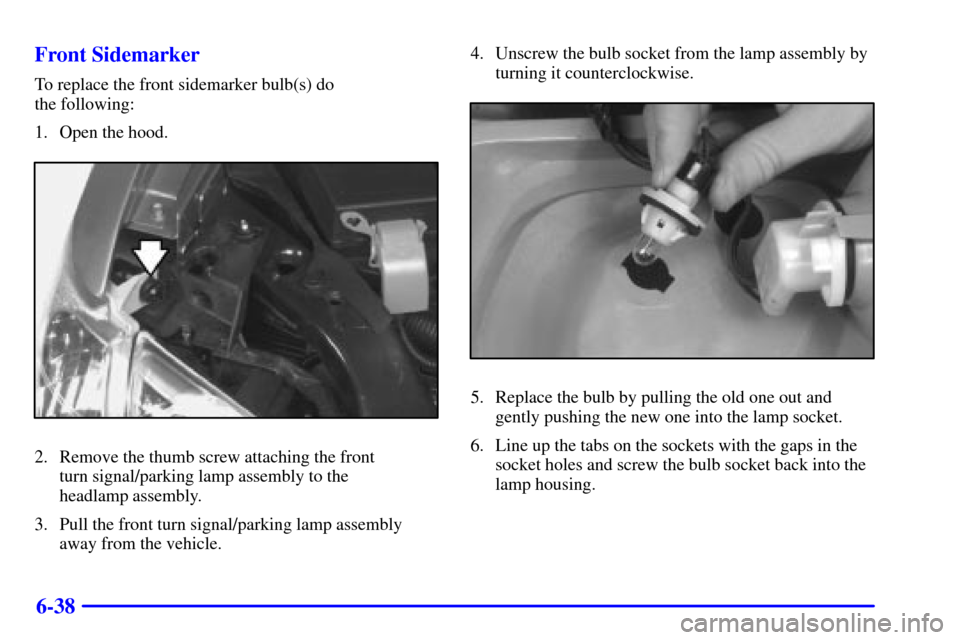
7. To reinstall the lamp assembly, line up and insert the
tabs on the back of the assembly in the slots in the
fender. Engage the lower clip on the back of the
lamp assembly into the fender, keeping the upper tab
on the front turn signal/parking lamp assembly
inboard of the headlamp bracket tab.
8. To align the front turn signal/parking lamp assembly
with the headlamp assembly, lift up the front turn
signal/parking lamp assembly until the upper edge is
contacting the fender.
9. Fasten the front turn signal/parking lamp assembly
to the headlamp assembly with the thumbscrew
removed in Step 2.
Page 389 of 460
6-38 Front Sidemarker
To replace the front sidemarker bulb(s) do
the following:
1. Open the hood.
2. Remove the thumb screw attaching the front
turn signal/parking lamp assembly to the
headlamp assembly.
3. Pull the front turn signal/parking lamp assembly
away from the vehicle.4. Unscrew the bulb socket from the lamp assembly by
turning it counterclockwise.
5. Replace the bulb by pulling the old one out and
gently pushing the new one into the lamp socket.
6. Line up the tabs on the sockets with the gaps in the
socket holes and screw the bulb socket back into the
lamp housing.
Page 413 of 460
6-62 Fuses and Circuit Breakers
The wiring circuits in your vehicle are protected from
short circuits by a combination of fuses, circuit breakers
and fusible thermal links.
Look at the silver
-colored band inside the fuse. If the
band is broken or melted, replace the fuse. Be sure you
replace a bad fuse with a new one of the identical size
and rating.
If you ever have a problem on the road and don't have a
spare fuse, you can borrow one that has the same
amperage or use one of the spare fuses in the underhood
fuse and relay center. Just pick some feature of your
vehicle that you can get along without
-- like the radio
or cigarette lighter
-- and use its fuse, if it is the right
amperage. Replace it as soon as you can.
There are two fuse blocks in your vehicle: the
instrument panel fuse block and the underhood fuse and
relay center.Instrument Panel Fuse Block
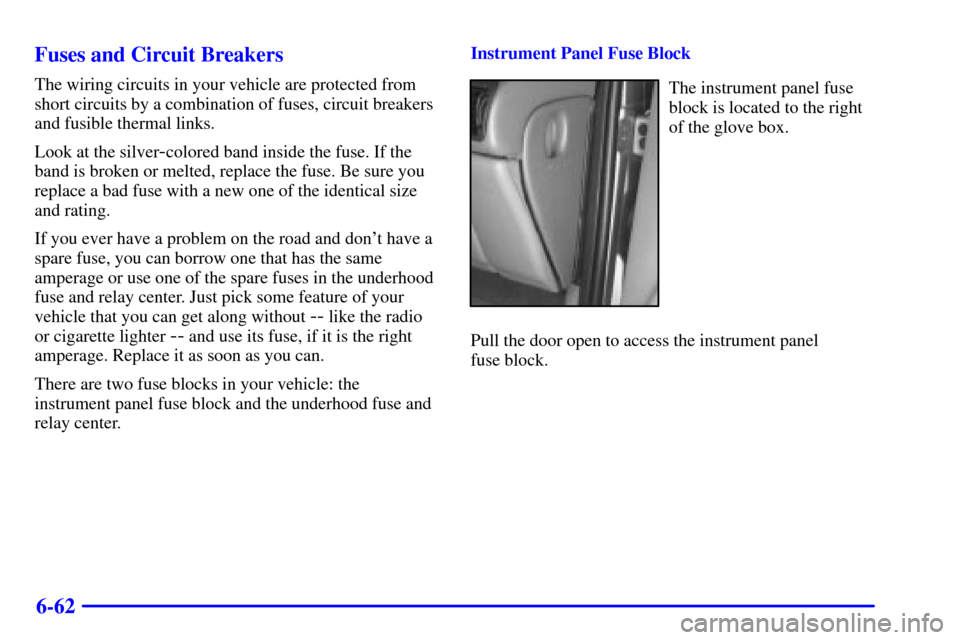
The instrument panel fuse
block is located to the right
of the glove box.
Pull the door open to access the instrument panel
fuse block.
Page 416 of 460
6-65
Fuses Usage
43 Not Used
44 Retained Accessory Power
(RAP) Relay
45 Not Used
46 Air Inlet Actuator, DIC Display,
DRL Control Module, Heater
-A/C
Control, Temperature Door
Actuator (Front) and Rear
Window Defogger Relay
47 BCM Programming
48 Not Used
49 Not Used
50 IGN MAIN Relay and PCM,
Electronic Break Control ModuleUnderhood Fuse and Relay Center
This fuse and relay center is
located in the engine
compartment, in front of the
windshield washer fluid
reservoir. See ªEngine
Compartment Overviewº in
the Index for more
information on location.
The fuses marked spare are available if a replacement
fuse is needed.
To remove the cover, turn the knob counterclockwise
and lift up. Remove the cover.
When finished, put the cover back on and turn the knob
clockwise. Make sure that the remote positive (+)
terminal cover is on correctly.
Page 417 of 460
6-66
Maxi Fuse Usage
1 COOL FAN 2 Coolant Fans
2 Not Used
3 HEADLAMPS Circuit Breakers: FRT HVAC HI
BLWR, and HEADLAMP Fuses
(Instrument Panel): HAZARD
and STOPLAMP
4 BATT MAIN 2 Circuit Breaker: PWR SEAT/PSD.
Fuses (Instrument Panel): ELC
and RR DEFOGMaxi Fuse Usage
5 IGN MAIN 1 Ignition Switch to Fuses
(Instrument Panel): ABS/TCS
IGN, CRUISE, DRL, ELEC
PRNDL, IGN 1, PSD, SIR, T/SIG
and PCM [IGN MAIN Relay
(Underhood Electrical Center
Fuses: A/C CLU, ELEK IGN,
IGN 1
-U/H, INJ, TCC)]
6 COOL FAN 1 Coolant Fans
7 BATT MAIN 1 Fuses (Instrument Panel): ABS
MOD BATT, CIGAR/DLC, CTSY
LAMP, FRT PWR SCKT, PWR
LOCK, PWR MIRROR and RR
PWR SCKT
8 IGN MAIN 2 Ignition Switch to Fuses (I/P):
BCM PRGRM, FRT HVAC
LOW/MED BLWR, FRT
WPR/WSHR, HVAC/DRL,
MALL/RADIO/DIC, PWR QRT
VENT, RR HVAC, RR
WPR/WSHR, SWC ACCY and
PWR WDO Circuit Breaker
Page 418 of 460
6-67
Mini Relays Usage
9 COOL FAN RH FAN 1, LH FAN 2
10 COOL FAN 2 LH FAN 2
11 IGN MAIN FUSES: A/C CLU, IGN 1
-U/H,
INS, ELEK IGN, TCC
12 COOL FAN 1 RH FAN 1, LH FAN 2
Micro Relays Usage
13 A/C CLU A/C Clutch
14 FUEL PUMP Fuel Pump
15 Not Used
16 HORN Horn
17 FOG LAMP LH Fog Lamp, RH Fog Lamp,
Fog Lamp Indicator
Mini Fuse Usage
18 INJ Fuel Injectors 1
-6
19 SPARE Not Used
20 SPARE Not UsedMini Fuse Usage
21 IGN1
-UH Evaporative Emissions (EVAP)
Canister Purge Valve, Heated
Oxygen Sensors 1 and 2, Mass Air
Flow (MAF) Sensor
22 SPARE Not Used
23 SPARE Not Used
24 SPARE Not Used
25 ELEK IGN Ignition Control Module (ICM)
26 SPARE Not Used
27 B/U LAMP Transaxle Range Switch to
Back
-up Lamps
28 A/C CLU A/C CLU Relay to A/C
Compressor Clutch Oil
29 RADIO Driver Information Display,
Heater A/C Control, Radio, Rear
Side Door Actuator Control
Motor, Remote Control Door Lock
Receiver (RCDLR), Security
Indicator Lamp and
Theft
-Deterrent Shock Sensor
Page 438 of 460
7-17 At Least Once a Year
Key Lock Cylinders Service
Lubricate the key lock cylinders with the lubricant
specified in Part D.
Body Lubrication Service
Lubricate all key lock cylinders, hood latch assemblies,
secondary latches, pivots, spring anchor and release
pawl, hood and door hinges, rear folding seats, fuel
door hinge, liftgate hinges, power sliding door cable
and sliding door track(s). Part D tells you what to use.
More frequent lubrication may be required when
exposed to a corrosive environment.Starter Switch Check
CAUTION:
When you are doing this check, the vehicle could
move suddenly. If it does, you or others could be
injured. Follow the steps below.
1. Before you start, be sure you have enough room
around the vehicle.
2. Firmly apply both the parking brake and the regular
brake. See ªParking Brakeº in the Index if necessary.
NOTE: Do not use the accelerator pedal, and be
ready to turn off the engine immediately if it starts.
3. Try to start the engine in each gear. The starter
should work only in PARK (P) or NEUTRAL (N).
If the starter works in any other position, your
vehicle needs service.