Page 314 of 460
4-36 Safety Chains
You should always attach chains between your vehicle
and your trailer. Cross the safety chains under the
tongue of the trailer to help prevent the tongue from
contacting the road if it becomes separated from the
hitch. Instructions about safety chains may be provided
by the hitch manufacturer or by the trailer manufacturer.
Follow the manufacturer's recommendation for attaching
safety chains and do not attach them to the bumper.
Always leave just enough slack so you can turn with
your rig. Never allow safety chains to drag on the ground.
Trailer Brakes
If your trailer weighs more than 1,000 lbs. (450 kg)
loaded, then it needs its own brakes
-- and they must
be adequate. Be sure to read and follow the instructions
for the trailer brakes so you'll be able to install, adjust
and maintain them properly.
Because you have anti
-lock brakes, do not try to tap
into your vehicle's brake system. If you do, both brake
systems won't work well, or at all.
Driving with a Trailer
CAUTION:
If you have a rear-most window open and you
pull a trailer with your vehicle, carbon monoxide
(CO) could come into your vehicle. You can't
see or smell CO. It can cause unconsciousness
or death. See ªEngine Exhaustº in the Index.
To maximize your safety when towing a trailer:
�Have your exhaust system inspected for
leaks, and make necessary repairs before
starting on your trip.
�Keep the rear
-most windows closed.
�If exhaust does come into your vehicle
through a window in the rear or another
opening, drive with your front, main
heating or cooling system on and with the
fan on any speed. This will bring fresh,
outside air into your vehicle. Do not use
RECIRCULATION because it only
recirculates the air inside your vehicle.
See ªComfort Controlsº in the Index.
Page 334 of 460
5-17 How to Add Coolant to the Radiator
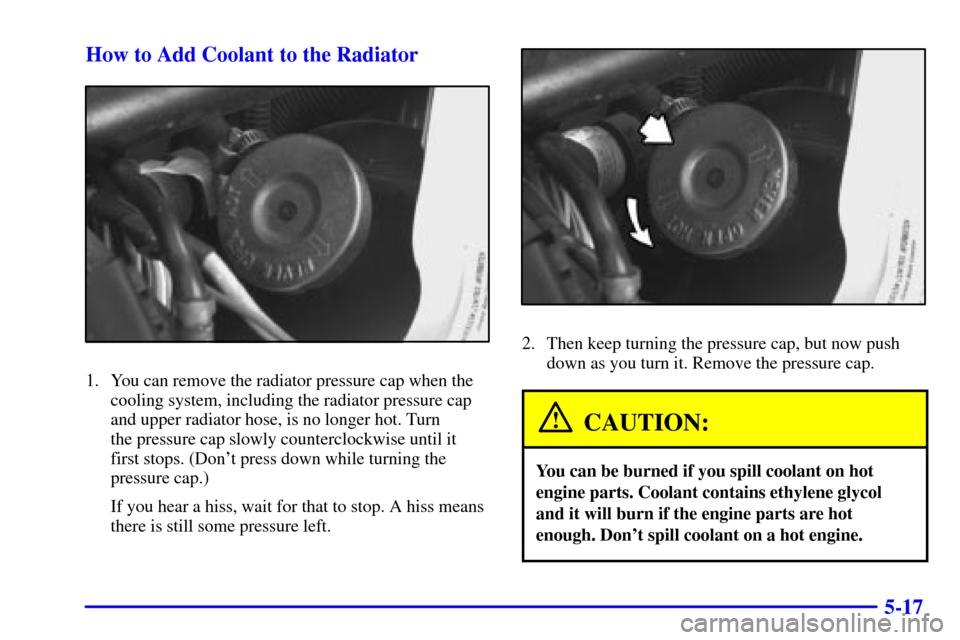
1. You can remove the radiator pressure cap when the
cooling system, including the radiator pressure cap
and upper radiator hose, is no longer hot. Turn
the pressure cap slowly counterclockwise until it
first stops. (Don't press down while turning the
pressure cap.)
If you hear a hiss, wait for that to stop. A hiss means
there is still some pressure left.
2. Then keep turning the pressure cap, but now push
down as you turn it. Remove the pressure cap.
CAUTION:
You can be burned if you spill coolant on hot
engine parts. Coolant contains ethylene glycol
and it will burn if the engine parts are hot
enough. Don't spill coolant on a hot engine.
Page 338 of 460
5-21
Changing a Flat Tire
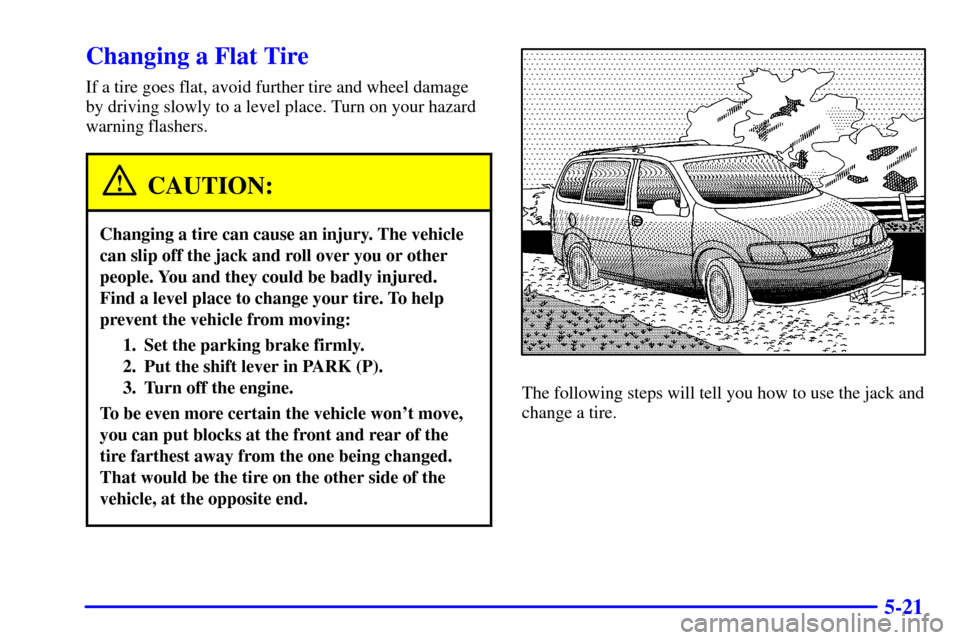
If a tire goes flat, avoid further tire and wheel damage
by driving slowly to a level place. Turn on your hazard
warning flashers.
CAUTION:
Changing a tire can cause an injury. The vehicle
can slip off the jack and roll over you or other
people. You and they could be badly injured.
Find a level place to change your tire. To help
prevent the vehicle from moving:
1. Set the parking brake firmly.
2. Put the shift lever in PARK (P).
3. Turn off the engine.
To be even more certain the vehicle won't move,
you can put blocks at the front and rear of the
tire farthest away from the one being changed.
That would be the tire on the other side of the
vehicle, at the opposite end.
The following steps will tell you how to use the jack and
change a tire.
Page 340 of 460
5-23
A. Hoist Shaft
B. Hoist Assembly
C. Retainer
D. Spare TireE. Extension
(Chisel End)
F. Folding WrenchThe compact spare tire is located under the vehicle,
ahead of the rear bumper. (See ªCompact Spare Tireº
later in this section for more information about the
compact spare.) Attach the folding wrench to the
extension and insert the chisel end on an angle through
the hole in the rear bumper and into the hoist shaft.
Then, turn the folding wrench counterclockwise to
lower the spare tire to the ground. Continue to turn
the wrench so the spare tire can be pulled out from
under the vehicle.
Page 343 of 460
5-26
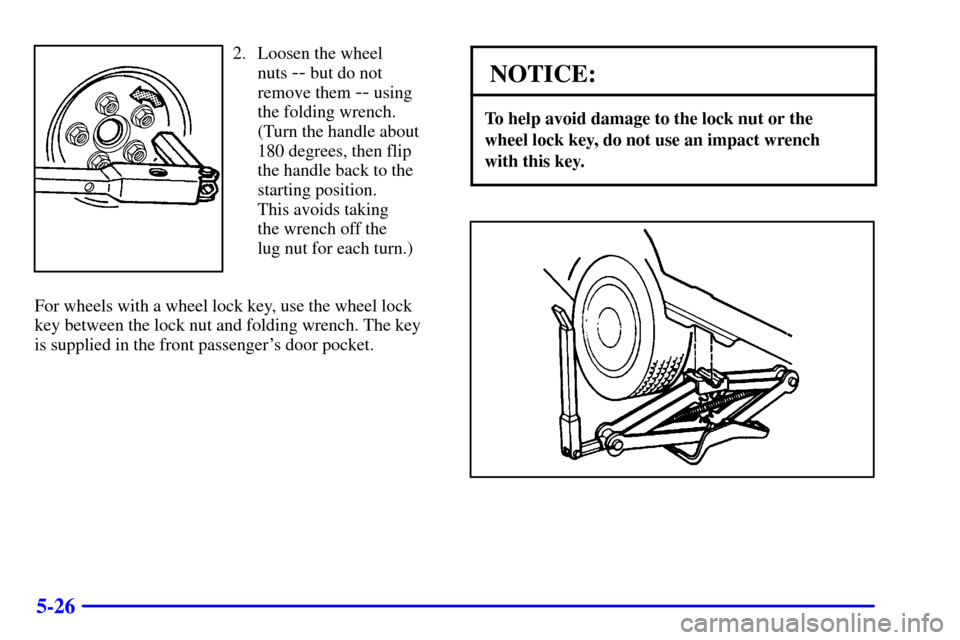
2. Loosen the wheel
nuts
-- but do not
remove them
-- using
the folding wrench.
(Turn the handle about
180 degrees, then flip
the handle back to the
starting position.
This avoids taking
the wrench off the
lug nut for each turn.)
For wheels with a wheel lock key, use the wheel lock
key between the lock nut and folding wrench. The key
is supplied in the front passenger's door pocket.NOTICE:
To help avoid damage to the lock nut or the
wheel lock key, do not use an impact wrench
with this key.
Page 345 of 460
5-28
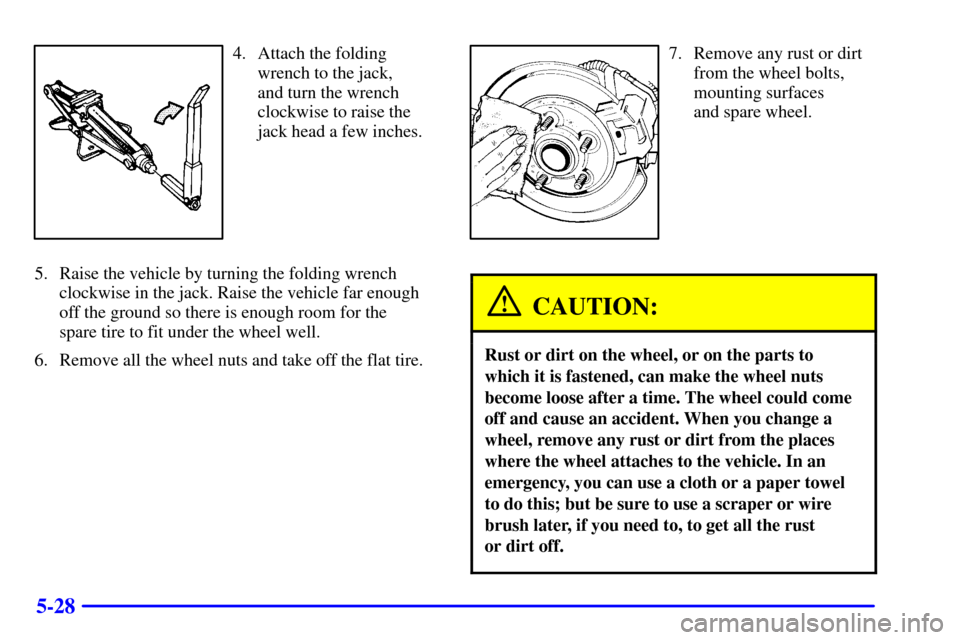
4. Attach the folding
wrench to the jack,
and turn the wrench
clockwise to raise the
jack head a few inches.
5. Raise the vehicle by turning the folding wrench
clockwise in the jack. Raise the vehicle far enough
off the ground so there is enough room for the
spare tire to fit under the wheel well.
6. Remove all the wheel nuts and take off the flat tire.7. Remove any rust or dirt
from the wheel bolts,
mounting surfaces
and spare wheel.
CAUTION:
Rust or dirt on the wheel, or on the parts to
which it is fastened, can make the wheel nuts
become loose after a time. The wheel could come
off and cause an accident. When you change a
wheel, remove any rust or dirt from the places
where the wheel attaches to the vehicle. In an
emergency, you can use a cloth or a paper towel
to do this; but be sure to use a scraper or wire
brush later, if you need to, to get all the rust
or dirt off.
Page 346 of 460
5-29
CAUTION:
Never use oil or grease on studs or nuts. If you
do, the nuts might come loose. Your wheel could
fall off, causing a serious accident.
8. Install the spare tire and put the wheel nuts back on
with the rounded end of the nuts toward the wheel.
Tighten each nut by hand until the wheel is held
against the hub.
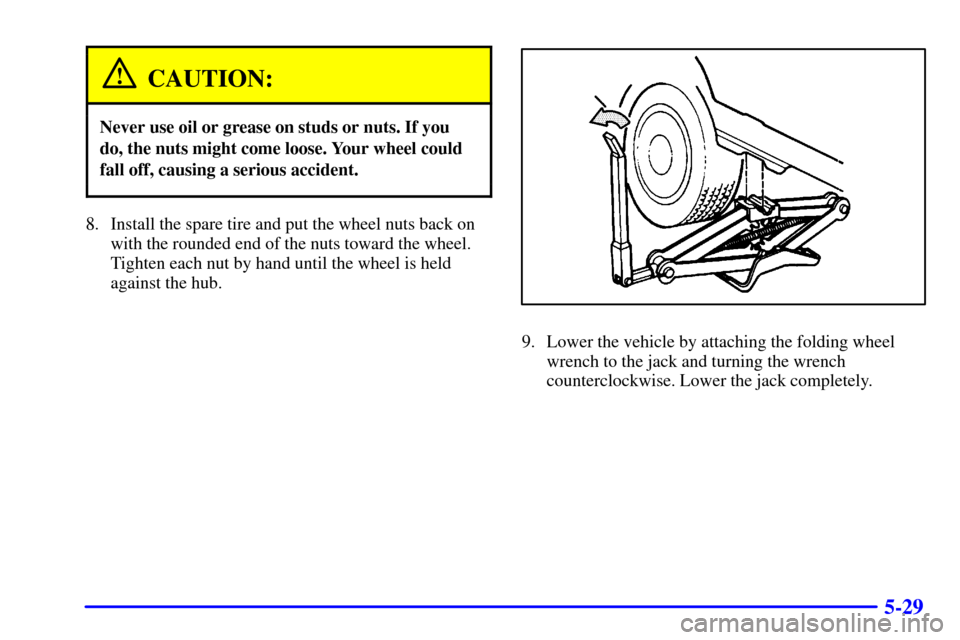
9. Lower the vehicle by attaching the folding wheel
wrench to the jack and turning the wrench
counterclockwise. Lower the jack completely.
Page 358 of 460
6-7
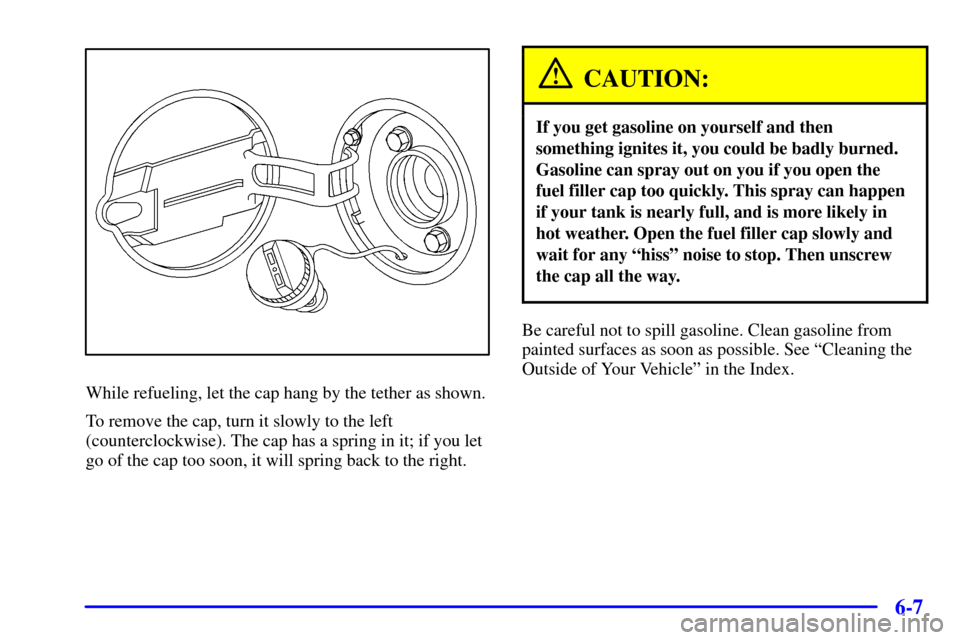
While refueling, let the cap hang by the tether as shown.
To remove the cap, turn it slowly to the left
(counterclockwise). The cap has a spring in it; if you let
go of the cap too soon, it will spring back to the right.
CAUTION:
If you get gasoline on yourself and then
something ignites it, you could be badly burned.
Gasoline can spray out on you if you open the
fuel filler cap too quickly. This spray can happen
if your tank is nearly full, and is more likely in
hot weather. Open the fuel filler cap slowly and
wait for any ªhissº noise to stop. Then unscrew
the cap all the way.
Be careful not to spill gasoline. Clean gasoline from
painted surfaces as soon as possible. See ªCleaning the
Outside of Your Vehicleº in the Index.