Page 347 of 460
5-30
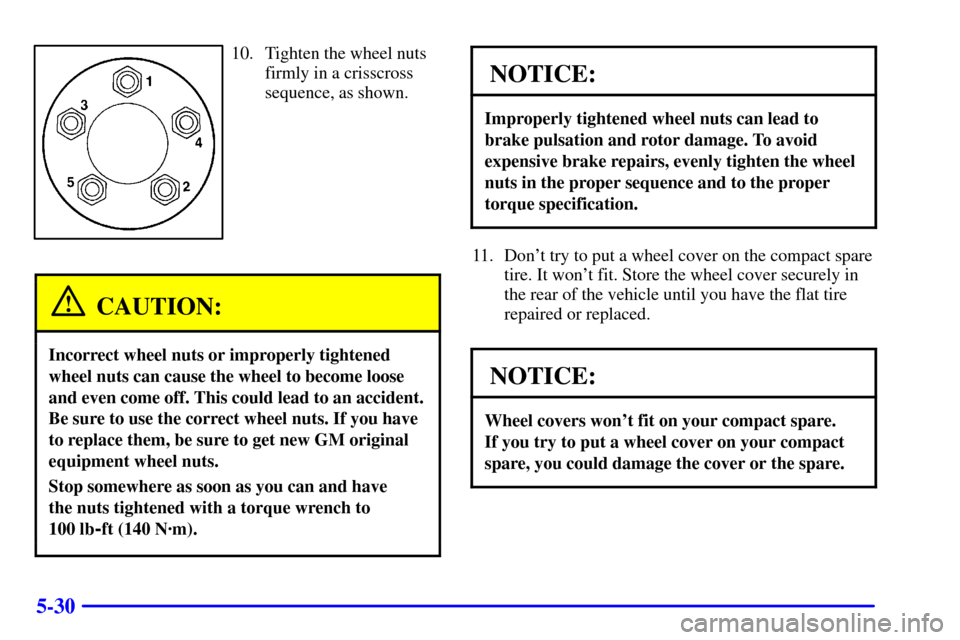
10. Tighten the wheel nuts
firmly in a crisscross
sequence, as shown.
CAUTION:
Incorrect wheel nuts or improperly tightened
wheel nuts can cause the wheel to become loose
and even come off. This could lead to an accident.
Be sure to use the correct wheel nuts. If you have
to replace them, be sure to get new GM original
equipment wheel nuts.
Stop somewhere as soon as you can and have
the nuts tightened with a torque wrench to
100 lb
-ft (140 N´m).
NOTICE:
Improperly tightened wheel nuts can lead to
brake pulsation and rotor damage. To avoid
expensive brake repairs, evenly tighten the wheel
nuts in the proper sequence and to the proper
torque specification.
11. Don't try to put a wheel cover on the compact spare
tire. It won't fit. Store the wheel cover securely in
the rear of the vehicle until you have the flat tire
repaired or replaced.
NOTICE:
Wheel covers won't fit on your compact spare.
If you try to put a wheel cover on your compact
spare, you could damage the cover or the spare.
Page 382 of 460
6-31 Brake Wear
Your vehicle has front disc brakes and rear drum brakes.
Disc brake pads have built
-in wear indicators that make
a high
-pitched warning sound when the brake pads
are worn and new pads are needed. The sound may
come and go or be heard all the time your vehicle is
moving (except when you are pushing on the brake
pedal firmly).
CAUTION:
The brake wear warning sound means that soon
your brakes won't work well. That could lead to
an accident. When you hear the brake wear
warning sound, have your vehicle serviced.
NOTICE:
Continuing to drive with worn-out brake pads
could result in costly brake repair.
Some driving conditions or climates may cause a brake
squeal when the brakes are first applied or lightly
applied. This does not mean something is wrong with
your brakes.
Properly torqued wheel nuts are necessary to help
prevent brake pulsation. When tires are rotated, inspect
brake pads for wear and evenly tighten wheel nuts in the
proper sequence to GM torque specifications.
Your rear drum brakes don't have wear indicators, but if
you ever hear a rear brake rubbing noise, have the rear
brake linings inspected immediately. Also, the rear
brake drums should be removed and inspected each time
the tires are removed for rotation or changing. When
you have the front brake pads replaced, have the rear
brakes inspected, too.
Brake linings should always be replaced as complete
axle sets.
See ªBrake System Inspectionº in Section 7 of
this manual under Part C ªPeriodic
Maintenance Inspections.º
Page 396 of 460
6-45
After the tires have been rotated, adjust the front and
rear inflation pressures as shown on the
Certification/Tire label. Make certain that all wheel nuts
are properly tightened. See ªWheel Nut Torqueº in
the Index.
CAUTION:
Rust or dirt on a wheel, or on the parts to which
it is fastened, can make wheel nuts become loose
after a time. The wheel could come off and cause
an accident. When you change a wheel, remove
any rust or dirt from places where the wheel
attaches to the vehicle. In an emergency, you can
use a cloth or a paper towel to do this; but be
sure to use a scraper or wire brush later, if you
need to, to get all the rust or dirt off. See
ªChanging a Flat Tireº in the Index.
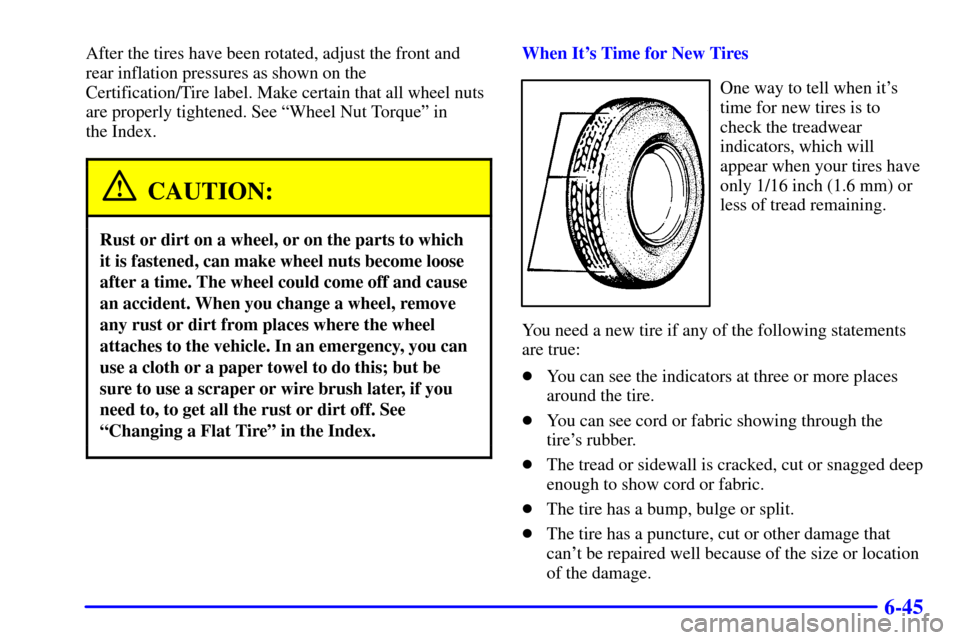
When It's Time for New Tires
One way to tell when it's
time for new tires is to
check the treadwear
indicators, which will
appear when your tires have
only 1/16 inch (1.6 mm) or
less of tread remaining.
You need a new tire if any of the following statements
are true:
�You can see the indicators at three or more places
around the tire.
�You can see cord or fabric showing through the
tire's rubber.
�The tread or sidewall is cracked, cut or snagged deep
enough to show cord or fabric.
�The tire has a bump, bulge or split.
�The tire has a puncture, cut or other damage that
can't be repaired well because of the size or location
of the damage.
Page 420 of 460

6-69
Replacement Bulbs
Headlamps 9004-HBI . . . . . . . . . . . . . . . . . . . . . . . . .
Front Turn Signal/
Parking Lamps 3157NA or 3157 NAK. . . . . . . . . .
Front Sidemarker Lamps 194. . . . . . . . . . . . . . . . . . .
Stop/Taillamps (Top) 3057. . . . . . . . . . . . . . . . . . . . .
Signal Lamps (2nd from Top) 3156. . . . . . . . . . . . . .
Back
-up Lamps (3rd from Top) 3156. . . . . . . . . . . . .
Taillamps (Bottom) 3057. . . . . . . . . . . . . . . . . . . . . .
Capacities and Specifications
The following approximate capacities are given in
English and metric conversions.
Please refer to ªRecommended Fluids and Lubricantsº
in the Index for more information.
Automatic Transaxle
Pan Removal and Replacement 7.4 quarts (7.0 L). . .
Complete Overhaul 10.0 quarts (9.5 L). . . . . . . . . . .
Cooling System
With A/C 9.6 quarts (9.1 L). . . . . . . . . . . . . . . . . . . .
With Rear Climate Control 11.9 quarts (11.3 L). . . . .
Engine Crankcase
- Oil and
Filter Change4.5 quarts (4.25 L) . . . . . . . . . . . . . . Fuel Capacity
Standard/Regular 20.0 U.S. gallons (75.0 L). . . . . . .
Optional/Extended 25.5 U.S. gallons (94.0 L). . . . . .
Refrigerant, Air ConditioningSee Refrigerant . . . .
Label under the hood.
Tire Pressures, SizesSee Certification/Tire label . . . .
on the rear edge of the driver's door.
Wheel Nut Torque100 lb
-ft (140 N´m) . . . . . . . . . .
Windshield
Washer Fluid1.0 U.S. gallon (0.37 L) . . . . . . . . . .
All capacities are approximate. When adding, be sure
to fill to the appropriate level, as recommended in
this manual.
Engine Specifications
Engine VIN Code E. . . . . . . . . . . . . . . . . . . . . . . . . . .
Engine Type V6. . . . . . . . . . . . . . . . . . . . . . . . . . . . . .
Firing Order 1
-2-3-4-5-6 . . . . . . . . . . . . . . . . . . . . . .
Horsepower 185. . . . . . . . . . . . . . . . . . . . . . . . . . . . .
Thermostat Temperature
Specification 195�F (91�C) . . . . . . . . . . . . . . . . . . .