2001 BMW Z8 ESP
[x] Cancel search: ESPPage 121 of 170

121n
IndexDataTechnologyRepairsCar careControlsOverview
Airbags 1 Front airbags on the driver and pas-
senger side
2 Side airbags on the driver and front
passenger sideImportant safety notices
Do not attempt to remove the gas
generators of the airbag restraint
system from the vehicle. Testing and
servicing are to be performed only by
trained technicians.
In the event of a malfunction, deactiva-
tion, or triggered actuation (as a
response to an accident) of the airbag
restraint system, consult your BMW
center for repairs or service operations.
520de021
Do not modify or tamper with either the
wiring or the individual components in
the airbag system. These include the
padded steering wheel hub, the instru-
ment panel, and the side trim panels of
the doors. Never apply adhesive mate-
rials to these components or cover or
modify them in any way. Do not remove
or dismantle the steering wheel your-
self.
To ensure compliance with applicable
safety regulations, have an BMW center
dispose of airbag generators.
Unprofessional attempts to service the
system could lead to failure in an emer-
gency or undesired airbag activation,
either of which could result in personal
injury.<
Page 122 of 170

122n
Vehicle storage
If the vehicle is to be stored for
more than three months, ensure
that the following service operations
are carried out first.<
Preparations for storageHave your BMW center perform the
following procedures:
1 Clean and apply a rust proofing agent
or other treatment to the engine,
engine compartment, undercarriage,
axles and major components in accor-
dance with approved repair proce-
dures. Wash the vehicle, clean the
interior and treat painted and
chromed parts. Clean the weather-
stripping around the hood, luggage
compartment and doors
2 Change engine oil and oil filter at
operating temperature. As an addi-
tional corrosion protection measure,
an anticorrosive agent can be added
to the engine in accordance with the
manufacturer's instructions
3 Check the coolant level and concen-
tration and top off if necessary
4 Check the fluid level of the wind-
shield washer fluid reservoir; top off
if necessary
5 Fill the fuel tank completely to
prevent the formation of condensa-
tion
6 Increase the tire inflation pressure to
51 psi (350 kPa).Before parking the vehicle1 Dry the parking brake and footbrake
by brake applications to prevent the
brake discs and drums from
corroding
2 Park the vehicle in a covered, dry,
and well-ventilated area. Place the
transmission in first gear or, if neces-
sary, chock the wheels to prevent the
vehicle from rolling. Do not engage
the parking brake
3 Remove the battery, charge it
completely and store it in a cool (but
frost-free) room
4 Remove the hardtop and store it
separately, refer to page 96
5 Close the convertible top.
During storageRecharge a battery that has been taken
out of the car every six months. If it is
not recharged, it will not be serviceable.
Every time the battery is discharged,
especially over extended periods, its
service life is reduced.Removing the vehicle from
storageRecharge the battery if the "Magic Eye"
turns black, refer to page 136.
Then have Inspection I performed by
your BMW center, including a brake
fluid replacement, if necessary. Refer to
the Service and Warranty Information
Booklet (US models) or the Warranty
and Service Guide Booklet (Canadian
models).
Page 137 of 170

137n
IndexDataTechnologyRepairsCar careControlsOverview
Battery
A highly explosive gas is
generated when the battery is
charged.
If you happen to get acid in
your eyes, rinse thoroughly for
some minutes with clear water.
Consult a physician immediately. If you
get acid spray on your skin or clothing,
rinse with plenty of water. If acid is acci-
dentally ingested, consult a physician
immediately.
In order to protect the battery
case from ultraviolet radiation,
do not place it in direct sunlight.
A discharged battery can freeze. Store
the battery in areas where temperature
remains above freezing.
Removing and installing
Do not disconnect the battery
cable when the engine is running.
Disconnecting the battery cable when
the engine is running will cause a
voltage surge which will damage the
vehicle's onboard electronics.
Do not make any modifications in the
wires to the positive terminal. If you do
so, the protective function of the safety
battery terminal is no longer ensured.
Repairs and disposal may only be
performed by specially trained
personnel.<
When removing, first disconnect the
cable to the negative terminal, then
disconnect the cable to the positive
terminal. Loosen the center adjusting
screw for the battery's retaining strap
(use the screwdriver found in the
onboard tool kit) and remove the
bracket.
When installing, first connect the cable
for the positive terminal, then the cable
for the negative terminal.
When installing, make sure that
the battery is seated properly, and
that the battery bracket is installed with
the center adjusting screw. Failure to
observe these precautions could result
in an inadequately secured battery,
which could then shift in an accident.<
Charging the battery Charge the battery in the vehicle only
when the engine is not running. Use the
connections provided in the engine
compartment (for correct connections,
refer to "Jump starting" on page 143).
Before performing any work on
the electrical system, disconnect
the cable from the negative terminal. If
you do not, short circuits can create the
risk of fire or personal injury.<
If you plan to park the vehicle for longer
than 4 weeks, disconnect the battery
from the vehicle's electrical system by
disconnecting the cable at the negative
terminal. Then recharge the battery with
an appropriate battery charger.
If you intend to store the vehicle for
longer than 12 weeks, remove the
battery, charge it and store it in a cool
and dust-free room where there is no
danger of freezing. During storage,
have the battery recharged every six
months. Also, recharge the battery
before it is reinstalled. Failure to
observe these precautions can render
the battery unsuitable for continued
use. Every time the battery is
discharged, especially over extended
periods, its service life is reduced.
Page 145 of 170

145n
IndexDataTechnologyRepairsCar careControlsOverview
Towing the vehicle
Avoid "off-center" towing. Be sure
that the tow rope is pulled tightly
when the towing vehicle begins to
move.<
The towed vehicle should always
be the lighter of the two vehicles.
If this is not the case, it is no longer
possible to control vehicle response.<
Tow-startingFor instructions on jump starting, refer
to page 143.
Never attempt to use your vehicle to
push another vehicle, since damage to
the energy-absorbing bumpers could
result.
Towing a vehicle1 Put the manual-shift gear lever in
neutral
2 Towing speed:
Max. 45 mph (70 km/h)
3 Towing distance:
Max. 95 miles (150 km)
4 Leave the ignition key in position 1
to ensure that the brake lamps, turn
signals, horn and windshield wipers
remain operative, and to prevent the
steering lock detent from engaging
5 Switch on the hazard-warning system
(comply with country-specific regula-
tions).
Find some means of identifying the
vehicle in tow, e. g. place a sign or
warning triangle in the rear window.
Make sure that the ignition key
remains in position 1 even
when the electrical system has failed
to prevent the steering lock from
engaging. The steering and brakes are
without power assist when the engine is
not running. This means that increased
effort is required for steering and
braking.<
Towing with a commercial tow
truck>Do not tow with sling-type equipment
>Use a wheel lift or flat bed equipment
>Please comply with applicable towing
laws.
Never allow passengers to ride in a
towed vehicle for any reason.<520us014
Page 148 of 170
148n
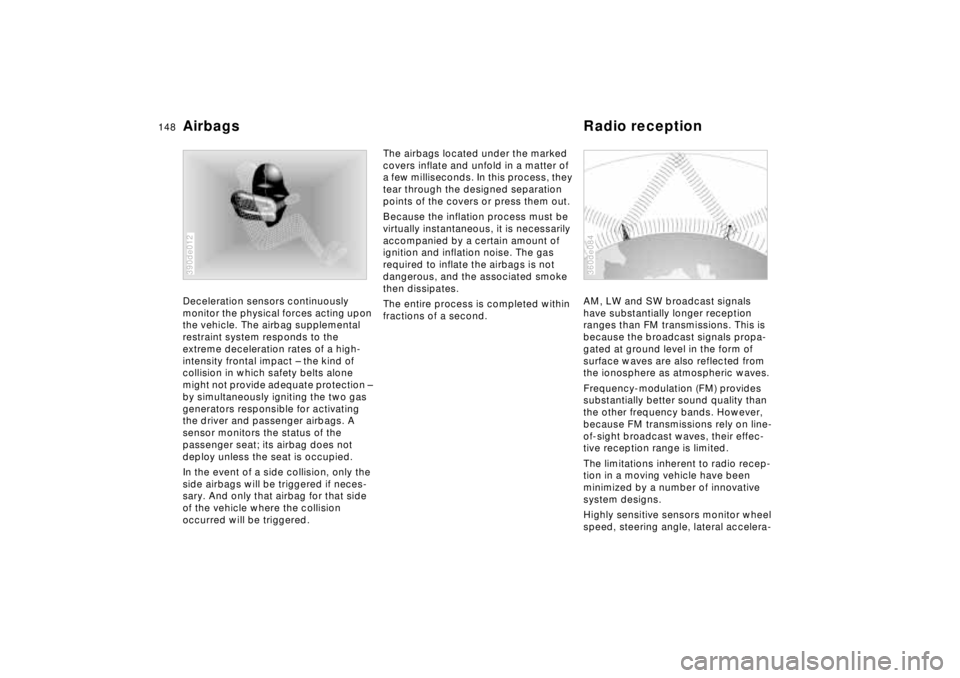
Deceleration sensors continuously
monitor the physical forces acting upon
the vehicle. The airbag supplemental
restraint system responds to the
extreme deceleration rates of a high-
intensity frontal impact Ð the kind of
collision in which safety belts alone
might not provide adequate protection Ð
by simultaneously igniting the two gas
generators responsible for activating
the driver and passenger airbags. A
sensor monitors the status of the
passenger seat; its airbag does not
deploy unless the seat is occupied.
In the event of a side collision, only the
side airbags will be triggered if neces-
sary. And only that airbag for that side
of the vehicle where the collision
occurred will be triggered.
390de012
The airbags located under the marked
covers inflate and unfold in a matter of
a few milliseconds. In this process, they
tear through the designed separation
points of the covers or press them out.
Because the inflation process must be
virtually instantaneous, it is necessarily
accompanied by a certain amount of
ignition and inflation noise. The gas
required to inflate the airbags is not
dangerous, and the associated smoke
then dissipates.
The entire process is completed within
fractions of a second.AM, LW and SW broadcast signals
have substantially longer reception
ranges than FM transmissions. This is
because the broadcast signals propa-
gated at ground level in the form of
surface waves are also reflected from
the ionosphere as atmospheric waves.
Frequency-modulation (FM) provides
substantially better sound quality than
the other frequency bands. However,
because FM transmissions rely on line-
of-sight broadcast waves, their effec-
tive reception range is limited.
The limitations inherent to radio recep-
tion in a moving vehicle have been
minimized by a number of innovative
system designs.
Highly sensitive sensors monitor wheel
speed, steering angle, lateral accelera-
360de084
Airbags Radio reception
Page 149 of 170

149n
IndexDataTechnologyRepairsCar careControlsOverview
tion, braking pressures and the
vehicle's yaw rate around its vertical
axis.
When the system detects substantial
differences in rotation rates between
wheels, it acts to inhibit uncontrolled
wheelspin by reducing the drive torque
transmitted to the affected wheel(s),
while also initiating selective braking
intervention as needed.
In addition, DSC permanently monitors
the vehicle's current operating condi-
tion and compares it with an ideal
status calculated based on sensor
signals. DSC reacts to deviations from
this ideal status such as incipient
understeer or oversteer by instanta-
neously reducing engine torque to
restore vehicle stability. This strategy
can be supplemented by selective
braking intervention, available at all four
wheels. DSC acts to prevent traction
loss and skids before the situation can
become critical.You may need some time to become
accustomed to this system's interven-
tion. However, it provides optimum
drive force and vehicle stability.
The braking intervention may be
accompanied by sounds specific to
the system.
The safety belt tensioner responds to
severe frontal collisions by tightening
the belt to ensure that occupants
remain firmly positioned in their seats.
A gas-pressure system retracts the
buckle assembly to tension the
shoulder and lap belts within fractions
of a second. This reduces the tendency
to slide under the lap belt.
520de148
Dynamic Stability Control (DSC) Safety belt tensioner
Page 151 of 170
151n
IndexDataTechnologyRepairsCar careControlsOverview
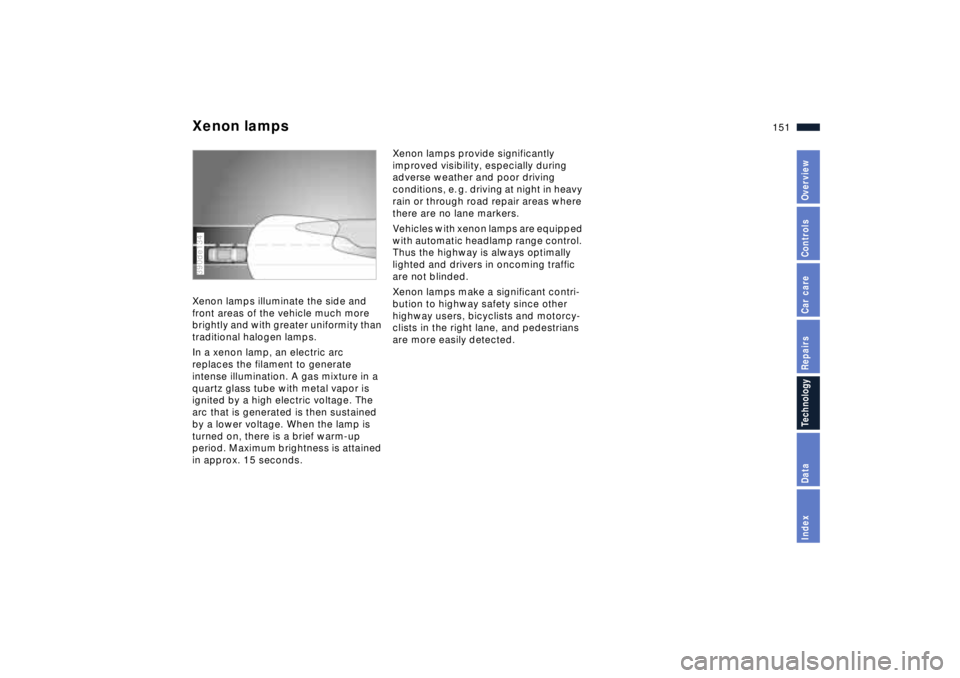
Xenon lamps Xenon lamps illuminate the side and
front areas of the vehicle much more
brightly and with greater uniformity than
traditional halogen lamps.
In a xenon lamp, an electric arc
replaces the filament to generate
intense illumination. A gas mixture in a
quartz glass tube with metal vapor is
ignited by a high electric voltage. The
arc that is generated is then sustained
by a lower voltage. When the lamp is
turned on, there is a brief warm-up
period. Maximum brightness is attained
in approx. 15 seconds.390de134
Xenon lamps provide significantly
improved visibility, especially during
adverse weather and poor driving
conditions, e. g. driving at night in heavy
rain or through road repair areas where
there are no lane markers.
Vehicles with xenon lamps are equipped
with automatic headlamp range control.
Thus the highway is always optimally
lighted and drivers in oncoming traffic
are not blinded.
Xenon lamps make a significant contri-
bution to highway safety since other
highway users, bicyclists and motorcy-
clists in the right lane, and pedestrians
are more easily detected.
Page 168 of 170
So that you will have important
specifications available when you
stop to refuel, we recommend
that you supplement this table
with data which apply to your
vehicle.
Fuel
Engine oil The oil volume between the
two marks on the oil dipstick
corresponds to approx.
1.1 US quarts (1 liter). Designation Premium Unleaded
Gasoline
AKI: minimum 91
QualityTire inflation pressures
Summer Winter
Front Rear Front Rear
2 persons
Refueling
BMW recommends Castrol