2001 BMW Z8 ESP
[x] Cancel search: ESPPage 48 of 170
48n
Mirrors Car Memory, Key MemoryInterior rearview mirror with
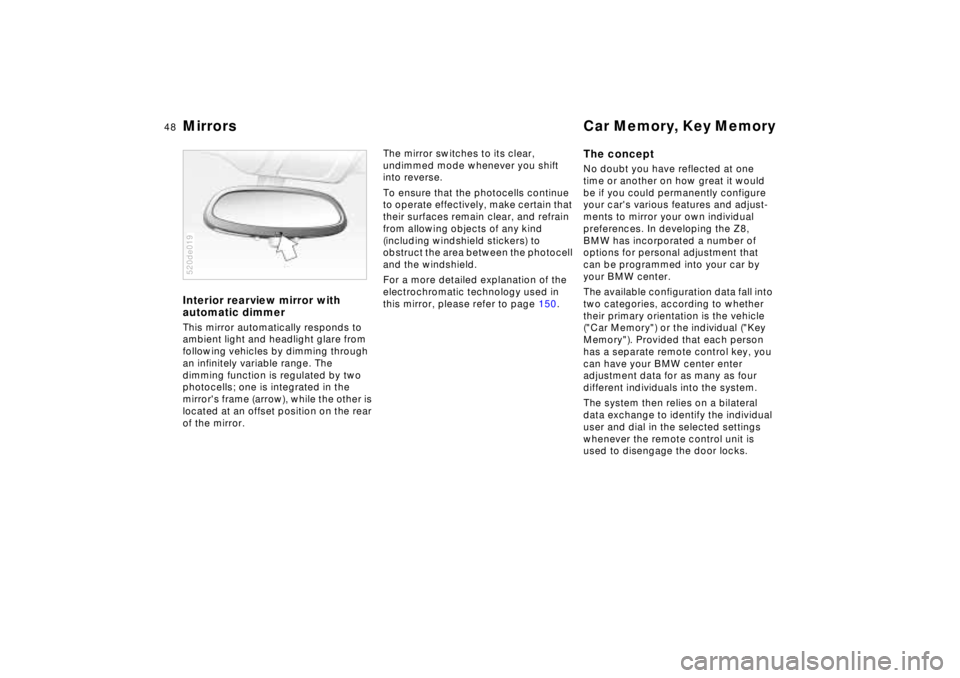
automatic dimmer This mirror automatically responds to
ambient light and headlight glare from
following vehicles by dimming through
an infinitely variable range. The
dimming function is regulated by two
photocells; one is integrated in the
mirror's frame (arrow), while the other is
located at an offset position on the rear
of the mirror. 520de019
The mirror switches to its clear,
undimmed mode whenever you shift
into reverse.
To ensure that the photocells continue
to operate effectively, make certain that
their surfaces remain clear, and refrain
from allowing objects of any kind
(including windshield stickers) to
obstruct the area between the photocell
and the windshield.
For a more detailed explanation of the
electrochromatic technology used in
this mirror, please refer to page 150.
The conceptNo doubt you have reflected at one
time or another on how great it would
be if you could permanently configure
your car's various features and adjust-
ments to mirror your own individual
preferences. In developing the Z8,
BMW has incorporated a number of
options for personal adjustment that
can be programmed into your car by
your BMW center.
The available configuration data fall into
two categories, according to whether
their primary orientation is the vehicle
("Car Memory") or the individual ("Key
Memory"). Provided that each person
has a separate remote control key, you
can have your BMW center enter
adjustment data for as many as four
different individuals into the system.
The system then relies on a bilateral
data exchange to identify the individual
user and dial in the selected settings
whenever the remote control unit is
used to disengage the door locks.
Page 51 of 170
51n
IndexDataTechnologyRepairsCar careControlsOverview
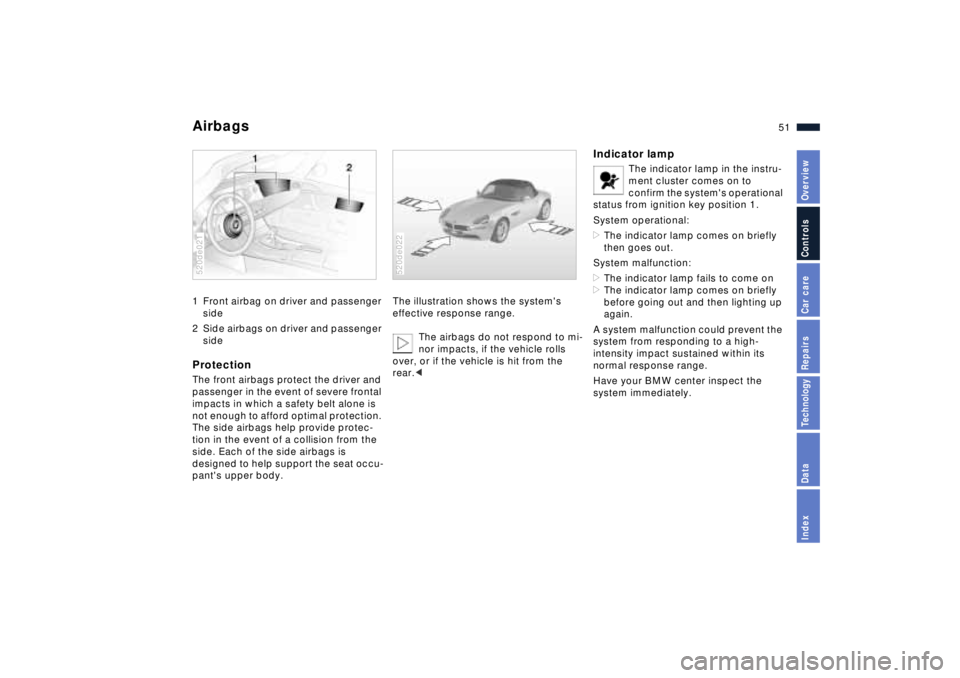
Airbags 1 Front airbag on driver and passenger
side
2 Side airbags on driver and passenger
sideProtectionThe front airbags protect the driver and
passenger in the event of severe frontal
impacts in which a safety belt alone is
not enough to afford optimal protection.
The side airbags help provide protec-
tion in the event of a collision from the
side. Each of the side airbags is
designed to help support the seat occu-
pant's upper body.520de021
The illustration shows the system's
effective response range.
The airbags do not respond to mi-
nor impacts, if the vehicle rolls
over, or if the vehicle is hit from the
rear.<520de022
Indicator lamp
The indicator lamp in the instru-
ment cluster comes on to
confirm the system's operational
status from ignition key position 1.
System operational:
>The indicator lamp comes on briefly
then goes out.
System malfunction:
>The indicator lamp fails to come on
>The indicator lamp comes on briefly
before going out and then lighting up
again.
A system malfunction could prevent the
system from responding to a high-
intensity impact sustained within its
normal response range.
Have your BMW center inspect the
system immediately.
Page 61 of 170
61n
IndexDataTechnologyRepairsCar careControlsOverview
Cruise control You can store and automatically main-
tain any desired vehicle speed above
approx. 20 mph (30 km/h).
Refrain from using the cruise
control on twisting roads, when
high traffic density prevents driving at a
constant speed, and when driving on
slippery (snow, rain, ice) or loose
(gravel, sand) road surfaces.< 520de061
Store and maintain
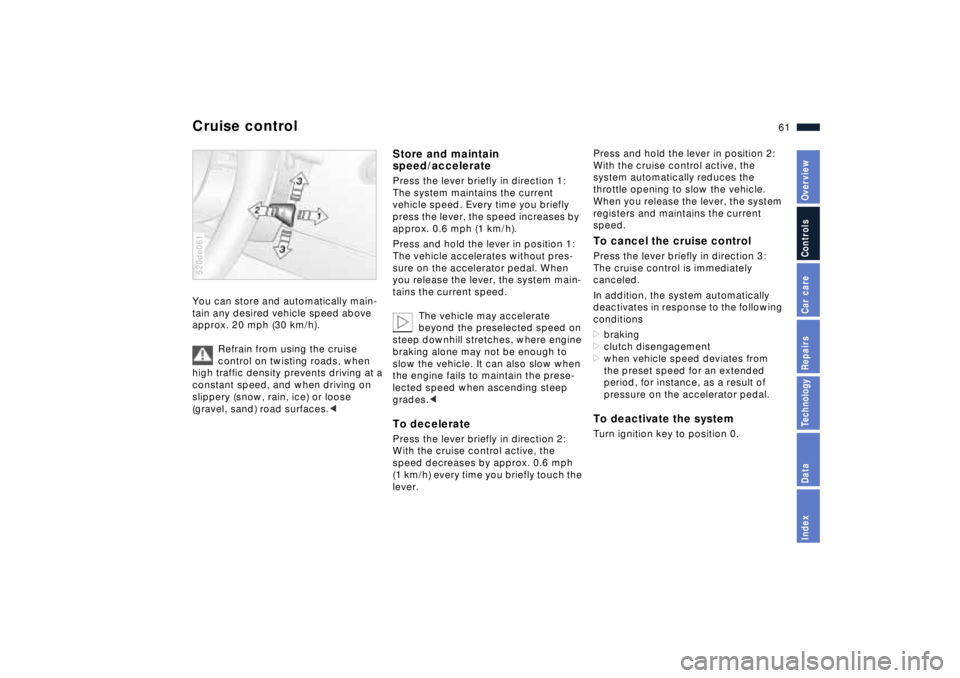
speed/acceleratePress the lever briefly in direction 1:
The system maintains the current
vehicle speed. Every time you briefly
press the lever, the speed increases by
approx. 0.6 mph (1 km/h).
Press and hold the lever in position 1:
The vehicle accelerates without pres-
sure on the accelerator pedal. When
you release the lever, the system main-
tains the current speed.
The vehicle may accelerate
beyond the preselected speed on
steep downhill stretches, where engine
braking alone may not be enough to
slow the vehicle. It can also slow when
the engine fails to maintain the prese-
lected speed when ascending steep
grades.< To deceleratePress the lever briefly in direction 2:
With the cruise control active, the
speed decreases by approx. 0.6 mph
(1 km/h) every time you briefly touch the
lever.
Press and hold the lever in position 2:
With the cruise control active, the
system automatically reduces the
throttle opening to slow the vehicle.
When you release the lever, the system
registers and maintains the current
speed.To cancel the cruise controlPress the lever briefly in direction 3:
The cruise control is immediately
canceled.
In addition, the system automatically
deactivates in response to the following
conditions
>braking
>clutch disengagement
>when vehicle speed deviates from
the preset speed for an extended
period, for instance, as a result of
pressure on the accelerator pedal. To deactivate the system Turn ignition key to position 0.
Page 63 of 170

63n
IndexDataTechnologyRepairsCar careControlsOverview
Coolant temperature gauge Service Interval Display BlueThe engine is still cold. Drive at
moderate engine and vehicle speeds.RedWhen you switch on the ignition, the
warning lamp comes on briefly to
confirm that the system is operational.
If the lamp comes on in the course of
normal vehicle operation, the engine
has overheated. Turn it off immediately
and let it cool down.520de031
Between the blue and red zonesNormal operating range. It is not
unusual for the needle to rise as far as
the edge of the red zone in response
to high outside temperatures or severe
operating conditions.
For checking coolant level, refer to
page 111.
Remaining distance before
serviceThe displays shown in the illustration
appear for a few seconds when the
ignition key is in position 1 or after the
engine is started.
The remaining distance in miles and the
next scheduled service will appear
together with the display OILSERVICE
or INSPECTION.
The computer bases its calculations
for the remaining distance on the
previous driving style.
A flashing display and a "Ð" in front of
the number indicate that service is past
due by the number of miles displayed.
Please contact your BMW center for an
appointment.520us006
Page 65 of 170

65n
IndexDataTechnologyRepairsCar careControlsOverview
The conceptDSC maintains vehicle stability even in
critical driving situations.
DSC maintains optimal, predictable re-
sponse while maximizing traction when
you accelerate from a standing start or
speed up while already underway. The
system recognizes any tendency for the
vehicle to assume an instable attitude
such as oversteer and understeer, and
counteracts this tendency with a com-
bination of graduated reductions in en-
gine torque and braking intervention at
individually selected wheels. DSC pro-
vides optimal stability Ð within the limits
defined by the laws of physics.
The system automatically assumes
operational status each time the en-
gine is started.
Indicator lamp
The indicator lamp in the in-
strument cluster goes out
shortly after you switch on the
ignition. Refer to page 22.
The indicator lamp flashes:
The system is actively regulating drive
torque.
The indicator lamp does not go out
after the engine is started, or if it comes
on during normal driving and stays on:
There is a system malfunction or the
system was deactivated with the button.
You can continue to drive the vehicle
normally, but without DSC.
Please respond to any suspected de-
fects by referring the problem to your
BMW center.
To deactivate the systemPress the button, the indicator lamp
comes on and stays on.
When the DSC is deactivated, you are
operating the vehicle in the conven-
tional drive mode.
In the following rare circumstances, it
may be effective to deactivate the DSC
for a short period of time:
>When rocking the vehicle or starting
off in deep snow or on loose surfaces.
To maintain vehicle stability,
always drive with the system
switched on when possible.<520de035
Dynamic Stability Control (DSC)
Page 66 of 170

66n
Dynamic Stability Control (DSC) Dynamic PerformanceTo reactivate the systemPress the button again; the indicator
lamp goes out.
Not even DSC can suspend the
laws of physics. Responsibility for
careless driving remains in the hands
(and feet) of the driver. Never use the
added safety afforded by DSC as an
excuse for taking unnecessary risks.
Do not make any modifications to the
DSC system. Service procedures on
the system are to be performed by
authorized technicians only.<
For additional details concerning DSC,
please refer to the chapter "Advanced
technology" on page 149.
The system reacts to current conditions
with an instantaneous recalibration. It
revises the accelerator's standard
response designed to furnish an ideal
combination of comfort and perform-
ance orientation Ð with a more perform-
ance-oriented response program. The
result is crisper, faster reaction to
throttle inputs (Sport mode).
The system resets to the standard re-
sponse mode, with its combination of
comfort and performance orientation,
each time the engine is restarted. Sport mode recognitionActivating:
In ignition position 2, press the button.
The indicator lamp will come on.
Deactivating:
Whenever the indicator lamp is on, it
will go out if you press the button again.520de057
Page 88 of 170

88n
Antilock Brake System (ABS) The concept ABS enhances active safety by helping
to prevent the wheels from locking
under braking. Why is this important?
When front wheels lock up and cease
to turn, the tires break into a slide.
Result: the driver loses the ability to
steer the vehicle. Traction loss at the
rear wheels can cause the back end of
the car to slip sideways and break away
in uncontrolled oversteer.
With ABS, you will achieve the shortest-
possible braking distances under all
given conditions (braking while driving
straight ahead or in curves, different
road surfaces).
ABS is designed to meet two essential
requirements during every brake appli-
cation:
>To help provide vehicle stability
>To help retain steering and maneu-
vering capability on all types of road
surfaces (asphalt, concrete, dirt, wet
surfaces, snow and ice).
Braking with ABSThe system is operative once the
vehicle exceeds a speed of approx.
6 mph (10 km/h). The ABS is deacti-
vated whenever the vehicle's speed
drops back below approx. 4 mph
(6 km/h). This means that the wheels
can lock only in the final phase of a
panic stop Ð a factor of no substantive
significance in actual use.
The ABS system works best in situa-
tions requiring maximum pressure on
the pedal (full braking). Since the
vehicle maintains steering responsive-
ness, you can nevertheless avoid
possible obstacles with a minimum of
steering effort.
The ABS system's closed-loop control
circuit cycles in fractions of a second.
A pulsing of the brake pedal, combined
with the sounds associated with the
hydraulic controls, tells you that the
brake system is within its maximum
limit range and reminds you that you
should adapt your vehicle's speed to
road conditions.On road surfaces that have a loose layer
on a firm base (on gravel or snow, for
instance), the braking distances with
ABS may be longer than with the wheels
locked. This also applies for driving with
snow chains. However, ABS continues
to provide enhanced vehicle stability
and steering response under these
conditions.
Page 89 of 170

89n
IndexDataTechnologyRepairsCar careControlsOverview
Antilock Brake System (ABS)Information for your safetyNot even ABS can suspend the laws
of physics. The consequences of brake
applications with inadequate clear-
ances for safety between vehicles,
excessive speed or if aquaplaning
occurs are always the responsibility of
the driver. You should never allow the
added safety of ABS to mislead you into
taking risks of any kind.
Do not make any modifications
to the ABS system.
Service procedures on ABS are to be
performed by authorized technicians
only.<
In case of a system malfunction
If the ABS warning lamp comes
on, refer to page 21. The brake
system will then function the
same as on vehicles without
ABS. However, have the brake
system checked by your BMW
center as soon as possible. To prevent
undetected defects and cumulative
faults from adversely affecting the brake
system, refer any problems to your
BMW center at the earliest opportunity.
Cornering Brake Control (CBC)CBC is an advanced ABS engineering
design. Vehicle stability is also
enhanced when braking during
cornering at a higher rate of lateral
acceleration and during lane changes.