2001 BMW Z8 ESP
[x] Cancel search: ESPPage 90 of 170

90n
Dynamic Brake Control (DBC) Disc brakesIf you step on the brake rapidly, this
system automatically produces maxi-
mum braking force boost and thus
helps to achieve the shortest possible
braking distance during "panic stops."
All of the benefits of the ABS system
are exploited under these circum-
stances.
Do not reduce the pressure on the
brake pedal during the brake applica-
tion. When the brake pedal is released,
the DBC is deactivated.
In the event of a malfunction,
the yellow brake warning lamp
comes on. Normal braking effi-
ciency and ABS are still fully
available. Have the system
checked and repaired at your
BMW center as soon as possible.
For your safetyNot even DBC can suspend the laws
of physics. The consequences of brake
applications with inadequate clear-
ances for safety between vehicles,
excessive speed or if aquaplaning
occurs are always the responsibility of
the driver. You should never allow the
added safety provided by DBC to
mislead you into taking risks of any
kind.Disc brakes furnish optimum decelera-
tion and braking control and greater
fade resistance under heavy use.
When the vehicle is driven only occa-
sionally, during extended periods when
the vehicle is not used at all, or in oper-
ating conditions where brake applica-
tions are less frequent, there is an
increased tendency for corrosion of the
rotors and accumulation of contamina-
tion on the brake pads. This occurs
because the minimal pressure which
must be exerted by the pads to clean
the rotors by brake applications is not
achieved.
If the brake rotors are corroded, they
will tend to respond to braking with a
pulsating effect that even extended
brake applications will fail to cure.
For your own safety: use only
brake pads BMW has approved
for your specific vehicle model. BMW
cannot evaluate non-approved brake
pads to determine if they are suited for
use, and therefore cannot ensure the
operating safety of the vehicle if they
are installed.<
Page 91 of 170

91n
IndexDataTechnologyRepairsCar careControlsOverview
Disc brakes Brake systemDriving notesWhen driving in heavy rain and on wet
roads it is advisable to apply light pres-
sure to the brake pedal every few miles.
Monitor traffic conditions to ensure that
this maneuver does not pose a hazard
to you or to other road users. The heat
generated in this braking process helps
dry the pads and rotors.
Maximum braking force is obtained
while the wheels are not locked, but
rather when they are still barely turning
immediately prior to locking. ABS main-
tains this state automatically. If the ABS
fails, you should revert to the staggered
braking technique (refer to page 93).
When descending steep hills and
extended grades, downshift to a gear
that will allow you to continue safely
with only a minimal amount of braking.
By minimizing the loads placed on the
brake system, this strategy helps
ensure that optimal brake system
response will remain available at all
times.
You can enhance the engine's braking
effect by engaging a lower gear, down-
shifting as far as first gear when
descending extremely steep slopes. Even if engine braking fails to slow the
vehicle sufficiently, you should still
make every effort to avoid prolonged
braking with continuous application of
low to moderate pressure at the pedal.
It is better to decelerate the vehicle by
applying a higher level of force at the
pedal (watch following traffic!) and then
subsequently pausing to allow the
brakes to cool briefly before starting on
your next braking cycle. By protecting
brake system components against
overheating, the cooling phases
afforded by this staggered, or intermit-
tent braking technique help maintain
consistent availability of optimal braking
response when it is needed.
Do not coast with the clutch
depressed, the gear-shift lever in
neutral, or, above all, with the engine
off; otherwise, the engine will provide
no braking effect if the transmission is
in neutral, and there is no braking or
steering power assist if the engine is
not running. Never allow floor mats,
carpets or any other objects to obstruct
the accelerator, clutch or brake pedals
and pose a safety hazard by reducing
their available travel range.<
Brake fluid level
The brake warning lamp comes
on with the parking brake
released:
The brake fluid level in the reser-
voir is too low, refer to page 112.
If the brake fluid level is too low
and brake pedal travel has become
noticeably longer, there may be a
defect in one of the brake system's
hydraulic circuits.
Proceed to the nearest BMW
center. Higher brake application
pressure may be necessary under these
conditions, and brake pedal travel may
be significantly longer. Please
remember to adapt your driving style
accordingly.<
Page 93 of 170

93n
IndexDataTechnologyRepairsCar careControlsOverview
Winter operationDriving on low-traction road
surfacesDo not activate the Sport mode (refer to
page 66). Use smooth, gentle pressure
to control the accelerator pedal. Avoid
excessive engine speeds and upshift
early. Downshift well in advance when
approaching uphill or downhill
grades. Maintain an adequate distance
between yourself and the vehicle
ahead.BrakesWinter road conditions substantially
reduce the amount of traction available
between the tires and the road surface.
The resulting increases in braking
distance are considerable and should
be kept in mind at all times.
ABS is intended to prevent the wheels
from locking during brake applications,
thus helping to maintain vehicle stability
and steering response.If the ABS does not respond in a critical
braking situation and the wheels lock,
reduce the pressure on the brake pedal
until the wheels just start to roll again
while still maintaining enough force to
continue braking.
Then increase the pressure, reduce the
pressure when the wheels lock, reapply
pressure etc.
This staggered braking procedure will
reduce braking distances while helping
you maintain steering control.
You can always then attempt to steer
around hazards after you have reduced
pressure on the brake pedal.
Never downshift to exploit engine
braking when driving on slippery
road surfaces, as this could lead to a
loss of traction at the rear wheels,
impairing your ability to control the
vehicle.<
Depress the clutch during hard
braking on road surfaces that
provide only poor or uneven traction.<
Skid control Depress the clutch and release the
accelerator pedal. Countersteer care-
fully and attempt to regain control of the
vehicle.ParkingEngage first or reverse gear. Depending
on the steepness of the incline, you can
apply the parking brake as well. In order
to prevent the parking brake pads from
locking due to frost or corrosion, dry
them by gently applying the parking
brake as the vehicle is coming to a stop.
Make sure that following traffic is not
endangered.
The brake lamps do not come
on when the parking brake is
engaged.<
Page 94 of 170

94n
Power steering Cellular phone Radio reception If there is a change in steering response
Ð e. g. difficult or over-responsive
steering Ð at increasing speeds, consult
a BMW center to have it checked.
If the power steering fails,
increased effort will be required to
steer the vehicle.<
Mobile communications systems
(cellular phone, radio, etc.) are
permitted with an output of up to 10
watts only. Mobile communications
devices not specifically designed for
use in your vehicle may trigger malfunc-
tions while you are operating your
vehicle. BMW can neither test nor
assume responsibility for every indi-
vidual product being offered on the
market. We recommend that you
consult your BMW center before
purchasing any device of this kind.
To ensure reliable and trouble-free
operation of your BMW, do not use any
cellular phones or other radio devices
where the antenna is located either
inside the passenger compartment or
otherwise not attached to the outside of
the vehicle.
You will find instructions for operating
your cellular phone in the supplemen-
tary Owner's Manual. The reception and sound quality
obtained from mobile radios vary
according to a variety of factors,
including the broadcast range of the
transmitter and the directional orienta-
tion of the antenna. Interference factors
such as high-tension power lines, struc-
tural or natural obstructions can all lead
to unavoidable reception interference,
regardless of how well the vehicle
sound system is operating. Climatic
factors such as intense solar radiation,
fog, rain and snow can also interfere
with reception.
Radio interference can also be caused
by either cellular phones not recom-
mended by BMW or by portable phones.
This phenomenon assumes the form of
a low-pitched hum emanating from the
speaker system.
For information on settings and opera-
tion of your radio, please refer to the
separate Owner's Manual.
Page 95 of 170
95n
IndexDataTechnologyRepairsCar careControlsOverview
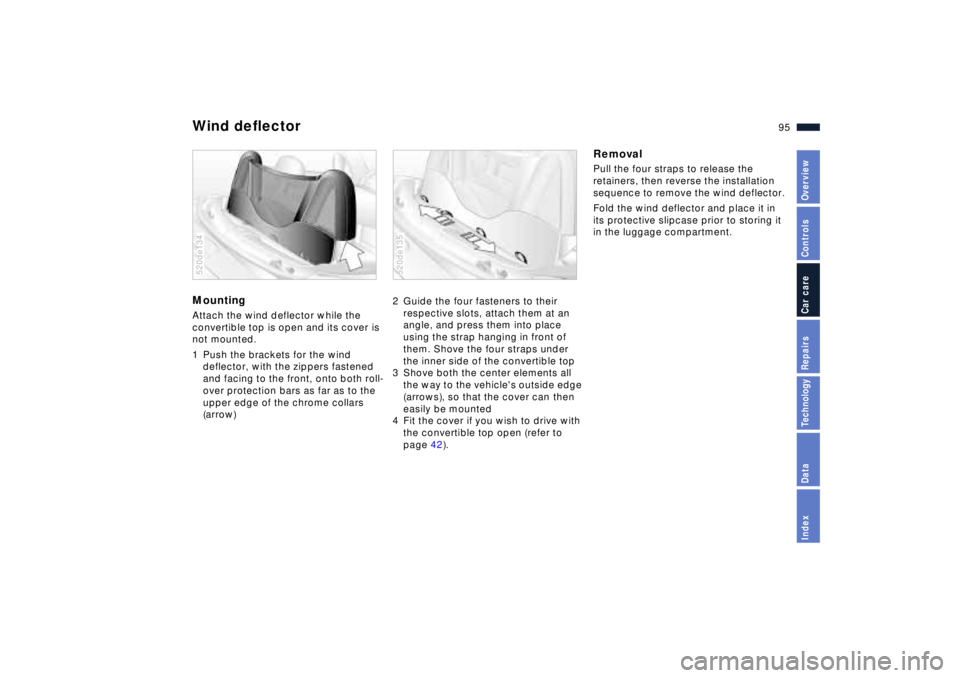
Wind deflector MountingAttach the wind deflector while the
convertible top is open and its cover is
not mounted.
1 Push the brackets for the wind
deflector, with the zippers fastened
and facing to the front, onto both roll-
over protection bars as far as to the
upper edge of the chrome collars
(arrow) 520de134
2 Guide the four fasteners to their
respective slots, attach them at an
angle, and press them into place
using the strap hanging in front of
them. Shove the four straps under
the inner side of the convertible top
3 Shove both the center elements all
the way to the vehicle's outside edge
(arrows), so that the cover can then
easily be mounted
4 Fit the cover if you wish to drive with
the convertible top open (refer to
page 42).520de135
RemovalPull the four straps to release the
retainers, then reverse the installation
sequence to remove the wind deflector.
Fold the wind deflector and place it in
its protective slipcase prior to storing it
in the luggage compartment.
Page 99 of 170

99n
IndexDataTechnologyRepairsCar careControlsOverview
Avoid overloading the vehicle so
that the permitted load on the tires
is not exceeded. Overloading can lead
to overheating and increases the rate
at which damage develops inside the
tires. You could have a blowout as a
result.
Unusual vibrations encountered during
normal vehicle operation can indicate
tire failure or some other vehicle defect,
as can variations in normal vehicle
response, such as a pronounced
tendency to pull to the left or right.
Should this occur, respond by immedi-
ately reducing your speed. Proceed
carefully to the nearest BMW center or
professional tire center, or have the
vehicle towed in to have it and its tires
inspected.
Tire damage can endanger the lives of
both the vehicle occupants and other
road users.<
To maintain good handling and vehicle
response, use only tires of a single tread
configuration from a single manufac-
turer. BMW tests and approves wheel/
tire combinations. Refer to page 103.DOT Quality GradesTread wear
Traction AA A B C
Temperature A B C
All passenger vehicle tires
must conform to Federal Safety
Requirements in addition to these
grades.
when tested under controlled condi-
tions on a specified government test
course.
For example, a tire graded 150 would
wear one and one-half (1g) times as
well on the government course as a tire
graded 100. The relative performance
of tires depends upon the actual condi-
tions of their use, however, and may
depart significantly from the norm due
to variations in driving habits, service
practices and differences in road char-
acteristics and climate.
TractionThe traction grades, from highest to
lowest, are AA, A, B and C.
Those grades represent the tire's ability
to stop on wet pavement as measured
under controlled conditions on speci-
fied government test surfaces of
asphalt and concrete. A tire marked C
may have poor traction performance.
The traction grade assigned to
this tire is based on straight-
ahead braking traction tests, and does
not include acceleration, cornering,
aquaplaning, or peak traction charac-
teristics.<
Tire condition Tire replacement
Page 100 of 170

100n
Tire replacement Tire rotation TemperatureThe temperature grades are A (the
highest), B and C, representing the
tire's resistance to the generation of
heat and its ability to dissipate heat
when tested under controlled condi-
tions on a specified indoor laboratory
test wheel.
Sustained high temperature can cause
the tire material to degenerate and
reduce tire life, and excessive tempera-
ture can lead to sudden tire failure. The
Grade C corresponds to a level of
performance which all passenger
vehicle tires must meet under the
Federal Motor Vehicle Safety Standard
No. 109. Grades B and A represent
higher levels of performance on the
laboratory test wheel than the minimum
required by law.
The temperature grade for this
tire is established for a tire that is
properly inflated and not overloaded.
Excessive speed, underinflation, or
excessive loading, either separately or
in combination, can cause heat buildup
and possibly a flat tire.<
Uniform Tire Quality GradingQuality grades can be found where
applicable on the tire sidewall between
tread shoulder and maximum section
width. For example:
Tread wear 200 Traction AA
Temperature A
Use only tires with emergency
driving characteristics as there is
no spare tire available if you get a flat
tire. For further information, refer to
page 135.
sidewall:
DOT ... 1200 indicates that the tire was
manufactured in week 12 of 2000.
Although tires may have a theoretical
service life of up to 10 years, BMW
strongly recommends that you replace
all tires after an absolute maximum of
6 years.
Between the axles
If different tire sizes are mounted
on the front and rear axles (refer to
page 103), then the tires may not be
rotated from one axle to the other.<
The tread wear patterns at the front end
differ from those at the rear Ð the actual
patterns will vary according to indi-
vidual driving conditions. In the inter-
ests of safety and maintaining optimal
handling characteristics, tire rotation is
not recommended.
Page 101 of 170

101n
IndexDataTechnologyRepairsCar careControlsOverview
Wheel and tire combinations The right choice
Use only wheels and tires
approved by BMW for the corre-
sponding vehicle model, as otherwise
the tires may make contact with the
body as the result of tolerances despite
the same nominal size being used,
resulting in serious accidents. If non-
approved wheels and tires are used,
BMW cannot evaluate their suitability,
and therefore cannot be held liable for
driving safety.<
For wheel and tire specifications
approved by BMW, refer to page 103.
The correct wheel-tire combina-
tion affects different systems that
otherwise will not function properly,
e.g. ABS, DSC and RDW.
For this reason, use only tires of the
same brand and tread pattern on the
vehicle and, for example, restore the
approved wheel-tire combination
following a flat tire as soon as
possible.<
Codes on tires and wheels The code on tires has the following
meaning.
Codes on radial tires:
The speed rating indicates the approved
maximum speed for the tire.
Summer tires:
S = up to 112 mph (180 km/h)
T = up to 118 mph (190 km/h)
H = up to 130 mph (210 km/h)
V = up to 150 mph (240 km/h)
W = up to 167 mph (270 km/h)
Y = up to 186 mph (300 km/h)
ZR = over 150 mph (240 km/h) For example:
Nominal width
in mm
Aspect ratio in X
Radial tire code
Rim diameter in inches
Load rating
(not on ZR tires)
Speed rating
(before R on ZR tires)
245/45 R 18 96 W
Winter tires:
Q M+S = up to 100 mph (160 km/h)
T M+S = up to 118 mph (190 km/h)
H M+S = up to 130 mph (210 km/h)
Codes on light-alloy wheels:
Protect tire valves from dirt by using
screw-on valve stem caps. Dirt in the
valves frequently leads to slow leaks.
Tires with emergency driving character-
istics also possess an additional identi-
fication mark that varies by manufac-
turer, e. g.:
Bridgestone RFT
Dunlop DSST
Goodyear EMT
Michelin ZPStorage Store tires in a cool, dry place,
protecting them against light when-
ever possible. Protect the tires against
contact with oil, grease and fuel. For example:
Rim width
in inches
Code letter for
flange type
Symbol for full-drop
center rim
Rim diameter in inches
Hump on the 2 rim shoulders
8x18EH 2
J